
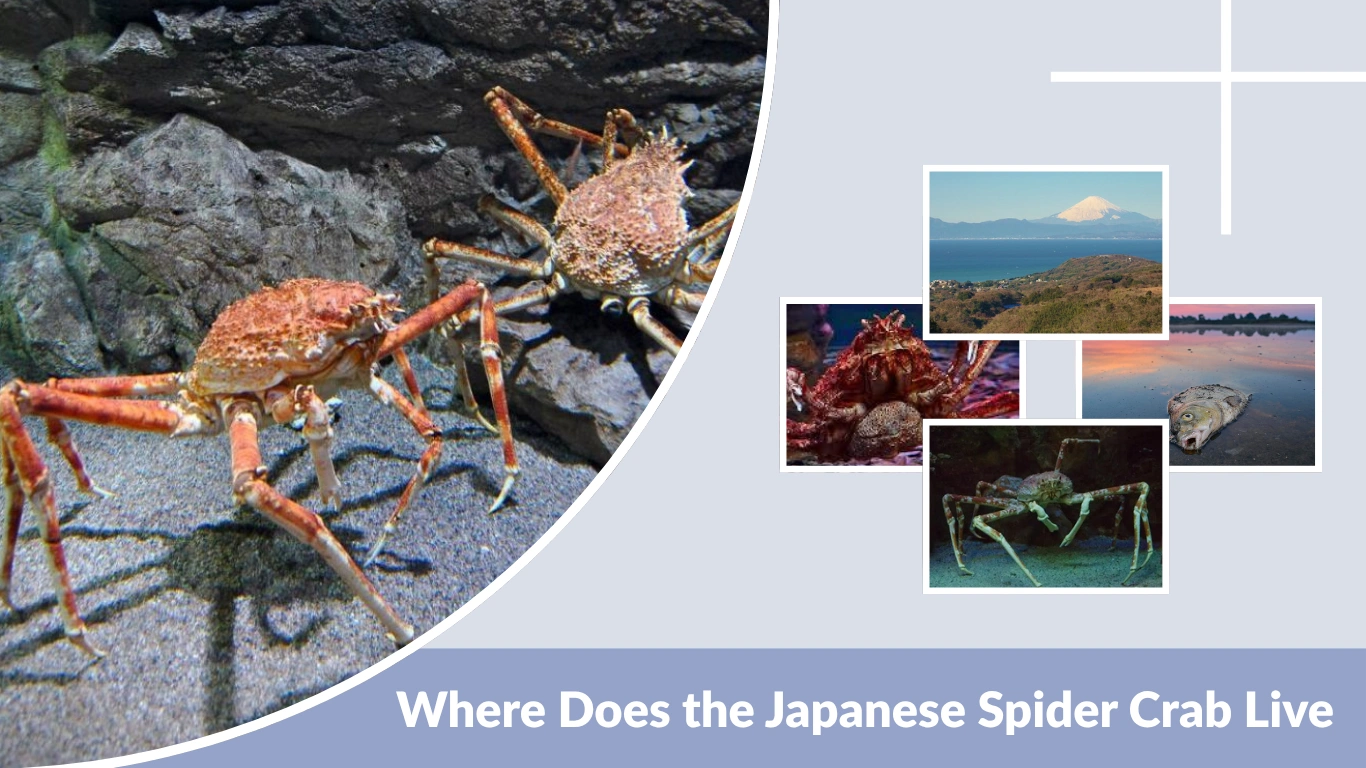
The Japanese Spider Crab (Macrocheira kaempferi) is one of the ocean’s most extraordinary creatures, known for its enormous leg span and eerie, alien-like appearance. Native to the deep waters surrounding Japan, it holds the record as the largest arthropod on Earth. Despite its fearsome look, this giant crab is a gentle scavenger that prefers the cold, dark depths of the Pacific Ocean, far away from human reach.
Natural Habitat
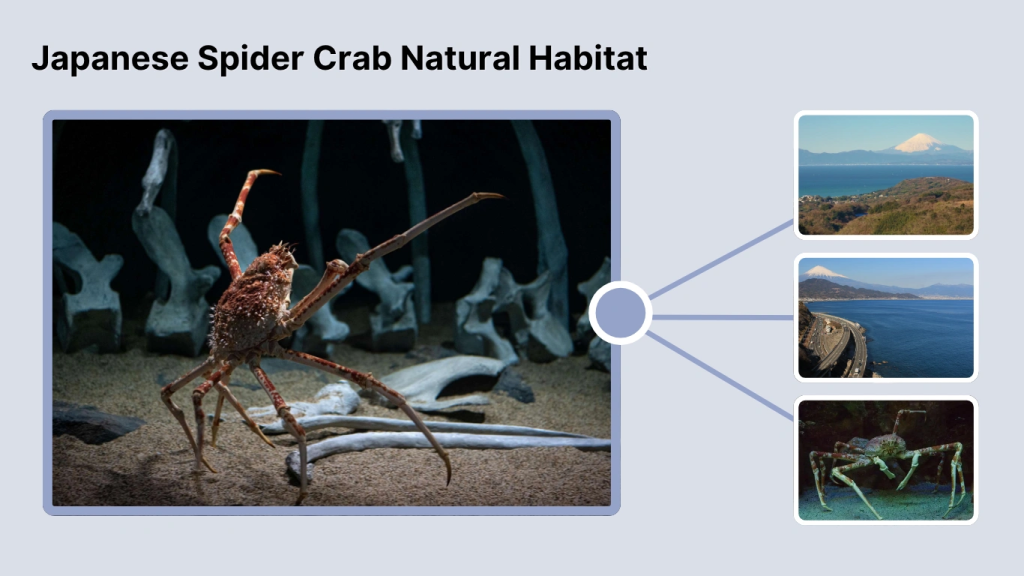
Geographic Range
The Japanese Spider Crab is found exclusively in the Pacific Ocean near Japan, particularly along the southern coasts of Honshu, Shikoku, and Kyushu islands. It thrives in three major deep-water bays:
- Sagami Bay
- Suruga Bay
- Tosa Bay
These regions provide ideal environmental conditions—steep slopes, rocky seabeds, and cold, nutrient-rich waters. Occasionally, they are also spotted near hydrothermal vents or volcanic ridges where the seafloor is rich in organic debris.
The species’ range extends from Tokyo Bay to as far south as Kagoshima Prefecture, making Japan’s coastal continental shelf its natural home.
Ocean Zone
Japanese spider crabs inhabit the bathyal zone—commonly known as the twilight zone of the ocean—where sunlight barely penetrates. This zone lies between 150 and 600 meters (490 to 1,970 feet) below sea level.
The darkness and cold temperatures in these depths provide protection from predators and human interference. The crabs rely on their sharp senses to locate food in low light, often using their long legs to feel around the ocean floor.
Environmental Conditions
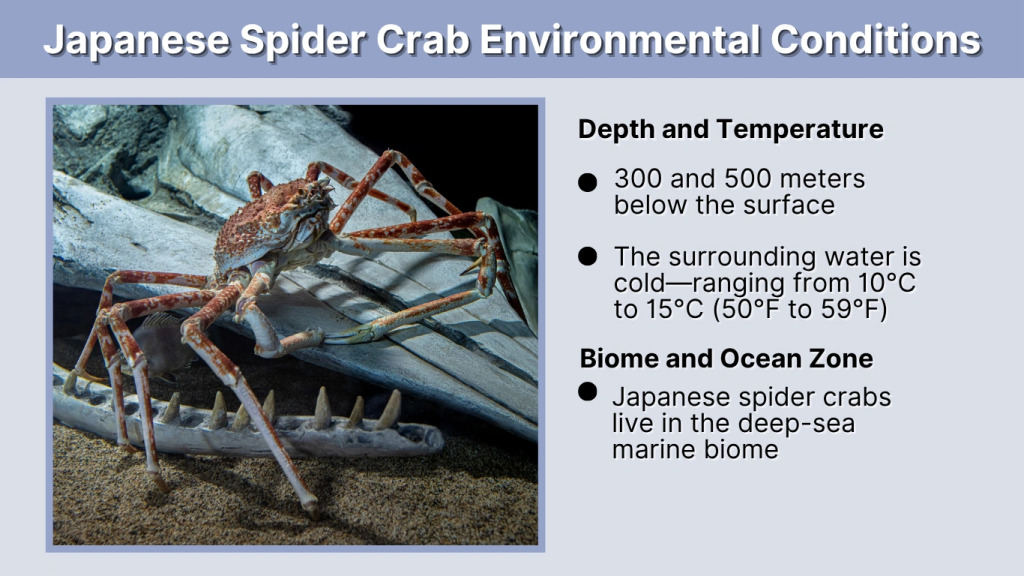
Depth and Temperature
These crabs are deep-sea dwellers that live primarily between 300 and 500 meters below the surface, though some have been found as deep as 800 meters. The surrounding water is cold—ranging from 10°C to 15°C (50°F to 59°F)—which slows their metabolism and contributes to their exceptional longevity.
The rocky seafloor plays a vital role in their lifestyle. It offers both camouflage and shelter, while also harboring an abundance of detritus and small animals that serve as food. Their orange coloration with white spots blends seamlessly with the rocky background and patches of coral.
Biome and Ocean Zone
Japanese spider crabs live in the deep-sea marine biome, specifically along the continental slope where the ocean floor begins to drop steeply. This region provides a stable environment with low currents and consistent temperatures year-round.
Some individuals are known to inhabit underwater canyons and areas rich in sediment, where they scavenge for decaying organic matter and algae. Because of the extreme depth, they exist in near darkness, relying more on touch and chemical cues than sight.
Behavior and Lifestyle
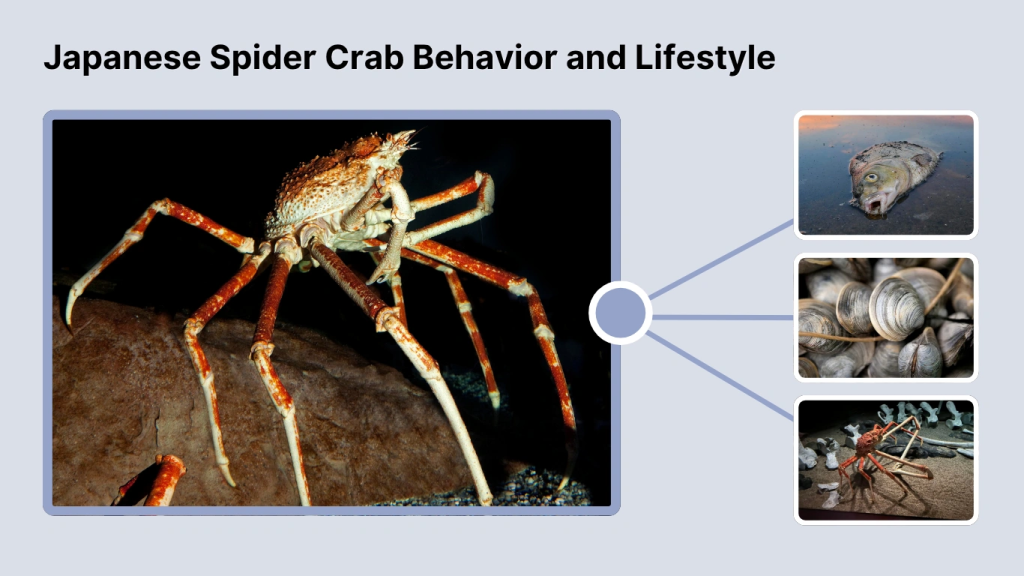
How Japanese Spider Crabs Live
Despite their monstrous size—reaching up to 12 feet (3.7 meters) from claw to claw—these crabs are slow-moving and non-aggressive. They are primarily scavengers, feeding on dead fish, clams, mollusks, and decaying plants that sink to the ocean floor. Their long, spindly legs allow them to move efficiently over rocky terrain and reach food from a distance.
Japanese spider crabs are often solitary but occasionally form small aggregations in nutrient-rich zones. They use their claws not only for defense and feeding but also for delicate tasks like picking up seaweed or shells to decorate their carapace for camouflage.
Adaptations for Deep-Sea Life
Living in the deep ocean requires unique adaptations. These crabs have evolved:
- Extremely long legs for walking across soft sediment and rocks.
- A tough exoskeleton that withstands high water pressure.
- Slow metabolism, which conserves energy in cold, nutrient-sparse environments.
- Excellent camouflage, blending with rocky surroundings to avoid predators.
Their behavior and physiology are perfectly suited for survival in one of Earth’s most extreme habitats.
Breeding and Migration

Breeding Behavior
In early spring, adult Japanese spider crabs migrate to shallower waters, usually between 50 and 150 meters deep, to breed. Mating occurs in these warmer regions where larvae have a better chance of survival. Females carry thousands of fertilized eggs attached to their abdomen until they hatch.
Once hatched, the larvae rise toward the ocean surface, floating freely as plankton for several weeks. After undergoing multiple molts, they slowly descend back into deeper waters to continue their life cycle.
Juvenile Habitat
Young spider crabs spend their early months in shallow coastal areas rich in coral and vegetation, where food is plentiful and predators are fewer. As they mature, they gradually migrate deeper into the ocean, adapting to colder, darker conditions. This migration marks their transition from the vulnerable juvenile stage to the resilient deep-sea adult stage.
Lifespan and Growth
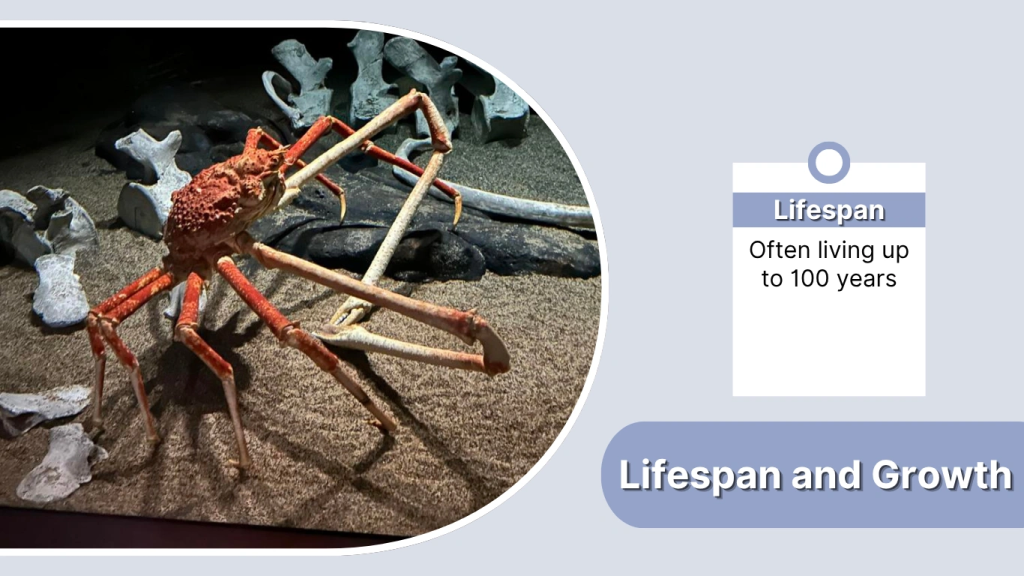
How Long Do Japanese Spider Crabs Live?
The Japanese Spider Crab has one of the longest lifespans in the animal kingdom, living up to 100 years in the wild. This extraordinary longevity is linked to their slow metabolism and cold-water environment, which reduces aging processes. As they grow older, they molt less frequently, strengthening their shell but limiting regeneration of lost limbs.
Growth and Development
At birth, the larvae are only a few millimeters long. They drift in the ocean as plankton before settling on the seabed, where they begin life as tiny crabs. Over decades, they grow gradually into giants with leg spans reaching up to 3.7 meters (12 feet). Growth slows significantly after maturity, but they continue to live for many decades under stable deep-sea conditions.
Other Species and Comparisons

| Species | Habitat | Depth Range | Region | Lifespan |
| Japanese Spider Crab (Macrocheira kaempferi) | Deep ocean slopes | 150–600 m | Japan | Up to 100 years |
| Portly Spider Crab (Libinia emarginata) | Shallow bays | 0–90 m | Atlantic, Gulf of Mexico | 3–5 years |
| Coconut Crab (Birgus latro) | Land and coastal forests | N/A | Pacific Islands | 50+ years |
| Crab Spider (Thomisidae family) | Gardens and plants | N/A | Worldwide | 1–2 years |
This comparison shows that the Japanese Spider Crab is not only the largest but also the longest-living species among crabs. Its deep-sea lifestyle, cold temperature, and isolation protect it from many natural threats faced by shallow-water species.
Interesting Facts
- World’s Largest Crab: Adult Japanese spider crabs can weigh up to 19 kilograms (42 pounds).
- Deep-Sea Adaptation: They can withstand immense water pressure at depths of more than half a kilometer.
- Coloration: Their orange-and-white pattern helps them blend into coral-covered rocks.
- Regeneration: They can regrow missing limbs, though this becomes slower with age.
- Cultural Importance: Known as taka-ashi-gani (“long-legged crab”) in Japan, they are a symbol of longevity and strength.
- Aquarium Favorite: Found in large aquariums such as Osaka Kaiyukan and Tokyo Sea Life Park, where they attract global attention.
FAQs
Where do Japanese spider crabs live?
Japanese spider crabs live off the coast of Japan in the Pacific Ocean, mainly around Honshu and Shikoku islands. They inhabit deep-sea slopes and canyons between 150 and 600 meters below the surface, where the water is cold and dark.
How deep do spider crabs live?
They typically dwell between 300–500 meters, though some may reach depths near 800 meters. These extreme depths protect them from most predators and keep temperatures stable year-round.
Can spider crabs live on land?
No. Japanese spider crabs are marine creatures that depend on saltwater for survival. They cannot live on land and will die if removed from water for extended periods.
How long do Japanese spider crabs live?
They are among the longest-living arthropods, reaching up to 100 years. Their slow metabolism and cold-water habitat contribute to their exceptional longevity.
What biome do spider crabs live in?
They inhabit the deep-sea marine biome, specifically the bathyal zone of the Pacific Ocean. This cold, dark environment provides safety and abundant detritus for feeding.