

In the world of common household spiders, two names often create confusion: hobo spiders and house spiders. They’re both brownish, build webs indoors, and show up in places we least expect. So, how do you actually tell them apart?
As someone who has dealt with both spiders in my home (and gotten quite the scare more than once), I’ve learned to spot the differences. This article walks you through everything you need to know—from appearance and behavior to habitat and danger levels.
Hobo Spider vs House Spider

| Feature | Hobo Spider | Common House Spider |
| Size | ½ to ¾ inch body | ¼ to ⅜ inch body |
| Color | Light brown with subtle patterns | Brown/yellow with darker streaks |
| Web | Funnel-shaped | Irregular, tangled |
| Aggression | Defensive when provoked | Passive, avoids confrontation |
| Venom Risk | Low (myth of necrotic bites) | Harmless to humans |
| Preferred Habitat | Basements, low corners | Windows, ceilings, garages |
What Is a Hobo Spider?

Physical Appearance
Hobo spiders (scientific name: Eratigena agrestis) are medium-sized arachnids. Their bodies typically measure between ½ to ¾ inch, with leg spans reaching up to 2 inches. They’re light to medium brown and often have subtle chevron patterns on their abdomens, but no distinct banding on their legs, which is a helpful ID tip.
Unlike many other spiders, hobo spiders do not have dark, shiny heads or bright contrasting colors. They look plain and uniform, which often adds to the confusion.
Behavior & Habits
Hobo spiders are active hunters. They build funnel-shaped webs and often sit at the base waiting for prey. They can be defensive if provoked, but they’re not aggressive by nature.
They’re fast movers and may dart across floors when disturbed. Unlike house spiders that tend to stay put in one spot, hobo spiders can roam more frequently, especially during mating season.
Habitat
You’re most likely to spot a hobo spider in your basement, crawl space, or garage. They prefer dark, secluded areas with minimal human activity.
They originally came from Europe and have established themselves in parts of the northwestern United States.
Are Hobo Spiders Dangerous?
There’s a long-standing myth that hobo spiders cause necrotic (flesh-eating) bites. However, most scientific research today, including findings from the CDC, suggests that hobo spider venom is not dangerous to humans.
Most reported bites are mild, causing minor irritation or swelling, similar to a bee sting.
What Is a Common House Spider?
Physical Appearance
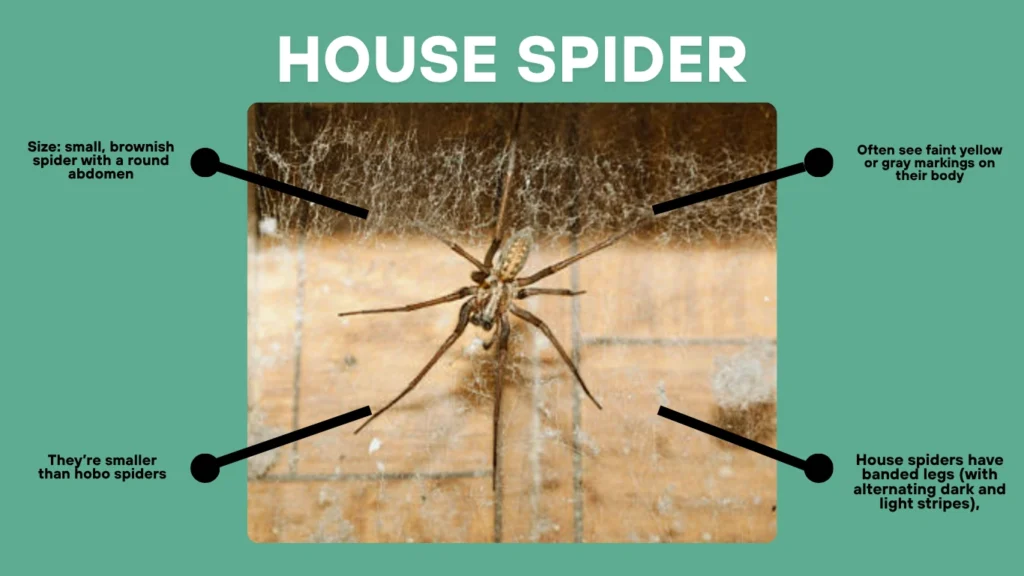
The term “house spider” typically refers to Parasteatoda tepidariorum—a small, brownish spider with a round abdomen. They’re smaller than hobo spiders, and you’ll often see faint yellow or gray markings on their body.
One key difference: house spiders have banded legs (with alternating dark and light stripes), while hobo spiders do not.
Behavior & Habits
House spiders are homebodies. Once they spin their webs, they usually don’t move unless disturbed. Their webs are messy and tangled, often found in corners near the ceiling, behind furniture, or around window frames.
They feed on insects like flies, moths, and mosquitoes, making them natural pest controllers.
Habitat
You’ll find house spiders all over the home: corners of ceilings, windows, under furniture, or near doorways. They favor places with light and insect activity.
Unlike hobo spiders, they’re comfortable in high-traffic zones and don’t hide as much.
Are House Spiders Dangerous?
Not at all. House spiders are harmless and rarely bite. Even if they do, their venom is mild and typically not felt. Their biggest offense is giving people a surprise when they drop from the ceiling or show up in the bathtub.
Key Differences Between Hobo and House Spiders

Here’s a closer look at how to tell these two apart:
- Web Shape:
Hobo spiders build funnel webs—narrow at the back and open at the front. House spiders weave messy, tangled webs with no specific pattern. - Leg Markings:
House spiders have banded legs, while hobo spiders’ legs are solid-colored and unpatterned. - Abdomen Shape:
House spiders have rounder abdomens. Hobo spiders’ abdomens appear elongated or oblong. - Behavior:
Hobo spiders tend to roam and run quickly if disturbed. House spiders prefer to stay put unless forced to relocate. - Location in Home:
Hobo spiders stick to lower, darker areas. House spiders can be found almost anywhere, including high corners and window sills.
How to Identify Them in Your Home
If you see a spider and aren’t sure which it is, follow these steps:
- Observe the web: Is it a funnel shape tucked in a basement corner? Likely a hobo spider. A chaotic web by a light? Probably a house spider.
- Look at the legs: Banded = house spider. Plain = hobo.
- Check for movement: If it dashes when you approach, it’s more likely a hobo spider.
When in doubt, snap a clear photo and compare with trusted sources or consult a pest professional.
What to Do If You’re Bitten
Most bites from either spider are harmless. But here’s what to do just in case:
- Clean the area with soap and water
- Apply ice to reduce swelling
- Monitor symptoms for 24-48 hours
- Seek medical attention if you notice signs of infection, spreading redness, or if symptoms worsen
For suspected hobo spider bites, it’s helpful to capture the spider (if safe) and bring it to a clinic for identification. Still, serious medical reactions are extremely rare.
Prevention and Control Tips
Want to reduce both types of spiders in your home? Try the following:
- Seal cracks in windows, walls, and baseboards
- Keep storage areas clean and clutter-free
- Use essential oils like peppermint or citrus (spiders hate the smell)
- Vacuum regularly, especially in corners and basements
- Install sticky traps near baseboards or behind furniture
If the population gets out of control, especially in basements or sheds, consider calling a licensed pest control company.
Conclusion
While hobo spiders and house spiders might look alike at first glance, they’re different in more ways than one. Hobo spiders are larger, faster, and prefer secluded spots, while house spiders are smaller, calmer, and tend to stay in place.
Most importantly, neither spider poses a serious danger to humans. So next time you spot a web in the corner or a spider crawling across the floor, take a moment to observe. It might just be a harmless roommate keeping your home bug-free.