

Opiliones, commonly known as harvestmen or daddy longlegs, are fascinating arachnids often mistaken for spiders. This guide explores 20 distinct types of Opiliones, covering their unique features, habitats, and behaviors. Whether you’re a nature lover or just curious about these leggy creatures, you’ll discover how to identify them and learn surprising facts that set them apart from true spiders.
1. Phalangiidae

Phalangiidae is one of the most well-known families within the Opiliones order, commonly referred to as “daddy longlegs” in many parts of the world. These harvestmen are often found in gardens, forests, and near human dwellings, especially during humid or rainy seasons.
Identification
- Long, slender legs, especially the second pair which can be extremely long
- Small, rounded or oval body structure
- Body color varies from light brown to dark gray, sometimes with mottled patterns
- Compact body with no visible segmentation between the head and abdomen
- Often seen walking slowly or remaining still on walls or vegetation
Habitat
They are mostly found in temperate regions and prefer moist environments. You’ll spot them under leaves, tree bark, or rocks, and occasionally inside homes during the rainy season.
Behavior
Phalangiidae are nocturnal scavengers. They feed on decaying matter, small insects, and plant material. They do not produce silk or venom.
Interesting Fact
Unlike true spiders, they have fused body parts, giving them a single, seamless body appearance. Also, some species can shed a leg to escape predators, a process called autotomy.
2. Sclerosomatidae
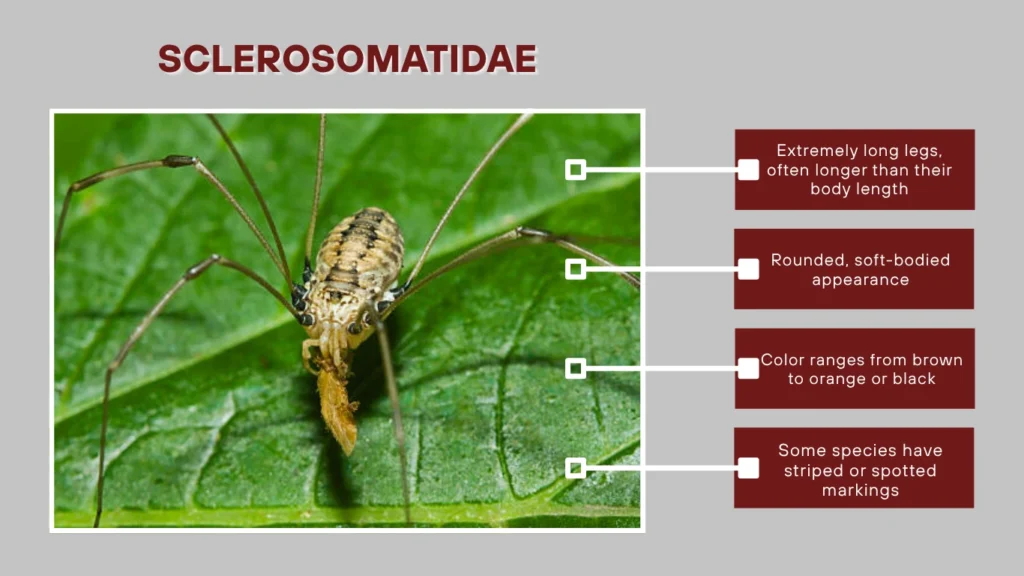
Sclerosomatidae is a large and diverse family of harvestmen, with many species found across North and South America, Asia, and parts of Europe. They are among the most commonly encountered harvestmen in grassy and wooded areas.
Identification
- Extremely long legs, often longer than their body length
- Rounded, soft-bodied appearance
- Color ranges from brown to orange or black
- Some species have striped or spotted markings
- Second pair of legs used as sensory feelers
Habitat
They prefer open fields, meadows, and forest edges. You can often find them clinging to grass blades, bushes, and tree trunks.
Behavior
Sclerosomatidae are fast-moving and agile. They are omnivores, feeding on small invertebrates and decaying plant or animal matter.
Interesting Fact
Many species in this family exhibit gregarious behavior, gathering in large clusters during daytime and dispersing at night.
3. Caddidae
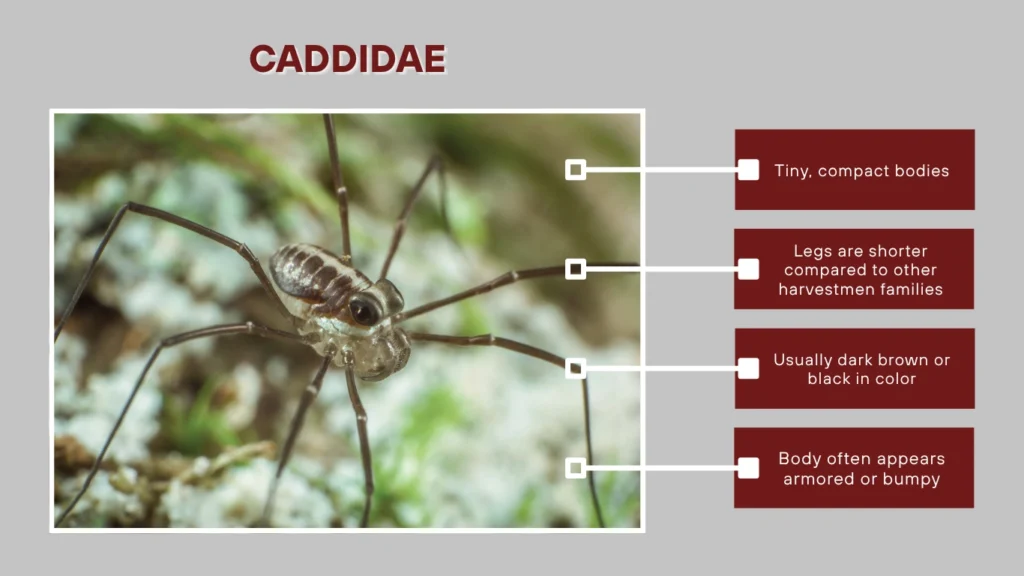
Caddidae is a small family of harvestmen that are less well-known but fascinating due to their limited geographic distribution. They are primarily found in the Southern Hemisphere, including parts of Africa, Australia, and South America.
Identification
- Tiny, compact bodies
- Legs are shorter compared to other harvestmen families
- Usually dark brown or black in color
- Body often appears armored or bumpy
- Lack distinct patterning
Habitat
They dwell in leaf litter, under stones, and in mossy forest floors—often in mountainous or tropical regions with high humidity.
Behavior
Caddidae are secretive and slow-moving. They tend to stay hidden during the day and are active at night. Their diet mainly consists of fungi and detritus.
Interesting Fact
Because of their secluded habitats and small size, many species of Caddidae remain undiscovered or poorly studied.
4. Sironidae
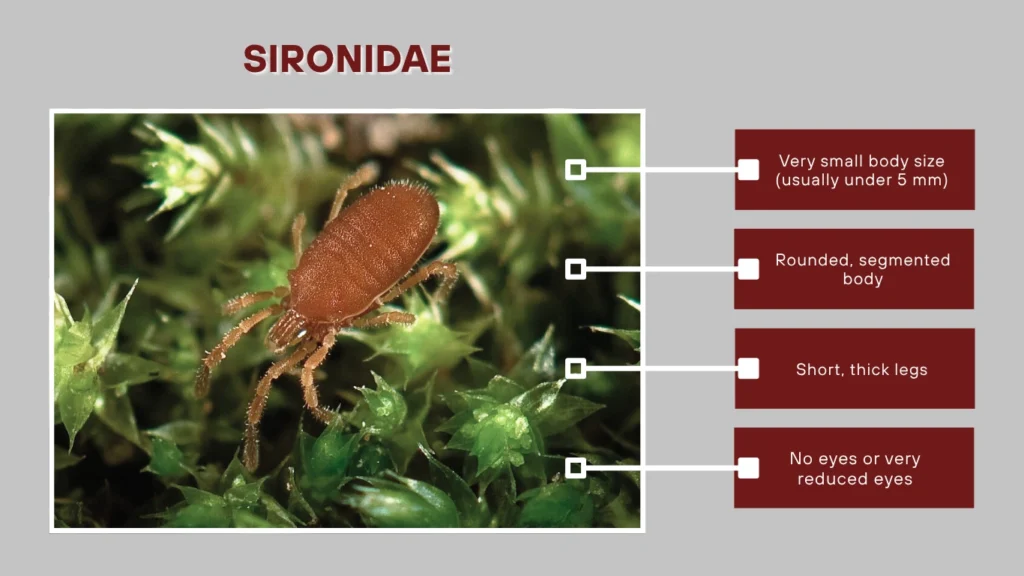
Sironidae is a family within the suborder Cyphophthalmi, often referred to as “mite harvestmen” due to their tiny size and compact bodies. Unlike the long-legged harvestmen, these are short-legged and resemble mites at a glance.
Identification
- Very small body size (usually under 5 mm)
- Rounded, segmented body
- Short, thick legs
- No eyes or very reduced eyes
- Brown to reddish coloration
Habitat
Sironidae are found in cool, moist forest habitats, particularly under bark, leaf litter, and soil. Most species are native to Europe and North America.
Behavior
They are slow-moving and secretive, feeding on detritus, decaying organic matter, and fungi.
Interesting Fact
Sironidae have a highly ancient lineage, with some species tracing back millions of years. They are considered “living fossils” of the arachnid world.
5. Pettalidae
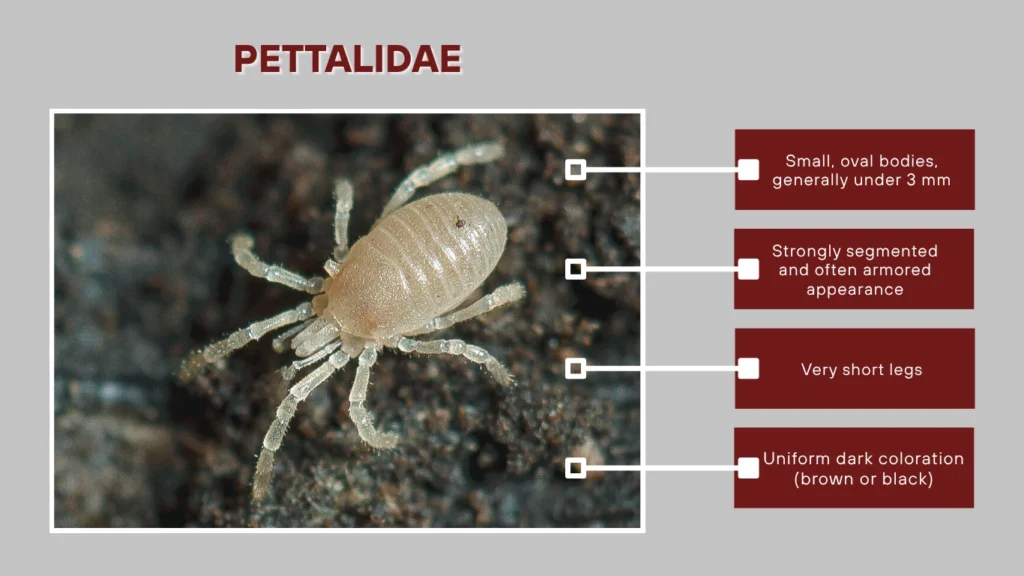
Pettalidae is another family of small-bodied harvestmen from the suborder Cyphophthalmi. They are distributed in the Southern Hemisphere, especially in New Zealand, South Africa, Madagascar, and South America.
Identification
- Small, oval bodies, generally under 3 mm
- Strongly segmented and often armored appearance
- Very short legs
- Uniform dark coloration (brown or black)
- Lack well-developed eyes
Habitat
They live in damp, undisturbed forest environments, especially in leaf litter and under stones. They avoid sunlight and require high humidity.
Behavior
Pettalidae are extremely reclusive and slow. They rely on their strong body armor as a defense rather than speed or agility.
Interesting Fact
Their limited distribution and ancient lineage make them important in biogeographic studies, helping scientists understand continental drift and evolution.
6. Neogoveidae
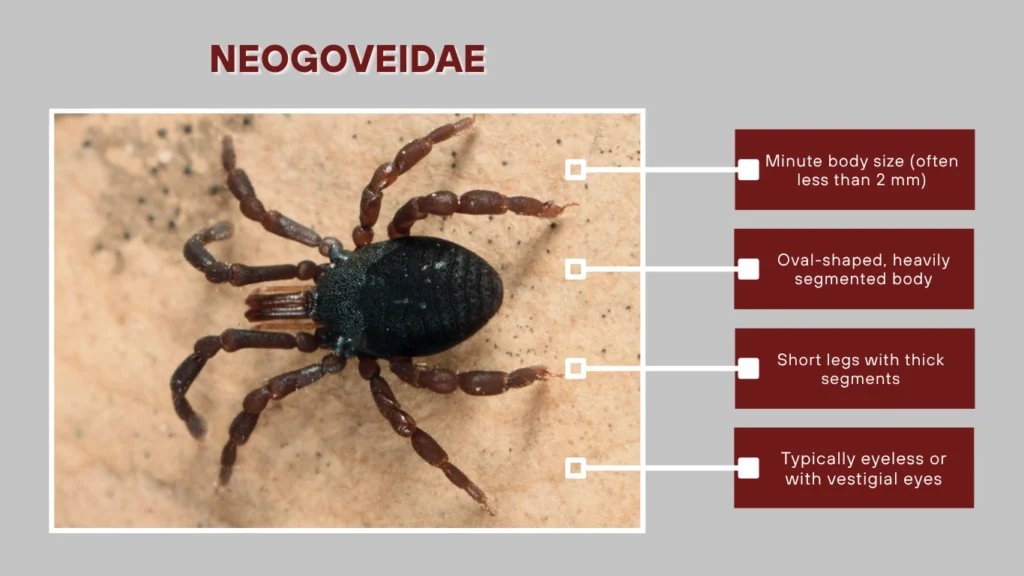
Neogoveidae is a family of tiny, cryptic harvestmen belonging to the suborder Cyphophthalmi. These minute creatures are rarely seen due to their secretive lifestyles and subterranean habitats.
Identification
- Minute body size (often less than 2 mm)
- Oval-shaped, heavily segmented body
- Short legs with thick segments
- Typically eyeless or with vestigial eyes
- Soft, reddish-brown or yellowish body
Habitat
They inhabit leaf litter, soil layers, and under logs in tropical rainforests, particularly in Central and South America and parts of Africa.
Behavior
Neogoveidae species are detritivores, feeding on decaying plant material and fungal spores. They are extremely reclusive and rarely active during the day.
Interesting Fact
Despite their small size, some Neogoveidae exhibit complex reproductive behaviors, including specialized structures for sperm transfer.
7. Nemastomatidae
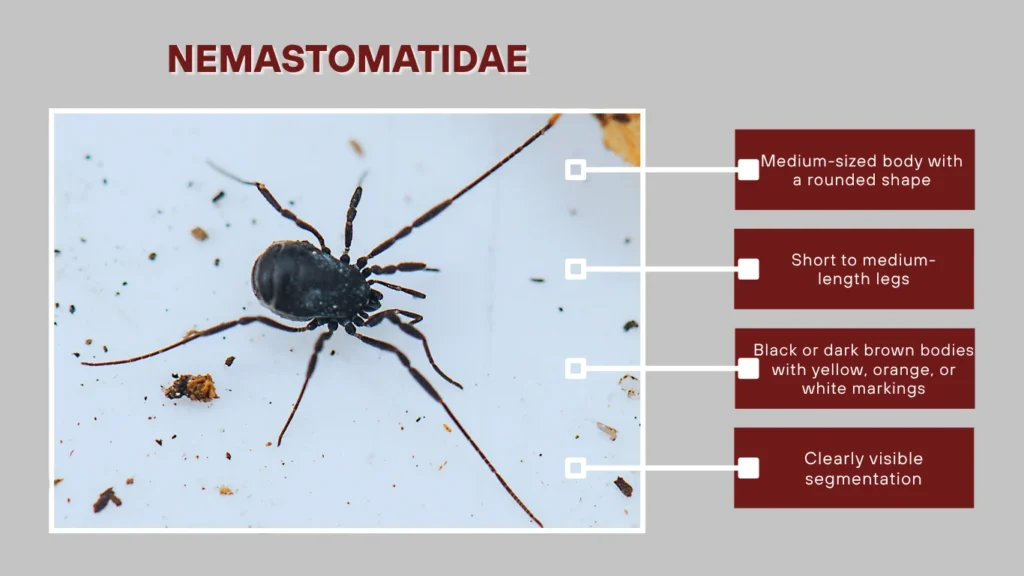
Nemastomatidae is a diverse family of harvestmen found mainly in Europe and Asia. These harvestmen are more robust than the typical long-legged types and often display striking color patterns.
Identification
- Medium-sized body with a rounded shape
- Short to medium-length legs
- Black or dark brown bodies with yellow, orange, or white markings
- Clearly visible segmentation
- Distinct, small eyes placed on a raised turret
Habitat
They live in mountainous and forested regions, often found under rocks, in moss, or near streams and caves.
Behavior
Nemastomatidae are solitary and cautious. They are mostly predators of small insects and invertebrates, though they also scavenge.
Interesting Fact
Some species in this family are adapted to cave environments, showing reduced pigmentation and eyes—an adaptation known as troglomorphism.
8. Ischyropsalididae
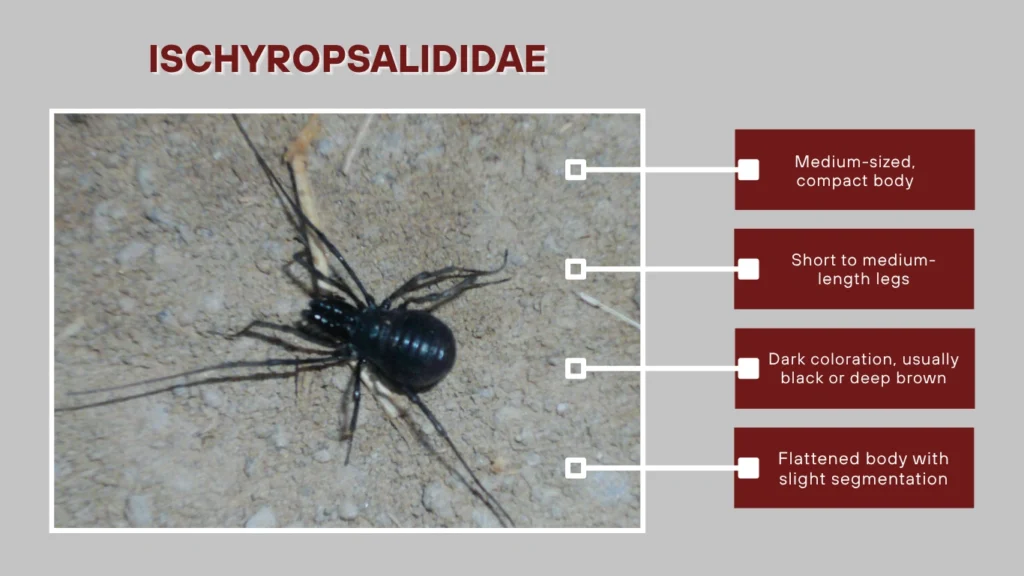
Ischyropsalididae is a small family of harvestmen found mostly in cool, mountainous regions of Europe and North America. These species are well adapted to cold, moist environments and are sometimes mistaken for spiders due to their robust appearance.
Identification
- Medium-sized, compact body
- Short to medium-length legs
- Dark coloration, usually black or deep brown
- Flattened body with slight segmentation
- Prominent eyes located on a raised central mound
Habitat
They are commonly found in alpine forests, rocky outcrops, and near caves. They prefer cool temperatures and high humidity.
Behavior
These harvestmen are slow-moving and typically hide under rocks or logs during the day. They are opportunistic feeders, eating insects, larvae, and decaying organic matter.
Interesting Fact
Some species exhibit cold tolerance and remain active even in chilly, late-autumn weather when many other arthropods are dormant.
9. Trogulidae

Trogulidae, also known as “moss harvestmen,” are an unusual family due to their dirt-covered appearance and sluggish movements. These harvestmen are found in Europe, the Middle East, and parts of Asia.
Identification
- Broad, flat, and heavily armored body
- Short, sturdy legs
- Covered with soil or moss particles (camouflage)
- Body color blends with surroundings: brown, gray, or greenish
- Small eyes located close to the front of the body
Habitat
Trogulidae are typically found under moss, leaf litter, or soil in forested regions. Their camouflage helps them avoid predators.
Behavior
They are slow and secretive, often burrowing or remaining hidden during the day. Their diet consists mostly of decomposing plant and animal matter.
Interesting Fact
Their ability to blend in with the forest floor by collecting dirt and plant debris on their bodies is a rare trait among arachnids.
10. Gonyleptidae
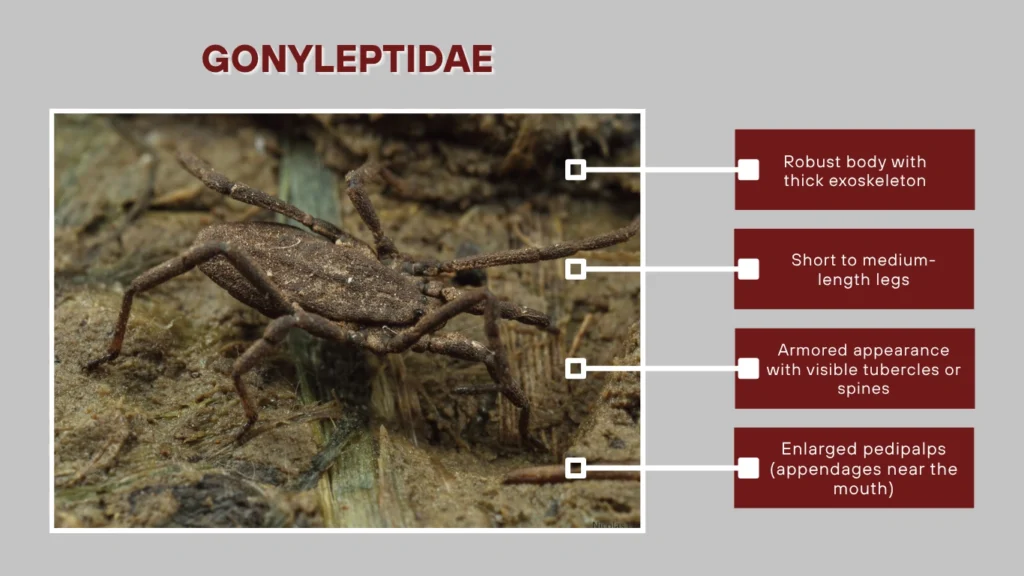
Gonyleptidae is the largest family within the suborder Laniatores and is primarily found in South and Central America. These harvestmen are known for their sturdy bodies, strong legs, and sometimes striking coloration.
Identification
- Robust body with thick exoskeleton
- Short to medium-length legs
- Often bright or contrasting colors like red, orange, or yellow on dark backgrounds
- Armored appearance with visible tubercles or spines
- Enlarged pedipalps (appendages near the mouth)
Habitat
Gonyleptidae species live in tropical rainforests, caves, and under rocks. They prefer moist, shaded environments and are active mostly at night.
Behavior
They are predators and scavengers, feeding on insects, worms, and decaying matter. Some exhibit parental care, guarding their eggs and young.
Interesting Fact
Several Gonyleptidae species display unique defense behaviors, including chemical secretions that repel predators.
11. Cosmetidae
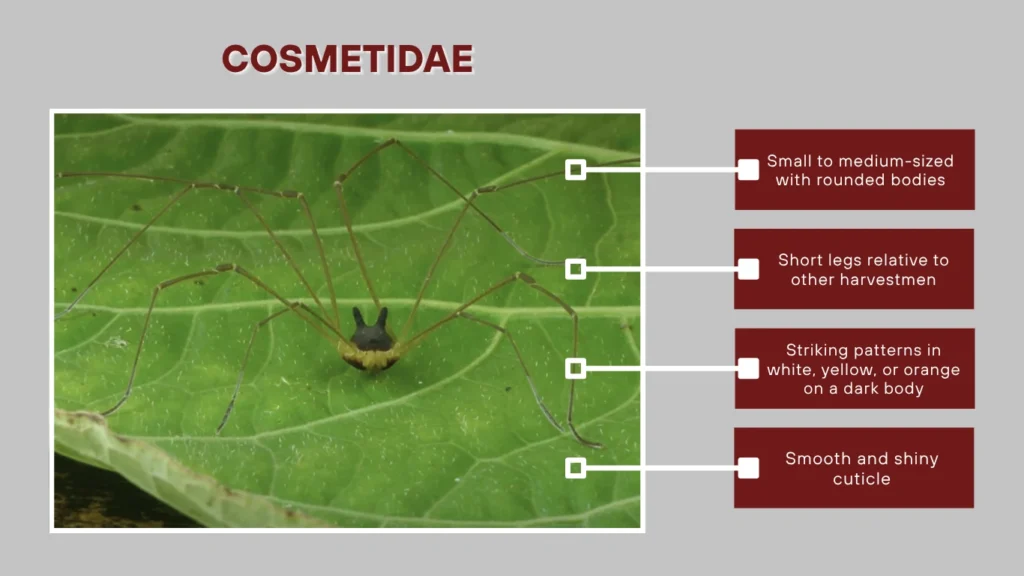
Cosmetidae is a visually distinctive family of harvestmen known for their ornate body markings and smooth, glossy exoskeletons. They are native to tropical regions of Central and South America.
Identification
- Small to medium-sized with rounded bodies
- Short legs relative to other harvestmen
- Striking patterns in white, yellow, or orange on a dark body
- Smooth and shiny cuticle
- Some have white “mask-like” facial markings
Habitat
They are commonly found in rainforests, on low vegetation, tree trunks, and leaf litter. Their colorful patterns help with camouflage among forest textures.
Behavior
Cosmetidae are slow and deliberate in movement. They feed on small insects, plant material, and fungi. Many species remain motionless during the day.
Interesting Fact
Because of their unique appearance, Cosmetidae are popular subjects for macro photography and arachnid collectors.
12. Cranaidae

Cranaidae is a family of robust, tropical harvestmen found mainly in the Andean regions of South America. They are part of the Laniatores suborder and are recognized for their heavily armored bodies and slow movements.
Identification
- Medium to large body size
- Thick, armored exoskeleton with ridges or bumps
- Short, powerful legs
- Earth-toned coloration: dark brown, reddish, or black
- Often have large, claw-like pedipalps
Habitat
They inhabit high-elevation cloud forests and montane rainforests, often hiding under stones, logs, or in leaf litter.
Behavior
Cranaidae are nocturnal and move slowly. They are opportunistic feeders, consuming dead insects, plant material, and fungi.
Interesting Fact
Because of their bulky appearance and armor, Cranaidae species are sometimes mistaken for beetles or crabs at first glance.
13. Assamiidae
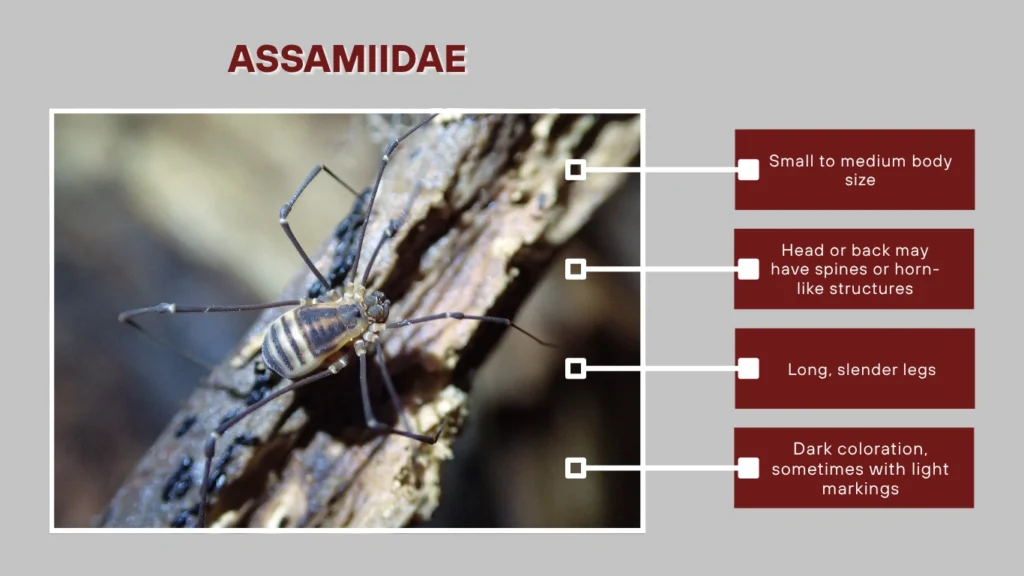
Assamiidae is a diverse family of harvestmen found mostly in Africa and parts of Asia. Many species have distinctive body shapes and horn-like projections, giving them a fierce appearance despite being harmless.
Identification
- Small to medium body size
- Long, slender legs
- Head or back may have spines or horn-like structures
- Dark coloration, sometimes with light markings
- Some species have a flattened or angular body
Habitat
They are typically found in savannas, dry forests, and caves. Many live in cracks in the ground or under debris.
Behavior
Assamiidae are secretive and solitary. They feed on small arthropods and organic debris. Many stay hidden during the day and emerge at night.
Interesting Fact
Several species are adapted to cave life and have reduced eyes, pale coloration, and elongated limbs—a sign of evolutionary specialization.
14. Agoristenidae
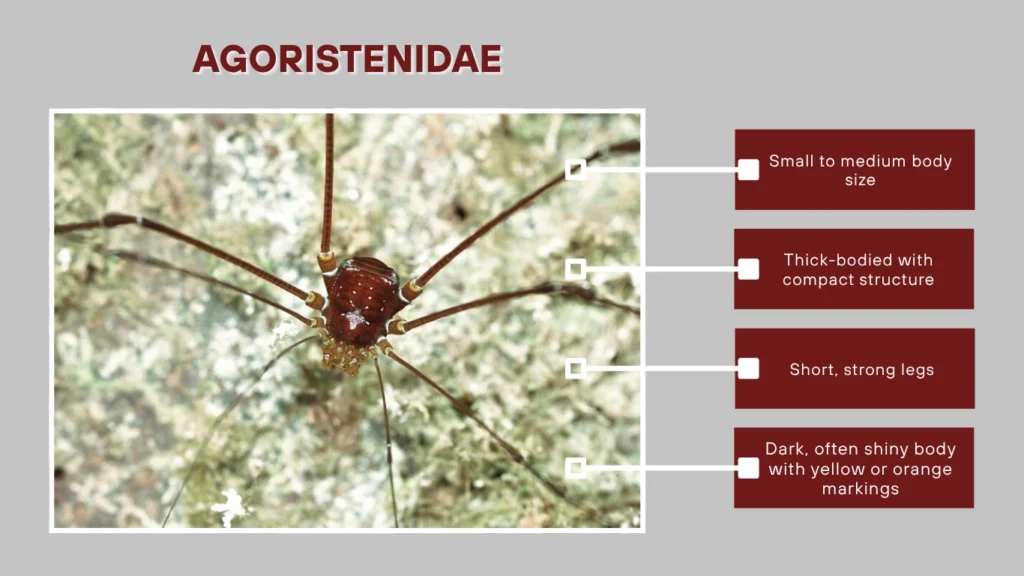
Agoristenidae is a lesser-known family of harvestmen belonging to the suborder Laniatores. These arachnids are mainly found in the Caribbean and parts of Central and South America, especially in forested regions.
Identification
- Small to medium body size
- Thick-bodied with compact structure
- Short, strong legs
- Dark, often shiny body with yellow or orange markings
- Some species have distinct spines or bumps on the body
Habitat
They prefer moist, forested areas with abundant leaf litter and decaying wood. They are commonly seen near tree bases and rocky outcrops.
Behavior
Agoristenidae are nocturnal and slow-moving. They feed on small insects and decaying organic matter, and are often difficult to spot due to their camouflage.
Interesting Fact
Some species in this family are found only on specific islands, making them important for studying island biogeography and species evolution.
15. Biantidae

Biantidae is a diverse family of tropical harvestmen spread across Africa, Asia, and parts of the Indian Ocean islands. These harvestmen are known for their small size and unique body shapes.
Identification
- Small, oval or pear-shaped body
- Short legs with strong segments
- Dark coloration, usually brown or black
- Some species have extended or pointed body features
- May show light markings or speckles
Habitat
They live in tropical forests, often hiding under leaves, bark, or stones. Some species are also found in caves or under logs.
Behavior
Biantidae are shy and secretive. They feed on small arthropods, plant debris, and fungi. They are mostly active at night and avoid light.
Interesting Fact
Despite their small size, some Biantidae species have intricate mating behaviors and body ornamentation, making them fascinating to study under magnification.
16. Epedanidae
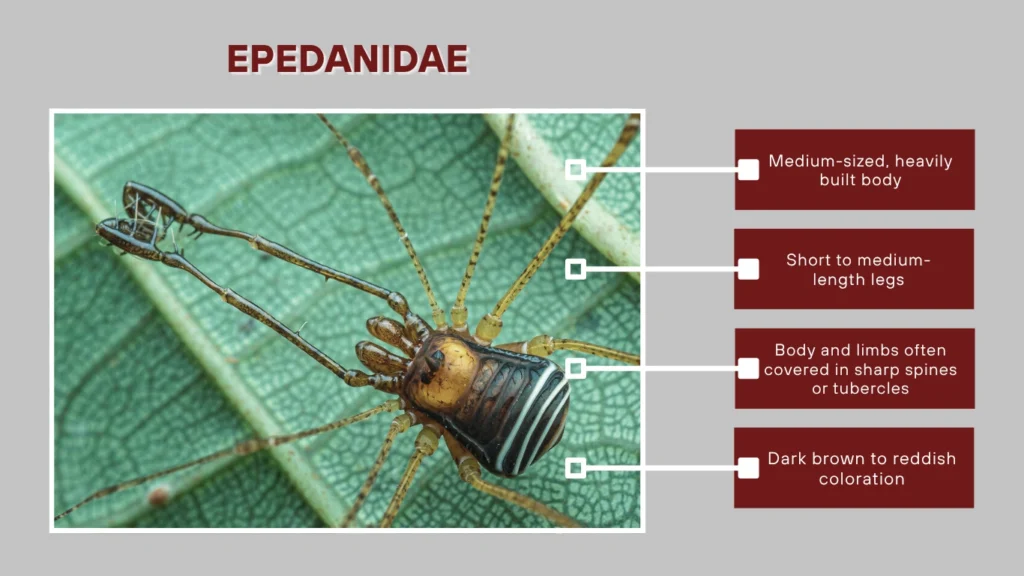
Epedanidae is a tropical family of harvestmen mainly distributed across Southeast Asia, including countries like Thailand, Malaysia, and Indonesia. They are known for their spiny appearance and strong limbs.
Identification
- Medium-sized, heavily built body
- Short to medium-length legs
- Body and limbs often covered in sharp spines or tubercles
- Dark brown to reddish coloration
- Enlarged pedipalps, sometimes shaped like pincers
Habitat
They are typically found in humid forests, under bark, stones, and dense vegetation. Some also live in caves or near forest streams.
Behavior
Epedanidae are nocturnal and territorial. They prey on small invertebrates and are known to use their spiny pedipalps for defense and feeding.
Interesting Fact
Due to their fierce appearance, they are sometimes mistaken for scorpions, but they are completely harmless to humans.
17. Sandokanidae
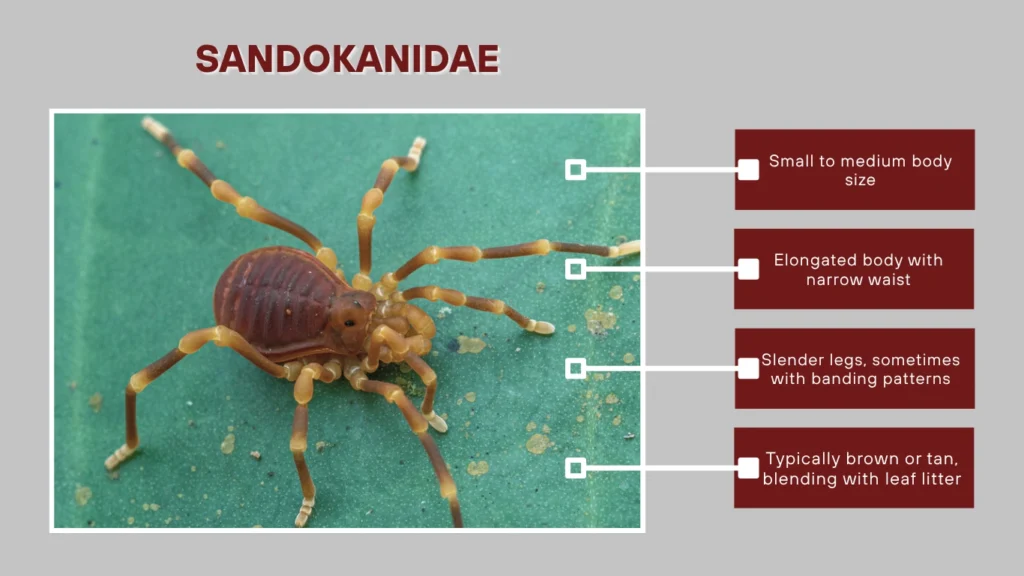
Sandokanidae is a small family of harvestmen named after the fictional pirate “Sandokan” due to their Southeast Asian distribution. This family is not widely studied but has a distinct appearance.
Identification
- Small to medium body size
- Elongated body with narrow waist
- Slender legs, sometimes with banding patterns
- Typically brown or tan, blending with leaf litter
- Subtle ornamentation on body and legs
Habitat
They live in leaf litter and low vegetation in tropical rainforests of Southeast Asia, including Borneo and nearby islands.
Behavior
Sandokanidae are elusive and mostly active at night. They feed on decaying plant material and small insects, staying close to the forest floor.
Interesting Fact
Because of their limited range and obscure habits, many species in this family are not yet described by science.
18. Stygnidae

Stygnidae is a family of tropical harvestmen primarily found in Central and South America. These harvestmen are often robust and darkly colored, with adaptations suited for dense forest environments.
Identification
- Small to medium body size
- Compact, rounded body with tough exoskeleton
- Legs short to medium in length
- Usually dark brown or black with faint markings
- May have small spines or ridges on the body surface
Habitat
They dwell in tropical rainforests, often hiding in leaf litter, under bark, or among roots and fallen logs. They prefer moist, shaded environments.
Behavior
Stygnidae are scavengers and predators, feeding on dead insects, fungi, and plant debris. They are nocturnal and generally inactive during the day.
Interesting Fact
Some Stygnidae species exhibit sexual dimorphism—males and females have different body structures or ornamentation, which helps in species identification.
19. Oncopodidae
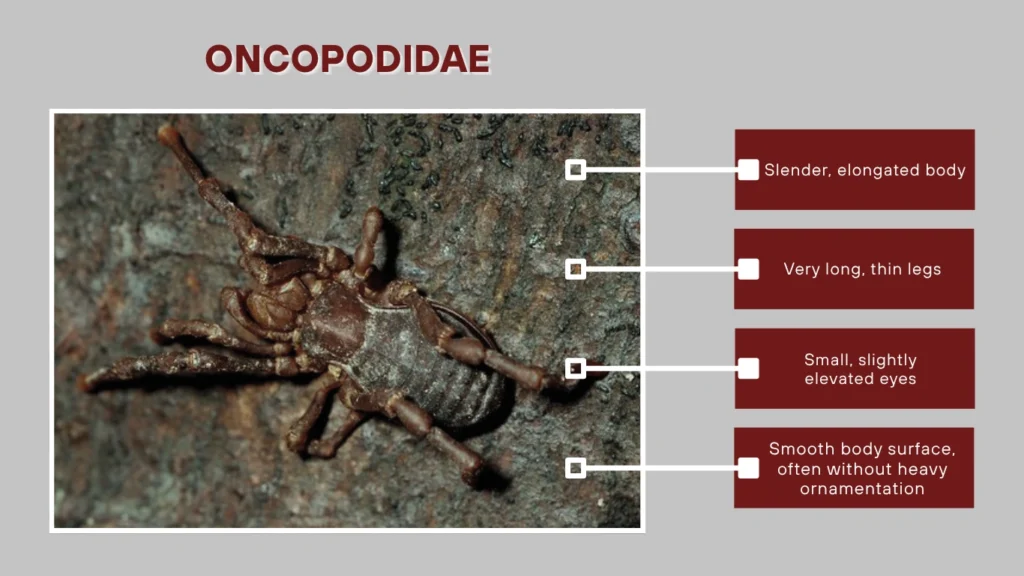
Oncopodidae is a small family of harvestmen distributed in Southeast Asia. Members of this family are notable for their long legs and slender bodies, somewhat resembling those in the Eupnoi suborder.
Identification
- Slender, elongated body
- Very long, thin legs
- Small, slightly elevated eyes
- Smooth body surface, often without heavy ornamentation
- Brown to yellowish coloration, sometimes with stripes
Habitat
Oncopodidae prefer warm, humid tropical forests. They are usually seen resting on vegetation or tree trunks during the night.
Behavior
They are fast-moving and delicate, feeding on soft-bodied insects and organic debris. They often use their long legs to sense vibrations and navigate their surroundings.
Interesting Fact
Despite their delicate appearance, some Oncopodidae are quite resilient and can survive in disturbed or secondary forest habitats.
20. Zalmoxidae
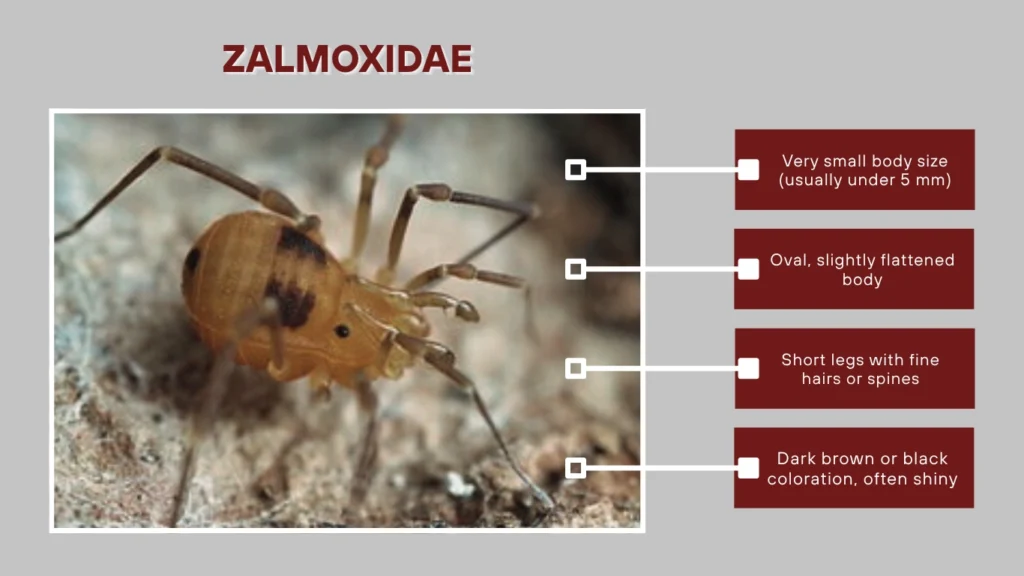
Zalmoxidae is a diverse family of small-bodied harvestmen found mostly in tropical regions of Central and South America, with some species also present in the Caribbean and Southeast Asia. They belong to the suborder Laniatores.
Identification
- Very small body size (usually under 5 mm)
- Oval, slightly flattened body
- Short legs with fine hairs or spines
- Dark brown or black coloration, often shiny
- Eyes positioned close together on a low mound
Habitat
They live in moist forest floors, leaf litter, under bark, or in cave-like microhabitats. Some species are also found in limestone regions and under moss.
Behavior
Zalmoxidae are elusive and typically active at night. They feed on fungi, decaying matter, and tiny arthropods. Most are secretive and difficult to observe.
Interesting Fact
Many species of Zalmoxidae remain undescribed due to their tiny size and cryptic lifestyles, making them a focus of interest for taxonomists studying tropical arthropods.
FAQs
Are Opiliones the same as spiders?
No, Opiliones are not true spiders. Although they belong to the class Arachnida like spiders, they are in a separate order. They do not produce silk, have venom glands, or possess a separated head and abdomen like spiders do.
Are harvestmen dangerous to humans?
Not at all. Harvestmen (Opiliones) are completely harmless to humans. They lack venom and cannot bite or sting. They are beneficial in gardens as they help break down decaying matter and feed on small pests.
Do Opiliones spin webs?
No, they do not spin webs. Unlike spiders, Opiliones do not have silk glands, so they do not create webs or use silk for capturing prey or building shelters.
What do harvestmen eat?
Opiliones are scavengers and opportunistic feeders. Their diet includes dead insects, plant material, fungi, and small invertebrates. Some are also known to feed on bird droppings and decaying organic matter.
Why are they called “daddy longlegs”?
The name “daddy longlegs” is often used for Opiliones due to their very long, slender legs. However, this name is also mistakenly applied to cellar spiders and crane flies, which are completely different types of animals.