

You’ve probably seen them in the corner of your ceiling or scuttling across your garden—those lanky creatures known as Daddy Long Legs. Many people assume they’re harmless spiders, while others believe they’re the most venomous spider in the world, just unable to bite humans. But here’s the truth: not all “Daddy Long Legs” are even spiders. Let’s clear up the confusion once and for all.
What Are Daddy Long Legs?
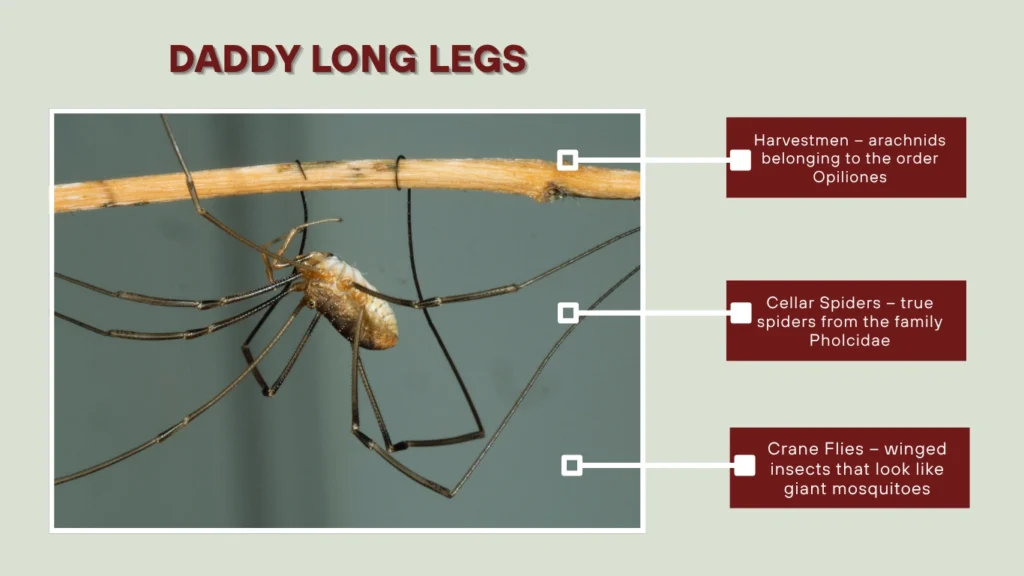
“Daddy Long Legs” is not a scientific term. It’s a common nickname used in different parts of the world for several different creatures. While they all share one key trait—long, thin legs—the similarities often stop there.
Common Names Around the World
Depending on where you live, “Daddy Long Legs” might refer to:
- Harvestmen – arachnids belonging to the order Opiliones
- Cellar Spiders – true spiders from the family Pholcidae
- Crane Flies – winged insects that look like giant mosquitoes
Because of this naming overlap, a lot of misinformation gets spread. So, let’s break down each type.
Are Harvestmen True Spiders?
Not at all.
Key Differences Between Harvestmen and Spiders
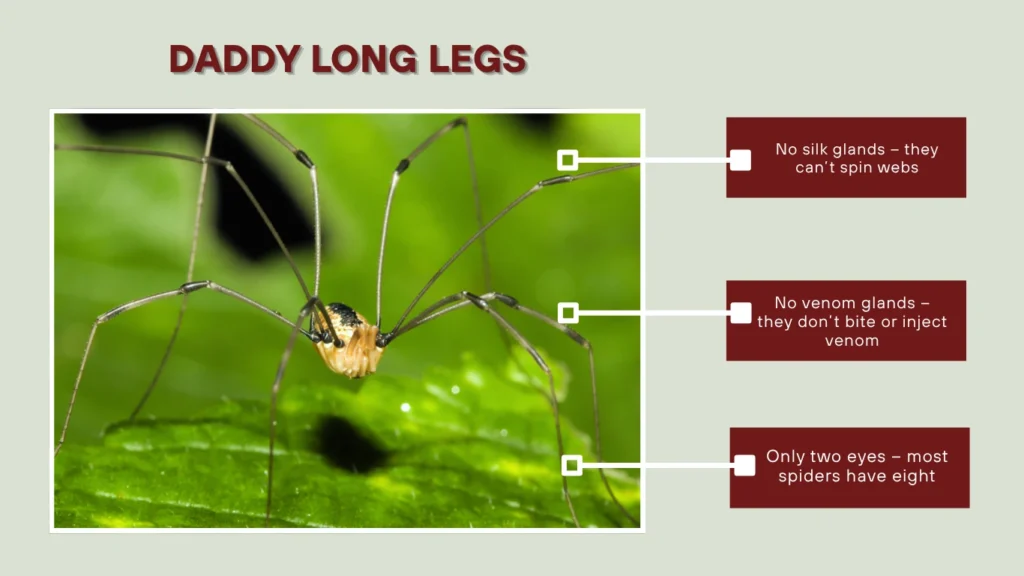
At first glance, harvestmen look like spiders, but when you look closer, they’re quite different. True spiders have two distinct body parts: the cephalothorax and the abdomen. Harvestmen, on the other hand, have a fused body that looks like a single oval.
Other key differences:
- No silk glands – they can’t spin webs
- No venom glands – they don’t bite or inject venom
- Only two eyes – most spiders have eight
So, while harvestmen are arachnids like spiders, they are not spiders.
Taxonomy and Classification
Harvestmen belong to the order Opiliones, not Araneae (the true spider order). They’re more closely related to scorpions than to spiders, although they’re harmless and don’t sting either.
Are Cellar Spiders True Spiders?

Yes, cellar spiders are 100% real spiders.
Why They Are Considered Spiders
Cellar spiders have:
- A segmented body with a narrow waist
- Silk-spinning ability (they build irregular, messy webs)
- Venom glands (used to subdue their prey)
These spiders are often found in basements, corners of ceilings, or sheds—hence the name “cellar spider.” They belong to the family Pholcidae and are known for their extremely thin legs and fragile appearance.
Behavior and Habitat
They’re non-aggressive and usually stay put in their webs. When disturbed, they vibrate or “bounce” in place, which makes them hard to catch. This odd behavior adds to their spooky reputation, but it’s just a defense mechanism.
Common Myths About Daddy Long Legs

These creatures are surrounded by myths, probably because of the confusion between harvestmen and cellar spiders.
Myth 1: They Are the Most Venomous Spiders in the World
You may have heard that Daddy Long Legs are “the most venomous spider in the world,” but their fangs are too short to penetrate human skin. This is completely false.
- Harvestmen have no venom at all.
- Cellar spiders do have venom, but it’s extremely weak and harmless to humans.
There’s no record of any “Daddy Long Legs” type creature ever causing a serious bite to a human.
Myth 2: All Daddy Long Legs Are the Same
As we’ve seen, they’re not. Some are spiders, some are not, and some aren’t even arachnids. It’s a catch-all term that covers very different animals.
Are They Dangerous to Humans?
Not in the slightest.
Harvestmen
These leggy wanderers don’t bite, sting, or produce venom. They mostly scavenge dead insects and plant material. In fact, they’re considered beneficial to gardens because they help with decomposition.
Cellar Spiders
While they can bite, it’s rare, and their venom is incredibly mild. You’re more likely to get bitten by a mosquito than a cellar spider.
Crane Flies
These are not spiders at all. They’re insects with wings and long legs. Some people call them “mosquito hawks,” but they don’t bite, don’t sting, and don’t harm anything. They’re just awkward fliers that often get stuck indoors.
How to Identify What Kind You Have
Not sure whether you’ve got a cellar spider, harvestman, or crane fly? Here’s how to tell the difference.
Look at the Body Structure
- Harvestmen
- Round, compact body (like a single oval)
- No silk or webs
- Moves quickly across surfaces
- Round, compact body (like a single oval)
- Cellar Spiders
- Two distinct body parts with a thin waist
- Lives in messy, irregular webs
- Will vibrate when disturbed
- Two distinct body parts with a thin waist
- Crane Flies
- Has wings
- Flies clumsily, often bumping into walls
- Looks like a large mosquito
- Has wings
FAQs
Are Daddy Long Legs poisonous?
No. Neither harvestmen nor cellar spiders are dangerous to humans. Harvestmen don’t even have venom.
Can Daddy Long Legs bite you?
Cellar spiders can bite, but it’s extremely rare and harmless. Harvestmen and crane flies cannot bite.
What do Daddy Long Legs eat?
Harvestmen eat decaying matter and small insects. Cellar spiders prey on insects. Crane flies don’t eat much as adults.
Are Daddy Long Legs good for the home?
Yes. Cellar spiders can help reduce populations of other indoor pests. Harvestmen help in gardens by breaking down organic matter.
How can I tell if it’s a cellar spider or a harvestman?
Look for webs. Cellar spiders make webs and have two body segments. Harvestmen have a single oval body and do not make webs.
Summary
Not all creatures called “Daddy Long Legs” are true spiders. The name is commonly used for three different animals: harvestmen, cellar spiders, and crane flies. Of these, only cellar spiders belong to the spider group (Araneae). Harvestmen are arachnids but not spiders—they lack venom and silk glands. Crane flies are winged insects and not arachnids at all. So, while some Daddy Long Legs are spiders, others are not. The confusion comes from their similar long legs and shared nickname.
