

You’ve probably walked into a sticky web in the corner of your ceiling or noticed a stringy mass in your basement and called it a “cobweb.” But is that just another word for spider web? While they may seem similar, cobwebs and spider webs are not exactly the same. The key differences lie in how they are made, which spiders create them, and their condition—active or abandoned. In this article, we’ll break down the differences in detail to help you understand which is which and what it means for your home.
Cobweb vs Spider Web
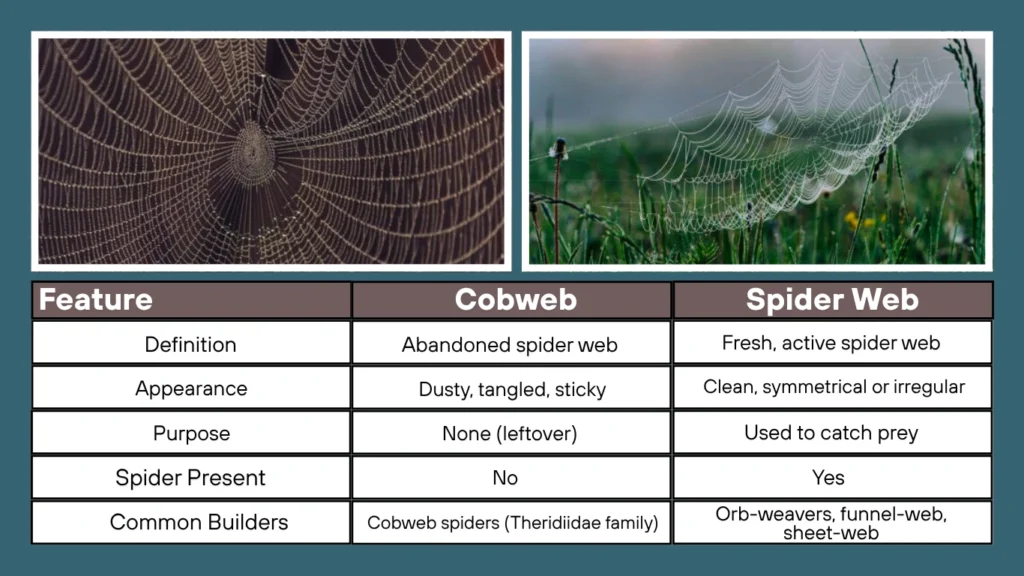
| Feature | Cobweb | Spider Web |
| Definition | Abandoned spider web | Fresh, active spider web |
| Appearance | Dusty, tangled, sticky | Clean, symmetrical or irregular |
| Purpose | None (leftover) | Used to catch prey |
| Spider Present | No | Yes |
| Common Builders | Cobweb spiders (Theridiidae family) | Orb-weavers, funnel-web, sheet-web |
| Location Found | Corners, ceilings, behind furniture | Gardens, windows, basements, trees |
| Web Condition | Old, unmaintained | Freshly spun, sticky |
| Risk | Indicates possible past infestation | Active spider presence |
Appearance and Structure Differences
Web Condition and Freshness
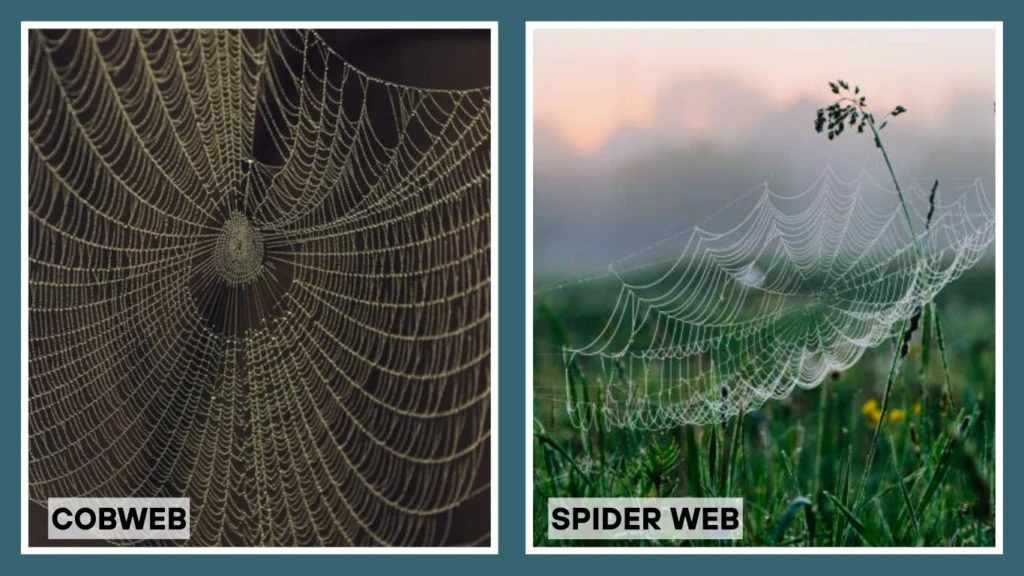
A cobweb is an old, abandoned web that is no longer maintained by a spider. It collects dust and may appear gray or dirty. These webs are often tangled and located in hard-to-reach areas like ceiling corners or behind furniture.
In contrast, a spider web is an active structure. It can be freshly spun and clean, with a specific purpose—usually to trap insects. Depending on the spider species, it may be symmetrical (like an orb-weaver’s web) or irregular (like a funnel web).
Symmetry and Shape
Cobwebs are typically asymmetrical and chaotic in shape. Since they are no longer maintained, the strands sag or break and accumulate dust. Spider webs, especially those built by orb-weavers, have a clear geometric design, showcasing radial lines and circular patterns. Other types like funnel or sheet webs are messy but are actively in use and strategically positioned.
Types of Spiders That Build Them

Cobweb Builders
The term “cobweb” also refers to webs made by cobweb spiders, such as the Theridiidae family. This includes the common house spider and even the black widow. These spiders build irregular tangle webs, usually in the corners of rooms or garages.
Once a cobweb spider abandons its web—or dies—the web quickly becomes dusty and useless, transforming into a true “cobweb” in the casual sense.
Spider Web Builders
Active spider webs are constructed by a variety of spider types:
- Orb-Weavers: Build symmetrical, wheel-shaped webs often seen in gardens.
- Funnel-Web Spiders: Create dense, sheet-like webs with a tubular retreat.
- Sheet-Web Builders: Build flat, horizontal layers of silk, usually in grass or low shrubs.
- Trapdoor Spiders: Don’t spin webs to catch prey but may create silk burrows.
These spider webs are purpose-built, and the spiders usually stay nearby to maintain and monitor them.
Function and Use
Cobweb Purpose
Cobwebs serve no purpose once abandoned. They no longer trap insects effectively and may instead collect dust, pollen, and debris. Their presence typically indicates that a spider once lived there but has since moved on or died.
Spider Web Purpose
Spider webs are active hunting tools. Depending on the spider, the web may trap flying insects, act as a vibration detector, or function as a hiding tunnel. Active webs are sticky, regularly repaired, and used for reproduction, hunting, or shelter.
Where You’ll Find Them
Cobweb Locations
Cobwebs are commonly found in:
- Ceiling corners
- Attics
- Behind bookcases
- Unused rooms
- Storage boxes
They build up over time and are most noticeable in homes that haven’t been cleaned recently or have had past spider activity.
Spider Web Locations
Fresh spider webs are found in:
- Garden shrubs
- Window frames
- Basements
- Outdoor fences
- Eaves and trees
Unlike cobwebs, these are maintained daily. If you destroy one, the spider may rebuild it the next night.
Risks and Concerns
Are Cobwebs a Sign of Infestation?
Not always. Cobwebs may simply indicate past spider presence. They don’t pose any harm themselves but suggest that the environment is favorable for spiders—meaning dusty, quiet, and undisturbed.
If you’re seeing a large number of cobwebs, it could mean your home is (or was) a suitable hiding place for spiders.
Are Active Spider Webs Dangerous?
It depends on the spider species. Most common house spiders are harmless. However, some cobweb builders like the black widow pose a serious threat. If you find a fresh web with an unfamiliar spider nearby, it’s best to identify the spider or contact pest control.
How to Tell the Difference
- Sticky or not: Active webs feel tacky and stretch when pulled. Cobwebs fall apart easily and are often coated with dust.
- Spider present: Active webs usually have a spider nearby or hidden in a retreat. Cobwebs are empty.
- Condition: A web that is dusty and broken is a cobweb. A clean, structured web is likely still in use.
Cleaning Tips for Cobwebs
- Use a duster or vacuum to remove cobwebs from corners.
- Check behind furniture, inside closets, and dark spaces frequently.
- Seal cracks and close vents that lead outside to prevent spider entry.
- Install screens on windows and doors and turn off porch lights at night, which attract insects (spider food).
FAQs
1. Are cobwebs always made by spiders?
Yes, all cobwebs originate from spiders, typically house spiders or cobweb spiders. However, once the spider leaves, the web degrades, collects dust, and becomes what we commonly call a cobweb. It’s not made by dust itself.
2. Do cobwebs mean my house is dirty?
Not necessarily. Cobwebs form in undisturbed areas, not just dirty homes. However, regular cleaning and dusting can prevent spider buildup and reduce the chances of cobweb formation over time.
3. Can cobwebs catch insects?
Not effectively. Once a web becomes a cobweb, it loses its stickiness and structure. It’s no longer effective at catching prey, and insects can usually walk through them without getting trapped.
4. How do spiders decide where to build webs?
Spiders choose locations based on food availability, airflow, and lack of disturbance. Quiet corners, ceilings, and shaded areas with flying insect traffic are ideal for building webs or cobwebs.
5. How can I prevent spider webs from forming in my home?
Regular cleaning, sealing gaps, reducing indoor lighting at night, and keeping other insects out will help. Spiders build webs where there’s prey and privacy, so minimizing both will discourage them.