

At first glance, the fishing spider and the wolf spider can look almost identical—both are large, fast-moving, and often brown or gray. They’re also common in wooded areas and near homes. But while they may be confused due to size and color, these spiders differ significantly in habitat, behavior, hunting techniques, and even how they interact with water. This guide will help you tell them apart and understand the role each plays in nature.
Fishing Spider vs Wolf Spider
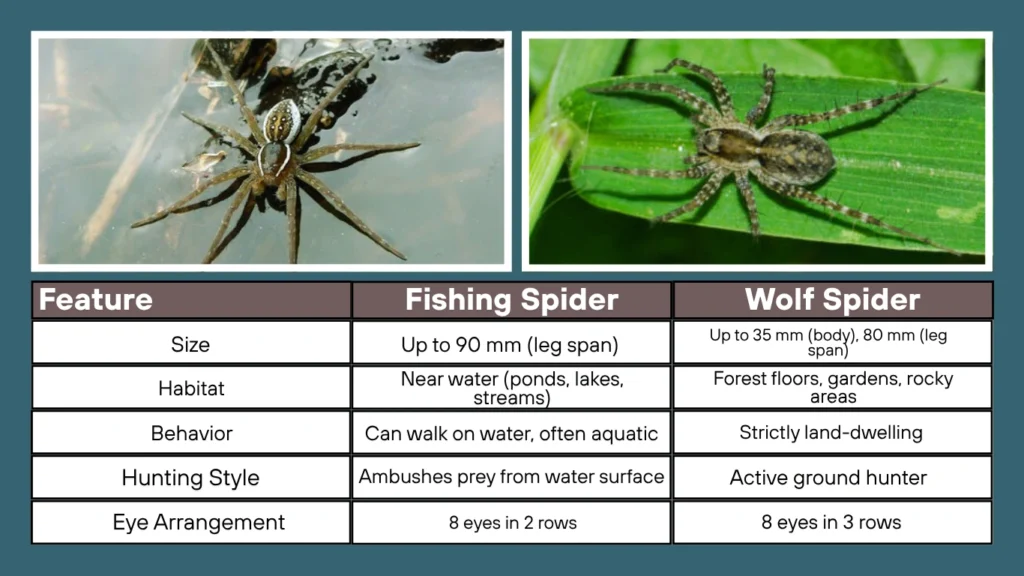
| Feature | Fishing Spider (Dolomedes spp.) | Wolf Spider (Lycosidae family) |
| Size | Up to 90 mm (leg span) | Up to 35 mm (body), 80 mm (leg span) |
| Habitat | Near water (ponds, lakes, streams) | Forest floors, gardens, rocky areas |
| Behavior | Can walk on water, often aquatic | Strictly land-dwelling |
| Hunting Style | Ambushes prey from water surface | Active ground hunter |
| Eye Arrangement | 8 eyes in 2 rows | 8 eyes in 3 rows |
| Appearance | Brown/gray with pale leg bands | Hairy, striped patterns |
| Venom | Mild, non-lethal | Mild, non-lethal |
| Web Use | No hunting web | No hunting web |
| Maternal Care | Carries egg sac in jaws, guards young | Carries egg sac on spinnerets, then young on back |
| Interaction with Water | Excellent swimmer, dives and floats | Cannot swim, avoids water |
Appearance and Body Features
Size and Color
Both spiders can appear large and intimidating. However:
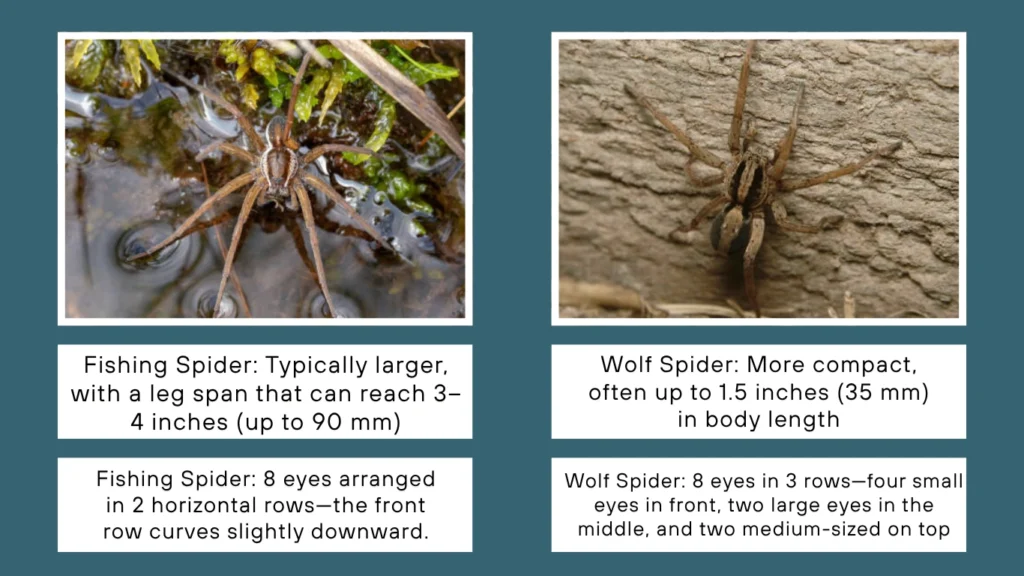
- Fishing Spider: Typically larger, with a leg span that can reach 3–4 inches (up to 90 mm). Their bodies are usually gray to brown with pale or cream leg bands.
- Wolf Spider: More compact, often up to 1.5 inches (35 mm) in body length. They are brown to gray with a striped or mottled appearance.
Both spiders have hairy legs and bodies, which can make them look more fearsome than they are.
Eye Arrangement
- Fishing Spider: 8 eyes arranged in 2 horizontal rows—the front row curves slightly downward.
- Wolf Spider: 8 eyes in 3 rows—four small eyes in front, two large eyes in the middle, and two medium-sized on top. Their middle row eyes glow when light shines on them at night.
Habitat and Lifestyle
Fishing Spider
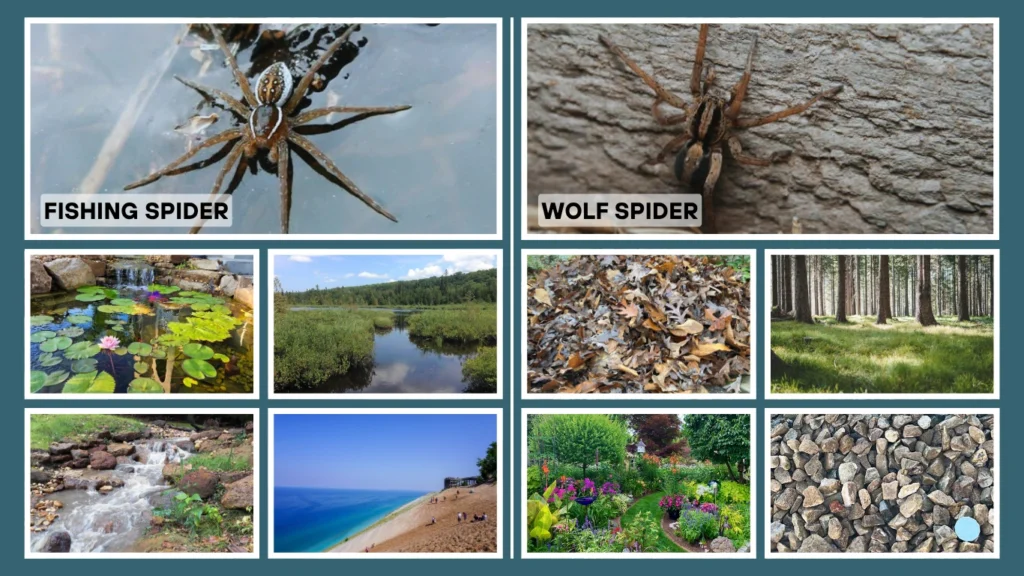
Fishing spiders are semi-aquatic and commonly found near:
- Ponds
- Marshes
- Streams
- Lakeshores
They’re known for their ability to walk on water, dive beneath the surface, and even detect vibrations caused by insects on the water.
Wolf Spider
Wolf spiders prefer dry, terrestrial environments, such as:
- Leaf litter
- Forest floors
- Gardens
- Under stones or logs
They do not swim and avoid water.
Hunting Behavior
Fishing Spider Hunting Style
Fishing spiders use ambush tactics. They sit at the edge of a pond or on floating debris, waiting for prey such as:
- Insects
- Tadpoles
- Small fish
They detect vibrations on the water’s surface and strike quickly. They can even dive to avoid predators or grab underwater prey.
Wolf Spider Hunting Style
Wolf spiders are active hunters that roam at night. They rely on speed and strong vision to catch insects on the ground. They don’t use webs but stalk and pounce on their prey like a miniature wolf.
Maternal Behavior
Fishing Spider
Female fishing spiders carry their egg sac with their chelicerae (mouthparts). Once hatched, they guard the nursery web, where hundreds of spiderlings may stay briefly before dispersing.
Wolf Spider
Wolf spider mothers attach the egg sac to their spinnerets and carry it behind them. Once the spiderlings hatch, they climb onto her back, and she carries them for several days—a behavior unique among spiders.
Web Use
Neither spider builds webs to catch prey. However:
- Fishing spiders may create a nursery web for their young.
- Wolf spiders use silk to line their burrows or create egg sacs but do not spin webs for hunting.
Venom and Risk to Humans
Are They Dangerous?
- Fishing Spider: Not aggressive. Bites are rare and typically cause mild redness or swelling. Their venom is not dangerous to humans.
- Wolf Spider: Also non-aggressive. If threatened, a bite may feel like a bee sting. Reactions are generally mild and not medically significant.
In both cases, bites may be a concern for individuals with allergies or compromised immune systems.
Key Differences at a Glance
| Trait | Fishing Spider | Wolf Spider |
| Water interaction | Walks on water, dives | Avoids water |
| Hunting location | Water edge or floating debris | Ground surfaces |
| Egg sac care | Held in mouth | Carried on back/spinnerets |
| Common sighting | Near ponds, wetlands | Gardens, woods, basements |
| Eye glow at night | No | Yes |
FAQs
1. Can a fishing spider bite hurt humans?
Yes, but it’s usually no worse than a bee sting. Their venom is designed for small prey like fish or insects. Symptoms might include swelling, redness, or slight pain, but severe reactions are rare.
2. Do wolf spiders ever go near water?
Not by choice. Wolf spiders are land-dwellers and avoid bodies of water. If found near water, it’s usually coincidental or in search of prey, not part of their typical behavior.
3. How can I tell if a large spider in my garden is a fishing spider?
Check the surroundings. If it’s near a pond or moist area and has pale bands on its legs, it’s likely a fishing spider. If it’s fast-moving, hairy, and in dry areas like leaf litter, it’s likely a wolf spider.
4. Are fishing spiders helpful in gardens?
Yes. They help control insect populations like mosquitoes and other aquatic insects. Even though they look intimidating, they play an important role in keeping ecosystems balanced.
5. Can wolf spiders infest homes?
They don’t form true infestations but may wander indoors in search of food or shelter. They’re solitary and don’t spin webs, so seeing one doesn’t mean many are present.
