

Though both are large, hairy, and often feared, wolf spiders and tarantulas are very different in behavior, appearance, and lifestyle. While a wolf spider might dash across your garage floor, a tarantula prefers to stay hidden in its burrow. In this article, we’ll break down all the key differences between the two—from body size to venom strength—so you can easily identify and understand these fascinating spiders.
Wolf Spider vs Tarantula

| Feature | Wolf Spider (Lycosidae family) | Tarantula (Theraphosidae family) |
| Size | 1–1.5 inches (2.5–4 cm) body | 2–5 inches (5–13 cm) body, up to 11-inch leg span |
| Hairiness | Moderately hairy | Densely covered in thick hairs (setae) |
| Color | Brown, gray, striped patterns | Brown, black, reddish, sometimes colorful |
| Habitat | Forest floor, gardens, leaf litter | Burrows, caves, desert, tropical forests |
| Movement | Fast, agile runner | Slow, deliberate crawl |
| Hunting Style | Active hunter | Ambush predator |
| Web Use | No webs for prey | Doesn’t spin webs to catch prey |
| Maternal Care | Carries egg sac, babies on back | Guards egg sac in burrow |
| Lifespan | 1–2 years | 10–25 years (females) |
| Venom to Humans | Mild, like bee sting | Mild to painful; not deadly |
Size and Appearance
Body Size
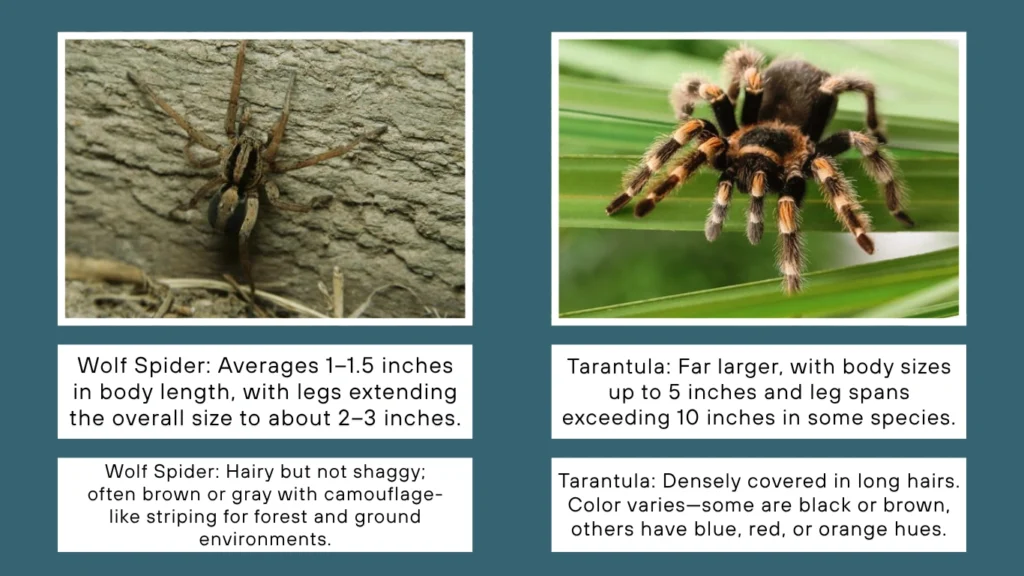
Wolf Spider: Averages 1–1.5 inches in body length, with legs extending the overall size to about 2–3 inches.
Tarantula: Far larger, with body sizes up to 5 inches and leg spans exceeding 10 inches in some species.
Hair and Coloration
Wolf Spider: Hairy but not shaggy; often brown or gray with camouflage-like striping for forest and ground environments.
Tarantula: Densely covered in long hairs. Color varies—some are black or brown, others have blue, red, or orange hues.
Tarantulas use their hairs (called urticating hairs) as a defense, flicking them at threats, while wolf spiders lack this feature.
Habitat and Behavior

Where They Live
Wolf Spider: Found all over the world, they prefer leaf litter, grassy fields, gardens, or under rocks. They often wander into garages or basements.
Tarantula: Prefer burrows, especially in warm or tropical environments like deserts, jungles, and scrublands. They rarely enter homes.
Tarantulas are most common in the Americas, Africa, and Asia, while wolf spiders are found worldwide, including colder regions.
Activity and Movement
- Wolf Spider: Fast and skittish, they dart quickly to escape danger and hunt on the move.
- Tarantula: Slow and steady, they rely on ambush rather than speed. Their heavy bodies are built for strength, not agility.
Hunting and Feeding Behavior
How They Catch Prey
Neither builds a web to catch prey.
Wolf Spider: Uses speed and strong vision to chase down and pounce on prey like insects and small arthropods.
Tarantula: Waits near its burrow and ambushes prey such as crickets, beetles, and even small lizards or frogs.
Web Use
Both species use silk, but not to catch prey:
- Wolf Spider: Uses silk to wrap eggs and sometimes line burrows.
- Tarantula: Uses silk to create trip lines at the burrow entrance to detect motion and guard the nest.
Lifespan and Reproduction
Lifespan
Wolf Spider: Lives about 1–2 years, with males typically dying soon after mating.
Tarantula: Females can live up to 25 years, while males survive only 3–7 years.
Maternal Care
- Wolf Spider: Females carry their egg sac on their spinnerets, and when spiderlings hatch, they ride on her back for several days.
- Tarantula: Guards the egg sac inside the burrow, and while she may stay near her young for a short time, she doesn’t carry them.
Venom and Interaction with Humans
Wolf Spider Bite
- Bites are rare and typically occur when the spider is trapped or handled.
- Symptoms:
- Pain similar to a bee sting
- Mild swelling and redness
- Pain similar to a bee sting
- No serious medical threat.
Tarantula Bite
- More intimidating due to size, but bites are usually not dangerous.
- Symptoms:
- Pain, swelling
- In rare cases, muscle cramps
- Pain, swelling
- Some species have more potent venom, but no tarantula is deadly to humans.
Tarantulas also defend themselves by flicking urticating hairs, which can irritate the skin or eyes.
Human Encounters and Popularity
Wolf Spiders are more commonly seen indoors or in gardens and are often confused with more dangerous spiders like the brown recluse.
Tarantulas are popular exotic pets, valued for their appearance and calm demeanor. Some people keep species like the Chilean rose hair or Mexican red-knee.
FAQs
1. Which spider is more dangerous—the wolf spider or the tarantula?
Neither is considered dangerous to humans. Both have venom, but it’s generally mild. Tarantula bites may cause more pain due to fang size, while wolf spider bites are like a mild sting.
2. Can a wolf spider kill a tarantula or vice versa?
In a natural setting, their paths rarely cross. However, a large tarantula could easily overpower a wolf spider due to its size and strength. Wolf spiders are quick, but they don’t have the power to fight a tarantula.
3. Which is more likely to come into my house?
Wolf spiders frequently enter homes by accident, especially in autumn. Tarantulas rarely do. If you see a large, hairy spider indoors, it’s more likely a wolf spider.
4. Are tarantulas good pets?
Yes, many tarantulas are calm and easy to care for, making them popular among exotic pet enthusiasts. They require minimal maintenance but need the right humidity, temperature, and space to burrow or climb.
5. How can I tell the difference at a glance?
Look at the size and behavior. Tarantulas are much bigger, slower, and more heavily hairy. Wolf spiders are quicker, smaller, and often appear outdoors or indoors darting across the floor.