
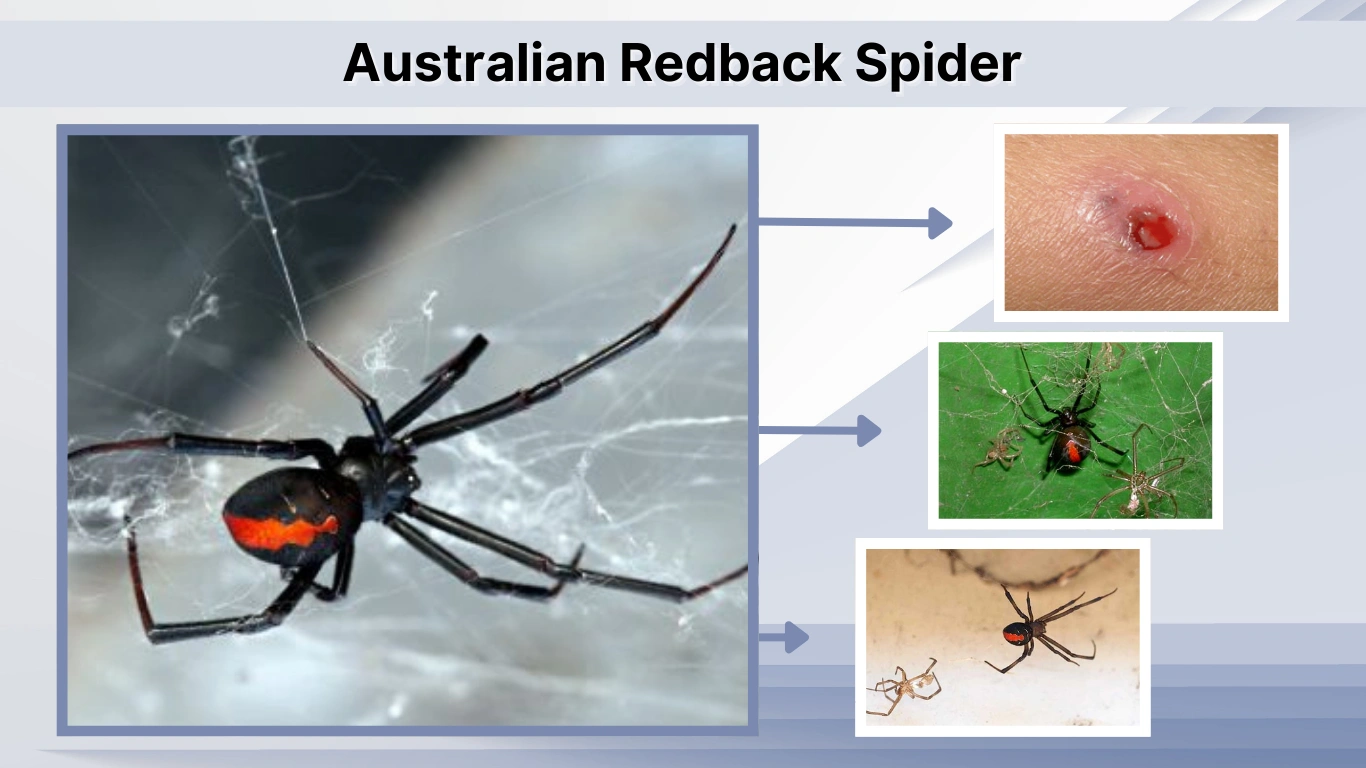
The Australian Redback Spider (Latrodectus hasselti) is one of the most recognizable and feared arachnids in the country. Known for its striking red stripe and potent venom, it has gained a reputation both in folklore and science. While dangerous, it is also a fascinating species that plays a role in maintaining ecological balance. In this article, we’ll explore its identification, behavior, venom, and surprising hunting abilities.
Identification & General Facts

The Redback Spider is an iconic Australian species, easily identified by its distinctive markings. Often found in backyards, sheds, and quiet corners, it has adapted to living close to humans.
What is the Australian Redback Spider?
The Redback belongs to the widow spider family and is closely related to the infamous Black Widow. Female Redbacks have a glossy black body with a prominent red stripe running down their back. Males, by contrast, are smaller and less vivid, often with white markings. This clear difference makes females both easier to identify and more feared.
Is the Redback Spider Native to Australia?
Yes, the Redback Spider is native to Australia and thrives across the continent. However, it has also spread to other parts of the world, including New Zealand, Japan, and parts of Europe, often hitching rides in cargo. Its ability to adapt to urban environments explains why it is so commonly encountered near homes.
Quick Redback Spider Facts
- Scientific name: Latrodectus hasselti
- Lifespan: Females may live up to three years, while males survive only a few months.
- Habitat: Gardens, sheds, mailboxes, and even outdoor furniture.
- Distribution: Found in every state and territory of Australia.
Size & Physical Characteristics

Redback Spiders display striking sexual dimorphism, with females being much larger than males. Their physical traits are tied closely to their survival strategies and hunting habits.
Female vs Male Redback Spider
Female Redbacks are around 1 cm in body length but appear much larger due to their long legs and vivid markings. Males are tiny, measuring just 3–4 mm, and rarely noticed. The size difference influences their behavior: females dominate hunting and reproduction, while males live shorter, sacrificial lives.
The Australian Redback Spider Web
Unlike the symmetrical webs of orb-weavers, Redback webs are messy and irregular. Constructed in sheltered, dark areas, the sticky strands hang downwards to trap insects and even small vertebrates. These webs act as both a hunting tool and a defense mechanism, keeping predators at bay while the spider waits in its retreat.
Behavior & Mating

The Redback Spider’s behavior is as fascinating as it is grim. From unusual mating rituals to survival strategies, this species demonstrates some of the most extreme behaviors in the arachnid world.
Mating Rituals of the Redback Spider
Redback mating is infamous for sexual cannibalism. During courtship, the male approaches cautiously, knowing he may be eaten. In many cases, males actively place themselves in the female’s jaws during copulation, sacrificing their lives. This behavior increases the chances of successful fertilization, ensuring their genetic line continues.
Male Australian Redback Spider
Males play a brief but critical role in reproduction. After mating, many are consumed, while those that survive live only a short time longer. Their smaller size means they cannot compete with females for food or territory. Instead, their evolutionary role is focused entirely on passing on their genes.
Venom & Bites

Redback venom has given the species its deadly reputation. Encounters with humans are relatively common because of their preference for urban areas, though fatalities today are extremely rare.
The Danger of an Australian Redback Spider Bite
A bite from a female Redback can cause severe pain, sweating, nausea, and muscle weakness. Symptoms typically worsen over several hours if untreated. While alarming, most bites occur when people accidentally disturb webs in gardens or outdoor storage. Immediate first aid involves applying ice and seeking medical help rather than pressure bandages, as these are not effective for neurotoxic venom.
Redback Spider Deaths in Australia
Before the development of antivenom in 1956, Redback bites were responsible for several recorded deaths. Since then, fatalities have become virtually nonexistent, though thousands of bites are reported each year. On average, around 200–300 cases require antivenom annually, highlighting the spider’s medical significance despite improved safety.
Predatory Behavior & Interactions

Redback Spiders are not only feared for their venom but also admired for their ability to subdue prey many times their size. Their hunting skills are an incredible showcase of evolution and survival.
Australian Redback Spider Eats Snake
Although rare, there have been documented cases of Redback Spiders overpowering and killing snakes. These events usually involve juvenile snakes becoming entangled in sticky web threads. Once trapped, the spider delivers venomous bites that immobilize the reptile. While shocking, this highlights the spider’s efficiency as a predator capable of handling prey beyond its usual diet of insects.
Redback Spider vs Snake – Who Wins?
The outcome of such encounters often favors the spider, despite its small size. Redbacks rely on patience and their highly toxic venom rather than brute strength. In contrast, snakes caught in webs are at a disadvantage, unable to free themselves. This unusual predator-prey interaction has been reported in Australian media, adding to the spider’s fearsome reputation.
Other Prey and Hunting Techniques
Snakes may make headlines, but Redbacks typically feed on more accessible prey such as flies, beetles, grasshoppers, and small lizards. They also scavenge on dead animals caught in their webs. Their irregular, sticky web is perfect for ensnaring creatures that wander too close, making them effective pest controllers in gardens and sheds.
Human Connection & Cultural Aspects
For Australians, the Redback Spider is more than just a creepy-crawly—it has become part of culture, slang, and even branding.
Redback Spider in Australian Culture
The Redback’s notoriety has found its way into songs, stories, and even jokes. Slim Newton’s country classic “Redback on the Toilet Seat” humorously reflects the spider’s habit of appearing in surprising places. Its dangerous reputation makes it both feared and iconic, symbolizing Australia’s rugged wildlife.
Australian Redback Spider Boots
The popular footwear brand Redback Boots draws its name from this arachnid, capitalizing on its association with toughness and survival. Just as the spider is resilient and adaptable, the boots are marketed as durable and dependable. This branding reflects how deeply the Redback Spider has seeped into Australian identity.
Conclusion
The Australian Redback Spider (Latrodectus hasselti) is both feared and respected. Recognizable by its red stripe and infamous for its venom, it has earned a place in global awareness as one of Australia’s deadliest creatures. Yet, thanks to effective antivenom, fatalities are almost unheard of today. Beyond the fear, the Redback plays a vital role in controlling pests and even fascinates scientists with its unique mating behaviors. Whether hiding in garden sheds, weaving webs in mailboxes, or making headlines for catching snakes, the Redback is a reminder of Australia’s extraordinary wildlife.
FAQs
1. Is the Redback Spider native to Australia?
Yes, it is native to Australia but has spread internationally through trade. It is now found in countries such as New Zealand, Japan, and parts of Europe.
2. How dangerous is a Redback Spider bite?
A female’s bite can cause severe pain, sweating, nausea, and muscle weakness. While dangerous, deaths are virtually nonexistent today due to effective antivenom developed in the 1950s.
3. How big do Redback Spiders grow?
Females reach around 1 cm in body length, with longer legs making them appear larger. Males are much smaller, typically only 3–4 mm.
4. Can a Redback Spider really kill a snake?
Yes, though rare, Redbacks have been observed trapping and killing small snakes in their webs. This unusual interaction highlights their hunting efficiency and venom potency.
5. How many people die from Redback Spider bites each year in Australia?
Thanks to antivenom, there have been no confirmed deaths from Redback bites in recent decades. However, hundreds of cases each year still require medical treatment.