




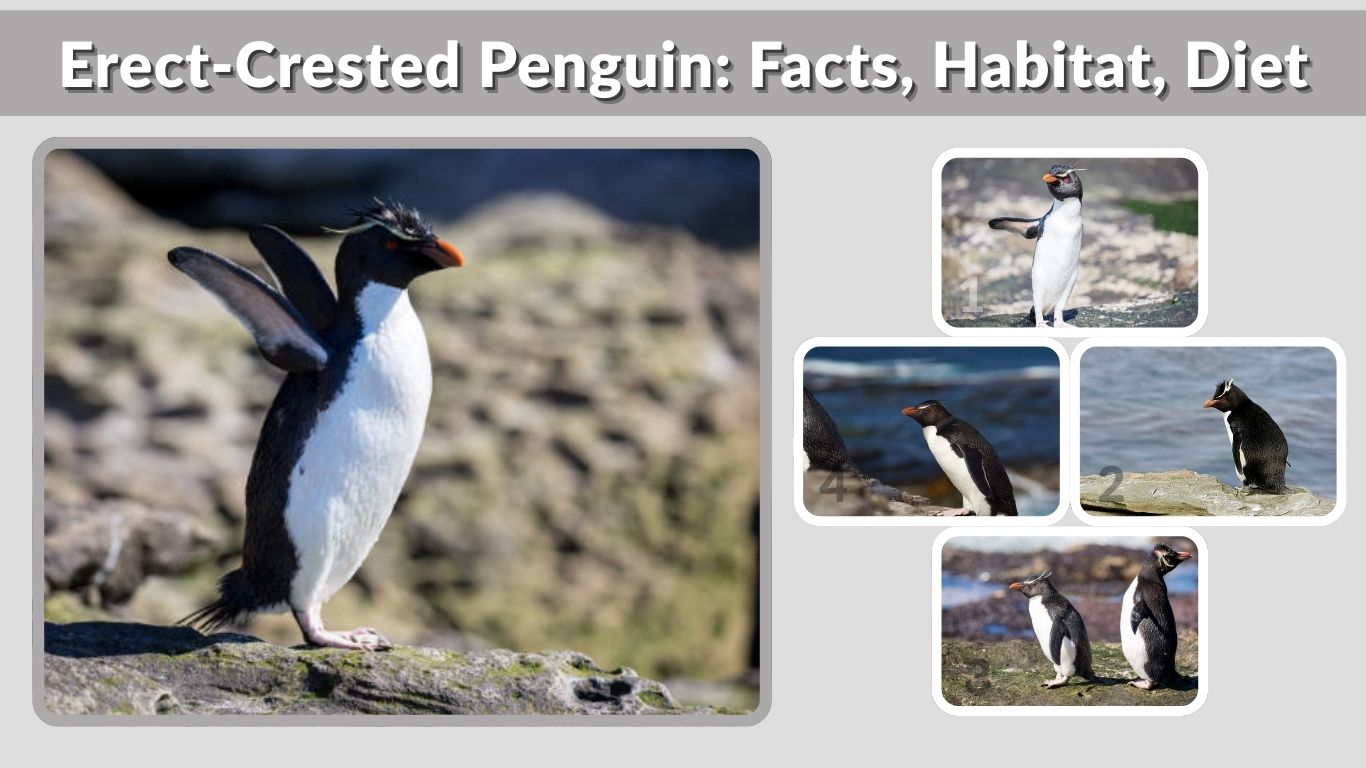
The erect-crested penguin is one of the rarest and least understood penguin species in the world. Recognized by its striking yellow crest feathers that stand upright above its eyes, this subantarctic bird lives in some of the most remote islands on Earth. Unlike more familiar penguin species, erect-crested penguins have a limited breeding range and face growing environmental threats. In this guide, you’ll discover detailed erect crested penguin facts, including their habitat, where they live, and what makes them unique.
Erect-Crested Penguin Overview
Scientific Classification
The erect-crested penguin’s scientific name is Eudyptes sclateri. It belongs to the family Spheniscidae, which includes all penguin species. Within this family, it is part of the crested penguin group, known for the yellow feather plumes on their heads. Other relatives in this group include the rockhopper penguin and the macaroni penguin. However, the erect-crested penguin stands out due to the distinctive way its crest feathers rise vertically rather than sweeping backward.
This species was first described in the late 19th century and remains one of the least studied penguins due to its extremely remote breeding grounds.
Physical Characteristics
The erect-crested penguin is medium-sized compared to other penguin species. Adults typically measure between 50 and 70 centimeters (20–28 inches) tall and weigh between 2.5 and 6 kilograms (5.5–13 pounds), depending on the season and food availability.
Its most recognizable feature is the bright yellow stripe that starts near the base of the beak and extends above each eye, forming erect crest feathers. Unlike other crested penguins, these feathers stand more upright, giving the bird a bold and expressive appearance.
Other physical features include:
- A black head and back
- A white belly
- Strong pinkish feet
- A reddish-orange beak
- Red or reddish-brown eyes
Their bodies are streamlined for swimming, with flipper-like wings that allow them to move quickly underwater.
Unique Traits
One of the most unusual aspects of erect-crested penguin behavior is their breeding pattern. Like other crested penguins, they typically lay two eggs. However, the first egg is significantly smaller than the second and rarely survives. The second egg is much larger and has a far higher chance of hatching successfully.
They are also known for being highly vocal during the breeding season. Colonies can become noisy as adults call to mates and defend small nesting territories. Despite their somewhat clumsy movement on land, they are agile and powerful swimmers in the ocean.
Erect-Crested Penguin Habitat
Natural Environment
The erect crested penguin habitat is located in the subantarctic region, characterized by cold temperatures, strong winds, and rough seas. These penguins prefer rocky coastlines and steep cliff areas rather than sandy beaches.
Vegetation in their habitat is sparse, consisting mainly of grasses, mosses, and low shrubs. The terrain is often rugged, making access difficult not only for predators but also for researchers.
Because their breeding islands are isolated and largely free from human settlement, the environment remains relatively undisturbed compared to other penguin habitats.
Nesting Areas
During breeding season, erect-crested penguins gather in large colonies on rocky slopes and coastal terraces. They build simple nests made from mud, stones, and small bits of vegetation. These nests are shallow scrapes in the ground rather than elaborate structures.
Colonial nesting provides several advantages:
- Increased protection through group vigilance
- Better chances of finding a mate
- Social interaction during breeding
However, nesting in dense colonies can also lead to competition and territorial disputes between neighboring pairs.
Climate Adaptations
Living in cold, storm-prone environments requires specialized adaptations. Erect-crested penguins have:
- Dense, waterproof feathers that trap insulating air
- A thick layer of blubber for warmth
- Counter-shaded coloring (dark back, white belly) for camouflage in water
Their dark backs blend into the ocean depths when viewed from above, while their white bellies blend with the bright surface when viewed from below. This adaptation helps protect them from marine predators.
Where Do Erect-Crested Penguins Live?
Breeding Locations
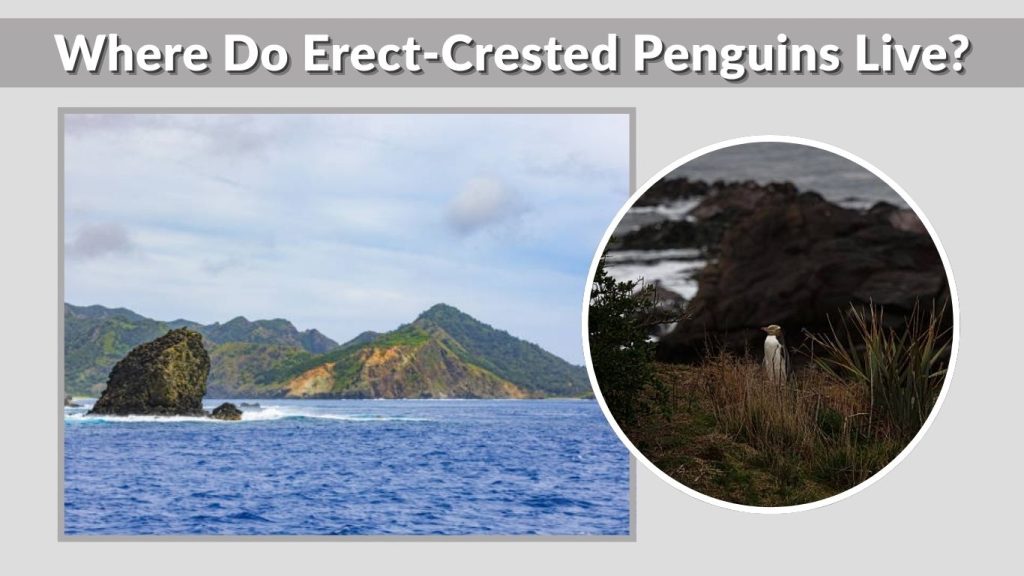
If you’re wondering where erect-crested penguins live, the answer is surprisingly specific. Nearly the entire global population breeds on just two island groups:
- The Antipodes Islands
- The Bounty Islands
Both are part of New Zealand’s subantarctic territory in the South Pacific Ocean. These islands are remote, uninhabited, and protected nature reserves.
The limited breeding distribution makes the species especially vulnerable. Any environmental change or ecological disruption on these islands can affect a large portion of the global population.
Non-Breeding Season Range
Outside the breeding season, erect-crested penguins spend most of their time at sea. Their movements during this period are not fully understood because tracking them in the vast Southern Ocean is challenging.
Scientists believe they disperse widely across the southern Pacific Ocean, foraging in cold, nutrient-rich waters. Like many seabirds, they may travel hundreds or even thousands of kilometers in search of food.
Because they spend so much time offshore, observing their full life cycle remains difficult, contributing to gaps in scientific knowledge about the species.
What Do Erect-Crested Penguins Eat?
Main Diet Components
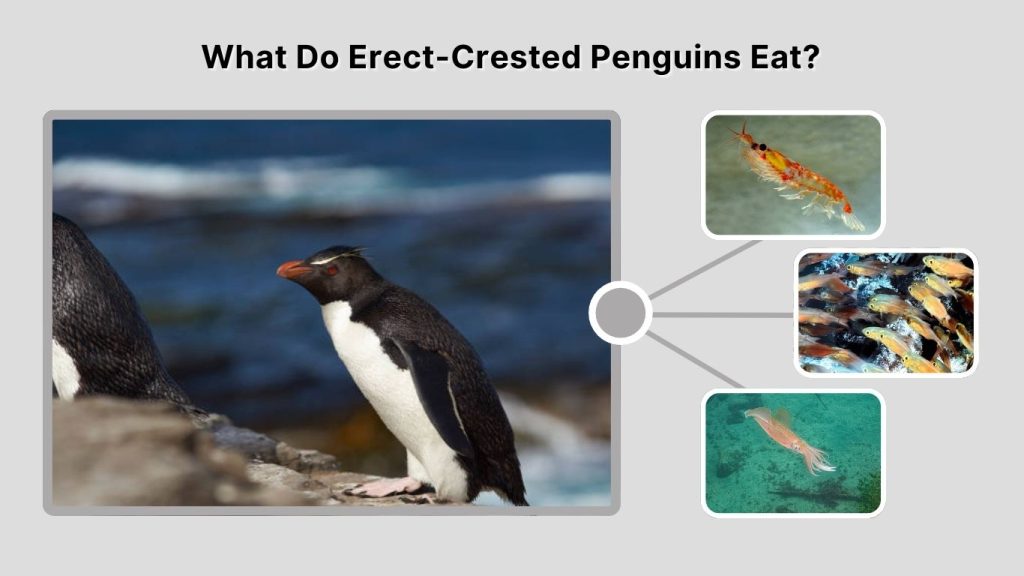
Understanding what erect-crested penguins eat helps explain both their survival and the threats they face. Like most crested penguins, their diet mainly consists of marine prey found in cold, nutrient-rich waters. Their primary food sources include:
- Krill
- Small schooling fish
- Squid
Krill often make up a significant portion of their diet, especially during the breeding season when adults must frequently return to feed their chicks. Small fish provide essential fats and proteins, while squid offer additional nutrients that support energy demands.
Their diet can vary depending on seasonal availability and ocean conditions. Changes in prey populations directly impact their breeding success and overall survival rates.
Hunting Techniques
Erect-crested penguins are skilled divers and efficient underwater hunters. Using their powerful flippers, they “fly” through the water with impressive speed and agility. Most dives are relatively short but can reach moderate depths as they chase prey.
They rely on sharp eyesight to detect movement underwater. Once prey is spotted, they pursue it quickly, catching it with their strong beaks. Like other penguins, they swallow smaller prey whole while still underwater.
During chick-rearing periods, adults may make multiple foraging trips daily. This demanding routine requires reliable food supplies close to breeding colonies.
Feeding Challenges
In recent decades, feeding conditions have become more unpredictable. Rising ocean temperatures can shift the distribution of krill and fish populations. If prey moves farther from breeding sites, adults must travel longer distances, reducing the frequency of chick feeding.
Overfishing also contributes to prey competition. When commercial fisheries target similar species, food availability for penguins can decline. These challenges make diet one of the most critical factors influencing erect-crested penguin population trends.
Erect-Crested Penguin Lifespan and Reproduction
Average Lifespan
The erect-crested penguin lifespan is estimated to range between 15 and 20 years in the wild, although exact figures are difficult to confirm due to limited long-term studies. Like many seabirds, individuals that survive their early years often live relatively long lives.
Juvenile survival rates tend to be lower than adult survival rates. Young penguins face threats from predators, harsh weather, and food shortages during their first years at sea. Adults that successfully navigate these challenges can return to breeding colonies year after year.
Breeding Behavior
Breeding season typically begins in September or October when adults return to their nesting islands. Males usually arrive first to establish nesting spots. Shortly after, females join them, and pairs reunite or form new bonds.
A distinctive feature of erect-crested penguin reproduction is the size difference between the two eggs laid. The first egg is much smaller and rarely survives. The second, larger egg almost always becomes the primary chick. This unusual pattern is still not fully understood but is consistent across most crested penguin species.
Both parents share incubation duties, taking turns guarding the nest and foraging for food.
Chick Development
After hatching, chicks go through several stages:
- Guard Stage – One parent stays with the chick while the other hunts.
- Crèche Stage – Chicks gather in small groups for safety while both parents forage.
- Fledging Stage – Young penguins develop waterproof feathers and prepare to enter the ocean.
Once fledged, juveniles head out to sea independently. They may spend several years at sea before returning to breed for the first time.
Conservation Status and Threats
Current Conservation Classification
The erect-crested penguin is currently classified as Endangered on the IUCN Red List. Population estimates suggest a decline over recent decades, although precise numbers are difficult to determine due to the remoteness of breeding colonies.
Because nearly the entire breeding population is concentrated on just a few islands, the species is particularly vulnerable to environmental changes.
Major Threats
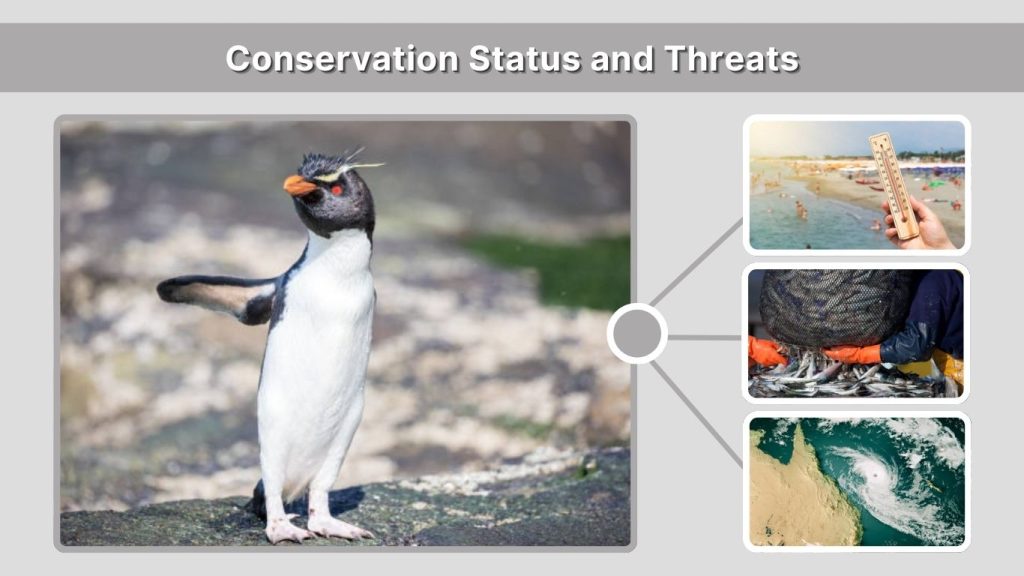
Several factors threaten the long-term survival of this rare penguin species:
- Climate change and ocean warming
- Changes in prey distribution
- Overfishing
- Severe weather events
- Limited breeding range
Warming oceans can disrupt marine ecosystems, affecting krill and fish populations. Additionally, extreme storms may damage nesting areas or reduce chick survival rates.
Conservation Efforts
Fortunately, the primary breeding islands are protected as nature reserves. Human access is restricted, which minimizes habitat disturbance. Conservation organizations and researchers continue to monitor population trends and study their ecology.
Long-term survival depends heavily on protecting marine ecosystems and addressing global climate change. Continued research is essential for developing effective conservation strategies.
Interesting Erect-Crested Penguin Facts
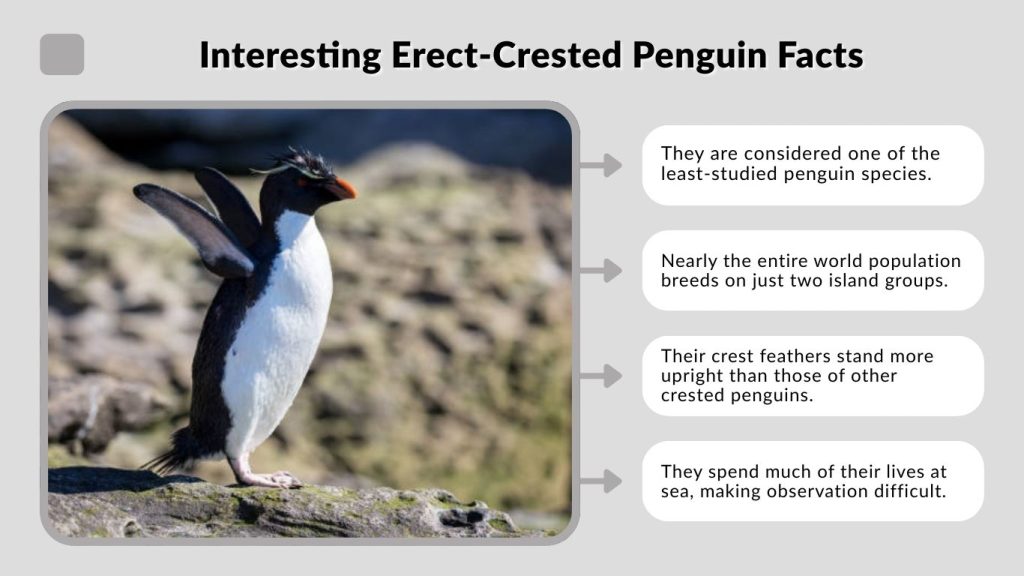
- They are considered one of the least-studied penguin species.
- Nearly the entire world population breeds on just two island groups.
- Their crest feathers stand more upright than those of other crested penguins.
- They spend much of their lives at sea, making observation difficult.
- The first egg they lay is significantly smaller and rarely produces a chick.
These fascinating traits make the erect-crested penguin a unique and important part of the subantarctic ecosystem.
Conclusion
The erect-crested penguin is a remarkable yet vulnerable species found in the remote subantarctic islands of New Zealand. From their distinctive upright yellow crests to their unusual breeding patterns, they stand out among crested penguins. Understanding erect crested penguin facts, including their habitat, diet, and lifespan, highlights both their resilience and their fragility. As environmental pressures increase, continued conservation efforts are crucial to ensure that this rare penguin species survives for generations to come.