




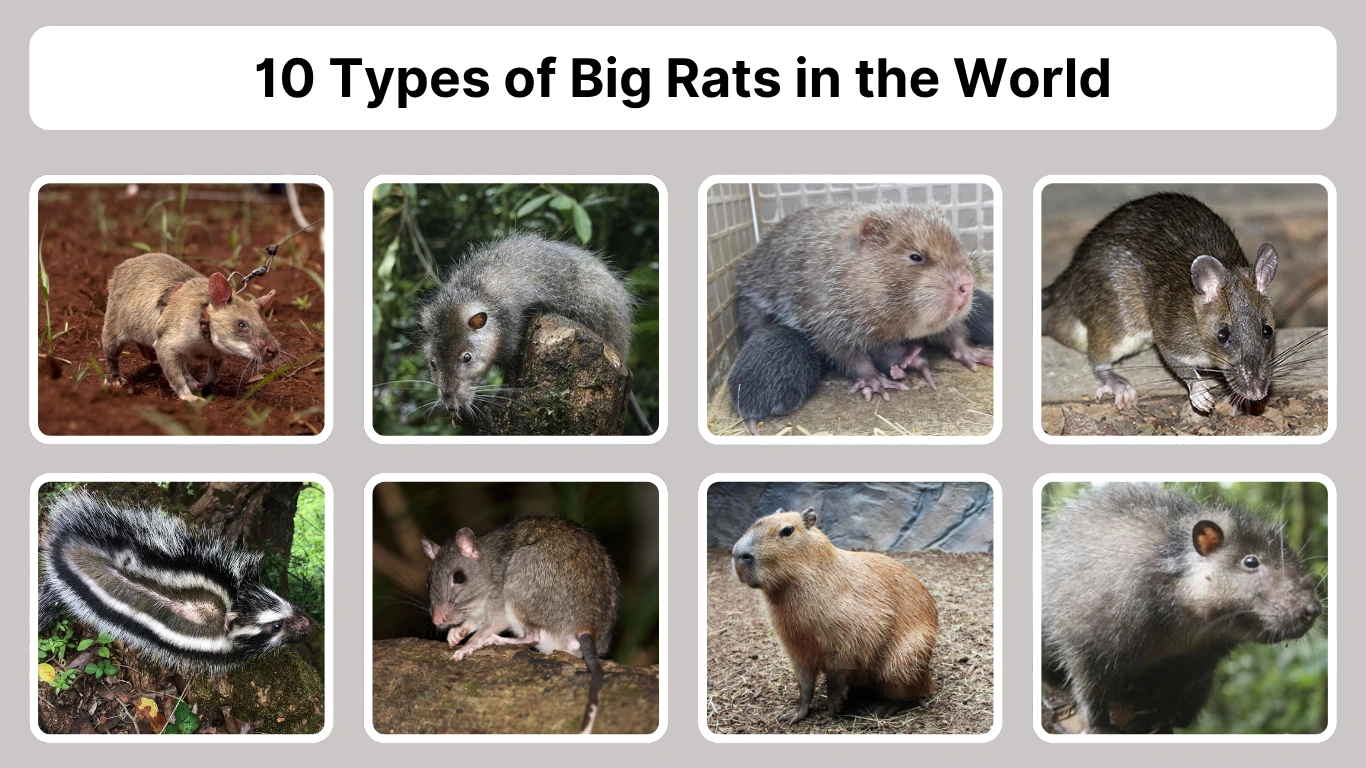
Rats are found in many shapes and sizes, but some species stand out for their impressive size, unique adaptations, and fascinating behaviors. From the giant cloud rats of the Philippines to the world’s largest rodent, the capybara, these big rats inhabit a wide range of environments — from dense rainforests and mountain highlands to grassy wetlands. In this guide, we’ll explore 10 of the largest rat species in the world, highlighting their appearance, habitat, diet, and behavior. Each one has its own story, offering a glimpse into the incredible diversity of the rodent family.
1. Gambian Pouched Rat

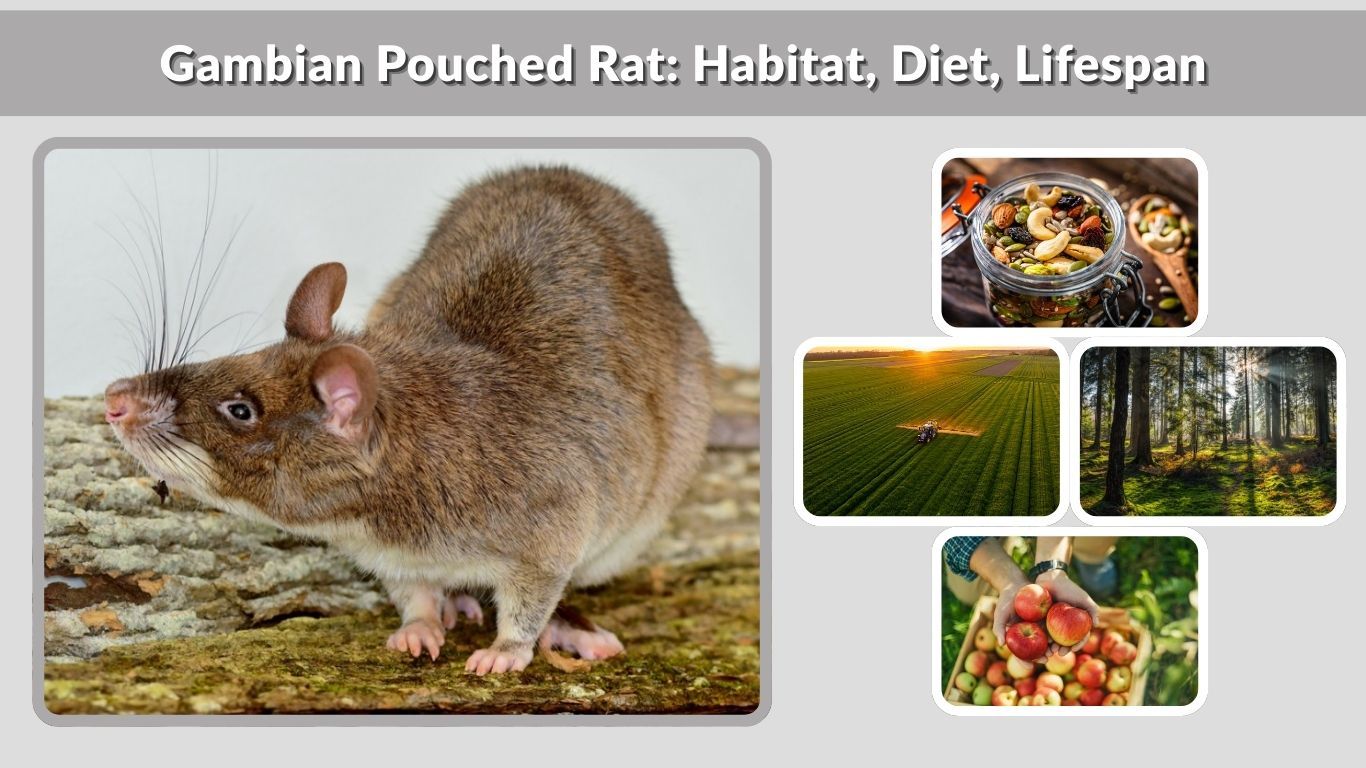
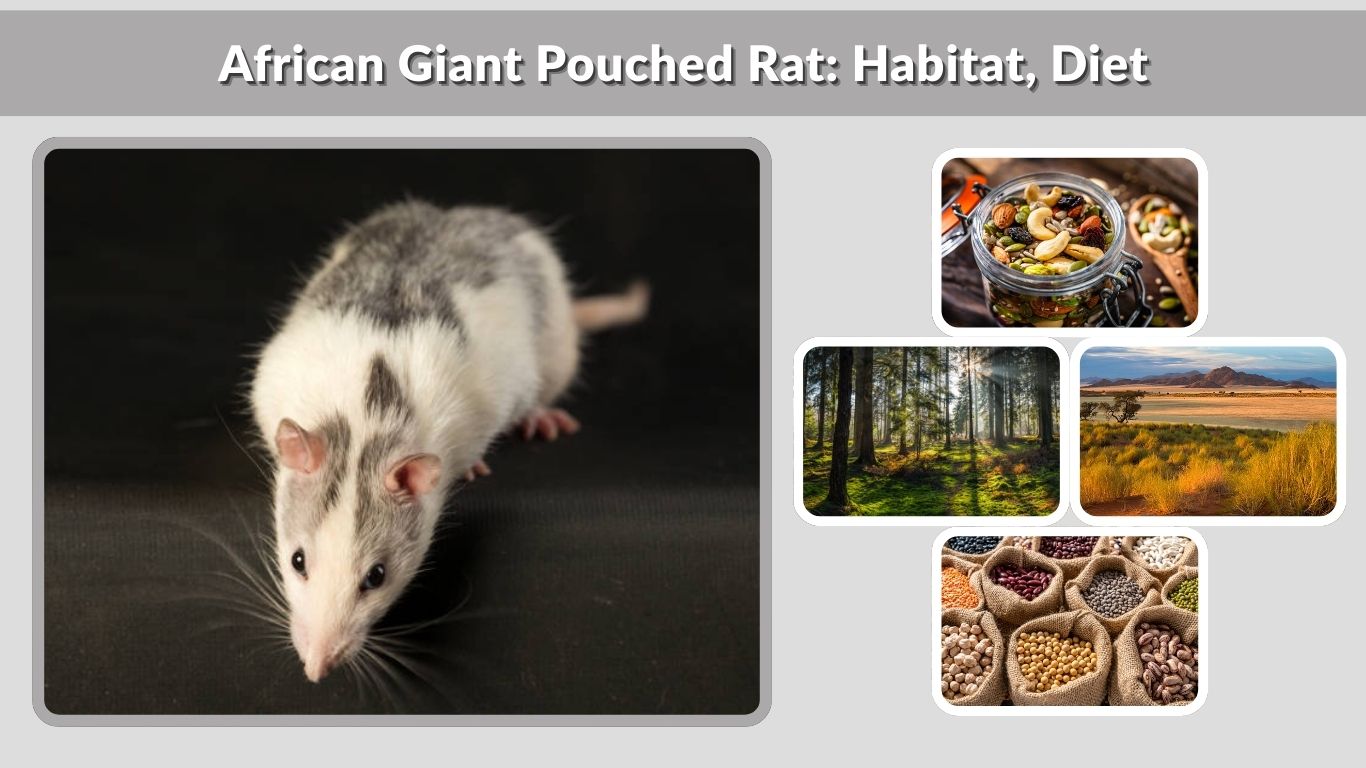
The Gambian pouched rat is one of the largest rat species in the world, known for its impressive size and unique cheek pouches used to store food. Native to sub-Saharan Africa, this species is intelligent, adaptable, and has even been trained for specialized tasks like detecting landmines and diagnosing diseases.
Identification
- Scientific Name: Cricetomys gambianus
- Size: 25–45 cm (10–17 in) body length, with an additional 36–45 cm (14–18 in) tail
- Weight: 1–1.4 kg (2.2–3.1 lbs)
- Fur Color: Grayish-brown upper body, lighter underside
- Distinct Feature: Large cheek pouches for food storage
Habitat and Range
The Gambian pouched rat thrives in grasslands, forests, and urban areas across sub-Saharan Africa. It prefers warm climates and is highly adaptable to different environments.
Diet
Its diet consists of fruits, seeds, nuts, insects, and occasionally small animals. In captivity, it can also eat commercial rodent food.
Behavior and Lifespan
This rat is nocturnal, using its keen sense of smell to forage at night. It is known for being intelligent and trainable. In the wild, it can live up to 5 years, while in captivity it may live up to 8 years.
2. Bosavi Woolly Rat

The Bosavi woolly rat is an extraordinary discovery from the remote volcanic rainforest of Papua New Guinea. First recorded in 2009 during a scientific expedition inside the Bosavi crater, this gentle giant captured global attention due to its size and docile nature. Unlike most wild rats, it shows no fear of humans, likely because it evolved in an isolated environment with no natural predators.
Identification
- Scientific Name: Mallomys sp.
- Size: Around 82 cm (32 in) from nose to tail tip
- Weight: Approximately 1.5 kg (3.3 lbs), making it one of the heaviest known rat species
- Fur Color: Dense, soft, gray-brown fur that gives it a woolly appearance
- Distinct Feature: Exceptionally large size and calm temperament, with thick fur suited for highland rainforest conditions
Habitat and Range
Found exclusively inside the Bosavi crater, a massive extinct volcano in Papua New Guinea, this rat lives in a pristine rainforest ecosystem. The area’s isolation has protected it from human activity and invasive predators. Its habitat is cool, moist, and rich in vegetation, providing ample food sources.
Diet
It is believed to feed primarily on fruits, leaves, and stems found in the rainforest. Researchers suspect it may also nibble on seeds and bark, similar to other members of the Mallomys genus.
Behavior and Lifespan
The Bosavi woolly rat is nocturnal, moving quietly through the undergrowth at night. It is non-aggressive and surprisingly tame when encountered. While its exact lifespan is unknown, it is estimated to live 5–7 years in the wild.
3. Sumatran Bamboo Rat
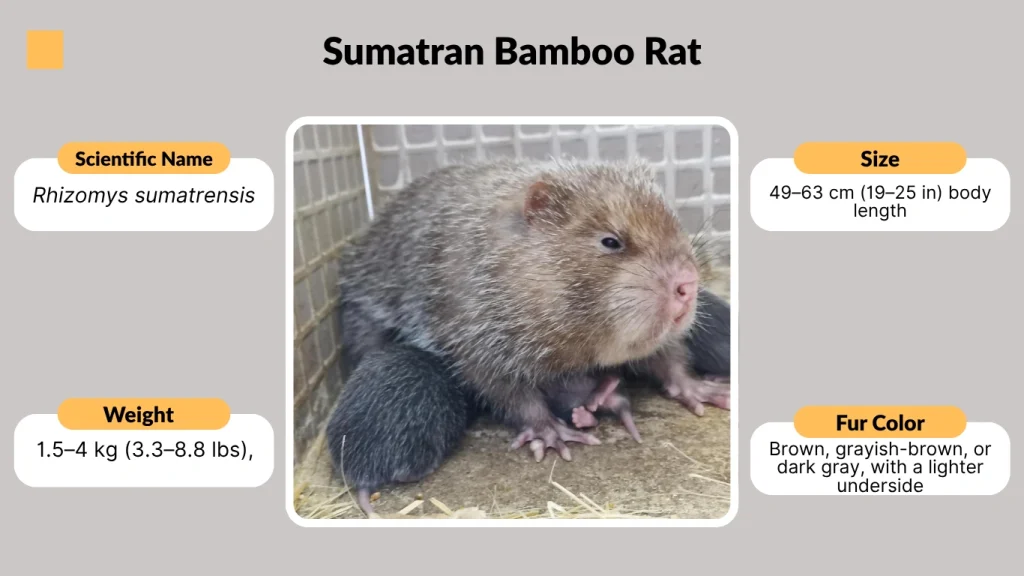
The Sumatran bamboo rat is a burrowing rodent known for its impressive size and powerful digging abilities. Commonly found in Southeast Asia, it spends most of its life underground and emerges mainly at night to forage. Farmers sometimes view it as a pest due to its habit of feeding on cultivated crops, especially bamboo plantations.
Identification
- Scientific Name: Rhizomys sumatrensis
- Size: 49–63 cm (19–25 in) body length, with a short 6–8 cm (2–3 in) tail
- Weight: 1.5–4 kg (3.3–8.8 lbs), making it one of the heaviest bamboo rat species
- Fur Color: Brown, grayish-brown, or dark gray, with a lighter underside
- Distinct Feature: Large head, stocky build, and short, almost hairless tail
Habitat and Range
Native to forested areas, farmlands, and bamboo groves in Indonesia, Thailand, Malaysia, Vietnam, and surrounding countries. Prefers soft, moist soil where it can dig extensive burrow systems.
Diet
Specializes in eating bamboo roots, shoots, and underground stems, but will also feed on sugarcane, cassava, and other cultivated plants if available.
Behavior and Lifespan
Solitary and nocturnal, the Sumatran bamboo rat spends daylight hours in its burrow. It uses its strong teeth and claws to dig and defend itself when threatened. Lifespan is typically 5–7 years in the wild, though it may live longer in captivity.
4. Mountain Giant Sunda Rat
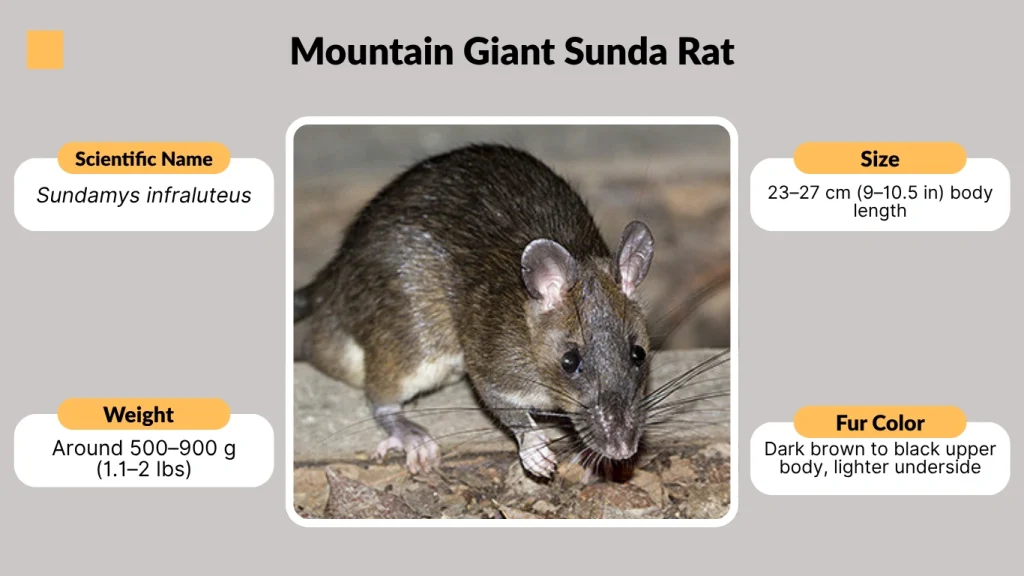
The Mountain Giant Sunda rat is one of Southeast Asia’s largest rat species, adapted to cool, high-altitude habitats. Unlike common rats, it has a slower lifestyle, feeding mainly on fruits and vegetation in its forest environment.
Identification
- Scientific Name: Sundamys infraluteus
- Size: 23–27 cm (9–10.5 in) body length, with a tail of 26–30 cm (10–12 in)
- Weight: Around 500–900 g (1.1–2 lbs), making it heavy for its body length
- Fur Color: Dark brown to black upper body, lighter underside
- Distinct Feature: Thick, coarse fur and a long tail for balance in tree climbing
Habitat and Range
Inhabits montane forests of Indonesia, Malaysia, and Brunei, typically at elevations of 700–2,400 meters (2,300–7,900 ft). Prefers dense vegetation and cooler climates.
Diet
Eats fruits, seeds, leaves, and occasionally insects. Plays a role in seed dispersal and forest ecology.
Behavior and Lifespan
Nocturnal and partly arboreal, it is agile in trees but also forages on the forest floor. Estimated lifespan is 3–5 years in the wild.
5. Mallomys Rat
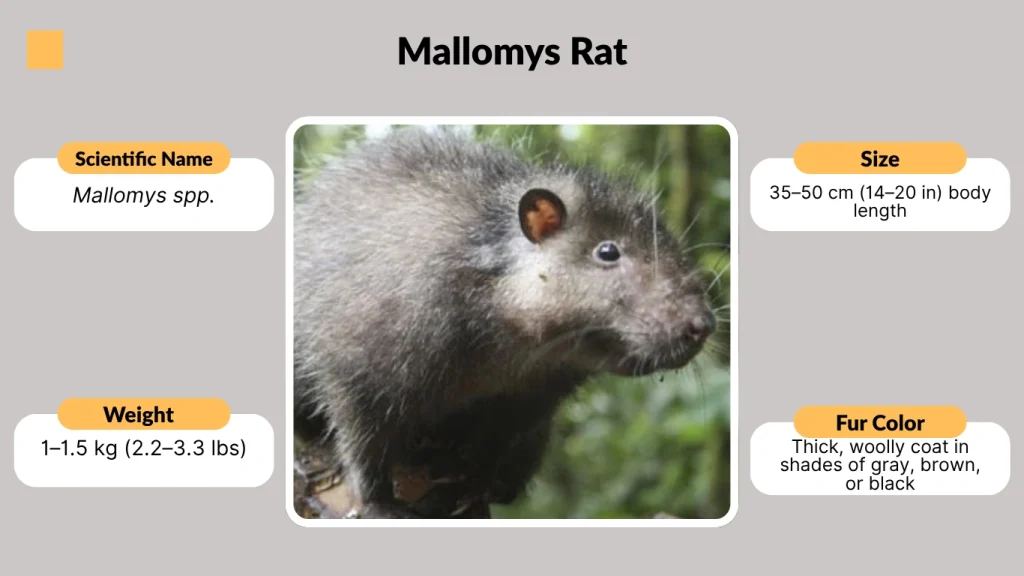
The Mallomys rat refers to a group of giant rats from New Guinea, some of which are among the largest in the world. They are slow-moving, gentle, and live in remote, mountainous rainforests far from human settlements.
Identification
- Scientific Name: Mallomys spp.
- Size: 35–50 cm (14–20 in) body length, with tails nearly as long
- Weight: 1–1.5 kg (2.2–3.3 lbs)
- Fur Color: Thick, woolly coat in shades of gray, brown, or black
- Distinct Feature: Large size and soft, dense fur adapted for cool highlands
Habitat and Range
Found in the highland forests of Papua New Guinea and Indonesian New Guinea, often in areas above 1,000 meters (3,280 ft). Their remote range keeps them relatively safe from human impact.
Diet
Feeds mainly on plant material such as leaves, stems, fruits, and possibly bark.
Behavior and Lifespan
Nocturnal and non-aggressive, spending much of the night foraging quietly. Their lifespan is believed to be around 5–7 years in the wild.
6. Crested Rat
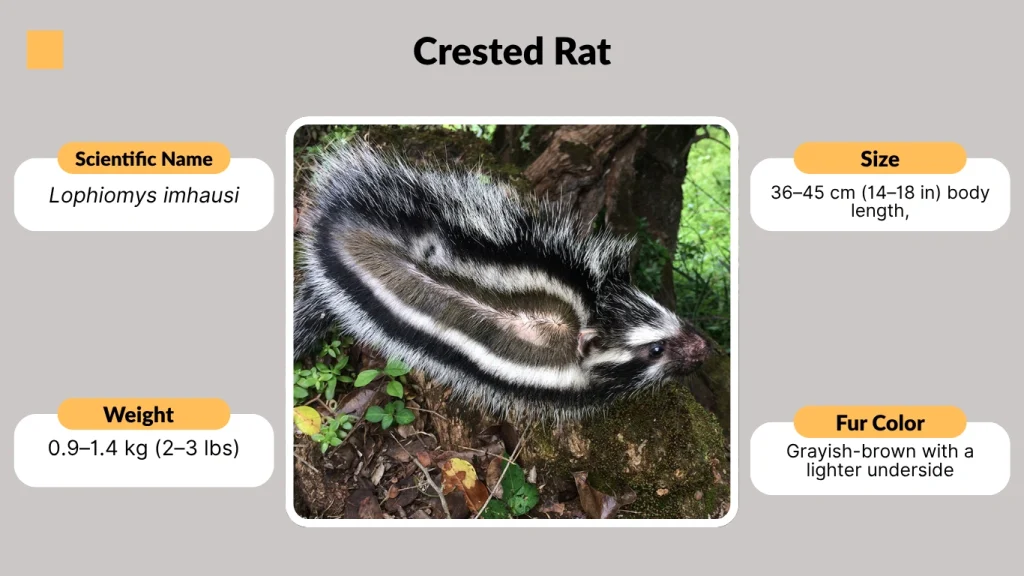
The Crested rat, also known as the African crested rat, is a unique large rodent famous for its unusual defense mechanism — it chews poisonous bark and applies the toxin to its fur, making it deadly to predators. This fascinating adaptation makes it one of the most remarkable rats in the world.
Identification
- Scientific Name: Lophiomys imhausi
- Size: 36–45 cm (14–18 in) body length, with a tail of 14–20 cm (5.5–8 in)
- Weight: 0.9–1.4 kg (2–3 lbs)
- Fur Color: Grayish-brown with a lighter underside; distinctive black-and-white crest along the back
- Distinct Feature: Long crest of hairs that can be raised when threatened; toxic fur from plant-derived poison
Habitat and Range
Inhabits dry forests, savannas, and rocky areas in East Africa, particularly Ethiopia, Kenya, Somalia, Tanzania, and Uganda.
Diet
Herbivorous — feeds mainly on leaves, fruits, seeds, and bark. Particularly fond of the bark of the poisonous Acokanthera tree, which it uses for self-defense.
Behavior and Lifespan
Mostly nocturnal and slow-moving, relying on its toxicity and camouflage rather than speed. In the wild, it can live 5–6 years; in captivity, slightly longer.
7. Giant White-Tailed Rat
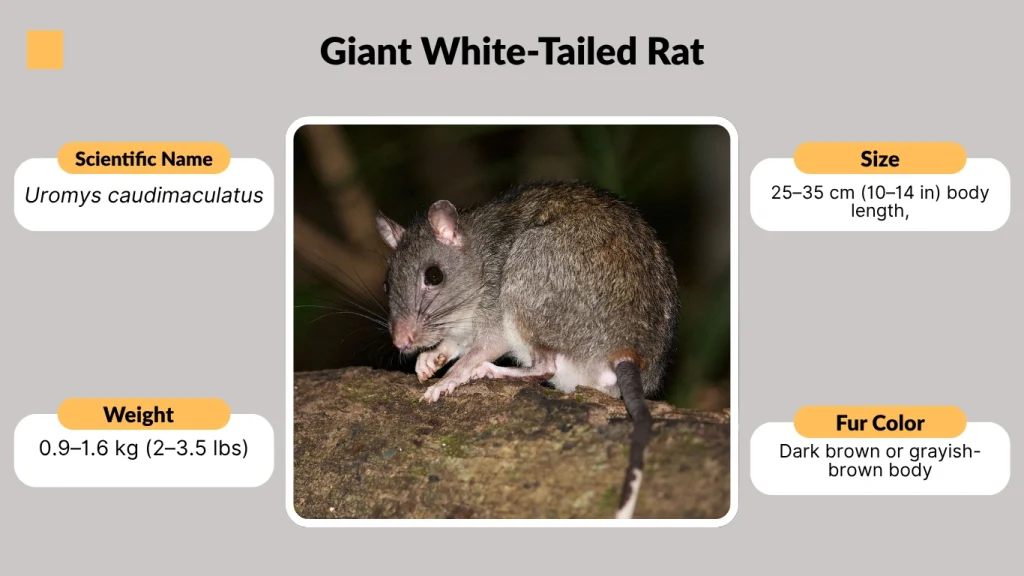
The Giant white-tailed rat is a large rodent native to Australia, valued for its role in seed dispersal in rainforest ecosystems. It is strong, agile, and can chew through hard-shelled fruits with ease.
Identification
- Scientific Name: Uromys caudimaculatus
- Size: 25–35 cm (10–14 in) body length, with a tail length of 30–38 cm (12–15 in)
- Weight: 0.9–1.6 kg (2–3.5 lbs)
- Fur Color: Dark brown or grayish-brown body with a distinctive pale to white tail tip
- Distinct Feature: Strong jaws capable of cracking nuts and seeds; long tail for balance in climbing
Habitat and Range
Found in the tropical rainforests of northeastern Queensland, Australia, and nearby islands. It prefers dense vegetation and tall forest canopies.
Diet
Feeds on fruits, seeds, nuts, and sometimes insects. Plays a vital role in spreading rainforest plants.
Behavior and Lifespan
Nocturnal and partly arboreal, nesting in tree hollows or dense vegetation. Lifespan in the wild is about 3–5 years, potentially longer in captivity.
8. Capybara
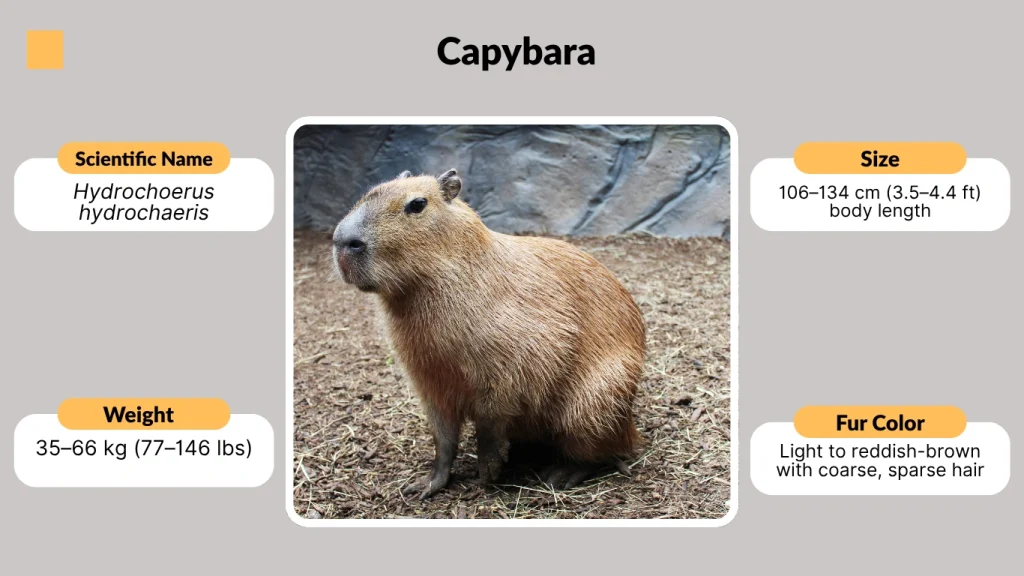
The Capybara is the largest rodent in the world, often mistaken for a giant guinea pig due to its gentle face and social nature. Native to South America, it thrives in aquatic environments and is known for living peacefully in large groups. Despite its size, it is a calm, non-aggressive animal that coexists well with other wildlife.
Identification
- Scientific Name: Hydrochoerus hydrochaeris
- Size: 106–134 cm (3.5–4.4 ft) body length, with a short, barely visible tail
- Weight: 35–66 kg (77–146 lbs)
- Fur Color: Light to reddish-brown with coarse, sparse hair
- Distinct Feature: Large, barrel-shaped body with webbed feet for swimming
Habitat and Range
Inhabits grassy wetlands, marshes, and riverbanks across South America, including Brazil, Venezuela, Colombia, Argentina, and Uruguay. Prefers areas with abundant water sources for swimming and grazing.
Diet
Herbivorous — grazes on grasses, aquatic plants, and occasionally fruits and bark. It practices coprophagy (re-ingestion of droppings) to digest food more efficiently.
Behavior and Lifespan
Highly social and semi-aquatic, often seen in groups of 10–20 individuals. Excellent swimmers and divers, using water as refuge from predators. In the wild, capybaras live 6–10 years, while in captivity they can live up to 12 years.
FAQs
1. What is the biggest rat in the world?
The capybara (Hydrochoerus hydrochaeris) is the largest rodent in the world, reaching up to 66 kg (146 lbs). Although not a “rat” in the strict scientific sense, it is part of the same order, Rodentia.
2. Are all big rats dangerous to humans?
No. Most large rat species, such as giant cloud rats and capybaras, are gentle and avoid humans. However, some can damage crops or carry diseases if they live close to human settlements.
3. Why do some big rats live only in certain areas?
Many large rat species, like the Bosavi woolly rat, are found in isolated habitats such as volcanic craters or highland forests. These limited ranges help protect them but also make them vulnerable to habitat loss.
4. Can big rats be kept as pets?
Some species, like the Gambian pouched rat, are kept as pets or trained for special tasks. However, not all large rat species are suitable for captivity due to their habitat needs and conservation status.
5. What role do big rats play in nature?
Large rats often help maintain ecosystems by dispersing seeds, controlling insect populations, and providing food for predators. Their presence can be vital for forest regeneration and biodiversity.