
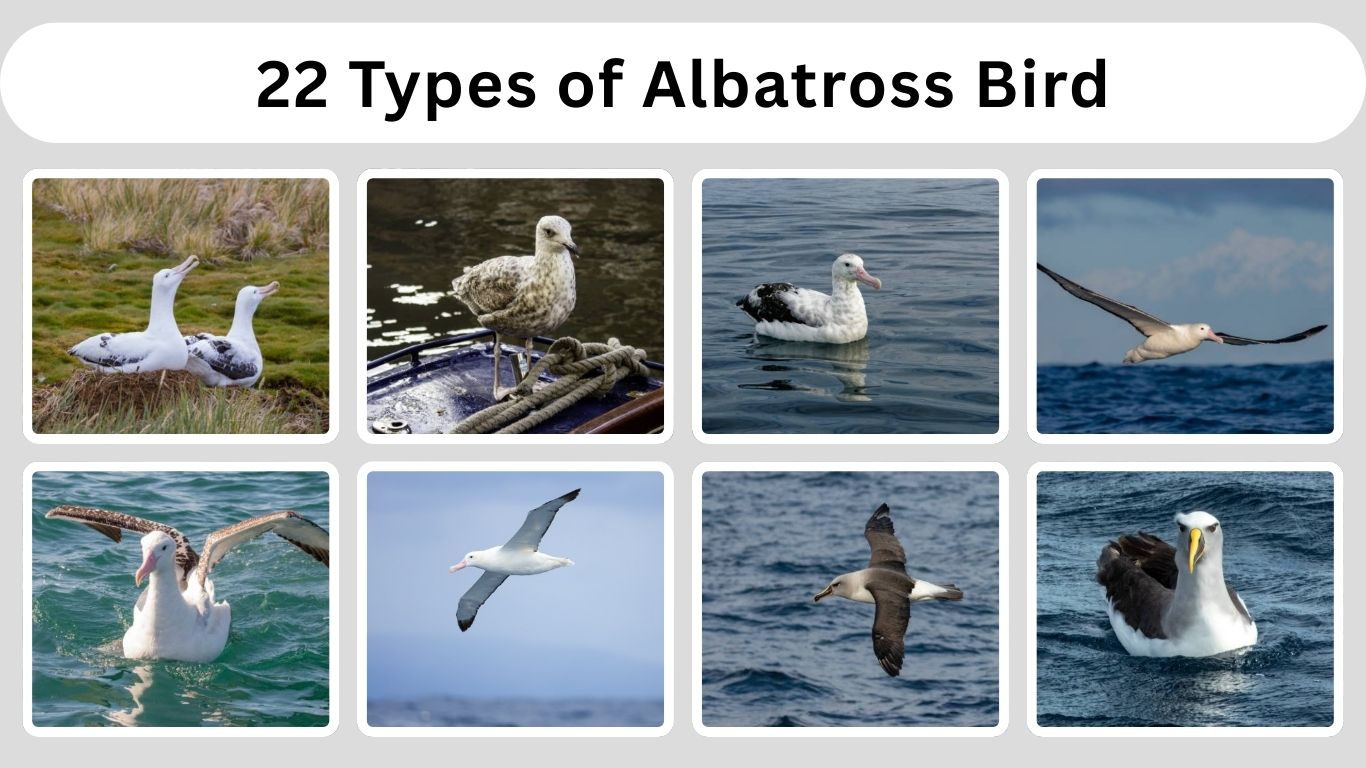
Albatrosses are among the most remarkable seabirds on Earth, famous for their enormous wingspans, graceful soaring flight, and ability to travel vast distances across open oceans. Found mainly in the Southern Ocean and the North Pacific, these birds spend most of their lives at sea, returning to remote islands only to breed. With slow breeding cycles and long lifespans, albatrosses symbolize endurance and ocean mastery, while also highlighting the growing need for marine conservation worldwide.
1. Wandering Albatross (Diomedea exulans)

The wandering albatross is one of the largest flying birds in the world, famous for its enormous wingspan and long-distance ocean travel. It spends most of its life gliding over the Southern Ocean, using wind currents to fly for hours with little effort. These birds are strong, slow breeders and return to remote islands to nest and raise a single chick.
Identification
- Size: Very large seabird; heavy-bodied with long, broad wings
- Wingspan: Extremely wide (among the widest of any bird)
- Color pattern: Mostly white body with black markings on the wings (varies by age and sex)
- Bill: Large, pale pink bill with a hooked tip
- Flight style: Smooth, effortless gliding close to the sea surface
Habitat
Wandering albatrosses live almost entirely over open ocean waters of the Southern Hemisphere. They are commonly seen around the Southern Ocean, especially in windy zones where soaring conditions are best, and they return to subantarctic islands for breeding.
Diet
Their diet mainly includes squid, fish, and other marine creatures found near the ocean surface. They often snatch prey while floating or during low flight, and they may also follow ships to pick up discarded fish or offal.
Nesting & Eggs
They breed on remote, windy islands and build a raised nest mound from soil, grass, and other vegetation. The female lays a single egg, and both parents take long turns incubating it while the other feeds at sea.
Behavior
Wandering albatrosses are expert gliders and can travel thousands of kilometers in a single foraging trip. They are generally quiet at sea but become more vocal and social at breeding colonies, using bill-clacking and displays to strengthen pair bonds.
2. Amsterdam Albatross (Diomedea amsterdamensis)
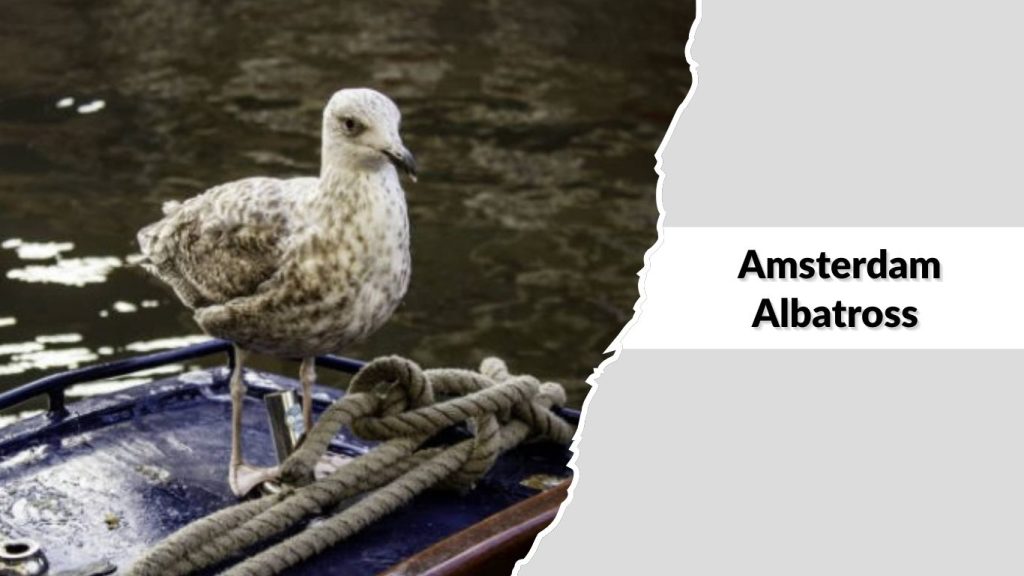
The Amsterdam albatross is one of the rarest albatross species in the world and is found only around Amsterdam Island in the southern Indian Ocean. It is a large, powerful seabird known for its long gliding flights and extremely limited breeding range. Because of its small population and restricted habitat, it is considered critically endangered.
Identification
- Size: Very large seabird with a heavy body
- Wingspan: Long and broad, built for soaring
- Color pattern: Mostly brown with lighter underparts; adults become paler with age
- Bill: Large, pale pink bill with a hooked tip
- Overall look: Similar to wandering albatross but darker and more compact
Habitat
The Amsterdam albatross spends most of its life over the open southern Indian Ocean. It breeds only on the Plateau des Tourbières of Amsterdam Island, making its nesting habitat one of the most restricted of any seabird.
Diet
Its diet mainly consists of squid, fish, and other marine organisms taken from the ocean surface. It often feeds by surface-seizing and may follow ships to scavenge discarded fish remains.
Nesting & Eggs
Breeding pairs build large nests from soil and vegetation in upland areas of Amsterdam Island. The female lays a single egg, and both parents share incubation duties over a long breeding cycle.
Behavior
Amsterdam albatrosses are strong, tireless gliders that travel vast distances over the ocean. They are mostly solitary at sea but form small, quiet colonies during the breeding season, where pairs perform gentle displays and calls.
3. Tristan Albatross (Diomedea dabbenena)
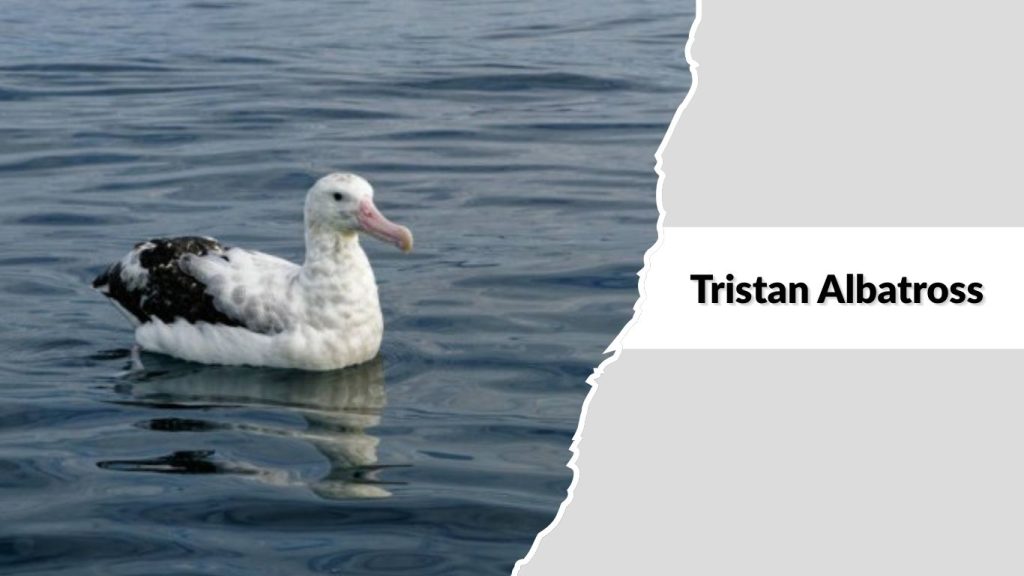
The Tristan albatross is a very large seabird closely related to the wandering albatross and is best known for its extremely limited breeding range. It nests mainly on Gough Island in the South Atlantic and spends most of its life gliding over vast ocean areas. Because of its small population and threats at breeding sites, it is considered a critically endangered species.
Identification
- Size: Very large, heavy-bodied seabird
- Wingspan: Extremely long and broad wings
- Color pattern: Mostly white body with black on the upper wings
- Bill: Large, pale pink bill with a strong hooked tip
- Overall look: Similar to wandering albatross but slightly darker wings
Habitat
Tristan albatrosses live almost entirely over the open South Atlantic Ocean. They breed on remote, windswept islands, especially Gough Island, where they choose high, open ground for nesting.
Diet
Their diet mainly includes squid, fish, and crustaceans picked from the sea surface. They may also scavenge fish waste from ships when available.
Nesting & Eggs
They build large mud-and-vegetation nests on elevated ground. The female lays a single egg, and both parents take long turns incubating and later feeding the chick.
Behavior
Tristan albatrosses are superb long-distance gliders, capable of crossing entire ocean basins. At breeding colonies, they perform ritualized displays, bill-clapping, and calls to maintain pair bonds.
4. Antipodean Albatross (Diomedea antipodensis)

The antipodean albatross is a massive oceanic bird closely related to the wandering albatross. It breeds mainly on the Antipodes Islands of New Zealand and spends most of its life soaring over the Southern Ocean. With its powerful wings and long lifespan, this species is built for extreme long-distance travel across open seas.
Identification
- Size: Very large seabird with a bulky body
- Wingspan: Extremely long and narrow, ideal for gliding
- Color pattern: Dark brown upperparts with white underparts; adult males become whiter with age
- Bill: Large, pale pink bill with a hooked tip
- Flight style: Long, stiff wings held straight while soaring
Habitat
Antipodean albatrosses are pelagic, living almost entirely over open ocean waters of the Southern Hemisphere. They return to remote subantarctic islands, especially the Antipodes Islands, to breed on open, windswept slopes.
Diet
They mainly feed on squid, fish, and other marine organisms taken from the ocean surface. They often forage alone, gliding low over the water and seizing prey without diving deeply.
Nesting & Eggs
Breeding pairs build raised nests from mud, grass, and plant material. The female lays a single egg, and both parents share the long incubation and chick-rearing duties.
Behavior
Antipodean albatrosses are long-distance travelers, often circling the Southern Ocean during feeding trips. At breeding sites, they form loose colonies and use bill-clacking and posturing displays to strengthen pair bonds.
5. Gibson’s Albatross (Diomedea gibsoni)
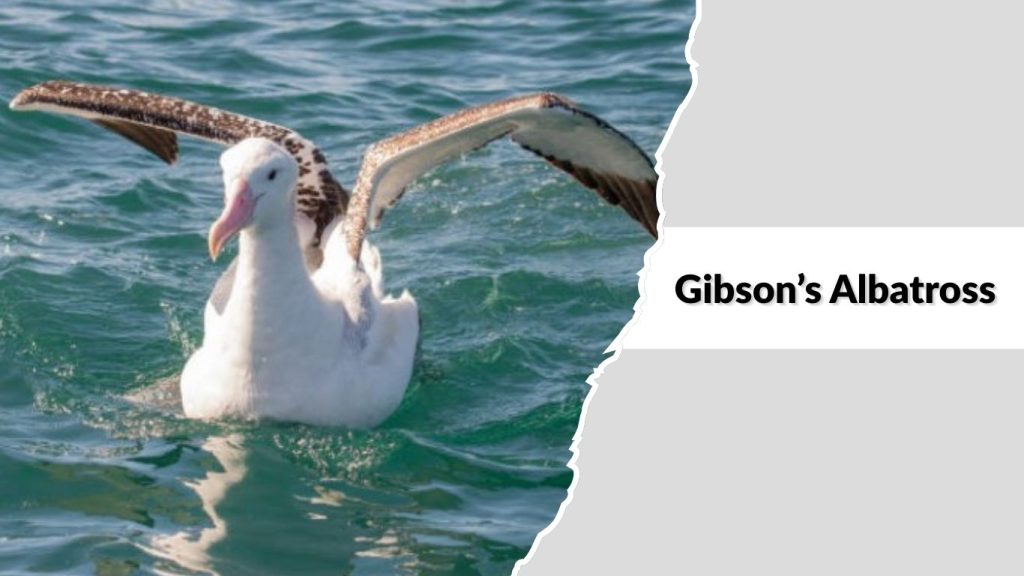
Gibson’s albatross is a very large seabird and a close relative of the wandering and antipodean albatrosses. It breeds mainly on the Auckland Islands south of New Zealand and spends most of its life gliding over the Southern Ocean. This powerful flier is known for its long lifespan, slow breeding cycle, and impressive wingspan.
Identification
- Size: Very large, heavy-bodied seabird
- Wingspan: Extremely long and broad
- Color pattern: Dark brown upperparts with white face and underparts
- Bill: Large, pale pink bill with a hooked tip
- Overall look: Robust albatross with strong shoulders and long wings
Habitat
Gibson’s albatross lives almost entirely over open southern oceans. During the breeding season, it nests on remote, windswept subantarctic islands, especially the Auckland Islands, where it chooses open slopes and plateaus.
Diet
Its diet mainly consists of squid, fish, and other marine animals found near the surface. It may also scavenge from fishing vessels when the opportunity arises.
Nesting & Eggs
The species builds a raised nest from soil, peat, and vegetation. The female lays one egg, and both parents share incubation and chick-feeding duties over a long breeding cycle.
Behavior
Gibson’s albatrosses are master gliders that can travel thousands of kilometers in a single journey. They are mostly solitary at sea but become social at breeding colonies, where pairs perform ritualized displays and calls.
6. Snowy Albatross (Diomedea exulans exulans)
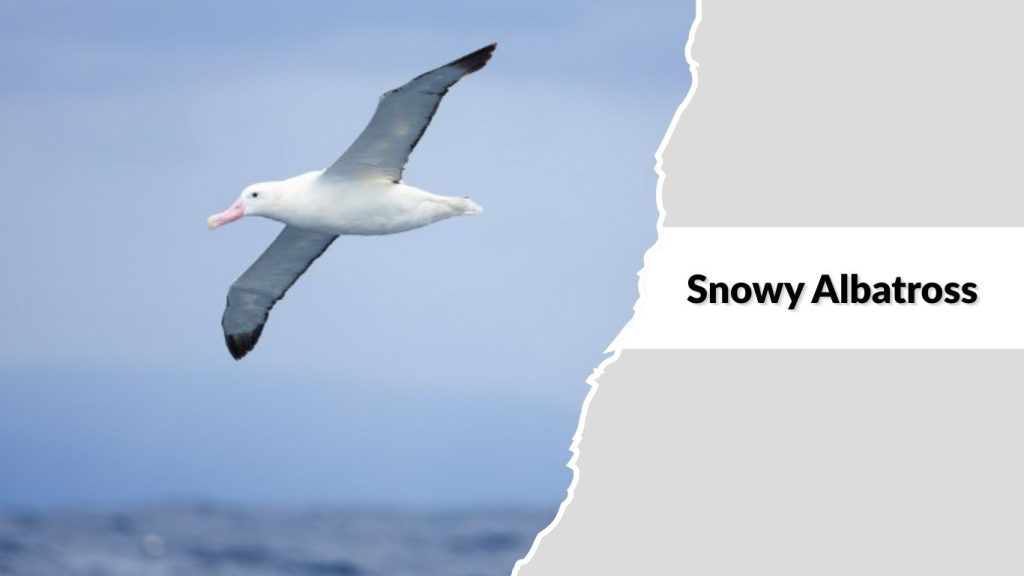
The snowy albatross is often considered the classic form of the wandering albatross and is named for its striking white plumage. It is among the largest flying birds on Earth and spends most of its life soaring over the cold, windy waters of the Southern Ocean. These birds are famous for their endurance and their ability to travel enormous distances with minimal effort.
Identification
- Size: Extremely large seabird with a heavy body
- Wingspan: Among the widest of any living bird
- Color pattern: Almost entirely white with narrow black edges on the wings
- Bill: Large, pale pink bill with a hooked tip
- Flight style: Long, effortless glides close to the sea surface
Habitat
Snowy albatrosses inhabit the open Southern Ocean, especially in cold, subantarctic and Antarctic waters. They return to remote, isolated islands to breed, choosing exposed, windy locations that support their soaring lifestyle.
Diet
Their diet mainly includes squid, fish, and other marine animals taken from the ocean surface. They are surface feeders and also scavenge floating carcasses or fish waste.
Nesting & Eggs
They build large nest mounds from soil, moss, and grasses. The female lays a single egg, and both parents take turns incubating it and later feeding the chick.
Behavior
Snowy albatrosses are tireless gliders capable of circling the Southern Ocean several times in a year. At breeding colonies, they perform slow, ritualized dances, bill-clacking, and vocal calls to reinforce long-term pair bonds.
7. Grey-headed Albatross (Thalassarche chrysostoma)
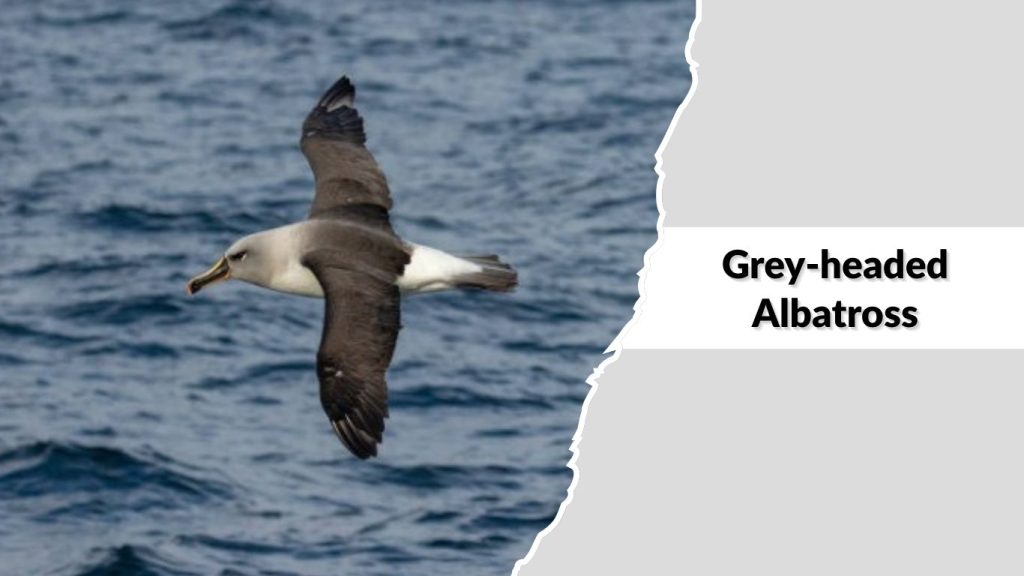
The grey-headed albatross is a large, fast-flying seabird known for its sleek build and striking head coloration. It is one of the most widespread albatrosses of the Southern Ocean, often seen gliding effortlessly over rough seas. This species is also one of the quickest of all birds, using strong winds to cover enormous distances.
Identification
- Size: Large seabird with a slim, powerful body
- Wingspan: Long, narrow wings adapted for fast soaring
- Color pattern: Grey head, white body, dark upper wings, black tail
- Bill: Yellow and orange bill with a darker tip
- Distinct feature: Dark eye stripe and contrasting grey head
Habitat
Grey-headed albatrosses live mainly over the open Southern Ocean, ranging from subantarctic to cool temperate waters. They breed on remote islands such as South Georgia, Prince Edward Islands, and parts of the New Zealand subantarctic region.
Diet
Their diet consists mostly of squid, fish, and krill. They feed by surface-seizing while in flight or sitting on the water and often follow fishing vessels to pick up scraps.
Nesting & Eggs
They build cone-shaped nests from mud, grass, and moss on steep slopes or cliffs. The female lays a single egg, and both parents share incubation and chick-rearing duties.
Behavior
Grey-headed albatrosses are powerful dynamic soarers and among the fastest flying birds on Earth. At breeding colonies, they are highly social, using head movements, calls, and bill-clacking displays to communicate and strengthen pair bonds.
8. Buller’s Albatross (Thalassarche bulleri)
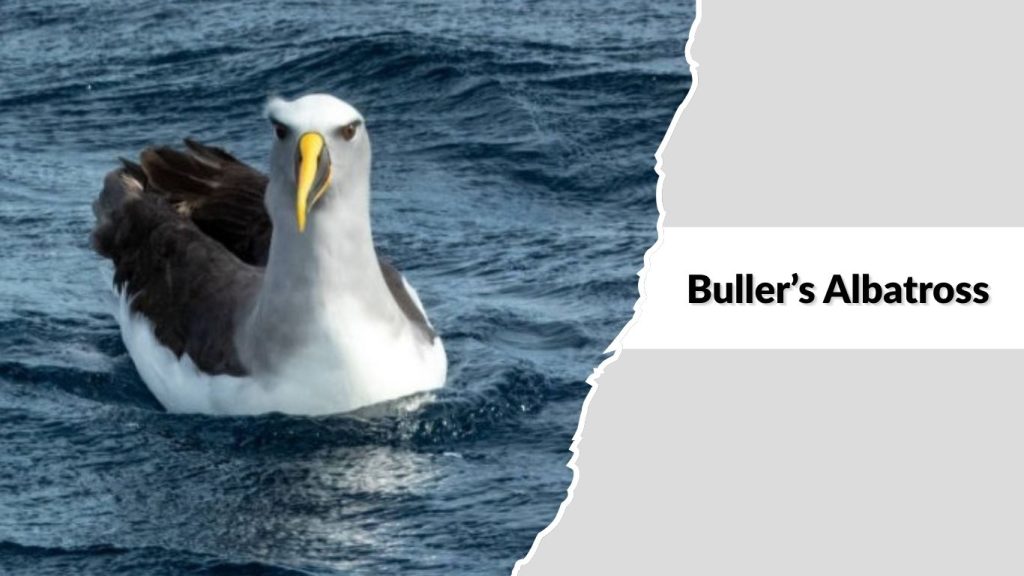
Buller’s albatross is a medium-sized albatross known for its elegant flight and striking facial markings. It breeds mainly around New Zealand and spends most of the year roaming the southern Pacific Ocean. This species is often seen gliding close to the sea surface, skillfully using wind currents to travel long distances with little effort.
Identification
- Size: Medium to large seabird with a slim body
- Wingspan: Long, narrow wings
- Color pattern: White head and body, black upper wings, dark tail
- Bill: Short, strong bill with yellow and black markings
- Face: Prominent dark eyebrow line and eye marking
Habitat
Buller’s albatross lives mainly over open ocean waters of the southern Pacific. It breeds on small islands near New Zealand, choosing steep slopes, ridges, and coastal cliffs for nesting.
Diet
Its diet mainly includes squid, small fish, and crustaceans. It usually feeds at the ocean surface and often gathers around fishing boats to scavenge discarded fish.
Nesting & Eggs
The nest is a low mound made of soil, grass, and plant material, usually placed on exposed ground. The female lays one egg, and both parents share incubation and chick-rearing duties.
Behavior
Buller’s albatrosses are graceful, agile flyers, frequently banking and gliding close to waves. At breeding sites, they perform ritualized head movements, calls, and bill-clacking to maintain strong pair bonds.
9. Black-browed Albatross (Thalassarche melanophris)
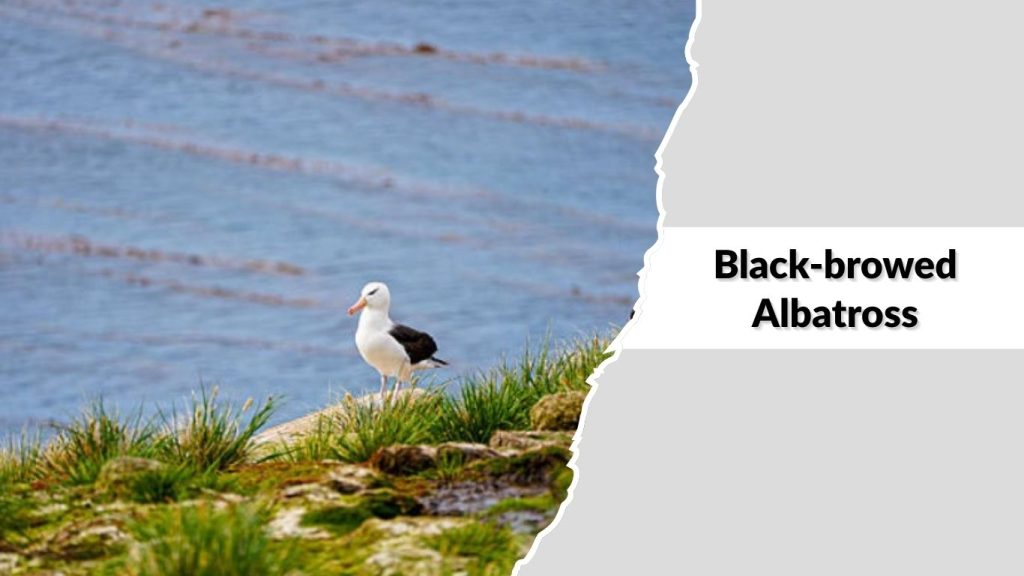
The black-browed albatross is one of the most common and widespread albatross species in the Southern Ocean. It is easily recognized by the dark eyebrow-like markings above its eyes. This powerful flier is often seen following ships and gliding low over the waves.
Identification
- Size: Medium to large seabird with a sturdy body
- Wingspan: Long, narrow wings
- Color pattern: White head and underparts, dark upper wings, black eyebrow stripe
- Bill: Strong yellow-orange bill with a darker tip
- Distinct feature: Bold black “brow” above each eye
Habitat
Black-browed albatrosses live across the Southern Ocean, from subantarctic to cool temperate waters. They breed in large colonies on rocky islands and coastal cliffs, especially around South Georgia, the Falkland Islands, and islands near New Zealand.
Diet
They mainly eat fish, squid, and krill. They feed at the ocean surface, by shallow plunges, and frequently scavenge behind fishing vessels.
Nesting & Eggs
They build sturdy mud-and-grass nests on cliffs, slopes, and flat coastal areas. The female lays one egg, and both parents share incubation and chick care.
Behavior
Black-browed albatrosses are energetic flyers, often circling ships and competing for food scraps. At colonies, they are noisy and social, using head displays, calls, and bill-clapping to communicate.
10. Campbell Albatross (Thalassarche impavida)
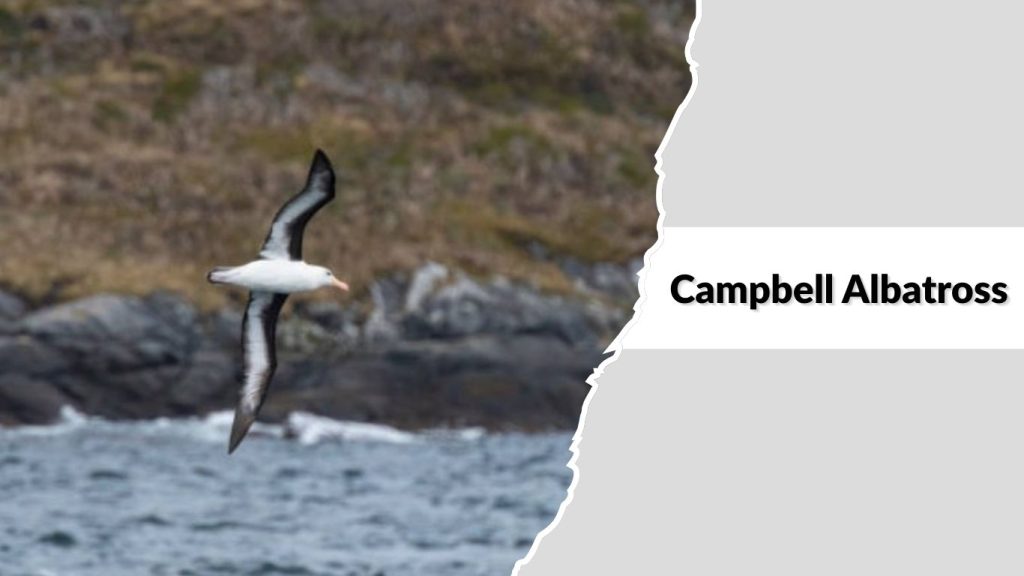
The Campbell albatross is a large seabird closely related to the black-browed albatross and is known for its bold facial markings and strong, direct flight. It breeds almost entirely on Campbell Island south of New Zealand and spends most of its life ranging widely over the Southern Ocean.
Identification
- Size: Medium to large albatross with a solid build
- Wingspan: Long, narrow wings
- Color pattern: White head and body, dark upper wings, broad black eyebrow
- Bill: Yellow bill with an orange tip
- Distinct feature: Thick black brow and pale grey face
Habitat
Campbell albatrosses live mainly over open southern oceans. They breed on coastal slopes and cliffs of Campbell Island, where strong winds provide ideal soaring conditions.
Diet
Their diet consists mainly of fish, squid, and krill captured at or near the ocean surface. They may also follow fishing vessels to scavenge food.
Nesting & Eggs
They build raised nests from mud, grass, and vegetation on open ground. The female lays a single egg, and both parents share long incubation and chick-feeding duties.
Behavior
Campbell albatrosses are powerful, direct flyers, often seen gliding low over waves. At breeding colonies, they perform ritualized displays involving bill-touching, head shaking, and calls.
11. Chatham Albatross (Thalassarche eremita)
The Chatham albatross is a large seabird with an extremely restricted breeding range, nesting almost entirely on a small rocky outcrop called The Pyramid near the Chatham Islands of New Zealand. Despite this tiny breeding area, it spends most of its life roaming the open southern Pacific Ocean.
Identification
- Size: Medium to large albatross with a sturdy body
- Wingspan: Long, narrow wings
- Color pattern: White head and underparts, dark upper wings, dark eye markings
- Bill: Bright yellow bill with a dark tip
- Distinct feature: Strongly contrasting bill and dark facial shading
Habitat
Chatham albatrosses live mainly over open ocean waters of the South Pacific. They breed only on steep, rocky stacks, choosing narrow ledges and exposed slopes for nesting.
Diet
They mainly feed on fish, squid, and marine invertebrates taken from the surface. They may also scavenge fish waste from fishing boats.
Nesting & Eggs
The nest is a tall cone of mud and plant material built on rock ledges. The female lays a single egg, and both parents take turns incubating and feeding the chick.
Behavior
Chatham albatrosses are strong soarers that travel vast distances. At breeding sites, they are highly vocal and social, performing ritualized head movements, calls, and bill-clapping displays.
12. Indian Yellow-nosed Albatross (Thalassarche carteri)
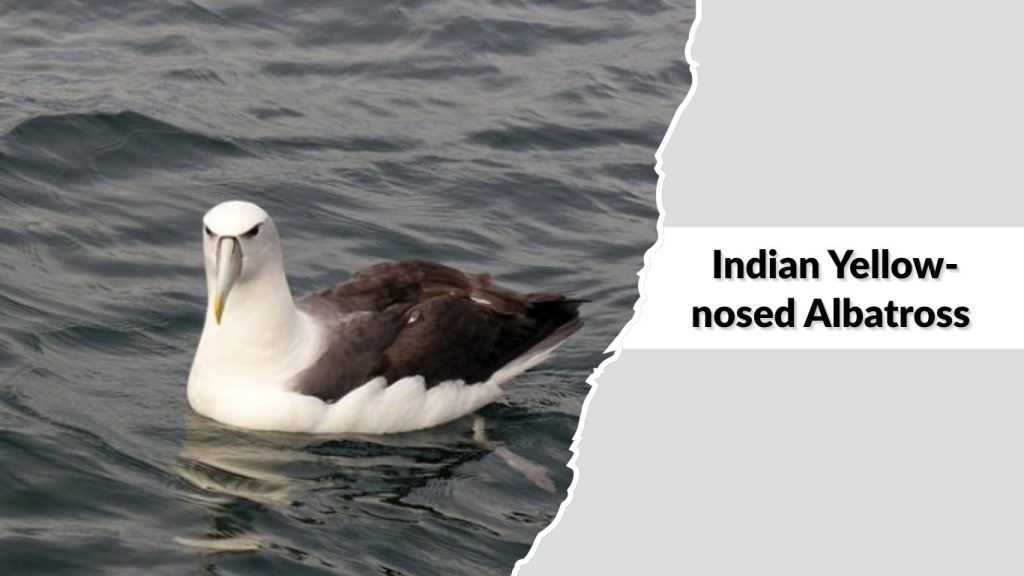
The Indian yellow-nosed albatross is a medium-sized albatross recognized by its sleek build and bright yellow stripe running along the top of its bill. It breeds on remote islands in the southern Indian Ocean and spends most of its life gliding over open waters.
Identification
- Size: Medium-sized albatross with a slim body
- Wingspan: Long, narrow wings
- Color pattern: White head and body, dark upper wings, grey shading on face
- Bill: Black bill with a bright yellow stripe and pinkish tip
- Distinct feature: Yellow line along the upper bill
Habitat
This species lives mainly over the southern Indian Ocean, from subtropical to subantarctic waters. It breeds on islands such as Amsterdam, St Paul, and the Prince Edward Islands, nesting on cliffs and open slopes.
Diet
Its diet includes squid, fish, and crustaceans captured at the ocean surface. It often follows ships and fishing vessels to scavenge food.
Nesting & Eggs
They build mud-and-grass nests on open ground or cliffs. The female lays a single egg, and both parents share incubation and chick-feeding duties.
Behavior
Indian yellow-nosed albatrosses are agile, fast flyers, frequently gliding low over waves. At colonies, they perform ritualized displays, bill-touching, and vocal calls to maintain pair bonds.
13. Atlantic Yellow-nosed Albatross (Thalassarche chlororhynchos)
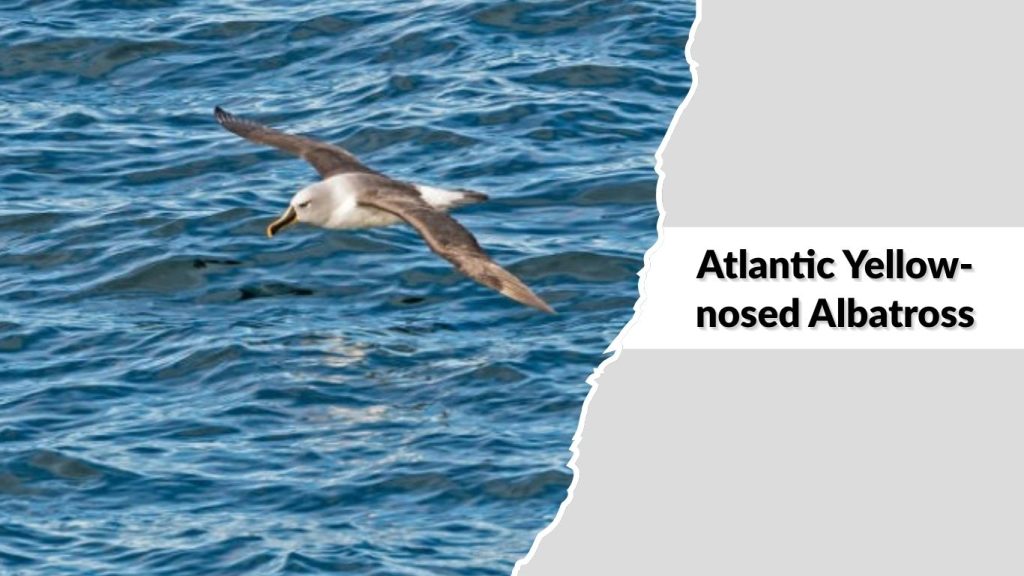
The Atlantic yellow-nosed albatross is a medium-sized seabird best known for the bright yellow stripe that runs along its dark bill. It breeds on a few remote islands in the South Atlantic and spends most of its life soaring over open ocean waters.
Identification
- Size: Medium-sized albatross with a slim, streamlined body
- Wingspan: Long, narrow wings
- Color pattern: White head and body, dark upper wings, light grey facial shading
- Bill: Black bill with a bright yellow stripe and pink tip
- Distinct feature: Bold yellow line along the upper bill
Habitat
Atlantic yellow-nosed albatrosses range widely over the South Atlantic Ocean. They breed mainly on islands such as Tristan da Cunha and Gough Island, nesting on cliffs and open slopes.
Diet
They feed mostly on squid, fish, and small marine animals taken from the surface. They may also scavenge behind fishing vessels.
Nesting & Eggs
They build raised nests from mud and vegetation. The female lays a single egg, and both parents share incubation and chick care.
Behavior
These albatrosses are swift, graceful flyers, often gliding low over the waves. At breeding colonies, they perform ritualized head movements, bill-touching, and calling displays.
14. Salvin’s Albatross (Thalassarche salvini)
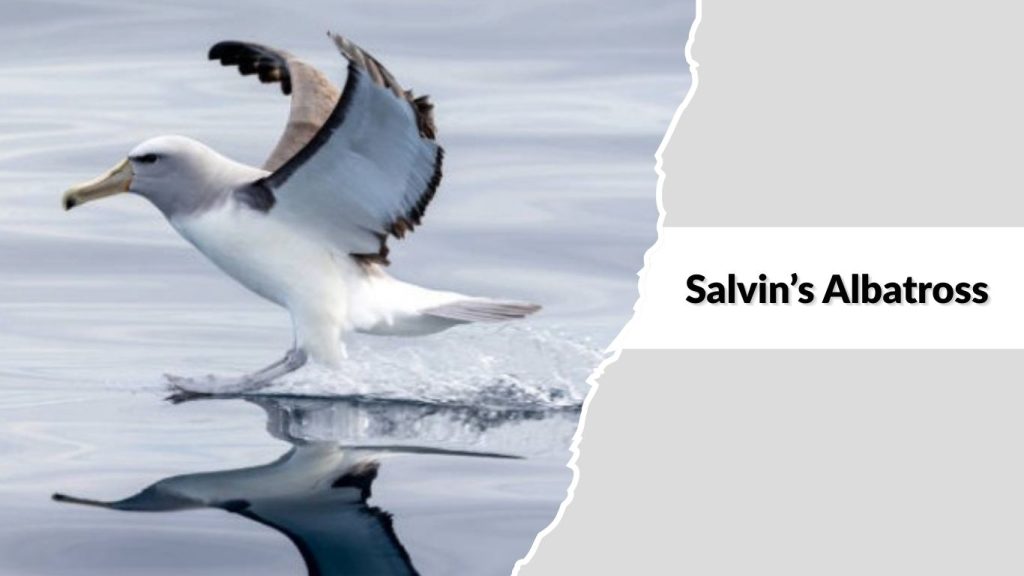
Salvin’s albatross is a large seabird of the Southern Ocean, closely related to the shy and white-capped albatrosses. It is a powerful flier that spends most of its life over open waters and returns to remote islands near New Zealand to breed.
Identification
- Size: Medium to large albatross with a strong build
- Wingspan: Long, narrow wings
- Color pattern: Grey head, white body, dark upper wings, black tail
- Bill: Grey-green bill with a pale tip
- Distinct feature: Clean grey head contrasting with white body
Habitat
Salvin’s albatross lives mainly over the southern Pacific and southern Indian oceans. It breeds on rocky islands such as the Bounty and Snares Islands, choosing steep slopes and cliff areas.
Diet
Its diet consists mainly of fish, squid, and marine invertebrates. It feeds at the surface and frequently follows fishing vessels to scavenge.
Nesting & Eggs
They build cone-shaped nests from mud, grass, and plant material on open slopes. The female lays one egg, and both parents share incubation and chick-feeding duties.
Behavior
Salvin’s albatrosses are strong, fast soarers that can travel enormous distances. At colonies, they engage in ritualized displays, head movements, and vocal calls to reinforce pair bonds.
15. White-capped Albatross (Thalassarche steadi)
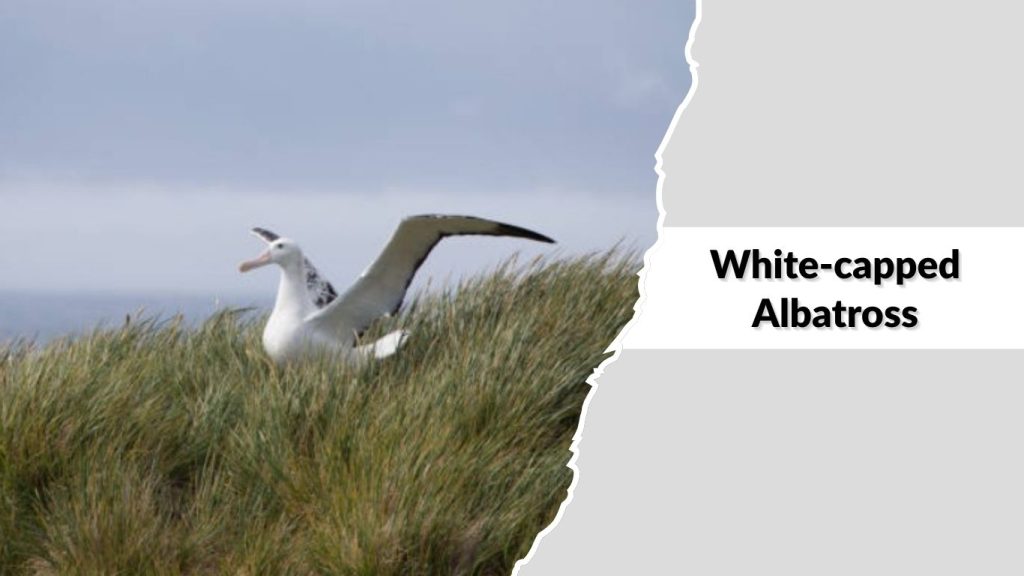
The white-capped albatross is a large seabird named for the pale crown on its head. It breeds mainly on islands south of New Zealand and is often seen gliding over cool southern oceans. This species is one of the most frequently observed albatrosses around fishing vessels.
Identification
- Size: Medium to large albatross with a solid body
- Wingspan: Long, narrow wings
- Color pattern: Light grey head with a white crown, white underparts, dark upper wings
- Bill: Pale grey bill with a pinkish tip
- Distinct feature: Whitish crown contrasting with grey face
Habitat
White-capped albatrosses live mainly over the southern Pacific and southern Indian oceans. They breed on subantarctic islands such as the Auckland Islands, nesting on open slopes and ridges.
Diet
They feed mostly on fish, squid, and crustaceans taken from the surface. They frequently follow fishing boats and trawlers to scavenge discarded fish.
Nesting & Eggs
They build raised nests from mud and vegetation on open ground. The female lays a single egg, and both parents share incubation and chick-feeding duties.
Behavior
White-capped albatrosses are strong, confident flyers and often gather in large numbers behind fishing vessels. At breeding sites, they perform ritualized displays with head movements, calls, and bill-touching.
16. Shy Albatross (Thalassarche cauta)
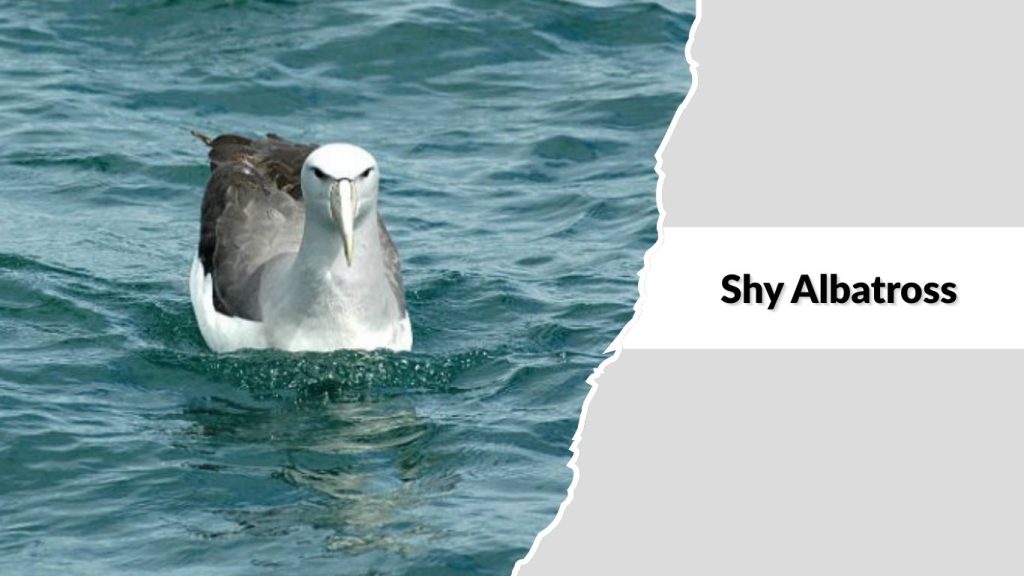
The shy albatross is a large seabird native mainly to Australian waters and nearby parts of the Southern Ocean. It is named for its relatively gentle behavior at breeding colonies and is easily recognized by its pale head and dark wings. This species spends most of its life gliding over open seas.
Identification
- Size: Medium to large albatross with a solid, compact body
- Wingspan: Long, narrow wings
- Color pattern: White head and underparts, dark upper wings, black tail
- Bill: Yellowish bill with a darker tip
- Distinct feature: Clean white face with dark eye shading
Habitat
Shy albatrosses live mainly over the southern Australian continental shelf and nearby ocean waters. They breed on only a few islands, especially Albatross Island off Tasmania, nesting on coastal slopes and cliff tops.
Diet
Their diet consists mainly of fish, squid, and crustaceans. They feed mostly at the surface and often follow fishing vessels to scavenge.
Nesting & Eggs
They build mud-and-vegetation nests on exposed ground near the sea. The female lays a single egg, and both parents share incubation and chick-feeding.
Behavior
Shy albatrosses are graceful soarers, often seen gliding close to waves. At colonies, they perform ritualized courtship displays including bill-touching, head shaking, and soft calls.
17. Laysan Albatross (Phoebastria immutabilis)
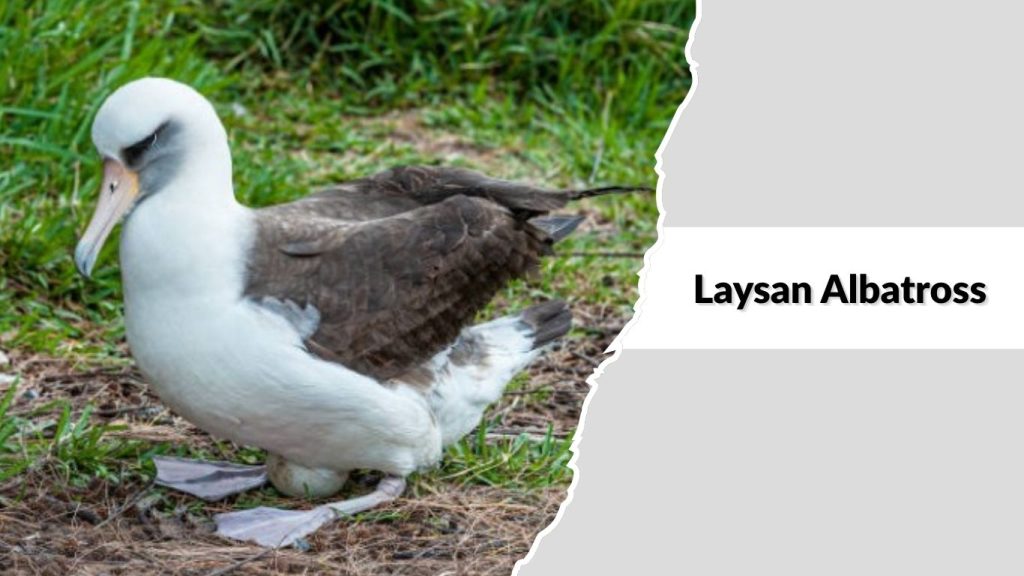
The Laysan albatross is one of the most common North Pacific albatross species and is well known for breeding in huge colonies on the Hawaiian Islands. It is a graceful flier that can spend years at sea without touching land, returning only to breed.
Identification
- Size: Medium to large albatross with a slim body
- Wingspan: Long, narrow wings
- Color pattern: White head and body, dark upper wings, dark eye patch
- Bill: Pale pink bill with a darker tip
- Distinct feature: Smudgy dark markings around the eyes
Habitat
Laysan albatrosses range widely across the North Pacific Ocean. They breed mainly on low, sandy islands, especially in the Northwestern Hawaiian Islands, nesting in open areas close to the sea.
Diet
They feed mostly on squid, fish, and crustaceans captured at the ocean surface. Floating fish eggs and scraps from fishing vessels are also part of their diet.
Nesting & Eggs
They make simple ground nests, often just shallow scrapes lined with vegetation. The female lays one egg, and both parents take turns incubating and feeding the chick.
Behavior
Laysan albatrosses are elegant dynamic soarers and famous for their elaborate courtship dances, which include bill clacking, head shaking, and sky-pointing displays.
18. Black-footed Albatross (Phoebastria nigripes)
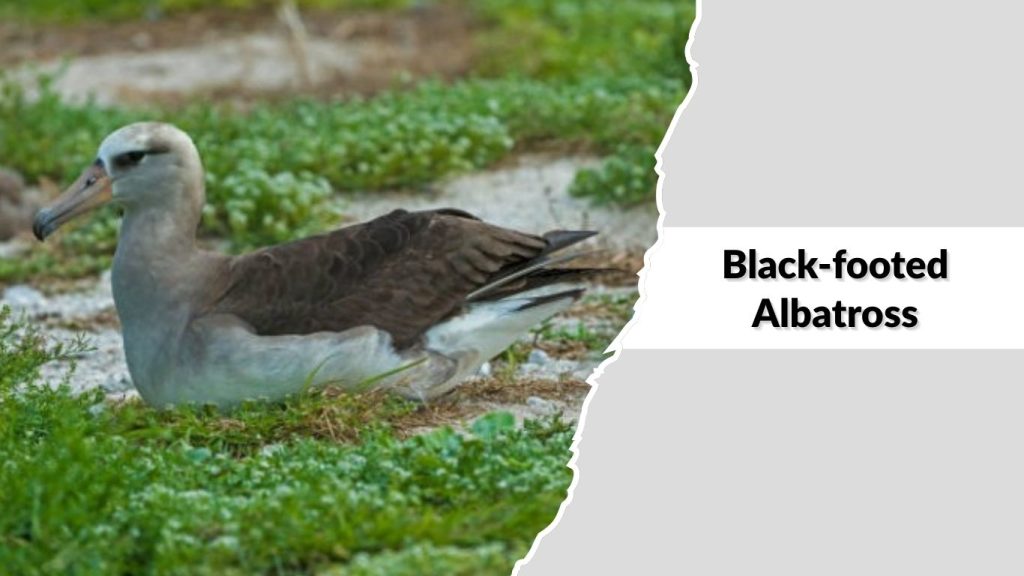
The black-footed albatross is a North Pacific species known for its dark plumage and long, narrow wings. It breeds mainly in the Hawaiian Islands and ranges widely across the North Pacific Ocean, often following ships and fishing fleets.
Identification
- Size: Medium to large albatross with a slim, powerful body
- Wingspan: Long and narrow
- Color pattern: Dark brown body with lighter areas near the face
- Bill: Large, dark bill with a pale tip
- Distinct feature: Dark feet and mostly dark plumage
Habitat
Black-footed albatrosses live across the open North Pacific, from subtropical to temperate waters. They breed on low, sandy islands and atolls, especially in the Northwestern Hawaiian Islands.
Diet
They mainly eat squid, fish, fish eggs, and crustaceans taken from the surface. They frequently scavenge behind fishing vessels.
Nesting & Eggs
They build simple ground nests of sand and sparse vegetation. The female lays one egg, and both parents share incubation and chick care.
Behavior
Black-footed albatrosses are strong, confident flyers, often seen gliding behind ships. At breeding colonies, they perform ritualized courtship displays involving bill-touching and calls.
19. Short-tailed Albatross (Phoebastria albatrus)
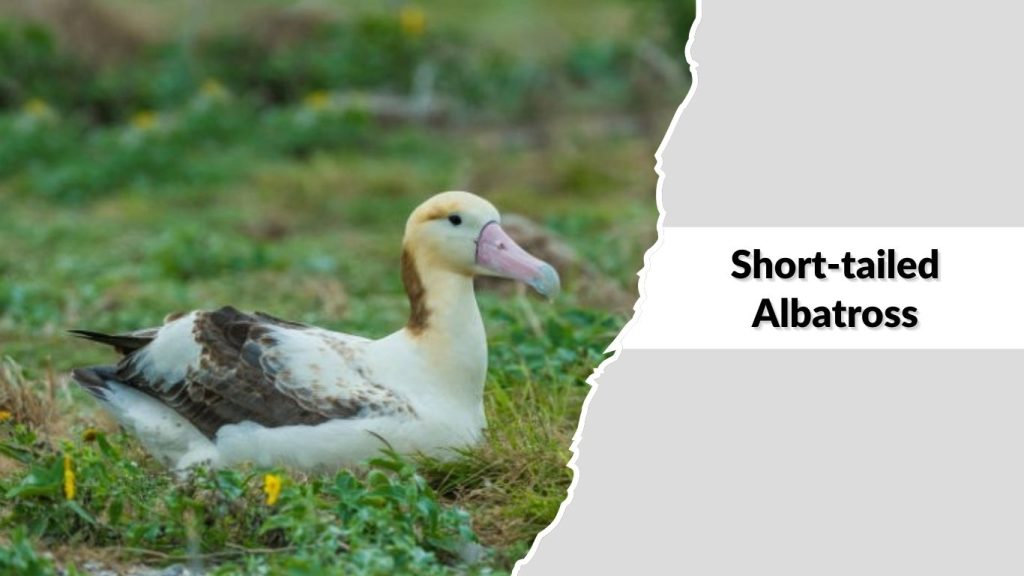
The short-tailed albatross is one of the rarest albatross species and is best known for its large size, powerful bill, and conservation comeback after near extinction. It breeds mainly on remote Japanese islands and ranges widely across the North Pacific Ocean.
Identification
- Size: Large, heavy-bodied albatross
- Wingspan: Very long and broad
- Color pattern: Mostly white body with black wings; adults have a golden-yellow head
- Bill: Massive pink bill with a hooked tip
- Distinct feature: Thick bill and golden head in adults
Habitat
Short-tailed albatrosses live mainly over the open North Pacific. They breed on isolated volcanic islands such as Torishima, nesting on open slopes and ridges.
Diet
They feed mostly on squid, fish, and other marine animals taken from the surface. They also scavenge floating carrion and fishing waste.
Nesting & Eggs
They build ground nests from sand, soil, and vegetation. The female lays a single egg, and both parents take turns incubating and feeding the chick.
Behavior
Short-tailed albatrosses are powerful soarers that can travel thousands of kilometers. At breeding colonies, they perform slow, ritualized courtship displays with bill-touching, head movements, and calls.
20. Waved Albatross (Phoebastria irrorata)
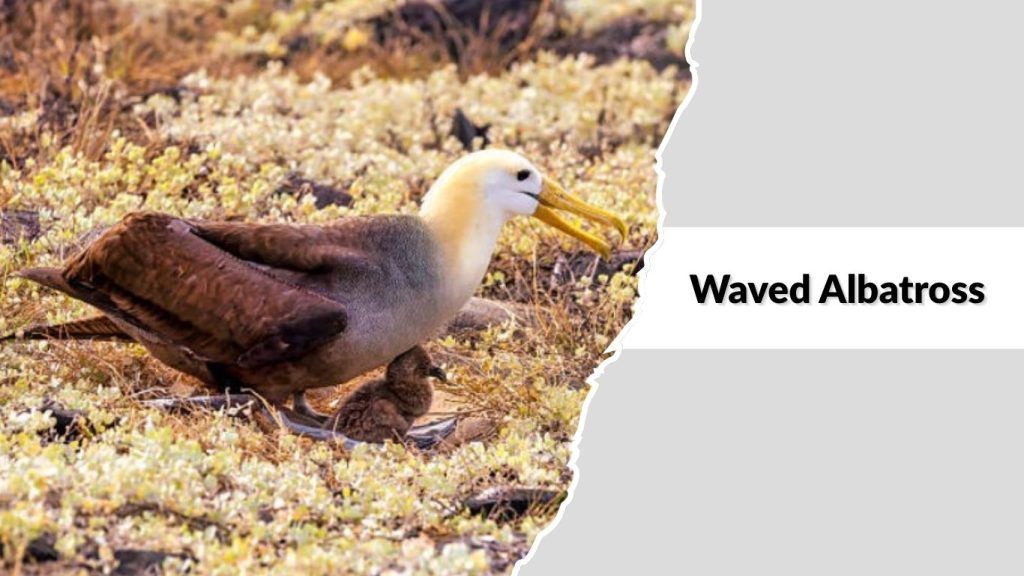
The waved albatross is the only albatross species found in the tropics and is best known for breeding almost exclusively on Española Island in the Galápagos. It is named for the fine wave-like pattern on its feathers and is famous for its dramatic courtship displays.
Identification
- Size: Medium to large albatross with a sturdy body
- Wingspan: Long, narrow wings
- Color pattern: Creamy head and neck, brown body, finely barred (wavy) markings
- Bill: Long yellow bill
- Distinct feature: Pale head with subtle wave-like feather pattern
Habitat
Waved albatrosses live mainly over warm waters of the eastern tropical Pacific. They breed on low, rocky ground in the Galápagos Islands, nesting in open areas.
Diet
They mainly eat squid and fish, especially prey associated with cold upwelling currents. They feed by surface-seizing and shallow plunges.
Nesting & Eggs
They build simple nests on bare ground. The female lays one egg, and both parents share incubation and chick care.
Behavior
Waved albatrosses are famous for elaborate courtship rituals that include bill fencing, head nodding, and loud calls. They are strong gliders, adapted to both tropical and open-ocean conditions.
21. Sooty Albatross (Phoebetria fusca)
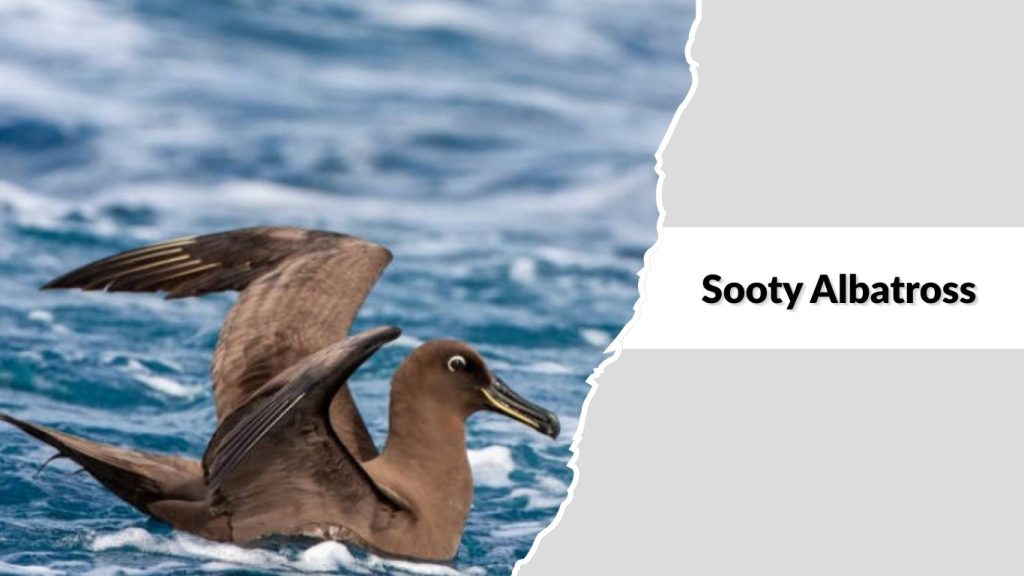
The sooty albatross is a sleek, dark-colored albatross known for its narrow wings and fast, agile flight. It spends most of its life over the open Southern Ocean and breeds on steep, remote islands.
Identification
- Size: Medium-sized albatross with a slim body
- Wingspan: Long, narrow wings
- Color pattern: Dark brown to sooty-black overall with paler facial areas
- Bill: Slender black bill with a pale blue groove
- Distinct feature: Dark plumage and sharp, scythe-like wings
Habitat
Sooty albatrosses range widely across the Southern Ocean. They breed on steep cliffs and rocky islands in subantarctic regions, nesting in crevices and ledges.
Diet
They mainly eat squid, fish, and other small marine animals taken from the surface or during shallow plunges.
Nesting & Eggs
They build simple nests in rock hollows or on cliff ledges. The female lays a single egg, and both parents share incubation and chick-feeding.
Behavior
Sooty albatrosses are fast, agile flyers, often gliding high above waves. At breeding sites, they are territorial and perform ritualized displays to defend nesting areas.
22. Light-mantled Albatross (Phoebetria palpebrata)
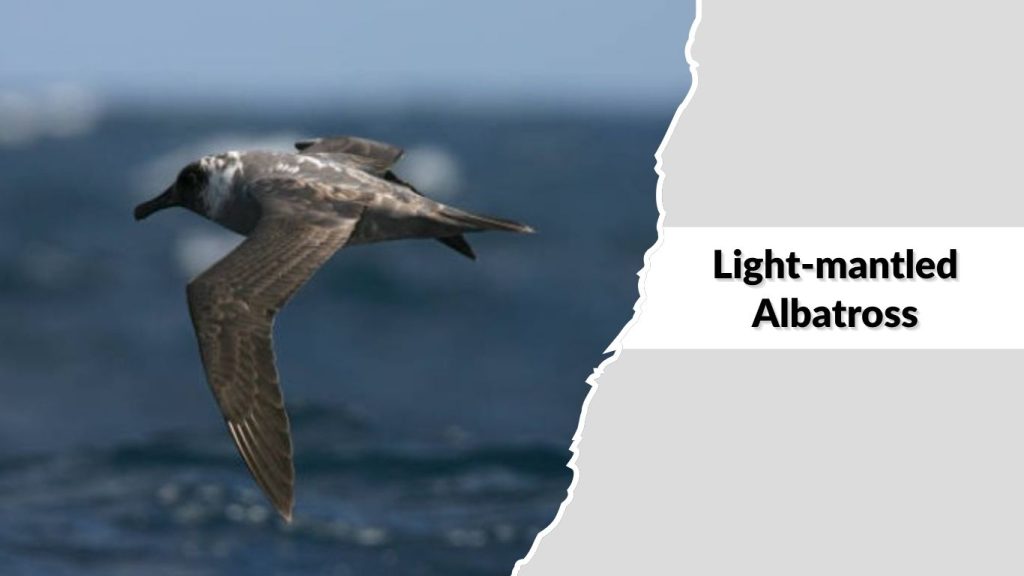
The light-mantled albatross is one of the most elegant albatross species, known for its smoky-grey back and very long, narrow wings. It ranges widely across the Southern Ocean and is often seen soaring effortlessly over cold, windy seas. This species is admired for its graceful flight and streamlined shape.
Identification
- Size: Medium-sized albatross with a slim, streamlined body
- Wingspan: Very long, narrow wings
- Color pattern: Pale grey back and mantle, dark wings, white facial markings
- Bill: Slender dark bill with a bluish groove
- Distinct feature: Light grey mantle contrasting with dark wings
Habitat
Light-mantled albatrosses live almost entirely over the open Southern Ocean, especially in subantarctic and Antarctic waters. They breed on remote, steep islands and rocky cliffs where strong winds aid their takeoff.
Diet
They mainly feed on squid, fish, and krill taken from the ocean surface. They often forage alone, gliding long distances between feeding opportunities.
Nesting & Eggs
They nest on narrow cliff ledges and rocky slopes, building small nests from mud, moss, and plant material. The female lays a single egg, and both parents share incubation and chick-feeding duties.
Behavior
Light-mantled albatrosses are superb, fast gliders with a buoyant flight style. At breeding sites, they are quiet and discreet, using subtle displays and calls to maintain pair bonds.
FAQs
What is the largest species of albatross?
The wandering albatross is the largest albatross species and also has the widest wingspan of any living bird. Some individuals reach wingspans over 3.5 meters, allowing them to glide effortlessly for hours over the Southern Ocean with minimal wing flapping.
Where do albatrosses usually live?
Albatrosses spend most of their lives over open oceans, especially in the Southern Ocean and the North Pacific. They only come to land to breed, choosing remote, windy islands and coastal cliffs where they are safe from most predators.
How long do albatrosses live?
Albatrosses are among the longest-living birds in the world. Many species regularly live 40 to 60 years, and some individuals have been recorded living even longer. They grow slowly and usually take several years before breeding for the first time.
What do albatrosses mainly eat?
Albatrosses mainly feed on squid, fish, krill, and other marine animals found near the ocean surface. They often seize prey while gliding low over the water and may also scavenge floating carrion or fish waste from fishing vessels.
Why are many albatross species endangered?
Many albatross species are threatened due to accidental capture in longline fisheries, plastic pollution, and habitat disturbance at breeding sites. Their slow breeding rate makes populations especially vulnerable, since most pairs raise only one chick every one to two years.