



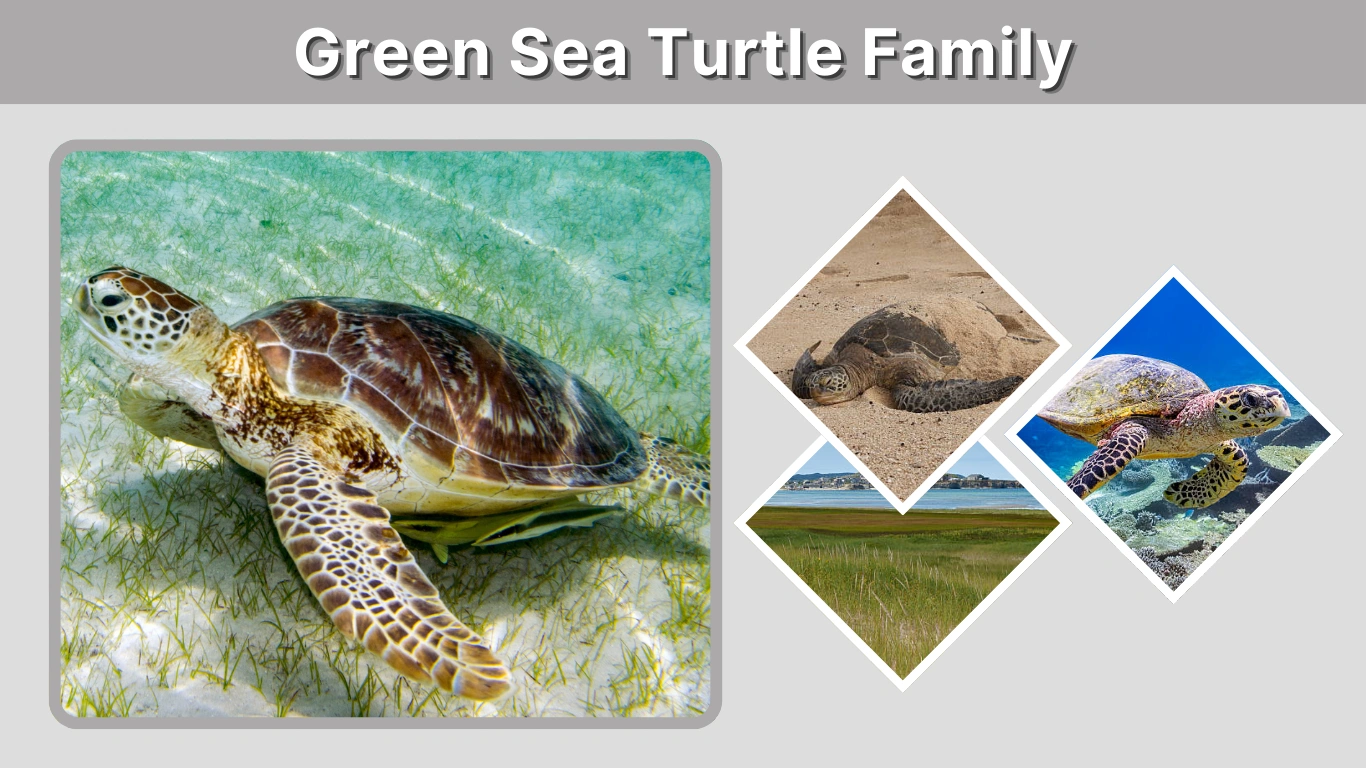
The green sea turtle family refers to the group of hard-shelled sea turtles that share close biological relationships and similar physical traits. Although many people think only of the green sea turtle itself, it actually belongs to a broader family that includes loggerheads, hawksbills, ridleys, and flatbacks. Learning about the green sea turtle family helps explain how these ancient reptiles evolved, how they are classified, and why nearly all of them now need conservation protection.
What Is the Green Sea Turtle Family?
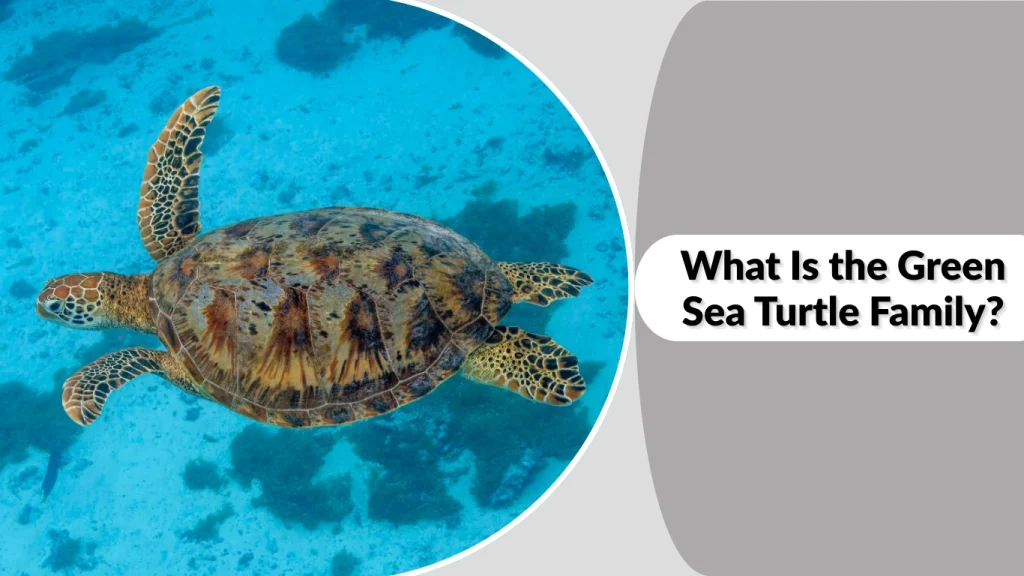
In biology, a “family” is a classification level used to group closely related animals that share common ancestors and major characteristics. The green sea turtle is part of a family known as Cheloniidae, which includes most of the world’s hard-shelled sea turtles.
This family is different from the leatherback turtle family, which has only one living species. Members of the green sea turtle family have solid shells, paddle-shaped flippers, and similar reproductive behaviors. Understanding this family connection helps scientists study turtle evolution, migration patterns, and conservation needs.
Green Sea Turtle Scientific Classification
The green sea turtle belongs to the following scientific groups:
- Kingdom: Animalia
- Phylum: Chordata
- Class: Reptilia
- Order: Testudines
- Family: Cheloniidae
- Genus: Chelonia
- Species: Chelonia mydas
Within Cheloniidae, the green sea turtle is unique for its largely plant-based adult diet, but it still shares many traits with its close relatives.
Cheloniidae – The Green Sea Turtle Family Group
Cheloniidae is the family that contains six of the world’s seven living sea turtle species. These turtles are often called “hard-shelled” sea turtles because they have a firm bony carapace covered by scutes.
Members of this family share streamlined bodies, powerful front flippers, and the ability to migrate vast distances. They breathe air, lay eggs on land, and return to the sea for feeding and growth. Compared to leatherback turtles, Cheloniidae species have shorter necks, more rigid shells, and different feeding adaptations.
Species in the Green Sea Turtle Family

The green sea turtle family includes several well-known sea turtle species, all of which belong to Cheloniidae.
- Green sea turtle (Chelonia mydas) – Herbivorous as an adult, found worldwide in warm seas.
- Loggerhead sea turtle (Caretta caretta) – Known for its large head and powerful jaws.
- Hawksbill sea turtle (Eretmochelys imbricata) – Recognized by its pointed beak and patterned shell.
- Flatback sea turtle (Natator depressus) – Restricted mostly to Australian waters.
- Kemp’s ridley sea turtle (Lepidochelys kempii) – The rarest sea turtle species.
- Olive ridley sea turtle (Lepidochelys olivacea) – Famous for mass nesting events called arribadas.
Although each species has unique features, all share core anatomical and reproductive traits that define the green sea turtle family group.
Key Characteristics of the Green Sea Turtle Family
Members of the green sea turtle family have evolved special adaptations that allow them to survive in marine environments. Their shells are streamlined to reduce water resistance, helping them swim efficiently across oceans. Their front flippers are long and powerful, acting like wings that propel them through the water.
They also possess salt glands near their eyes, allowing them to drink seawater and excrete excess salt. Their lungs are adapted to store large amounts of oxygen, enabling long dives. All Cheloniidae species lay eggs on sandy beaches, and hatchlings instinctively move toward the ocean after emerging.
Evolution of the Green Sea Turtle Family
The ancestors of the green sea turtle family appeared more than 100 million years ago, during the time of the dinosaurs. Early marine turtles gradually evolved flatter bodies, stronger flippers, and lighter shells, making them better suited for life in the ocean.
Fossil evidence shows that Cheloniidae turtles developed hard shells and feeding specializations that allowed them to exploit a wide range of marine food sources. Over millions of years, this family diversified into different species adapted for coral reefs, coastal shelves, and open-ocean migration.
Unlike leatherback turtles, which evolved a leathery shell and deep-diving abilities, the green sea turtle family retained bony shells and specialized more toward coastal and surface-water habitats.
Habitat and Global Distribution of the Green Sea Turtle Family
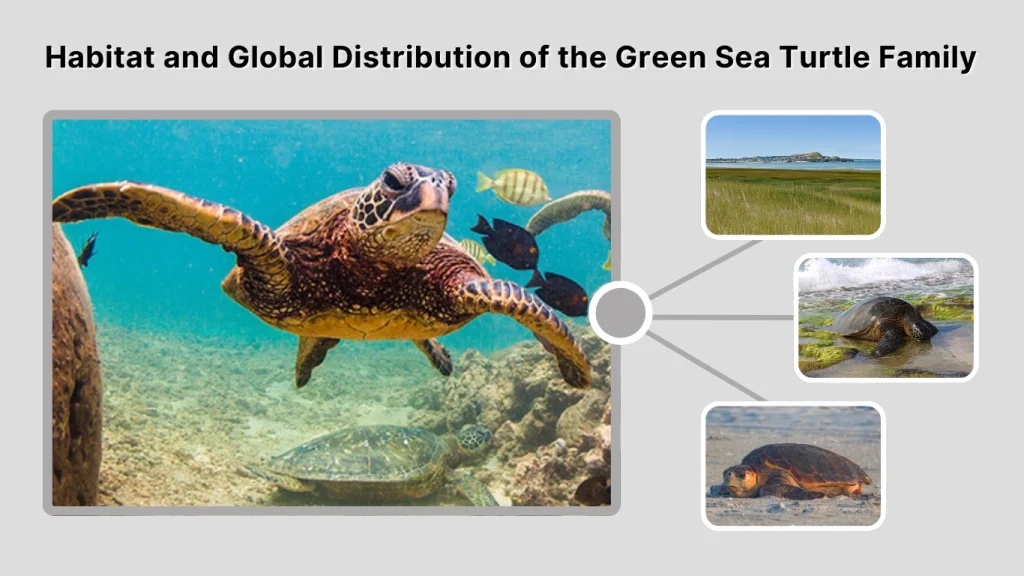
Members of the green sea turtle family live mainly in tropical and subtropical oceans around the world. They are found in the Atlantic, Pacific, and Indian Oceans, using coral reefs, seagrass meadows, lagoons, and coastal shelves as feeding grounds.
Nesting occurs on sandy beaches, often on remote islands or undeveloped coastlines. Many species migrate thousands of kilometers between feeding and nesting sites, showing remarkable navigation skills.
Diet Patterns Within the Green Sea Turtle Family
Although closely related, species within the green sea turtle family have developed different feeding strategies.
- Some species are mainly herbivorous as adults, feeding on seagrass and algae.
- Others are omnivorous or carnivorous, eating jellyfish, crabs, mollusks, and sponges.
- Juveniles of all species usually eat a wider variety of foods before specializing as adults.
- These feeding habits help control marine populations and maintain ecosystem balance.
Life Cycle Traits Shared by the Green Sea Turtle Family
All members of the green sea turtle family follow a similar life cycle that depends on both land and sea. Adult females return to sandy beaches, often the same ones where they were born, to lay eggs. They dig deep nests above the high-tide line and deposit between 50 and 150 eggs, depending on the species.
After an incubation period of about 45 to 70 days, hatchlings emerge and instinctively crawl toward the ocean. This is the most dangerous phase of their lives, as birds, crabs, and other predators feed heavily on them. Those that reach the water enter an early oceanic stage, drifting and swimming through surface currents.
As juveniles, they move into coastal feeding habitats such as reefs, seagrass beds, and continental shelves. Over many years, they slowly grow to maturity. Once mature, they begin long-distance migrations between feeding grounds and nesting beaches, repeating this cycle for decades.
Are Members of the Green Sea Turtle Family Endangered?
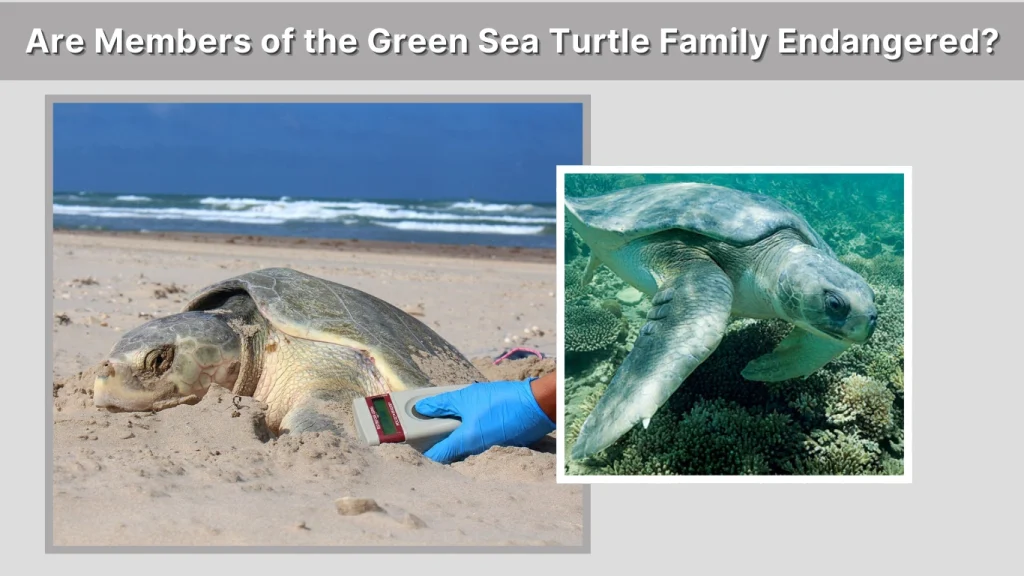
Almost every species in the green sea turtle family is currently listed as Vulnerable, Endangered, or Critically Endangered. Kemp’s ridley is critically endangered, hawksbill is critically endangered, and green, loggerhead, olive ridley, and flatback turtles are all considered threatened or conservation-dependent in various regions.
Their slow growth, late maturity, and low hatchling survival make recovery extremely slow. Even small increases in adult mortality can have serious long-term impacts on populations.
Threats Facing the Green Sea Turtle Family
One of the most serious threats is accidental capture in fishing gear, including trawls, longlines, and gillnets. Many turtles drown before they can reach the surface. Plastic pollution is another major danger, as turtles often mistake floating debris for food.
Coastal development destroys nesting beaches and artificial lighting disorients hatchlings. Climate change alters sand temperatures, which affects hatchling sex ratios, and rising sea levels erode nesting habitat. Illegal harvesting of eggs and meat still occurs in some parts of the world.
Importance of the Green Sea Turtle Family
The green sea turtle family plays a vital role in maintaining healthy ocean ecosystems. Green sea turtles graze on seagrass, helping keep meadows short and productive. Hawksbills control sponge populations on coral reefs, allowing corals to thrive. Ridley turtles regulate jellyfish and invertebrate numbers.
By transporting nutrients from the ocean to beaches through nesting, sea turtles also support coastal food webs. Their presence is often a sign of a healthy marine environment, making them important indicator species for conservation science.
Culturally, sea turtles have been respected by coastal communities for thousands of years, symbolizing longevity, navigation, fertility, and the connection between land and sea.
Conservation Efforts Protecting the Green Sea Turtle Family
Many international agreements protect members of the green sea turtle family, including CITES, the Convention on Migratory Species, and numerous national endangered species laws. These regulations make it illegal to harm, capture, or trade sea turtles in most countries.
Conservation programs focus on protecting nesting beaches, monitoring populations, relocating vulnerable nests, and rescuing injured turtles. The use of turtle excluder devices in fishing nets has significantly reduced bycatch where properly enforced.
Public education, plastic-reduction initiatives, and marine protected areas all contribute to the long-term survival of these ancient reptiles.
FAQs
What family does the green sea turtle belong to?
The green sea turtle belongs to the family Cheloniidae. This family includes most of the world’s hard-shelled sea turtles, such as loggerheads, hawksbills, ridleys, and flatbacks.
How many species are in the green sea turtle family?
There are six living species in the Cheloniidae family: green, loggerhead, hawksbill, flatback, Kemp’s ridley, and olive ridley sea turtles.
What makes the green sea turtle family unique?
Members of this family have hard shells, long flippers, salt glands, and strong migration abilities. They are specially adapted for ocean life but must return to land to lay eggs.
Are all green sea turtle family members endangered?
Nearly all species in the green sea turtle family are threatened or endangered. Their populations are affected by fishing bycatch, pollution, climate change, and habitat loss.
Why is the green sea turtle family important?
These turtles help maintain reef health, seagrass ecosystems, and marine food balance. They also hold cultural importance and serve as key indicators of ocean health.