
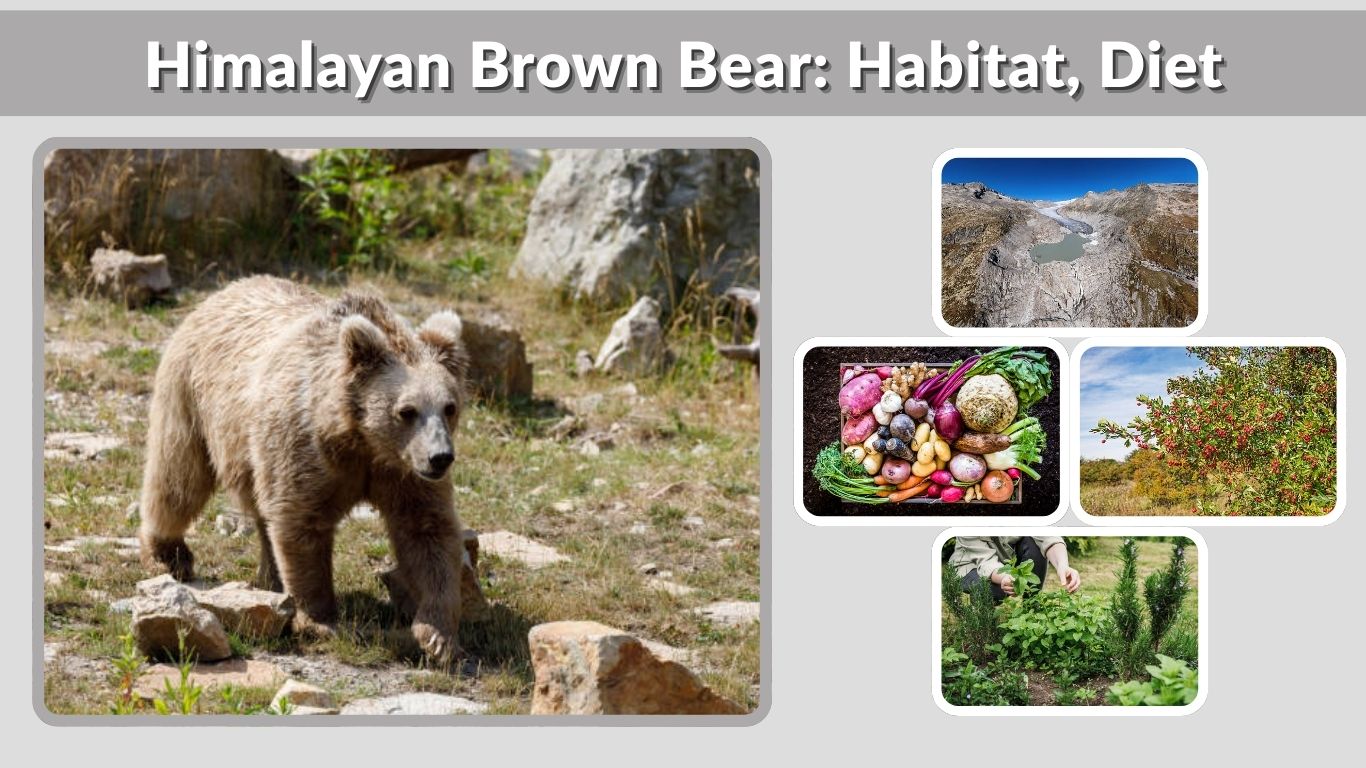
The Himalayan brown bear is one of the rarest and most fascinating brown bear subspecies in the world. Scientifically known as Ursus arctos isabellinus, this high-altitude bear inhabits some of the most rugged and remote mountain landscapes across the Himalayas. Often referred to as the Himalayan red bear or Isabelline bear, it is specially adapted to survive in cold, dry alpine environments. From its distinctive sandy coat to its omnivorous diet and endangered status, the Himalayan brown bear represents a unique and vulnerable part of the mountain ecosystem.
What Is the Himalayan Brown Bear?
The Himalayan brown bear is a subspecies of the widespread brown bear (Ursus arctos). Unlike its larger relatives such as the Kodiak or Kamchatka brown bear, this subspecies has evolved to survive in harsh, high-altitude conditions where food can be scarce and winters are long and severe.
Scientific Classification and Background
The scientific name of the Himalayan brown bear is Ursus arctos isabellinus. It belongs to the same species as other brown bears found across North America, Europe, and Asia. However, geographic isolation in the Himalayan region has resulted in distinct physical and behavioral adaptations.
This bear is sometimes called the “Himalayan red bear” due to the reddish or sandy tones of its fur. The name “Isabelline” refers to its pale, yellowish-brown coat color. Over thousands of years, the population became adapted to cold desert mountains, alpine meadows, and sparse vegetation zones.
Today, it is considered one of the most endangered brown bear populations in Asia, with fragmented groups spread across different Himalayan countries.
Historical and Cultural Significance
The Himalayan brown bear appears in local folklore and mountain traditions. In parts of India and Pakistan, it is viewed with a mixture of fear and respect. Some remote communities historically believed the bear had mystical qualities due to its size and power.
In the Deosai region of Pakistan, the bear has become a symbol of wildlife conservation success. In India’s Ladakh region, local awareness programs aim to reduce human-bear conflict while preserving this rare animal’s presence in the mountains.
Himalayan Brown Bear Identification
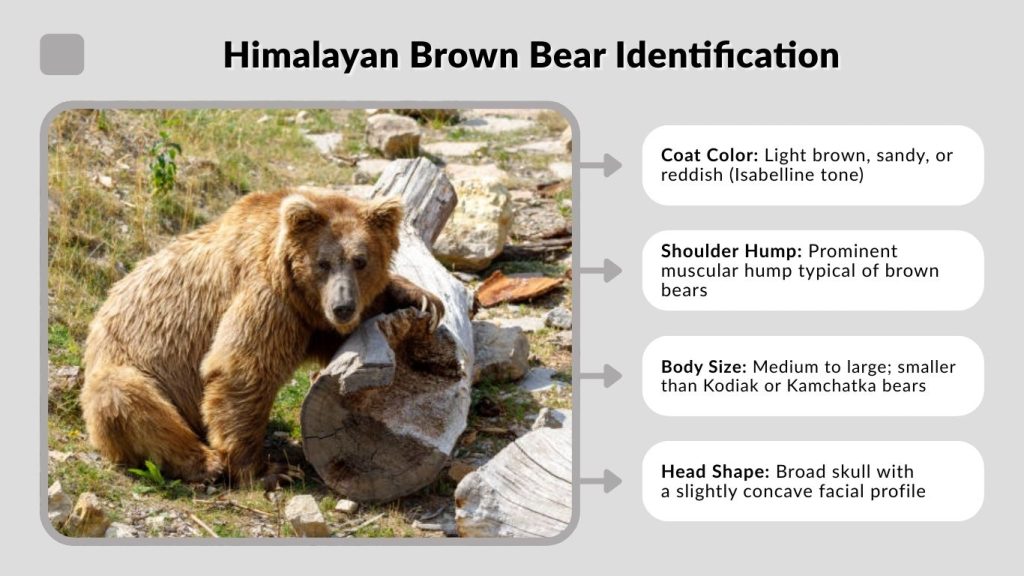
The Himalayan brown bear (Ursus arctos isabellinus) can be identified by its lighter coat color, muscular build, and adaptation to high-altitude environments. Although it belongs to the brown bear family, it has distinct features that separate it from other subspecies and from the Asiatic black bear. Its sandy or reddish fur helps it blend into alpine meadows and rocky mountain slopes, while its strong limbs and shoulder hump reflect its digging ability and physical power.
Key Identification Features
- Coat Color: Light brown, sandy, or reddish (Isabelline tone)
- Shoulder Hump: Prominent muscular hump typical of brown bears
- Body Size: Medium to large; smaller than Kodiak or Kamchatka bears
- Head Shape: Broad skull with a slightly concave facial profile
- Ears: Small and rounded compared to head size
- Claws: Long, curved claws adapted for digging
- Build: Strong forelimbs and thick neck
- Height (Standing): Around 6–7 feet (1.8–2.1 meters)
How It Differs From the Asiatic Black Bear
- Lighter fur instead of black
- No white crescent chest marking
- More pronounced shoulder hump
- Broader and heavier facial structure
These identification traits help wildlife researchers and trekkers distinguish the Himalayan brown bear from other bear species living in the Himalayan region.
Himalayan Brown Bear Habitat
The Himalayan brown bear habitat is defined by extreme altitudes, cold temperatures, and rugged terrain. These bears are specially adapted to survive in some of the harshest mountain environments in Asia.
Geographic Range
The Himalayan brown bear is found across parts of northern India, Pakistan, Nepal, and the Tibetan Plateau. In India, it mainly inhabits Ladakh, Himachal Pradesh, and parts of Uttarakhand. In Pakistan, one of the most important populations survives in Deosai National Park, often called the “Land of Giants.” Smaller populations are scattered across remote mountainous regions of Nepal and western Tibet.
Due to habitat fragmentation and human expansion, these populations are often isolated from one another. This fragmentation makes conservation more challenging and increases the species’ vulnerability.
Preferred Ecosystems
Unlike forest-dwelling bear species, the Himalayan brown bear prefers open landscapes such as alpine meadows, high-altitude grasslands, and rocky slopes. These areas provide seasonal vegetation and space for foraging.
During warmer months, bears are commonly seen grazing in alpine pastures rich in grasses and herbs. They also frequent river valleys where plant growth is more abundant. The sparse vegetation at high elevations requires them to travel long distances in search of food.
Rocky terrain and mountain caves offer suitable denning sites during winter. In areas without natural caves, they dig dens into slopes where snow accumulation provides insulation.
Seasonal Movements
Seasonal movement is essential for survival in the Himalayas. In summer, bears move to higher elevations where alpine vegetation flourishes. As winter approaches and temperatures drop, they descend slightly to find safer denning locations.
Hibernation typically begins in late autumn and may last several months, depending on weather conditions and food availability. During this time, the bear survives entirely on stored body fat accumulated during the active seasons.
Himalayan Brown Bear Diet
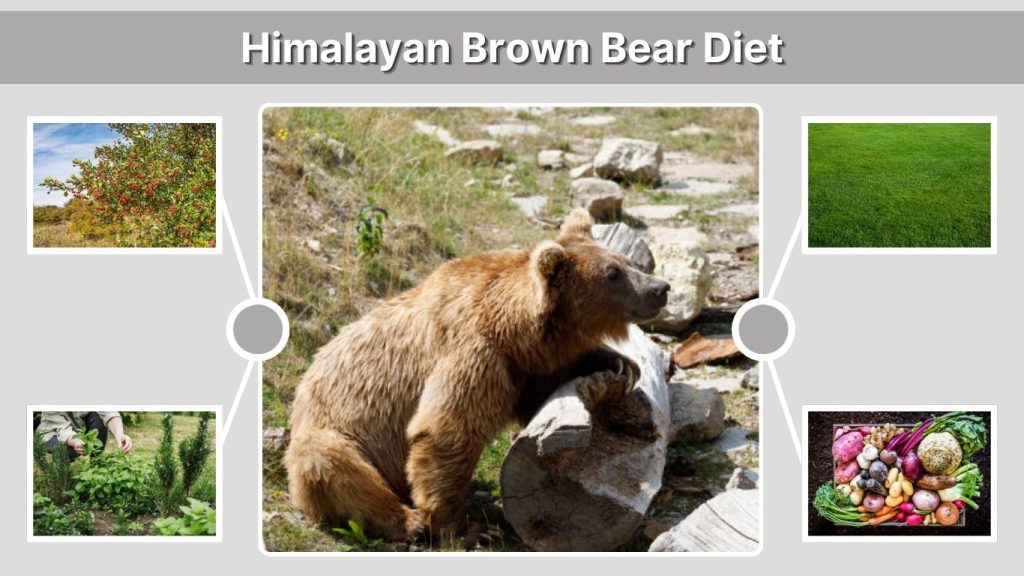
The Himalayan brown bear diet reflects its omnivorous nature and the limited food availability at high altitudes. Survival depends heavily on seasonal resources.
Omnivorous Feeding Behavior
Primarily, the Himalayan brown bear feeds on plant material. Grasses, roots, tubers, berries, and herbs make up a significant portion of its diet. Its powerful claws allow it to dig for underground food sources, especially in early spring when vegetation begins to emerge.
Insects, including ants and larvae, are another important food source. Bears overturn rocks and dig into soil to access insect colonies. They may also consume small mammals such as rodents when available.
Although not specialized hunters of large prey, they may occasionally scavenge carcasses or prey on weak animals.
Seasonal Diet Changes
Diet shifts throughout the year based on availability:
- Spring: Emerging grasses, roots, and insects
- Summer: Abundant alpine vegetation and berries
- Autumn: Increased feeding to build fat reserves before hibernation
Unlike salmon-dependent brown bears of coastal regions, Himalayan brown bears rely more heavily on plant-based nutrition due to the absence of large fish runs in most of their range.
Livestock Conflict
In some areas, limited natural food resources lead to occasional livestock predation. Bears may attack sheep, goats, or yaks grazing in high pastures. This creates tension between local communities and wildlife authorities.
Conservation programs now focus on compensation schemes and awareness initiatives to reduce retaliatory killings and promote coexistence.
Behavior and Reproduction
The Himalayan brown bear is generally solitary, except during mating season or when females are raising cubs.
Solitary Lifestyle
Adult bears maintain large home ranges and avoid one another outside breeding periods. Males may roam widely in search of mates during late spring and early summer.
Despite their size and strength, they tend to avoid human contact whenever possible, especially in remote mountainous terrain.
Hibernation Patterns
Winter hibernation is a crucial survival strategy. Bears retreat to dens dug into hillsides or located in natural caves. Hibernation may last from November to March or even longer, depending on climate severity.
During this period, their metabolic rate slows significantly, and they rely entirely on stored fat.
Cubs and Life Cycle
After mating, delayed implantation ensures cubs are born during winter while the mother is in her den. Cubs are typically born between January and February, with litter sizes usually ranging from one to three.
The cubs remain with their mother for up to two or three years, learning essential survival skills such as foraging and recognizing danger. In the wild, Himalayan brown bears may live up to 20–25 years under favorable conditions.
Conservation Status and Threats
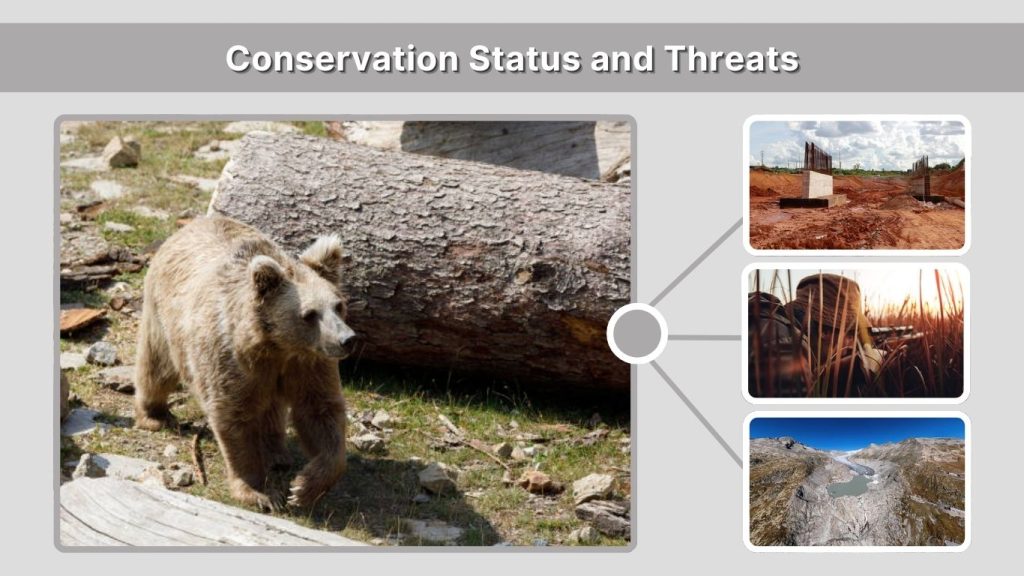
The Himalayan brown bear is considered endangered or critically threatened in parts of its range. Population estimates suggest only a few hundred individuals remain across the entire Himalayan region.
Major Threats
Key threats include:
- Habitat fragmentation due to infrastructure development
- Human-wildlife conflict
- Illegal hunting
- Climate change affecting alpine ecosystems
Shrinking habitats and isolated populations reduce genetic diversity, making long-term survival more difficult.
Conservation Efforts
Protected areas such as Deosai National Park in Pakistan and various wildlife reserves in India have helped stabilize certain populations. Community-based conservation programs encourage local participation in protecting the species.
Continued habitat protection and conflict mitigation strategies are essential for the survival of the Himalayan brown bear.
FAQs
Is the Himalayan brown bear endangered?
Yes, the Himalayan brown bear is considered endangered in many parts of its range. Populations are small and fragmented, making the species vulnerable to habitat loss and human conflict.
Where does the Himalayan brown bear live?
It lives in high-altitude regions of the Himalayas, including northern India, Pakistan’s Deosai Plateau, Nepal, and parts of Tibet. It prefers alpine meadows and mountainous terrain.
What does the Himalayan brown bear eat?
Its diet mainly consists of grasses, roots, berries, and insects. It may occasionally consume small mammals or livestock, depending on availability.
How is it different from the Asiatic black bear?
The Himalayan brown bear has lighter brown or reddish fur and a prominent shoulder hump, while the Asiatic black bear has black fur with a white chest marking and typically inhabits denser forests.
Conclusion
The Himalayan brown bear is a rare and remarkable subspecies uniquely adapted to life in high-altitude mountain ecosystems. From its sandy coat and powerful build to its plant-based diet and long winter hibernation, it represents a resilient survivor of the harsh Himalayan environment. However, habitat loss and human pressures threaten its future. Protecting this endangered bear is essential not only for biodiversity but also for maintaining the fragile balance of Himalayan ecosystems.