



House finches and purple finches are among the most frequently confused backyard birds in North America. At a quick glance, both look similar in size, shape, and feeding behavior, often visiting the same feeders and perching in the same trees. However, when you study their coloration, facial patterns, songs, and habitats more closely, clear differences appear. This guide explores those key traits step by step, helping you confidently identify whether you are seeing a house finch or a purple finch.
Quick Overview of Both Finches
House finches (Haemorhous mexicanus) were originally native to the southwestern United States and Mexico but are now widespread across most of North America. They thrive in urban and suburban areas and are one of the most common birds at backyard feeders.
Purple finches (Haemorhous purpureus) are more strongly associated with forests, woodland edges, and mixed habitats. They are native to northern and eastern parts of North America and are more common in coniferous and mixed woods, especially during the breeding season.
Because both species belong to the same genus and share similar body proportions, many people assume they are the same bird. In reality, differences in head pattern, feather color distribution, and habitat preference provide reliable clues for identification.
Identification Guide (Key Visual Clues)
Although both finches are small, brown-streaked birds with red tones in males, several visual markers help separate them when observed carefully.
- Head shape and facial pattern – Purple finches show a stronger, more defined face pattern, especially in females, while house finches have softer, less contrasted facial markings.
- Body size and posture – Purple finches usually appear slightly bulkier with a thicker neck and fuller chest, whereas house finches look slimmer and longer.
- Bill thickness and curve – Purple finches often have a heavier, more powerful-looking bill compared to the more delicate bill of house finches.
- Streaking and feather texture – House finches tend to show heavier brown streaking on the sides and belly, while purple finches appear cleaner underneath.
- Color distribution – In males, the red on purple finches spreads across the head and back, while house finches usually show red concentrated on the face, chest, and rump.
House Finch vs Purple Finch (Side-by-Side Comparison)
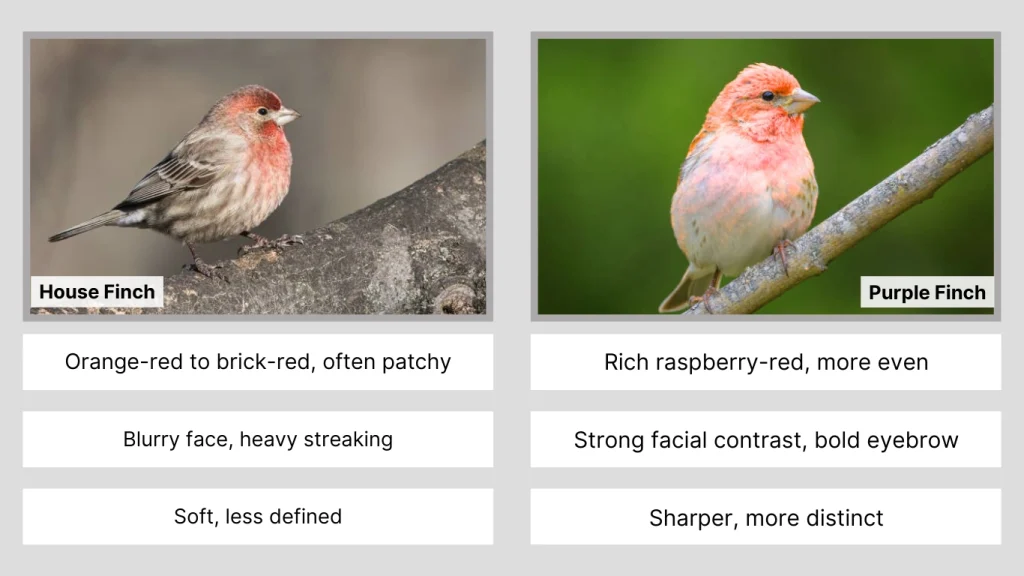
| Feature | House Finch | Purple Finch |
| Male color | Orange-red to brick-red, often patchy | Rich raspberry-red, more even |
| Female markings | Blurry face, heavy streaking | Strong facial contrast, bold eyebrow |
| Head pattern | Soft, less defined | Sharper, more distinct |
| Body size | Slightly slimmer | Slightly bulkier |
| Bill shape | Smaller, narrower | Thicker, more powerful |
| Song style | Long, lively warble | Rich, smoother warble |
| Habitat | Cities, suburbs, open areas | Forests, woodland edges |
| Feeder behavior | Very common, social | Common but more seasonal |
Male House Finch vs Male Purple Finch
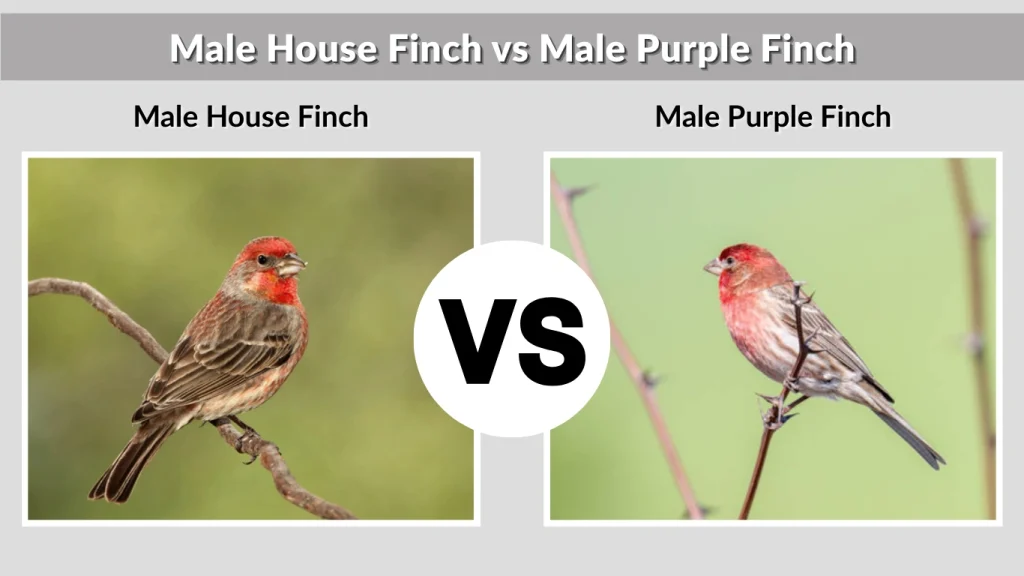
Red coloration and tone
Male house finches typically show orange-red, yellowish-red, or sometimes dull red coloring. The shade varies depending on diet and often appears uneven. Purple finch males, in contrast, display a deep raspberry or wine-red tone that looks richer and more uniform.
Head and crown pattern
On a house finch, red is usually strongest on the forehead, throat, and upper chest, with brown streaking remaining visible on the back. Purple finches look as if they were “dipped” in red, with color spreading across the crown, cheeks, and upper back.
Chest, back, and flank markings
House finches usually retain heavy brown streaks along their sides and belly. Purple finches have less streaking on the flanks and appear cleaner and brighter overall, especially during breeding season.
Female House Finch vs Female Purple Finch
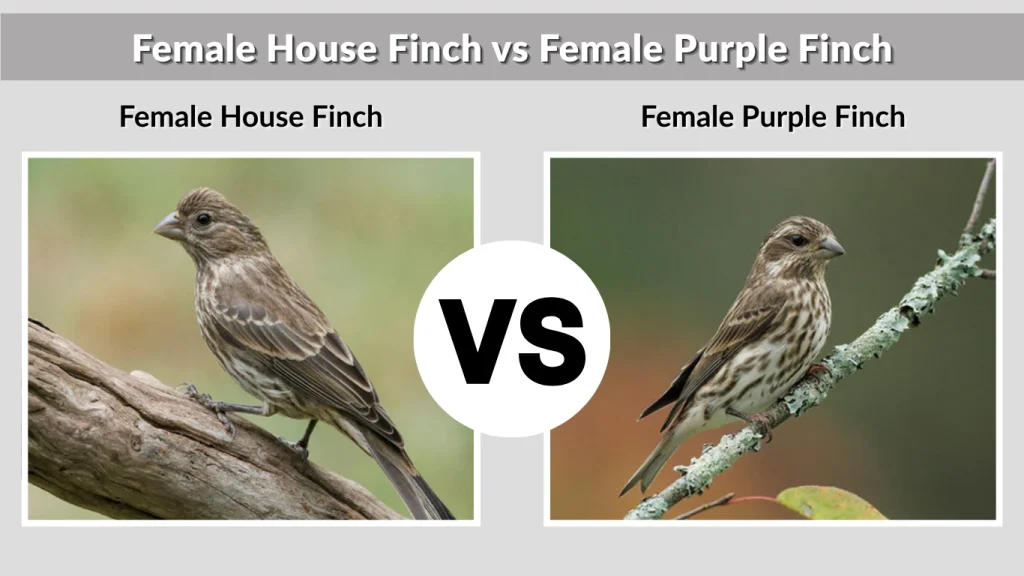
Facial contrast and eyebrow line
Female purple finches have a very noticeable light eyebrow stripe, dark cheek patch, and well-defined facial markings. Female house finches lack this strong contrast, giving them a plainer, blurrier facial appearance.
Body streaking patterns
House finch females are heavily streaked from throat to belly, with streaks often appearing thick and close together. Purple finch females show streaking mainly on the sides, with a lighter, less cluttered chest area.
Overall color tone
Female purple finches often appear cooler gray-brown, while house finch females lean warmer brown with a more uniform look across the body.
Size, Shape, and Physical Structure
Both birds are similar in length, usually measuring about five to six inches, but purple finches often appear slightly heavier-bodied. Their chests look fuller, and their heads appear more rounded.
The bill can be a subtle but helpful clue. Purple finches generally have a thicker, stronger bill adapted for cracking larger seeds, while house finches have a slimmer, more delicate bill.
Posture also differs slightly. Purple finches tend to sit more upright and compact, whereas house finches often appear stretched and slimmer when perched.
Habitat and Range Differences
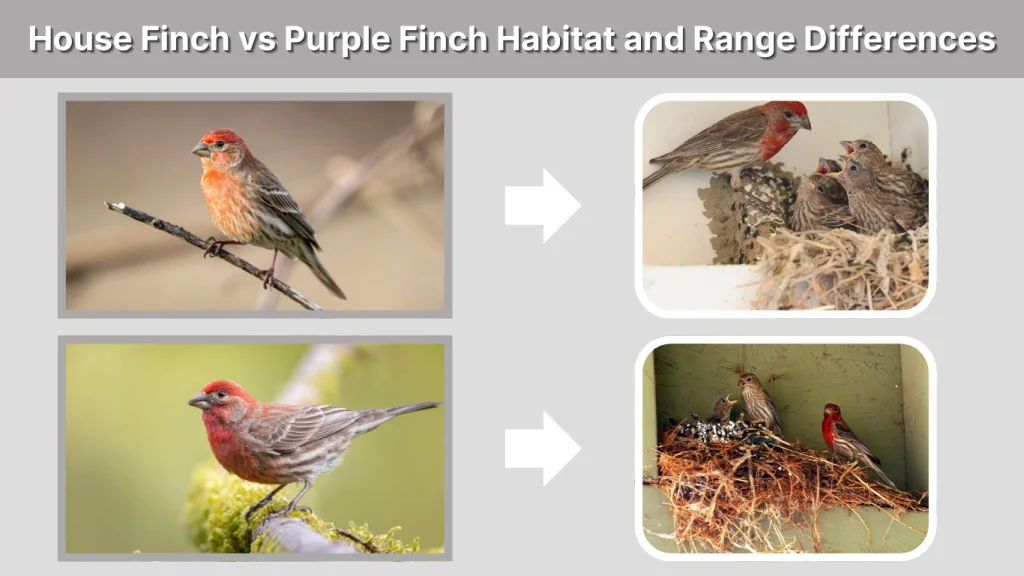
Typical house finch environments
House finches are highly adaptable and are now found across most of North America. They thrive in cities, suburbs, farms, desert edges, and parks. You will often see them nesting on buildings, hanging planters, streetlights, and porch ledges. Their close relationship with human environments is one reason they are so commonly seen at backyard feeders.
Typical purple finch environments
Purple finches are more closely tied to natural habitats. They prefer mixed woodlands, coniferous forests, forest edges, and overgrown fields. During the breeding season, they are most common in northern forests, especially where spruce, fir, and hemlock trees are present.
Seasonal movement and overlap
In winter, purple finches move southward, sometimes appearing in suburban yards where house finches already live year-round. This seasonal overlap is when most identification confusion happens, especially at feeders.
Diet and Feeder Behavior
Both species eat a mix of seeds, fruits, buds, and insects, but their feeding habits can still provide useful clues.
- Favorite foods – Sunflower seeds, nyjer, millet, berries, and soft fruits. Purple finches often take larger seeds more easily.
- Preferred feeder types – Tube feeders, hopper feeders, and platform feeders attract both, though purple finches often favor sturdier feeders.
- Aggressiveness and flocking – House finches are highly social and often arrive in noisy groups. Purple finches are usually quieter and less dominant.
- Ground vs elevated feeding – House finches frequently feed on the ground under feeders, while purple finches more often remain in shrubs and trees.
Song and Call Comparison
House finch song traits
House finches sing long, energetic warbling songs made of short, quick notes. Their song often sounds cheerful, rapid, and slightly jumbled, with frequent pitch changes.
Purple finch song traits
Purple finch songs are rich, smooth, and more musical. They often sound calmer and more fluid, with a rolling quality that birders describe as more “polished” than the house finch’s song.
How to recognize them by sound
If the song sounds bright, hurried, and busy, it is more likely a house finch. If it sounds fuller, sweeter, and more controlled, you are probably hearing a purple finch.
Nesting and Breeding Habits
House finches commonly nest close to human structures. Their nests are often built in hanging baskets, vents, ledges, or dense shrubs. The female builds a cup-shaped nest from grass, twigs, feathers, and string.
Purple finches usually nest in trees, especially conifers. Their nests are placed higher and farther from human disturbance. They use twigs, roots, moss, and fine grasses to create a well-hidden cup.
Both species lay small clutches of pale blue or greenish eggs with light spotting. Females handle most incubation duties, while males provide food and guard the territory.
Behavior and Temperament
House finches are extremely social birds. They travel in flocks, feed together, and often vocalize while eating. At feeders, they can be assertive and sometimes push smaller birds aside.
Purple finches are more reserved. They may join mixed winter flocks, but they are less noisy and less aggressive. They often remain in trees and shrubs longer before approaching feeders.
Daily activity patterns are similar, with both species being active during daylight hours, feeding in the morning and late afternoon.
Seasonal Appearance Changes
Both finches molt at least once a year. During molting periods, colors may appear patchy, faded, or dull, making identification harder.
In male house finches, red coloration can fade to orange or yellow depending on diet and feather wear. Purple finch males may look browner outside of breeding season, with less vivid red.
Juvenile birds of both species resemble adult females, which is another common cause of confusion, especially in late summer and early fall.
Common Misidentification Mistakes
Lighting conditions can dramatically alter how red tones appear, making house finches seem darker or purple finches seem duller. Always check facial patterns and streaking, not just color.
Molting birds often lose defining features, so relying on bill thickness, body shape, and behavior becomes more important.
Young birds and winter plumage create the most mistakes. Observing habitat, posture, and song can help confirm identification when color is unclear.
FAQs
What is the easiest way to tell a house finch from a purple finch?
The easiest method is to check facial patterns and red coloration. Purple finches have richer raspberry-red tones and stronger facial contrast, especially in females. House finches usually show orange-red patches and blurrier faces with heavier streaking on the body.
Are purple finches rarer than house finches?
Purple finches are not truly rare, but they are less common around cities and suburban neighborhoods. They prefer forested habitats and are often seen only seasonally in yards, while house finches live year-round near people.
Do house finches and purple finches live in the same areas?
Yes, their ranges overlap, especially in winter when purple finches move south. During this time, both species may visit the same feeders, which is why careful identification becomes important.
Which finch has a more musical song?
Most birders consider the purple finch’s song more musical because it is smoother and richer. House finch songs are lively and pleasant but tend to sound quicker and more jumbled.
Can house finches and purple finches interbreed?
There is no reliable evidence that house finches and purple finches interbreed in the wild. Although they are closely related, they maintain separate breeding behaviors and habitats.