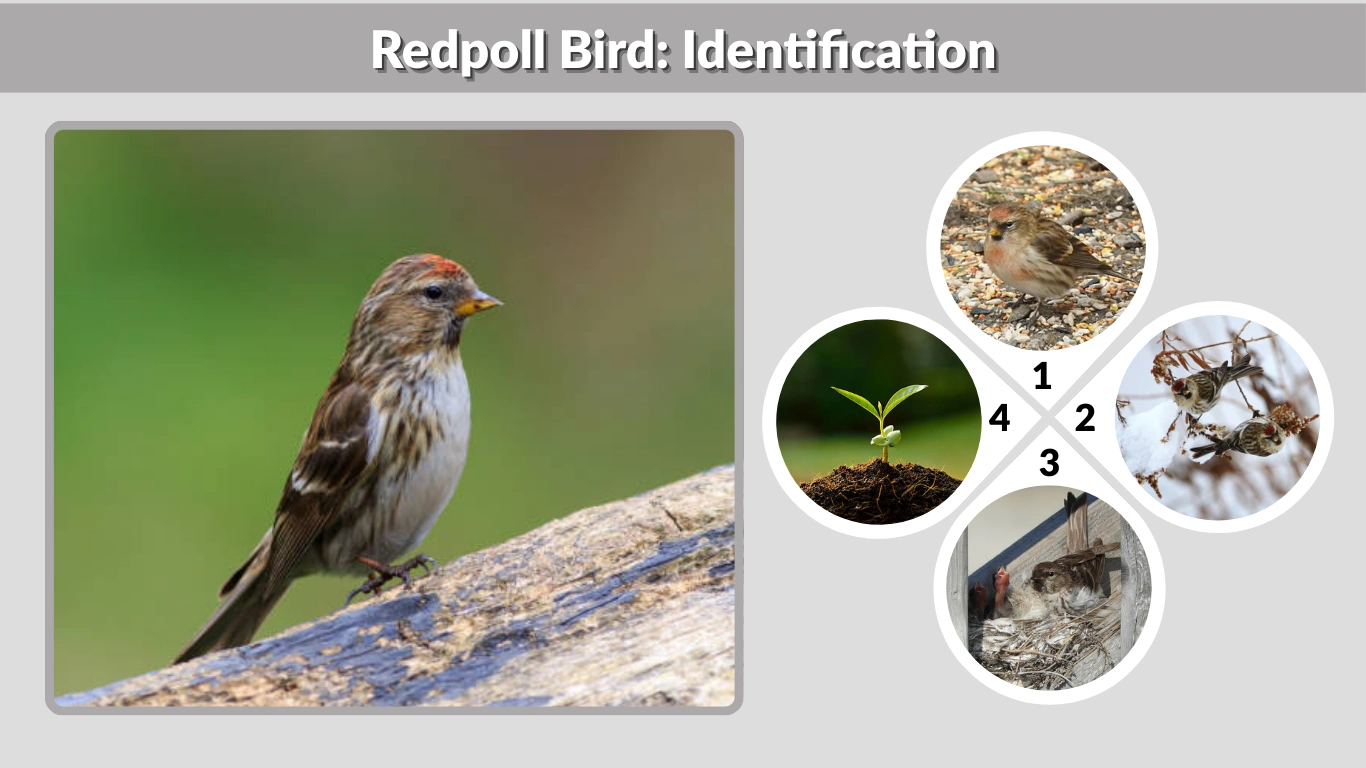
The redpoll is a small, cold-loving finch best known for the tiny red patch on its forehead and its ability to survive in some of the harshest environments on Earth. These lively birds are commonly seen moving in energetic winter flocks across northern forests, tundra edges, and open fields. Although they are lightweight and delicate in appearance, redpolls are remarkably resilient. This article explores how to identify redpoll birds, where they live, what they eat, and the behaviors that make them unique among finches.
What Is a Redpoll Bird?
Redpolls are small finches belonging to the family Fringillidae and the genus Acanthis. They are strongly associated with Arctic and subarctic regions, where they breed in open woodlands, birch forests, and tundra shrub zones. Despite their tiny size, redpolls are perfectly adapted to cold climates, relying on thick insulating feathers and efficient feeding strategies to survive long, freezing winters.
In appearance, redpolls have a delicate, compact body, a short pointed bill, and a forked tail. Their most recognizable feature is the red patch on the forehead, which gives the bird its common name. A small black chin spot and heavy brown streaking on a pale background further help with identification. During winter, their feathers puff out, making them appear rounder and fluffier, an important adaptation that traps warm air close to the body.
Redpolls are highly social birds. Outside the breeding season, they almost always appear in flocks, sometimes numbering in the hundreds. These flocks constantly move through trees and low vegetation, calling to one another as they search for seeds. Their active behavior and willingness to visit feeders have made them a favorite among winter birdwatchers.
Scientific Classification and Main Types
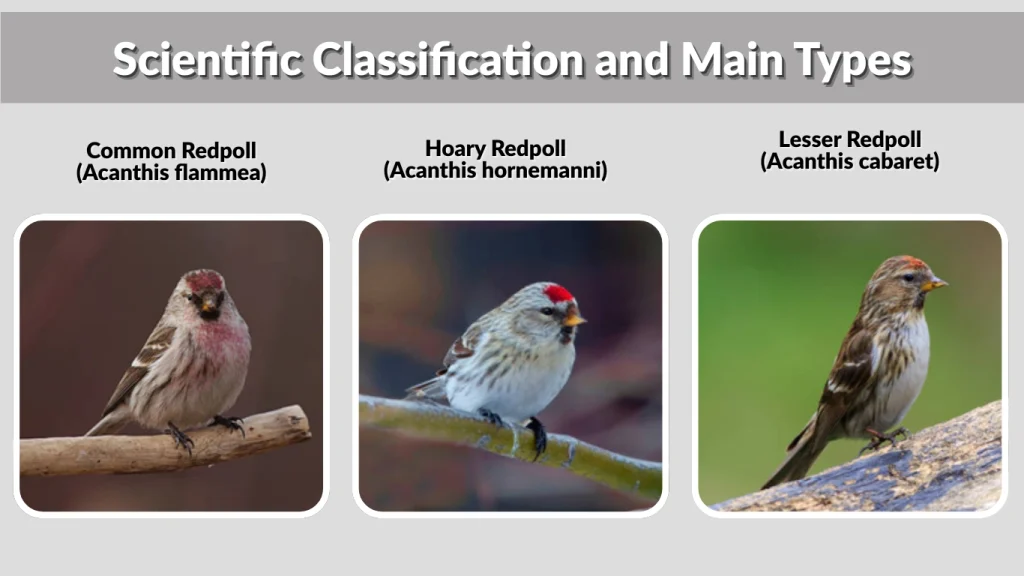
Common Redpoll (Acanthis flammea)
The common redpoll is the most widespread and frequently observed form. It breeds across northern North America, Greenland, and large parts of northern Eurasia. This bird typically shows noticeable brown streaking along the chest and sides, a clear red forehead patch, and pale wing bars. In winter, common redpolls often travel south in large flocks, appearing in southern Canada, the northern United States, and parts of Europe.
Hoary Redpoll (Acanthis hornemanni)
The hoary redpoll is a paler, frostier-looking bird of the high Arctic. It has less streaking on the body, a whiter overall appearance, and a shorter, stubbier bill. Hoary redpolls mainly inhabit extreme northern tundra regions and are less commonly seen farther south. When they do appear, they are often mixed into flocks of common redpolls, making careful observation important.
Lesser Redpoll (Acanthis cabaret)
The lesser redpoll is found mainly in Europe and parts of western Asia. It is slightly darker and browner than the common redpoll and tends to occupy milder habitats such as woodlands, hedgerows, and scrublands. While smaller in range, it shares many behaviors and feeding habits with its northern relatives.
Redpoll Bird Identification
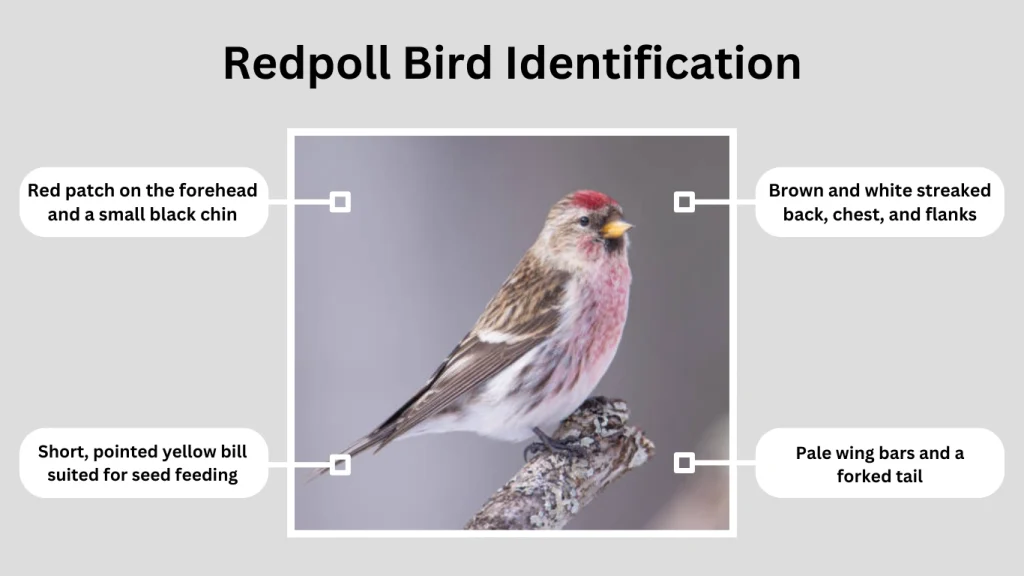
Redpolls are easiest to recognize by their small size, restless movements, and distinctive facial markings. When observed closely, several traits help separate them from other finches.
- Red patch on the forehead and a small black chin
- Brown and white streaked back, chest, and flanks
- Short, pointed yellow bill suited for seed feeding
- Pale wing bars and a forked tail
- Fluffy, rounded appearance in cold weather
- Body length of about five inches with a lightweight build
Their calls are high-pitched and buzzing, often heard before the birds are clearly seen. In flight, redpolls show a bouncing, undulating pattern as they move between trees and feeding sites.
Size, Color, and Physical Features
Redpolls are among the smallest finches, typically measuring between twelve and fourteen centimeters in length. Their wingspan is narrow, and their bodies are extremely lightweight, helping them maneuver easily through shrubs and tree branches. Despite their size, their plumage is dense, with layers of soft feathers that trap air and provide excellent insulation.
Coloration is generally a mix of brown, cream, and white, heavily streaked across the body. Males often show a faint pink or rosy wash on the chest, especially during the breeding season, while females remain more subdued in tone. Both sexes share the iconic red forehead patch, although it may appear brighter in males.
One of the most remarkable physical traits of redpolls is their ability to cope with extreme cold. They have feathered nostrils that warm incoming air, and their metabolism can slow significantly at night, allowing them to conserve energy. These adaptations enable redpolls to remain active in environments where temperatures plunge far below freezing.
Natural Habitat and Global Range
Typical Habitats
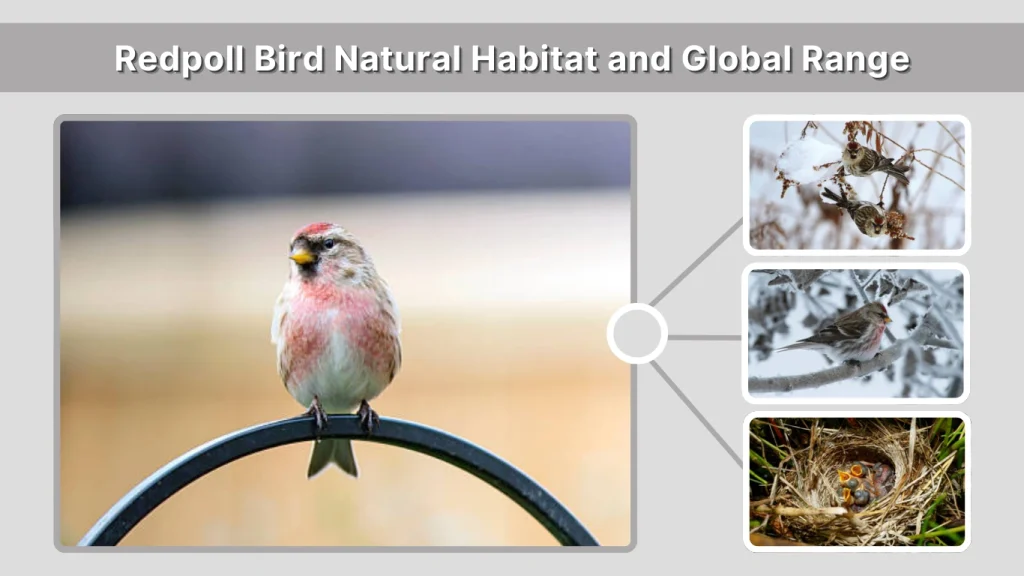
Redpolls breed in northern birch forests, willow thickets, and tundra shrublands. These areas provide both nesting cover and abundant seed sources. During winter, they move into more open habitats such as weedy fields, forest edges, and suburban areas where food remains accessible.
Geographic Distribution
Redpolls occur across the circumpolar north, including Canada, Alaska, Greenland, Scandinavia, and Siberia. Their wide range reflects their strong ability to adapt to cold, windswept environments.
Winter Irruptions
In some years, redpoll populations move unusually far south in massive numbers. These irregular movements, known as irruptions, happen when northern seed crops fail, forcing the birds to search widely for food.
Diet and Feeding Behavior
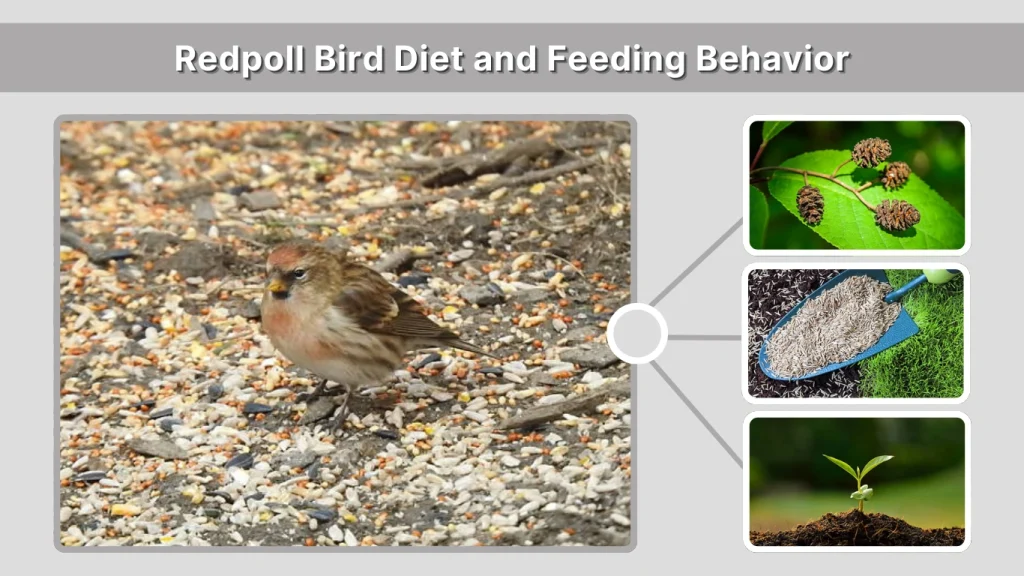
Redpolls are primarily seed-eating birds, perfectly adapted for feeding on tiny, hard seeds that many other species ignore. Their small, sharply pointed bills allow them to extract seeds from birch catkins, alder cones, and dry weed heads. During winter, when insects disappear and vegetation is buried under snow, seeds become their main energy source.
- Birch and alder seeds
- Grass and weed seeds
- Buds and young shoots
- Insects and larvae during the breeding season
- Feeder foods such as nyjer seed and sunflower chips
One unusual feeding adaptation of redpolls is their expandable throat pouch, which allows them to temporarily store seeds and move to a safer location to eat. This reduces the time spent exposed to predators while feeding. At backyard feeders, redpolls often cling acrobatically to seed heads and mesh feeders, sometimes feeding upside down.
Behavior and Social Life
Flocking Behavior
Outside the breeding season, redpolls are extremely social. They gather in lively flocks that may include hundreds of individuals and often mix with siskins, goldfinches, and snow buntings. These flocks travel constantly in search of food, filling winter landscapes with soft buzzing calls. Flocking improves feeding efficiency and offers protection from predators through shared vigilance.
Flight and Daily Activity
Redpoll flight is light and bouncing, with quick wingbeats followed by brief glides. They are rarely still for long, constantly shifting between branches, seed heads, and the ground. On the ground, they hop actively while picking up fallen seeds. During daylight hours, much of their time is spent feeding to maintain the high energy levels needed for cold survival.
Cold-Climate Survival Skills
Redpolls possess remarkable cold-weather strategies. At night, they fluff their feathers and reduce their metabolic rate, conserving valuable energy. Some individuals tunnel into snow to shelter from wind and extreme cold. These behaviors allow redpolls to remain in regions where winter temperatures would overwhelm most small birds.
Breeding, Nesting, and Life Cycle
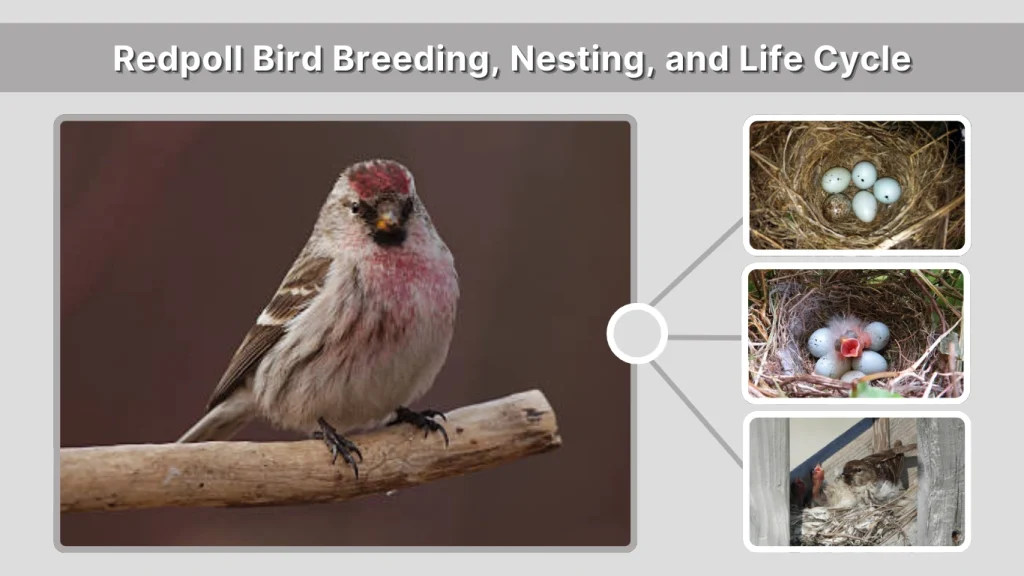
The breeding season begins in late spring when northern landscapes briefly explode with plant growth and insects. Redpolls build their nests low in shrubs, small conifers, or dense tundra vegetation. The female constructs a compact cup-shaped nest using grass, moss, twigs, and spider silk, lining it heavily with feathers for insulation.
- Breeding usually starts from May to July
- Nests are placed close to the ground and well hidden
- Clutches typically contain three to seven eggs
- Eggs are pale blue-green with fine reddish speckles
- Incubation lasts about eleven to thirteen days
- Both parents feed the chicks regurgitated seeds and insects
Chicks grow quickly during the short northern summer. Within two weeks, they are ready to leave the nest, though parents continue to feed them for some time. By late summer, young redpolls join roaming flocks and gradually develop their winter plumage.
Redpoll vs Hoary Redpoll
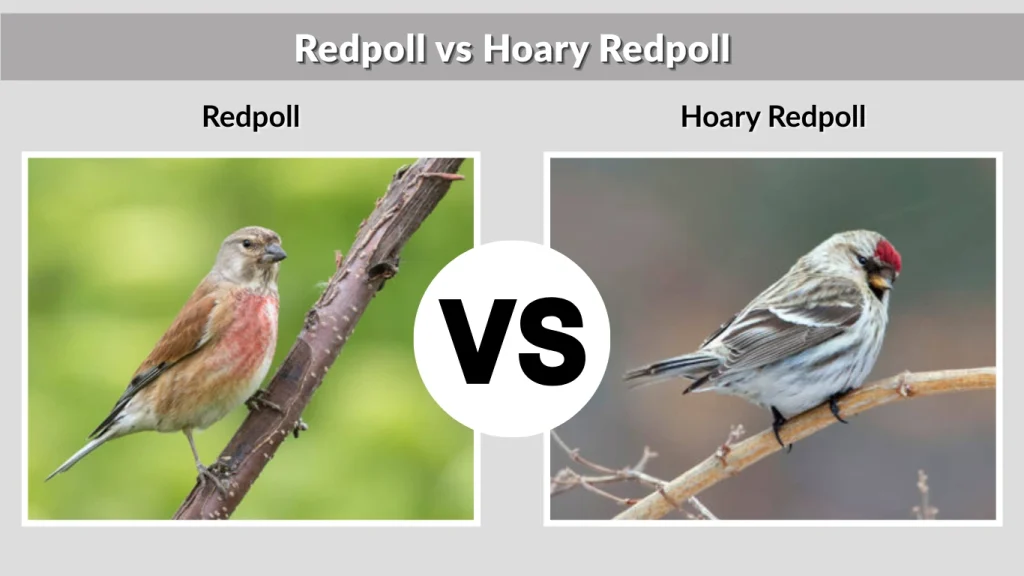
Redpolls are often confused with hoary redpolls, especially when both species appear together in winter flocks. The hoary redpoll is generally paler, with a frost-washed appearance and much less streaking on the body. Its bill is shorter and thicker, giving the head a more compact look.
Common redpolls show heavier brown streaking along the chest and flanks and usually appear darker overall. Habitat preference also differs slightly, as hoary redpolls are more strongly tied to high Arctic tundra, while common redpolls occupy a wider range of northern forests and shrublands. Because variation is subtle, even experienced birders sometimes find these birds challenging to separate.
Predators, Threats, and Conservation Status
Redpolls are preyed upon by small falcons, owls, and shrikes, as well as mammals such as foxes and weasels. Nestlings and eggs are vulnerable to Arctic predators, including jaegers and corvids. Despite these threats, redpoll populations remain relatively stable across much of their range.
Currently, most redpoll species are not considered globally endangered. However, climate change presents a growing concern. Shifts in temperature and vegetation may alter northern breeding habitats and affect seed availability. Long-term monitoring is important to understand how warming trends could influence redpoll distribution and survival.
Interesting Redpoll Bird Facts
Redpolls can survive temperatures below minus forty degrees by trapping air within their feathers and slowing their nighttime metabolism. They are capable of forming winter flocks numbering in the thousands when food is abundant. Their ability to store seeds in a throat pouch is rare among songbirds. In some years, redpoll irruptions carry them hundreds of miles south of their normal range, delighting birdwatchers who rarely see Arctic species.
FAQs
What does a redpoll bird look like?
A redpoll is a small finch with a red patch on its forehead, a black chin, and brown-and-white streaked plumage. Its body appears round and fluffy in winter. Pale wing bars, a forked tail, and a short yellow bill help distinguish it from other cold-season finches.
Where do redpoll birds live?
Redpolls live mainly in Arctic and subarctic regions across North America, Europe, and Asia. They breed in northern birch forests and tundra shrublands. In some winters, they travel far south into southern Canada, the northern United States, and central Europe.
What do redpolls eat?
Redpolls mostly eat seeds from birch, alder, grasses, and weeds. During the breeding season, they also consume insects and larvae to provide protein for their chicks. At feeders, they strongly prefer nyjer seed and finely shelled sunflower pieces.
Are redpolls migratory birds?
Redpolls are irregular migrants rather than true long-distance migrants. They move south only when northern food supplies fail. These unpredictable movements, called irruptions, can bring massive numbers of redpolls into areas where they are rarely seen.
How can you attract redpolls to your feeder?
To attract redpolls, offer nyjer seed or sunflower chips in tube or mesh feeders. Place feeders in sheltered locations near shrubs or small trees. Keeping feeders full during winter greatly increases the chances of hosting visiting redpoll flocks.