




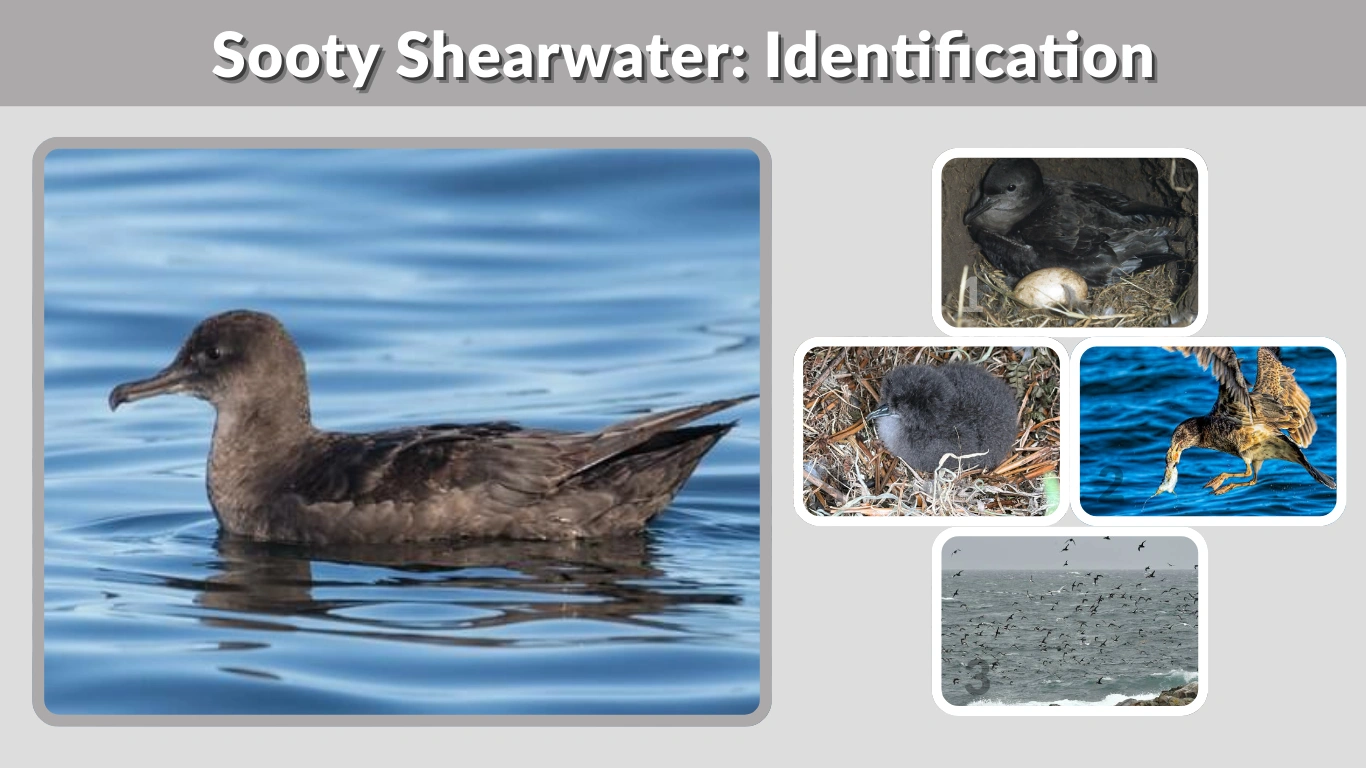
The sooty shearwater is a powerful ocean-going seabird famous for its dark smoky plumage and some of the longest migrations ever recorded in the bird world. Spending most of its life gliding over open seas, this species only comes ashore to breed on remote islands. Its ability to travel across entire ocean basins, locate distant feeding grounds, and return precisely to its nesting burrow makes it one of the most remarkable seabirds on Earth.
Scientific Classification and Taxonomy
The sooty shearwater’s scientific name is Ardenna grisea. It belongs to the family Procellariidae, a group that includes petrels, shearwaters, and fulmars. These birds are specially adapted for life over open oceans, possessing tubular nostrils that enhance their sense of smell and help regulate salt intake.
For many years, the sooty shearwater was classified in the genus Puffinus. However, advances in genetic research revealed deeper evolutionary divisions within shearwaters, leading scientists to move this species into the genus Ardenna. This change reflects its closer relationship to larger, wide-ranging shearwaters rather than smaller coastal species. Understanding this classification helps explain its powerful flight style, pelagic lifestyle, and close ties to other long-distance ocean travelers.
Physical Description and Body Structure
The sooty shearwater is a medium-to-large seabird with a streamlined body built for endurance. Adults typically measure about 40 to 50 centimeters in length, with a wingspan that can exceed one meter. Their long, narrow wings allow them to exploit wind gradients just above the ocean surface, a technique known as dynamic soaring.
Plumage is mostly dark brown to sooty black, giving the bird its name. In bright sunlight, feathers may appear glossy with a subtle silvery sheen. The bill is slender, slightly hooked, and dark in color, well suited for grasping slippery prey such as fish and squid. Like other members of its family, the sooty shearwater has tubular nostrils on the upper bill, which aid in smell and help excrete excess salt from seawater.
Webbed feet positioned toward the rear of the body make the bird a strong swimmer but somewhat clumsy on land. In the air, however, the sooty shearwater is exceptionally graceful, capable of covering vast distances with minimal energy expenditure.
Identification Features
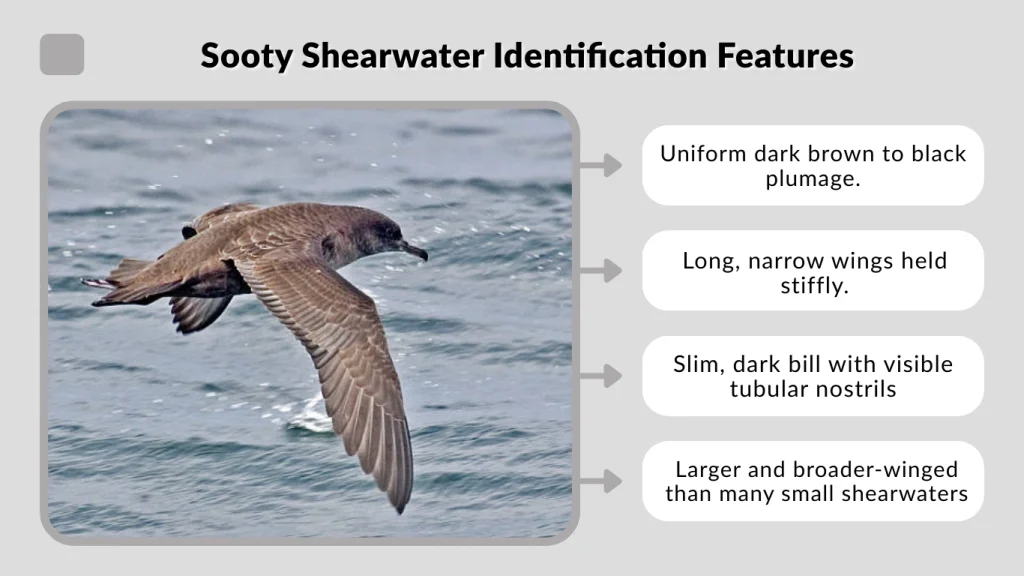
Recognizing a sooty shearwater at sea can be challenging, especially among mixed flocks of similar seabirds. However, several features help distinguish it.
- Overall coloration and sheen – Uniform dark brown to black plumage, sometimes appearing silvery underneath in strong light
- Wing shape and flight silhouette – Long, narrow wings held stiffly, with smooth gliding arcs close to the waves
- Bill, nostrils, and facial features – Slim, dark bill with visible tubular nostrils
- Size comparison with similar shearwaters – Larger and broader-winged than many small shearwaters
- Key field marks for birdwatchers – Low, fast flight over water and dense feeding flocks in productive seas
Global Distribution and Ocean Range
Southern Hemisphere Strongholds
The sooty shearwater breeds mainly in the Southern Hemisphere. Major nesting colonies are found around New Zealand, southern Chile, the Falkland Islands, and various subantarctic islands. These remote, predator-limited environments provide ideal conditions for burrow nesting and chick development. During the breeding season, adults commute between offshore feeding areas and land-based colonies, sometimes traveling hundreds of kilometers in a single foraging trip.
Northern Hemisphere Feeding Areas
Outside the breeding season, sooty shearwaters disperse widely across the world’s oceans. Large numbers migrate into the North Pacific and North Atlantic, where they are commonly seen off the coasts of Japan, Alaska, Canada, the United States, and parts of Europe. These regions offer cold, nutrient-rich waters that support vast populations of fish and plankton, creating prime feeding opportunities during the northern summer.
Migration and Movement Patterns
One of the Longest Bird Migrations on Earth
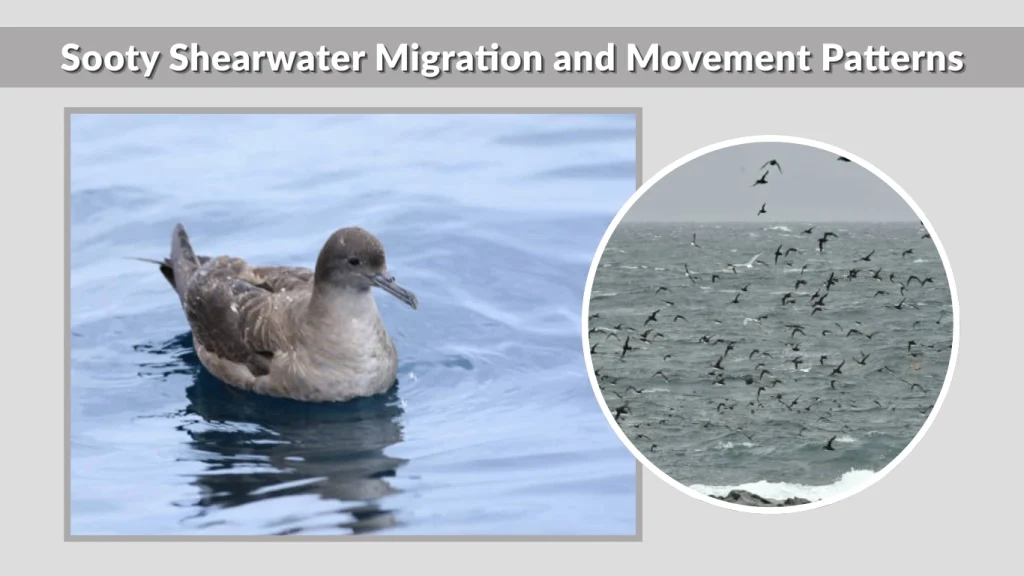
The sooty shearwater is legendary for its extreme migrations. Some individuals travel over 60,000 kilometers each year, following figure-eight routes between southern breeding colonies and northern feeding grounds. This journey can include circuits of the entire Pacific Ocean, making it one of the longest known animal migrations on the planet.
Navigation and Timing
Migration timing is closely linked to seasonal food availability. Birds depart southern colonies after breeding and ride prevailing winds northward, arriving in productive northern waters during peak summer abundance. Scientists believe sooty shearwaters use a combination of Earth’s magnetic field, wind patterns, ocean odors, and celestial cues to navigate with astonishing precision across featureless seas.
Habitat and Living Environment
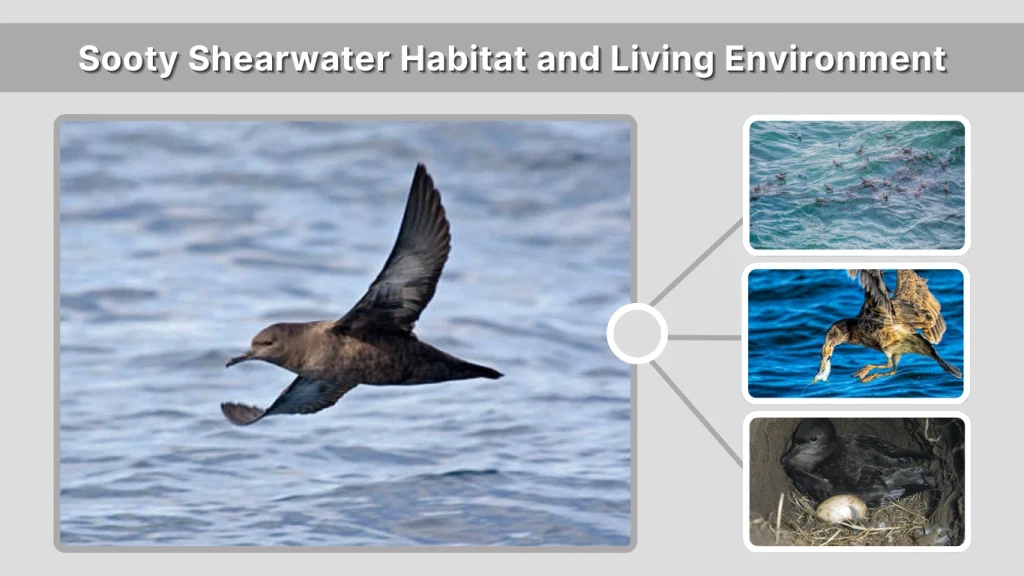
Sooty shearwaters are true pelagic birds, spending most of their lives far from land. Their habitat changes between oceanic feeding zones and isolated breeding islands.
- Pelagic ocean zones where they glide and forage across open waters
- Productive coastal upwellings rich in fish and plankton
- Remote breeding islands free from many land predators
- Underground burrow systems used for nesting and chick rearing
- Preferred climate and ocean conditions including cool, nutrient-dense seas
Diet and Feeding Behavior
Primary Food Sources
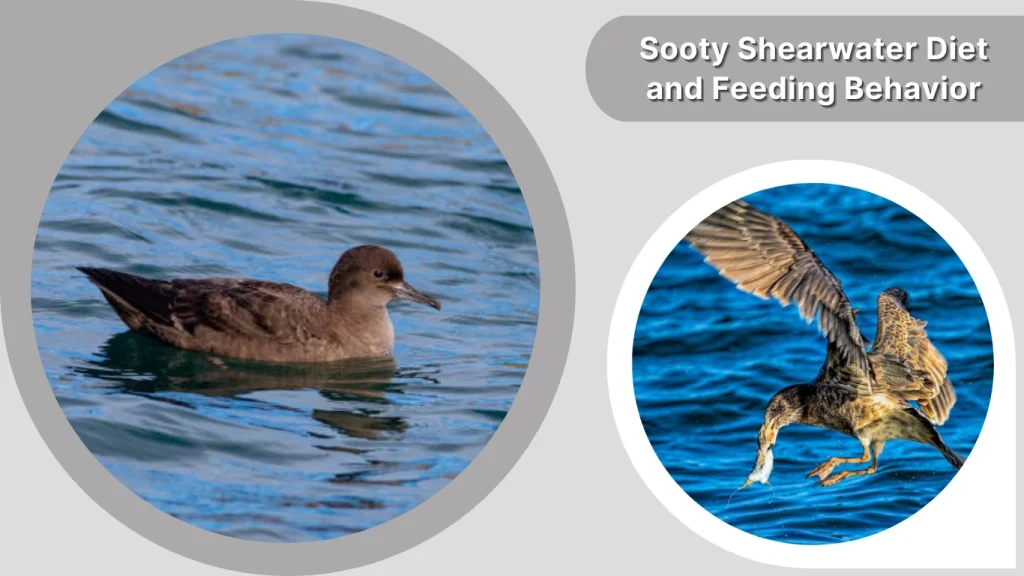
The sooty shearwater feeds mainly on small fish, squid, krill, and other marine invertebrates. Its diet changes with location and season, reflecting the shifting abundance of ocean prey. In northern waters, fish and squid dominate, while in southern seas, crustaceans can form a significant portion of their intake.
Hunting and Foraging Techniques
Sooty shearwaters capture prey by surface seizing, shallow plunges, and short underwater pursuits. They often gather in massive feeding flocks, especially where whales, dolphins, or predatory fish drive prey toward the surface. These mixed-species feeding events create some of the most dramatic wildlife spectacles in the open ocean.
Life Cycle and Reproduction
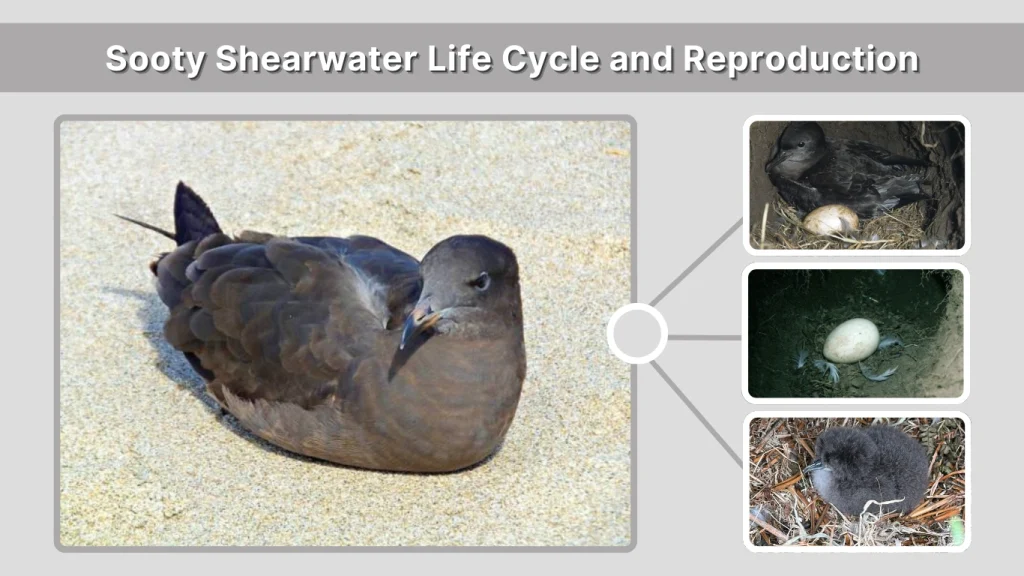
The sooty shearwater has a slow but highly specialized life cycle adapted to long-distance travel and island breeding. Most individuals do not return to land for several years after fledging, spending their early life entirely at sea. Once mature, they form strong, long-term pair bonds and often reunite with the same partner each breeding season.
- Courtship and long-term pair bonds – Pairs perform vocal and physical displays, usually at night, to strengthen bonds and locate burrows.
- Burrow construction and nesting sites – Nests are built in soil or peat on grassy slopes, sometimes reused for decades.
- Egg laying and incubation roles – A single egg is laid, and both parents share long incubation shifts.
- Chick growth and parental care – Adults make extended foraging trips, returning with rich, oily food.
- Fledging and first ocean journey – Chicks leave the burrow at night and head straight to sea, beginning a fully pelagic life.
Behavior and Social Structure
At sea, sooty shearwaters are highly social, often forming large, swirling flocks over feeding areas. Their flight is low and fast, using wave lift and wind gradients to travel long distances with minimal effort. On land, they become mostly nocturnal, a behavior thought to reduce predation risk from gulls and skuas.
Breeding colonies are noisy after dark, filled with eerie calls used to locate mates and burrows. Sooty shearwaters also possess a strong sense of smell, which helps them find food across vast oceanic distances and identify their own nesting tunnels among thousands of others.
Role in Marine Ecosystems
Position in the Ocean Food Web
Sooty shearwaters are important mid-level predators, feeding on schooling fish, squid, and crustaceans. They also serve as prey for large seabirds, sharks, and marine mammals. Through these interactions, they help regulate prey populations and support energy transfer within marine food webs.
Nutrient Transport and Ecological Impact
By moving between distant oceans and land-based colonies, sooty shearwaters transport nutrients from productive seas to island ecosystems. Their guano enriches coastal soils, supporting plant growth and invertebrate communities. Population shifts in this species are often viewed as early warning signs of changes in ocean productivity and climate patterns.
Predators and Natural Threats
Eggs and chicks are vulnerable to gulls, skuas, and other seabirds, while adults face occasional predation from large predatory fish and marine mammals. On some islands, introduced mammals such as rats and cats have caused serious declines by raiding burrows.
Natural threats also include severe storms, which can exhaust or displace migrating birds, and changes in ocean temperature that reduce food availability. These pressures can significantly affect breeding success and long-term survival.
Conservation Status and Population Trends
The sooty shearwater is currently listed as Near Threatened on the IUCN Red List. Although it remains widespread, many colonies have shown noticeable declines over recent decades. Historical overharvesting, especially in parts of New Zealand where chicks were traditionally collected as “muttonbirds,” reduced some populations.
Today, the greatest concerns include climate-driven shifts in ocean food webs, bycatch in commercial fisheries, and the loss of predator-free breeding habitat. Ongoing monitoring programs aim to track population changes and migration health.
Human Impact and Conservation Efforts
Modern threats to sooty shearwaters are closely tied to human activity. Longline and trawl fisheries accidentally capture thousands of seabirds each year. Plastic pollution introduces toxins into the marine food chain, while rising sea temperatures alter prey distribution.
Conservation efforts focus on protecting breeding islands, controlling introduced predators, promoting seabird-safe fishing techniques, and conducting satellite-tracking studies. International cooperation is critical, as this species crosses the waters of many nations during its migrations.
Interesting Facts About the Sooty Shearwater
Sooty shearwaters may fly farther annually than any other bird species. Some individuals have been tracked circling the entire Pacific Ocean in a single year. They can live for several decades and may use smell more than sight to locate food. In parts of the Southern Hemisphere, they are culturally known as “muttonbirds.”
FAQs
What is sooty shearwater?
A sooty shearwater is a large pelagic seabird belonging to the petrel family. It is recognized for its dark plumage, strong gliding flight, and extreme oceanic lifestyle. The species spends most of its life at sea, returning to remote islands only to breed.
How far can sooty shearwaters migrate each year?
Sooty shearwaters are among the longest-migrating birds in the world. Some individuals travel more than 60,000 kilometers annually, moving between Southern Hemisphere breeding colonies and Northern Hemisphere feeding grounds across entire ocean basins.
What do sooty shearwaters eat in the wild?
They mainly feed on small fish, squid, krill, and other marine invertebrates. Their diet varies with region and season, and they often forage in large flocks where ocean predators drive prey close to the surface.
Where do sooty shearwaters usually nest?
They nest in underground burrows on remote coastal and subantarctic islands, especially around New Zealand and southern South America. These burrows protect eggs and chicks from harsh weather and many natural predators.
Are sooty shearwaters endangered or threatened?
Sooty shearwaters are currently classified as Near Threatened. While still widespread, some populations are declining due to climate change, fishing bycatch, habitat disturbance, and reduced food availability in key ocean regions.