
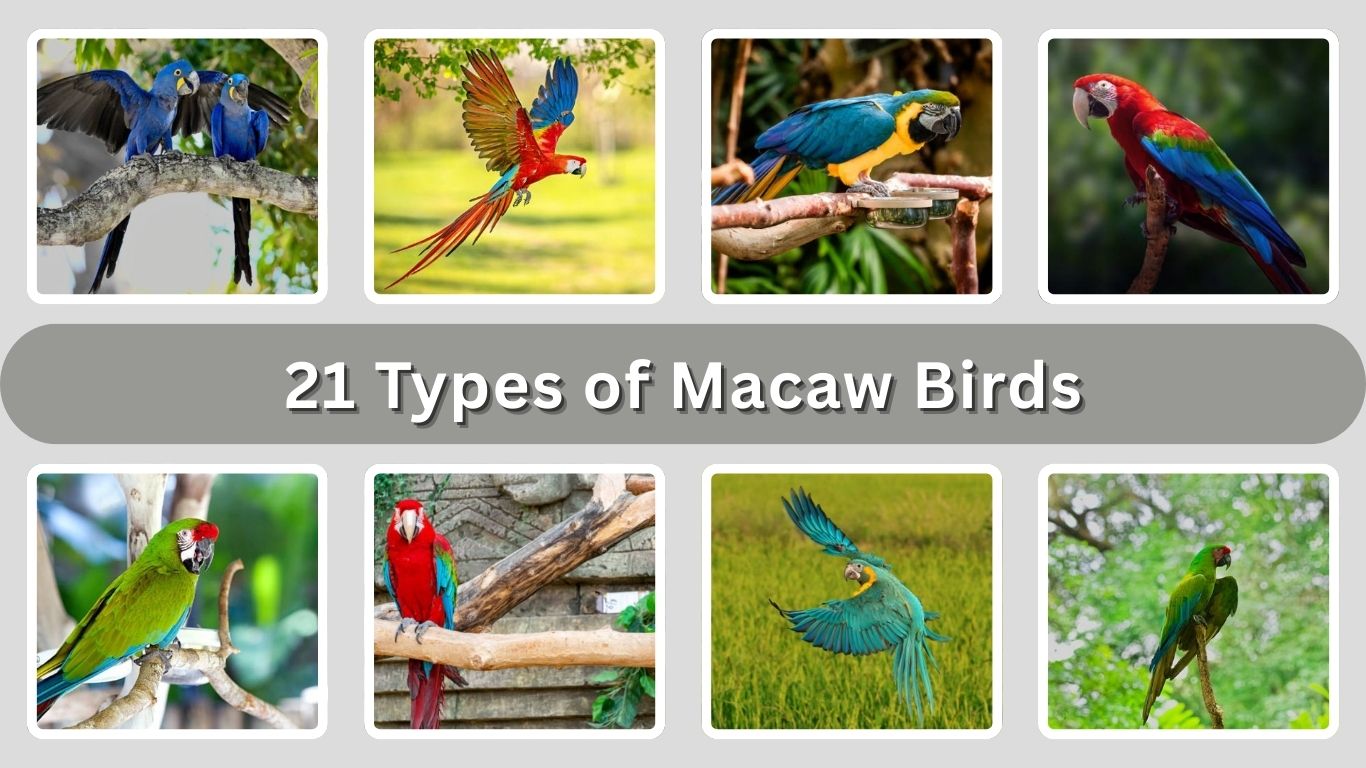
Macaws are among the most colorful and intelligent birds in the world, famous for their long tails, powerful beaks, and striking feather patterns. Native mainly to Central and South America, these parrots inhabit rainforests, river edges, palm swamps, and open woodlands. Macaws are highly social birds, often seen in pairs or flocks, and are known for their loud calls and strong lifelong bonds. This guide explores different types of macaw birds, highlighting their unique traits, habitats, and lifestyles.
1. Hyacinth Macaw
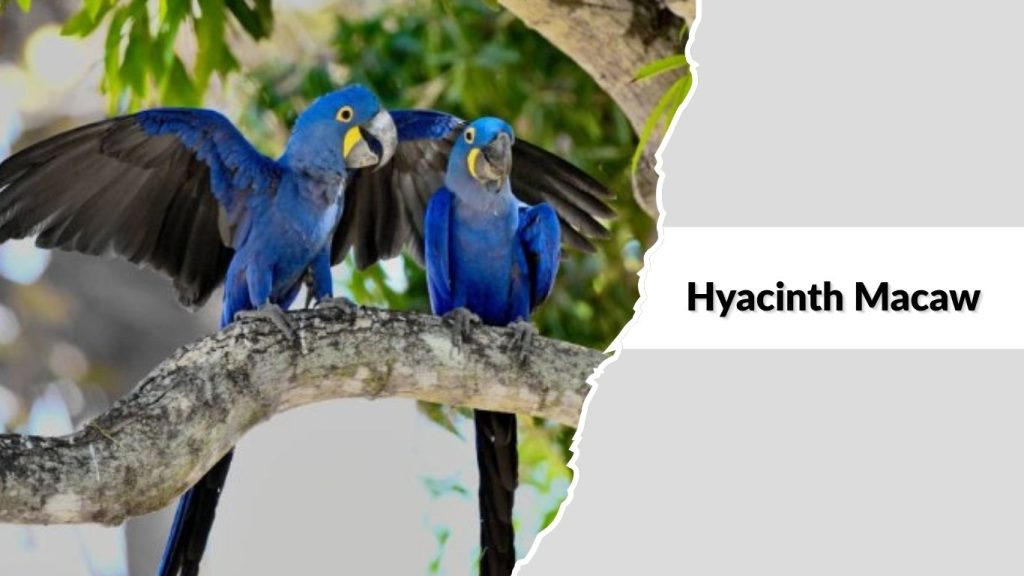
The Hyacinth Macaw is the largest flying parrot species in the world and is instantly recognizable for its deep cobalt-blue feathers and bright yellow skin around the eyes and beak. Native to central and eastern South America, this macaw is known for its powerful beak, loud calls, and strong social bonds. It mainly inhabits open woodlands, palm swamps, and riverine forests.
Identification
- Largest macaw species, reaching up to 100 cm (39 inches) in length
- Bright cobalt-blue plumage over the entire body
- Distinct yellow skin patches around the eyes and lower beak
- Very strong, curved black beak adapted for cracking hard nuts
- Long, pointed tail feathers
- Dark gray feet with sharp, curved claws
Habitat
Hyacinth Macaws are found mainly in Brazil, Bolivia, and Paraguay. They prefer open habitats such as palm swamps (especially areas with moriche and acuri palms), river edges, seasonally flooded grasslands, and lightly wooded savannas. They rely heavily on specific palm species for both nesting sites and food.
Behaviors
These macaws are highly social and are often seen in pairs or small family groups. They form strong lifelong bonds with their mates and communicate using loud, harsh calls that can travel long distances. Hyacinth Macaws are intelligent, playful, and spend much of their day flying, foraging, preening, and interacting with their partner.
Diet
Their diet mainly consists of hard palm nuts, especially from acuri and bocaiuva palms. They also eat seeds, fruits, and occasionally vegetation. Their extremely powerful beaks allow them to crack nuts that most other birds cannot open, making them specialists in their ecosystem.
Lifespan
In the wild, Hyacinth Macaws typically live around 30 to 40 years. In captivity, with proper care, they can live 50 years or more. Their long lifespan, slow breeding rate, and habitat dependence make them especially vulnerable to environmental changes and illegal wildlife trade.
2. Scarlet Macaw
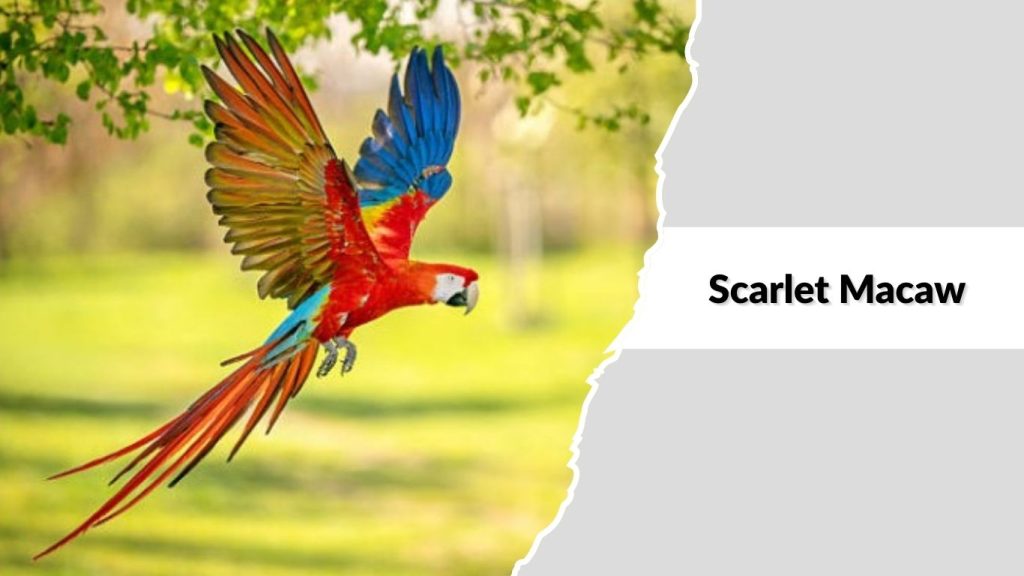
The Scarlet Macaw is one of the most colorful and recognizable parrots in the world, famous for its brilliant red plumage combined with bright yellow and blue wings. Native to tropical forests of Central and South America, this macaw is highly intelligent, social, and vocal. It is often seen flying in pairs or small flocks high above the rainforest canopy.
Identification
- Large macaw, about 81–96 cm (32–38 inches) long
- Bright red body with yellow and blue wing feathers
- Long, pointed red-and-blue tail
- Bare white facial skin with fine feather lines
- Strong, pale upper beak and black lower beak
- Dark gray legs and zygodactyl feet
Habitat
Scarlet Macaws live mainly in lowland tropical rainforests, river-edge forests, and open woodlands. They are commonly found near rivers and clay licks, which provide essential minerals. Their range extends from southern Mexico through Central America and into the Amazon Basin of South America.
Behaviors
These macaws are very social and usually travel in pairs or noisy flocks. They form strong lifelong pair bonds and communicate with loud, harsh calls. Scarlet Macaws are active, agile flyers and are known for their playful nature, strong curiosity, and complex social interactions.
Diet
Their diet consists mainly of fruits, nuts, seeds, flowers, and leaf buds. They often visit clay licks to consume mineral-rich soil, which helps neutralize toxins found in some seeds and supports digestion.
Lifespan
In the wild, Scarlet Macaws typically live 30 to 40 years. In captivity, they can live 50 years or more with proper care. Their slow reproduction and dependence on forest habitats make them vulnerable to deforestation and illegal pet trade.
3. Blue-and-Yellow Macaw
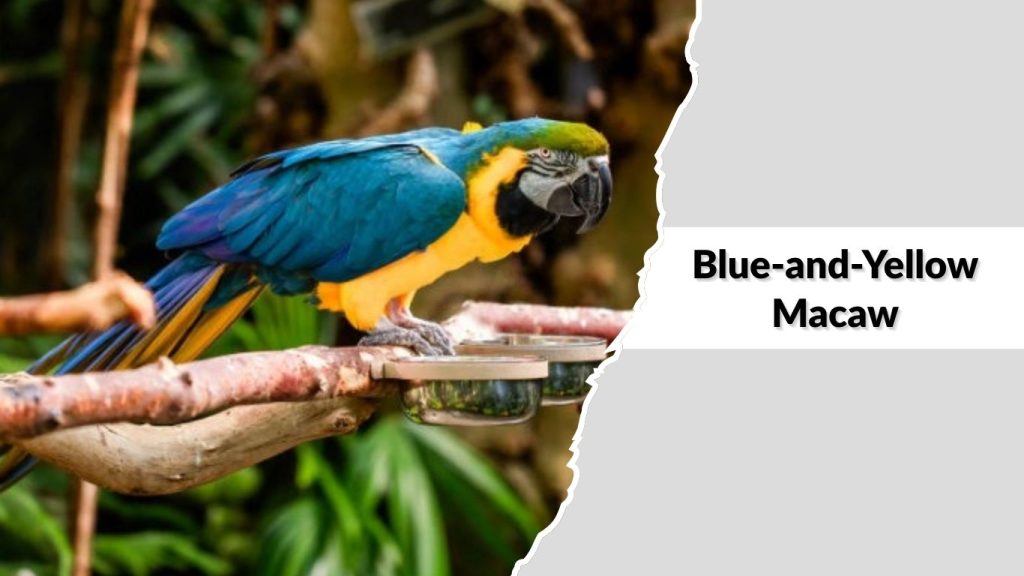
The Blue-and-Yellow Macaw is a large, striking parrot known for its bright blue upperparts and rich golden-yellow underparts. Native to South America, it is one of the most widespread macaw species and is often seen flying in pairs or small flocks over forests and river corridors. This macaw is highly intelligent, vocal, and strongly bonded to its mate.
Identification
- Large macaw, about 76–86 cm (30–34 inches) in length
- Bright blue wings, back, and tail with golden-yellow chest and belly
- Greenish forehead fading into blue crown
- Bare white facial skin with thin black feather lines
- Large, curved black beak built for cracking nuts
- Long, pointed tail and dark gray feet
Habitat
Blue-and-Yellow Macaws inhabit a wide range of environments including tropical rainforests, seasonally flooded forests, palm swamps, gallery forests, and open woodland near rivers. They are distributed across much of northern and central South America, especially within the Amazon Basin.
Behaviors
They are very social birds, usually seen in pairs or small groups, though larger flocks may gather at feeding sites and clay licks. They communicate through loud calls, squawks, and screams. These macaws are intelligent, curious, and spend much of the day flying, feeding, and preening with their partners.
Diet
Their diet includes fruits, seeds, nuts, berries, and plant material. They regularly visit clay licks to consume mineral-rich soil, which helps neutralize plant toxins and aids digestion.
Lifespan
In the wild, Blue-and-Yellow Macaws generally live 30 to 35 years. In captivity, they can live 50 years or longer with proper care, enriched environments, and a balanced diet.
4. Green-Winged Macaw
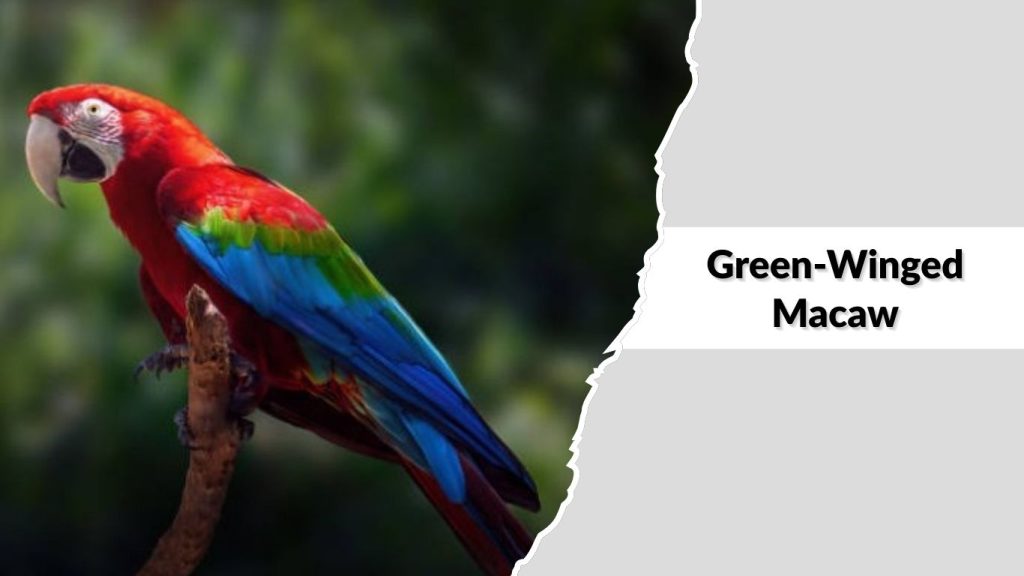
The Green-Winged Macaw, also known as the Red-and-Green Macaw, is one of the largest macaw species and is admired for its deep red body, green wings, and blue flight feathers. Native to the tropical forests of South America, this powerful and intelligent parrot is known for its gentle temperament, loud calls, and strong pair bonds.
Identification
- Very large macaw, reaching 90–95 cm (35–37 inches) in length
- Deep red head, chest, and upper body
- Green wings with blue flight feathers
- Long red-and-blue tail
- Bare white facial skin with thin red feather lines
- Massive, strong black-and-ivory beak
Habitat
Green-Winged Macaws are found in lowland rainforests, river-edge forests, swamp forests, and open woodlands across the Amazon Basin and surrounding regions. They often stay near large rivers, where tall trees provide suitable nesting cavities and abundant food sources.
Behaviors
These macaws are usually seen in pairs or small family groups. They are highly social, form lifelong bonds, and communicate with loud, rolling calls. Green-Winged Macaws are intelligent, playful, and affectionate, often engaging in mutual preening and synchronized flying with their mates.
Diet
Their natural diet consists of fruits, nuts, seeds, berries, and occasionally flowers and leaf buds. Like many macaws, they regularly visit clay licks to ingest minerals that help detoxify their diet.
Lifespan
In the wild, Green-Winged Macaws can live around 30 to 40 years. In captivity, they often live 50 to 60 years with proper nutrition, space, and mental stimulation.
5. Military Macaw
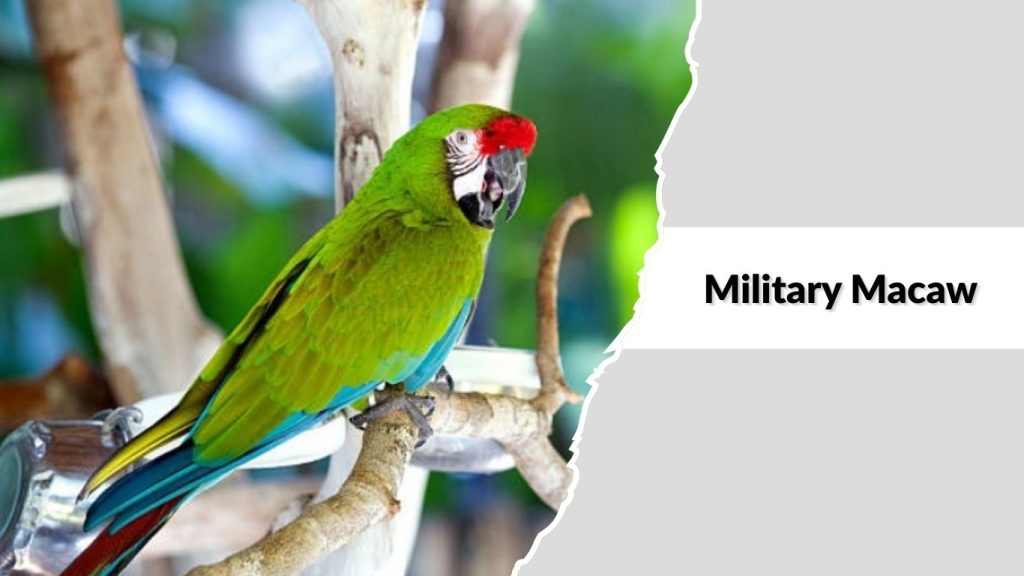
The Military Macaw is a large, mostly green macaw known for its bright red forehead, blue flight feathers, and powerful hooked beak. It inhabits forests and mountainous regions of Central and South America and is named for its uniform-like green coloration. This intelligent and social bird often travels in pairs or small flocks and is recognized by its loud, echoing calls.
Identification
- Large macaw, about 70–78 cm (27–31 inches) long
- Predominantly green plumage
- Bright red patch on the forehead
- Blue wings and tail tips
- Bare white facial skin with fine black feather lines
- Strong black beak and dark gray feet
Habitat
Military Macaws live in tropical and subtropical forests, wooded canyons, and foothills, often near rivers and cliffs. Their range stretches from western Mexico through Central America and into parts of South America, especially Peru, Colombia, and Bolivia. They commonly nest in tall trees or rocky cliff cavities.
Behaviors
These macaws are social and typically seen in pairs or small groups. They form strong lifelong bonds and communicate using loud, harsh calls that carry long distances. Military Macaws are agile flyers and spend much of their time foraging, preening, and resting high in forest canopies.
Diet
Their diet includes fruits, seeds, nuts, berries, and leafy plant material. They also feed on figs and other forest fruits and may travel long distances daily between roosting and feeding sites.
Lifespan
In the wild, Military Macaws usually live around 30 to 40 years. In captivity, they can live 50 years or more with proper care, a balanced diet, and mental stimulation.
6. Red-Fronted Macaw
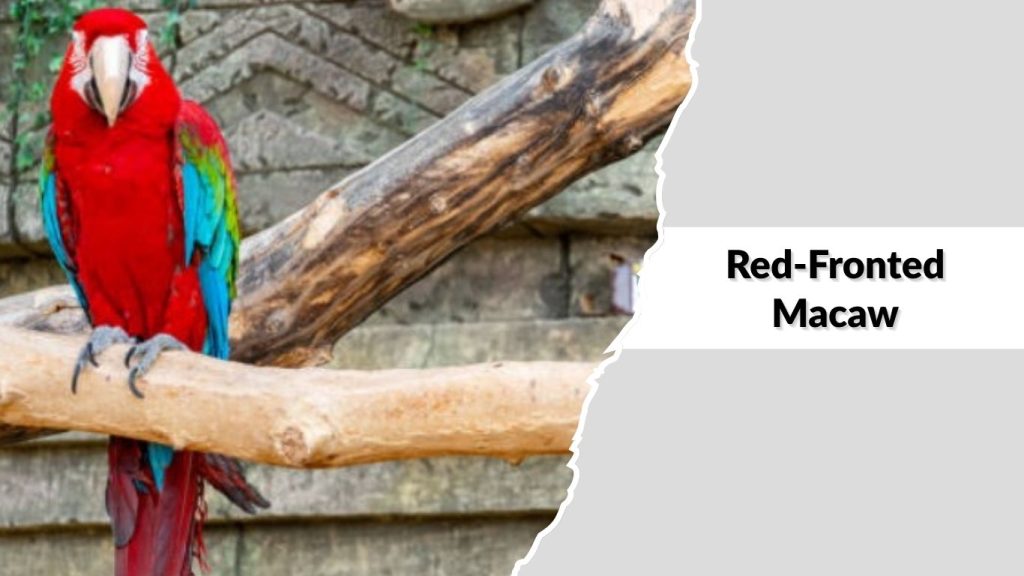
The Red-Fronted Macaw is a rare and striking macaw species distinguished by its mostly green body and bright red forehead. It is endemic to a small region of central Bolivia, making it one of the most geographically restricted macaws in the world. This macaw is well adapted to dry valleys and rocky landscapes, unlike most forest-dwelling macaws.
Identification
- Medium-sized macaw, about 55–60 cm (22–24 inches) long
- Predominantly green plumage
- Bright red patch on the forehead and face
- Blue on wings and tail
- Bare white facial skin with fine feather lines
- Strong gray-black beak and dark feet
Habitat
Red-Fronted Macaws inhabit dry intermontane valleys, thorn forests, cactus-rich slopes, and rocky cliffs of central Bolivia. They often nest in cliff crevices rather than tree cavities and forage in surrounding agricultural areas, scrublands, and river valleys.
Behaviors
These macaws are usually seen in pairs or small flocks, though larger groups may gather at feeding sites. They are noisy, social, and strong fliers, often traveling long distances between roosting and feeding areas. Cliff-nesting and flock roosting are key behavioral traits.
Diet
Their diet consists of seeds, fruits, nuts, maize, cactus fruits, and other cultivated crops. They also feed on wild vegetation, adapting their diet to seasonal food availability in their dry habitat.
Lifespan
In the wild, Red-Fronted Macaws are believed to live around 25 to 35 years. In captivity, they may live over 40 years with proper care and nutrition.
7. Blue-Throated Macaw
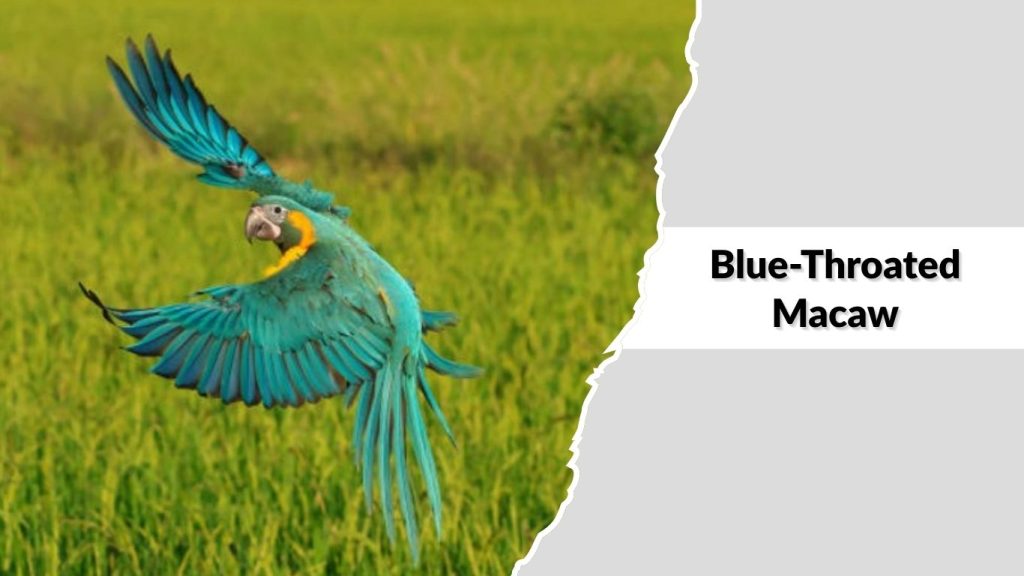
The Blue-Throated Macaw is a critically endangered macaw species known for the vivid blue patch on its throat and its bright turquoise-blue wings. It is native to a small area of northern Bolivia and is one of the rarest macaws in the world. This beautiful bird depends heavily on palm-rich savannas and forest islands.
Identification
- Medium-large macaw, about 85 cm (33 inches) long
- Bright blue throat patch and facial markings
- Golden-yellow chest and underparts
- Turquoise-blue wings, back, and tail
- Bare facial skin with fine blue feather lines
- Strong black curved beak and gray feet
Habitat
Blue-Throated Macaws live mainly in seasonally flooded savannas, palm groves, and forest islands of northern Bolivia, particularly in the Beni region. They rely on large palms for nesting cavities and food and are usually found near rivers and wetlands.
Behaviors
They are social birds typically seen in pairs or small family groups. Blue-Throated Macaws form strong pair bonds and communicate through loud calls. They are strong, graceful fliers and spend much of their day feeding, preening, and moving between forest patches.
Diet
Their diet mainly includes palm fruits, nuts, seeds, and other seasonal fruits. They are especially dependent on palm species, which provide both nutrition and nesting sites.
Lifespan
In the wild, Blue-Throated Macaws are estimated to live 30 to 40 years. In captivity, they can live over 50 years with proper care, protection, and a nutritionally balanced diet.
8. Great Green Macaw
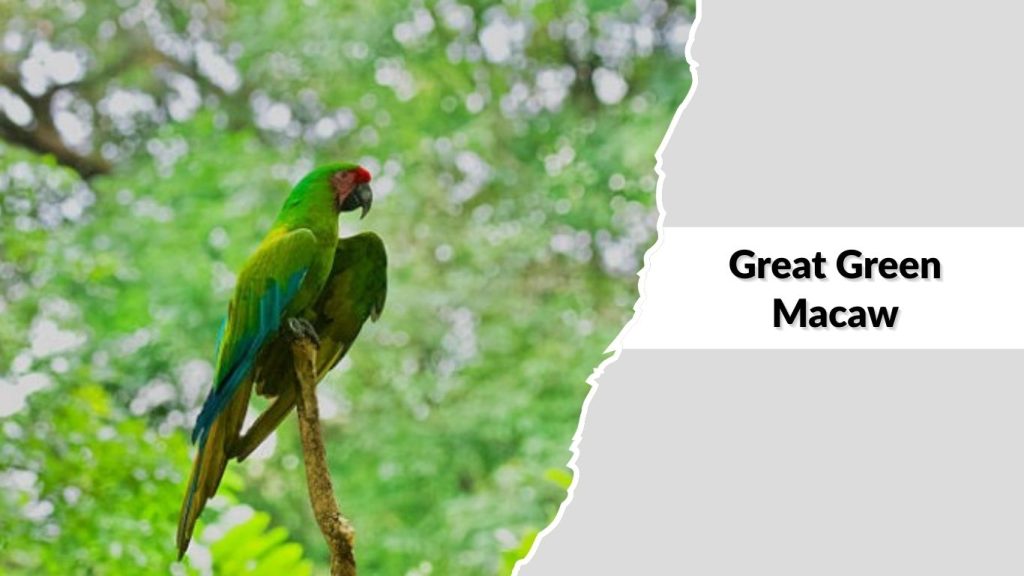
The Great Green Macaw, also known as the Buffon’s Macaw, is a large and impressive parrot recognized for its mostly green plumage accented with blue wings and a red forehead. Native to Central America and the northwestern parts of South America, this macaw is strongly associated with lowland rainforests and large fruiting trees.
Identification
- Large macaw, about 85–90 cm (33–35 inches) long
- Predominantly green body with turquoise-blue wings
- Bright red patch on the forehead
- Pale green to blue tail
- Bare white facial skin with thin black feather lines
- Heavy black beak and dark gray feet
Habitat
Great Green Macaws inhabit lowland tropical rainforests, river-edge forests, and tall evergreen forests. They are most commonly found in Costa Rica, Nicaragua, Panama, Colombia, and Ecuador. Large mature trees are essential for nesting and feeding.
Behaviors
These macaws are usually seen in pairs or small family groups. They form lifelong bonds and are known for powerful flight and loud, rolling calls. Great Green Macaws often travel long distances daily between nesting and feeding sites.
Diet
Their diet consists mainly of fruits and seeds from large rainforest trees, especially almond trees, along with nuts and other seasonal fruits. They play an important role in seed dispersal within their ecosystem.
Lifespan
In the wild, Great Green Macaws generally live around 30 to 40 years. In captivity, they may live over 50 years when provided with proper care, space, and nutrition.
9. Illiger’s Macaw
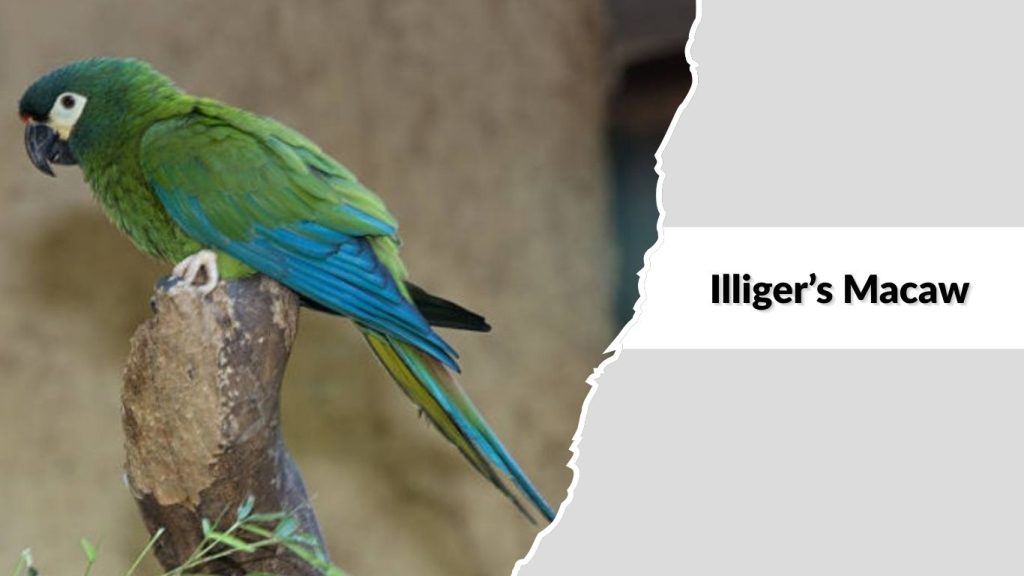
Illiger’s Macaw, also known as the Blue-Winged Macaw, is a medium-sized macaw admired for its green body, blue wing feathers, and reddish forehead. It is native to central South America and is commonly found near river forests and palm groves. This species is energetic, intelligent, and often seen flying swiftly between feeding and roosting sites.
Identification
- Medium-sized macaw, about 45–50 cm (18–20 inches) long
- Mostly green plumage with blue flight feathers
- Reddish patch on the forehead and belly
- Long tapered tail with bluish tips
- Bare pale facial skin with fine dark feather lines
- Strong dark beak and gray feet
Habitat
Illiger’s Macaws inhabit gallery forests, woodland edges, palm swamps, and riverine forests of Brazil, Paraguay, Bolivia, and northern Argentina. They are especially associated with palm-rich areas, which provide both food and nesting cavities.
Behaviors
These macaws are social and usually occur in pairs or small flocks. They are fast, agile fliers and are known for their sharp, high-pitched calls. Illiger’s Macaws are active birds that spend much of the day foraging, climbing, and interacting with their mates.
Diet
Their diet mainly includes palm fruits, seeds, nuts, berries, and other available fruits. They also feed on buds and occasional vegetation, adjusting their diet according to seasonal availability.
Lifespan
In the wild, Illiger’s Macaws are believed to live around 25 to 35 years. In captivity, they can live over 40 years with proper nutrition, enrichment, and veterinary care.
10. Yellow-Collared Macaw
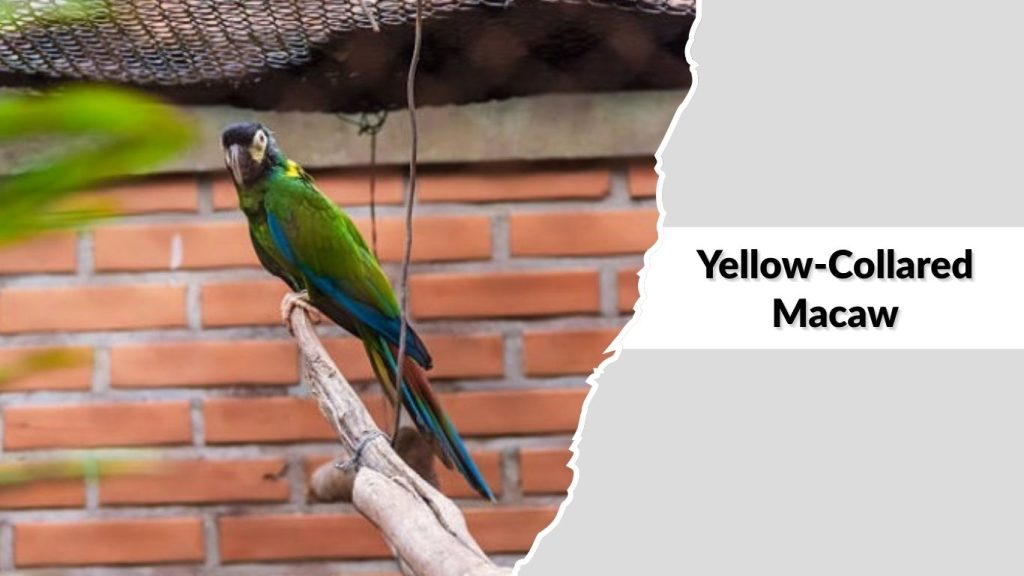
The Yellow-Collared Macaw is a small, lively macaw species recognized by the bright yellow band around the back of its neck and its mostly green body. Native to central South America, it is one of the more adaptable macaws and is often found in open woodlands, savannas, and palm groves. This species is energetic, social, and highly vocal.
Identification
- Small macaw, about 33–38 cm (13–15 inches) long
- Predominantly green plumage
- Distinct yellow collar on the nape of the neck
- Bluish wings and tail
- Bare pale facial skin
- Black curved beak and gray feet
Habitat
Yellow-Collared Macaws inhabit savannas, open forests, palm groves, woodland edges, and riverine forests. Their range includes Brazil, Bolivia, Paraguay, and parts of northern Argentina. They often stay near water sources and palm-rich areas.
Behaviors
These macaws are usually seen in pairs or small flocks. They are fast, agile fliers and communicate with sharp, high-pitched calls. Yellow-Collared Macaws are curious, active, and often forage both in trees and on the ground.
Diet
Their diet includes fruits, seeds, nuts, berries, blossoms, and palm fruits. They may also feed on cultivated crops, especially during seasons when wild food sources are limited.
Lifespan
In the wild, Yellow-Collared Macaws generally live around 25 to 35 years. In captivity, they may live over 40 years with proper care, social interaction, and a balanced diet.
11. Red-Bellied Macaw
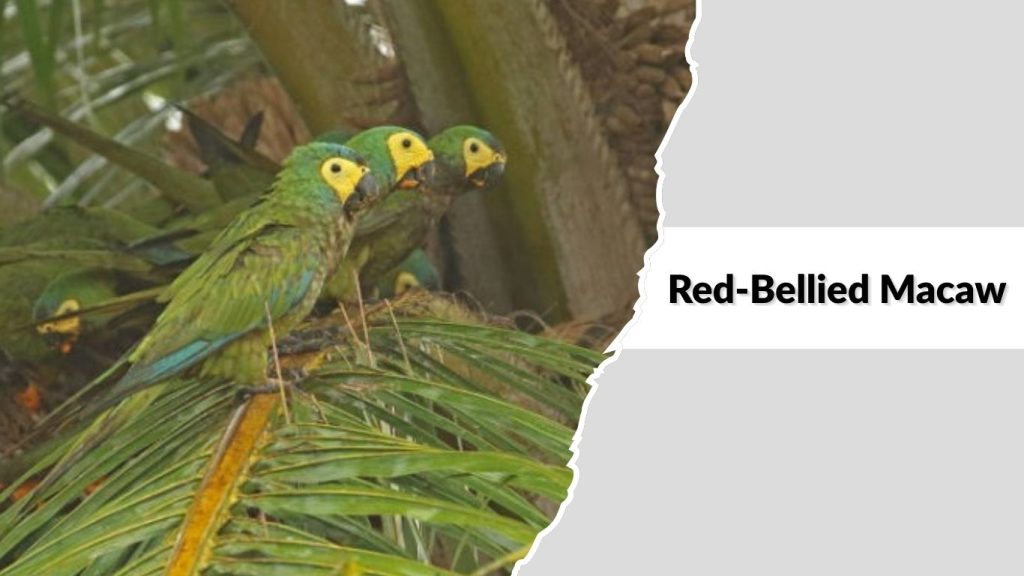
The Red-Bellied Macaw is a medium-sized macaw known for its mostly green plumage and the distinct reddish patch on its lower belly. Unlike many forest macaws, this species is closely associated with palm swamps and flooded lowlands. Native to northern South America, it is a strong flier and is often seen moving in noisy flocks over wetlands and river corridors.
Identification
- Medium-sized macaw, about 46–51 cm (18–20 inches) long
- Predominantly green body
- Distinct red patch on the lower belly
- Blue wings and tail
- Bare pale facial skin
- Strong dark beak and gray feet
Habitat
Red-Bellied Macaws inhabit palm swamps, flooded forests, riverine woodlands, and lowland wetlands. They are found mainly in the Amazon Basin and Orinoco regions, including Brazil, Venezuela, Colombia, and the Guianas.
Behaviors
These macaws are social and usually appear in pairs or small flocks, though larger groups gather where food is abundant. They are loud, active, and powerful fliers, often traveling long distances between roosting and feeding areas.
Diet
Their diet is strongly dominated by palm fruits, especially from moriche and other swamp palms. They also eat seeds, fruits, and occasionally flowers and vegetation.
Lifespan
In the wild, Red-Bellied Macaws typically live around 25 to 35 years. In captivity, they can live over 40 years when provided with proper nutrition and care.
12. Blue-Headed Macaw
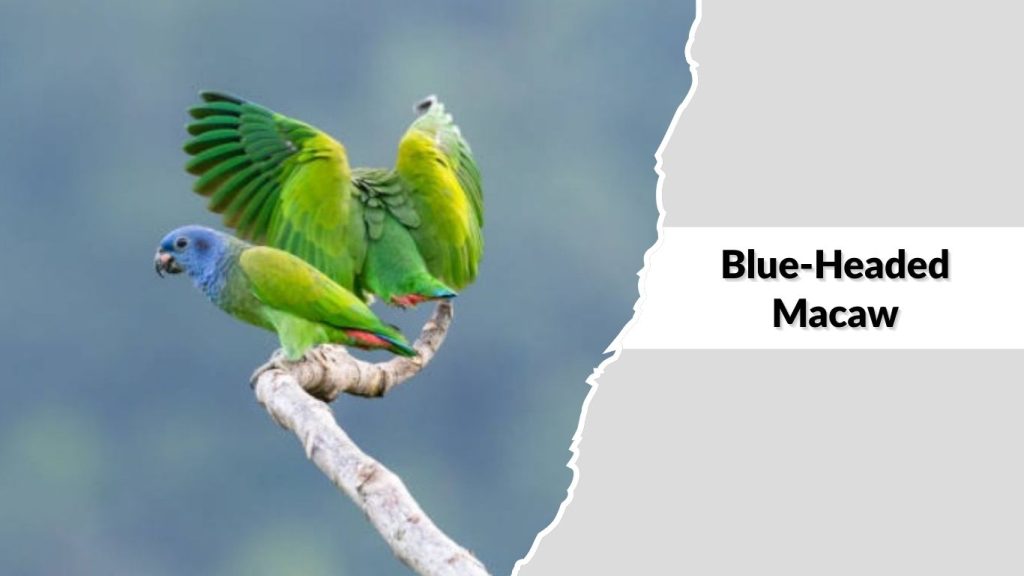
The Blue-Headed Macaw is a rare and striking macaw species distinguished by its blue head, green body, and reddish shoulder patches. Native to southwestern Amazonia, it inhabits humid lowland forests and river-edge woodlands. This secretive macaw is less commonly seen than many others and is usually found in small, quiet groups.
Identification
- Medium-sized macaw, about 41–45 cm (16–18 inches) long
- Bright blue head and crown
- Predominantly green body
- Reddish shoulder patches
- Long green-and-blue tail
- Pale facial skin with thin feather lines
Habitat
Blue-Headed Macaws inhabit humid lowland rainforests, terra firme forests, and river-edge woodlands. They are found mainly in Peru, western Brazil, and parts of Bolivia, often staying near tall forest canopies.
Behaviors
These macaws are usually seen in pairs or small family groups. They are quieter and more secretive than many other macaws but still communicate with sharp calls. They are agile fliers and spend much of their time high in the forest canopy.
Diet
Their diet consists of fruits, seeds, nuts, and berries gathered from tall rainforest trees. They may also feed on flowers and plant material depending on seasonal availability.
Lifespan
In the wild, Blue-Headed Macaws are believed to live around 25 to 35 years. In captivity, they can live over 40 years with appropriate care and conservation management.
13. Chestnut-Fronted Macaw
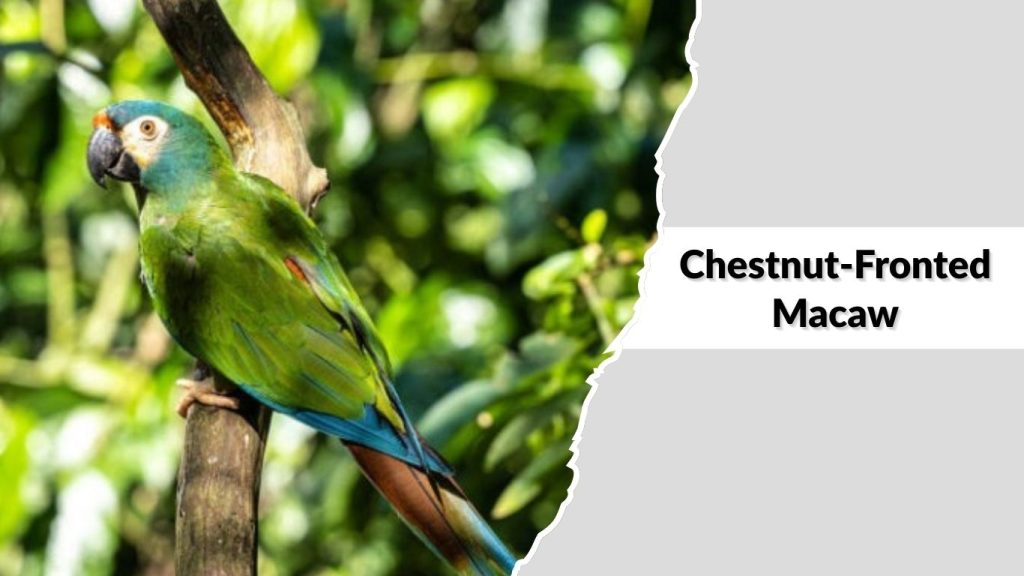
The Chestnut-Fronted Macaw, also called the Severe Macaw, is a medium-sized macaw recognized by the chestnut-brown patch on its forehead and its mostly green plumage. It is widely distributed across northern and central South America and is commonly seen along forest edges and river corridors. This macaw is energetic, vocal, and highly social.
Identification
- Medium-sized macaw, about 45–50 cm (18–20 inches) long
- Predominantly green body
- Distinct chestnut-brown forehead patch
- Blue wings and tail
- Bare white facial skin
- Strong dark beak and gray feet
Habitat
Chestnut-Fronted Macaws inhabit lowland rainforests, gallery forests, river-edge forests, and forest clearings. Their range extends across the Amazon Basin, including Brazil, Colombia, Peru, Venezuela, and the Guianas.
Behaviors
These macaws are typically seen in pairs or small flocks. They are loud, active, and excellent fliers. Chestnut-Fronted Macaws are known for their playful behavior, frequent vocalizations, and strong pair bonds.
Diet
Their diet includes fruits, nuts, seeds, berries, flowers, and leaf buds. They may also visit clay licks to obtain minerals and aid digestion.
Lifespan
In the wild, Chestnut-Fronted Macaws usually live around 25 to 35 years. In captivity, they can live over 40 years with proper nutrition, enrichment, and veterinary care.
14. Hahn’s Macaw
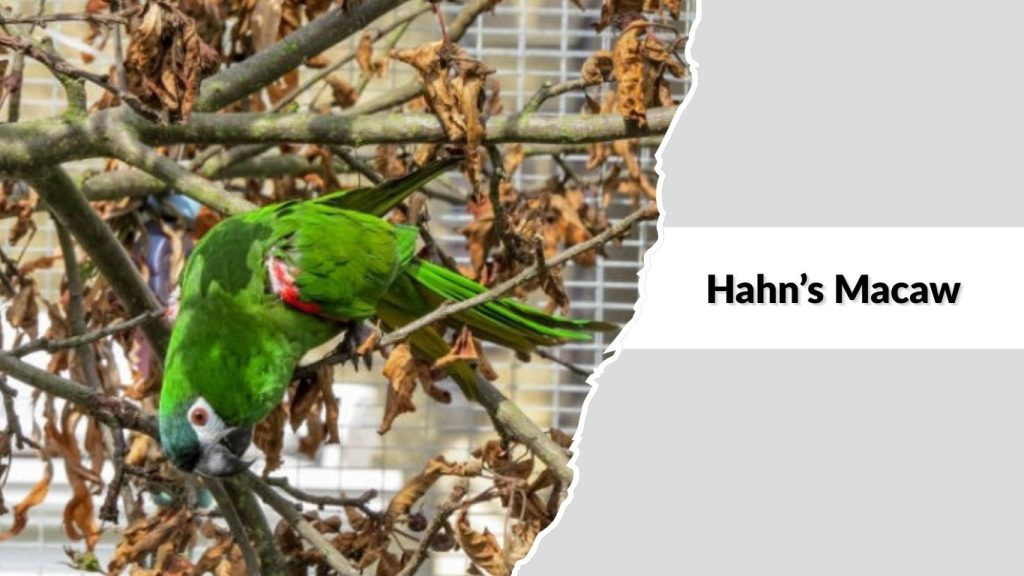
The Hahn’s Macaw, also known as the Red-Shouldered Macaw, is one of the smallest macaw species and is admired for its compact size, green body, and bright red shoulder patches. Native to northern and central South America, this macaw is energetic, intelligent, and very social. It is often seen flying in fast-moving pairs or small flocks over forests and river corridors.
Identification
- Small macaw, about 30–33 cm (12–13 inches) long
- Mostly green plumage
- Bright red patches on the shoulders and wing bends
- Bluish flight feathers and tail
- Bare pale facial skin
- Strong dark beak and gray feet
Habitat
Hahn’s Macaws inhabit lowland rainforests, riverine forests, palm groves, and woodland edges. They are found across Brazil, Venezuela, Colombia, Peru, and the Guianas, usually staying close to water sources and dense vegetation.
Behaviors
These macaws are social and typically appear in pairs or small flocks. They are fast, agile fliers and communicate using sharp, high-pitched calls. Hahn’s Macaws are active, curious birds that spend much of their time foraging, climbing, and interacting with their mates.
Diet
Their diet consists of fruits, seeds, nuts, berries, blossoms, and palm fruits. They may also feed on cultivated crops when wild foods are scarce.
Lifespan
In the wild, Hahn’s Macaws usually live around 25 to 30 years. In captivity, they can live over 40 years with proper care, social interaction, and a balanced diet.
15. Golden-Collared Macaw
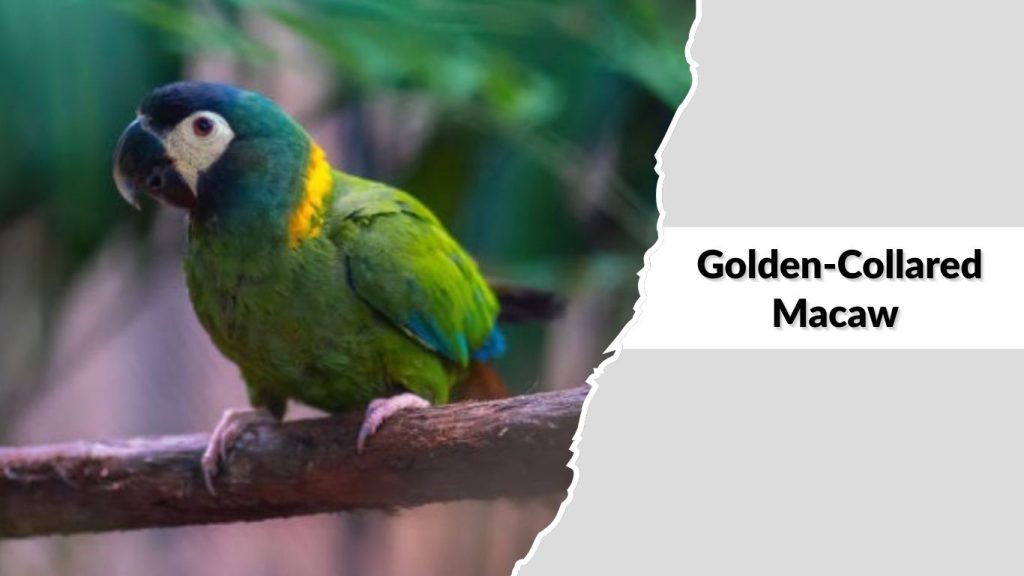
The Golden-Collared Macaw is a small, attractive macaw species known for the bright golden-yellow band around the back of its neck and its vivid green body. Native to central South America, this macaw inhabits open woodlands, savannas, and palm groves. It is energetic, intelligent, and often seen in fast-moving, noisy flocks.
Identification
- Small macaw, about 33–36 cm (13–14 inches) long
- Predominantly green plumage
- Bright golden-yellow collar on the nape
- Bluish wings and tail
- Bare pale facial skin
- Black curved beak and gray feet
Habitat
Golden-Collared Macaws live in savannas, palm groves, open forests, woodland edges, and riverine habitats. They are found mainly in Brazil, Bolivia, and Paraguay, often near water sources and palm-rich environments.
Behaviors
These macaws are social and usually occur in pairs or small flocks. They are fast, agile fliers and communicate with high-pitched, sharp calls. Golden-Collared Macaws are active, curious, and spend much of their day foraging and interacting.
Diet
Their diet includes fruits, seeds, nuts, palm fruits, blossoms, and berries. They may also feed on cultivated crops, especially during dry seasons.
Lifespan
In the wild, Golden-Collared Macaws generally live around 25 to 35 years. In captivity, they can live over 40 years with proper care, mental stimulation, and a balanced diet.
16. Glaucous Macaw
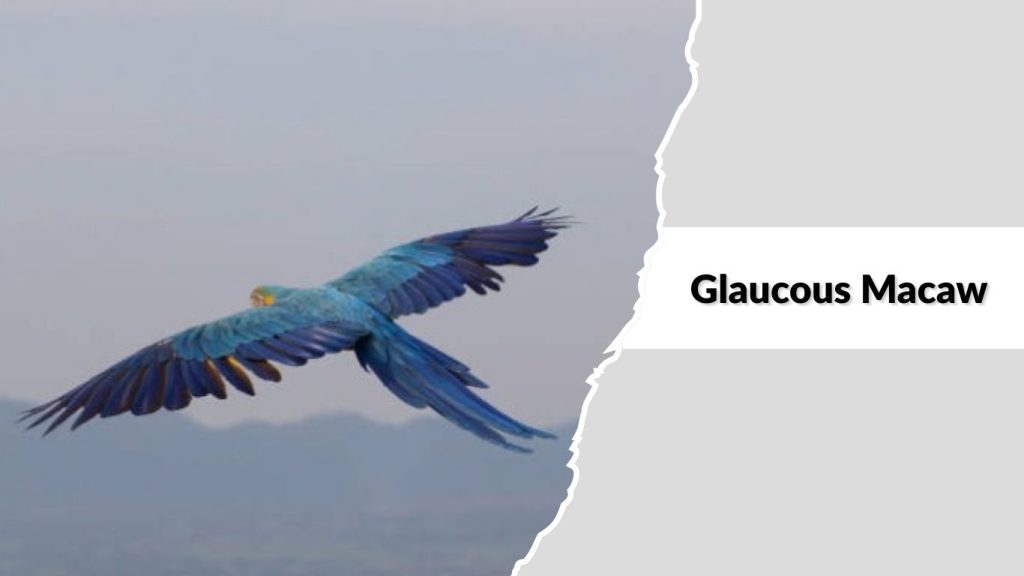
The Glaucous Macaw is an extinct or possibly critically endangered macaw species that was once native to southern South America. It was known for its pale bluish-gray (glaucous) plumage and association with river systems and palm forests. Very little is known about its behavior because it disappeared before detailed scientific studies could be completed.
Identification
- Medium-large macaw, about 70 cm (27 inches) long
- Pale bluish-gray body coloration
- Yellow bare skin around the eyes and base of the beak
- Long pointed tail
- Strong curved black beak
- Dark gray feet
Habitat
Historically, Glaucous Macaws inhabited riverine forests, palm groves, and wetlands along the Paraná, Uruguay, and Paraguay river systems in Brazil, Argentina, Paraguay, and Uruguay. They were closely associated with palm species that likely provided both food and nesting sites.
Behaviors
Very little is documented about their behavior. They were believed to be social birds, probably living in pairs or small flocks like other macaws. They were likely strong fliers and relied on tall palms and riverside forests.
Diet
Their diet was thought to consist mainly of palm nuts, seeds, and fruits, especially from native palm species. Specialized feeding habits may have contributed to their decline.
Lifespan
The exact lifespan is unknown. Based on related macaw species, Glaucous Macaws likely lived 30 to 40 years in the wild.
17. Cuban Macaw
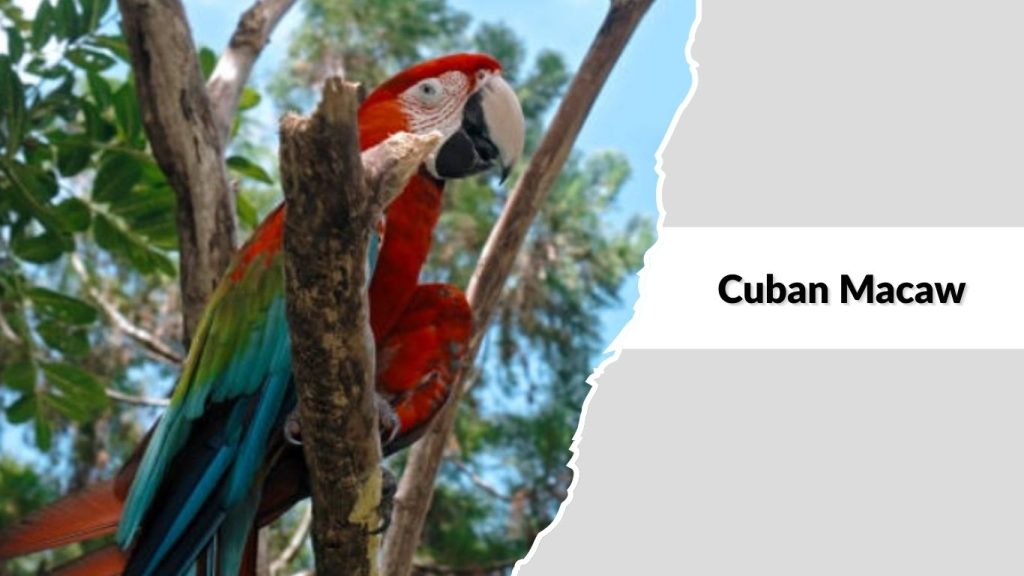
The Cuban Macaw is an extinct macaw species that once lived on the island of Cuba. It was smaller than many South American macaws and was known for its colorful plumage, including red, blue, and yellow tones. The species disappeared in the late 19th century, mainly due to habitat destruction and hunting.
Identification
- Medium-sized macaw, about 45–50 cm (18–20 inches) long
- Reddish head and body
- Blue wings and tail feathers
- Yellow patches on parts of the body
- Bare pale facial skin
- Strong curved beak and gray feet
Habitat
Cuban Macaws originally lived in lowland forests, palm groves, and wooded savannas across Cuba. They depended on large trees for nesting cavities and nearby fruiting trees and palms for food.
Behaviors
Little was recorded about their behavior. They were likely social birds, living in pairs or small flocks. Like other macaws, they probably formed strong pair bonds and were noisy, powerful fliers.
Diet
Their diet likely consisted of fruits, seeds, nuts, and palm fruits. They may also have fed on buds and soft plant material.
Lifespan
The exact lifespan is unknown. Based on related macaws, Cuban Macaws probably lived around 30 to 40 years in the wild.
18. Spix’s Macaw
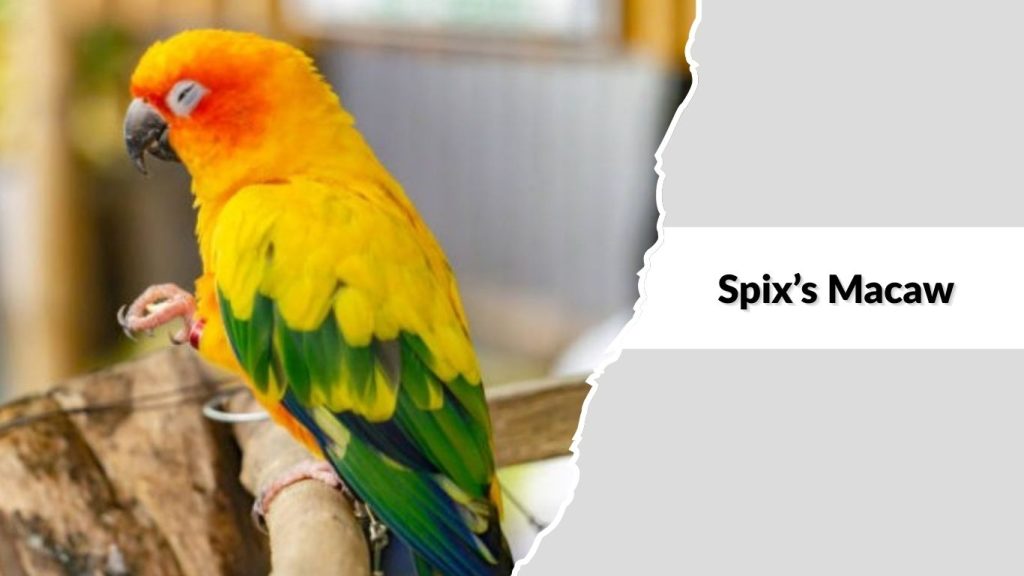
Spix’s Macaw, also known as the Little Blue Macaw, is a critically endangered (once considered extinct in the wild) species famous for its soft blue-gray plumage. It is native to a very small region of northeastern Brazil and became a global symbol of wildlife conservation. Thanks to intensive conservation efforts, reintroduction programs are now underway.
Identification
- Medium-sized macaw, about 55–57 cm (22 inches) long
- Pale blue-gray body and head
- Darker blue wings and tail
- Bare dark facial skin
- Strong curved black beak
- Dark gray feet
Habitat
Spix’s Macaws historically inhabited gallery forests along seasonal rivers in the Caatinga region of Brazil. They relied heavily on specific tree species for nesting and foraging, especially caraibeira trees.
Behaviors
Very little natural behavior was recorded before they disappeared from the wild. They were believed to live in pairs or small family groups and to form strong lifelong bonds. They were likely vocal, social, and dependent on riverine forest corridors.
Diet
Their diet consisted mainly of seeds, nuts, fruits, and plant material from native trees and shrubs. They may have specialized in certain local food sources.
Lifespan
Spix’s Macaws are estimated to live around 25 to 35 years. In managed conservation settings, individuals have lived over 40 years.
19. Indigo Macaw
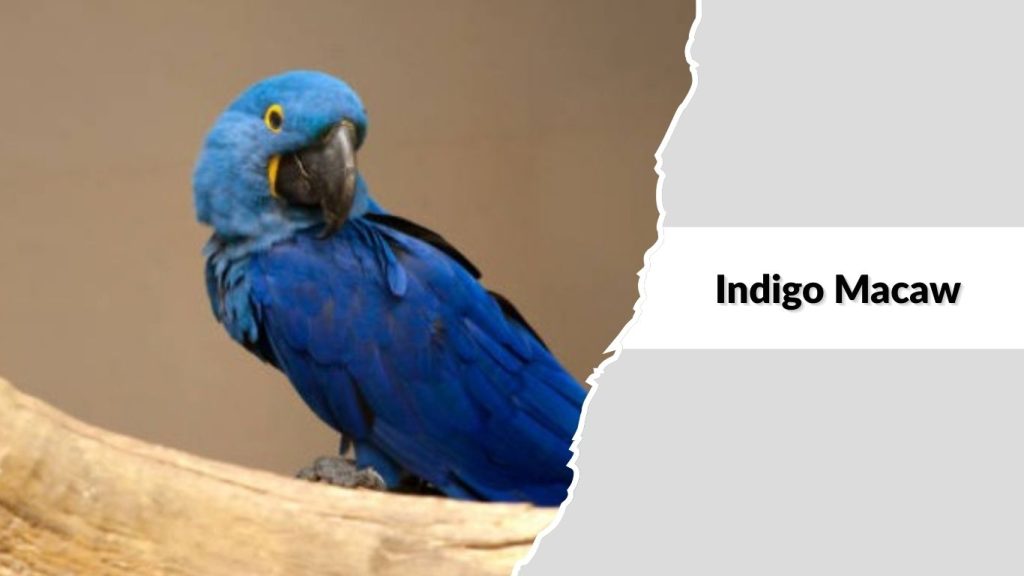
The Indigo Macaw is an extinct macaw species believed to have lived in the Caribbean region, possibly in Jamaica or nearby islands. Its existence is based mainly on historical descriptions and old illustrations rather than preserved specimens. It was said to have deep blue or indigo-colored plumage, which gave rise to its name.
Identification
- Medium-sized macaw (exact size unknown)
- Described as having deep indigo or dark blue plumage
- Likely long-tailed like other macaws
- Strong curved beak typical of macaws
- Bare facial skin around the eyes (assumed)
Habitat
The Indigo Macaw was thought to inhabit tropical forests and woodland areas of Caribbean islands. It likely depended on large trees for nesting cavities and nearby fruiting plants for food.
Behaviors
No direct scientific observations exist. Based on related macaw species, it was probably social, living in pairs or small flocks, and communicated using loud calls. It was likely a strong flier and canopy-dwelling bird.
Diet
Its diet was probably made up of fruits, seeds, nuts, and possibly palm fruits, similar to other macaws living in tropical regions.
Lifespan
The exact lifespan is unknown. Based on comparable macaw species, Indigo Macaws may have lived around 30 to 40 years.
20. Severa Macaw
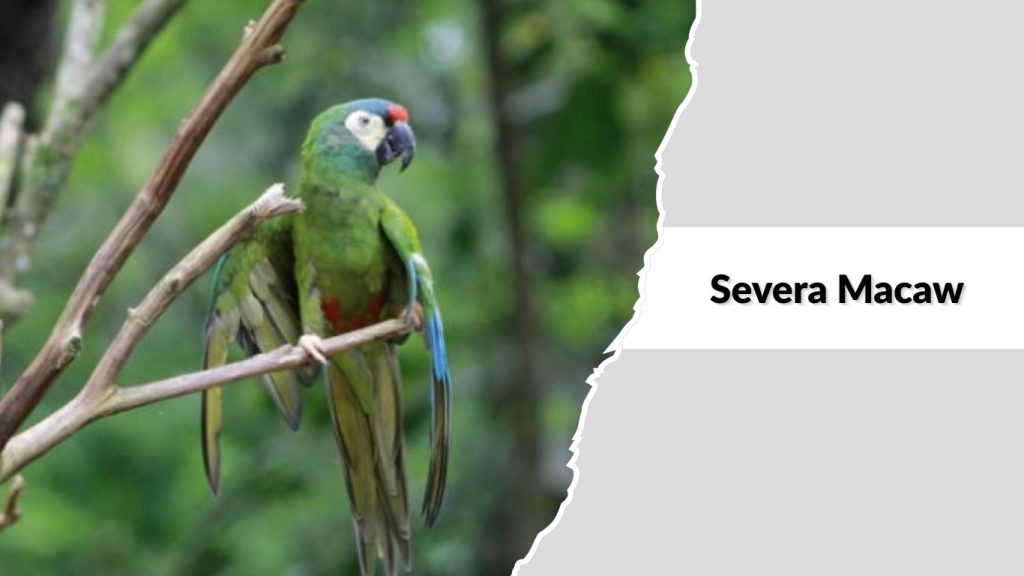
The Severa Macaw, more commonly known as the Severe Macaw or Chestnut-Fronted Macaw, is a medium-sized macaw native to northern and central South America. It is named for the chestnut-brown patch on its forehead and its mostly green body. This energetic species is adaptable and often seen along forest edges and river corridors.
Identification
- Medium-sized macaw, about 45–50 cm (18–20 inches) long
- Predominantly green plumage
- Distinct chestnut-brown forehead patch
- Blue wings and tail
- Bare white facial skin
- Strong dark beak and gray feet
Habitat
Severa Macaws inhabit lowland rainforests, gallery forests, river-edge forests, and forest clearings across the Amazon Basin and surrounding regions.
Behaviors
They are social birds usually seen in pairs or small flocks. Severa Macaws are loud, playful, and agile fliers. They form strong pair bonds and spend much of their day flying, foraging, and interacting.
Diet
Their diet consists of fruits, seeds, nuts, berries, flowers, and leaf buds. They may also visit clay licks to obtain minerals.
Lifespan
In the wild, Severa Macaws typically live around 25 to 35 years. In captivity, they may live over 40 years with proper care.
21. Lear’s Macaw
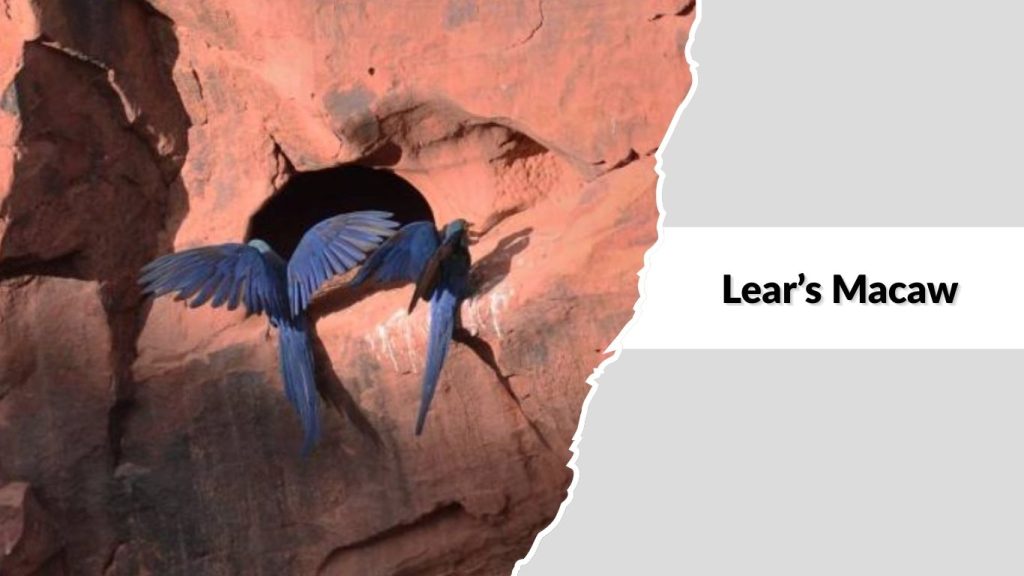
Lear’s Macaw, also called the Indigo Macaw (in modern taxonomy), is a large, deep-blue macaw species endemic to a small region of northeastern Brazil. It is best known for its strong dependence on licuri palm nuts and its dramatic recovery from near extinction due to focused conservation efforts.
Identification
- Large macaw, about 70–75 cm (27–30 inches) long
- Deep cobalt-blue plumage over most of the body
- Slight greenish tint on the head
- Bright yellow skin at the base of the beak and around the eyes
- Very strong black curved beak
- Long pointed tail and dark gray feet
Habitat
Lear’s Macaws inhabit dry caating woodlands, rocky cliffs, and palm-dominated valleys of northeastern Brazil. They nest mainly in sandstone cliffs and forage daily in nearby palm groves.
Behaviors
They are highly social birds, usually seen in pairs or small flocks. Lear’s Macaws are powerful fliers and very vocal, using loud calls to communicate across long distances. They show strong pair bonds and often roost communally on cliffs.
Diet
Their diet is highly specialized and consists mainly of licuri palm nuts, along with seeds and seasonal fruits. Their strong beaks are perfectly adapted for cracking extremely hard palm shells.
Lifespan
In the wild, Lear’s Macaws are believed to live around 30 to 40 years. In protected and managed environments, individuals may live over 50 years.
FAQs
What is the largest type of macaw in the world?
The Hyacinth Macaw is the largest macaw species and also the largest flying parrot in the world. It can reach about 100 cm (39 inches) in length. It is easily recognized by its deep blue feathers, massive black beak, and bright yellow skin around the eyes and lower beak.
Are all macaw species found in South America?
Most macaw species are native to South America, especially the Amazon Basin, but some also live in Central America and historically in the Caribbean. Their habitats range from rainforests and river-edge forests to savannas, palm swamps, and dry woodland regions.
What do macaws mainly eat in the wild?
Macaws primarily feed on fruits, nuts, seeds, and berries. Many species rely heavily on palm nuts. Some macaws visit clay licks to consume mineral-rich soil, which helps neutralize toxins from certain seeds and supports healthy digestion.
How long do macaw birds usually live?
In the wild, most macaw species live between 25 and 40 years, depending on the species and environment. In captivity, with proper care, balanced nutrition, and veterinary support, many macaws can live 50 years or even longer.
Are any macaw species extinct or critically endangered?
Yes, several macaw species are extinct, such as the Cuban Macaw and likely the Indigo Macaw. Others, including Spix’s Macaw and the Blue-Throated Macaw, are critically endangered due to habitat loss and illegal wildlife trade, although conservation efforts are helping some populations recover.