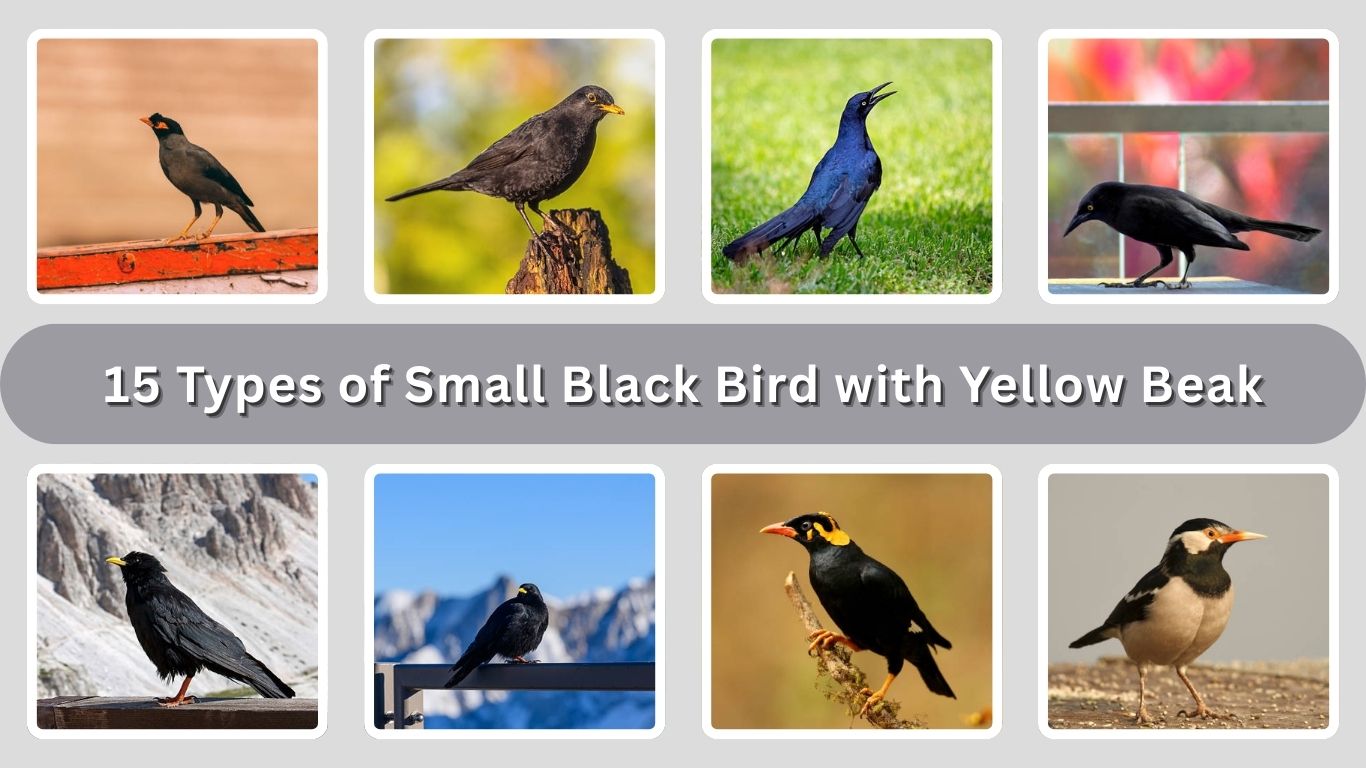
Small black birds with yellow beaks are eye-catching and easy to recognize thanks to their bold color contrast. Found across many parts of the world, these birds belong to different families and thrive in a wide range of habitats, from gardens and forests to mountains and savannas. Despite their similar appearance, each species has unique behaviors, diets, and lifestyles. This guide explores some of the most notable small black birds with yellow beaks and highlights what makes each one special.
1. Common Blackbird (Turdus merula)
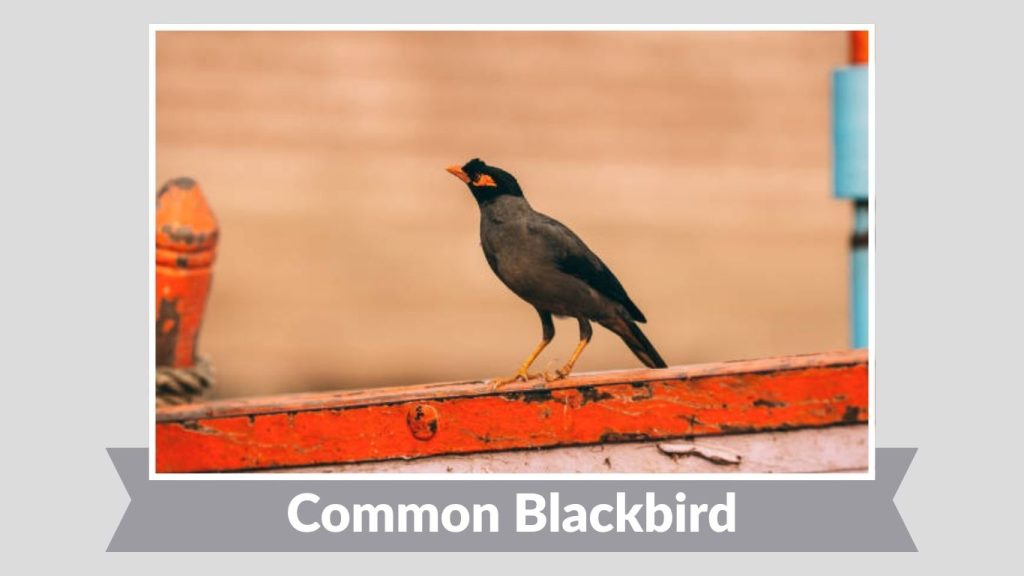
The Common Blackbird is a familiar and widespread songbird known for its glossy black plumage and bright yellow beak. Often seen hopping across lawns or singing from rooftops and trees, it is one of the most recognizable birds in gardens and woodlands across Europe and parts of Asia.
Identification
- Male has jet-black feathers with a bright yellow beak and eye-ring
- Female is dark brown with a duller, brownish beak
- Medium-small body with a long tail
- Clear, rich, flute-like song
Habitat
Common Blackbirds thrive in a wide range of habitats including gardens, parks, forests, hedgerows, and farmland. They adapt well to urban environments as long as trees and shrubs are available.
Behaviors
These birds are mostly ground feeders and are often seen running and stopping abruptly while foraging. Males are territorial during breeding season and sing loudly to defend their space.
Diet
Their diet consists mainly of earthworms, insects, berries, fruits, and seeds. In winter, they rely more on fruits and food scraps found in gardens.
Lifespan
In the wild, Common Blackbirds typically live 3–5 years, though some individuals have been recorded living over 10 years under favorable conditions.
2. Eurasian Blackbird (Turdus merula)
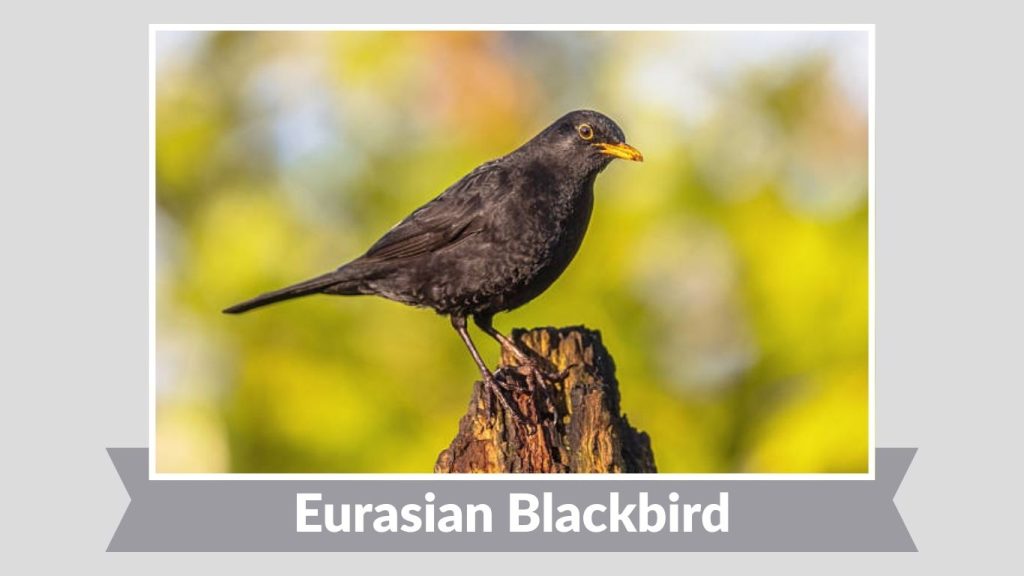
The Eurasian Blackbird is a well-known songbird across Europe, western Asia, and North Africa. Closely associated with gardens and woodlands, it is admired for its strong melodic song and bold presence near human settlements.
Identification
- Adult male has glossy black plumage
- Bright yellow beak and yellow eye-ring
- Female is brown with a slightly speckled chest
- Long tail and rounded wings
Habitat
This bird lives in forests, parks, gardens, orchards, and hedgerows. It easily adapts to urban and suburban areas where food and nesting sites are available.
Behaviors
Eurasian Blackbirds are territorial, especially during the breeding season. Males sing from exposed perches at dawn and dusk, and they forage mainly on the ground.
Diet
Their diet includes insects, worms, snails, berries, fruits, and seeds. Seasonal changes affect their food choices, with more fruit consumed in winter.
Lifespan
The average lifespan is around 3–5 years in the wild, though some individuals can live more than 10 years in protected environments.
3. Common Grackle (Quiscalus quiscula)
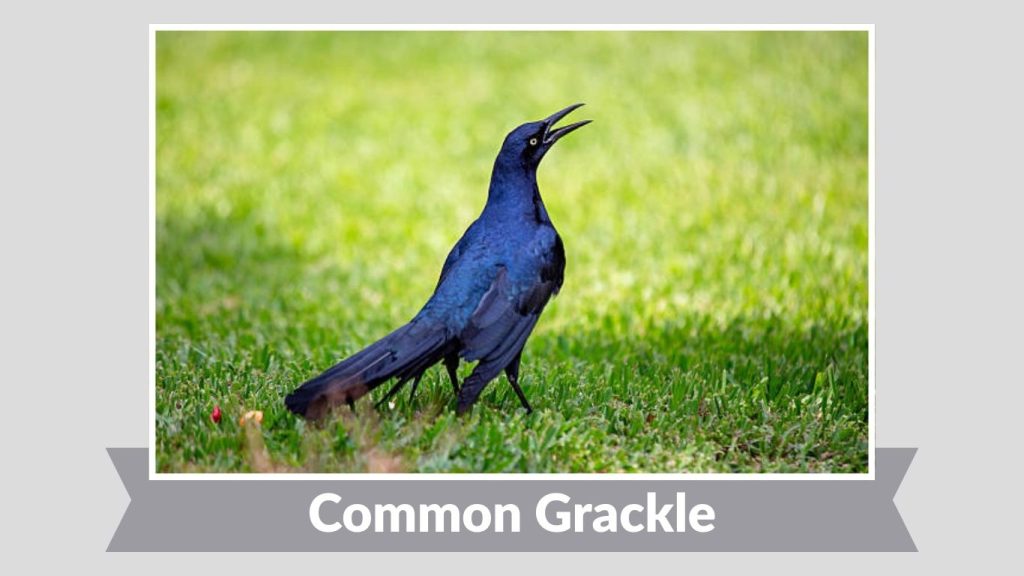
The Common Grackle is a striking blackbird known for its glossy, iridescent feathers and bold, intelligent behavior. Although larger than many blackbirds, it is often grouped with them due to its similar appearance and social habits.
Identification
- Glossy black body with purple or green iridescence
- Pale yellow to golden eyes
- Long tail, often held in a V-shape during flight
- Strong, slightly curved beak
Habitat
Common Grackles are found in open woodlands, fields, wetlands, parks, and urban areas. They are highly adaptable and frequently live near human settlements.
Behaviors
These birds are very social and often gather in large, noisy flocks. They are confident foragers and may dominate feeders or displace smaller birds.
Diet
Their diet is omnivorous and includes insects, seeds, grains, fruits, small fish, and food scraps. They are known for their problem-solving skills when searching for food.
Lifespan
In the wild, Common Grackles usually live around 5–7 years, though some individuals have been recorded living longer under favorable conditions.
4. Brewer’s Blackbird (Euphagus cyanocephalus)
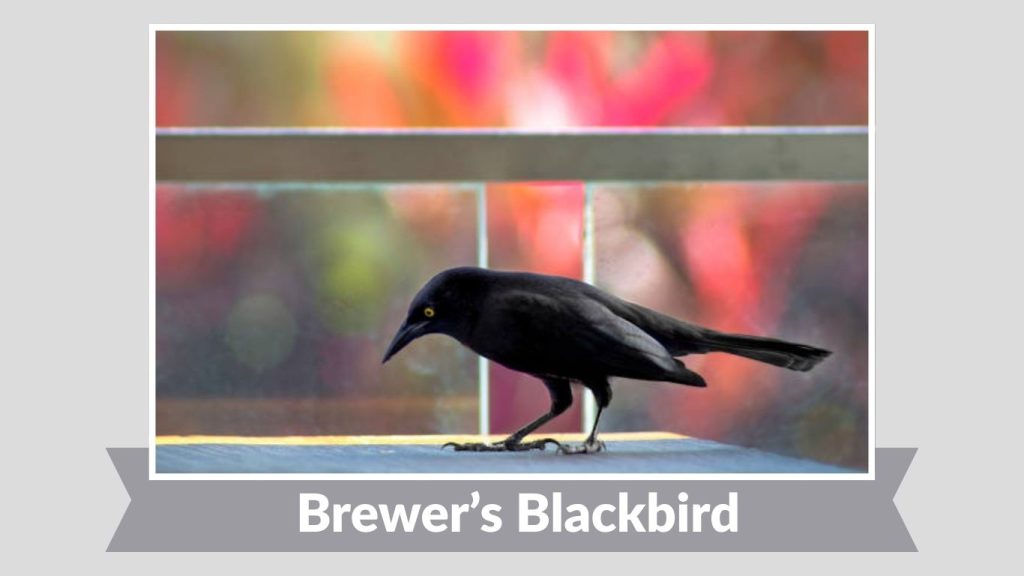
Brewer’s Blackbird is a sleek North American blackbird often seen in flocks around open landscapes and urban areas. It is known for its subtle iridescence and frequent association with human activity.
Identification
- Male is glossy black with purple-green sheen
- Bright yellow eyes in males
- Female is grayish-brown with dark eyes
- Slim body with a straight, pointed beak
Habitat
This species inhabits open fields, grasslands, wetlands, parking lots, farms, and city parks. It commonly nests near water sources and adapts well to disturbed environments.
Behaviors
Brewer’s Blackbirds are highly social and usually forage in groups. They often walk rather than hop on the ground while searching for food.
Diet
Their diet includes insects, seeds, grains, berries, and human food scraps. They frequently feed on the ground and around agricultural areas.
Lifespan
The average lifespan is about 4–6 years in the wild, though survival depends heavily on environmental conditions and predation.
5. Yellow-billed Chough (Pyrrhocorax graculus)

The Yellow-billed Chough is a striking mountain bird known for its glossy black plumage and curved yellow beak. Highly intelligent and acrobatic in flight, it is commonly seen soaring and calling loudly over alpine landscapes.
Identification
- Shiny black feathers with a slight bluish gloss
- Long, curved yellow beak
- Red legs and feet
- Slender body with broad wings adapted for soaring
Habitat
This species primarily inhabits high-altitude regions such as alpine meadows, rocky cliffs, and mountainous grasslands. It is often found above the tree line and may descend to lower elevations during winter.
Behaviors
Yellow-billed Choughs are very social and usually live in flocks. They are excellent fliers, performing aerial acrobatics and gliding effortlessly on mountain winds. They are also known for their loud, whistling calls and playful interactions.
Diet
Their diet mainly consists of insects, larvae, spiders, and other invertebrates. During colder months, they also feed on seeds, berries, and food scraps left by humans in mountain areas.
Lifespan
In the wild, Yellow-billed Choughs can live 10–20 years, making them one of the longer-lived small black bird species, especially in stable alpine environments.
6. Alpine Chough (Pyrrhocorax graculus)
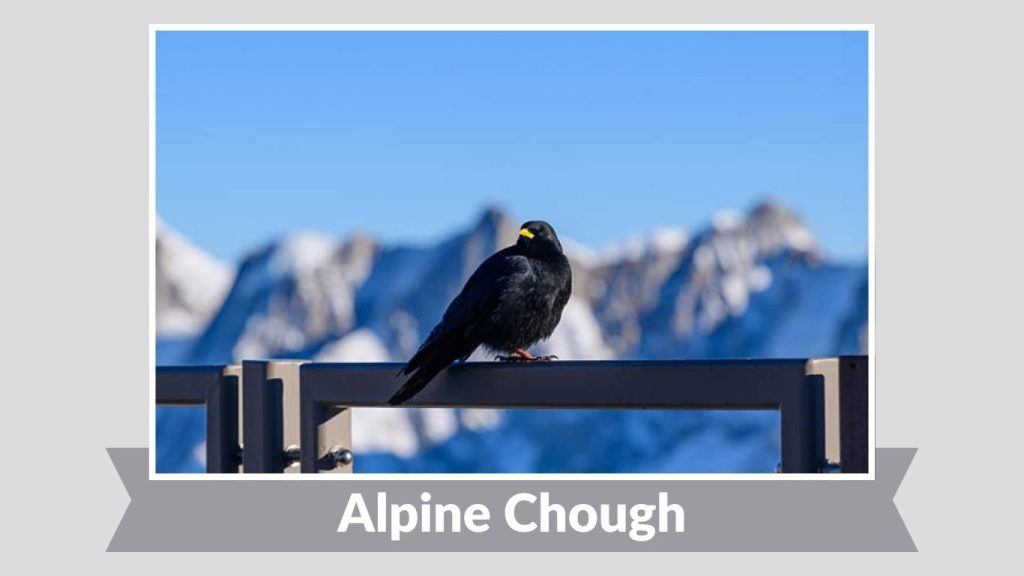
The Alpine Chough is a charismatic mountain bird famous for its glossy black feathers, bright yellow beak, and remarkable flying skills. Often seen circling high peaks, it is one of the most recognizable birds of alpine regions.
Identification
- Glossy black plumage with a slight blue sheen
- Short, curved yellow beak
- Red legs and feet
- Long, pointed wings suited for soaring
Habitat
Alpine Choughs live mainly in high-altitude areas such as rocky mountains, alpine meadows, cliffs, and ski resorts. They frequently remain above the tree line and may move to lower valleys during harsh winter weather.
Behaviors
These birds are highly social and usually form flocks, even during the breeding season. They are exceptional gliders, using air currents to perform graceful aerial maneuvers, and are known for their sharp, whistling calls.
Diet
Their diet consists largely of insects and other small invertebrates found in soil and grasslands. In winter, they rely more on seeds, berries, and human-provided food around mountain settlements.
Lifespan
Alpine Choughs are long-lived birds, often reaching 15–20 years in the wild when living in stable mountainous environments with low human disturbance.
7. Hill Myna (Gracula religiosa)
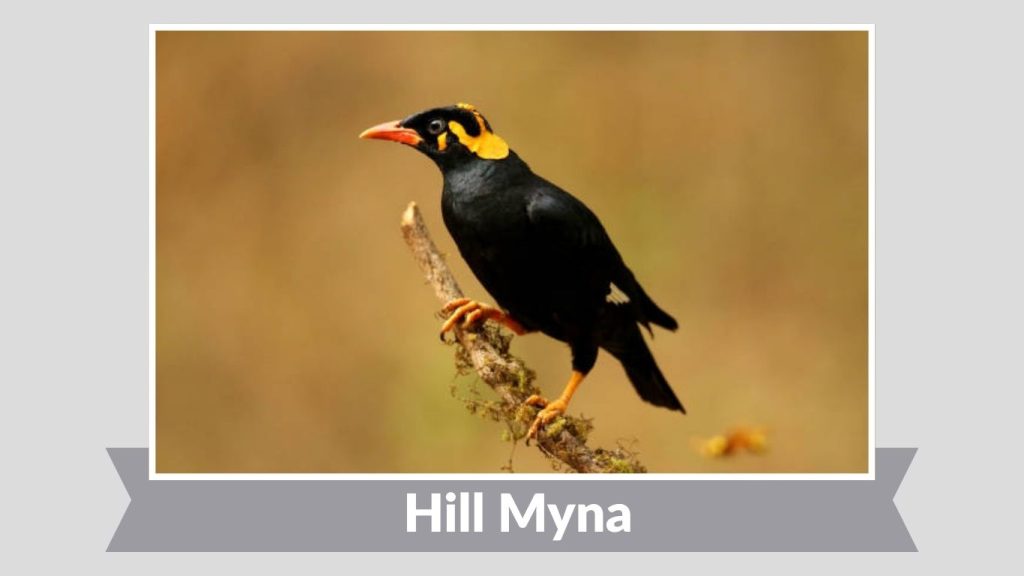
The Hill Myna is a glossy black bird well known for its bright yellow beak and remarkable ability to mimic human speech and other sounds. It is one of the most intelligent and vocal birds found in tropical forests.
Identification
- Shiny black plumage with a greenish sheen
- Bright yellow beak
- Yellow wattles on the sides of the head
- Strong legs and broad wings
Habitat
Hill Mynas inhabit tropical and subtropical forests, forest edges, and wooded hills. They are commonly found in South and Southeast Asia, especially in dense evergreen forests.
Behaviors
These birds are highly social and usually seen in pairs or small groups. They are famous for their vocal mimicry, often copying whistles, human speech, and environmental sounds.
Diet
Their diet mainly includes fruits, berries, seeds, nectar, and insects. They play an important role in seed dispersal within forest ecosystems.
Lifespan
Hill Mynas can live 15–25 years in the wild, and even longer in captivity when provided with proper care and nutrition.
8. Bank Myna (Acridotheres ginginianus)
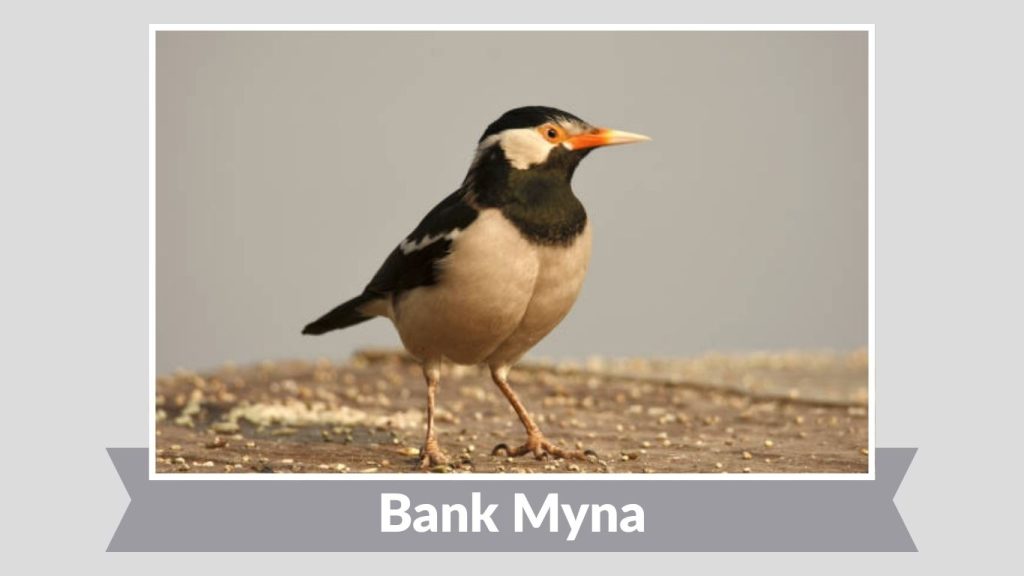
The Bank Myna is a small, sociable black bird recognized for its yellow beak and distinctive bare skin around the eyes. Commonly found near rivers and human settlements, it is an active and noisy member of the starling family.
Identification
- Dark gray to black body
- Bright yellow beak
- Yellow bare skin around the eyes
- Short tail and compact body
Habitat
Bank Mynas prefer riverbanks, open plains, agricultural fields, and towns. They often nest in holes along muddy riverbanks or in man-made structures.
Behaviors
These birds are highly social and usually seen in flocks. They are active during the day and are known for their constant chattering and aggressive defense of nesting sites.
Diet
Their diet includes insects, grains, seeds, fruits, and human food waste. They frequently forage on the ground in open areas.
Lifespan
In the wild, Bank Mynas typically live around 4–8 years, depending on food availability and environmental conditions.
9. Satin Bowerbird (Ptilonorhynchus violaceus)
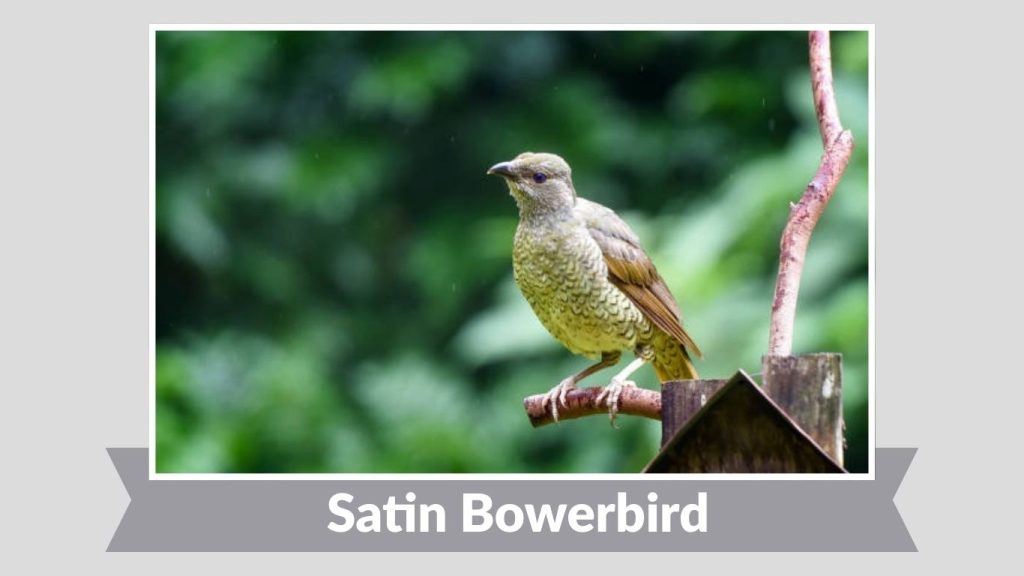
The Satin Bowerbird is a striking bird best known for its glossy dark plumage and the elaborate bowers built by males to attract mates. It is famous for its intelligence and unique courtship behavior rather than its song.
Identification
- Adult male has glossy blue-black plumage
- Pale yellowish to bluish beak
- Bright blue eyes in males
- Female is greenish-brown with scalloped markings
Habitat
Satin Bowerbirds live in rainforests, open woodlands, forest edges, and suburban gardens, mainly in eastern Australia. They prefer areas with dense vegetation and access to fruiting trees.
Behaviors
Males build decorative stick structures called bowers and decorate them with blue objects to attract females. They are highly intelligent and curious, often stealing shiny items from human surroundings.
Diet
Their diet consists mainly of fruits and berries, along with insects, leaves, and flowers. They often forage both in trees and on the ground.
Lifespan
Satin Bowerbirds typically live 15–20 years in the wild, with longer lifespans possible in protected environments.
10. Black Oystercatcher (Haematopus bachmani)
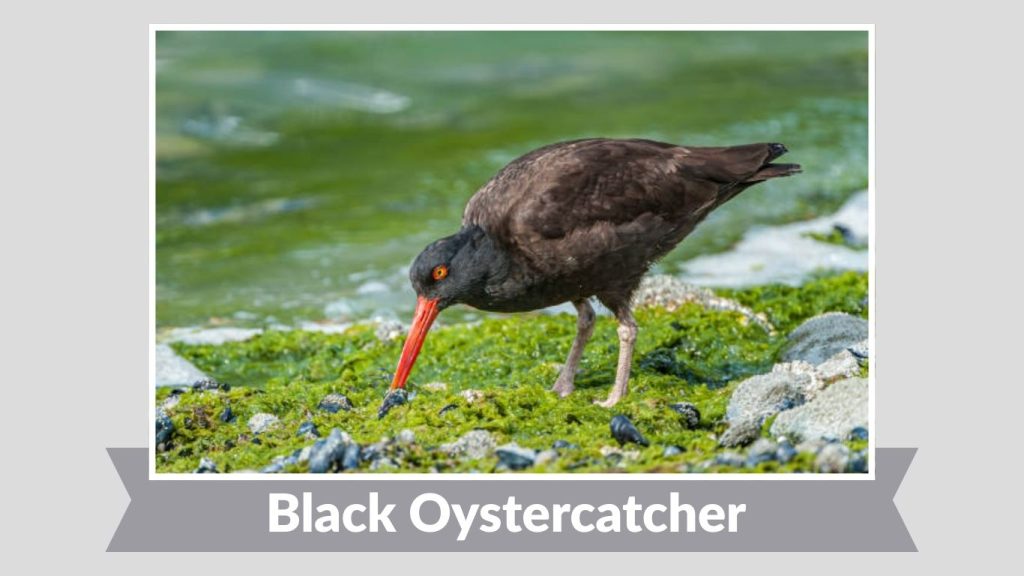
The Black Oystercatcher is a bold coastal bird with all-black plumage and a strong, bright bill. Although slightly larger than typical blackbirds, it is included here due to its black body and contrasting yellowish bill tones seen in some lighting.
Identification
- Entire body covered in black feathers
- Long, thick bill that appears yellow-orange to red
- Pink legs and feet
- Bright yellow eye with a red eye-ring
Habitat
This bird lives along rocky coastlines, shorelines, and offshore islands. It is rarely found far from the ocean and prefers areas with abundant shellfish.
Behaviors
Black Oystercatchers are usually seen alone or in pairs. They are territorial and vocal, often calling loudly to defend feeding or nesting areas along the shore.
Diet
Their diet mainly consists of mussels, clams, limpets, and other marine invertebrates, which they pry open using their strong bills.
Lifespan
In the wild, Black Oystercatchers can live 15–20 years, especially in protected coastal environments with low disturbance.
11. Common Myna (Acridotheres tristis)
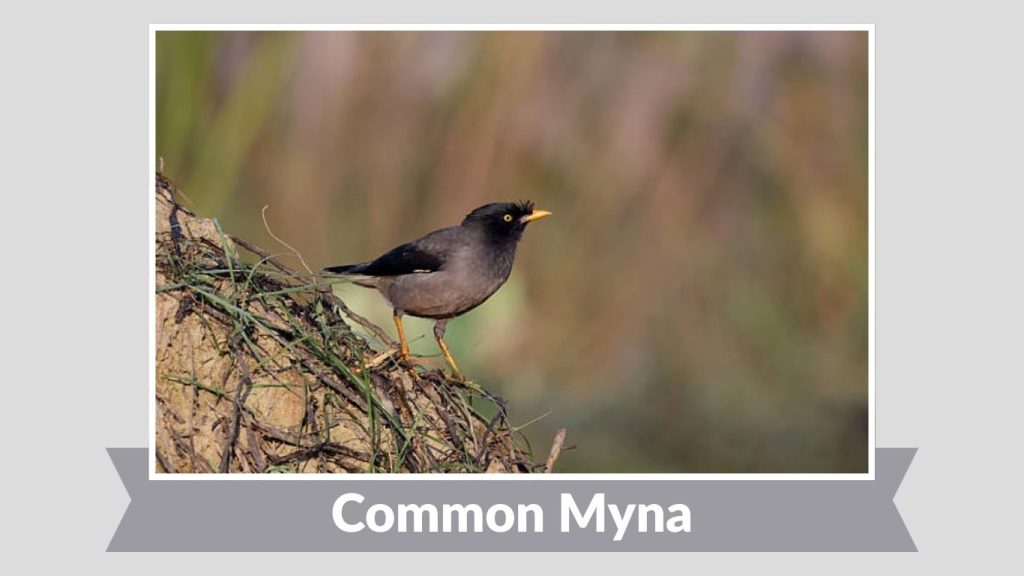
The Common Myna is a bold, adaptable bird well known for its intelligence and close association with human habitats. Its blackish body, bright yellow beak, and expressive behavior make it easy to recognize in towns and cities.
Identification
- Dark brown to black body
- Bright yellow beak
- Yellow bare skin around the eyes
- White wing patches visible in flight
Habitat
Common Mynas thrive in urban areas, villages, farmland, open woodlands, and gardens. They readily nest in buildings, tree cavities, and other man-made structures.
Behaviors
This species is highly social and often seen in noisy groups. It is territorial, aggressive toward other birds, and known for its ability to mimic sounds and human speech.
Diet
Their diet is omnivorous, including insects, fruits, grains, seeds, small reptiles, and human food waste.
Lifespan
In the wild, Common Mynas typically live 4–12 years, with longer lifespans possible in favorable environments.
12. Great Myna (Acridotheres grandis)
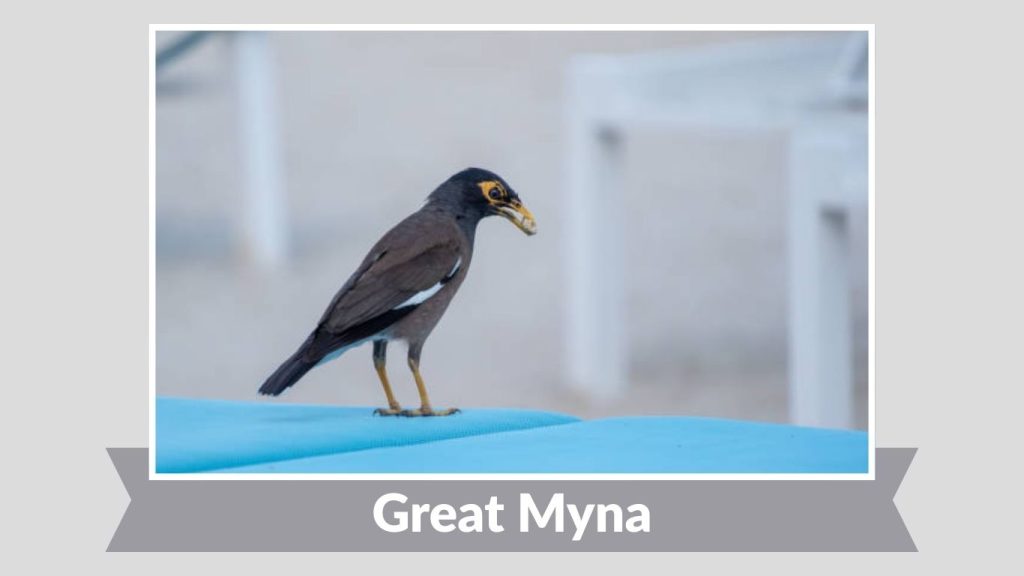
The Great Myna is a large, striking myna species recognized for its glossy black plumage and bright yellow bill. It is less common than the Common Myna and is usually found in forested and semi-open landscapes.
Identification
- Glossy black body with slight green sheen
- Bright yellow beak
- Yellow bare skin around the eyes
- White patches on wings visible during flight
Habitat
Great Mynas inhabit forest edges, open woodlands, river valleys, and agricultural areas. They prefer regions with tall trees for nesting and roosting.
Behaviors
These birds are usually seen in pairs or small groups. They are vocal, alert, and often perch conspicuously while calling loudly.
Diet
Their diet includes insects, fruits, seeds, nectar, and small vertebrates. They forage both on the ground and in trees.
Lifespan
Great Mynas typically live around 8–15 years in the wild, depending on habitat quality and predation pressure.
13. Yellow-billed Cacique (Amblycercus holosericeus)
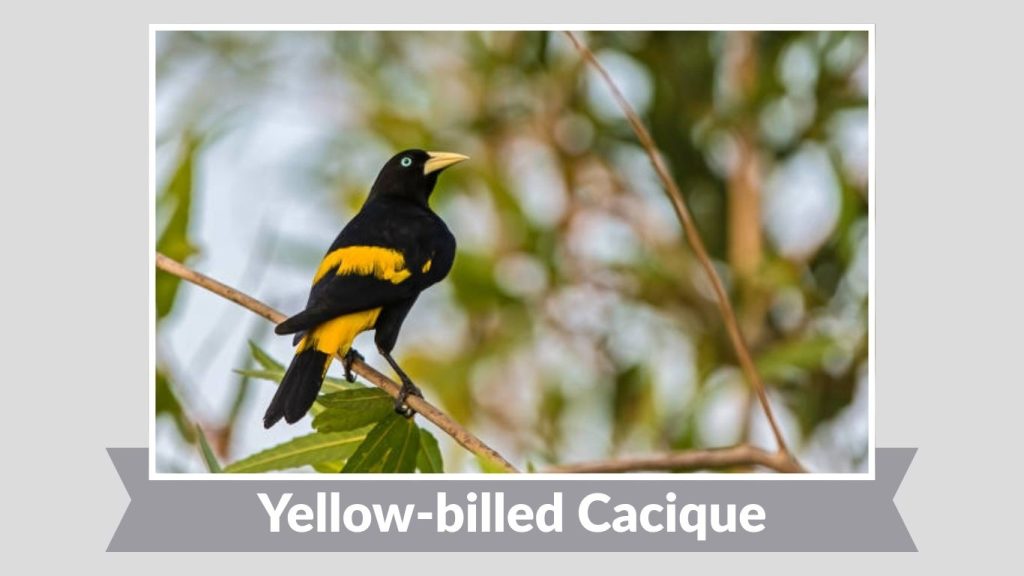
The Yellow-billed Cacique is a sleek, all-black bird known for its vivid yellow bill and striking yellow eyes. It is a shy forest species with a rich, whistling voice, often heard more than seen.
Identification
- Entirely black plumage with a glossy finish
- Bright yellow bill
- Yellow eyes that stand out sharply
- Medium-sized body with a long tail
Habitat
This species inhabits tropical and subtropical forests, forest edges, and dense undergrowth, mainly in Central America and parts of South America.
Behaviors
Yellow-billed Caciques are usually solitary or found in pairs. They are secretive birds that move quietly through dense vegetation and are known for their musical, flute-like calls.
Diet
Their diet consists of insects, spiders, fruits, and seeds. They often forage in low to mid-level forest layers.
Lifespan
In the wild, Yellow-billed Caciques are believed to live around 10–15 years, though detailed lifespan data is limited.
14. Yellow-billed Magpie (Pica nuttalli)
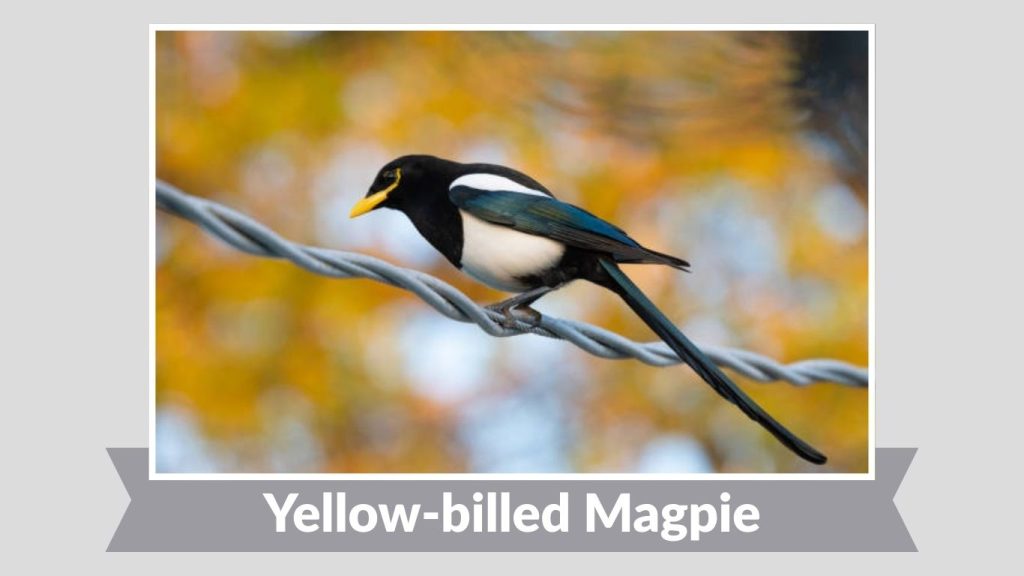
The Yellow-billed Magpie is a striking black-and-white bird distinguished by its bright yellow bill and bold personality. It is a highly intelligent species and closely related to other magpies, though it has a very limited geographic range.
Identification
- Black head, chest, wings, and long tail
- White belly and shoulder patches
- Bright yellow bill and eye-ring
- Long tail with a slight greenish-blue sheen
Habitat
This species is mainly found in open woodlands, oak savannas, farmlands, and grasslands with scattered trees. It prefers areas that provide both open ground for foraging and tall trees for nesting.
Behaviors
Yellow-billed Magpies are very social and often live in small groups or loose colonies. They are curious, vocal, and known for problem-solving abilities and cooperative behavior.
Diet
Their diet includes insects, small mammals, eggs, fruits, seeds, carrion, and food scraps. They forage mostly on the ground but also search trees and shrubs.
Lifespan
In the wild, Yellow-billed Magpies typically live 7–15 years, depending on environmental conditions and threats.
15. Yellow-billed Hornbill (Tockus leucomelas)
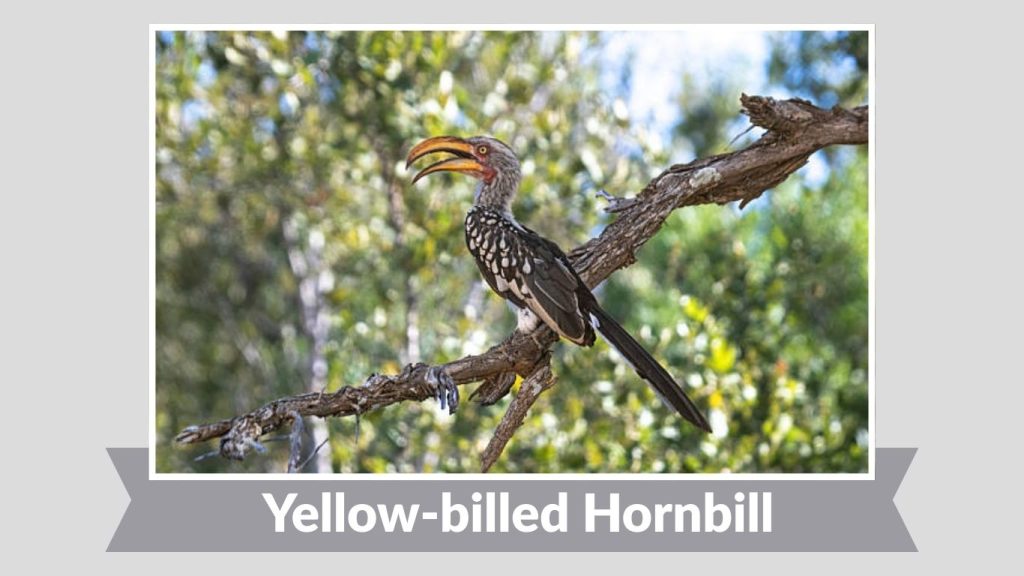
The Yellow-billed Hornbill is a distinctive bird with bold black-and-white plumage and a large curved yellow bill. Famous for its unique nesting behavior and expressive calls, it is one of the most recognizable birds of African savannas.
Identification
- Black-and-white patterned body
- Large, curved bright yellow bill
- Long tail and strong legs
- Bare skin around the eyes
Habitat
This species inhabits open savannas, dry woodlands, and scrublands across sub-Saharan Africa. It prefers areas with scattered trees and open ground for foraging.
Behaviors
Yellow-billed Hornbills are usually seen in pairs or small family groups. They spend much of their time on the ground searching for food and are known for their loud, laughing calls and unusual nesting habits.
Diet
Their diet includes insects, small reptiles, fruits, seeds, and occasionally small mammals. They play an important role in controlling insect populations.
Lifespan
In the wild, Yellow-billed Hornbills typically live 10–15 years, with some individuals living longer in protected habitats.
FAQs
What are small black birds with yellow beaks called?
Small black birds with yellow beaks belong to different bird families, including blackbirds, mynas, starlings, and crows. Common examples include the Common Blackbird, Hill Myna, and Yellow-billed Cacique.
Where are small black birds with yellow beaks commonly found?
These birds are found worldwide, depending on the species. They live in habitats ranging from gardens and woodlands to tropical forests, mountains, coastal areas, and savannas.
Are all black birds with yellow beaks the same species?
No, they are not the same species. Similar coloration can appear in unrelated birds due to adaptation, but they may differ greatly in size, behavior, diet, and habitat.
What do small black birds with yellow beaks eat?
Most are omnivorous, feeding on insects, fruits, seeds, berries, and sometimes small animals or human food scraps, depending on the species and environment.
Are black birds with yellow beaks good for the ecosystem?
Yes, many of these birds help control insect populations, disperse seeds, and contribute to healthy ecosystems through their feeding and nesting behaviors.