




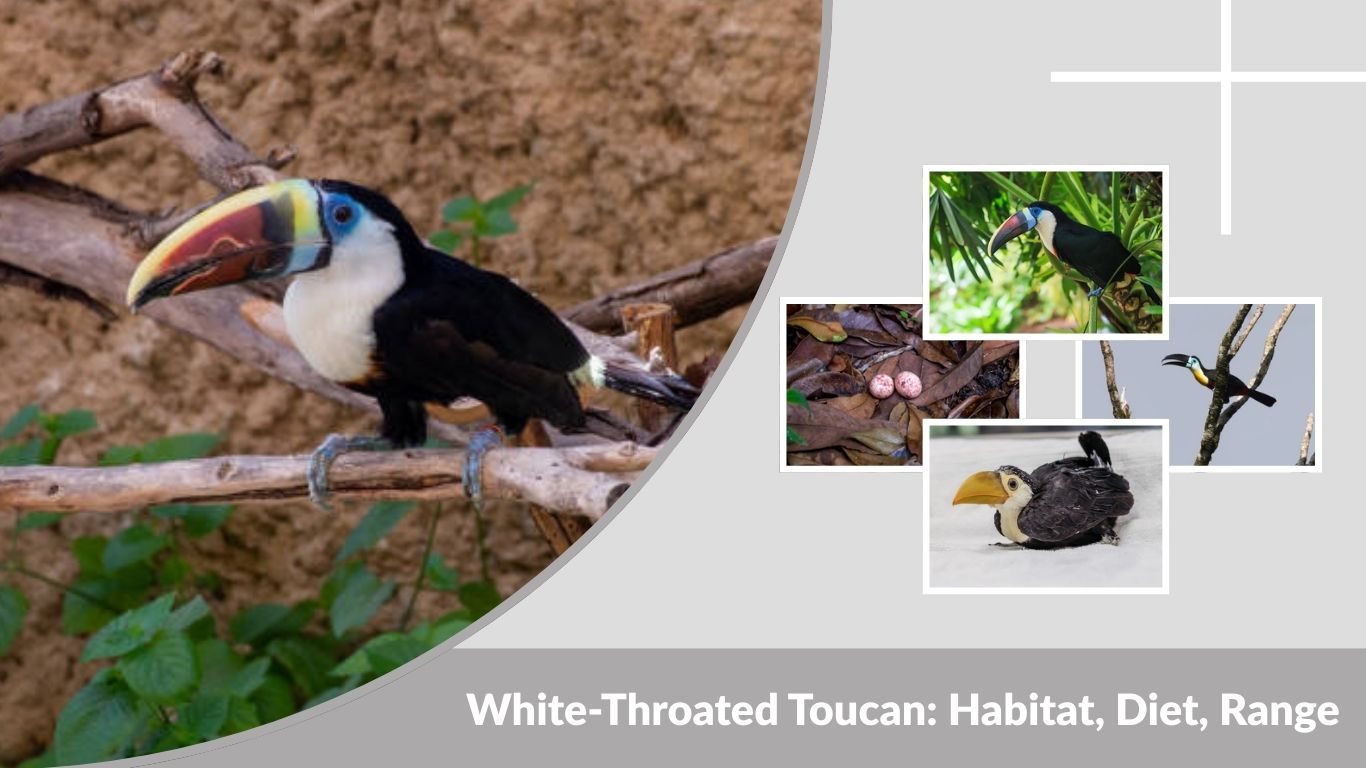
The white-throated toucan is one of the most striking birds of the South American rainforest, known for its bold black plumage, bright bill, and unmistakable white throat and chest. As a large member of the toucan family, this species plays an important role in maintaining healthy forest ecosystems. White-throated toucans are highly social, intelligent birds that spend most of their lives in the forest canopy, where their feeding habits help spread seeds and support plant diversity across tropical regions.
What Is a White-Throated Toucan?
The white-throated toucan (Ramphastos tucanus) is a large tropical bird distinguished by its glossy black feathers, white throat and upper chest, and a long, colorful beak that may appear heavy but is surprisingly lightweight. The bill is primarily yellow with darker markings and is made of keratin, supported by an internal honeycomb structure.
Among common white throated toucan facts is that this species is often confused with similar toucans, such as the channel-billed toucan. However, the clean white throat and subtle differences in bill shape help identify it. Adults can reach lengths of up to 22 inches, including the bill, making them one of the larger toucan species found in South America.
White-Throated Toucan Habitat and Natural Environment
The white throated toucan habitat consists mainly of dense tropical rainforests and humid lowland forests. These birds prefer areas with tall, mature trees that provide an abundance of fruit and natural cavities for nesting. They are especially common in undisturbed forests where the canopy remains intact.
A suitable white throated toucan location includes river basins, floodplain forests, and evergreen rainforests. Because they rely on large trees for both food and shelter, white-throated toucans are sensitive to deforestation. When forests are cleared, nesting sites disappear, and food sources become scarce, forcing the birds to move or decline in number.
White-Throated Toucan Range and Geographic Distribution
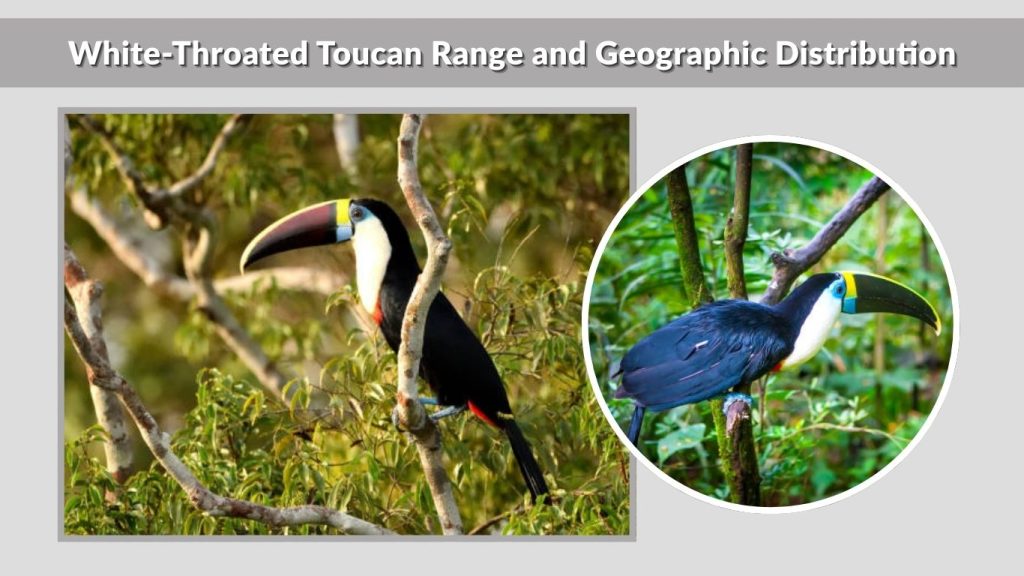
The white throated toucan range covers much of northern South America. These birds are commonly found in countries such as Brazil, Colombia, Venezuela, Guyana, Suriname, and French Guiana. Their range closely follows tropical rainforest regions, where warm temperatures and high humidity support year-round fruit production.
Unlike some toucan species that adapt easily to forest edges, white-throated toucans are more dependent on intact rainforest habitats. This makes them valuable indicators of forest health, as their presence often signals a well-preserved ecosystem.
White-Throated Toucan Diet and Feeding Behavior
The white throated toucan diet is primarily fruit-based, with figs, palm fruits, and berries making up the majority of their meals. Using their long beaks, they pluck fruit from branches that cannot support their body weight, tossing the food into the air before swallowing it whole.
In addition to fruit, white-throated toucans also eat insects, small reptiles, bird eggs, and nestlings. This varied diet provides essential nutrients and protein. As they travel between feeding areas, they disperse seeds through their droppings, helping regenerate forest plants and maintain biodiversity throughout their habitat.
White-Throated Toucan Lifespan and Survival
The white throated toucan lifespan in the wild typically ranges from 15 to 20 years. Survival depends on habitat quality, food availability, and predator pressure. Natural predators include large birds of prey, snakes, and arboreal mammals that target nests and eggs.
Habitat loss remains the greatest threat to the species. Logging, agriculture, and road development reduce available nesting sites and fragment forests, making it harder for white-throated toucans to find food and safe breeding areas.
White-Throated Toucan Eggs, Babies, and Breeding Behavior
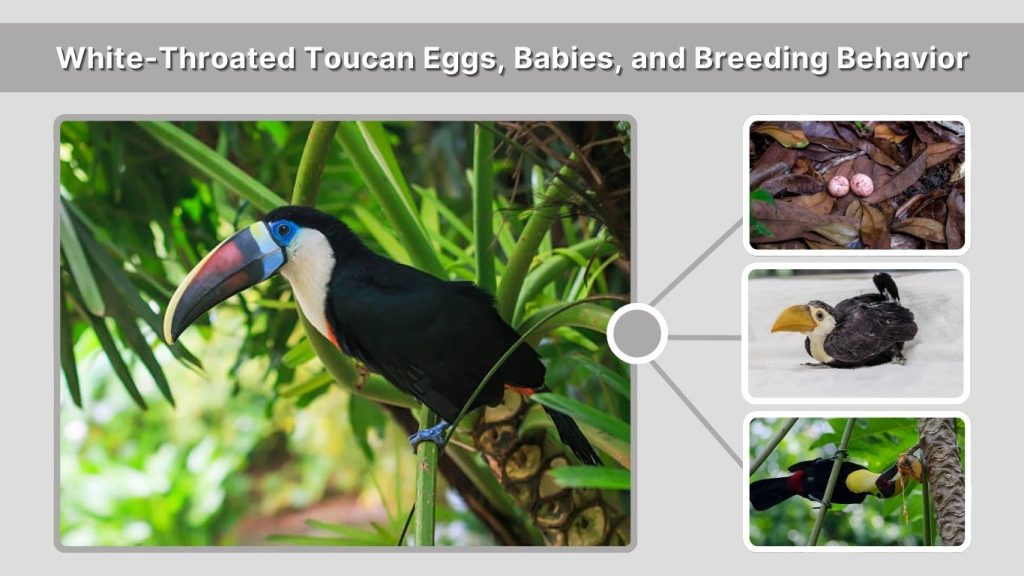
White-throated toucans do not construct nests from scratch. Instead, they rely on natural tree cavities or abandoned woodpecker holes located high in the forest canopy. These nesting sites provide protection from predators and harsh weather during the breeding season.
White-Throated Toucan Eggs
The female typically lays two to four white throated toucan eggs, which are white and slightly oval in shape. Both parents take turns incubating the eggs, a process that lasts approximately 16 to 18 days. This shared responsibility improves hatching success and allows the adults to maintain their energy levels during incubation.
White-Throated Toucan Baby Development
A white throated toucan baby hatches blind and featherless, completely dependent on parental care. During the first weeks of life, the chicks grow rapidly and develop thick pads on their heels to protect their feet from the hard nest floor. Parents feed the chicks regurgitated fruit and small prey until feathers and beaks are sufficiently developed. After about eight to nine weeks, the young toucans leave the nest and begin exploring nearby branches.
Male and Female White-Throated Toucan Differences
Male and female white-throated toucans look very similar, making them difficult to distinguish in the wild. The white throated toucan female is generally slightly smaller than the male and may have a marginally shorter beak. These differences are subtle and usually only noticeable when a breeding pair is observed side by side. Both sexes share equal roles in incubating eggs, feeding chicks, and defending the nest site.
Can White-Throated Toucans Fly?
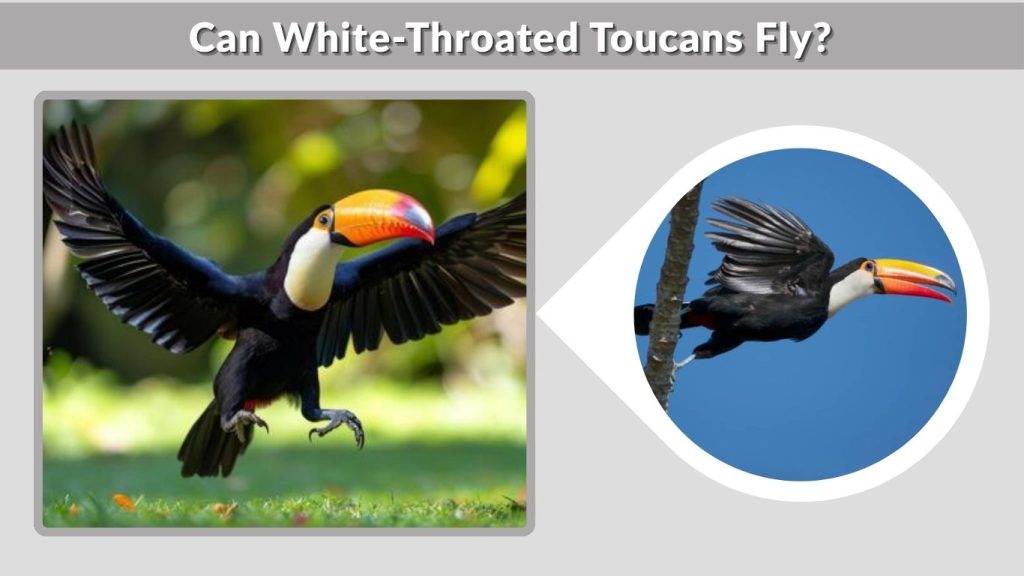
Despite their large beaks, white throated toucan flying ability is well suited to life in the canopy. They are capable of flight but typically travel short distances between trees. Their flight pattern consists of quick, shallow wingbeats followed by brief glides. This style of flight conserves energy and allows them to move efficiently through dense forest environments. On the ground, white-throated toucans are less agile and prefer hopping rather than walking.
Interesting White-Throated Toucan Facts
There are many fascinating white throated toucan facts that highlight how well adapted this bird is to its environment. One of the most notable is that the toucan’s large bill helps regulate body temperature by releasing excess heat through blood vessels near the surface. The bill is also used in social interactions, including displays and gentle tapping during courtship.
White-throated toucans are highly vocal birds, communicating with loud croaking calls that can be heard across the forest. They are also social and often move in small groups, which helps them locate food and watch for predators.
Another interesting behavior is how these birds sleep. They tuck their beaks under their wings and curl their tails over their backs, allowing their large bodies to fit comfortably inside narrow tree cavities.
Why the White-Throated Toucan Matters
The white-throated toucan plays a vital role in maintaining healthy rainforest ecosystems. By spreading seeds over wide areas, these birds help regenerate forests and support countless plant species. Their dependence on intact rainforests also makes them important indicators of environmental health.
Protecting the habitats of white-throated toucans helps preserve biodiversity and ensures that future generations can continue to admire one of South America’s most remarkable birds. Conservation efforts focused on forest protection are essential for the long-term survival of this species.
FAQs
Where do white-throated toucans live?
The white-throated toucan habitat includes tropical rainforests and humid lowland forests in northern South America. They are commonly found in countries such as Brazil, Colombia, Venezuela, Guyana, Suriname, and French Guiana.
What do white-throated toucans eat?
The white-throated toucan diet is mainly made up of fruit, including figs, berries, and palm fruits. They also eat insects, small reptiles, bird eggs, and nestlings, which provide important nutrients and protein.
How long do white-throated toucans live?
The average white-throated toucan lifespan is around 15 to 20 years in the wild. In captivity, where predators and food shortages are reduced, they may live even longer with proper care.
Are male and female white-throated toucans different?
Male and female white-throated toucans look very similar. The white-throated toucan female is usually slightly smaller and may have a shorter beak, but these differences are subtle and difficult to notice in the wild.
Can white-throated toucans fly?
Yes, white-throated toucan flying ability is well developed. They can fly but usually travel short distances between trees using quick wingbeats followed by brief glides, which suits their canopy-dwelling lifestyle.