


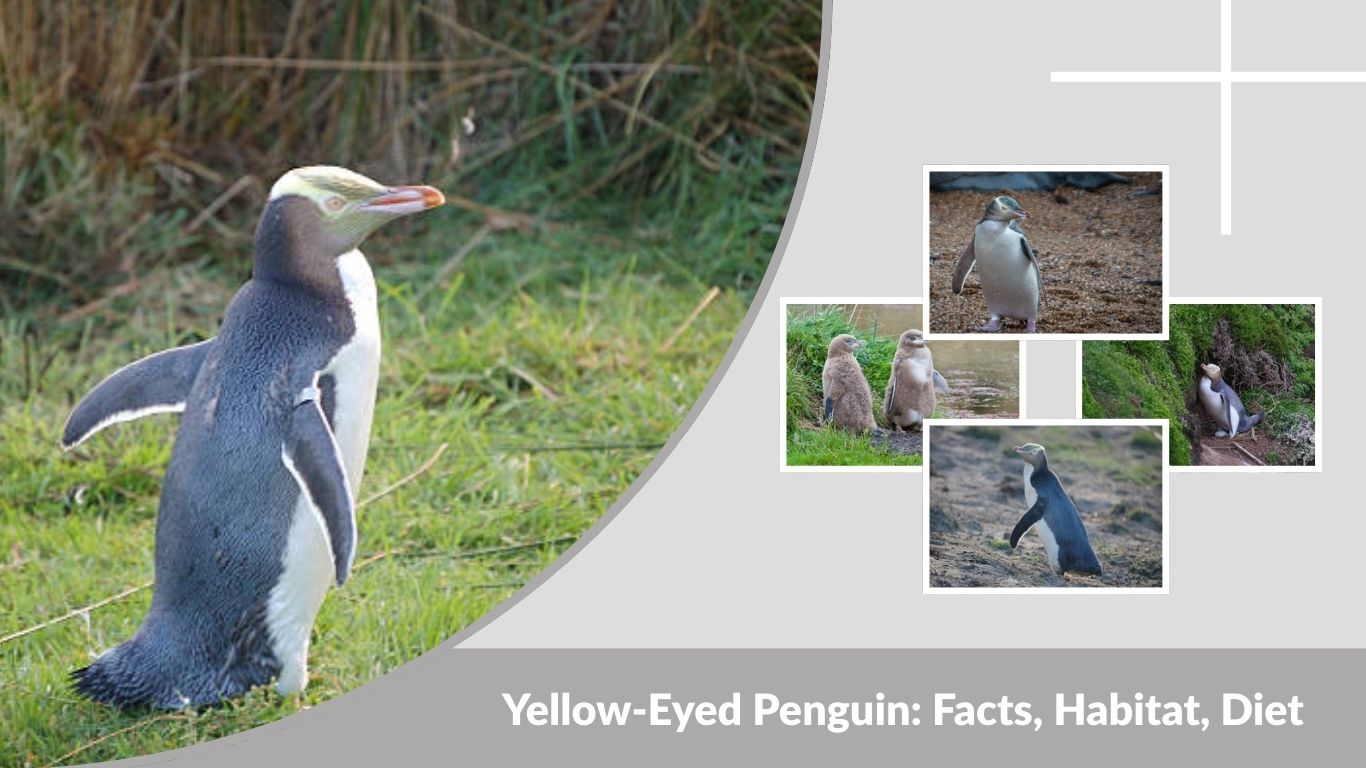
The yellow-eyed penguin is one of the rarest penguin species in the world and one of New Zealand’s most treasured native birds. Known for its striking pale yellow eyes and distinctive yellow band across its head, this penguin stands out from other species both in appearance and behavior. Unlike highly social penguins that gather in massive colonies, the yellow-eyed penguin prefers solitude and secluded nesting areas. In this guide, you’ll discover essential yellow-eyed penguin facts, including where they live and the unique habitat they depend on for survival.
Yellow-Eyed Penguin Overview
Scientific Classification
The yellow-eyed penguin’s scientific name is Megadyptes antipodes. It is the only living species in its genus, making it evolutionarily distinct from other penguins. As a member of the family Spheniscidae, it shares characteristics common to penguins, such as flipper-like wings and strong swimming ability. However, genetic studies suggest that this species represents one of the most ancient penguin lineages still in existence today.
In New Zealand, the bird is also known as “Hoiho,” a Māori name meaning “noise shouter,” which refers to its loud, distinctive calls during breeding season.
Physical Characteristics
The yellow-eyed penguin is relatively large compared to many other penguin species. Adults typically stand between 60 and 80 centimeters (24–31 inches) tall and weigh around 5 to 8 kilograms (11–18 pounds), depending on the season and food availability.
Its most defining feature is its pale yellow eyes, which give the species its common name. A band of soft yellow feathers wraps around the back of the head, contrasting with the slate-blue and black feathers on its back. The chest and belly are white, while the flippers are strong and well-adapted for underwater movement.
Their streamlined bodies allow them to swim efficiently, reaching impressive speeds when hunting. On land, however, they appear more cautious and reserved compared to other penguins.
Unique Traits
Unlike many penguin species that nest in large, noisy colonies, yellow-eyed penguins are more solitary. They prefer nesting sites that are hidden from view, often separated by vegetation or natural barriers. This shy behavior helps reduce conflict and disturbance.
They are also known for forming strong pair bonds. Breeding pairs often return to the same nesting area year after year, showing high site fidelity. Their loud braying calls, especially during courtship and territory defense, are a distinctive feature of the species.
Where Do Yellow Eyed Penguins Live?
Geographic Distribution
If you are wondering where do yellow eyed penguins live, their range is limited almost entirely to New Zealand. They are found along the southeastern coast of the South Island, as well as on Stewart Island. In addition, important populations exist on the Auckland Islands and Campbell Islands, which are part of New Zealand’s subantarctic region.
These remote islands provide safer breeding grounds with fewer human disturbances compared to mainland areas.
Mainland vs Subantarctic Populations
Mainland populations tend to face greater risks from introduced predators such as dogs, cats, and stoats. Human activity, including coastal development and tourism, can also disturb nesting sites.
Subantarctic populations are more isolated and generally less affected by human presence. However, they still face environmental threats such as climate change and shifting ocean conditions.
Because their overall distribution is so limited, any negative impact in these regions can significantly affect the global population of yellow-eyed penguins.
Yellow Eyed Penguin Habitat
Coastal Forest and Scrub Habitat
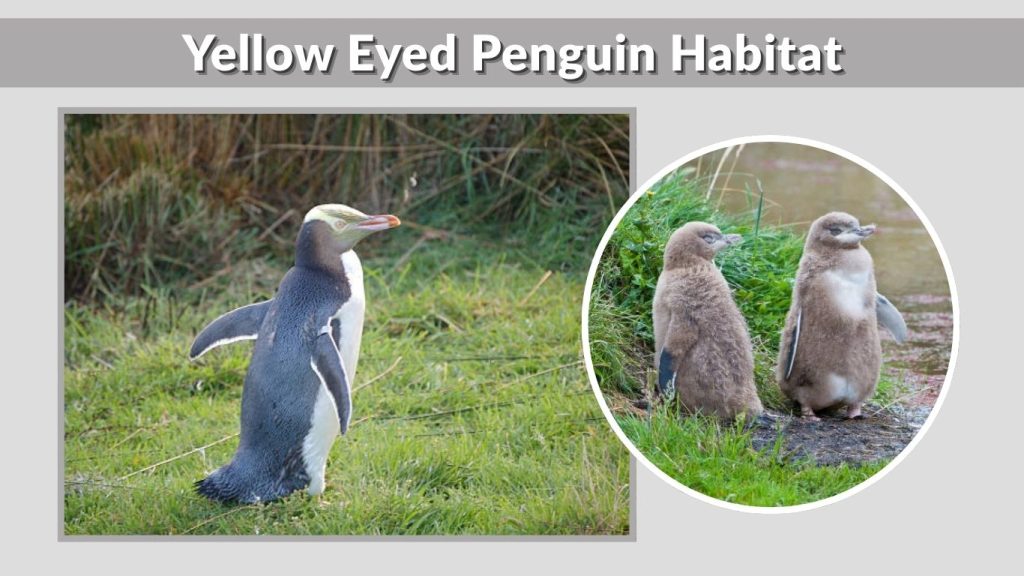
The yellow eyed penguin habitat is quite different from that of many other penguin species. Instead of nesting on open, rocky beaches in large colonies, these penguins prefer secluded coastal forests, dense scrublands, and areas with tall grasses. Vegetation provides important shelter from wind, heavy rain, and extreme temperatures.
Nests are usually hidden under bushes, inside natural hollows, or among thick coastal plants. This concealment helps protect eggs and chicks from predators and reduces stress caused by human disturbance. Because they require such specific conditions, suitable nesting areas are limited.
Breeding Habitat Requirements
During breeding season, yellow-eyed penguins look for quiet, undisturbed sites with easy access to the sea. Ideal breeding habitat includes:
- Dense vegetation for privacy
- Natural shade to protect chicks from overheating
- Sloped terrain for drainage
- Short travel distance to feeding grounds
Unlike colonial penguins that crowd together, yellow-eyed penguins maintain significant space between nests. This territorial spacing means fewer breeding pairs can occupy a given area, which naturally limits population density.
Marine Habitat
At sea, yellow-eyed penguins rely on productive coastal waters along the continental shelf. They typically forage in depths ranging from 40 to 120 meters (130–390 feet). These waters provide access to bottom-dwelling fish species that make up much of their diet.
Healthy marine ecosystems are critical for their survival. Changes in ocean temperature or food supply can quickly affect breeding success and chick survival.
What Do Yellow-Eyed Penguins Eat?
Primary Diet
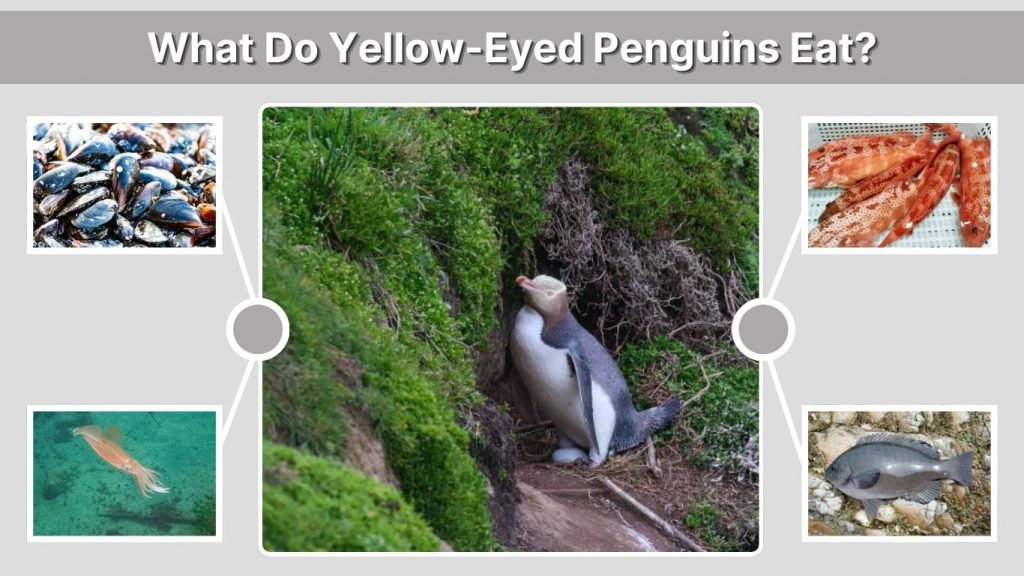
If you’re asking what do yellow eyed penguins eat, their diet mainly consists of small fish and marine invertebrates. Common prey includes:
- Red cod
- Opalfish
- Sprat
- Squid
- Crustaceans
They are primarily benthic feeders, meaning they hunt near the ocean floor rather than at the surface. This feeding strategy sets them apart from some other penguin species that rely heavily on krill.
Hunting Behavior
Yellow-eyed penguins are solitary foragers. Unlike species that hunt in groups, each bird searches for food independently. They are strong divers and can exceed depths of 100 meters during feeding trips.
During the breeding season, adults typically leave the nest early in the morning and return later in the day with food for their chicks. Efficient foraging is essential because chicks depend entirely on their parents for nourishment during their early weeks.
Feeding Challenges
Food availability is one of the biggest factors affecting population stability. Overfishing in coastal waters can reduce prey numbers, forcing penguins to travel farther to find food. Ocean warming can also shift fish distribution patterns, making traditional feeding areas less reliable.
When adults must spend more time searching for food, chicks may receive fewer feedings, lowering survival rates.
Reproduction and Lifespan
Breeding Season
Breeding season usually begins in September. After courtship displays and vocal exchanges, females lay two eggs several days apart. Both parents share incubation duties, taking turns guarding the nest while the other forages at sea.
The incubation period lasts about six weeks. Strong cooperation between parents increases the chances of successful hatching.
Chick Development
Once chicks hatch, they enter a guard phase in which one parent remains at the nest while the other hunts. As they grow stronger, they enter a crèche stage, where they may gather loosely with other chicks while both parents forage.
Fledging occurs at around 14 to 16 weeks of age. At this point, the young penguins head to sea independently and may not return to breed for several years.
Average Lifespan
The yellow-eyed penguin lifespan generally ranges from 15 to 20 years in the wild, though some individuals may live longer. Survival depends heavily on food availability, predator presence, and environmental stability.
Juvenile mortality rates can be high during the first year at sea. Those that survive to adulthood often return to the same nesting sites year after year.
Yellow-Eyed Penguin Facts
There are many fascinating yellow-eyed penguin facts that make this species unique. First, it is considered one of the rarest penguins globally, with a relatively small and declining population. Its restricted range and specialized habitat requirements make it especially vulnerable to environmental changes.
Another interesting fact is that yellow-eyed penguins are highly territorial during breeding season. Pairs maintain space between nests rather than crowding together. This spacing helps reduce stress and competition but limits how many birds can breed in a single area.
They also have relatively long lifespans compared to some seabirds. In the wild, individuals may live 15 to 20 years or more if they survive early life challenges. However, juvenile survival rates can be low due to predators and food scarcity.
Culturally, the yellow-eyed penguin holds significant importance in New Zealand. Conservation efforts often highlight it as a symbol of the country’s unique wildlife heritage.
Conservation Status and Threats
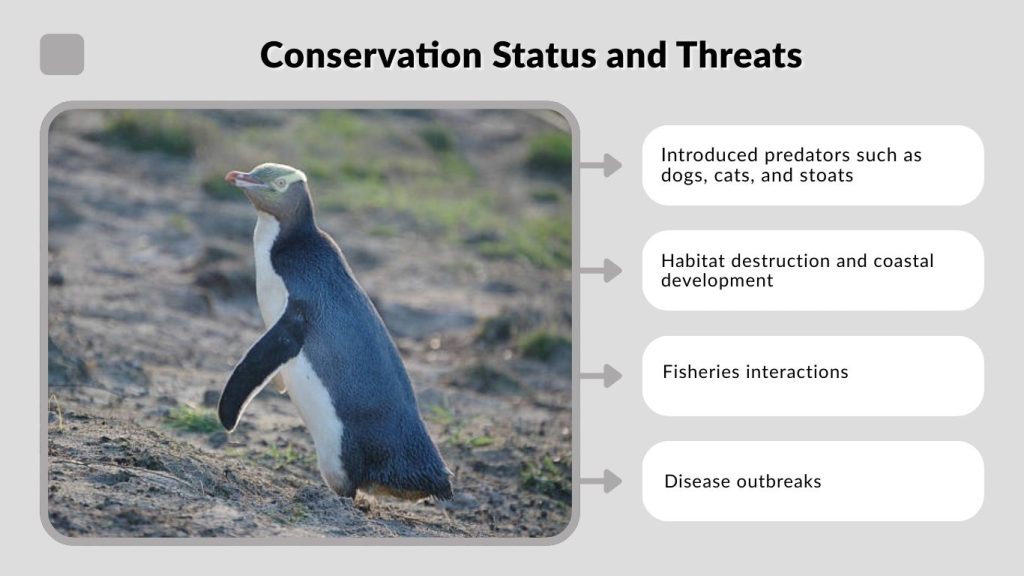
The yellow-eyed penguin is currently classified as Endangered. Population numbers have declined over recent decades, particularly on mainland New Zealand.
Major threats include:
- Introduced predators such as dogs, cats, and stoats
- Habitat destruction and coastal development
- Fisheries interactions
- Disease outbreaks
- Climate change
Conservation efforts focus on predator control, habitat restoration, and protected reserves. Community involvement plays a vital role in protecting nesting areas and minimizing human disturbance.
Conclusion
The yellow-eyed penguin is a rare and remarkable species found only in New Zealand. From its distinctive pale eyes to its preference for secluded forest habitats, it differs greatly from more familiar penguins. Understanding where yellow eyed penguins live, their habitat needs, and what they eat highlights how vulnerable they are to environmental change. Continued conservation action is essential to ensure that future generations can witness this unique and ancient penguin species thriving in the wild.