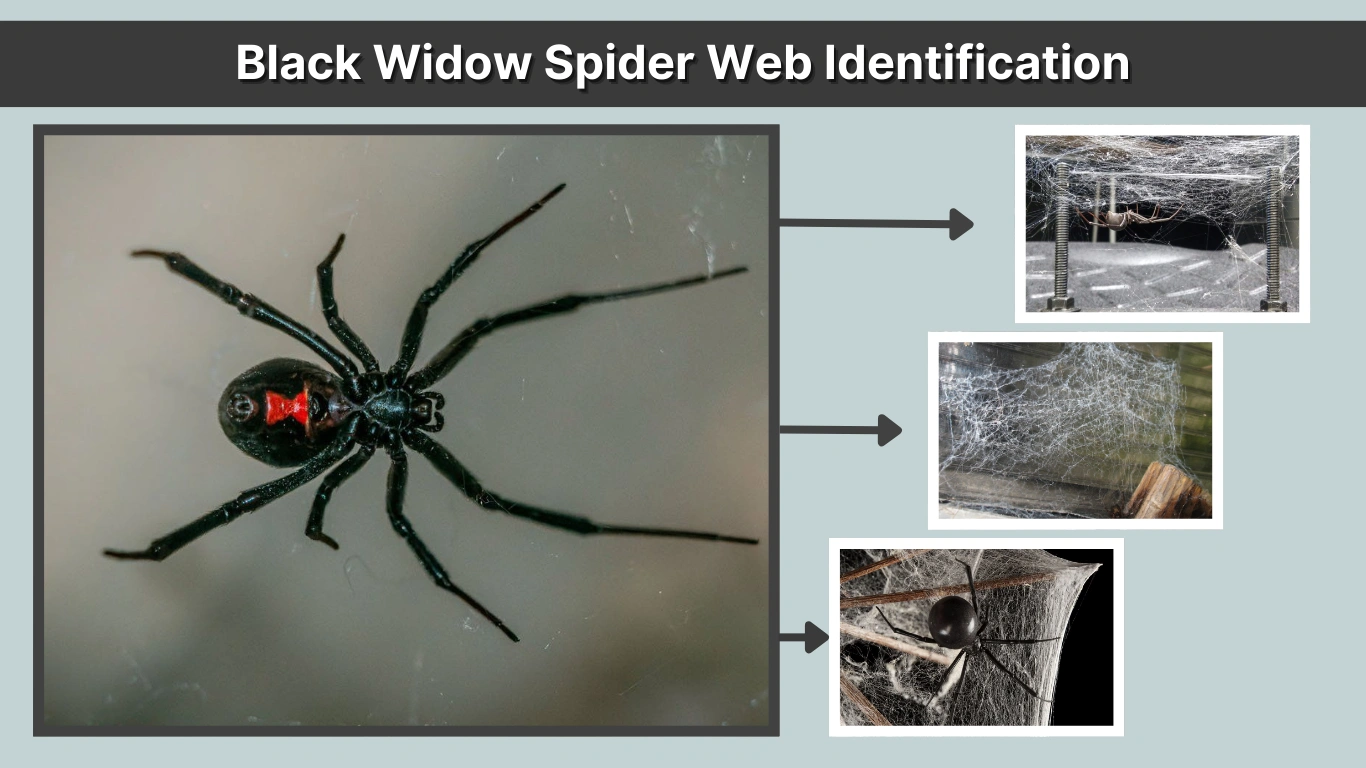
Black widow spiders are infamous for their venom, but their webs are just as distinctive and play a key role in identifying their presence. Unlike the neat and symmetrical designs of orb-weavers, black widow webs are messy, irregular, and extremely strong. These spiders use their webs not only for catching prey but also for protection and reproduction. Recognizing a black widow spider web can help homeowners stay safe and avoid dangerous encounters.
What Does a Black Widow Spider Web Look Like?
Web Shape and Structure
A black widow’s web is chaotic, lacking any circular or spiral patterns. Instead, it appears as a tangled, three-dimensional structure with sticky threads stretching in multiple directions. Unlike the delicate webs of other spiders, this one is coarse, dense, and designed to trap struggling prey effectively.
Appearance vs Other Spider Webs
Compared to the orb-weaver’s round and symmetrical webs, black widow webs look disorganized and rough. They also differ from funnel web spiders, which create structured tunnel-like webs leading into burrows. Because false black widows also build messy webs, spotting the actual spider is often necessary to confirm identification.
Characteristics of Black Widow Spider Webs

Web Strength
One of the most remarkable traits of a black widow web is its strength. The silk is several times stronger than steel by weight and incredibly resilient. Prey caught in the threads find it nearly impossible to escape, and even small reptiles or other spiders can be trapped.
Web Pattern
Unlike decorative orb webs, the widow’s web is functional rather than beautiful. The tangled design creates sticky pockets where insects are more likely to get stuck. The spider positions itself strategically, often hanging upside down, ready to bite and wrap its prey.
Web Size
Most black widow webs measure between one and two feet in width, though they may expand if the spider has remained undisturbed for a long period. They are typically built close to the ground, where crawling insects are more likely to pass through.
Where Are Black Widow Spider Webs Found?

Common Locations
Outdoors, black widow webs appear in woodpiles, under rocks, inside hollow logs, or tucked into corners of fences and outdoor furniture. Any undisturbed location near the ground provides an ideal site for building.
Indoor Webs
Inside homes, garages, basements, and sheds are common places to find these webs. Cluttered storage areas provide the dark, still environment that black widows prefer. Because they dislike disturbances, their webs often form in rarely visited spaces.
Identifying a Black Widow Spider on the Web

Female Black Widow Behavior
The female black widow is the most iconic, easily recognized by the red hourglass marking on her glossy black abdomen. She usually hangs upside down in the web, making the hourglass visible. Her larger size and distinctive markings are the best clues for confirming the web’s owner.
Male and Juvenile Web Use
Male black widows and juveniles also inhabit webs but are much smaller and less striking in appearance. Males often remain at the edges of female webs, especially during mating season. They do not display the bright red hourglass, which can make them harder to spot.
False Black Widow vs Black Widow Webs
Similarities
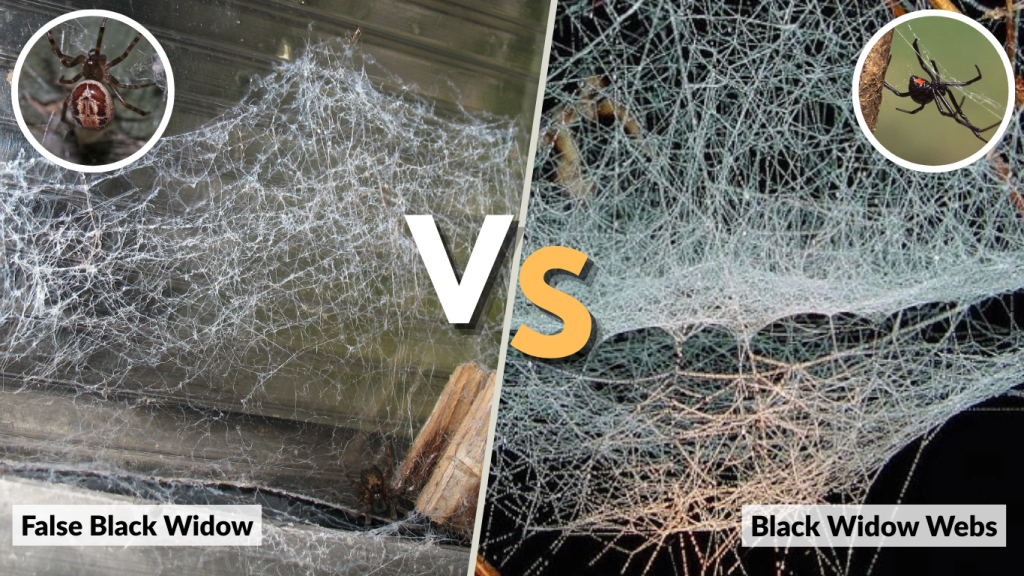
Both false black widows and true black widows create tangled, messy webs in sheltered spaces. Both favor dark corners, sheds, and garages, making them easy to confuse.
Key Differences
The silk of a true black widow is noticeably stickier and stronger. False black widow webs may feel looser and less durable. However, the surest way to differentiate them is by locating the spider itself. A glossy black body with the red hourglass confirms a true widow.
Black Widow Spider vs Funnel Web Spider Webs

Funnel Web Structure
Funnel web spiders create distinctive webs with a tubular entrance leading into a burrow or crevice. These webs look like sheets of silk with a clear funnel-shaped retreat where the spider hides.
Black Widow Comparison
By contrast, black widow webs lack structure and appear more chaotic. They do not contain a funnel or retreat tunnel. This difference makes funnel webs easier to identify if you’re familiar with the two species.
Behavior in the Web
Web Building
Black widows typically spin their webs at night. The female is the primary builder, using her strong silk to create a safe place for catching prey and laying egg sacs. Once established, the web can remain active for weeks or even months if undisturbed.
Prey Capture
The web’s strength and stickiness are essential for hunting. Flies, mosquitoes, beetles, and other insects get trapped in the tangled strands. The widow quickly bites, injecting venom, and then wraps the prey in silk for later feeding. This combination of venom and durable webbing makes her a successful predator.
Black Widow Spider Web Facts

Black widow webs are not just messy tangles of silk; they have some fascinating qualities:
- Silk strength: Black widow silk is stronger than steel by weight and has been studied for potential use in bulletproof materials and aerospace engineering.
- Durability: Their webs can remain intact for months if undisturbed, unlike delicate orb webs that need daily repairs.
- Egg sac support: The web doubles as a nursery, holding egg sacs in place until spiderlings hatch.
- Trap efficiency: The sticky, disorganized design is highly effective for ensnaring multiple insects.
Food Web Connection
Role as a Predator
Black widows are vital parts of local ecosystems. Their webs allow them to catch and control insect populations, including flies, moths, mosquitoes, and beetles. By preying on these insects, they help balance natural food chains.
Prey in the Web
Once trapped, insects are immobilized by the widow’s venom and wrapped in silk. Some larger victims, like grasshoppers or other spiders, may remain stuck in the web for days before being consumed.
Position in the Food Web
While black widows are formidable hunters, they are not at the top of the food web. Birds, lizards, and even some wasps prey on them. Their messy webs, however, provide partial defense by making it harder for predators to reach them.
Misconceptions About Black Widow Webs
There are many myths surrounding these spiders and their webs:
- “They spin giant webs that cover houses” – False. Their webs are modest in size, usually just a few feet wide, and located in corners or sheltered spots.
- “They make funnel webs” – Incorrect. Funnel web spiders and black widows are completely different species. Widow webs lack the organized funnel shape.
- “All messy webs are from black widows” – Not true. Many house spiders spin irregular webs, so identifying the spider itself is critical.
These misconceptions often lead to unnecessary fear or mistaken extermination of harmless spiders.
Identifying a Black Widow Web in Your House

Recognizing widow webs indoors is especially important since bites usually occur when humans accidentally disturb them.
Signs of Widow Webs
- Messy, tangled, and sticky silk, often near the ground.
- Webs located in dark corners, behind boxes, or under furniture.
- The presence of egg sacs—small, white, papery spheres—hanging within the web.
Spotting the Spider
The female black widow usually rests upside down in the web, making her red hourglass marking visible. This behavior is a strong confirmation that the web belongs to her. Males and juveniles may be present but are harder to spot due to their smaller size.
Safety Precautions
If you find a suspected widow web in your home:
- Avoid disturbing it with bare hands.
- Use gloves if cleaning cluttered spaces.
- Consider professional pest control if multiple webs are found.
Black Widow Webs in Texas and Beyond
Black widow populations are most common in warm climates, such as the southern United States, including Texas. In these areas, their webs are frequently found around houses, barns, and outdoor equipment. Recognizing their webs helps prevent accidental contact, especially in regions where people store firewood or spend time in outdoor sheds.
Black Widow vs Brown Widow Webs
Brown widows, a close relative, also build messy webs. While similar in appearance, brown widow silk tends to be a little less sticky and the spiders themselves are lighter brown with orange or yellow markings. Both species prefer man-made structures, making it easy to confuse their webs.
Unique Uses of Black Widow Silk
Researchers have studied black widow silk extensively. Its remarkable strength and elasticity have potential applications in:
- Medical sutures and bandages
- Military-grade protective clothing
- Aerospace and engineering materials
Though not yet widely commercialized, black widow silk remains a focus of biomaterial research.
FAQs
What does a black widow spider web look like?
It is messy, irregular, and sticky, lacking the neat circular pattern of orb-weavers. The web looks tangled but functions as an effective trap.
Are black widow webs dangerous?
The web itself isn’t dangerous, but the spider hiding in it can deliver a venomous bite if disturbed. Always use caution when approaching suspected webs.
How can I tell the difference between black widow and false widow webs?
Both are messy, but black widow webs feel stronger and stickier. Confirm by looking for the spider—true widows show a red hourglass marking on their underside.
Do male black widows spin webs?
Yes, but males build smaller and less noticeable webs. They often linger around female webs during mating season instead of building large webs of their own.
Where in Texas are black widow webs most common?
They are usually found in woodpiles, barns, garages, and outdoor furniture across both rural and suburban areas of Texas, especially in warm, dry regions.