

If you’ve spotted a long-legged, brown spider in your basement, it’s easy to worry that it might be a brown recluse. However, in many cases, the spider is actually a cellar spider, a completely harmless species. These two spiders are often confused due to their coloring and indoor presence—but they are very different in appearance, behavior, and medical risk.
Let’s take a closer look at the key differences between cellar spiders and brown recluse spiders, so you can identify them confidently and understand which (if any) to be concerned about.
Cellar Spider vs Brown Recluse

| Feature | Cellar Spider (Pholcidae family) | Brown Recluse (Loxosceles reclusa) |
| Common Nickname | Daddy longlegs spider | Violin spider |
| Body Shape | Small, oval body; long thin legs | Flat, oval body; proportionate legs |
| Leg Span | Very long (up to 2 inches) | Shorter, more compact |
| Color | Pale tan, gray, or yellowish | Light to medium brown |
| Violin Marking | None | Yes, on back (cephalothorax) |
| Eye Arrangement | 8 eyes in clusters | 6 eyes in 3 pairs |
| Web Type | Loose, messy web | Irregular retreat web |
| Behavior | Vibrates in web when disturbed | Hides in cluttered, dark areas |
| Bite Danger to Humans | Harmless | Potentially dangerous (necrotic bites) |
| Found Indoors | Very common in basements, corners | Often found in closets, boxes, or shoes |
Appearance and Body Shape
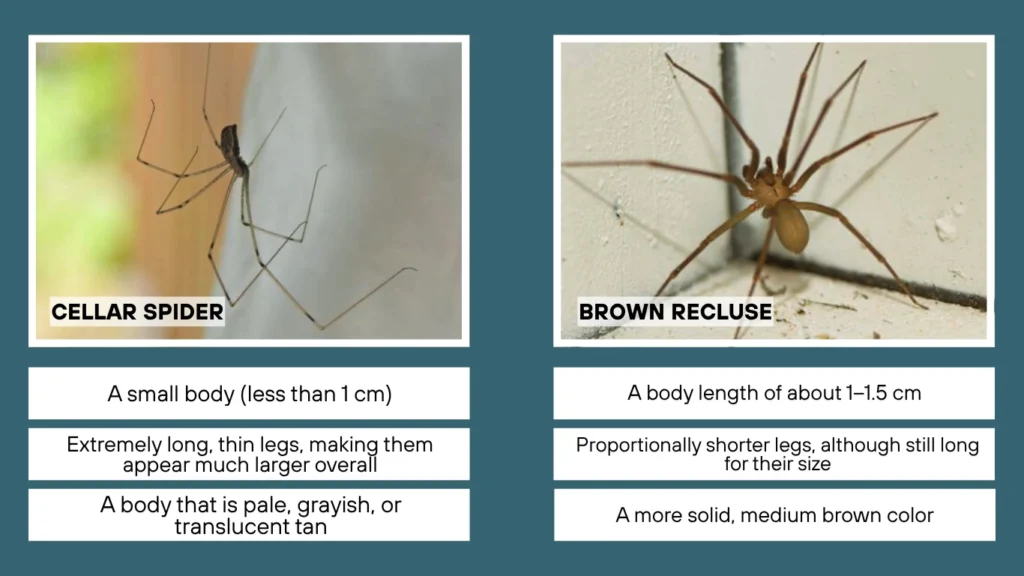
The most obvious difference between these two spiders is size and shape—especially when it comes to legs.
Cellar spiders, often called “daddy longlegs spiders”, have:
- A small body (less than 1 cm)
- Extremely long, thin legs, making them appear much larger overall
- A body that is pale, grayish, or translucent tan
- Legs that may shake or quiver when the web is disturbed
Brown recluses, in contrast, are more compact, with:
- A body length of about 1–1.5 cm
- Proportionally shorter legs, although still long for their size
- A more solid, medium brown color
- A body covered in fine, velvety hairs
Markings and Eye Pattern
One of the most notable features of the brown recluse is its violin-shaped marking on the top of its cephalothorax (head region). The “neck” of the violin points toward the abdomen.
Cellar spiders do not have any violin-shaped markings, nor do they resemble the recluse in this regard.
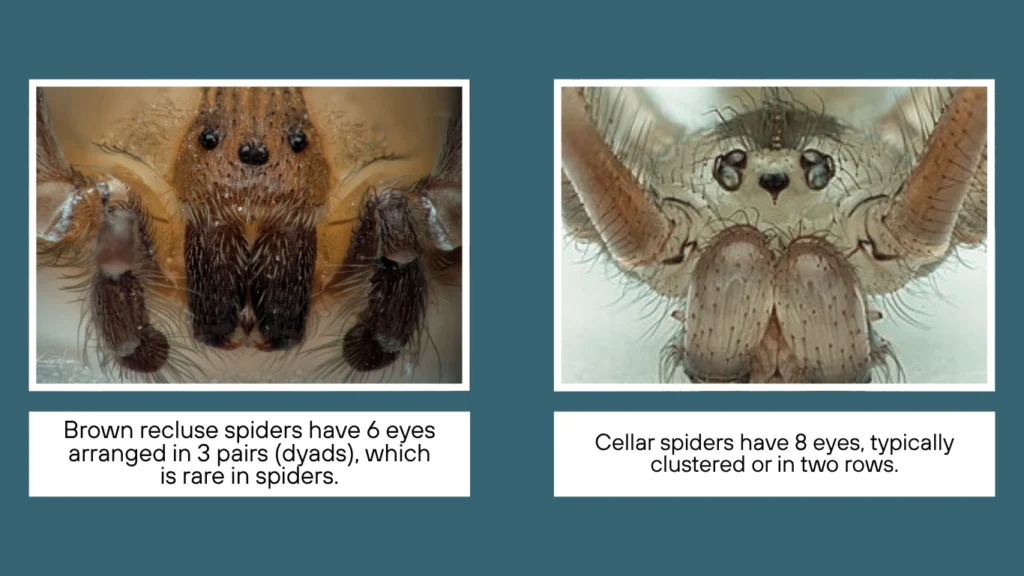
Another reliable identifier is the eye arrangement:
- Brown recluse spiders have 6 eyes arranged in 3 pairs (dyads), which is rare in spiders.
- Cellar spiders have 8 eyes, typically clustered or in two rows.
Because most people aren’t checking eye patterns up close, the violin marking is often the easiest visual clue to start with.
Web Behavior and Hunting Style
Cellar spiders are web builders. They create loose, messy, tangled webs in ceiling corners, garages, basements, and other undisturbed spaces. If disturbed, they often vibrate rapidly in their web to confuse predators.
They stay in or near their webs, waiting for small insects to get trapped. They are not aggressive and are completely harmless to humans.
Brown recluses, on the other hand, build small, irregular webs in dark, dry, undisturbed areas—not for catching prey, but as a retreat or hiding spot. They are active hunters, typically coming out at night to search for insects, rather than relying on webs to catch food.
Habitat and Where They’re Found
Cellar spiders are extremely common indoors in homes across North America. You’ll typically see them in:
- Basement corners
- Ceilings
- Closets
- Garages
- Behind furniture
They’re especially noticeable because of their leg span and web vibrations.
Brown recluses are more regionally limited to the Midwestern and Southern United States, including:
- Missouri
- Arkansas
- Kansas
- Texas
- Oklahoma
They prefer:
- Cardboard boxes
- Clothing piles
- Closets
- Attics
- Behind baseboards
They are rarely seen unless their hiding place is disturbed.
Bite Danger and Human Risk
This is where the two spiders differ dramatically.
Cellar Spider
- Completely harmless to humans
- Cannot pierce human skin effectively
- No venom threat
- May help control other pests by eating insects and even other small spiders
Brown Recluse
- Medically significant bite
- Venom can cause necrotic lesions, skin damage, and in rare cases, systemic illness
- Most bites occur when the spider is accidentally pressed against the skin (e.g., in clothing or bedding)
- Requires medical attention if symptoms worsen after 24–48 hours
Quick Identification Tips
- Very long legs, small body, visible web? → Cellar spider
- Violin-shaped marking, smooth brown body, found in boxes or shoes? → Brown recluse
- Spider shakes when web is touched? → Cellar spider
- Hiding in clutter with no visible web? → Brown recluse
FAQs
1. Are cellar spiders venomous?
Technically, yes—they have venom used to kill small prey—but they are not dangerous to humans. Their fangs are too small to penetrate human skin effectively.
2. How can I be sure I’m not seeing a brown recluse?
Look for the violin marking, six eyes, and smooth legs. Also consider your region—if you’re outside the central U.S., it’s less likely to be a recluse.
3. Should I get rid of cellar spiders?
Not necessarily. They are natural pest controllers and help reduce flies, mosquitoes, and even other spiders. If you dislike them, gently remove them rather than kill.
4. What should I do if I think I’ve been bitten by a brown recluse?
Clean the wound, apply a cold compress, and monitor for worsening symptoms like ulceration, darkening skin, or spreading pain. If symptoms appear, seek medical help immediately.
5. Are brown recluses common in basements?
They can be, especially in homes located in their native range. However, many spiders found in basements—especially those with long legs—are usually cellar spiders, not recluses.