
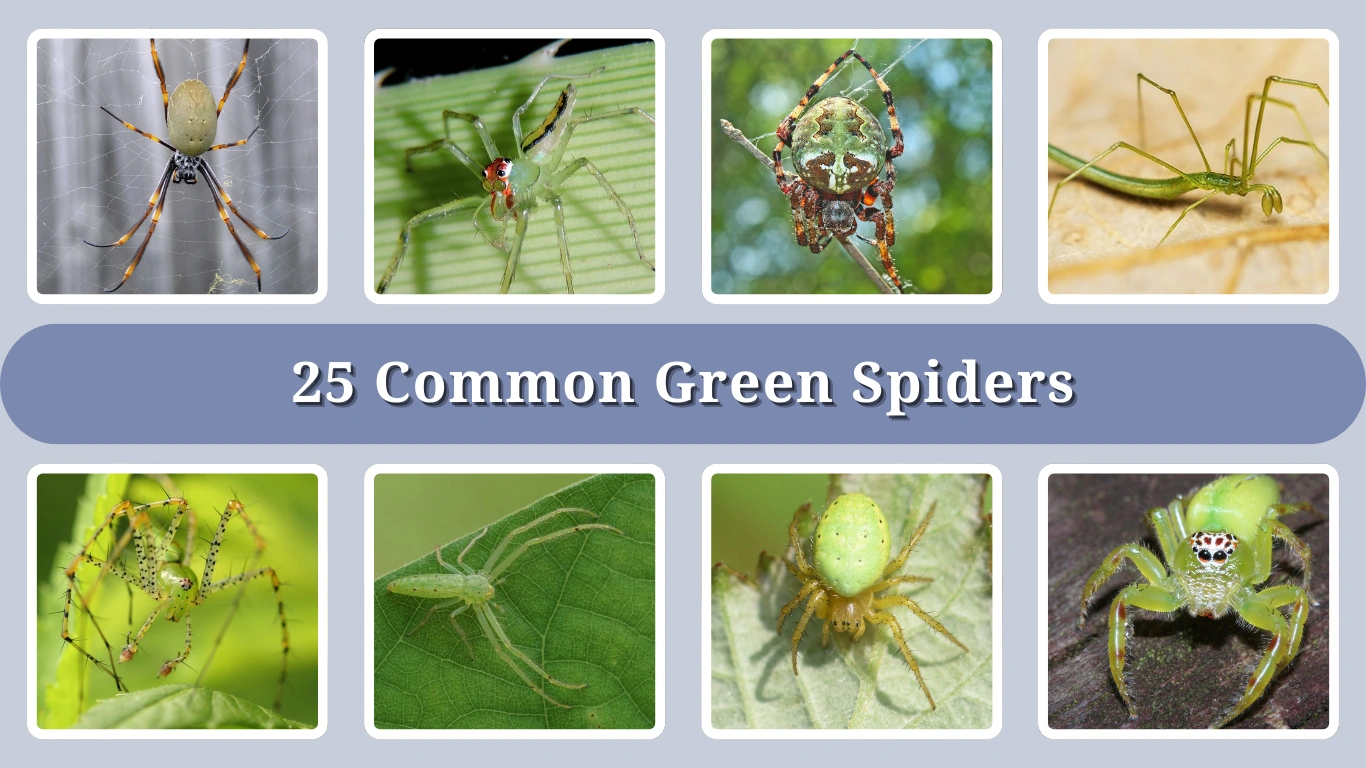
Green spiders are a fascinating group of arachnids found across the globe, from gardens and forests to wetlands and grasslands. Their vibrant coloration not only helps them camouflage among leaves but also makes them stand out as some of nature’s most striking hunters. This guide introduces 25 common green spider species, detailing their identification, habitats, behaviors, and the risks (or lack thereof) they pose to humans.
1. Green Lynx Spider

The Green Lynx Spider (Peucetia viridans) is one of the most recognized green spiders in North America. Known for its vivid green body and agile hunting style, it plays an important role in controlling garden pests. This species is often found in vegetation where it blends perfectly with leaves and stems.
Identification
- Bright green elongated body with reddish spots on the upper surface
- Long, thin legs covered with black spines
- Females larger (up to 22 mm) than males (about 12 mm)
- Eight eyes arranged in a hexagonal pattern
- Excellent camouflage among leaves and stems
Habitat
These spiders thrive in warm climates, especially in the southern United States, Mexico, Central America, and the Caribbean. They prefer shrubs, gardens, and fields where flowers attract insects.
Behaviors
Unlike orb-weaving spiders, the Green Lynx does not build webs to catch prey. Instead, it actively hunts, leaping quickly to capture insects. Females are protective mothers and will guard their egg sacs fiercely.
Bite and Danger to Humans
The bite of a Green Lynx Spider is not considered medically dangerous to humans. It may cause temporary pain, redness, or swelling, but it is not venomous enough to cause severe harm. Its role in pest control makes it more beneficial than harmful.
2. American Green Crab Spider

The American Green Crab Spider (Misumessus oblongus) is a small but efficient ambush predator. Its crab-like stance and ability to blend into green plants make it a fascinating species often spotted in meadows and gardens.
Identification
- Small body, usually less than 6 mm in size
- Bright green or yellowish-green coloration
- Long, sideways-extending front legs (crab-like stance)
- Oval-shaped abdomen, often slightly translucent
- Can change shades slightly to match surroundings
Habitat
This species is found across North America, often in fields, gardens, and flowering plants where pollinators are active. It uses camouflage to hide among petals and leaves.
Behaviors
The American Green Crab Spider does not spin webs to catch prey. Instead, it waits motionless on flowers, ambushing visiting insects such as flies, bees, and butterflies.
Bite and Danger to Humans
Its bite is harmless to humans. At most, it may cause mild irritation if provoked. The spider is more beneficial as it helps regulate insect populations.
3. Magnolia Green Jumping Spider

The Magnolia Green Jumping Spider (Lyssomanes viridis) is a tiny, energetic hunter native to the Americas. Known for its bright green body and large forward-facing eyes, it is one of the most visually striking jumping spiders.
Identification
- Small body, about 6–8 mm long
- Vibrant green coloration with transparent legs
- Large forward-facing eyes giving excellent vision
- Compact body with noticeable agility
- Juveniles may appear lighter in shade than adults
Habitat
Magnolia Green Jumping Spiders are commonly found in the southeastern United States, Mexico, and parts of Central America. They prefer magnolia trees, shrubs, and leafy plants where prey insects are abundant.
Behaviors
These spiders are active hunters, leaping onto their prey with precision. Unlike web-building spiders, they rely on their keen eyesight and agility. They may also use silk threads as a safety line during jumps.
Bite and Danger to Humans
The bite is not harmful to humans. At worst, it can cause minor redness or irritation. Their small size makes them unlikely to bite unless handled roughly.
4. Green Orb Weaver

The Green Orb Weaver (Araniella cucurbitina) is a common small spider in Europe and Asia, easily recognized for its vivid green body and orb-shaped webs.
Identification
- Small size, usually 4–6 mm in length
- Bright green abdomen with possible tiny black spots
- Legs pale green to yellowish
- Rounded body shape typical of orb weavers
- Webs are circular and delicate, often between shrubs
Habitat
Green Orb Weavers are found in gardens, woodlands, and hedgerows. They prefer sunny spots with dense vegetation where they can build their webs.
Behaviors
They construct orb-shaped webs to catch flying insects. During summer, they are most active and visible. Females often remain in the center of their webs, waiting for prey.
Bite and Danger to Humans
Bites are extremely rare and harmless. At most, they cause mild redness or itching, similar to a mosquito bite.
5. Green Huntsman Spider
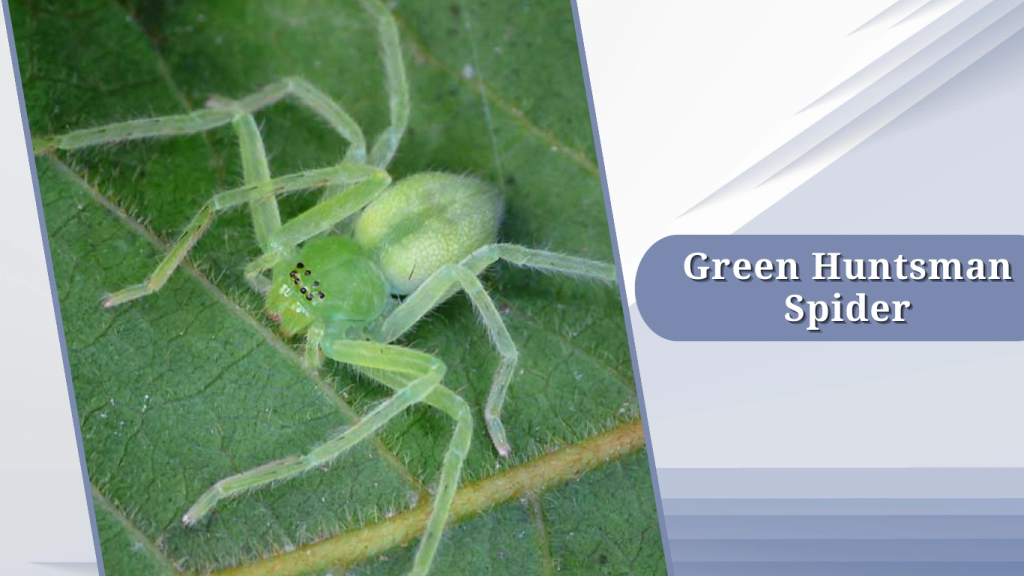
The Green Huntsman Spider (Micrommata virescens) is a striking, bright green spider found mainly in Europe. Its vibrant coloration helps it camouflage in lush vegetation.
Identification
- Medium size, females up to 15 mm, males smaller
- Uniform bright green body and legs
- Long, agile legs adapted for hunting
- Darker stripe may run along the body in some specimens
- Eight eyes arranged in two rows
Habitat
These spiders are often found in grasslands, shrubs, and forest edges. They prefer dense green vegetation where they can remain hidden.
Behaviors
The Green Huntsman is an active hunter, not a web-builder. It relies on stealth and speed to ambush prey, often during the daytime.
Bite and Danger to Humans
The bite is harmless to humans. It may cause mild irritation but no lasting effects. This species is valued for controlling insect pests naturally.
6. Cucumber Green Spider

The Cucumber Green Spider (Araniella opisthographa) is a tiny but vibrant orb-weaving spider often confused with other green orb species. Its striking color makes it a favorite subject of garden photographers.
Identification
- Small body size, about 4–5 mm long
- Bright cucumber-green abdomen with faint markings
- Legs yellowish-green, semi-translucent
- Rounded, compact body typical of orb-weavers
- Sometimes shows a reddish spot near the spinnerets
Habitat
This spider is widespread across Europe and Asia, thriving in hedgerows, woodland edges, and gardens. It often builds its web in sunny, open spaces where flying insects are common.
Behaviors
The Cucumber Green Spider builds delicate orb webs to capture small flies and gnats. It is mostly active during the warmer months, staying hidden in leaves or web retreats when not hunting.
Bite and Danger to Humans
Completely harmless to humans, its bite is too weak to penetrate skin. It poses no medical threat and contributes to natural insect control.
7. Green Garden Spider

The Green Garden Spider (Araniella displicata) is a close relative of other Araniella orb-weavers, but it is especially well-adapted to garden habitats where it thrives among plants and flowers.
Identification
- Body length ranges from 4–9 mm
- Bright green abdomen with a reddish or yellowish spot near the rear
- Legs are pale green to light yellow, with fine hairs
- Rounded abdomen with subtle darker markings
- Eight small black eyes arranged in two rows
Habitat
Found across North America, especially in gardens, meadows, and forest edges. They build webs between plants, shrubs, and flowers where insect activity is high.
Behaviors
Green Garden Spiders are orb-weavers, creating circular webs to trap prey. They stay motionless in the center of the web or hide nearby, waiting for vibrations signaling captured insects.
Bite and Danger to Humans
Bites are rare and non-threatening. If they occur, they may cause minor skin irritation but nothing serious. They are highly beneficial in controlling flies, gnats, and other garden pests.
8. Green Crab Spider

The Green Crab Spider (Diaea dorsata) is a well-camouflaged ambush predator found throughout Europe and Asia. Its crab-like stance and leafy-green color make it almost invisible in foliage.
Identification
- Small size, around 6–8 mm long
- Leafy-green body with a slightly rough texture
- Front legs extended outward, resembling a crab stance
- Abdomen broad and slightly flattened
- Sometimes with faint yellow or brown markings on the legs
Habitat
This species is found mainly in forests, shrubs, and meadows across Europe and parts of Asia. It prefers deciduous trees and bushes with dense leaves for camouflage.
Behaviors
The Green Crab Spider does not spin webs for hunting. Instead, it waits motionless on leaves, ambushing unsuspecting insects. Its ability to blend seamlessly with foliage gives it an advantage in catching flies, beetles, and small pollinators.
Bite and Danger to Humans
Harmless to humans. Its bite is not strong enough to break skin in most cases. At worst, it may cause a minor pinch or irritation.
9. Emerald Jumping Spider

The Emerald Jumping Spider (Lyssomanes jemineus) is a shimmering green jumping spider native to Central and South America. Known for its excellent vision and quick leaps, it is both beautiful and agile.
Identification
- Body length between 5–8 mm
- Shiny emerald-green coloration on body and legs
- Large forward-facing eyes typical of jumping spiders
- Compact, slender body shape
- Some may show faint white or translucent markings
Habitat
Commonly found in tropical forests of Central and South America, particularly in shrubs, tree bark, and leafy vegetation. They prefer humid, warm environments.
Behaviors
Emerald Jumping Spiders are active hunters, using their sharp eyesight to stalk and leap onto prey. They often explore plants and tree trunks, securing themselves with silk draglines before making jumps.
Bite and Danger to Humans
Not dangerous to humans. A bite, if it occurs, may cause slight irritation similar to a mosquito bite. Their small size makes bites extremely uncommon.
10. Green Leaf Spider

The Green Leaf Spider (Diaea viridissima) is a crab spider well known for its ability to blend seamlessly with leaves. Its bright green coloration makes it a master of disguise in shrubs and trees.
Identification
- Small to medium size, 6–10 mm long
- Bright green body matching leaf surfaces
- Front legs extended sideways like a crab stance
- Rounded abdomen, slightly flattened
- Sometimes shows faint yellowish markings
Habitat
This species is commonly found in Europe and Asia. It prefers woodlands, gardens, and hedgerows, usually on the undersides of leaves where it hides from predators and ambushes prey.
Behaviors
Green Leaf Spiders do not spin webs to trap insects. Instead, they wait motionless on leaves and strike when flies, bees, or small beetles come close. Their camouflage makes them nearly invisible to both predators and prey.
Bite and Danger to Humans
Harmless to humans. The bite is rare and only causes mild local irritation if it occurs.
11. Green Sac Spider

The Green Sac Spider (Cheiracanthium inclusum) is a small hunter commonly found indoors and outdoors. It is one of the few green spiders sometimes encountered inside homes.
Identification
- Small body length, about 5–10 mm
- Light green to yellow-green coloration
- Slightly elongated body with darker chelicerae (fangs)
- Long, slender legs without spines
- Creates silken sacs instead of webs
Habitat
Green Sac Spiders are found worldwide, including North and South America, Europe, and Africa. Outdoors, they live in foliage, shrubs, and fields; indoors, they may build sacs in corners, ceilings, or behind objects.
Behaviors
Unlike orb-weavers, these spiders do not spin webs to capture prey. They actively hunt at night and rest in silken sacs during the day. They are opportunistic predators, feeding on small insects.
Bite and Danger to Humans
Bites can occur more frequently than with many green spiders, especially indoors. Though not considered dangerous, their bite can cause redness, itching, and mild swelling. Rarely, secondary infection may occur if the wound is scratched.
12. Green Lynx Spider (Florida Variant)

The Green Lynx Spider Florida (Peucetia viridans) is the same species as the common Green Lynx Spider but noted for its prominence in Florida’s warm and humid climate. It is a vital garden predator, helping to control pests year-round.
Identification
- Medium-sized spider, females up to 22 mm
- Vivid green body with red spots on the upper abdomen
- Long, thin legs covered in black spines
- Distinctive eye arrangement in hexagonal shape
- Camouflage perfectly suited for leafy plants and shrubs
Habitat
Especially common in Florida, Central America, and the Caribbean. Found in gardens, fields, and meadows where insect prey is plentiful.
Behaviors
Active hunters that leap onto their prey rather than using webs. Females guard their egg sacs aggressively, making them more visible during breeding season.
Bite and Danger to Humans
Not medically dangerous. A bite may cause mild pain, redness, and swelling, but symptoms usually disappear within a day or two.
13. Green Huntsman of Europe

The Green Huntsman Spider of Europe (Micrommata ligurina) is closely related to Micrommata virescens but is found mainly in southern Europe. It is a bright green hunter adapted to Mediterranean habitats.
Identification
- Medium-sized, females up to 14 mm, males smaller
- Uniform green body, sometimes with faint yellow or white markings
- Long agile legs suited for running and hunting
- Elongated cephalothorax with distinct dark eyes
- Males may show reddish or brownish tones on the abdomen
Habitat
Native to southern and central Europe, especially Mediterranean forests, grasslands, and shrublands. Prefers dense vegetation where its coloration provides camouflage.
Behaviors
Does not spin webs for prey. Instead, it stalks and ambushes insects on leaves and branches. More active in warm daylight hours compared to many other spiders.
Bite and Danger to Humans
Not harmful to humans. Its bite is mild and may cause slight skin irritation but no serious effects. It is considered ecologically beneficial as a natural pest controller.
14. Little Green Crab Spider

The Little Green Crab Spider (Misumena vatia – green morph) is a small ambush hunter with the ability to change color between white, yellow, and green depending on its environment.
Identification
- Small body size, 5–8 mm long
- Usually green but may shift between white or yellow
- Flattened, crab-like body with sideways-extending front legs
- Abdomen broad and oval-shaped
- Subtle markings may appear on the dorsal surface
Habitat
Widespread across North America, Europe, and Asia. It is commonly found on flowers, shrubs, and leafy plants where it waits for pollinators.
Behaviors
Uses camouflage to ambush prey, especially bees, flies, and butterflies visiting flowers. It relies on stillness and sudden strikes rather than webs.
Bite and Danger to Humans
Not dangerous to humans. At most, a bite causes mild irritation or redness.
15. Neon Green Jumping Spider

The Neon Green Jumping Spider (Lyssomanes spp.) is a group of small, brightly colored jumping spiders with dazzling green bodies and sharp vision.
Identification
- Very small size, usually 4–6 mm
- Neon green coloration with translucent legs
- Large, forward-facing eyes characteristic of jumping spiders
- Agile, compact body built for leaping
- Some species have faint white or yellow markings
Habitat
Found in tropical and subtropical regions of Central and South America, often on leaves, shrubs, and low vegetation.
Behaviors
Active daytime hunters that rely on keen vision and rapid leaps. They stalk insects carefully before pouncing, often using silk draglines for safety.
Bite and Danger to Humans
Completely harmless to humans. Their bite is extremely rare due to their tiny size and non-aggressive nature.
16. Green Orb Spider

The Green Orb Spider (Araniella alpica) is a small orb-weaver species that builds delicate circular webs in shrubs and trees. Its fresh green color gives it excellent camouflage in vegetation.
Identification
- Small body length, usually 4–7 mm
- Bright green abdomen, sometimes with faint red markings near the spinnerets
- Legs pale green or yellowish, semi-translucent
- Rounded abdomen typical of orb-weavers
- Eight small eyes arranged in two rows
Habitat
Found across Europe and parts of Asia. Prefers hedgerows, meadows, and woodland edges where it can spin webs among leaves and branches.
Behaviors
Constructs classic orb-shaped webs to capture flying insects. During summer, it is most visible in sunny spots. Spends much of its time resting in the center of its web.
Bite and Danger to Humans
Harmless to humans. A bite may cause mild irritation, similar to a mosquito bite, but is extremely rare.
17. Green Long-Jawed Orb Weaver
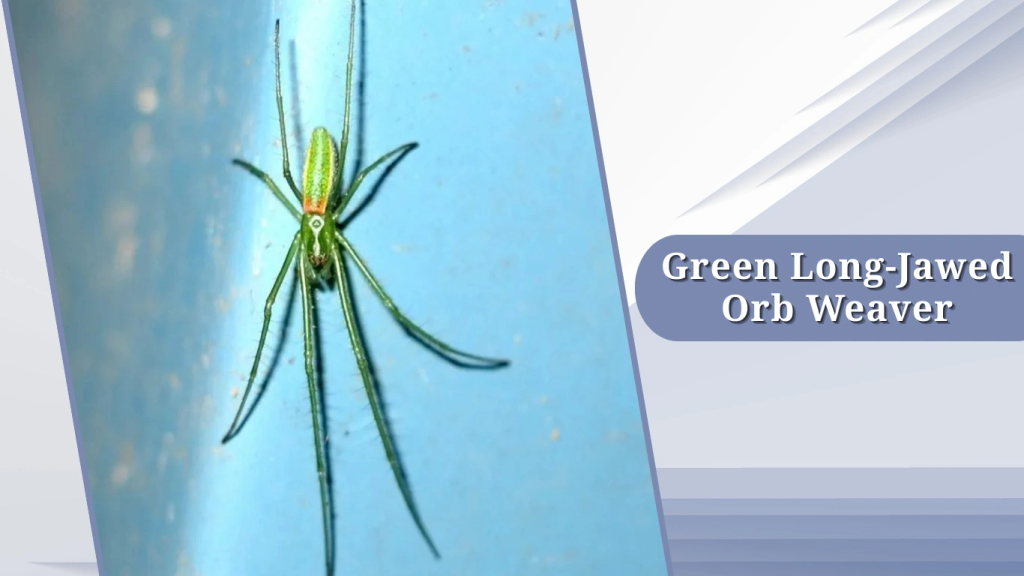
The Green Long-Jawed Orb Weaver (Tetragnatha viridis) is a slender, green spider with extended jaws (chelicerae) that hunts near water and dense vegetation.
Identification
- Long, thin body, 6–12 mm in size
- Bright green abdomen, sometimes with silvery streaks
- Extremely long legs, especially the front pair
- Prominent elongated chelicerae (“jaws”)
- Narrow body adapted for resting along grass stems
Habitat
Found in Europe, Asia, and parts of North America. Common near wetlands, rivers, and lakes, but also present in tall grasslands and shrubs.
Behaviors
Builds horizontal orb webs close to water surfaces or vegetation. It often rests stretched out along grass stems, making it nearly invisible. Hunts mosquitoes, flies, and other small insects.
Bite and Danger to Humans
Not dangerous to humans. Its bite is weak and rarely penetrates the skin. Even when it does, symptoms are mild and short-lived.
18. Greenish Cellar Spider
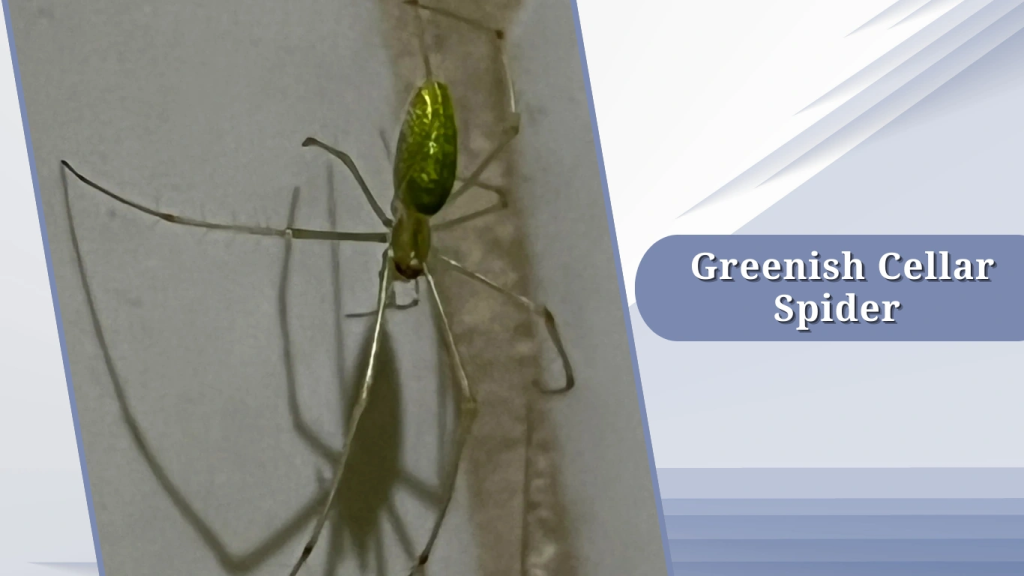
The Greenish Cellar Spider (Pholcus phalangioides – green morph) is a variant of the well-known cellar spider, sometimes called “daddy long-legs.” While usually pale or gray, some individuals take on a greenish tint that helps them blend with vegetation.
Identification
- Very long, thin legs compared to body size
- Small body length, about 7–10 mm
- Greenish or pale translucent body
- Tiny abdomen, almost cylindrical
- Eight small eyes clustered closely together
Habitat
Found worldwide in homes, basements, caves, and under rocks. The green morph is more common in damp outdoor areas with vegetation.
Behaviors
Builds loose, irregular webs in corners or sheltered areas. When disturbed, it vibrates rapidly in its web to blur its outline. It preys on small insects and even other spiders.
Bite and Danger to Humans
Not dangerous to humans. Although commonly encountered indoors, its bite is too weak to penetrate skin.
19. Green Grass Spider

The Green Grass Spider (Agelenopsis spp. – green morph) is part of the funnel weaver family, known for their sheet-like webs in grass and shrubs. Some individuals develop a greenish tint that blends with vegetation.
Identification
- Medium size, 10–20 mm body length
- Greenish to light brown coloration with darker stripes
- Long legs adapted for sprinting across webs
- Distinct pair of spinnerets extending from the abdomen
- Elongated cephalothorax
Habitat
Found across North America in grassy fields, lawns, shrubs, and forest edges. Webs are built low to the ground in dense vegetation.
Behaviors
Constructs sheet-like webs with funnel retreats. Waits at the funnel’s entrance, dashing out quickly when prey lands on the web. Extremely fast runners when disturbed.
Bite and Danger to Humans
Mildly irritating bite if provoked, similar to a bee sting. Not dangerous, and they rarely bite unless pressed against the skin.
20. Green Tree Crab Spider
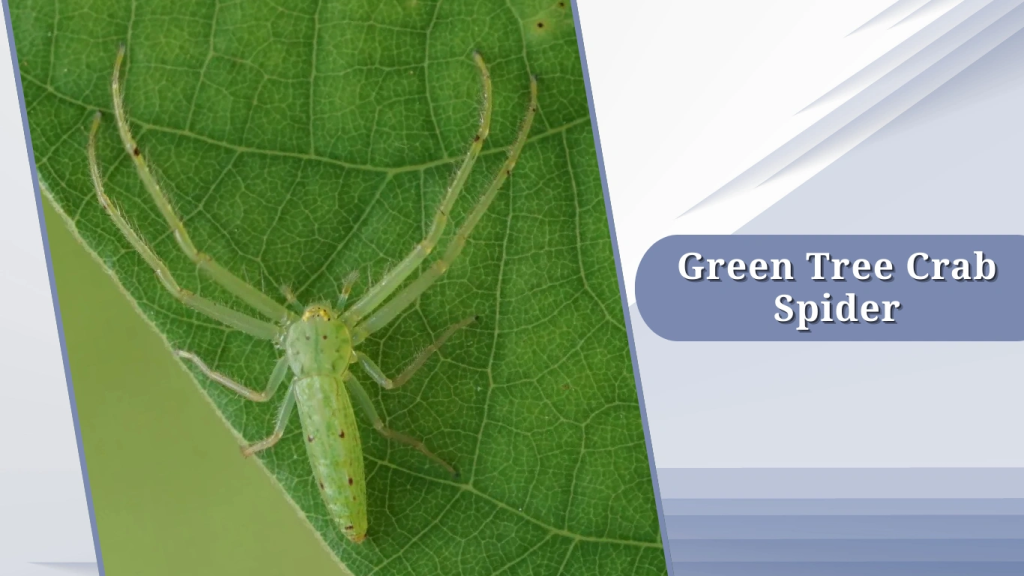
The Green Tree Crab Spider (Diaea dorsata – arboreal form) is a leafy-green crab spider that prefers living high among trees and shrubs. Its natural camouflage makes it very difficult to spot.
Identification
- Small body, about 6–8 mm long
- Bright green coloration resembling fresh leaves
- Broad, flattened abdomen with smooth surface
- Front legs extended sideways like other crab spiders
- Occasionally with faint yellow or brownish tints on the legs
Habitat
Widespread across Europe and Asia, especially in deciduous forests and wooded areas. Often found on leaves, branches, and tree bark.
Behaviors
Ambush predator that waits patiently on leaves or branches, striking insects that land nearby. Unlike orb-weavers, it relies solely on camouflage and stealth.
Bite and Danger to Humans
Harmless to humans. Its bite is too weak to cause anything more than a slight, temporary irritation.
21. Fluorescent Green Lynx Spider
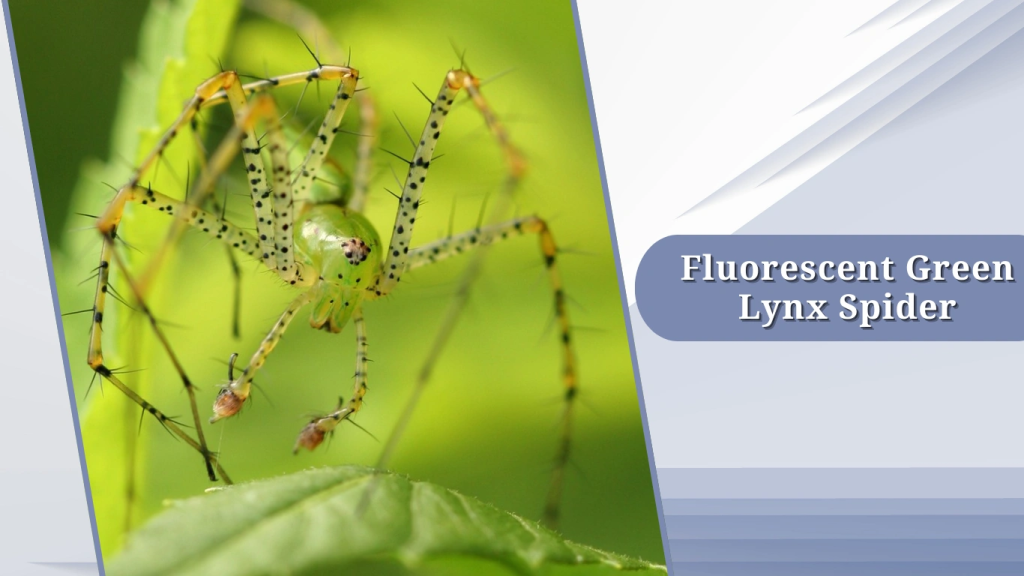
The Fluorescent Green Lynx Spider (Peucetia longipalpis) is a close relative of the common Green Lynx Spider, notable for its more vibrant and glowing coloration.
Identification
- Medium-sized spider, females up to 20 mm
- Fluorescent green body, sometimes appearing almost glowing
- Long, spiny legs with black-tipped spines
- Reddish spots often present on the dorsal side
- Distinctive forward-facing posture while hunting
Habitat
Native to tropical and subtropical regions, especially in Central and South America. Found in fields, shrubs, and flowering plants where prey insects are abundant.
Behaviors
Active daytime hunters that leap onto insects, particularly grasshoppers, moths, and flies. Females are protective of their egg sacs, just like other lynx spiders.
Bite and Danger to Humans
Not dangerous to humans. A bite may cause short-term swelling or redness but is not medically significant.
22. Green Twig Spider

The Green Twig Spider (Ariamnes spp.) is a slender, elongated spider that disguises itself as a twig or stem. Its cryptic shape and coloration make it a master of camouflage in forests and shrublands.
Identification
- Long, thin body resembling a twig or stem
- Green to brownish-green coloration
- Very slender legs that extend outward like twigs
- Small head region compared to elongated abdomen
- Can remain motionless for long periods
Habitat
Found in tropical and subtropical regions worldwide, particularly in dense forests and shrubby areas. It prefers perches on thin branches, stems, and twigs.
Behaviors
Specialized in camouflage, often aligning itself with stems to remain undetected. Hunts at night by dangling from silk threads and capturing flying insects.
Bite and Danger to Humans
Not considered dangerous. Its bite is very rare and only causes mild, temporary discomfort if it occurs.
23. Green Dwarf Orb Weaver

The Green Dwarf Orb Weaver (Araniella proxima) is a close relative of the Green Orb Weaver, known for its tiny size and bright coloration.
Identification
- Very small size, usually 3–5 mm
- Bright green abdomen with occasional reddish spot near spinnerets
- Legs pale green to yellow, slightly translucent
- Rounded body typical of orb-weaving spiders
- Subtle darker markings on the back in some individuals
Habitat
Found across Europe and Asia, commonly in gardens, meadows, and hedgerows. Builds small orb webs among shrubs and low plants.
Behaviors
Constructs miniature orb webs to catch gnats, midges, and other tiny flying insects. They are more active during summer and are often overlooked due to their size.
Bite and Danger to Humans
Completely harmless. Too small to bite through human skin effectively, and poses no threat.
24. Green Jumping Spider of Mexico

The Green Jumping Spider of Mexico (Lyssomanes mexicanus) is a brightly colored jumping spider native to Central America. With its vivid green body and sharp eyesight, it is both an effective predator and an eye-catching species.
Identification
- Small size, about 6–8 mm in length
- Vivid green body with semi-transparent legs
- Large forward-facing eyes typical of jumping spiders
- Compact, agile body adapted for leaping
- May show subtle yellow or white markings
Habitat
Native to Mexico and parts of Central America. Found in tropical forests, shrubs, and gardens with abundant vegetation.
Behaviors
An active daytime hunter that stalks prey using keen vision, then leaps with precision. Uses silk draglines for safety during jumps. Prefers small flying insects.
Bite and Danger to Humans
Harmless to humans. A bite is extremely rare and causes only mild irritation if it occurs.
25. Green Golden Orb Weaver

The Green Golden Orb Weaver (Trichonephila senegalensis – green morph) is a striking orb-weaving spider found in Africa. Some individuals display a vivid green hue, making them stand out among other golden orb weavers.
Identification
- Large body, females up to 25–30 mm
- Greenish abdomen with golden sheen
- Long legs with banded or dark segments
- Builds large, strong orb webs
- Males much smaller and less colorful than females
Habitat
Native to Africa, particularly in tropical and subtropical regions. Found in forests, gardens, and grasslands where they construct massive orb webs between trees and shrubs.
Behaviors
Builds some of the largest orb webs in the spider world, capable of trapping sizable insects. Females dominate the web, while males linger nearby. Active during warm seasons.
Bite and Danger to Humans
Not considered dangerous. The bite is rare and only mildly painful, comparable to a bee sting.