

The European Garden Spider (Araneus diadematus), also known as the Cross Orb-Weaver, is one of the most recognizable spiders across Europe and North America. With its distinctive cross markings and orb-shaped webs, it’s both fascinating and beneficial. This species plays a vital role in controlling insect populations and maintaining ecological balance in gardens and forests alike.
Overview of the European Garden Spider
This spider belongs to the Araneidae family, a group known for crafting intricate orb-shaped webs. The European Garden Spider thrives in both natural and urban habitats, especially in gardens, hedges, and forest edges. Its population is widespread across Europe and has successfully adapted to North America, particularly in regions like Michigan, Washington, and California.
Identification and Appearance
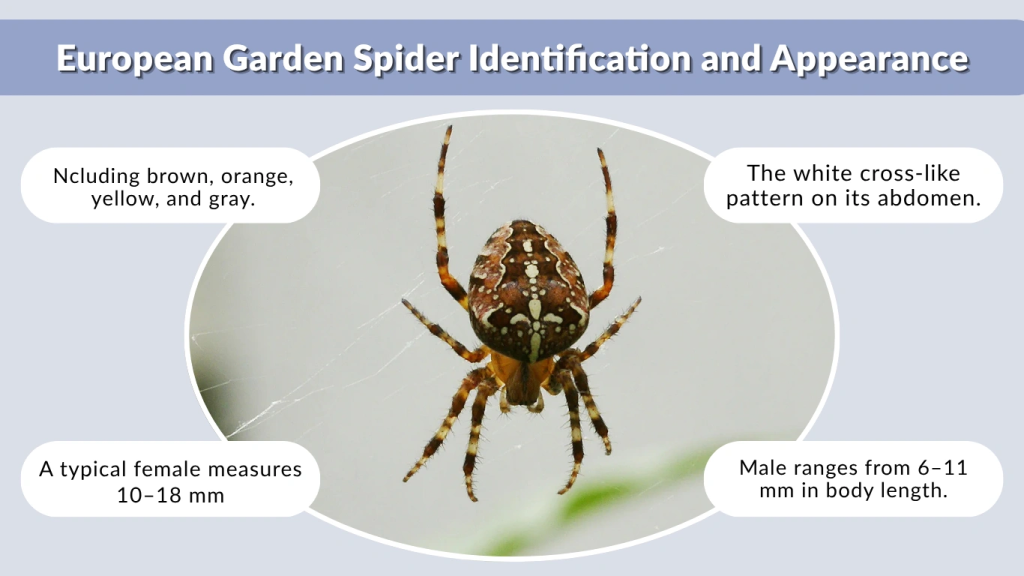
Key Physical Features
The European Garden Spider exhibits a variety of colors, including brown, orange, yellow, and gray, often matching its surroundings for camouflage. The most defining feature is the white cross-like pattern on its abdomen, formed by several pale spots. Its legs are long and banded with tiny spines, helping it sense vibrations and movement in its web.
European Garden Spider Size
Females are significantly larger than males. A typical female measures 10–18 mm, while a male ranges from 6–11 mm in body length. Despite the size difference, both sexes have proportionate leg spans, giving them a similar overall appearance when viewed in the web.
Male vs. Female European Garden Spider
Physical Differences
Female spiders have larger, rounder abdomens, especially noticeable when they are full of eggs. Males are slimmer, with longer legs relative to their bodies. These differences are part of their sexual dimorphism, a common trait among orb-weavers.
Behavioral Differences
Males are more mobile, spending most of their adult lives searching for females during the late summer. Females, on the other hand, remain stationary, guarding their webs and later their egg sacs. The female’s web-building skills are more refined, allowing her to capture enough prey to sustain reproduction.
Habitat and Distribution
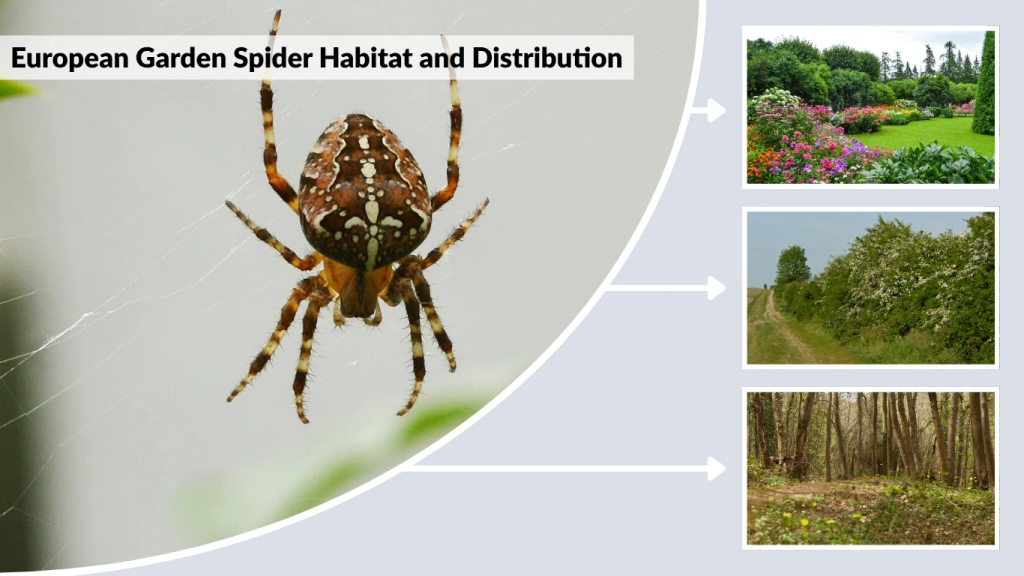
The European Garden Spider is found throughout Europe, extending into North America and parts of Asia. In the United States, it’s often seen in Michigan, Ohio, Pennsylvania, and California. These spiders prefer humid, temperate regions, thriving in gardens, hedgerows, and wooded areas. Urban dwellers may spot them near windows, fences, and porches, where artificial lights attract flying insects at night.
Their adaptability to various environments has allowed them to establish strong populations even in cities, making them one of the most common spiders encountered by homeowners.
Web Structure and Hunting Behavior
The web of the European Garden Spider is an engineering marvel — a symmetrical orb-shaped structure used to trap prey and detect vibrations.
- Web Type: Circular and spiral, stretching up to 30 cm in diameter.
- Location: Commonly between shrubs, walls, or lamp posts.
- Purpose: To trap flying insects like flies and mosquitoes.
- Daily Routine: Rebuilt each evening, with the old web eaten for nutrient recycling.
- Prey: Includes moths, beetles, and gnats.
At dusk, the spider patiently waits at the center of the web or hides in a retreat connected by a signal line. When an insect hits the web, the vibrations instantly alert the spider. It rushes forward, injects venom, and wraps the prey in silk before feeding later.
European Garden Spider Bite

Are They Dangerous?
Despite their intimidating size and appearance, European Garden Spiders are harmless to humans. They only bite if directly provoked or mishandled. Their small fangs are capable of piercing human skin, but the venom is mild and not medically significant.
Bite Symptoms
A bite might cause slight redness, itching, or swelling, similar to a mosquito bite. Symptoms usually disappear within a few days without medical treatment. Allergic reactions are rare, and most people never experience any complications.
Is the European Garden Spider Poisonous or Venomous?
This species is often misunderstood as “poisonous,” but that term doesn’t accurately describe it. The European Garden Spider is venomous, meaning it uses venom to subdue prey — not to harm humans. Its venom contains mild neurotoxins that quickly immobilize small insects like flies and mosquitoes.
However, the venom’s potency is too weak to affect humans. Even if bitten, the result is a mild local irritation rather than a serious reaction. In short, they’re venomous to insects but harmless to people.
European Garden Spider Life Cycle

The life of this spider is short yet fascinating, progressing through several well-defined stages:
- Egg Stage: Females lay hundreds of eggs inside protective silk sacs during late summer or early autumn.
- Spiderlings: Eggs overwinter and hatch in spring, producing small yellow spiderlings.
- Ballooning Stage: Spiderlings release silk threads into the air and disperse with the wind — a process called ballooning.
- Juvenile Growth: Young spiders molt several times as they grow through summer.
- Adult Stage: Maturation occurs by late summer, and mating soon follows. Females die after laying eggs, while males perish shortly after mating.
This annual cycle ensures the continuation of the species each year, with the next generation emerging as spring warms the landscape.
Reproduction and Mating
Courtship Behavior
During late summer, males set out to find females by following silk pheromones left in the air. Upon reaching a female’s web, the male gently plucks the strands to signal his presence. If accepted, mating occurs cautiously to prevent the female from attacking him.
Mating is brief, after which males either retreat or are sometimes consumed — a phenomenon called sexual cannibalism, although it’s not always the case with this species.
European Garden Spider Egg Sac
After mating, the female produces one or more silk egg sacs, each containing up to 800 eggs. She attaches these sacs under leaves, fences, or hidden corners of structures, ensuring protection from predators and weather. Once eggs are laid, the female’s life nears its end, completing her life cycle.
European Garden Spider Lifespan
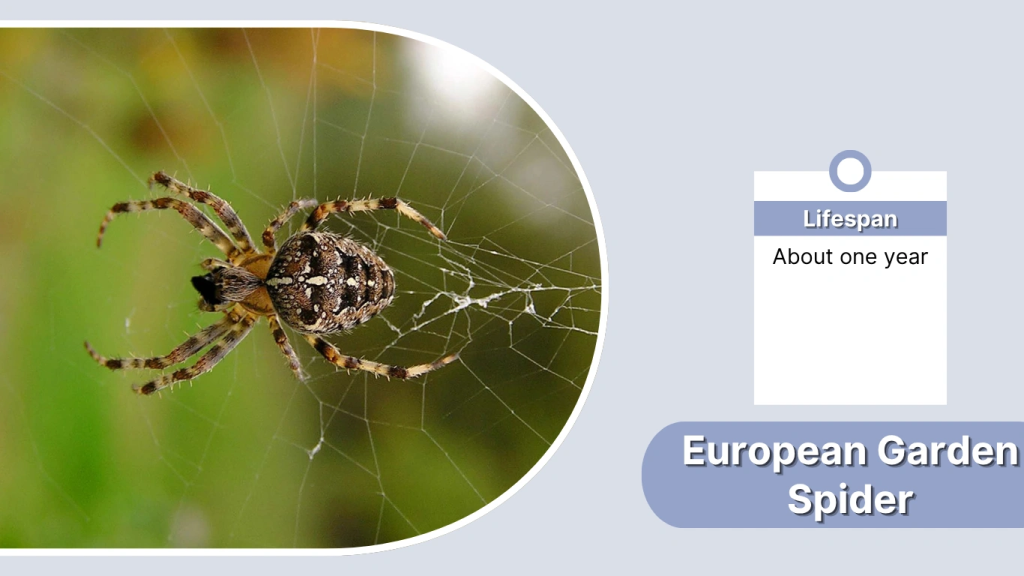
The average lifespan of the European Garden Spider is about one year. Spiderlings hatch in spring, mature through summer, and adults reproduce by autumn. Most die before winter due to cold or exhaustion after reproduction.
In mild climates or sheltered areas, some females may survive slightly longer, but generally, they complete their lifecycle within a single year — a natural rhythm common among orb-weavers.
Diet and Feeding Habits

These spiders are efficient insect predators, feeding primarily on small flying insects. Their diet includes flies, wasps, moths, and beetles. When prey gets trapped in the sticky web, the spider uses its venom to paralyze it and wraps it in silk.
The spider then injects digestive enzymes, which liquefy the prey’s insides, allowing it to drink the nutrients. This external digestion method helps the spider absorb maximum energy with minimal effort.
Habitat by Region
The European Garden Spider is remarkably adaptable, thriving in diverse climates across continents:
- Europe: Common in meadows, gardens, and hedgerows.
- United States: Found in Michigan, Ohio, Pennsylvania, Washington, and California.
- Canada: Widespread in Ontario, Alberta, and British Columbia.
- UK: Particularly abundant in gardens and woodlands during late summer and early autumn.
Their wide distribution highlights their ecological versatility and ability to coexist near human settlements.
European Garden Spider Behavior

Daily Routine
The European Garden Spider is primarily nocturnal, becoming active at dusk. It often sits motionless at the center of its web or hides in a nearby retreat connected by a silk thread. As night falls, it repairs or rebuilds its web to ensure maximum efficiency for catching prey. During the day, it rests quietly to conserve energy.
Defense Mechanisms
When threatened, this spider’s instinct is to drop from its web and play dead, hanging motionless until the danger passes. It also uses camouflage, blending seamlessly with surroundings such as dried leaves or wooden surfaces. This combination of stealth and stillness makes it difficult for predators to detect.
Color Variations and Rare Types
Common Colors
The European Garden Spider displays a wide range of color variations, from pale yellow to deep orange and dark brown. This diversity helps it blend into its habitat. The iconic white cross pattern on the abdomen remains constant regardless of color, making identification easy.
Rare Types
Occasionally, observers report albino or very light-colored individuals. These rare morphs lack pigmentation but survive normally. Such color mutations are uncommon and usually short-lived in the wild due to reduced camouflage.
Predators and Threats

Despite being efficient hunters, European Garden Spiders face many natural enemies. Birds, wasps, lizards, and other larger spiders often prey on them. Parasitic wasps, in particular, pose a significant threat by laying eggs inside the spider’s egg sacs or directly on their bodies.
Human activities such as pesticide use and habitat destruction also affect their survival. Garden maintenance, frequent cleaning of webs, and reduced insect populations can unintentionally limit their numbers.
Ecological Importance
European Garden Spiders are vital components of the ecosystem. They help control insect populations, reducing the spread of pests in both agricultural and urban environments. By preying on mosquitoes, flies, and beetles, they maintain a natural balance without the need for chemical control.
Their presence also indicates a healthy, biodiverse habitat. Gardeners often welcome them as natural pest managers who quietly perform an essential ecological service.
European Garden Spider in Human Environments
These spiders coexist peacefully with humans and are often found near homes. They prefer places with good insect activity, such as porches, sheds, balconies, and flowerbeds. Although their large webs can look intimidating, they pose no danger.
At night, porch lights attract flying insects — an easy feeding opportunity for these spiders. Their webs, glistening with dew in the morning, add beauty to gardens and landscapes.
Fun Facts About the European Garden Spider
- Web strength: The silk is five times stronger than steel of the same thickness.
- Recycling ability: They eat old webs daily to conserve protein.
- Communication: They sense vibrations through silk, allowing them to “feel” their environment.
- Cultural symbolism: Often associated with creativity and patience in European folklore.
- Autumn appearance: Most visible in late summer and autumn when adults reach full size.
These fascinating details show that even the most ordinary garden spider exhibits extraordinary adaptations.
European Garden Spider Classification

- Kingdom: Animalia
- Phylum: Arthropoda
- Class: Arachnida
- Order: Araneae
- Family: Araneidae
- Genus: Araneus
- Species: A. diadematus
This classification places the spider among the true orb-weavers, a family known for their impressive web-building skills.
Interesting Research and Studies
Scientists have long studied the European Garden Spider for its web architecture and silk composition. Research shows that its silk has high elasticity and tensile strength, inspiring innovations in biomaterials and engineering.
Behavioral studies reveal that sexual dimorphism affects survival strategies — females focus on reproduction and web defense, while males emphasize mobility and mate-searching. Additionally, research into their urban adaptation highlights their ability to tolerate pollution and artificial lighting, proving their remarkable resilience.
European Garden Spider in the United States
States with High Populations
After being introduced from Europe, this species has become well-established in Michigan, Ohio, Pennsylvania, Washington, and California. It thrives in both humid and temperate regions, especially around gardens and forest edges.
Invasive or Naturalized?
The European Garden Spider is considered naturalized, not invasive. It integrates smoothly into local ecosystems without displacing native spiders. Its role as an insect predator contributes positively to ecological balance across North America.
European Garden Spider Myths and Misconceptions
Many people fear the European Garden Spider because of its large size and striking appearance. However, several myths have been debunked:
- Myth: It’s poisonous to humans.
Fact: It’s venomous to insects only. Human bites are harmless. - Myth: It’s aggressive.
Fact: It’s timid and defensive, preferring to hide rather than attack. - Myth: It’s an invasive threat.
Fact: It coexists peacefully with native species and supports pest control.
Education and awareness are key to appreciating this misunderstood spider.
European Garden Spider in Seasonal Changes
As temperatures rise in summer, spiderlings grow rapidly, becoming adults by August or September. During autumn, their webs become more visible due to dew and sunlight.
When winter approaches, most adults die after egg-laying, leaving behind silk egg sacs that protect the next generation. The eggs endure cold temperatures, hatching in spring to restart the yearly cycle — a natural rhythm perfectly tuned to seasonal changes.
European Garden Spider Eggs and Babies
Each egg sac contains hundreds of small, yellow spiderlings. These babies stay clustered together for several days before dispersing. Their ballooning behavior allows them to travel long distances, ensuring wide population spread.
As they mature, they undergo several molts before reaching adulthood. Despite their delicate appearance, these spiderlings are remarkably resilient, surviving rain, wind, and predators to continue their species.
European Garden Spider as an Urban Inhabitant
In cities and towns, these spiders adapt easily to man-made structures. They spin webs near streetlights, balconies, and gardens where flying insects are abundant. Their non-aggressive nature and effectiveness in reducing pest insects make them beneficial neighbors.
Homeowners often find them hanging near windows during the evening, waiting patiently for prey. Their ability to live peacefully near humans proves how adaptable and important they are in modern ecosystems.
FAQs
What does the European Garden Spider eat?
It feeds on small flying insects such as mosquitoes, flies, moths, and beetles. The spider traps its prey in a sticky orb web, then injects venom to immobilize it. Digestion occurs externally, allowing the spider to absorb liquefied nutrients efficiently.
Is the European Garden Spider poisonous to humans?
No, it is not poisonous. While it uses venom to paralyze prey, its toxin is harmless to humans. Even in rare cases of bites, symptoms are mild, such as slight redness or itching, and heal naturally without medical attention.
Where are European Garden Spiders commonly found?
They are widespread across Europe, the UK, and North America, particularly in gardens, forests, and urban backyards. In the U.S., they’re often seen in Michigan, Washington, and California, spinning large webs near plants and light sources.
How long do European Garden Spiders live?
Their typical lifespan is one year. They hatch in spring, mature in summer, mate during autumn, and die after egg-laying. In warm regions, a few females might live slightly longer, but most complete their life cycle before winter.
Are European Garden Spiders beneficial?
Yes, they play a major role in pest control by capturing insects naturally. They help reduce populations of mosquitoes and flies, making them valuable for gardeners, farmers, and ecosystems that rely on balance between predator and prey.