

The Goliath birdeater (Theraphosa blondi) is widely known as the largest spider in the world by mass. Native to the dense rainforests of northern South America, this enormous tarantula can grow to an impressive size with a leg span reaching nearly a foot. Despite its intimidating appearance, the spider is more mysterious than dangerous. From its unusual defense mechanisms to its powerful hunting skills, the Goliath birdeater remains one of the most fascinating creatures of the Amazon rainforest.
What Is the Goliath Birdeater?
The Goliath birdeater spider is a giant tarantula species belonging to the family Theraphosidae. It is scientifically known as Theraphosa blondi and is famous for being the largest spider on Earth by weight and body size. Adult specimens can weigh more than 170 grams (about 6 ounces), making them significantly heavier than most other spiders.
Unlike the delicate spiders many people see in homes or gardens, the Goliath birdeater has a thick, hairy body and powerful fangs designed for hunting and defense. Its intimidating appearance often causes fear, but this spider usually prefers to avoid confrontation with larger animals.
Scientific Classification
Understanding the classification of the Goliath birdeater helps explain where it fits in the animal kingdom.
- Scientific name: Theraphosa blondi
- Kingdom: Animalia
- Phylum: Arthropoda
- Class: Arachnida
- Order: Araneae
- Family: Theraphosidae
This family includes many well-known tarantula species, but the Goliath birdeater is considered the most massive among them.
Why Is It Called “Birdeater”?
The name “Goliath birdeater” sounds dramatic and somewhat frightening. However, the name comes from a historical illustration made in the 18th century. European explorers observed a large spider eating a small bird and recorded the scene in a drawing. The name “birdeater” stuck, even though birds are not a regular part of its diet.
In reality, these spiders mostly eat insects, worms, frogs, and small reptiles. While it is technically possible for them to catch a small bird, such events are extremely rare.
Goliath Birdeater Size and Physical Characteristics
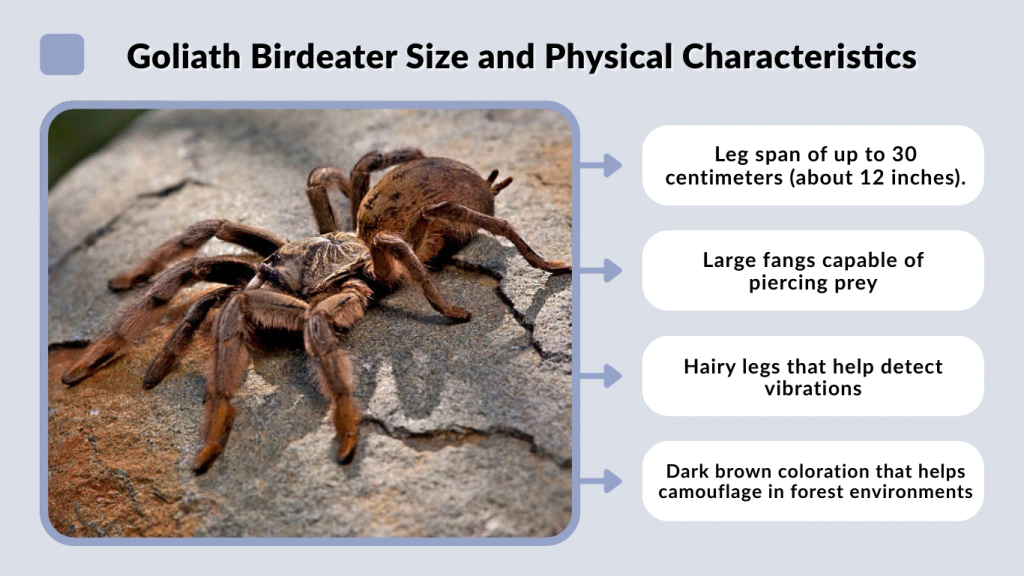
One of the most remarkable aspects of the Goliath birdeater is its incredible size. This spider has earned its reputation as a giant of the arachnid world.
How Big Is the Goliath Birdeater?
The Goliath birdeater can reach a leg span of up to 30 centimeters (about 12 inches). This is roughly the size of a large dinner plate. Its body alone can measure around 11–12 centimeters (4–5 inches).
In terms of weight, it is the heaviest spider species known, sometimes reaching more than 170 grams. While some spiders may have longer legs, very few match the Goliath birdeater’s overall bulk.
Appearance
The spider’s body is covered with dense brown hairs, giving it a rugged and somewhat intimidating appearance. These hairs serve several important functions, including protection and sensory detection.
Key physical features include:
- Large fangs capable of piercing prey
- Hairy legs that help detect vibrations
- Robust body structure designed for strength
- Dark brown coloration that helps camouflage in forest environments
Unlike brightly colored spiders, the Goliath birdeater relies on natural camouflage to blend into the forest floor.
Unique Features
The Goliath birdeater has several unusual characteristics that make it different from most spiders.
One of the most notable is its urticating hairs. These are tiny, barbed hairs located on the spider’s abdomen. When threatened, the spider can flick these hairs toward predators. If they come into contact with skin or eyes, they can cause severe irritation and itching.
Another fascinating trait is its ability to produce a hissing sound. This sound is created through a process called stridulation, where the spider rubs parts of its body together. The sound acts as a warning signal to potential predators.
Habitat and Distribution
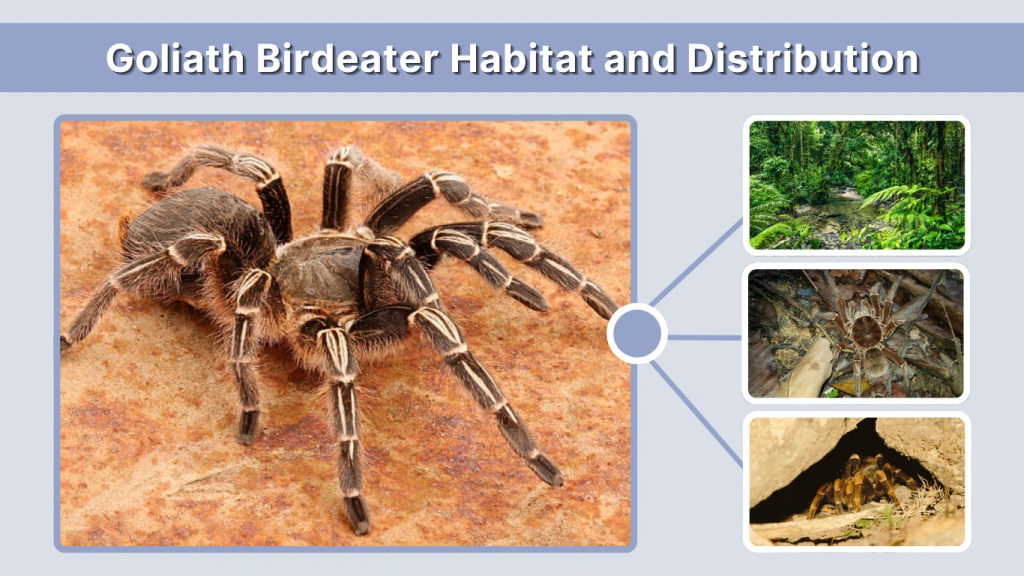
The Goliath birdeater is native to the tropical rainforests of northern South America. These humid environments provide the perfect conditions for the spider to survive and hunt.
Where Do Goliath Birdeaters Live?
These spiders primarily inhabit regions of the Amazon rainforest, where dense vegetation and moist soil create ideal living conditions. They are commonly found in countries such as:
- Brazil
- Venezuela
- Guyana
- Suriname
- French Guiana
The warm climate and abundant prey in these areas allow the species to thrive.
Natural Environment
The Goliath birdeater prefers humid, swampy forests with plenty of hiding places. Instead of building large webs like many spiders, it typically lives in burrows dug into the ground.
These burrows help the spider:
- Stay protected from predators
- Maintain moisture levels needed for survival
- Ambush prey more effectively
Many burrows are located near tree roots, rocks, or fallen logs, which provide extra cover.
Diet – What Do Goliath Birdeaters Eat?
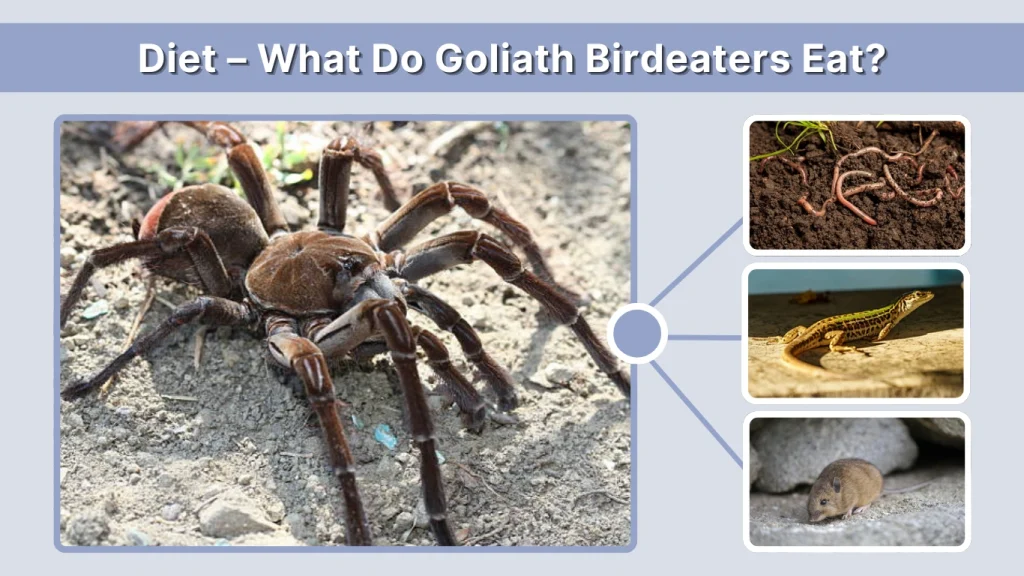
Despite their frightening reputation, Goliath birdeaters are simply opportunistic predators that feed on whatever prey they can capture.
Typical Prey
Their diet mainly consists of small animals that live on the forest floor. Common prey includes:
- Large insects
- Earthworms
- Frogs
- Lizards
- Small rodents
Because they are ground-dwelling hunters, they rely on vibration sensing rather than webs to locate prey.
Do They Really Eat Birds?
Although the spider’s name suggests that birds are a major food source, this is largely a myth. While it is technically possible for a Goliath birdeater to capture a small bird or nestling, such events are very uncommon.
Most of the time, these spiders stick to prey that is easier to catch and less risky.
Hunting Strategy
The Goliath birdeater is primarily an ambush predator. It waits quietly near its burrow and uses sensitive hairs on its legs to detect vibrations in the ground.
Once prey approaches, the spider quickly lunges forward, grabs it with its legs, and injects venom using its fangs. The venom helps paralyze the prey and begin digestion, allowing the spider to consume its meal.
Behavior and Lifestyle
The Goliath birdeater is a solitary and mostly nocturnal creature. Like many tarantulas, it prefers to remain hidden during the day and becomes active at night when temperatures are cooler and prey is easier to find. Its lifestyle is built around stealth, patience, and effective defense mechanisms.
Nocturnal Habits
Goliath birdeaters are primarily nocturnal hunters. During the daytime, they remain inside their burrows to avoid predators and maintain proper humidity levels. At night, they emerge to search for food.
Their excellent ability to detect vibrations helps them sense nearby prey even in complete darkness. Instead of relying on vision, the spider uses the sensitive hairs on its legs to feel movements in the ground.
Defense Mechanisms
Despite their intimidating size, Goliath birdeaters prefer to avoid conflict whenever possible. However, when threatened, they can use several defense strategies.
One common defense is releasing urticating hairs from their abdomen. These tiny barbed hairs can cause intense irritation if they contact skin or eyes. This defense is especially effective against predators such as mammals or birds.
Another defense is their threat posture. When feeling threatened, the spider raises its front legs and displays its large fangs as a warning.
They can also produce a loud hissing sound through stridulation. This sound is created by rubbing specialized body parts together and serves as a warning signal to potential predators.
Molting Process
Like all spiders, the Goliath birdeater grows through a process called molting. During molting, the spider sheds its old exoskeleton so it can grow larger.
This process is critical but also dangerous. While molting, the spider is extremely vulnerable because its new exoskeleton is soft. During this time, it avoids movement and remains hidden until the new outer layer hardens.
Young spiders molt more frequently as they grow, while adult spiders molt less often.
Goliath Birdeater Bite – Is It Dangerous?

Because of its enormous size and long fangs, many people assume the Goliath birdeater is extremely dangerous. In reality, its bite is not considered deadly to humans.
Venom Strength
The venom of the Goliath birdeater is relatively mild compared to many smaller spiders. It is mainly designed to immobilize small prey rather than defend against large animals.
For humans, the venom is usually not medically significant.
Effects on Humans
A bite from a Goliath birdeater can still be painful because of its large fangs, which can reach nearly 2 centimeters in length.
Possible symptoms may include:
- Localized pain
- Swelling
- Mild nausea in some cases
Many experts compare the pain to a bee or wasp sting, though the mechanical puncture from the fangs can make it feel more intense.
When They Bite
Bites usually occur only when the spider feels cornered or threatened. In most situations, the Goliath birdeater will attempt to escape rather than attack.
Because of this, encounters with humans rarely lead to bites.
Lifespan and Reproduction
One of the most interesting aspects of the Goliath birdeater is its long lifespan, particularly for female spiders.
How Long Do They Live?
There is a major difference in lifespan between males and females.
- Females: 15–25 years
- Males: 3–6 years
Female tarantulas live significantly longer because males typically die soon after reaching maturity and mating.
Mating Behavior
Male Goliath birdeaters must approach females carefully. Before mating, the male performs vibrational tapping signals to indicate that he is a potential mate rather than prey.
If the female accepts the male, mating occurs quickly. Afterward, the male usually retreats quickly to avoid being attacked or eaten.
Egg Sac and Spiderlings
Female Goliath birdeaters can produce a large egg sac containing hundreds of eggs, sometimes around 100–200 spiderlings.
The mother guards the egg sac inside her burrow until the young spiders hatch. After emerging, the spiderlings eventually disperse and begin independent lives.
Goliath Birdeater vs Other Giant Spiders
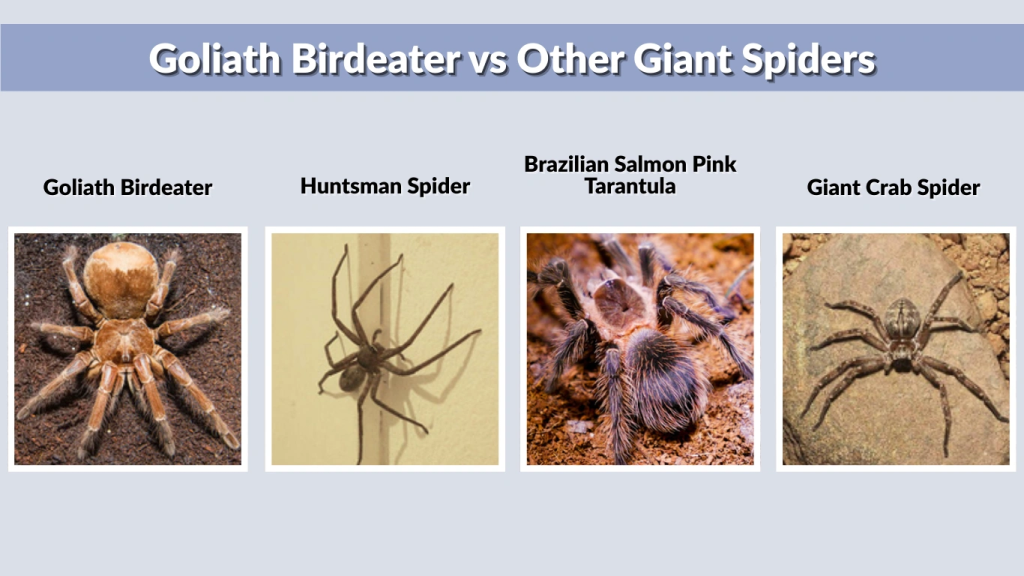
Although the Goliath birdeater is the largest spider by mass, other spiders compete with it in different size categories.
Huntsman Spider
The Huntsman spider holds the record for the largest leg span among spiders. Some species can reach up to 30 centimeters or more, similar to the Goliath birdeater.
However, huntsman spiders are much lighter and slimmer.
Brazilian Salmon Pink Tarantula
The Brazilian salmon pink tarantula is another large tarantula species found in South America. While impressive in size, it usually does not reach the same body mass as the Goliath birdeater.
Giant Crab Spider
Giant crab spiders are known for their wide leg span and speed, but they are generally smaller and lighter compared to the massive Goliath birdeater.
Interesting Facts About the Goliath Birdeater
The Goliath birdeater is full of fascinating traits that make it one of the most remarkable spiders on Earth.
Some interesting facts include:
- It is the largest spider in the world by weight and body size.
- Its fangs can reach nearly 2 centimeters long.
- It can produce a hissing sound loud enough for humans to hear.
- Some indigenous communities in South America eat roasted tarantulas, including this species.
- The spider relies heavily on vibration detection rather than eyesight.
Conservation Status
Currently, the Goliath birdeater is not officially listed as endangered, but like many rainforest species, it still faces environmental challenges.
Threats
Some potential threats include:
- Deforestation in the Amazon rainforest
- Habitat destruction
- Collection for the exotic pet trade
Protecting rainforest ecosystems is essential to ensure the long-term survival of this species.
FAQs
Is the Goliath birdeater the biggest spider in the world?
Yes, it is the largest spider in the world by weight and body mass, although some spiders have slightly longer leg spans.
Can a Goliath birdeater kill a human?
No, the venom is not strong enough to kill humans. While a bite can be painful, it is generally not dangerous.
How fast can a Goliath birdeater move?
Despite its large size, the spider can move surprisingly quickly when hunting or escaping danger.
Do people keep Goliath birdeaters as pets?
Yes, some spider enthusiasts keep them as exotic pets, although they require special care and controlled humidity levels.
Conclusion
The Goliath birdeater is one of the most impressive and misunderstood spiders in the world. With its enormous size, powerful fangs, and unique defense mechanisms, it has earned a legendary reputation among arachnids. Despite its fearsome appearance, this giant tarantula is generally harmless to humans and plays an important role in maintaining the balance of rainforest ecosystems. Studying and protecting species like the Goliath birdeater helps us better understand the incredible diversity of life found in the Amazon rainforest.