

Jumping spiders are tiny, curious hunters with big eyes and even bigger personalities. But do they bite? Are they venomous? Can they really recognize humans? In this detailed guide, we answer 42 of the most common questions about jumping spiders—from their intelligence and diet to whether they make good pets. Whether you’re a spider enthusiast or just curious, you’ll learn everything you need to know about these fascinating and harmless creatures.
FAQs About Behavior & Personality

Jumping spiders are some of the most curious and charismatic arachnids you’ll ever encounter. Unlike many other spiders, they are known for their keen eyesight, bold movements, and even what some consider “personality.” This section explores how they interact with the world—and with humans.
Are jumping spiders friendly?
While they aren’t “friendly” in the human sense, jumping spiders are known to be calm and curious. They often watch humans closely, follow movement, and even investigate by moving toward a person rather than away. They rarely bite and seem more interested in observing than defending.
Are jumping spiders intelligent?

Yes, for their size and brain capacity, jumping spiders show remarkable intelligence. Studies suggest they can:
- Plan routes to hunt prey
- Navigate mazes
- Remember and learn from past experiences
Their problem-solving abilities and hunting tactics go far beyond instinct alone, making them some of the smartest spiders known.
Are jumping spiders smart?
They’re considered smart compared to most other arachnids. Their visual learning, attention to motion, and ability to distinguish objects or prey types suggest complex cognitive skills, especially for an invertebrate.
Can jumping spiders recognize humans?
Research and anecdotal observations suggest that jumping spiders may recognize humans, at least visually. They can track faces, notice when they’re being watched, and respond differently to familiar movement patterns—though it’s not the same as true facial recognition in mammals.
Can jumping spiders recognize faces?
Not in a human-specific way, but they can distinguish between different shapes and forms, including faces. Their forward-facing eyes allow depth perception and image processing that lets them lock onto and follow a person’s face with surprising precision.
Do jumping spiders recognize their owners?
There’s no conclusive scientific proof that they recognize individual humans like pets do. However, many spider keepers notice consistent behavior changes when their jumping spiders see them, suggesting a basic form of recognition or pattern memory based on visual cues and routine.
Why are jumping spiders so cute?
Jumping spiders have large, forward-facing eyes and rounded faces that resemble mammals more than typical spiders. This triggers a psychological response called “baby schema” in humans—where we find creatures with large eyes and small faces cute. Their expressive movements and tiny size add to the effect.
Why are jumping spiders so friendly?
They’re not aggressive and tend to show curious, non-defensive behavior. Unlike many spiders that hide or flee, jumping spiders will pause, turn toward you, and sometimes approach. Their calm behavior and tiny size make them appear “friendly,” especially when compared to larger, faster, or more reclusive spiders.
Why do jumping spiders look at you?
They have excellent vision and are naturally alert to movement. When they look at you, they’re likely assessing whether you’re a threat—or just something interesting. They may follow your finger, tilt their head, or hop in your direction just to investigate.
Why do jumping spiders wave at you?
This “waving” behavior is part of their communication and signaling, usually involving their front legs or pedipalps. In nature, it’s used to:
- Communicate with other spiders during courtship
- Signal territorial boundaries
- Show non-aggression or curiosity toward larger animals (like humans)
If a jumping spider waves at you, it’s likely responding to your movement and light—not trying to make friends, but also not trying to scare you off.
FAQs About Biting & Venom

Jumping spiders are often feared simply because they’re spiders—but in reality, they are not a threat to humans. While they do have fangs and venom for hunting, their bites are rare, mild, and usually harmless. This section clears up the most common concerns.
Do jumping spiders bite?
Yes, they can bite, but it’s very uncommon. Jumping spiders are not aggressive and will typically run away or leap to safety if disturbed. Bites happen only when the spider feels trapped—like if it’s pressed against the skin or handled roughly.
Can jumping spiders bite?
They absolutely can, as all spiders have fangs. But again, they rarely choose to. They tend to rely on their agility and awareness to avoid danger, not on biting in defense.
Do jumping spiders bite humans?

In rare cases, yes—but it’s usually accidental. A bite might occur if a spider gets trapped in clothing or is handled without care. Even then, most people report that the bite is less painful than a bee sting, and symptoms are mild.
Will jumping spiders bite?
Unlikely. They don’t bite unless provoked, and they give plenty of warning through retreating, jumping, or backing away. If you leave them alone, they’ll leave you alone.
Does jumping spider attack humans?
No, jumping spiders do not attack humans. They do not see humans as prey or threats unless directly disturbed. Most will freeze, watch, or quickly flee if approached.
Are jumping spiders dangerous?
No, jumping spiders are not dangerous to humans. Their venom is designed for subduing small insects, not large animals. They pose no medical risk to healthy adults or children.
Are jumping spiders dangerous to humans?
Still no. Even if bitten, the effects are mild. Common symptoms include:
- Slight redness or swelling
- Mild irritation or itchiness
These symptoms usually disappear on their own within a few hours to a couple of days.
Are jumping spiders venomous?
Yes, like nearly all spiders, jumping spiders are venomous, but their venom is not harmful to humans. It’s used to paralyze small insect prey and begins the digestive process, but it has no serious effect on humans.
Are jumping spiders venomous to humans?
Technically yes, but in practical terms, no. Their venom is too weak to cause harm to people. Unless you’re allergic (which is extremely rare), you won’t experience any severe reaction.
Are jumping spiders poisonous?
No. “Poisonous” refers to something harmful when eaten or touched. Jumping spiders are not poisonous, even if swallowed. The correct term is venomous—but again, only to their prey.
Are jumping spiders poisonous to humans?
No, they are not poisonous to humans. Even if accidentally ingested (not recommended!), they are harmless. This is a common misconception due to confusing venomous and poisonous.
Are jumping spiders harmful?
Not at all. In fact, they’re beneficial. They help control insect populations by feeding on pests like mosquitoes, flies, and even ants. They pose no threat to people or pets.
Do jumping spiders have venom?
Yes, but only for hunting. They inject venom to immobilize insects, not to defend themselves from humans. Their venom is not medically significant, and they do not carry disease.
Is jumping spider poisonous?
No. The correct term is venomous, and even then, not in a harmful way to people. Their venom is mild, and they’re generally shy, cautious, and not interested in biting unless absolutely necessary.
FAQs About Diet & Feeding

Jumping spiders are active hunters with excellent vision, and they don’t rely on webs to catch food. Instead, they stalk, pounce, and subdue prey using precision and speed. This section covers what they eat and how to care for them in captivity.
What do jumping spiders eat?
In the wild, jumping spiders eat a variety of small insects and arthropods. Their diet typically includes:
- Flies
- Mosquitoes
- Gnats
- Moths
- Small beetles
- Aphids
They use their keen eyesight to track and then leap onto prey, injecting venom to immobilize it before feeding.
Do jumping spiders eat ants?

Yes, they can eat ants, but not all species prefer them. Ants can fight back and release formic acid, making them a more challenging meal. However, some jumping spiders are skilled enough to take down ants, especially smaller or slower ones.
Can jumping spiders eat ants?
They can eat ants when necessary, especially if other food sources are limited. In captivity, though, ants are usually avoided due to their defensive nature and potential to harm the spider.
Will jumping spiders eat ants?
If the situation calls for it, yes. In the wild, they may eat ants opportunistically. In captivity, it’s better to feed them easier and safer options like flies, fruit flies, or pinhead crickets.
Can jumping spiders eat mealworms?
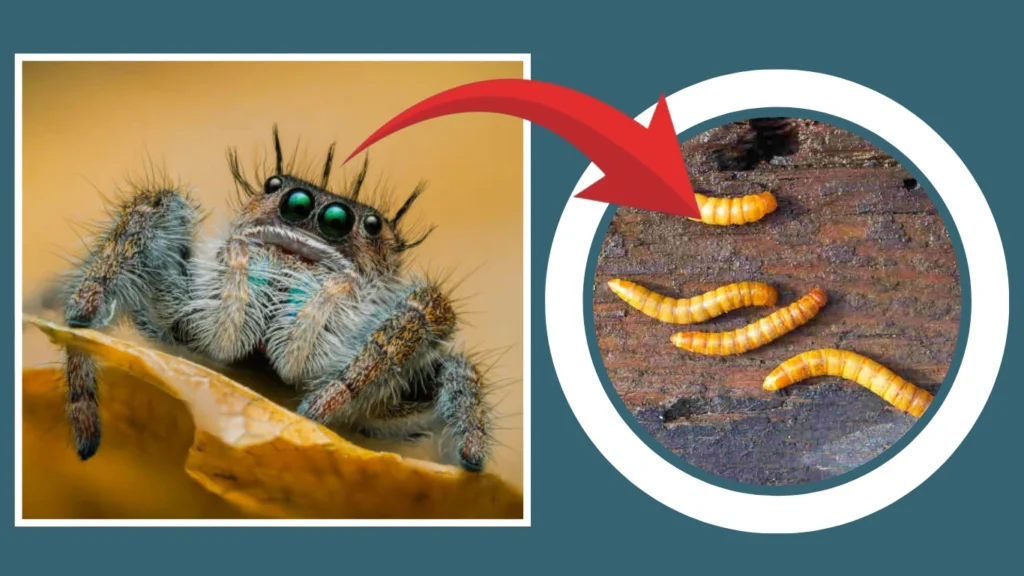
Yes, small or freshly molted mealworms can be eaten by jumping spiders. Mealworms are often used in captivity, but because of their thick exoskeleton and slow movement, they may not be as appealing as live flies or crickets. Always size the prey appropriately—too large, and the spider may ignore or avoid it.
Will jumping spiders eat isopods?
Rarely. Isopods have a hard shell and don’t move quickly, which makes them less attractive as prey. Jumping spiders prefer fast-moving, soft-bodied insects. Isopods are usually ignored unless the spider is starving.
Do jumping spiders eat other spiders?
Yes, jumping spiders are known to eat smaller or similar-sized spiders, including other jumping spiders. This predatory behavior is common in the wild and is one reason why they should not be housed together in captivity.
How often should I feed my jumping spider?
In captivity:
- Juveniles: Feed every 1–2 days
- Adults: Feed every 2–3 days
They don’t need to eat daily, and overfeeding can lead to uneaten prey wandering the enclosure. Always remove leftover insects after a day to keep the habitat clean.
FAQs About Habitat & Webs

Jumping spiders live in a wide range of environments and use silk in surprising ways. Unlike web-building spiders, they rely on speed and vision, not traps, to hunt. This section explains where they live and how they use their silk.
Where do jumping spiders live?
Jumping spiders are found on every continent except Antarctica. They prefer warm environments and are commonly seen:
- On windowsills and indoor walls
- In gardens, tree bark, or on leaves
- Under rocks and outdoor furniture
- On fences, decks, and even rooftops
They are day-active hunters and are often spotted in sunny areas where insects gather. Many live in homes but stay hidden in corners or cracks, rarely causing problems.
Do jumping spiders make webs?

Yes, but not to catch prey. Jumping spiders use silk to:
- Create a silken retreat or sleeping sac for rest and molting
- Secure a safety dragline when they leap
- Wrap eggs in a protective cocoon
They do not spin large, visible webs across rooms like orb-weavers. Their silk is used strategically, not for trapping insects.
Can jumping spiders make webs?
They absolutely can, but their web usage is limited to support, safety, and shelter. If you see one resting inside a silk-lined pocket under a leaf or in a corner, it’s using that spot as a temporary home, not a web for hunting.
FAQs About Pet Ownership & Care
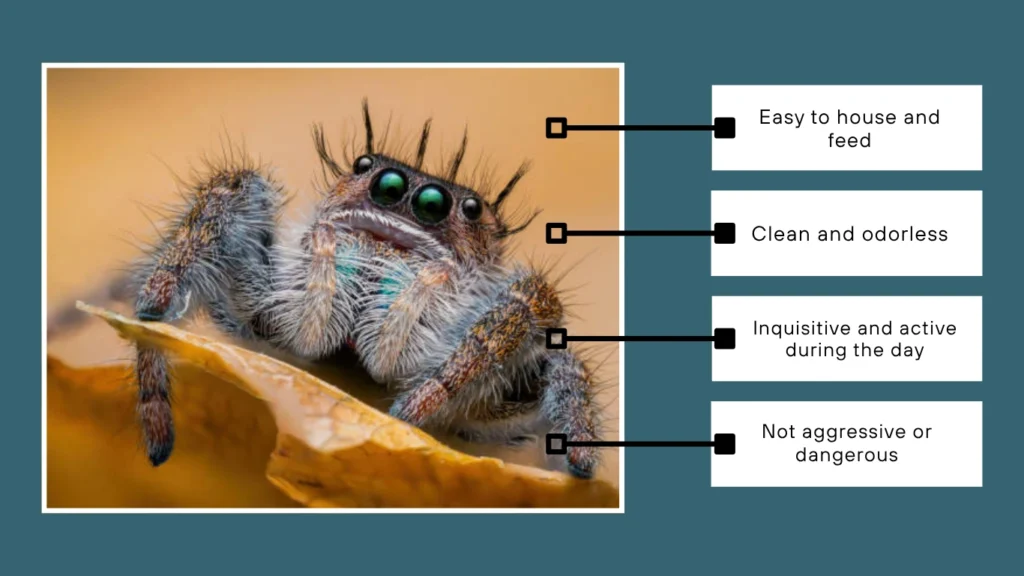
Thanks to their small size, gentle nature, and curious behavior, jumping spiders are becoming increasingly popular as low-maintenance pets. This section explores their suitability as pets and how to care for them responsibly.
Are jumping spiders good pets?
Yes, jumping spiders are considered excellent beginner pets for those interested in exotic animals. They are:
- Easy to house and feed
- Clean and odorless
- Inquisitive and active during the day
- Not aggressive or dangerous
Their expressive movements and visual awareness make them surprisingly entertaining to watch.
Do jumping spiders make good pets?
Yes. Many keepers find them engaging, interactive, and fun to observe. Their short lifespans and simple needs make them ideal for small enclosures, and they don’t require special lighting or expensive equipment.
Can jumping spiders be pets?
Absolutely. They can be kept in small, secure containers or terrariums with proper ventilation. Popular container setups include:
- Small acrylic enclosures with vertical climbing space
- A hide or leaf for resting
- A few sticks or mesh for anchoring silk
Their minimal space and food requirements make them easy to care for, even in small apartments.
Can jumping spiders live together?
No. Jumping spiders are solitary and territorial. Housing them together often leads to cannibalism, especially if one is larger or more aggressive. Each spider should always be kept in its own enclosure.
How long do jumping spiders live?
In the wild or in captivity, jumping spiders usually live:
- Males: around 6–12 months
- Females: up to 18 months, sometimes longer with good care
They grow quickly, maturing in a few months, and then spend the remainder of their lives as adults. Their short lifespan is one of the only downsides to keeping them as pets.
Do jumping spiders need water?
Yes, but very little. They don’t drink from bowls like other animals. Instead, mist the enclosure lightly every 2–3 days to provide water droplets on leaves or walls. They’ll drink from these droplets as needed. Avoid soaking the enclosure or making it humid—too much moisture can be harmful.
FAQs About Physical Abilities & Lifecycle

Jumping spiders are known for their agility, precision, and fascinating survival adaptations. This section answers questions about how they move, develop, and respond to their environment.
Do jumping spiders jump?
Yes, jumping spiders are incredible jumpers. They can leap several times their body length to:
- Catch prey
- Escape predators
- Move between surfaces
They anchor a silk dragline before each jump to prevent injury in case of a fall. Their powerful back legs and internal hydraulic pressure give them explosive jumping strength.
Do jumping spiders molt?
Yes. Like all spiders, jumping spiders go through molting—shedding their exoskeleton as they grow.
- Juveniles molt multiple times before becoming adults
- Adults may molt once or twice more, especially females
Before molting, they often stop eating and hide inside a silk retreat. The process is delicate and leaves them vulnerable, so it’s important not to disturb them during this time.
Do jumping spiders hibernate?
They don’t hibernate in the traditional sense, but in colder climates, they may enter a state of dormancy or reduced activity. Outdoors, they hide in crevices or bark during winter. In captivity, their behavior may slow in cooler temperatures, but they don’t undergo true hibernation.
Can jumping spiders hear?
Jumping spiders do not have ears, but they can detect sound vibrations through specialized hairs on their legs and body. These hairs allow them to sense:
- Approaching footsteps
- Loud noises
- Air movement from nearby activity
Though not hearing in the human sense, this sensitivity helps them detect threats and prey even when they can’t see them.