





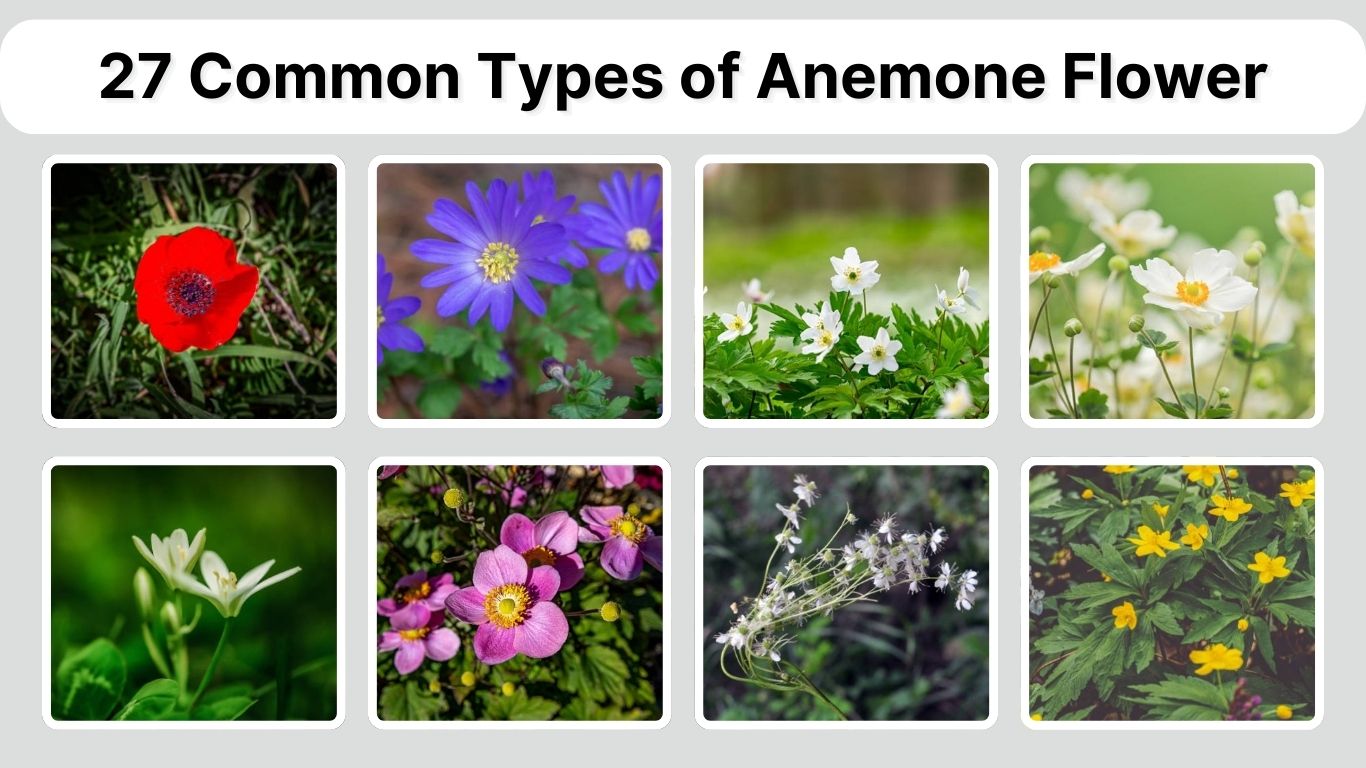
Anemone flowers, often called windflowers, are admired for their delicate beauty, wide color range, and long history in gardens and wild landscapes. With species that bloom from early spring through autumn, anemones offer seasonal interest almost year-round. They grow in many forms, from tiny woodland plants to tall border perennials, making them suitable for diverse garden styles. This guide explores 27 common types of anemone flowers, highlighting their diversity, habitats, and ornamental value.
1. Poppy Anemone (Anemone coronaria)

Poppy anemone is one of the most popular and widely cultivated anemone species, admired for its bright, poppy-like blooms and strong ornamental value. Native to the Mediterranean region, it is commonly grown in gardens and used as a cut flower because of its long-lasting, colorful blossoms.
Identification
- Bright, poppy-shaped flowers with single or double petals
- Colors include red, white, pink, blue, and purple
- Dark central disk, often black or deep purple
- Grows 8–16 inches tall
- Soft, deeply divided green leaves
- Blooms mainly in spring
Growth Habit
Poppy anemone grows from tubers and forms compact, upright clumps. It prefers cool seasons and develops quickly once established. The plant produces slender stems that hold flowers well above the foliage, giving it a neat, garden-friendly appearance.
Native Range and Habitat
This species originates from southern Europe, North Africa, and the Middle East. In nature, it thrives in open fields, rocky slopes, and coastal regions where winters are mild and soils drain well.
Flowering Characteristics
The blooms are large relative to the plant’s size and often appear in bold, eye-catching colors. Many varieties have contrasting centers, which enhance their ornamental appeal and make them especially attractive in floral arrangements.
Gardening Use
Poppy anemone is widely planted in borders, containers, and flower beds. It is also a favorite in the cut-flower industry due to its straight stems and long vase life. Gardeners often plant it in autumn for spring blooms.
2. Grecian Windflower (Anemone blanda)

Grecian windflower is a low-growing anemone species known for its daisy-like flowers and early spring blooms. Native to southeastern Europe and parts of the Middle East, it is one of the first anemones to flower, often appearing when winter is just ending.
Identification
- Small, daisy-shaped flowers with narrow petals
- Common colors include blue, violet, white, and pink
- Yellow central disk
- Grows 4–6 inches tall
- Fern-like, finely divided green leaves
- Blooms in early spring
Growth Habit
Grecian windflower spreads slowly from tubers and forms dense, carpet-like patches. Its low height and spreading nature make it ideal for ground cover, edging, and naturalized garden areas.
Native Range and Habitat
This species is native to Greece, Turkey, Lebanon, and surrounding regions. It naturally grows in open woodlands, rocky hillsides, and meadows where the soil is well drained and winters are cool.
Flowering Characteristics
The flowers open wide in sunlight and close during cloudy weather or at night. Their star-shaped appearance and soft colors give early spring gardens a fresh, delicate look.
Gardening Use
Grecian windflower is commonly planted under trees, along pathways, and in rock gardens. It is valued for its ability to naturalize and return year after year with minimal care.
3. Wood Anemone (Anemone nemorosa)

Wood anemone is a delicate, spring-flowering species that carpets forest floors with soft white blooms. It is one of the most well-known wild anemones in Europe and is valued for its natural, woodland appearance and early seasonal color.
Identification
- Star-shaped flowers with 6–8 petal-like sepals
- Usually white, sometimes tinged pink, blue, or purple
- Yellow center of stamens
- Grows 6–10 inches tall
- Deeply divided, dark green leaves
- Blooms in early to mid-spring
Growth Habit
Wood anemone spreads through underground rhizomes and slowly forms wide colonies. It emerges early in spring before trees fully leaf out, taking advantage of filtered sunlight in woodland environments.
Native Range and Habitat
This species is native to Europe and parts of western Asia. It naturally grows in deciduous forests, shaded meadows, and hedgerows with moist, humus-rich soil.
Flowering Characteristics
The flowers open flat in sunlight and gently close in cooler or cloudy conditions. Each bloom is short-lived, but colonies flower in succession, creating a prolonged spring display.
Gardening Use
Wood anemone is ideal for woodland gardens, shaded borders, and naturalized areas. It pairs well with other early spring bulbs and perennials, creating a soft, natural ground cover effect.
4. Japanese Anemone (Anemone hupehensis)

Japanese anemone is a tall, late-blooming species valued for its graceful stems and long-lasting flowers. Unlike spring anemones, this type flowers from late summer into autumn, bringing soft color to gardens when many plants are fading.
Identification
- Saucer-shaped flowers with 5–7 broad sepals
- Common colors include soft pink, rose, and white
- Prominent yellow central stamens
- Grows 2–4 feet tall
- Dark green, three-lobed leaves
- Blooms from late summer to fall
Growth Habit
Japanese anemone grows from spreading rhizomes and gradually forms wide clumps. It has strong, wiry stems that sway gently in the wind, giving borders a light, airy appearance.
Native Range and Habitat
This species is native to China but has long been cultivated in Japan, which is how it gained its common name. In the wild, it grows along woodland edges, grassy slopes, and moist, well-drained soils.
Flowering Characteristics
The flowers are held well above the foliage, creating a floating effect. Buds open successively over many weeks, allowing the plant to remain in bloom for a long period.
Gardening Use
Japanese anemone is widely planted in perennial borders, cottage gardens, and partial-shade landscapes. It is especially valued for extending floral interest into early autumn.
5. Snowdrop Anemone (Anemone sylvestris)

Snowdrop anemone is a charming, early-summer anemone known for its pure white, lightly fragrant flowers and soft, downy foliage. It is often grown for its elegant, nodding blooms and its ability to spread gently in open garden spaces.
Identification
- White, cup-shaped flowers with 5–6 broad sepals
- Bright yellow central stamens
- Lightly fragrant blooms
- Grows 10–18 inches tall
- Soft, gray-green, slightly hairy leaves
- Blooms in late spring to early summer
Growth Habit
Snowdrop anemone grows from creeping rhizomes and slowly forms loose colonies. It produces upright flowering stems above a basal clump of leaves, giving it a tidy but natural appearance.
Native Range and Habitat
This species is native to central and eastern Europe. In nature, it grows in open woods, dry meadows, and limestone hills where soils are well drained and sunlight is moderate.
Flowering Characteristics
The flowers often begin nodding and gradually turn upward as they mature. Their simple white form and gentle fragrance make them attractive to pollinators and well suited to naturalistic gardens.
Gardening Use
Snowdrop anemone is commonly planted in borders, cottage gardens, and wildflower-style plantings. It performs well in sunny to lightly shaded areas and is valued for its long-lived clumps.
6. Canada Anemone (Anemone canadensis)

Canada anemone is a hardy, spreading species known for its bright white flowers and vigorous growth. It is often used in naturalized plantings because of its ability to quickly form dense colonies and suppress weeds.
Identification
- White flowers with 5 petal-like sepals
- Yellow center of stamens
- Blooms about 1.5–2 inches wide
- Grows 12–24 inches tall
- Deeply lobed, bright green leaves
- Blooms in late spring to early summer
Growth Habit
Canada anemone spreads aggressively through underground rhizomes and can cover large areas over time. It forms upright clumps with numerous flowering stems emerging from a shared root system.
Native Range and Habitat
This species is native to North America, where it grows along riverbanks, wet meadows, open woods, and prairies. It prefers moist soils but can tolerate a range of conditions once established.
Flowering Characteristics
The flowers are simple but abundant, often appearing in large numbers across a single colony. Blooming continues for several weeks, providing a long-lasting white display.
Gardening Use
Canada anemone is well suited for naturalized gardens, rain gardens, and large landscape areas. It is best planted where its spreading habit can be controlled or where ground coverage is desired.
7. Tall Thimbleweed (Anemone virginiana)

Tall thimbleweed is a native North American anemone valued more for its distinctive seed heads than for its flowers. After blooming, it produces tall, thimble-shaped fruiting structures that remain attractive well into summer.
Identification
- Small greenish-white flowers with 5 narrow sepals
- Prominent yellow center
- Blooms about 1 inch wide
- Grows 2–4 feet tall
- Deeply lobed, rough-textured leaves
- Blooms in early to mid-summer
Growth Habit
Tall thimbleweed grows upright from fibrous roots and forms loose clumps rather than dense mats. Its tall stems and airy form allow it to blend naturally among grasses and meadow plants.
Native Range and Habitat
This species is native to much of the eastern and central United States. It naturally occurs in prairies, open woods, roadsides, and dry meadows where sunlight is abundant.
Flowering Characteristics
The flowers are short-lived and subtle, but the plant quickly transitions into its ornamental seed stage. The elongated seed heads give the plant its common name and visual interest.
Gardening Use
Tall thimbleweed is often used in native plant gardens, prairie restorations, and wildlife landscapes. It provides structure, supports pollinators, and adds textural contrast among other wildflowers.
8. Yellow Wood Anemone (Anemone ranunculoides)

Yellow wood anemone is a cheerful, early-blooming species recognized for its bright yellow flowers and woodland charm. It closely resembles white wood anemone but stands out for its golden color and compact growth.
Identification
- Star-shaped, bright yellow flowers
- Usually 5–6 petal-like sepals
- Yellow central stamens
- Grows 4–8 inches tall
- Deeply divided, soft green leaves
- Blooms in early spring
Growth Habit
Yellow wood anemone spreads by creeping rhizomes and gradually forms small colonies. It emerges very early in the season, often flowering before trees leaf out, making it well suited to shaded garden areas.
Native Range and Habitat
This species is native to central and eastern Europe. In the wild, it grows in deciduous forests, shaded slopes, and woodland clearings with moist, humus-rich soils.
Flowering Characteristics
The flowers open wide in sunshine and create bright carpets of yellow across the forest floor. Each bloom lasts only a short time, but colonies flower over several weeks.
Gardening Use
Yellow wood anemone is ideal for woodland gardens, shaded borders, and naturalized plantings. It pairs beautifully with early bulbs and other spring ephemerals.
9. Balkan Anemone (Anemone apennina)

Balkan anemone is a low-growing spring anemone admired for its vivid blue flowers and early seasonal display. It is closely related to Grecian windflower and is often used to create colorful carpets in spring gardens.
Identification
- Star-shaped flowers with narrow petals
- Most commonly bright blue, sometimes white or pink
- Pale yellow or white central disk
- Grows 4–6 inches tall
- Finely divided, soft green leaves
- Blooms in early spring
Growth Habit
Balkan anemone grows from small tubers and spreads steadily to form dense mats. It naturalizes well and often multiplies each year when planted in suitable conditions.
Native Range and Habitat
This species is native to southern Europe, particularly the Balkan Peninsula and Italy. It naturally occurs in open woodlands, grassy slopes, and rocky areas with well-drained soil.
Flowering Characteristics
The flowers open fully on sunny days and close in cloudy weather. Their intense blue shades make them especially striking in early spring landscapes.
Gardening Use
Balkan anemone is widely planted under deciduous trees, along pathways, and in rock gardens. It is valued for its bright color, compact form, and reliable spring performance.
10. Pasque Flower (Anemone patens / Pulsatilla patens)

Pasque flower is a distinctive early-blooming anemone relative, known for its silky hairs, nodding buds, and soft purple flowers. It is one of the first wildflowers to appear in spring, often blooming when snow has only recently melted.
Identification
- Bell-shaped to star-like flowers, usually violet or lavender
- Bright yellow central stamens
- Entire plant covered with fine, silky hairs
- Grows 6–12 inches tall
- Deeply divided, feathery leaves
- Blooms in very early spring
Growth Habit
Pasque flower grows in compact clumps from a strong taproot. Unlike many spreading anemones, it stays relatively contained and becomes more robust each year rather than forming large colonies.
Native Range and Habitat
This species is native to cold and temperate regions of Europe, Asia, and North America. It naturally grows in dry grasslands, open slopes, and prairie habitats with full sun.
Flowering Characteristics
The nodding buds rise and open into upright flowers as temperatures warm. After flowering, the plant produces attractive, feathery seed heads that extend its ornamental value.
Gardening Use
Pasque flower is commonly planted in rock gardens, alpine gardens, and dry borders. It is valued for its early blooms, soft texture, and drought-tolerant nature once established.
11. Cutleaf Anemone (Anemone multifida)

Cutleaf anemone is a compact, clump-forming species recognized for its finely divided foliage and small, colorful flowers. It is often grown in rock gardens and cool-climate landscapes where subtle detail is appreciated.
Identification
- Small, cup-shaped flowers
- Colors range from red and pink to yellow and cream
- Yellow central stamens
- Grows 6–12 inches tall
- Deeply cut, fern-like leaves
- Blooms in late spring to early summer
Growth Habit
Cutleaf anemone grows from a short rootstock and forms neat, slowly expanding clumps. It does not spread aggressively and maintains a tidy, mound-like appearance.
Native Range and Habitat
This species is native to western North America and parts of South America. It naturally grows in alpine meadows, open slopes, and cool, well-drained habitats.
Flowering Characteristics
The flowers are smaller than those of many anemones but are produced in good numbers above the foliage. Their delicate size and varied colors give the plant a refined, alpine character.
Gardening Use
Cutleaf anemone is well suited to rock gardens, alpine beds, and borders with good drainage. It is often used as an accent plant among stones or low-growing perennials.
12. Long-headed Anemone (Anemone cylindrica)

Long-headed anemone is a North American native species best known for its tall, cylindrical seed heads that develop after flowering. While its blooms are modest, the plant becomes highly ornamental as the fruits mature.
Identification
- Small greenish-white flowers
- Narrow, petal-like sepals
- Prominent central cluster of stamens
- Grows 1–3 feet tall
- Deeply lobed, medium-green leaves
- Blooms in late spring to early summer
Growth Habit
Long-headed anemone grows upright from fibrous roots and forms loose clumps. It is not aggressive and fits well into mixed plantings and naturalized landscapes.
Native Range and Habitat
This species is native to much of North America. It naturally grows in prairies, open woods, fields, and roadsides, preferring well-drained to moderately moist soils.
Flowering Characteristics
The flowers are short-lived and subtle, quickly giving way to elongated, thimble-like seed heads. These seed structures persist and provide visual interest well into summer.
Gardening Use
Long-headed anemone is commonly used in native plant gardens, prairie restorations, and wildlife-friendly landscapes. It adds vertical interest and supports pollinators.
13. Liverleaf Anemone (Anemone hepatica / Hepatica nobilis)

Liverleaf anemone is a charming woodland species valued for its early spring flowers and distinctive three-lobed leaves. It is one of the first anemones to bloom, often flowering before most woodland plants have emerged.
Identification
- Small star-shaped flowers
- Colors include blue, violet, pink, and white
- Yellow or pale centers
- Grows 4–8 inches tall
- Three-lobed, leathery evergreen leaves
- Blooms in very early spring
Growth Habit
Liverleaf anemone grows in slow-spreading clumps from short rhizomes. It is long-lived and becomes more attractive each year as the foliage thickens and flowering increases.
Native Range and Habitat
This species is native to Europe, Asia, and North America. It naturally occurs in deciduous forests, shaded slopes, and woodland gardens with moist, humus-rich soils.
Flowering Characteristics
The flowers often emerge before new leaves fully develop. Their jewel-like colors stand out against late winter leaf litter, making them especially noticeable in woodland settings.
Gardening Use
Liverleaf anemone is ideal for woodland gardens, shaded rock gardens, and naturalized areas. It is prized for early blooms, evergreen foliage, and long-term garden value.
14. Three-leaf Anemone (Anemone trifolia)

Three-leaf anemone is a compact spring-flowering species known for its neat growth and simple, elegant white blooms. It is especially valued in alpine and woodland-style gardens for its low habit and refined appearance.
Identification
- Small white star-shaped flowers
- Usually 6–9 narrow sepals
- Bright yellow central stamens
- Grows 4–8 inches tall
- Leaves divided into three main leaflets
- Blooms in early to mid-spring
Growth Habit
Three-leaf anemone grows from small tubers and forms tidy, low clumps. It spreads slowly and maintains a well-contained form, making it suitable for smaller garden spaces.
Native Range and Habitat
This species is native to central and southern Europe. It naturally grows in mountain meadows, woodland edges, and rocky slopes with cool temperatures and well-drained soils.
Flowering Characteristics
The flowers are held just above the foliage and open fully in sunlight. Though delicate in appearance, the blooms are long-lasting for a spring anemone.
Gardening Use
Three-leaf anemone is well suited to alpine gardens, shaded borders, and rock gardens. It works well alongside early bulbs and other low-growing spring perennials.
15. Narcissus Anemone (Anemone narcissiflora)

Narcissus anemone is an elegant, cool-climate species known for its clusters of white, daisy-like flowers. It is often found in mountainous regions and is valued for its upright stems and refined appearance.
Identification
- White, daisy-like flowers often produced in clusters
- Yellow central disk
- Each flower about 1–2 inches wide
- Grows 12–24 inches tall
- Deeply lobed, medium-green leaves
- Blooms in late spring to early summer
Growth Habit
Narcissus anemone grows from short rhizomes and forms compact clumps. Unlike many spreading anemones, it remains fairly contained and slowly increases in size over time.
Native Range and Habitat
This species is native to mountainous regions of Europe and Asia. It naturally grows in alpine meadows, open slopes, and high-altitude grasslands with cool temperatures.
Flowering Characteristics
The flowers are usually borne in small groups on each stem, giving a light, airy look. Blooming lasts several weeks, especially in cooler climates.
Gardening Use
Narcissus anemone is best suited to alpine gardens, cool borders, and meadow-style plantings. It is appreciated for its upright form and clustered floral display.
16. Palm-leaf Anemone (Anemone palmata)

Palm-leaf anemone is a striking Mediterranean species recognized for its large, glossy leaves and soft yellow flowers. It stands out from many anemones because of its bold foliage and shrub-like presence.
Identification
- Pale yellow to creamy flowers
- Broad petal-like sepals
- Prominent yellow center
- Grows 12–24 inches tall
- Large, palm-shaped, glossy green leaves
- Blooms in late winter to spring
Growth Habit
Palm-leaf anemone grows in upright clumps from tuberous roots. It develops a strong leaf rosette that remains attractive even when the plant is not in bloom.
Native Range and Habitat
This species is native to the western Mediterranean, especially Spain and North Africa. It naturally grows in open woodlands, scrublands, and rocky hillsides.
Flowering Characteristics
The flowers are larger than many anemone species and are often followed by decorative seed heads. Blooming can begin very early in mild climates.
Gardening Use
Palm-leaf anemone is commonly planted in mild-climate gardens, Mediterranean-style landscapes, and sheltered borders. It is valued for both its foliage and flowers.
17. River Anemone (Anemone rivularis)

River anemone is a graceful species known for its soft white to pale lavender flowers and its preference for moist environments. It is often found near streams and wet meadows, where it adds a natural, airy beauty to the landscape.
Identification
- White to pale lavender flowers
- 5–6 broad, petal-like sepals
- Yellow central stamens
- Grows 12–30 inches tall
- Deeply lobed, medium-green leaves
- Blooms in late spring to summer
Growth Habit
River anemone grows from short rhizomes and forms upright, slowly spreading clumps. It has slender flowering stems that rise well above the foliage.
Native Range and Habitat
This species is native to parts of Asia, including the Himalayas, China, and Southeast Asia. It naturally grows along riversides, damp meadows, and forest edges.
Flowering Characteristics
The flowers are lightly nodding and open wide in sunlight. Blooming often continues over a long period, especially where moisture is consistent.
Gardening Use
River anemone is suitable for moisture-retentive borders, streamside gardens, and woodland edges. It is valued for its soft coloring and tolerance of damp soil.
18. Downy Japanese Anemone (Anemone tomentosa)

Downy Japanese anemone is a tall, robust anemone species appreciated for its soft, hairy foliage and large late-season flowers. It is closely related to Japanese anemone and is often used in breeding many popular garden hybrids.
Identification
- Large, saucer-shaped flowers
- Colors range from pale pink to soft lavender
- Bright yellow central stamens
- Grows 3–5 feet tall
- Leaves covered with fine, downy hairs
- Blooms from late summer to early autumn
Growth Habit
Downy Japanese anemone grows from spreading rhizomes and forms strong, upright clumps. It is more vigorous and taller than many other anemones, making it suitable as a background or structural plant.
Native Range and Habitat
This species is native to China. In the wild, it grows on grassy slopes, woodland edges, and open mountain areas with moist, well-drained soils.
Flowering Characteristics
The flowers are held high above the foliage on sturdy stems. Blooming occurs over many weeks, providing valuable color when most spring and summer anemones have finished.
Gardening Use
Downy Japanese anemone is widely planted in perennial borders, woodland-style gardens, and large landscapes. It is valued for height, late blooms, and reliable performance.
19. Hybrid Anemone (Anemone × hybrida)

Hybrid anemone is a group of garden-developed anemones created from crosses between Asian species, especially Japanese and downy Japanese anemones. These plants are prized for their large flowers, long blooming season, and wide range of colors.
Identification
- Large, showy flowers with broad sepals
- Colors include white, blush, rose, and deep pink
- Prominent yellow central stamens
- Grows 2–4 feet tall
- Dark green, three-lobed leaves
- Blooms from late summer into autumn
Growth Habit
Hybrid anemones grow from spreading rhizomes and form broad, slowly expanding clumps. They develop upright, wiry stems that hold the flowers well above the foliage.
Native Range and Habitat
Hybrid plants do not occur naturally in the wild. They were developed in cultivation, primarily in Europe and Asia, using species originally native to China and Japan.
Flowering Characteristics
The flowers are larger and more uniform than most wild anemones. Many cultivars bloom for several months, making them among the most valuable late-season perennials.
Gardening Use
Hybrid anemones are commonly planted in cottage gardens, mixed borders, and partial-shade landscapes. They are valued for dependable late color, strong stems, and elegant form.
20. Scarlet Windflower (Anemone fulgens)

Scarlet windflower is a brilliant spring-blooming anemone admired for its intense red flowers and compact growth. It is closely related to poppy anemone and is often grown for its vivid color and strong ornamental impact.
Identification
- Bright scarlet to crimson flowers
- 6–8 glossy, petal-like sepals
- Dark central eye with black or deep purple tones
- Grows 8–14 inches tall
- Finely divided, bright green leaves
- Blooms in early to mid-spring
Growth Habit
Scarlet windflower grows from small tubers and forms neat, low clumps. It develops upright flower stems that rise just above the foliage, giving it a tidy and well-balanced appearance.
Native Range and Habitat
This species is native to southern Europe, particularly France, Italy, and nearby Mediterranean regions. In nature, it grows in open meadows, rocky slopes, and lightly wooded areas.
Flowering Characteristics
The flowers open wide in full sun and create a striking contrast against the green foliage. Blooming usually lasts several weeks, especially in cool spring conditions.
Gardening Use
Scarlet windflower is widely planted in borders, containers, and spring flower beds. It is also valued as a cut flower and is often used to add strong red accents to spring gardens.
21. Star Anemone (Anemone hortensis)

Star anemone is a Mediterranean species valued for its early spring flowers and soft pastel colors. It is closely related to poppy anemone but is generally more delicate in appearance, with star-shaped blooms and fine foliage.
Identification
- Star-shaped flowers with narrow sepals
- Colors include pink, lavender, purple, and white
- Dark or yellow central disk
- Grows 6–12 inches tall
- Finely divided, soft green leaves
- Blooms in early spring
Growth Habit
Star anemone grows from small tubers and forms low, compact clumps. It spreads gradually and performs best in well-drained soils with full sun to light shade.
Native Range and Habitat
This species is native to the Mediterranean region. It naturally grows in open fields, grassy slopes, and light woodlands with mild winters and dry summers.
Flowering Characteristics
The flowers appear early in the season and open fully in bright light. Their star-like form and gentle coloring make them especially attractive in spring displays.
Gardening Use
Star anemone is commonly planted in spring borders, containers, and rock gardens. It is valued for early blooms, graceful form, and compatibility with bulbs and other spring flowers.
22. Peacock Anemone (Anemone pavonina)

Peacock anemone is a striking spring species best known for its deep red, almost velvety flowers and dark central eye. It is closely related to poppy anemone and is especially admired for its dramatic color contrast.
Identification
- Deep red to scarlet flowers
- Broad, glossy petal-like sepals
- Dark purple to black central disk
- Grows 8–16 inches tall
- Finely divided, bright green leaves
- Blooms in early to mid-spring
Growth Habit
Peacock anemone grows from tubers and forms compact, upright clumps. It prefers well-drained soil and cool spring temperatures, producing strong flower stems above the foliage.
Native Range and Habitat
This species is native to the eastern Mediterranean region, particularly Greece and Turkey. In the wild, it grows in open grasslands, rocky slopes, and lightly wooded areas.
Flowering Characteristics
The flowers open wide in sunlight, showing off their dark central eye. Blooming is often brief but intense, creating vivid spring color.
Gardening Use
Peacock anemone is commonly grown in spring borders, containers, and cutting gardens. It is valued for its rich red tones and bold visual impact.
23. Rock Anemone (Anemone rupicola)

Rock anemone is a hardy, mountain-dwelling species known for its large, open flowers and strong, upright growth. It is valued in gardens for its toughness, long flowering period, and ability to perform well in cooler climates.
Identification
- Large, open flowers with broad sepals
- Colors range from white to pale lavender
- Bright yellow central stamens
- Grows 12–24 inches tall
- Deeply lobed, medium-green leaves
- Blooms from late spring to summer
Growth Habit
Rock anemone grows from thickened roots and forms upright, slowly expanding clumps. It has sturdy stems that hold flowers well above the foliage, giving the plant a bold, structural presence.
Native Range and Habitat
This species is native to the Himalayan region. It naturally grows on rocky slopes, alpine meadows, and open mountain areas where temperatures are cool and soils are well drained.
Flowering Characteristics
The flowers are larger than many anemones and open flat, making the bright central stamens very visible. Blooming often continues over a long period in mild, cool conditions.
Gardening Use
Rock anemone is well suited to alpine gardens, cool-climate borders, and rock gardens. It is appreciated for its resilience, upright form, and extended flowering season.
24. Himalayan Anemone (Anemone obtusiloba)

Himalayan anemone is a variable and colorful species admired for its wide range of flower colors and long blooming season. It is commonly found in mountain regions and brings a wildflower look to gardens.
Identification
- Cup-shaped to open flowers
- Colors include yellow, cream, pink, purple, and blue
- Bright yellow central stamens
- Grows 8–18 inches tall
- Deeply lobed, soft green leaves
- Blooms from late spring to summer
Growth Habit
Himalayan anemone grows from fibrous roots and forms low, slowly spreading clumps. It is adaptable and can naturalize gently in suitable environments.
Native Range and Habitat
This species is native to the Himalayan region, including Nepal, northern India, and western China. It naturally grows in alpine meadows, forest margins, and mountain slopes.
Flowering Characteristics
The plant is known for its color variability, with different populations producing different shades. Individual plants often bloom over several weeks.
Gardening Use
Himalayan anemone is well suited to rock gardens, alpine beds, and cool borders. It is valued for extended blooming and its natural, meadow-like appearance.
25. Small-flowered Anemone (Anemone parviflora)

Small-flowered anemone is a delicate, low-profile species valued for its subtle beauty and compact growth. It is less showy than many garden anemones but plays an important role in alpine and subalpine ecosystems.
Identification
- Small white flowers
- Usually 5 petal-like sepals
- Yellow central stamens
- Grows 4–10 inches tall
- Finely divided, soft green leaves
- Blooms in late spring to early summer
Growth Habit
Small-flowered anemone grows from slender rhizomes and forms low, scattered clumps. It spreads slowly and remains unobtrusive among grasses and alpine plants.
Native Range and Habitat
This species is native to northern Asia and parts of North America. It naturally grows in alpine tundra, mountain meadows, and cool open forests.
Flowering Characteristics
The flowers are modest in size but appear in numbers, creating a gentle, natural look. They open in sunlight and often nod slightly on thin stems.
Gardening Use
Small-flowered anemone is suited to alpine gardens, native plant gardens, and cool-climate rock gardens. It is valued for subtle texture rather than bold color.
26. Leveille’s Anemone (Anemone leveillei)

Leveille’s anemone is a lesser-known Asian species valued for its soft-colored flowers and refined, natural appearance. It is appreciated by collectors and gardeners who favor woodland and mountain-style plants.
Identification
- Pale pink to lavender flowers
- 5–6 rounded, petal-like sepals
- Bright yellow central stamens
- Grows 10–20 inches tall
- Deeply lobed, medium-green leaves
- Blooms in late spring to early summer
Growth Habit
Leveille’s anemone grows from short rhizomes and forms upright, slowly spreading clumps. It has a light, open structure that blends well with other woodland and meadow plants.
Native Range and Habitat
This species is native to parts of East Asia, especially China. In nature, it grows in open forests, mountain slopes, and grassy clearings with moist, well-drained soils.
Flowering Characteristics
The flowers are carried on slender stems above the foliage. They open wide in good light and have a soft, almost translucent quality.
Gardening Use
Leveille’s anemone is suitable for woodland gardens, cool borders, and naturalistic plantings. It is valued for its gentle color tones and graceful growth form.
27. Rue Anemone (Thalictrum thalictroides)

Rue anemone is a delicate woodland wildflower that resembles true anemones but belongs to a closely related genus. It is prized for its soft white to pink flowers and fine, lacy foliage.
Identification
- Small white or pale pink flowers
- Usually 5–10 petal-like sepals
- Yellow central stamens
- Grows 4–9 inches tall
- Blue-green, finely divided leaves
- Blooms in early spring
Growth Habit
Rue anemone grows from small tubers and forms loose, low clumps. It spreads slowly and creates gentle colonies over time in suitable woodland conditions.
Native Range and Habitat
This species is native to eastern North America. It naturally grows in rich deciduous forests, shaded slopes, and woodland floors with moist, well-drained soil.
Flowering Characteristics
The flowers rise just above the foliage and open in soft sunlight. Though short-lived, they often appear in numbers, creating a light spring display.
Gardening Use
Rue anemone is ideal for woodland gardens, shade borders, and naturalized areas. It is valued for its early blooms, subtle beauty, and compatibility with other spring ephemerals.
FAQs
What is the best time to plant anemone flowers?
Anemones are usually planted in fall or early spring, depending on the species. Spring-blooming tuberous anemones prefer fall planting in mild climates and late winter or early spring planting in colder regions. Fall-blooming anemones are typically planted in spring so they can establish strong roots before flowering.
Do anemone flowers come back every year?
Most anemone species are perennial and return each year when grown in suitable conditions. Some spread by rhizomes or tubers and gradually form colonies. With proper soil, moisture, and light, anemones can live for many years and often increase in size over time.
Are anemones sun-loving or shade-loving plants?
Anemone light preferences vary by species. Spring woodland anemones usually prefer partial shade, while Mediterranean types such as poppy anemone grow best in full sun. Fall-blooming anemones often thrive in partial shade with protection from intense afternoon sunlight.
How long do anemone flowers bloom?
Individual anemone flowers may last one to two weeks, but plants often produce multiple blooms over an extended period. Depending on the species and climate, flowering can range from early spring through summer and even into autumn for late-blooming types.
Are anemone flowers easy to grow for beginners?
Many anemone species are considered easy to grow once established. They generally need well-drained soil, moderate moisture, and suitable light. Some types spread readily and require little care, making them good choices for beginner gardeners and naturalized landscapes.