





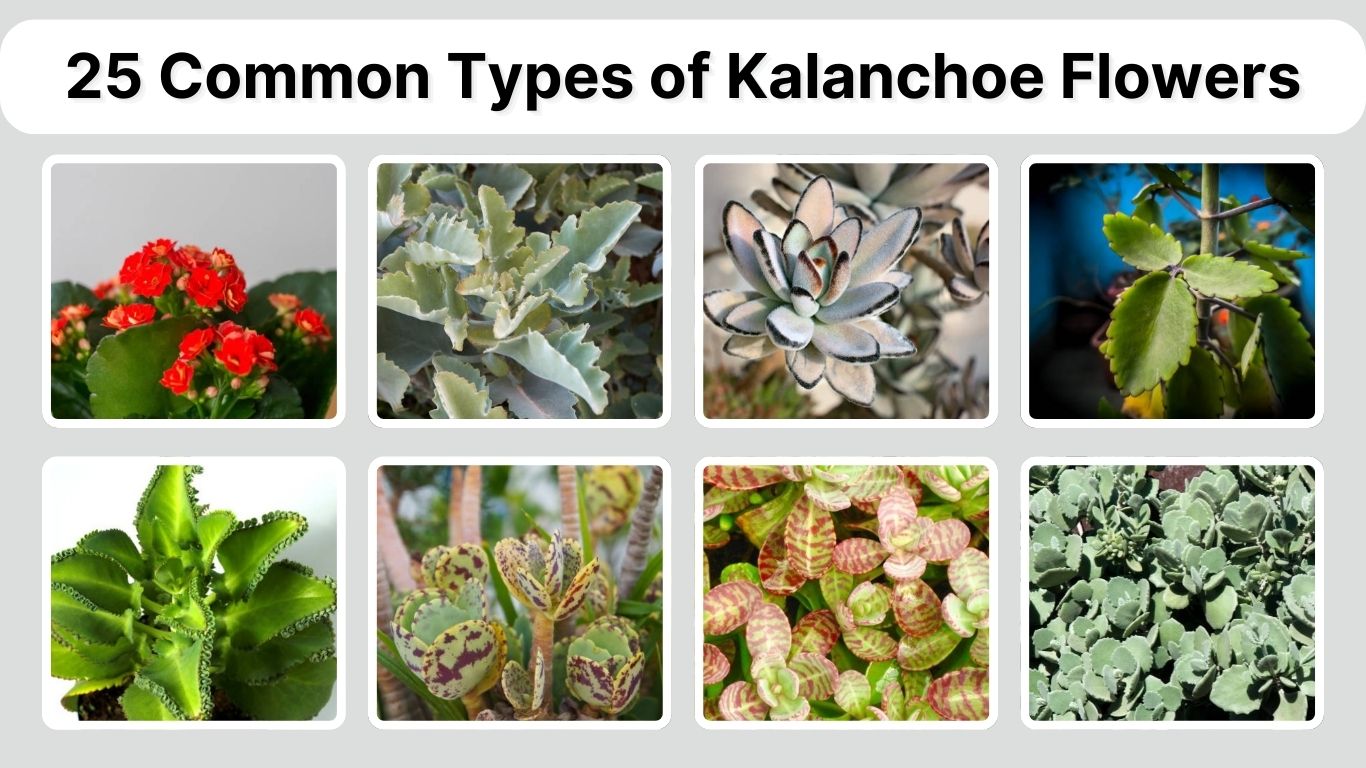
Kalanchoe flowers are popular succulent plants known for their vibrant blooms, unique leaf shapes, and low-maintenance nature. Native mainly to Madagascar and parts of Africa, these plants range from compact flowering houseplants to bold, sculptural foliage types. Some varieties are grown for their long-lasting colorful flowers, while others are valued for dramatic leaves, fuzzy textures, or unusual growth habits. Together, the many types of Kalanchoe offer gardeners and plant lovers an impressive mix of beauty, diversity, and easy care.
1. Kalanchoe blossfeldiana (Flaming Katy)

Kalanchoe blossfeldiana, commonly known as Flaming Katy, is the most popular and widely cultivated Kalanchoe species in the world. It is prized for its long-lasting, brightly colored flowers and compact growth habit, making it a favorite indoor flowering plant. Native to Madagascar, this succulent thrives in warm conditions and blooms mainly in winter and early spring, producing dense clusters of cheerful, star-shaped flowers.
Identification
- Thick, glossy, dark green succulent leaves with slightly scalloped edges
- Compact, bushy growth form, usually 6–12 inches tall
- Dense clusters of small, four-petaled, star-shaped flowers
- Flower colors include red, pink, orange, yellow, white, and purple
- Smooth, fleshy stems adapted for water storage
Flower Characteristics
The flowers of Kalanchoe blossfeldiana grow in tight terminal clusters above the foliage. Each bloom has four delicate petals and a waxy texture that helps extend its lifespan. Under good light conditions, the plant can bloom for several weeks, making it one of the longest-lasting flowering succulents.
Habitat and Growth
In its natural habitat of Madagascar, Kalanchoe blossfeldiana grows in rocky, well-drained soils with warm temperatures. As a houseplant, it prefers bright, indirect sunlight and moderate watering. Overwatering can easily damage its roots, so good drainage is essential.
Uses and Popularity
Flaming Katy is widely used as a decorative indoor plant and gift flower, especially during winter months. Its vibrant colors, low maintenance needs, and long blooming period make it popular for homes, offices, and commercial displays.
2. Kalanchoe beharensis (Felt Bush)
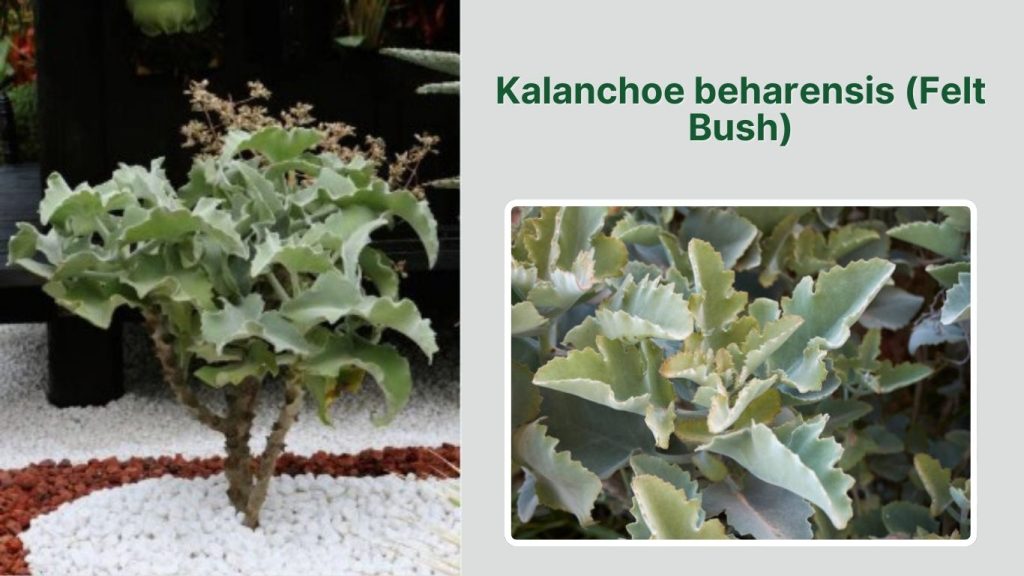
Kalanchoe beharensis, commonly called Felt Bush or Elephant Ear Kalanchoe, is a striking species known for its large, velvety leaves and sculptural form. Native to Madagascar, this plant is valued more for its dramatic foliage than its flowers. It develops into a shrubby, tree-like succulent that adds a bold, architectural look to indoor collections and warm-climate gardens.
Identification
- Large, triangular to shield-shaped leaves covered in soft, felt-like hairs
- Leaf color ranges from silvery gray to olive green or bronze
- Thick, woody stems that become tree-like with age
- Leaves often have scalloped or slightly toothed edges
- Can grow several feet tall in suitable outdoor conditions
Flower Characteristics
The flowers of Kalanchoe beharensis are small and less showy compared to its foliage. They usually appear in clusters and are yellowish-green in color. Blooming is infrequent in indoor plants and typically occurs on mature specimens grown in optimal outdoor conditions.
Habitat and Growth
In the wild, this species grows in arid, rocky regions of Madagascar. It prefers bright light, warm temperatures, and very well-drained soil. As it matures, lower leaves often drop naturally, revealing thick, woody stems that enhance its miniature tree appearance.
Uses and Popularity
Felt Bush is mainly grown as an ornamental foliage plant. Its unusual leaf texture and bold shape make it popular in succulent collections, modern interiors, and xeriscape gardens. It is often used as a statement plant in pots or mixed succulent landscapes.
3. Kalanchoe tomentosa (Panda Plant)
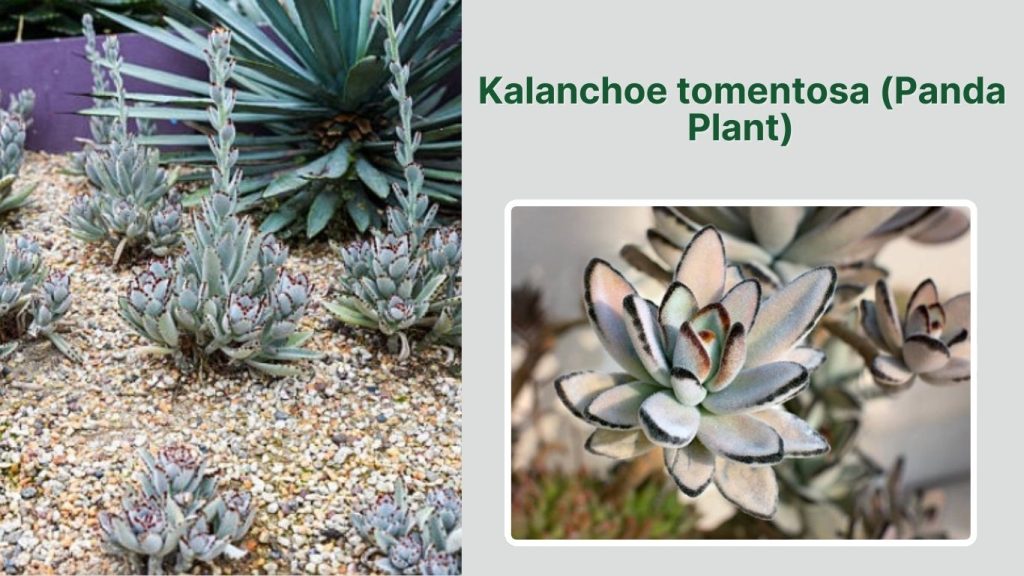
Kalanchoe tomentosa, widely known as the Panda Plant, is a charming succulent recognized for its soft, fuzzy leaves and distinctive brown-edged markings. Native to Madagascar, it is especially popular as a houseplant because of its compact size, drought tolerance, and unique texture. Its thick, velvety foliage gives it a plush appearance, making it a favorite among beginners and succulent collectors alike.
Identification
- Oblong, fleshy leaves densely covered with fine, silvery hairs
- Dark brown to chocolate-colored markings along the leaf edges and tips
- Upright, branching growth habit forming a small shrub
- Soft, velvety texture that gives the plant a “panda-like” look
- Typically grows 12–18 inches tall indoors
Flower Characteristics
The flowers of Kalanchoe tomentosa are small, tubular, and usually pale yellow to greenish in color. They appear on tall stalks above the foliage, but flowering is uncommon in indoor environments. When blooms do occur, they are subtle and secondary to the plant’s ornamental leaves.
Habitat and Growth
In nature, Panda Plant grows in dry, rocky areas with strong sunlight. As a houseplant, it prefers bright, indirect light and well-drained succulent soil. It requires infrequent watering, allowing the soil to dry between watering sessions to prevent rot.
Uses and Popularity
Kalanchoe tomentosa is mainly grown for decorative foliage. It is commonly used in windowsill displays, succulent bowls, and small indoor gardens. Its soft appearance, low care needs, and compact form make it ideal for homes, offices, and gift plants.
4. Kalanchoe pinnata (Cathedral Bells / Miracle Leaf)
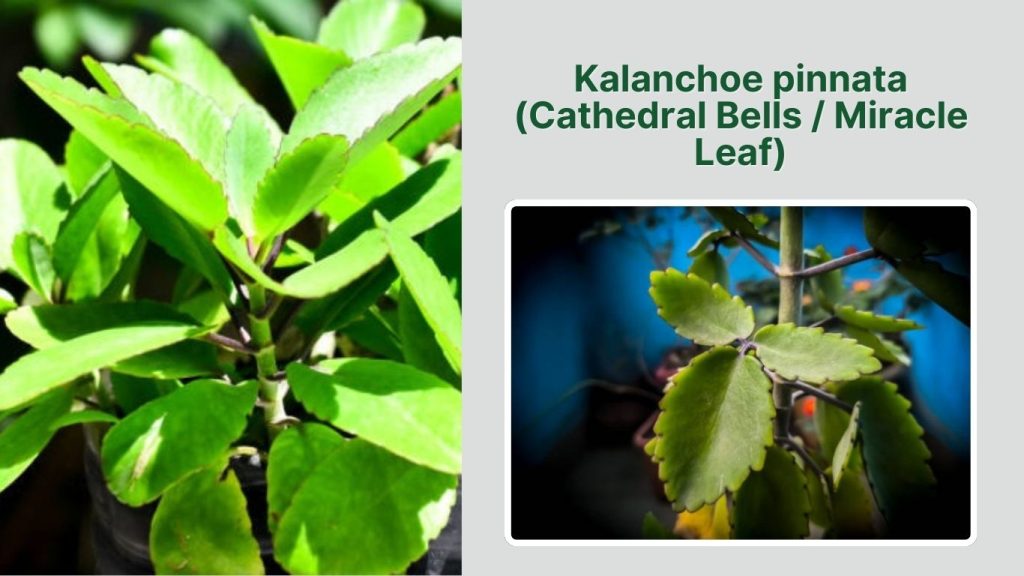
Kalanchoe pinnata, often called Cathedral Bells, Miracle Leaf, or Air Plant, is a fast-growing Kalanchoe species known for its medicinal reputation and remarkable ability to reproduce from leaf edges. Native to Madagascar and widely naturalized in tropical regions, this succulent features thick, fleshy leaves and produces hanging, bell-shaped flowers, making it both useful and ornamental.
Identification
- Thick, oval to oblong succulent leaves with scalloped edges
- Small plantlets often form along the leaf margins
- Upright, hollow, fleshy stems
- Leaves are bright to deep green, sometimes with reddish margins
- Can grow 2–5 feet tall in warm climates
Flower Characteristics
The flowers of Kalanchoe pinnata are tubular, pendulous, and bell-shaped, usually green with purple or reddish tinges. They grow in loose clusters on tall stalks and are more common on mature, outdoor plants. Blooming typically occurs in late winter to spring.
Habitat and Growth
This species thrives in tropical and subtropical regions, often growing on rocky slopes and open ground. It prefers bright light, warm temperatures, and well-drained soil. Kalanchoe pinnata spreads easily because new plants develop directly from fallen leaves.
Uses and Popularity
Kalanchoe pinnata is widely known in traditional medicine systems and is often grown in home gardens for both ornamental and folk-remedy purposes. Its ease of propagation and unique leaf plantlets make it popular among plant enthusiasts and educational gardens.
5. Kalanchoe daigremontiana (Mother of Thousands)
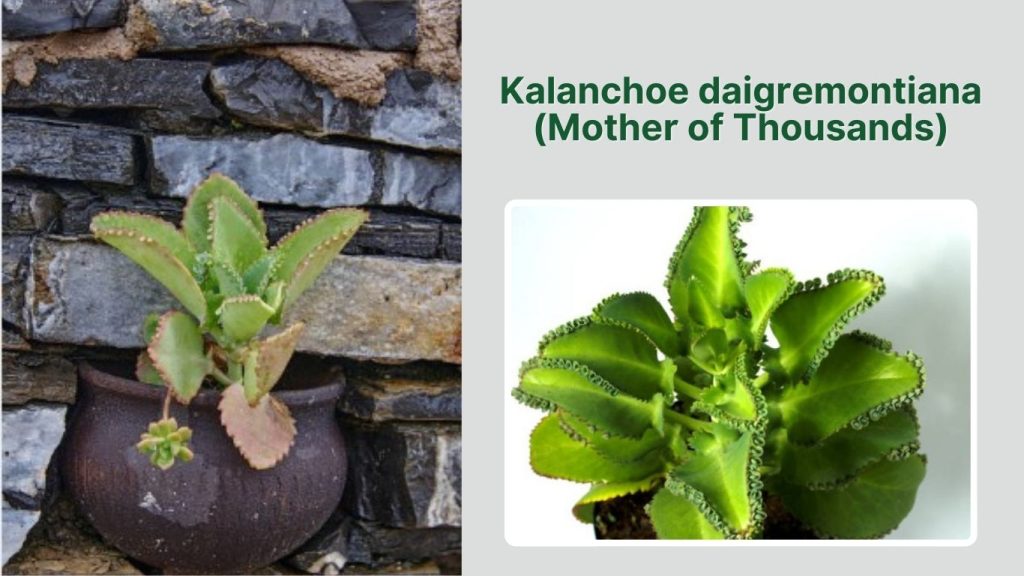
Kalanchoe daigremontiana, commonly called Mother of Thousands, is one of the most fascinating Kalanchoe species due to its unusual method of reproduction. Native to Madagascar, this plant produces tiny plantlets along the edges of its leaves, which drop off and grow into new plants. Its bold leaf shape and rapid growth make it both attractive and highly distinctive.
Identification
- Long, narrow, triangular succulent leaves
- Gray-green leaf surface often marked with darker blotches
- Tiny plantlets forming all along the leaf margins
- Upright, single-stem growth habit in young plants
- Can reach 2–3 feet in height
Flower Characteristics
The flowers of Kalanchoe daigremontiana are tubular and bell-shaped, usually pinkish, gray, or purplish. They hang downward in loose clusters from tall flower stalks. Flowering mainly occurs on mature plants grown outdoors or in very bright light.
Habitat and Growth
In the wild, this species grows on rocky, dry hillsides. It prefers bright light, warm temperatures, and very well-drained soil. Because of its rapid reproduction, it can spread aggressively in favorable climates and is considered invasive in some regions.
Uses and Popularity
Mother of Thousands is widely grown as a curiosity plant and in succulent collections. Its dramatic leaf form and self-propagating nature make it popular for educational displays, beginner plant collections, and decorative indoor pots.
6. Kalanchoe fedtschenkoi (Lavender Scallops)
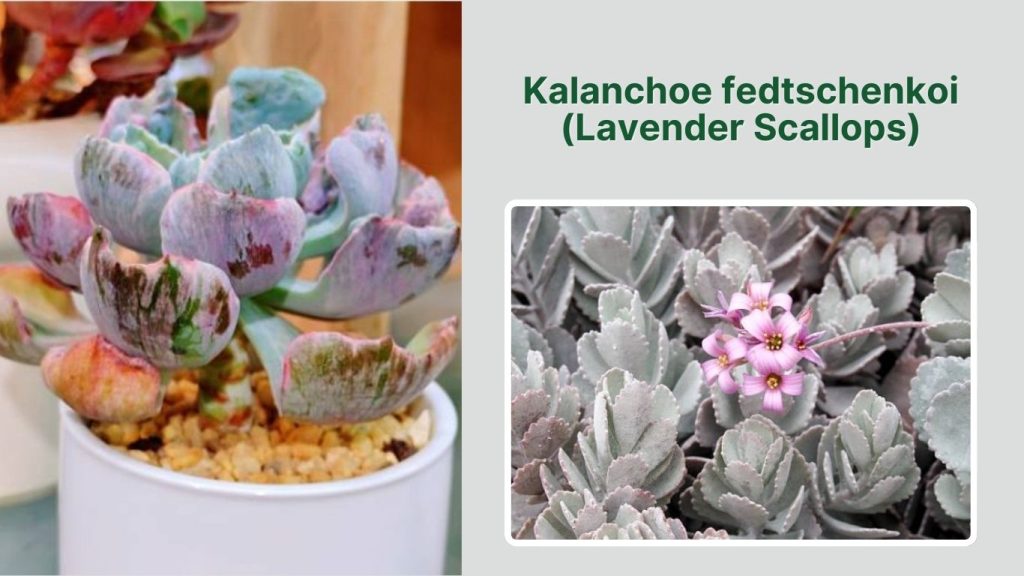
Kalanchoe fedtschenkoi, commonly known as Lavender Scallops, is a low-growing, spreading Kalanchoe species admired for its soft blue-green leaves and gently scalloped edges. Native to Madagascar, it is widely used as an ornamental succulent in pots, hanging baskets, and ground cover in warm climates. Its trailing habit and subtle lavender tones make it especially attractive in mixed succulent arrangements.
Identification
- Fleshy, oval to spoon-shaped leaves with scalloped margins
- Blue-green to silvery leaves often edged with pink or lavender
- Trailing, spreading growth habit
- Thin, succulent stems that root easily when touching soil
- Typically grows 6–12 inches tall but spreads wider
Flower Characteristics
The flowers are tubular, bell-shaped, and usually coral, orange, or reddish in color. They grow in loose clusters at the ends of upright stalks that rise above the foliage. Blooming often occurs in late winter or spring under bright light conditions.
Habitat and Growth
Kalanchoe fedtschenkoi grows naturally in dry, rocky regions. It prefers bright sunlight, warm temperatures, and sandy, well-drained soil. This species is drought tolerant and very easy to propagate from stem cuttings or fallen leaves.
Uses and Popularity
Lavender Scallops is popular in succulent gardens, hanging baskets, and decorative containers. Its trailing form makes it ideal for edging pots or spilling over walls. Gardeners value it for its soft coloring, fast growth, and minimal care needs.
7. Kalanchoe thyrsiflora (Paddle Plant)
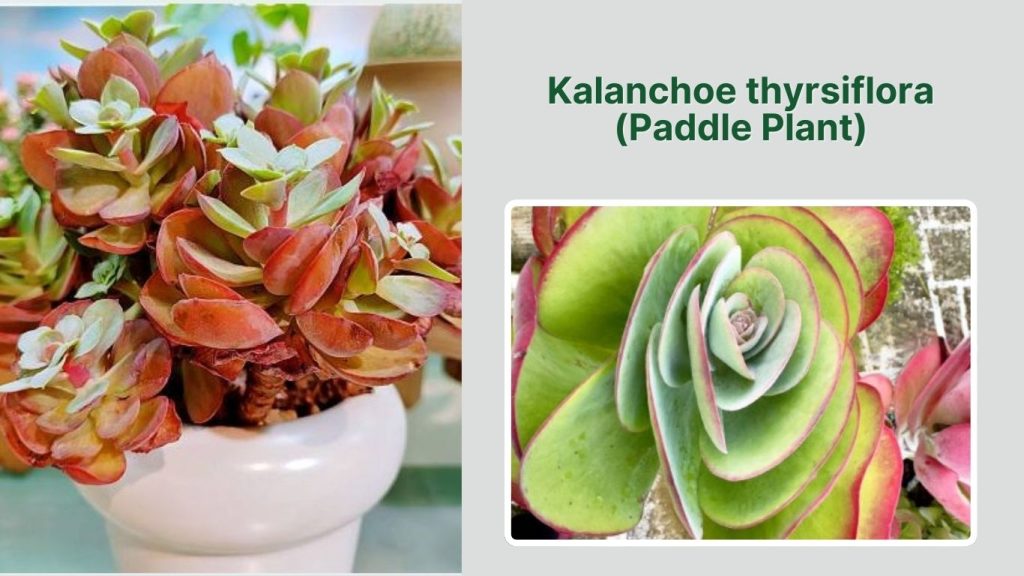
Kalanchoe thyrsiflora, widely known as Paddle Plant, Flapjack, or Desert Cabbage, is a bold, sculptural Kalanchoe species famous for its large, flat, paddle-shaped leaves. Native to southern Africa, this succulent develops dramatic red edges when exposed to strong sunlight, making it one of the most visually striking members of the genus.
Identification
- Large, round to paddle-shaped, flat succulent leaves
- Smooth, powdery blue-green surface with red or pink margins
- Leaves arranged in tight, upright rosettes
- Thick, fleshy, upright stems
- Can reach 12–24 inches tall
Flower Characteristics
The flowers appear on a tall, thick central stalk rising well above the leaf rosette. They are small, tubular, and yellow to pale green, forming a dense cylindrical cluster. After flowering, the main rosette often declines, but offsets usually develop at the base.
Habitat and Growth
This species naturally grows in dry, sunny environments with excellent drainage. It thrives in full sun to bright light, which enhances its red coloration. Kalanchoe thyrsiflora prefers infrequent watering and warm conditions, making it ideal for both indoor pots and outdoor succulent gardens.
Uses and Popularity
Paddle Plant is widely used as a statement succulent in containers, rock gardens, and modern landscape designs. Its bold leaf shape, color contrast, and architectural form make it extremely popular among succulent collectors and home gardeners.
8. Kalanchoe luciae (Red Pancakes)
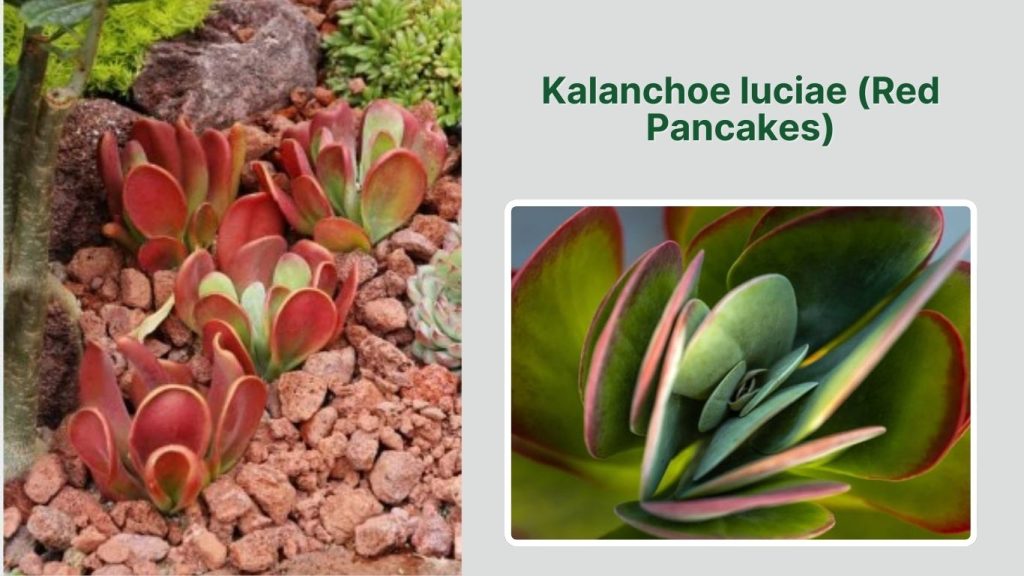
Kalanchoe luciae, commonly called Red Pancakes or Desert Cabbage, is a stunning succulent known for its large, rounded leaves that turn deep red under strong sunlight. Closely related to Kalanchoe thyrsiflora, this species is prized for its dramatic color changes and bold rosette form. It is native to southern Africa and is widely grown as an ornamental plant.
Identification
- Large, thick, rounded, pancake-like leaves
- Smooth leaf surface with a pale green to bluish base color
- Intense red or crimson coloration in bright sun
- Upright rosette growth pattern
- Can grow up to 2 feet tall
Flower Characteristics
The flowers of Kalanchoe luciae grow on a tall central stalk and are small, tubular, and yellowish to greenish-white. They form dense clusters and usually appear on mature plants. Flowering often signals the end of the main rosette’s life cycle, though offsets continue growing.
Habitat and Growth
In nature, Red Pancakes thrives in arid, rocky habitats with strong sunlight. It prefers full sun, warm temperatures, and fast-draining soil. Compared to many other Kalanchoe species, it shows stronger red pigmentation when exposed to bright light and mild stress.
Uses and Popularity
Kalanchoe luciae is widely used in decorative pots, rock gardens, and landscape displays. Its intense coloration and bold leaf shape make it a centerpiece plant in succulent collections and a favorite for modern garden designs.
9. Kalanchoe marmorata (Penwiper Plant)
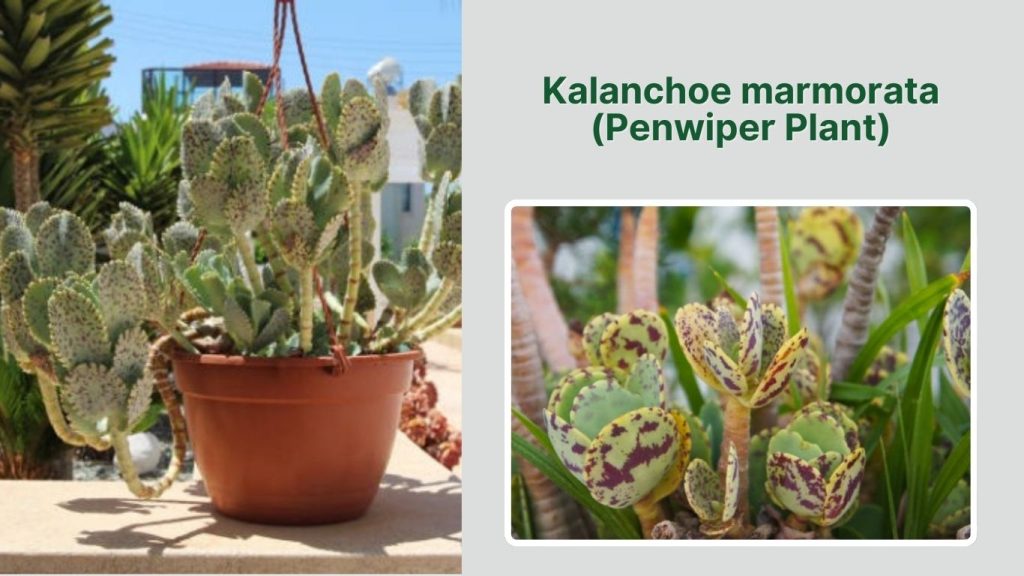
Kalanchoe marmorata, commonly known as Penwiper Plant, is a distinctive Kalanchoe species admired for its broad leaves covered in purple or brownish blotches. Native to Africa, this plant stands out because of its marbled leaf pattern and large, star-shaped flowers. It combines attractive foliage with showy blooms, making it a valued ornamental succulent.
Identification
- Large, thick, oval to oblong leaves
- Pale green to gray-green surface with dark purple or brown spots
- Smooth, fleshy texture
- Upright, branching growth habit
- Can grow 12–24 inches tall
Flower Characteristics
The flowers of Kalanchoe marmorata are large, white to pale cream, and star-shaped, often marked with faint lines. They grow in loose clusters on tall flower stalks and are lightly fragrant. Blooming usually occurs in late winter or early spring.
Habitat and Growth
This species grows naturally in rocky grasslands and open woodlands. It prefers bright light, warm temperatures, and well-drained soil. Compared to many Kalanchoe types, it tolerates slightly cooler conditions and benefits from good air circulation.
Uses and Popularity
Penwiper Plant is commonly grown as both a foliage and flowering ornamental. Its patterned leaves add visual interest year-round, while its large flowers make it especially attractive during its blooming season.
10. Kalanchoe orgyalis (Copper Spoons)
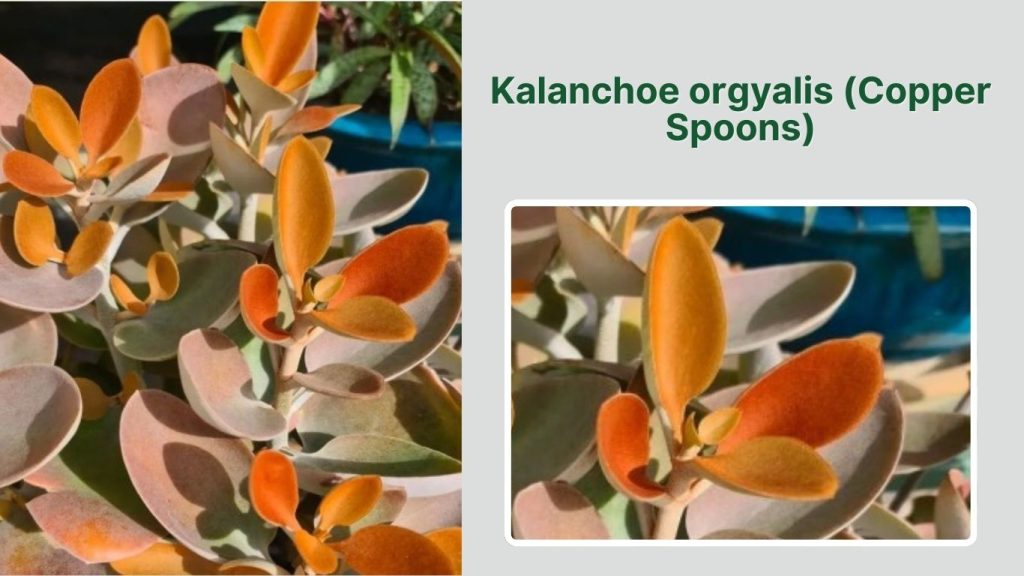
Kalanchoe orgyalis, commonly called Copper Spoons, is a slow-growing Kalanchoe species valued for its thick, spoon-shaped leaves coated with soft brown hairs. Native to Madagascar, this plant develops a rich coppery tone as it matures, giving it a metallic appearance. It is especially popular among collectors who appreciate unusual foliage textures and colors.
Identification
- Long, narrow, spoon-shaped succulent leaves
- Dense brown to cinnamon-colored felt covering the leaf surface
- New growth often appears silvery before turning coppery
- Upright, branching growth habit
- Can reach 2–4 feet tall in ideal conditions
Flower Characteristics
The flowers of Kalanchoe orgyalis are small, yellow, and tubular, appearing in clusters at the tips of mature stems. Flowering is uncommon in indoor plants and usually occurs on large, well-established specimens grown outdoors.
Habitat and Growth
This species naturally grows in dry, rocky habitats. It prefers bright sunlight, warm temperatures, and excellent drainage. Copper Spoons is drought tolerant but grows slowly, making it well suited to container culture.
Uses and Popularity
Copper Spoons are mainly grown as an ornamental foliage plant. Its unique color, velvety texture, and upright form make it a striking addition to succulent collections, modern interiors, and xeriscape-style gardens.
11. Kalanchoe humilis (Desert Surprise)
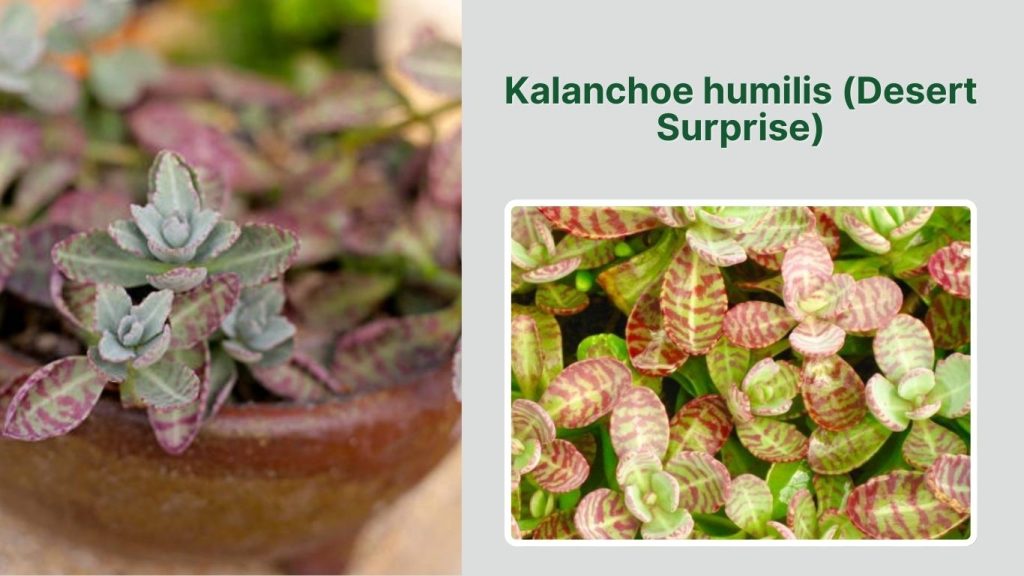
Kalanchoe humilis, often called Desert Surprise, is a compact and eye-catching Kalanchoe species best known for its boldly patterned leaves. Native to East Africa, this succulent features silvery-green foliage marked with rich purple bands, giving it a dramatic, almost painted appearance. Its low-growing form and strong coloration make it especially attractive in small containers and succulent displays.
Identification
- Thick, oblong to oval succulent leaves
- Silvery-green base color with dark purple or maroon horizontal bands
- Smooth leaf surface with a slight powdery coating
- Low-growing, clumping growth habit
- Typically grows 8–12 inches tall
Flower Characteristics
The flowers of Kalanchoe humilis are small, tubular, and usually pale pink to lavender. They appear on upright stalks that rise above the foliage, often forming loose clusters. Flowering is secondary to the plant’s striking leaf patterns.
Habitat and Growth
In nature, this species grows in dry, rocky environments with strong light. It prefers bright sun, warm temperatures, and well-drained soil. Strong light enhances the purple markings, while low light may cause the patterns to fade.
Uses and Popularity
Desert Surprise is popular in ornamental pots, succulent bowls, and rock gardens. Its compact size and vivid leaf patterns make it ideal for decorative indoor collections and small outdoor succulent landscapes.
12. Kalanchoe longiflora (Tugela Cliff Kalanchoe)
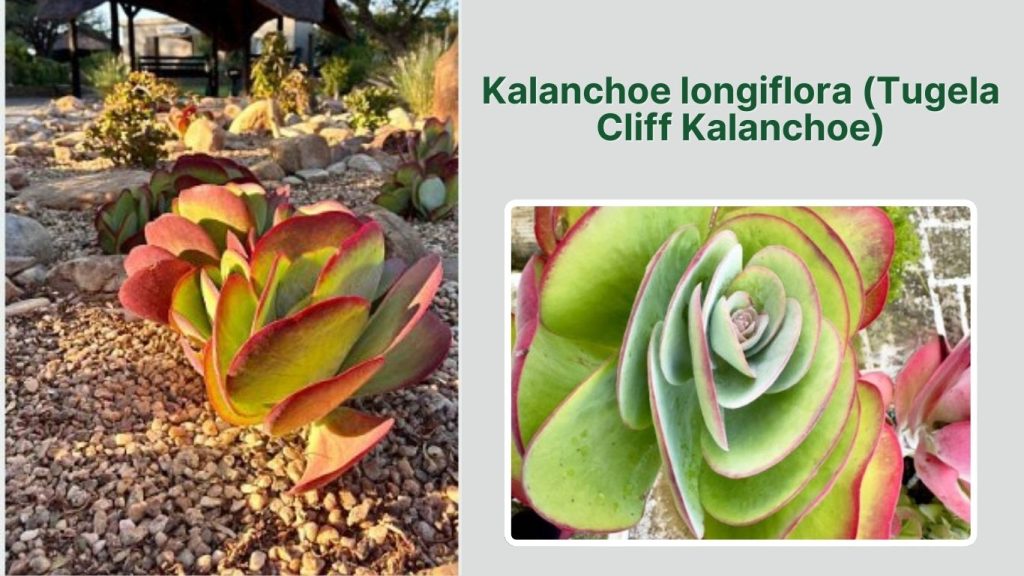
Kalanchoe longiflora, commonly known as Tugela Cliff Kalanchoe, is a trailing succulent species valued for its thick, bluish leaves and bright, showy flowers. Native to South Africa, this plant naturally grows along rocky cliffs, where it spreads and cascades over stone surfaces. Its colorful foliage and vibrant blooms make it a striking addition to both indoor and outdoor succulent collections.
Identification
- Thick, fleshy, wedge-shaped to oval leaves
- Blue-green to gray leaves often tinged with pink or red edges
- Trailing or spreading growth habit
- Succulent stems that root easily when in contact with soil
- Generally grows 6–12 inches tall with wider spread
Flower Characteristics
The flowers of Kalanchoe longiflora are tubular and brightly colored, ranging from yellow to orange-red. They appear in loose clusters on upright stalks above the foliage and are more prominent and decorative than many other Kalanchoe flowers.
Habitat and Growth
In the wild, this species thrives on rocky cliffs and well-drained slopes. It prefers bright light or full sun, warm temperatures, and fast-draining soil. Regular light stress encourages richer leaf coloring.
Uses and Popularity
Tugela Cliff Kalanchoe is popular for hanging baskets, wall planters, and rock gardens. Its spreading habit and colorful foliage make it ideal for cascading arrangements and mixed succulent displays.
13. Kalanchoe millotii (Velvet Leaf Kalanchoe)
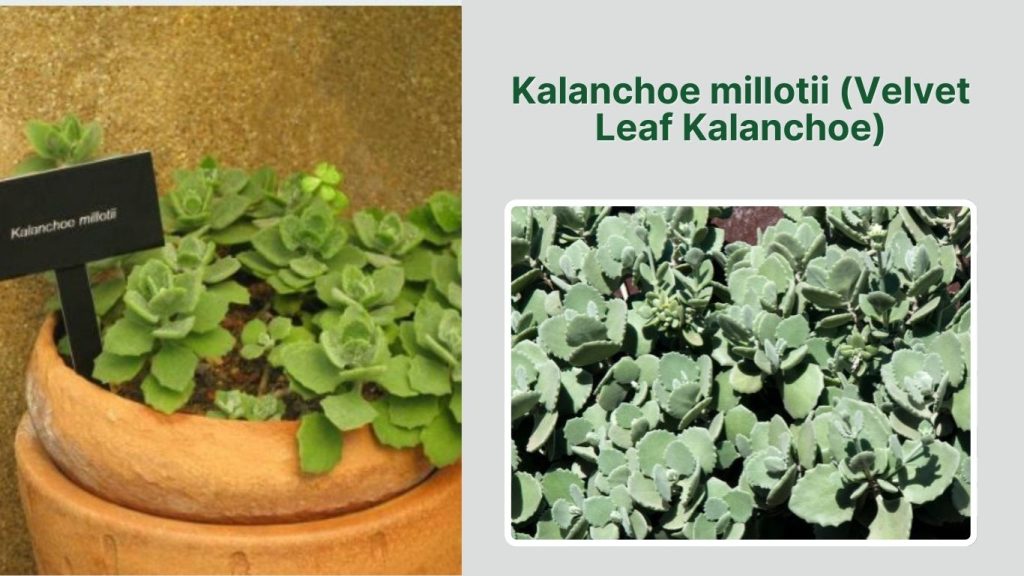
Kalanchoe millotii is a compact, soft-textured Kalanchoe species admired for its round, velvety leaves and decorative form. Native to Madagascar, this plant resembles a smaller, gentler version of Felt Bush, with pale green foliage covered in fine hairs. Its subtle appearance and neat growth habit make it a favorite among collectors of fuzzy succulents.
Identification
- Rounded to heart-shaped succulent leaves
- Soft, velvety surface covered with fine white hairs
- Pale green to silvery-green leaf color
- Low, branching, bushy growth habit
- Typically grows 8–12 inches tall
Flower Characteristics
The flowers of Kalanchoe millotii are small, yellowish to greenish, and appear in loose clusters on short stalks. They are not particularly showy and are rarely the main attraction compared to the plant’s attractive foliage.
Habitat and Growth
This species naturally grows in dry, rocky regions of Madagascar. It prefers bright, indirect sunlight, warm temperatures, and well-drained soil. Like most fuzzy-leaved Kalanchoe, it is sensitive to overwatering and excess humidity.
Uses and Popularity
Velvet Leaf Kalanchoe is commonly grown as a decorative foliage plant. Its soft appearance and compact size make it suitable for windowsills, indoor succulent gardens, and small decorative pots.
14. Kalanchoe rotundifolia (Round-Leaf Kalanchoe)
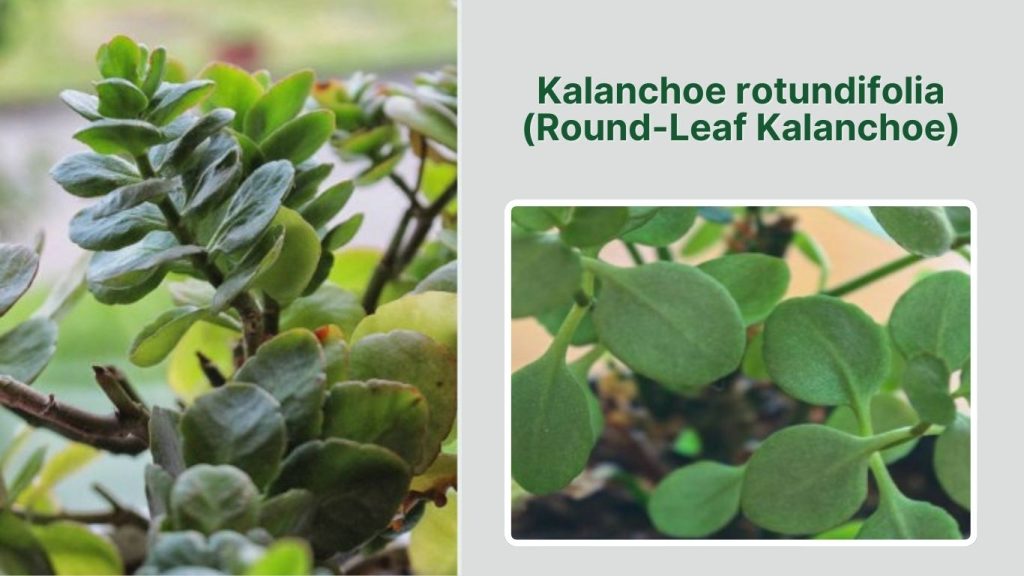
Kalanchoe rotundifolia, commonly known as Round-Leaf Kalanchoe, is a hardy, upright-growing species known for its smooth, rounded leaves and bright tubular flowers. Native to parts of Africa and the Arabian Peninsula, this plant combines ornamental foliage with attractive seasonal blooms, making it suitable for both container growing and warm-climate gardens.
Identification
- Thick, rounded to oval succulent leaves
- Smooth, bright green surface sometimes tinged with red
- Upright, branching stems
- Bushy growth habit
- Can grow 2–4 feet tall in favorable conditions
Flower Characteristics
The flowers of Kalanchoe rotundifolia are tubular and brightly colored, usually orange to red. They hang slightly downward in loose clusters on tall stalks and attract pollinators such as birds and insects in outdoor settings.
Habitat and Growth
This species naturally grows on rocky slopes and open grasslands. It prefers full sun to bright light, warm temperatures, and fast-draining soil. It is drought tolerant and performs well in outdoor succulent gardens.
Uses and Popularity
Round-Leaf Kalanchoe is grown as an ornamental flowering succulent. Its combination of upright form, green foliage, and colorful blooms makes it attractive for borders, large pots, and landscape displays in warm regions.
15. Kalanchoe sexangularis (Six-Angled Kalanchoe)
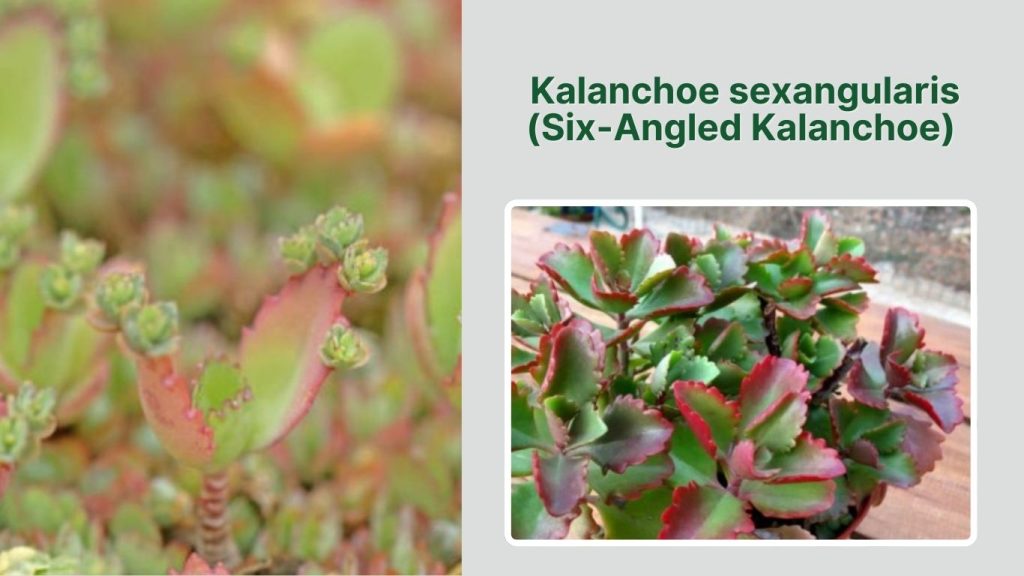
Kalanchoe sexangularis, often called Six-Angled Kalanchoe, is a colorful succulent species best known for its vibrant red foliage that develops under strong sunlight. Native to southern Africa, this plant changes dramatically in appearance depending on light exposure, shifting from green to deep crimson tones. Its upright form and bold color make it a striking ornamental plant.
Identification
- Thick, fleshy, oval leaves arranged along upright stems
- Bright green leaves that turn red or burgundy in strong light
- Distinct angular stems, especially on mature plants
- Upright, branching growth habit
- Typically grows 1–3 feet tall
Flower Characteristics
The flowers of Kalanchoe sexangularis are small, tubular, and yellow to greenish-yellow. They appear in clusters on tall stalks above the foliage, usually during late winter or early spring.
Habitat and Growth
This species naturally grows in rocky, sunny habitats. It prefers full sun, warm temperatures, and well-drained soil. Strong light is essential to bring out its signature red coloration, while shade keeps the leaves mostly green.
Uses and Popularity
Six-Angled Kalanchoe is widely grown for its dramatic foliage color. It is popular in outdoor succulent gardens, decorative pots, and mixed plantings where bold red tones are desired.
16. Kalanchoe beharensis ‘Fang’ (Fang Kalanchoe)
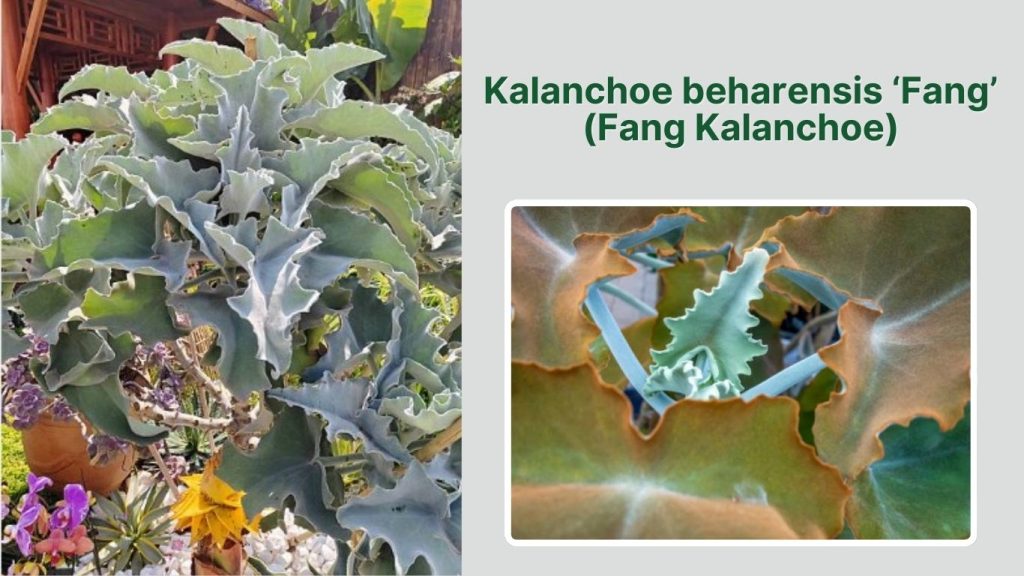
Kalanchoe beharensis ‘Fang’ is a striking cultivated variety of Kalanchoe beharensis, famous for the fang-like projections that develop along the undersides of its leaves. Native to Madagascar through its parent species, this unusual succulent is prized for its dramatic, almost prehistoric appearance. It forms a small shrubby plant with large, velvety leaves that make it a standout in any succulent collection.
Identification
- Large, triangular to shield-shaped leaves
- Soft, felt-like surface with gray-green to bronze coloring
- Distinct fang-like bumps along the underside of leaf margins
- Thick, upright stems that become woody with age
- Can grow several feet tall in warm, outdoor conditions
Flower Characteristics
The flowers are small, yellowish, and grow in clusters on tall stalks. Blooming is rare in indoor cultivation and usually occurs only on mature outdoor plants grown in ideal climates.
Habitat and Growth
This cultivar prefers bright light, warm temperatures, and very well-drained soil. Like other Kalanchoe beharensis forms, it is drought tolerant and sensitive to overwatering. As it matures, lower leaves often drop, giving it a tree-like structure.
Uses and Popularity
Fang Kalanchoe is mainly grown as a collector’s plant. Its unusual leaf texture and dramatic projections make it popular in specialty succulent collections, modern interiors, and display gardens.
17. Kalanchoe tubiflora (Chandelier Plant)
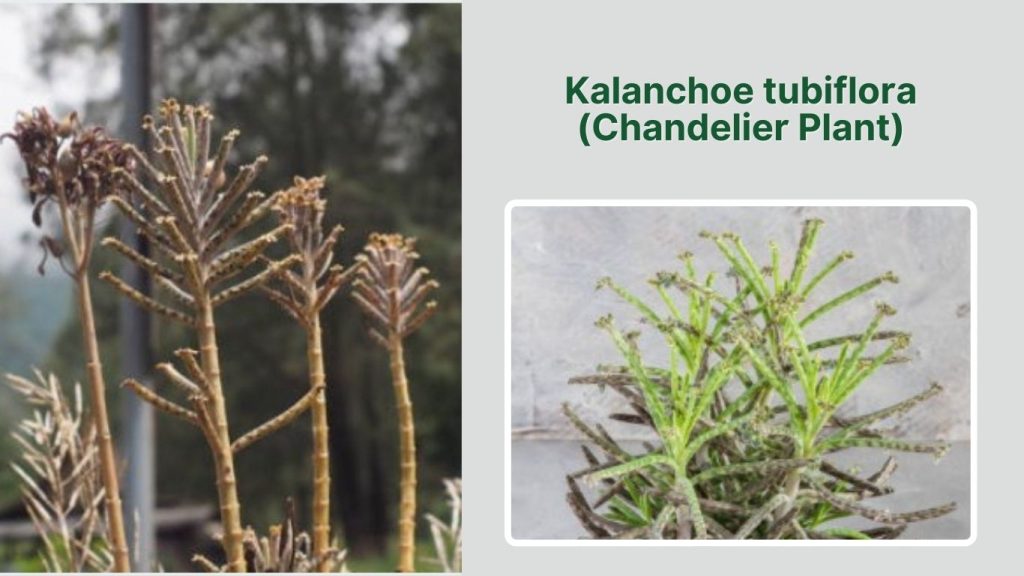
Kalanchoe tubiflora, commonly known as Chandelier Plant or Mother of Millions, is a unique Kalanchoe species recognized for its narrow, tubular leaves and prolific plantlet production. Native to Madagascar, this succulent produces tiny baby plants at the tips of its leaves, allowing it to spread rapidly. Its upright form and unusual foliage make it a fascinating ornamental plant.
Identification
- Long, narrow, tube-like succulent leaves
- Gray-green to bluish leaves often with dark spots
- Tiny plantlets forming at the leaf tips
- Upright, cane-like stems
- Can grow 2–3 feet tall
Flower Characteristics
The flowers of Kalanchoe tubiflora are tubular, bell-shaped, and usually orange to red. They hang downward in loose clusters from tall flower stalks. Flowering typically occurs on mature plants grown in bright light or outdoor conditions.
Habitat and Growth
In nature, this species grows in dry, rocky areas. It prefers full sun to bright light, warm temperatures, and fast-draining soil. Because of its rapid self-propagation, it can become invasive in some warm regions.
Uses and Popularity
Chandelier Plant is widely grown as a curiosity plant and in succulent collections. Its unusual leaf shape and easy reproduction make it popular for educational displays, beginner growers, and decorative pots.
18. Kalanchoe manginii (Trailing Kalanchoe)
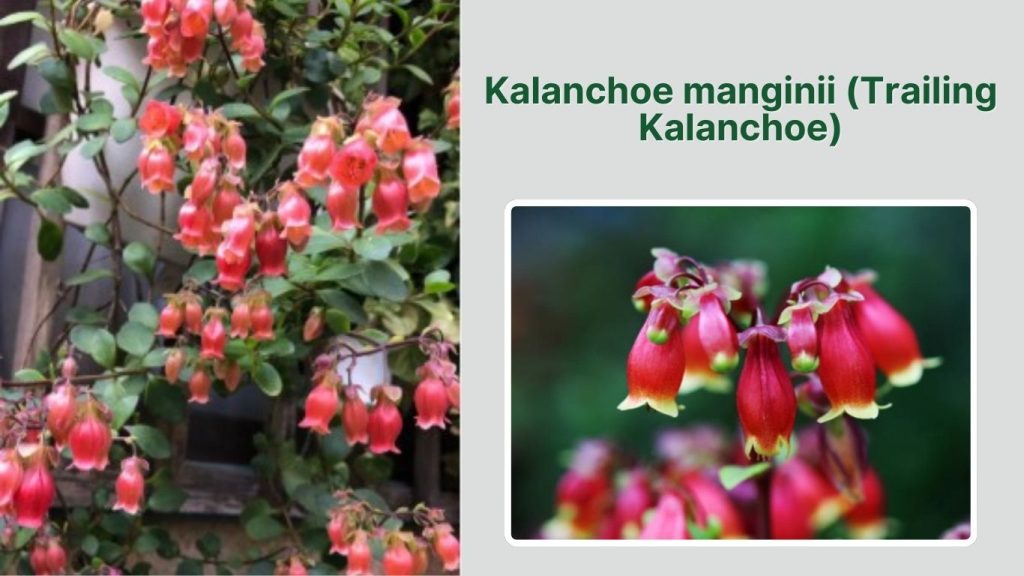
Kalanchoe manginii, commonly known as Trailing Kalanchoe, is a graceful, cascading species admired for its small rounded leaves and bright, bell-shaped flowers. Native to Madagascar, this plant naturally grows along rocky slopes, where it drapes and spreads. Its long, arching stems and colorful blooms make it especially popular for hanging baskets and elevated containers.
Identification
- Small, round to oval succulent leaves
- Glossy green surface sometimes tinged with red
- Thin, trailing stems that arch and spill over containers
- Soft, flexible growth habit
- Usually grows under 12 inches tall but spreads widely
Flower Characteristics
The flowers of Kalanchoe manginii are showy, tubular, and bell-shaped, typically bright red, orange, or coral. They hang gracefully from slender stalks and bloom mainly in late winter and spring.
Habitat and Growth
This species grows naturally in rocky, shaded cliffs. It prefers bright, indirect light, warm temperatures, and well-drained soil. Compared to upright Kalanchoe, it enjoys slightly more frequent watering while still requiring good drainage.
Uses and Popularity
Trailing Kalanchoe is widely used in hanging baskets, window boxes, and decorative containers. Its cascading habit and vibrant flowers make it ideal for indoor displays and sheltered outdoor patios.
19. Kalanchoe pumila (Flower Dust Plant)
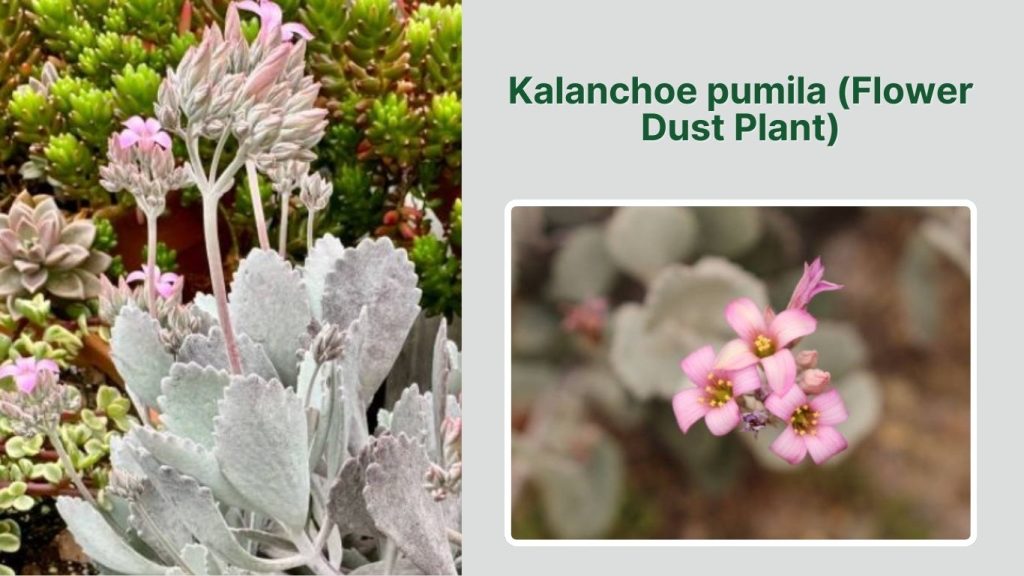
Kalanchoe pumila, commonly known as Flower Dust Plant, is a compact, low-growing Kalanchoe species valued for its silvery foliage and delicate pink flowers. Native to Madagascar, this plant forms a soft, spreading mound that looks dusted with powder, giving it a gentle, pastel appearance. It is especially attractive when in bloom, as the flowers rise neatly above the foliage.
Identification
- Small, rounded to oval succulent leaves
- Silvery-gray surface with a powdery coating
- Low, spreading, clumping growth habit
- Short, fleshy stems
- Typically grows 6–10 inches tall
Flower Characteristics
The flowers of Kalanchoe pumila are soft pink to lavender and star-shaped, appearing in loose clusters on thin stalks. They usually bloom in late winter or early spring and are more noticeable than those of many other compact Kalanchoe species.
Habitat and Growth
This species naturally grows in dry, rocky environments. It prefers bright light, warm temperatures, and fast-draining soil. Moderate sun exposure enhances both leaf color and flower production.
Uses and Popularity
Flower Dust Plant is popular in small pots, succulent bowls, and decorative indoor gardens. Its compact form, pale foliage, and gentle blooms make it ideal for windowsills and mixed succulent arrangements.
20. Kalanchoe prolifera (Blooming Box)
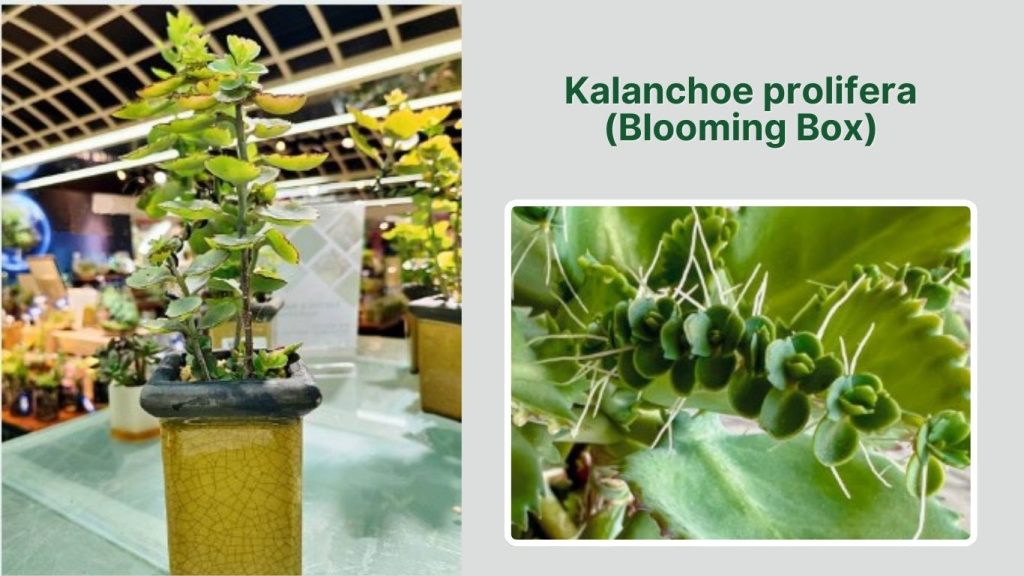
Kalanchoe prolifera, often called Blooming Box or Proliferating Kalanchoe, is an attractive shrubby species known for its tall flower stalks and ability to produce new shoots along its stems. Native to Madagascar, this plant combines lush green foliage with clusters of bright blooms, giving it a more leafy and flowering appearance than many compact Kalanchoe types.
Identification
- Thick, oval to oblong succulent leaves
- Bright green foliage sometimes tinged with red
- Upright, branching growth habit
- Tendency to form new plantlets along stems and nodes
- Can grow 2–5 feet tall in warm climates
Flower Characteristics
The flowers are small, tubular, and typically yellow to orange-red, forming loose clusters at the tops of tall stalks. Blooming often occurs in cooler months and is more common in mature, well-grown plants.
Habitat and Growth
In the wild, this species grows on rocky slopes and open ground. It prefers bright light, warm temperatures, and well-drained soil. Kalanchoe prolifera is relatively fast growing and benefits from occasional pruning to maintain shape.
Uses and Popularity
Blooming Box is grown as an ornamental flowering succulent. Its upright form and colorful blooms make it suitable for large pots, outdoor gardens in warm climates, and mixed landscape plantings.
21. Kalanchoe synsepala (Walking Kalanchoe)
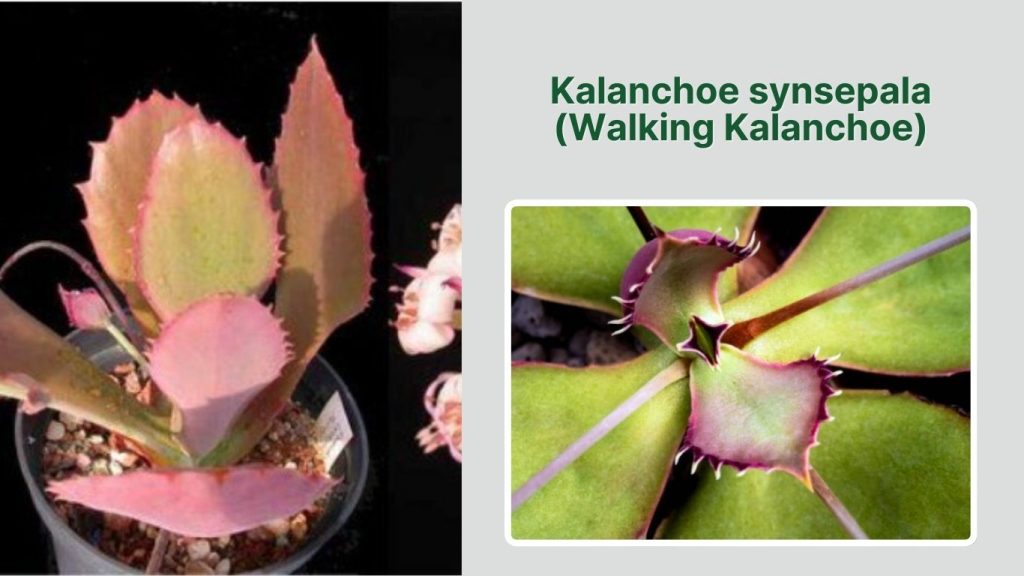
Kalanchoe synsepala, commonly known as Walking Kalanchoe, is a distinctive species famous for its long, arching flower stalks that bend down and root when they touch the ground. Native to Madagascar, this unusual growth habit gives the impression that the plant is “walking” across the soil. It is admired for both its decorative foliage and its fascinating method of propagation.
Identification
- Large, thick, oval to paddle-shaped succulent leaves
- Glossy green surface often with reddish edges
- Long, arching stems that produce plantlets at the tips
- Upright base with spreading, creeping extensions
- Can reach 2–4 feet in height and spread
Flower Characteristics
The flowers of Kalanchoe synsepala are small, tubular, and yellowish-green. They appear in clusters along tall stalks, mainly on mature plants. While not very showy, they add seasonal interest to the plant.
Habitat and Growth
This species grows naturally in dry, rocky habitats. It prefers bright light, warm temperatures, and well-drained soil. Its “walking” habit allows it to spread easily, making it well suited to large containers or open garden spaces.
Uses and Popularity
Walking Kalanchoe is popular among plant collectors and educational gardens. Its unusual spreading behavior and bold leaves make it a conversation piece in succulent collections and botanical displays.
22. Kalanchoe laxiflora (Milky Widow’s Thrill)
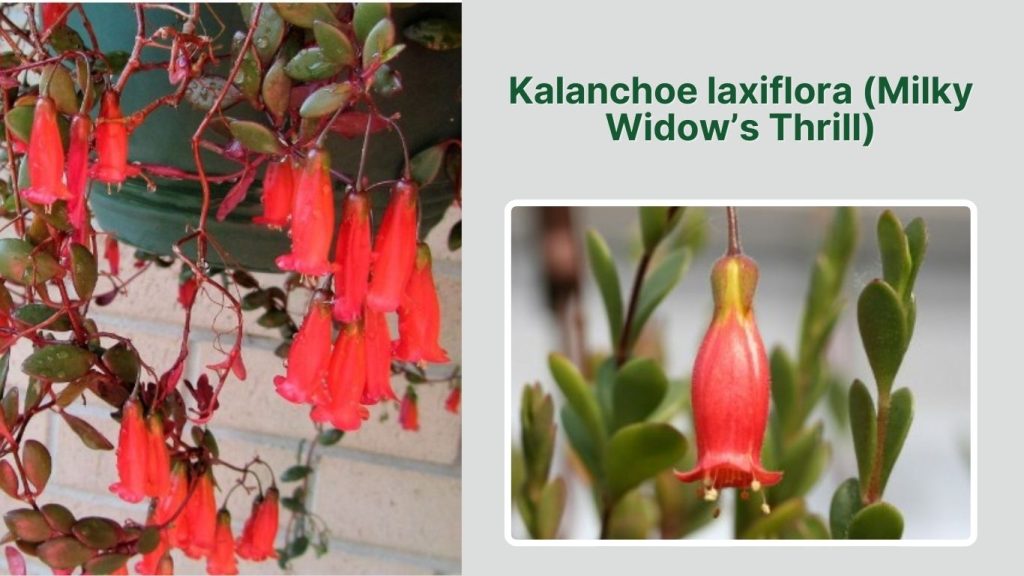
Kalanchoe laxiflora, often called Milky Widow’s Thrill, is a beautiful Kalanchoe species admired for its soft gray-green leaves and colorful hanging flowers. Native to Madagascar, this plant forms loose rosettes and produces arching stems topped with clusters of bright blooms. It is closely related to Paddle Plant types but is grown mainly for its attractive flowering display.
Identification
- Broad, fleshy, oval leaves with a powdery coating
- Gray-green to bluish leaf color, sometimes tinged with pink
- Loose rosette growth form
- Smooth, succulent stems
- Typically grows 12–20 inches tall
Flower Characteristics
The flowers of Kalanchoe laxiflora are tubular, drooping, and usually bright red, coral, or orange. They grow in loose clusters at the ends of tall stalks and often bloom in late winter or early spring.
Habitat and Growth
In nature, this species grows on dry, rocky slopes. It prefers bright sunlight, warm temperatures, and very well-drained soil. Adequate light encourages both compact growth and abundant flowering.
Uses and Popularity
Milky Widow’s Thrill is grown as a decorative flowering succulent. Its colorful blooms and soft-toned foliage make it popular in containers, outdoor succulent beds, and mixed ornamental plantings.
23. Kalanchoe delagoensis (Mother of Millions)
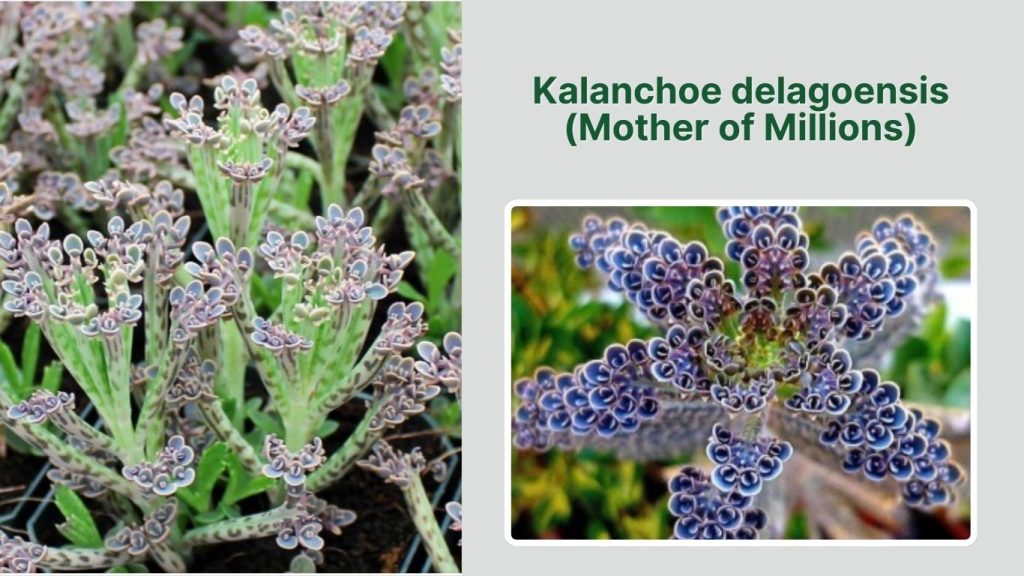
Kalanchoe delagoensis, commonly known as Mother of Millions, is a striking succulent species recognized for its narrow tubular leaves and extraordinary ability to reproduce. Native to Madagascar, this plant produces numerous tiny plantlets along the leaf tips, which drop off and quickly grow into new plants. Its unusual appearance and rapid spread make it both fascinating and controversial in cultivation.
Identification
- Long, thin, cylindrical succulent leaves
- Gray-green leaves often marked with dark spots
- Tiny plantlets forming along the leaf tips
- Upright, cane-like growth habit
- Can grow 2–3 feet tall
Flower Characteristics
The flowers are tubular, drooping, and typically orange, coral, or reddish. They appear in clusters on tall stalks and usually bloom on mature plants grown in bright light or outdoor conditions.
Habitat and Growth
This species naturally grows in dry, rocky habitats. It prefers full sun, warm temperatures, and very well-drained soil. Because of its prolific reproduction, it can become invasive in some regions and should be grown responsibly.
Uses and Popularity
Mother of Millions is widely grown as a novelty plant and in succulent collections. Its dramatic form and self-propagating habit make it popular for educational displays and decorative containers.
24. Kalanchoe rosei (Rose-Leaf Kalanchoe)
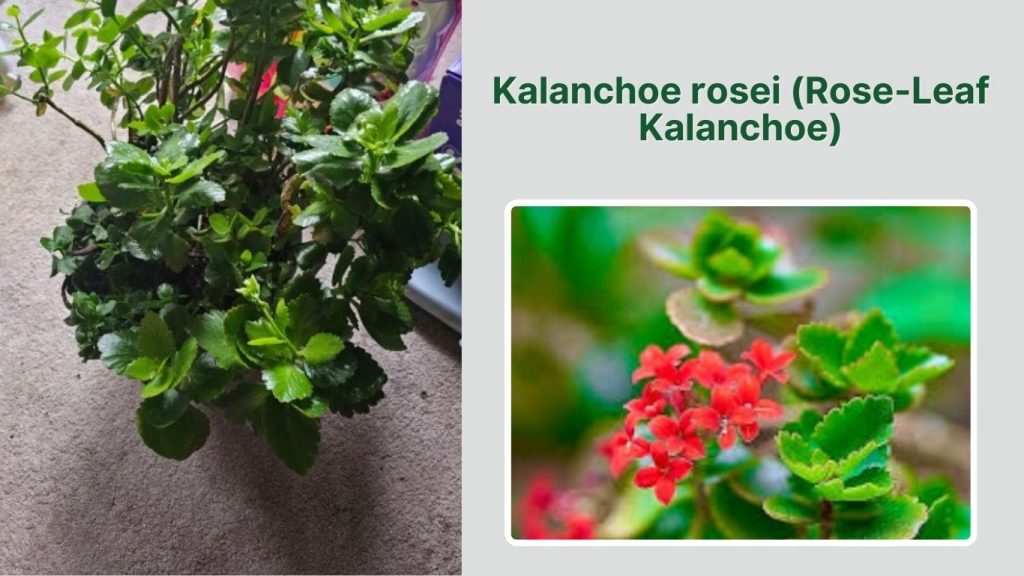
Kalanchoe rosei is a lesser-known but attractive Kalanchoe species appreciated for its smooth, fleshy leaves and compact, shrubby growth. Native to Madagascar, this plant develops neat clusters of rounded leaves and produces delicate flowers under favorable conditions. It is mainly grown by collectors who enjoy rare and subtle Kalanchoe varieties.
Identification
- Thick, rounded to oval succulent leaves
- Smooth, soft green surface sometimes tinged with red
- Compact, upright to slightly spreading growth habit
- Fleshy stems that become woody with age
- Generally grows 12–24 inches tall
Flower Characteristics
The flowers of Kalanchoe rosei are small and tubular, usually pale yellow to light pink. They grow in loose clusters on slender stalks and typically appear on mature, well-established plants.
Habitat and Growth
In the wild, this species grows in dry, rocky regions. It prefers bright light, warm temperatures, and fast-draining soil. Like most Kalanchoe plants, it is drought tolerant and sensitive to excess moisture.
Uses and Popularity
Kalanchoe rosei is mainly grown as an ornamental foliage and collector’s plant. Its neat form and subtle beauty make it suitable for indoor pots, specialty succulent collections, and botanical displays.
25. Kalanchoe nyikae (Nyika Kalanchoe)
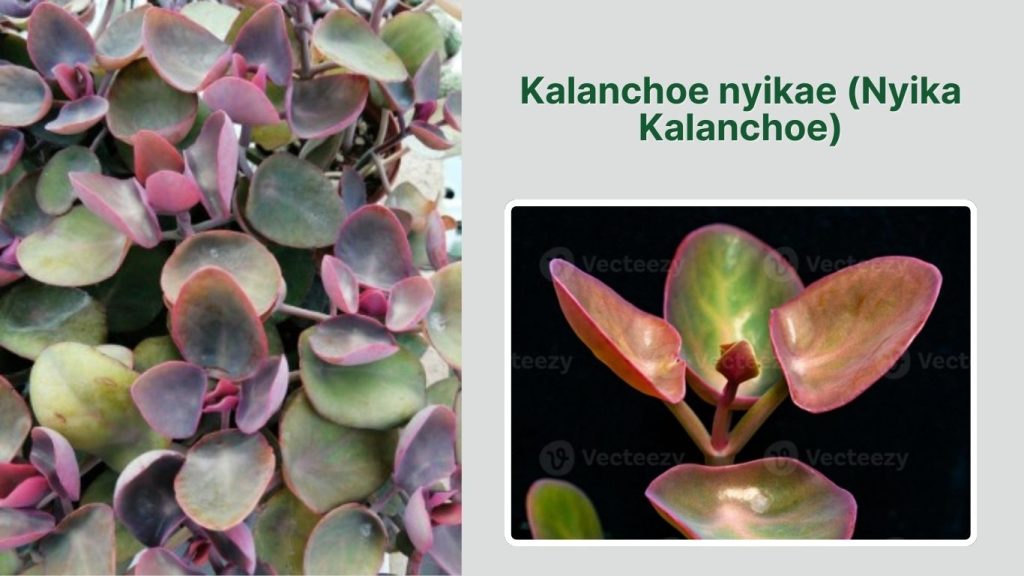
Kalanchoe nyikae is a distinctive Kalanchoe species native to East Africa, particularly regions around the Nyika Plateau. It is admired for its upright form, broad succulent leaves, and attractive flowering habit. Compared to more common Kalanchoe types, it has a more natural, wild appearance, making it especially appealing to collectors and botanical garden displays.
Identification
- Large, thick, oval to oblong succulent leaves
- Bright green surface sometimes tinged with red along the edges
- Upright, sturdy stems
- Shrubby growth habit
- Can grow 2–4 feet tall in favorable conditions
Flower Characteristics
The flowers of Kalanchoe nyikae are tubular and usually yellow to greenish-yellow. They appear in loose clusters on tall flower stalks above the foliage, adding seasonal interest to the plant.
Habitat and Growth
This species naturally grows in rocky grasslands and open woodland areas. It prefers bright light or full sun, warm temperatures, and well-drained soil. It is drought tolerant and performs best when given space to grow.
Uses and Popularity
Nyika Kalanchoe is mainly grown as an ornamental and collector’s plant. Its bold leaves and upright structure make it suitable for large containers, outdoor succulent gardens, and educational plant collections.
FAQs
What is the most common type of Kalanchoe flower?
Kalanchoe blossfeldiana is the most common and widely grown type. It is popular worldwide because of its bright, long-lasting flowers, compact growth, and ability to bloom indoors. It is often sold as a flowering houseplant, especially during winter and early spring.
Do all Kalanchoe plants produce flowers?
Yes, all Kalanchoe species are flowering plants, but some are grown mainly for their decorative leaves. While many types bloom only under strong light and proper care, their flowers can be small and less noticeable compared to their foliage.
Are Kalanchoe flowers easy to grow at home?
Kalanchoe plants are generally easy to grow at home. They prefer bright light, warm temperatures, and well-drained soil. Because they store water in their leaves, they need only occasional watering, making them suitable for beginners.
How often do Kalanchoe plants bloom?
Most Kalanchoe plants bloom once a year, usually in winter or early spring. Flowering depends on light exposure, especially shorter daylight hours. With proper light control and care, some varieties can be encouraged to rebloom.
Are Kalanchoe plants safe for pets?
Kalanchoe plants are considered toxic to cats, dogs, and other pets if ingested. They contain compounds that can cause vomiting, diarrhea, and heart rhythm problems. It is best to keep Kalanchoe plants out of reach of animals.