





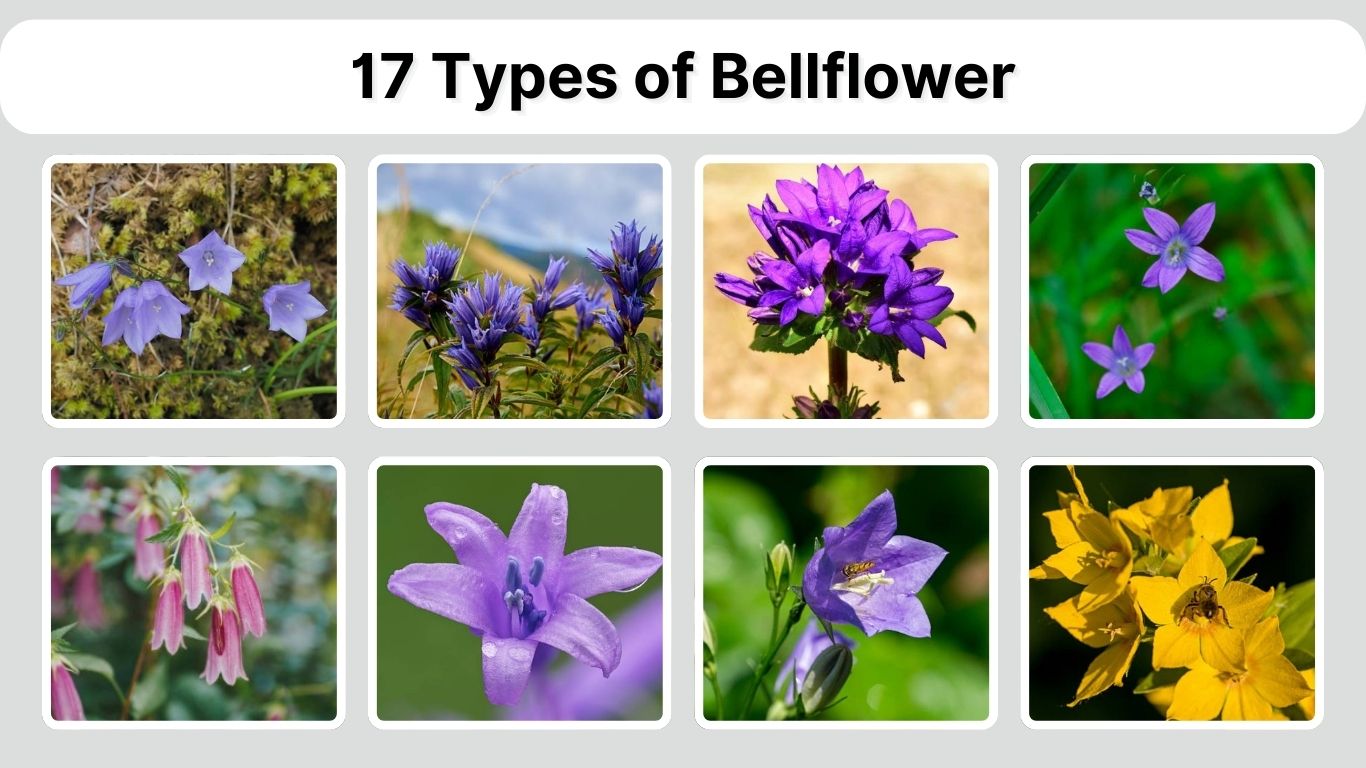
Bellflowers, scientifically known as Campanula, are a diverse group of flowering plants admired for their charming bell-shaped and star-shaped blooms. They grow naturally across Europe, Asia, and North America, appearing in habitats ranging from alpine slopes to open meadows and woodlands. Gardeners value bellflowers for their long blooming season, rich blue and purple tones, and adaptability to borders, rock gardens, containers, and wildflower landscapes, making them both decorative and pollinator-friendly plants.
1. Canterbury Bell (Campanula medium)

Canterbury Bell is one of the most popular and visually striking bellflowers, widely grown in cottage gardens for its tall spikes of large, bell-shaped blooms. Native to southern Europe, this biennial plant is admired for its classic blue, pink, purple, and white flowers that bloom in late spring to early summer, making it a favorite for borders and cut-flower gardens.
Identification
- Upright flowering stems that usually grow 1.5 to 3 feet tall
- Large, cup-shaped or bell-shaped blooms held in loose clusters
- Flower colors commonly include blue, violet, pink, and white
- Soft, slightly hairy green leaves with a rounded base rosette
- Thick central stem that supports multiple blooms
Habitat and Natural Range
Canterbury Bell is native to Mediterranean regions of southern Europe, where it grows in open woodlands, rocky slopes, and grassy hillsides. In gardens, it prefers sunny to lightly shaded locations with well-drained soil. It adapts well to temperate climates and is commonly cultivated across Europe, North America, and parts of Asia.
Growth and Lifecycle
This plant is typically grown as a biennial. In the first year, it forms a low rosette of leaves. In the second year, it sends up tall flowering stalks, blooms heavily, sets seed, and then completes its life cycle. With proper care, it can self-seed and reappear in the garden.
Uses and Garden Value
Canterbury Bell is widely used in ornamental borders, cottage gardens, and floral arrangements. Its tall, colorful flower spikes create strong vertical interest, while its long-lasting blooms make it excellent for cutting gardens. It also attracts bees and other pollinators, adding ecological value to decorative landscapes.
2. Harebell (Campanula rotundifolia)

Harebell, often called the “bluebell of Scotland,” is a delicate, graceful bellflower known for its thin, wiry stems and nodding sky-blue blooms. Native to the Northern Hemisphere, this perennial species thrives in meadows, cliffs, and open grasslands, where its soft appearance contrasts beautifully with its surprisingly hardy nature.
Identification
- Slender, thread-like stems that gently arch and sway in the wind
- Small, nodding, bell-shaped flowers in pale to bright blue shades
- Narrow upper leaves with rounded basal leaves that often wither early
- Fine, smooth texture giving the plant an airy, light appearance
- Blooming period typically extends from early summer into autumn
Habitat and Natural Range
Harebell has a very wide natural range, occurring across Europe, Asia, and North America. It grows in dry grasslands, sand dunes, rocky outcrops, roadsides, and coastal cliffs. This adaptability allows it to survive in both lowland meadows and high alpine environments.
Growth and Lifecycle
Harebell is a long-lived perennial that regrows each spring from its root system. It flowers over an extended season, often producing new buds continuously through summer. The plant spreads mainly by seed and can naturalize easily in suitable open habitats.
Uses and Ecological Value
Harebell is valued for wildflower meadows, rock gardens, and naturalistic landscapes. Its nectar-rich flowers attract bees, butterflies, and other pollinators. Because of its fine texture and gentle movement, it is often used to soften hard edges in garden design.
3. Peach-leaved Bellflower (Campanula persicifolia)

Peach-leaved bellflower is a classic garden perennial admired for its elegant, upright stems and large, open bell-shaped flowers. Native to Europe and parts of western Asia, it brings a refined, cottage-garden look with its soft blue or white blooms that appear in late spring and early summer.
Identification
- Upright, slender stems typically reaching 1.5 to 3 feet in height
- Narrow, glossy leaves resembling peach leaves along the stem
- Large, cup- to bell-shaped flowers facing outward or slightly nodding
- Flower colors mainly blue, lavender, or pure white
- Smooth green foliage forming neat clumps at the base
Habitat and Natural Range
In the wild, peach-leaved bellflower grows in woodland edges, open forests, and grassy slopes across Europe and western Asia. It prefers sunny to lightly shaded areas with well-drained soil. Because of its adaptability, it is now widely cultivated in temperate gardens around the world.
Growth and Lifecycle
This species is a hardy perennial that emerges each spring from its rootstock. It blooms heavily in early summer and may produce a second flush of flowers if spent blooms are removed. Over time, clumps slowly expand, making it suitable for perennial borders.
Uses and Garden Value
Peach-leaved bellflower is popular in borders, cottage gardens, and cutting gardens. Its tall stems and large flowers make it excellent for floral arrangements, while its long bloom period and pollinator-friendly nature add both beauty and ecological value.
4. Carpathian Bellflower (Campanula carpatica)

Carpathian bellflower is a low-growing, mound-forming bellflower prized for its profusion of open, starry bell-shaped blooms. Native to the Carpathian Mountains of Central and Eastern Europe, it is especially valued as a rock garden and edging plant because of its compact size and long flowering season.
Identification
- Low, rounded clumps usually growing 6 to 12 inches tall
- Numerous upward-facing, cup-shaped to bell-shaped flowers
- Blooms commonly in violet-blue, lavender, or white
- Small, heart-shaped to rounded green leaves forming a dense base
- Fine, branching stems that spread gently outward
Habitat and Natural Range
In nature, the Carpathian bellflower grows on rocky slopes, alpine meadows, and mountain ledges of the Carpathian region. It prefers sunny to lightly shaded sites with well-drained, often gritty soil. These preferences make it ideal for rock gardens and containers.
Growth and Lifecycle
This species is a hardy perennial that returns reliably each year. It begins flowering in early summer and often continues well into late summer if conditions are favorable. Plants slowly widen over time, creating neat, flowering mats.
Uses and Garden Value
Carpathian bellflower is widely used for rock gardens, borders, groundcover edging, and containers. Its continuous bloom, compact habit, and pollinator-friendly flowers make it a versatile choice for both ornamental and ecological garden designs.
5. Clustered Bellflower (Campanula glomerata)
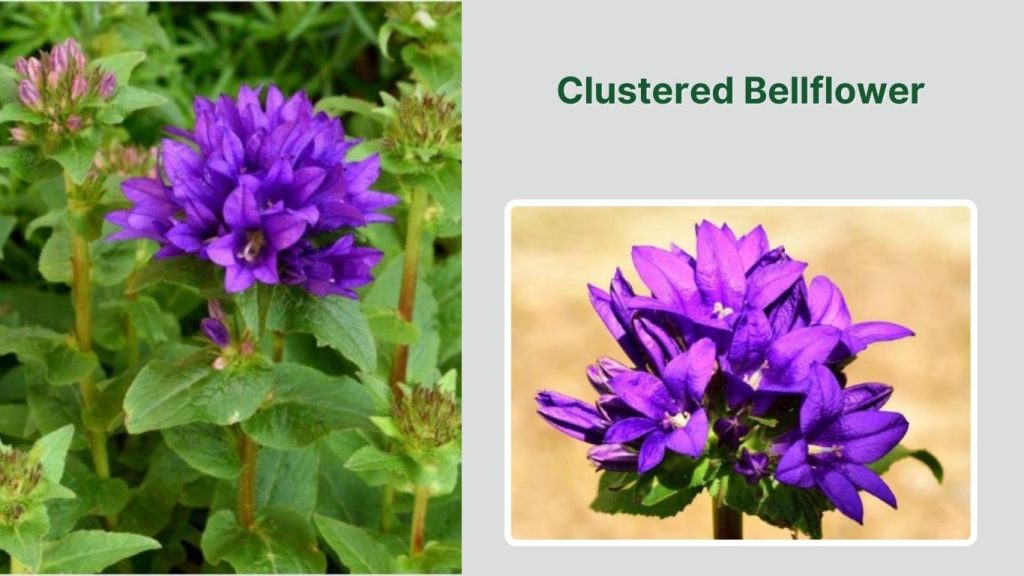
Clustered bellflower is a bold, upright species recognized for its dense heads of deep violet to purple flowers packed tightly at the tops of stiff stems. Native to Europe and Asia, it brings strong color and structure to wildflower plantings and traditional perennial borders.
Identification
- Upright, sturdy stems usually 12 to 24 inches tall
- Dense, rounded clusters of bell-shaped flowers at stem tips
- Rich purple, violet, or occasionally white blooms
- Broad, slightly hairy green leaves along the stem
- Compact flower heads that give the plant a bold, tufted look
Habitat and Natural Range
In the wild, clustered bellflower grows in open meadows, woodland edges, steppes, and grassy hillsides across Europe and temperate Asia. It prefers full sun to partial shade and well-drained soil, tolerating a range of conditions from dry grasslands to moist meadows.
Growth and Lifecycle
This species is a hardy perennial that emerges in spring and blooms from late spring into early summer. It spreads by underground rhizomes as well as seed, allowing it to form expanding colonies over time if left unmanaged.
Uses and Garden Value
Clustered bellflower is valued for mass plantings, naturalized gardens, and pollinator borders. Its dense flower heads provide a strong visual impact, and the nectar-rich blooms attract bees, butterflies, and other beneficial insects.
6. Serbian Bellflower (Campanula poscharskyana)

Serbian bellflower is a fast-spreading, low-growing species known for its carpets of starry, violet-blue flowers. Native to the mountainous regions of the Balkans, it is especially popular as a ground cover and wall plant because it trails beautifully over rocks, steps, and garden edges.
Identification
- Trailing or spreading stems forming dense mats
- Numerous star-shaped to bell-shaped flowers with pointed lobes
- Flower color typically violet-blue to lavender
- Small, heart-shaped to rounded green leaves
- Low growth habit, usually 4 to 8 inches tall
Habitat and Natural Range
In nature, Serbian bellflower grows on rocky cliffs, limestone crevices, and mountain slopes of the Balkan Peninsula. It thrives in sunny to lightly shaded sites with well-drained soil and tolerates both cool and moderately warm climates.
Growth and Lifecycle
This bellflower is a hardy perennial that spreads quickly by creeping stems and self-seeding. It blooms from late spring through much of summer, often creating a long-lasting floral carpet when grown in suitable conditions.
Uses and Garden Value
The Serbian bellflower is widely used for rock gardens, ground cover, hanging baskets, and wall gardens. Its cascading habit softens hard surfaces, while its abundant blooms provide nectar for pollinators and continuous visual interest.
7. Korean Bellflower (Campanula takesimana)

Korean bellflower is a distinctive and ornamental species admired for its inflated, lantern-like buds that open into spotted, drooping bells. Native to coastal regions of Korea, it stands out from many other bellflowers because of its glossy foliage and uniquely patterned flowers.
Identification
- Arching stems that typically grow 12 to 24 inches tall
- Drooping, balloon-like buds opening into bell-shaped flowers
- Creamy white to pale pink blooms often marked with purple spots inside
- Thick, glossy, heart-shaped green leaves
- Clump-forming habit with gently spreading growth
Habitat and Natural Range
In the wild, Korean bellflower grows along rocky seashores, cliffs, and forest edges of Korea. It prefers partial shade to full sun and moist, well-drained soil, making it well suited to woodland gardens and sheltered borders.
Growth and Lifecycle
This species is a hardy perennial that emerges in spring and blooms from early to mid-summer. It spreads slowly by rhizomes, forming tidy clumps that expand over time without becoming aggressively invasive.
Uses and Garden Value
The Korean bellflower is popular in ornamental borders, woodland gardens, and specialty plant collections. Its unusual flower shape adds curiosity and texture, while its shade tolerance and pollinator-friendly blooms increase its landscape versatility.
8. Milky Bellflower (Campanula lactiflora)

Milky bellflower is a tall, graceful bellflower species known for its large, airy sprays of soft, milky-blue to lavender flowers. Native to the Caucasus region and parts of the Middle East, it brings height, movement, and a cloud-like floral effect to summer gardens.
Identification
- Tall, upright stems often reaching 3 to 6 feet
- Loose, branched clusters of many small bell-shaped flowers
- Bloom colors ranging from milky blue to pale lavender or white
- Broad, slightly toothed green leaves along the stems
- Bushy, fountain-like growth habit
Habitat and Natural Range
In nature, milky bellflower grows in mountain meadows, forest clearings, and open slopes of the Caucasus and northern Iran. It prefers full sun to light shade and moist, well-drained soil, thriving in cooler summer climates.
Growth and Lifecycle
This is a hardy perennial that forms large clumps over time. It blooms in early to mid-summer, and deadheading can encourage a longer flowering period. Its strong root system supports tall flowering stems year after year.
Uses and Garden Value
Milky bellflower is valued for the back of borders, cottage gardens, and naturalistic plantings. Its tall, misty flower sprays attract bees and butterflies and blend beautifully with grasses and other summer perennials.
9. Creeping Bellflower (Campanula rapunculoides)

Creeping bellflower is a vigorous, spreading species known for its tall spikes of nodding, violet-blue bells and its ability to quickly colonize an area. Native to Europe and western Asia, it is admired for its beauty but also noted for its strong, persistent growth habit.
Identification
- Upright flowering stems usually 1.5 to 3 feet tall
- Rows of nodding, bell-shaped flowers along one side of the stem
- Deep blue to violet blooms with narrow, flared lobes
- Heart-shaped basal leaves with narrower upper leaves
- Spreading underground roots that allow rapid expansion
Habitat and Natural Range
In the wild, creeping bellflower grows in meadows, woodland margins, roadsides, and disturbed soils across Europe and Asia. It tolerates a wide range of conditions, from full sun to partial shade, and adapts easily to different soil types.
Growth and Lifecycle
This species is a hardy perennial that regrows from an extensive rhizome system. It blooms in early to mid-summer and spreads aggressively through underground shoots and seed, allowing it to form dense colonies over time.
Uses and Garden Considerations
Creeping bellflower is sometimes used in wildflower gardens and informal landscapes for its tall floral display. However, because of its invasive tendencies in many regions, it should be planted cautiously and managed to prevent unwanted spread.
10. Spotted Bellflower (Campanula punctata)
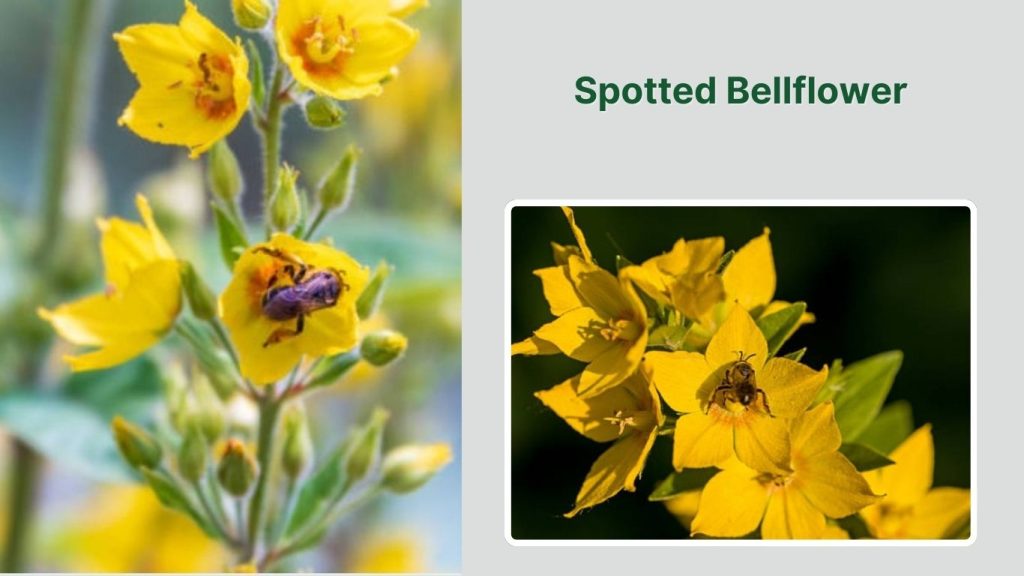
Spotted bellflower is an eye-catching species valued for its large, drooping bells that are often decorated with dark speckles inside. Native to East Asia, it adds a bold and exotic look to gardens with its inflated blooms and lush foliage.
Identification
- Arching stems usually growing 12 to 24 inches tall
- Large, drooping, tubular bell-shaped flowers
- Creamy white to pale pink blooms with purple or maroon spots inside
- Soft, fuzzy, heart-shaped leaves forming basal clumps
- Thick stems that support heavy, showy flowers
Habitat and Natural Range
In nature, spotted bellflower grows in woodland edges, forest clearings, and mountain meadows of Japan, Korea, and parts of China. It prefers partial shade and consistently moist, well-drained soil, though it can tolerate full sun in cooler climates.
Growth and Lifecycle
This species is a hardy perennial that spreads by creeping rhizomes. It blooms from late spring through early summer and may slowly form broad patches if left undisturbed, making it suitable for naturalized shade gardens.
Uses and Garden Value
Spotted bellflower is widely used in ornamental borders, woodland gardens, and shade plantings. Its unusual spotted flowers attract pollinators and provide strong visual interest among ferns, hostas, and other shade-loving plants.
11. Tussock Bellflower (Campanula carica)
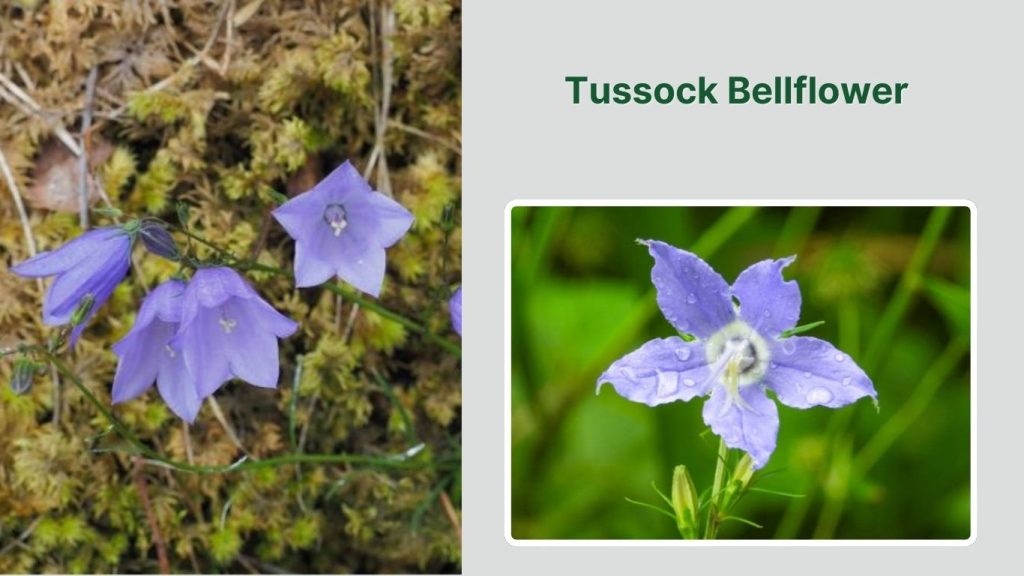
Tussock bellflower is a compact, tuft-forming species admired for its neat growth habit and soft blue, starry bell-shaped flowers. Native to parts of southeastern Europe and western Asia, it is well suited to rock gardens and small spaces where controlled, low growth is desired.
Identification
- Dense, cushion-like clumps forming low mounds
- Small, open bell-shaped to star-shaped blue flowers
- Short flowering stems rising just above the foliage
- Narrow, slightly toothed green leaves
- Overall tidy, tufted appearance
Habitat and Natural Range
In the wild, tussock bellflower grows on rocky slopes, alpine meadows, and open mountain habitats. It prefers sunny positions and sharply drained soil, tolerating cooler temperatures and relatively dry conditions.
Growth and Lifecycle
This species is a hardy perennial that slowly expands from its base. It blooms in late spring and early summer, producing a concentrated flush of flowers. Its slow spread and compact habit make it easy to manage in gardens.
Uses and Garden Value
Tussock bellflower is ideal for rock gardens, troughs, alpine beds, and edging. Its low, rounded form provides contrast to taller plants, while its delicate flowers support pollinators and add subtle seasonal color.
12. Rampion Bellflower (Campanula rapunculus)

Rampion bellflower is a tall, traditional bellflower species once widely cultivated as a vegetable as well as an ornamental plant. Native to Europe, it is known for its elegant spikes of violet-blue bells and its historical use as an edible root and leafy green.
Identification
- Upright flowering stems usually growing 2 to 4 feet tall
- Long, narrow clusters of nodding, bell-shaped flowers
- Blue to violet blooms opening gradually from bottom to top
- Basal rosettes of elongated, slightly toothed green leaves
- Slender, straight stems with evenly spaced flowers
Habitat and Natural Range
In the wild, rampion bellflower grows in dry meadows, grassy slopes, open woodlands, and along roadsides throughout Europe. It prefers sunny locations with light, well-drained soil and adapts well to disturbed ground.
Growth and Lifecycle
Rampion bellflower is typically biennial. In the first year, it forms a leafy rosette and develops its thick taproot. In the second year, it produces a tall flowering stem, sets seed, and completes its life cycle.
Uses and Garden Value
Rampion bellflower is valued for heritage gardens, wildflower meadows, and cottage-style plantings. Its tall, elegant flower spikes attract bees and butterflies, while its historical culinary role adds unique interest for educational and traditional gardens.
13. Chimney Bellflower (Campanula pyramidalis)

Chimney bellflower is a dramatic, architectural species known for its towering, pyramid-shaped spikes densely covered in starry bellflowers. Native to the Adriatic region of southern Europe, it is one of the tallest bellflowers and creates a strong vertical focal point in gardens.
Identification
- Tall, upright flower spikes often reaching 4 to 7 feet
- Numerous star-shaped to bell-shaped blue or white flowers
- Rigid central stem with many short side branches
- Large, toothed basal leaves with smaller upper leaves
- Distinct pyramid or chimney-like overall form
Habitat and Natural Range
In the wild, chimney bellflower grows on rocky cliffs, stone walls, and mountainous limestone regions near the Adriatic Sea. It thrives in sunny locations with well-drained soil and tolerates dry, rocky conditions once established.
Growth and Lifecycle
This species is usually biennial or short-lived perennial. It forms a leaf rosette in its first year and sends up a massive flowering spike in its second year. After flowering and seed production, the original plant often declines.
Uses and Garden Value
Chimney bellflower is used as a dramatic specimen plant in borders, cottage gardens, and architectural plantings. Its tall floral spires attract pollinators and add height, structure, and a striking silhouette to summer landscapes.
14. Nettle-leaved Bellflower (Campanula trachelium)

Nettle-leaved bellflower is a robust woodland bellflower recognized for its rough, nettle-like leaves and large, open purple-blue bells. Native to much of Europe, it brings a natural, slightly wild character to shaded gardens and woodland-style plantings.
Identification
- Upright, slightly hairy stems growing 1.5 to 3 feet tall
- Broad, toothed leaves resembling stinging nettle foliage
- Large, open bell-shaped flowers in violet to deep blue shades
- Blooms carried in loose clusters along the upper stems
- Strong, coarse texture compared to many other bellflowers
Habitat and Natural Range
In nature, nettle-leaved bellflower grows in deciduous woodlands, hedgerows, forest edges, and shaded clearings throughout Europe. It prefers partial shade and moist, well-drained, humus-rich soils.
Growth and Lifecycle
This is a hardy perennial that returns each spring from its root system. It blooms from early to mid-summer and spreads gradually by seed, often forming natural-looking colonies in suitable woodland conditions.
Uses and Garden Value
Nettle-leaved bellflower is valued in woodland gardens, cottage borders, and wildlife-friendly landscapes. Its sturdy stems and nectar-rich flowers attract bees, while its shade tolerance makes it useful where many flowering plants struggle.
15. Throatwort Bellflower (Campanula trachelium subsp. trachelium / Campanula rapunculoides group)

Throatwort bellflower is a traditional name used for robust bellflower types known for their large, open-throated blooms and strong upright growth. Often associated with old European meadow species, it is admired for its bold flowers and long history in herbal and ornamental gardens.
Identification
- Upright stems typically 1.5 to 3 feet tall
- Large, open bell-shaped flowers with wide “throats”
- Flower colors ranging from blue to violet-purple
- Coarse green leaves with toothed edges
- Blooms arranged along the upper portion of the stem
Habitat and Natural Range
Throatwort bellflowers occur naturally in European meadows, woodland edges, hedgerows, and grassy slopes. They prefer sunny to partially shaded habitats with moderately fertile, well-drained soil.
Growth and Lifecycle
These bellflowers are hardy perennials that regrow each year from established root systems. They usually bloom in early to mid-summer and spread gradually by seed and underground growth, forming loose natural colonies.
Uses and Garden Value
Throatwort bellflowers are used in traditional cottage gardens, wildflower plantings, and naturalized borders. Their large, open blooms attract bees and other pollinators and add a classic wildflower look to landscapes.
16. Dalmatian Bellflower (Campanula portenschlagiana)

Dalmatian bellflower is a low-growing, spreading bellflower famous for its dense mats of small, starry purple-blue flowers. Native to the Dalmatian Mountains of Croatia, it is especially valued for covering walls, rocks, and garden edges with long-lasting color.
Identification
- Low, trailing stems forming tight groundcover mats
- Abundant small, star-shaped to bell-shaped flowers
- Deep violet-blue to purple blooms
- Small, rounded to heart-shaped green leaves
- Compact growth habit, usually under 8 inches tall
Habitat and Natural Range
In the wild, Dalmatian bellflower grows on rocky cliffs, limestone crevices, and mountain slopes of the Dalmatian region. It prefers sunny to lightly shaded sites with well-drained soil and tolerates drought once established.
Growth and Lifecycle
This species is a hardy perennial that spreads by creeping stems and self-seeding. It blooms heavily from late spring through summer, often creating a solid carpet of flowers.
Uses and Garden Value
Dalmatian bellflower is widely used for rock gardens, wall plantings, borders, and containers. Its trailing habit softens hard surfaces, while its long flowering period and pollinator-friendly blooms make it a favorite groundcover bellflower.
17. Trailing Bellflower (Campanula cochleariifolia)

Trailing bellflower, also known as fairy’s thimble, is a delicate, mat-forming bellflower admired for its small, nodding blue bells and fine-textured foliage. Native to the mountains of Europe, it is especially popular in alpine gardens and rockeries.
Identification
- Slender, trailing stems forming low mats
- Small, nodding, bell-shaped flowers in soft blue shades
- Tiny, rounded green leaves creating a dense carpet
- Very low growth habit, often only 3 to 6 inches tall
- Fine, airy overall appearance
Habitat and Natural Range
In nature, trailing bellflower grows on alpine slopes, rocky ledges, and mountain grasslands across Europe. It prefers cool conditions, good drainage, and sunny to lightly shaded sites.
Growth and Lifecycle
This species is a hardy perennial that slowly spreads to form neat mats. It blooms in late spring and early summer, often producing a charming display of delicate flowers just above the foliage.
Uses and Garden Value
Trailing bellflower is ideal for rock gardens, troughs, crevice gardens, and container plantings. Its miniature size, graceful blooms, and pollinator-friendly nature make it perfect for small-scale and alpine-style landscapes.
FAQs
What is a bellflower plant?
Bellflower is the common name for plants in the genus Campanula. They are known for their bell-shaped or star-shaped flowers, which usually bloom in shades of blue, purple, white, or pink. Bellflowers include annuals, biennials, and perennials.
Are bellflowers easy to grow?
Most bellflowers are considered easy to grow. They adapt well to many climates, prefer well-drained soil, and grow in full sun to partial shade. Many species are hardy perennials that return each year with minimal care.
Do bellflowers attract pollinators?
Yes, bellflowers are excellent pollinator plants. Their nectar-rich flowers attract bees, butterflies, and other beneficial insects. This makes them valuable additions to wildlife-friendly gardens and natural landscapes.
Are bellflowers invasive?
Some species, such as creeping bellflower, can spread aggressively through underground roots and seeds. Other types are well-behaved and slow-growing. It is important to choose the species carefully and manage spreading types.
When do bellflowers usually bloom?
Most bellflowers bloom from late spring through summer. Some low-growing alpine types bloom earlier, while taller species may continue into late summer, especially if spent flowers are regularly removed.