





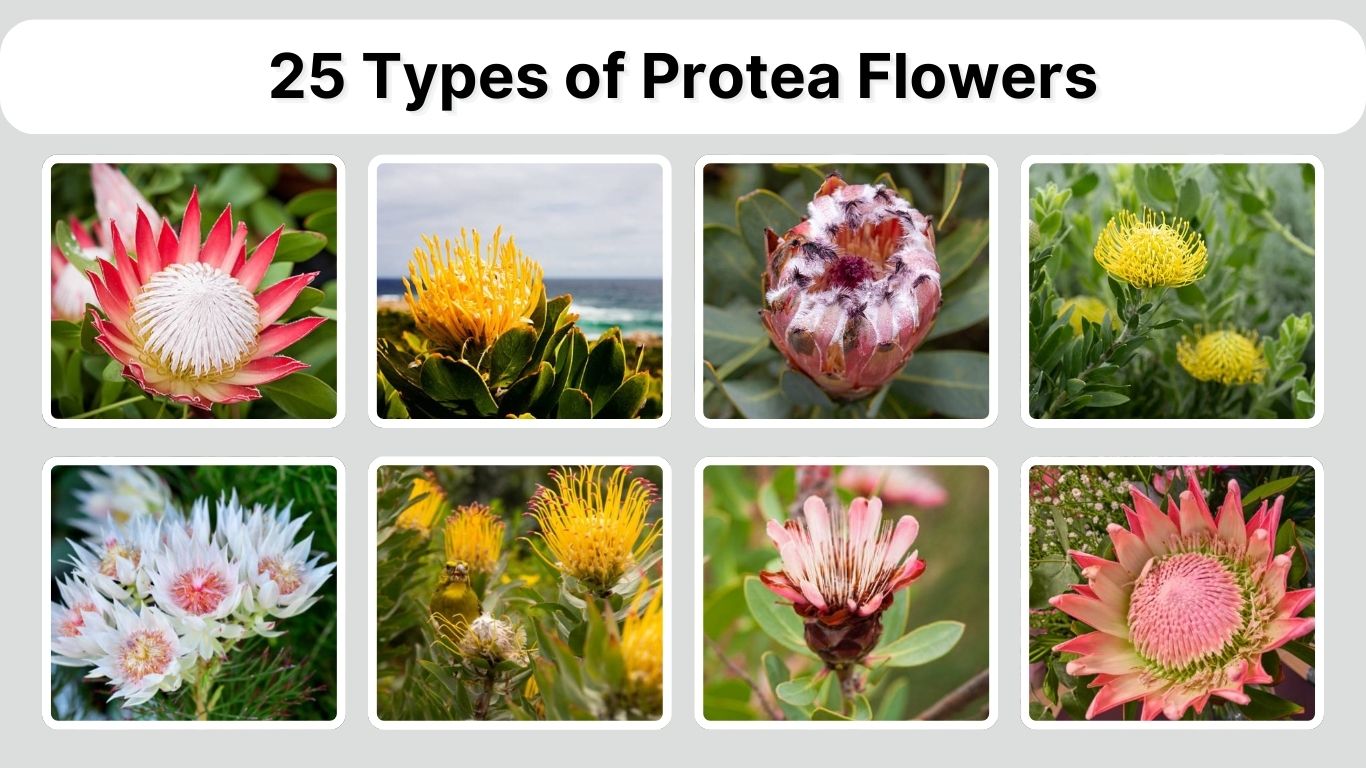
Protea flowers are among the most ancient and visually striking flowering plants in the world, admired for their bold shapes, rich colors, and remarkable adaptability. Native mainly to South Africa and parts of Australia, these flowers thrive in harsh, nutrient-poor environments and have evolved extraordinary forms. From the iconic King Protea to delicate, feathery varieties, proteas are widely loved in gardens and floral design for their long-lasting blooms and dramatic appearance.
1. King Protea (Protea cynaroides)
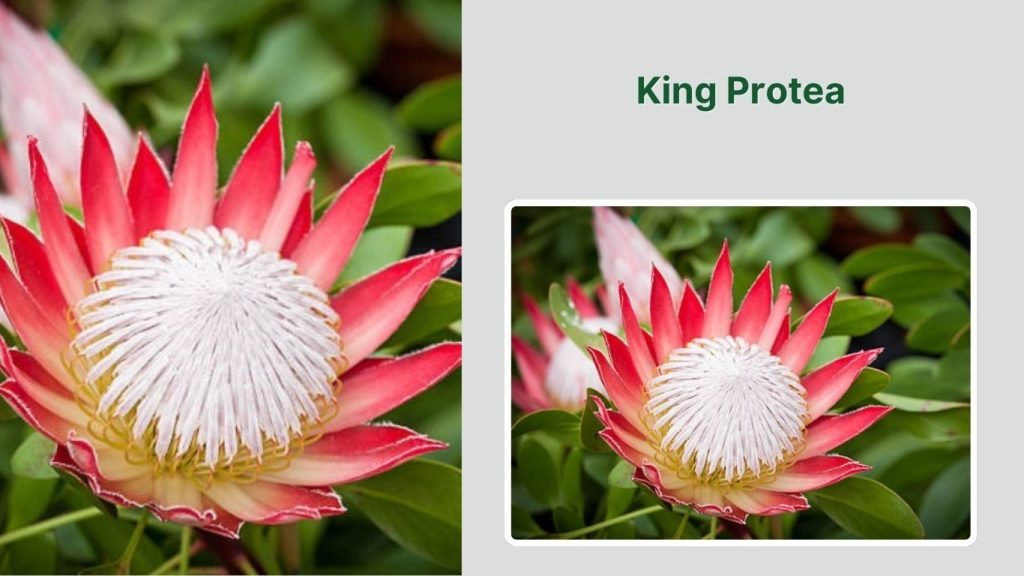
The King Protea is the national flower of South Africa and one of the most spectacular members of the Proteaceae family. It is famous for its enormous, crown-like blooms, which can reach up to 12 inches across. With thick, leathery leaves and striking pink, cream, or silvery bracts, this flower is widely cultivated for ornamental gardens and the global cut-flower industry.
Identification
- Large, bowl-shaped flower heads (up to 30 cm wide)
- Stiff, thick, leathery green leaves
- Showy pink, pale red, or creamy bracts surrounding a fuzzy central dome
- Strong woody stems adapted to dry, windy conditions
- Evergreen shrub growth form
Natural Habitat
King Protea is native to the fynbos biome of South Africa, where it grows on mountain slopes and coastal plains. It thrives in nutrient-poor, acidic, well-drained soils and is highly adapted to regions with winter rainfall and dry summers. Fire plays an important ecological role in its natural habitat, helping trigger seed release and regeneration.
Blooming Season and Growth
Flowering usually occurs from late winter through spring, though cultivated plants may bloom at different times depending on climate. King Protea grows as a slow-developing evergreen shrub, often reaching 3 to 6 feet in height. It prefers full sun, excellent air circulation, and minimal root disturbance to produce strong stems and large flower heads.
Uses and Symbolism
King Protea is widely used in floral arrangements because of its long-lasting blooms and dramatic appearance. Symbolically, it represents change, courage, and diversity, reflecting its bold form and resilience in harsh environments. It is also an iconic plant in landscaping, botanical collections, and eco-tourism focused on South African flora.
2. Queen Protea (Protea magnifica)
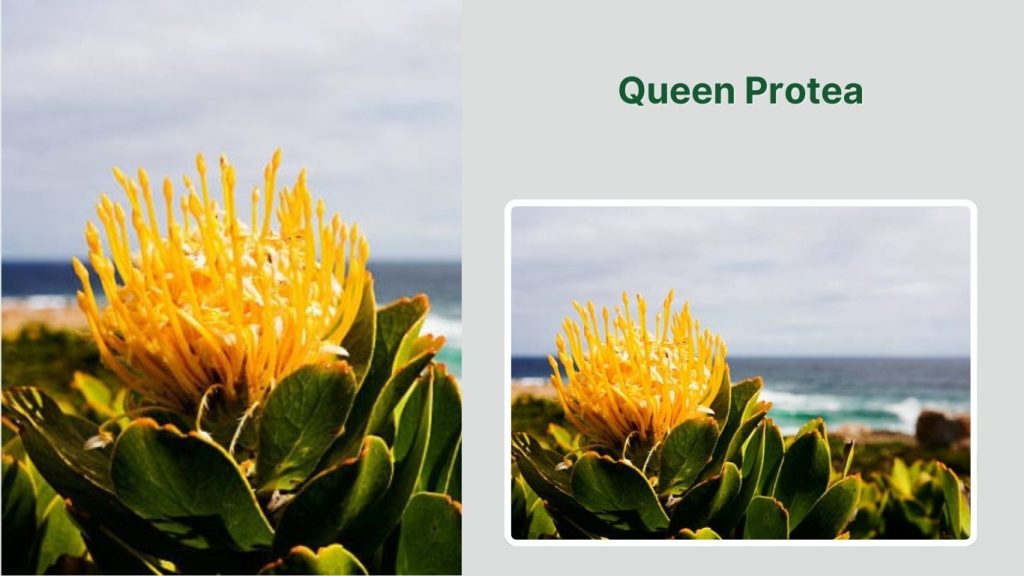
The Queen Protea is admired for its large, rounded flower heads and soft, silvery-pink bracts that give the bloom a regal appearance. It is closely related to the King Protea but is generally more compact and colder-tolerant. This species is popular in both botanical gardens and commercial flower farming due to its long-lasting blooms and elegant structure.
Identification
- Large, globe-shaped flower heads
- Silvery-pink to deep rose bracts with a soft texture
- Thick, oval, blue-green leaves
- Upright woody shrub growth habit
- Prominent central dome of tightly packed florets
Natural Habitat
Queen Protea is native to the mountainous regions of South Africa, especially in areas with cool winters and well-drained sandstone soils. It commonly grows on slopes and open fynbos landscapes where sunlight is abundant and competition from taller plants is limited. The species is well adapted to fire-prone ecosystems.
Blooming Season and Growth
This protea usually blooms from late winter to early summer. It grows as a medium-sized evergreen shrub, often reaching 4 to 7 feet tall. The plant prefers full sun, low-nutrient soil, and moderate watering, with excellent drainage being essential for healthy root development and flower production.
Uses and Symbolism
Queen Protea is highly valued in the cut-flower industry for its symmetrical shape and long vase life. Symbolically, it is associated with grace, beauty, and strength. It is also used in ornamental landscaping, especially in Mediterranean-style and drought-tolerant gardens.
3. Sugarbush Protea (Protea repens)
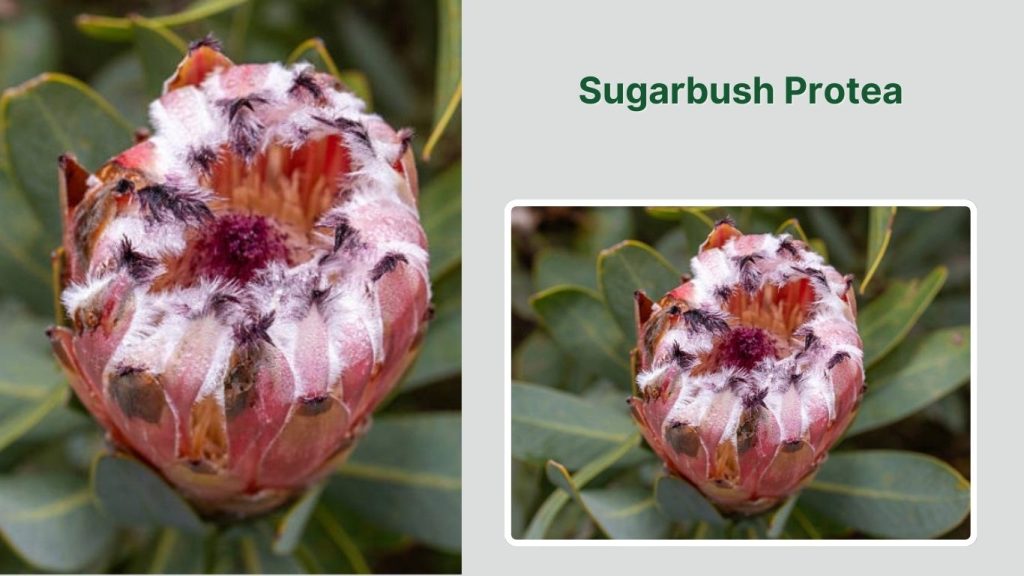
The Sugarbush Protea is one of the most widespread and adaptable protea species, known for its rich nectar and elongated flower heads. Historically, its sweet nectar was used by indigenous people as a natural syrup, giving rise to its common name. The flowers range in color from creamy white to deep crimson.
Identification
- Cylindrical to goblet-shaped flower heads
- Bracts colored pink, red, or creamy white
- Narrow, leathery, elongated leaves
- Woody evergreen shrub form
- Abundant nectar attracting birds and insects
Natural Habitat
Sugarbush Protea is native to coastal and inland regions of South Africa, growing in sandy plains, mountain slopes, and open shrublands. It thrives in fynbos ecosystems with winter rainfall and nutrient-poor soils. Its strong fire-resilience allows it to regenerate naturally after wildfires.
Blooming Season and Growth
Blooming typically occurs from autumn through spring, making it one of the longest-flowering proteas. The plant grows as a tall shrub or small tree, often reaching 6 to 10 feet in height. It requires full sun, good airflow, and minimal fertilizer to thrive successfully.
Uses and Symbolism
Sugarbush Protea is important both ecologically and commercially. It is widely cultivated for cut flowers and also planted to attract birds such as sugarbirds and sunbirds. Symbolically, it represents vitality, endurance, and natural abundance due to its rich nectar and extended blooming season.
4. Pincushion Protea (Leucospermum cordifolium)
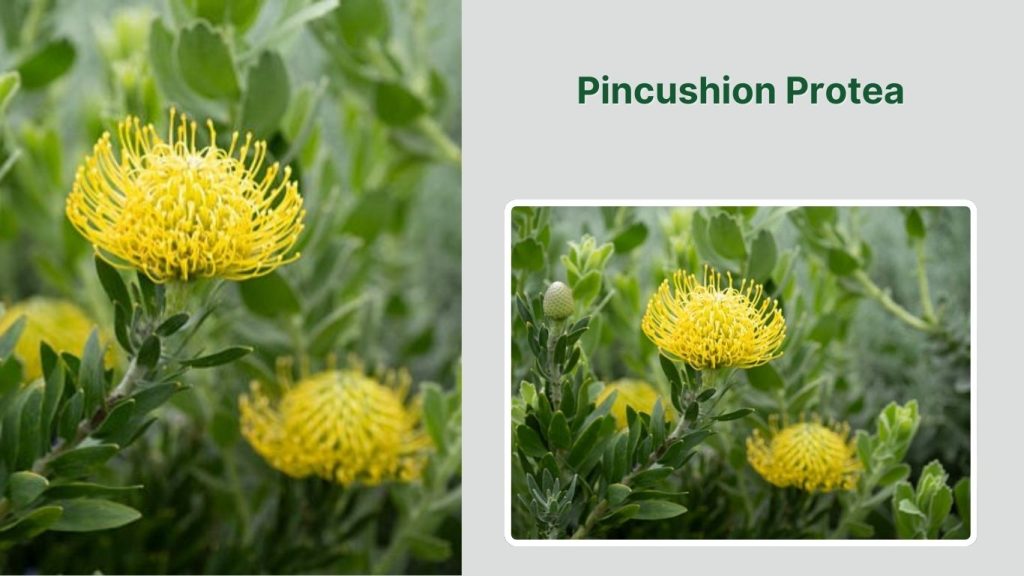
The Pincushion Protea is famous for its striking, spiky blooms that resemble colorful pincushions filled with pins. Although botanically classified under Leucospermum, it is commonly grouped with proteas because it belongs to the Proteaceae family. Its bright orange, yellow, and red flowers make it one of the most eye-catching protea relatives in ornamental gardens.
Identification
- Rounded, pincushion-shaped flower heads
- Long, protruding styles that create a spiky look
- Bright orange, red, or yellow coloration
- Glossy green, oval leaves with pointed tips
- Dense, spreading shrub form
Natural Habitat
Pincushion Protea is native to the Western Cape of South Africa, where it grows in coastal scrublands and rocky slopes. It prefers sandy, well-drained soils and open, sunny locations. In the wild, it is strongly associated with bird pollinators, especially sunbirds, which feed on its abundant nectar.
Blooming Season and Growth
Flowering mainly occurs from late winter through spring. The plant grows as a low to medium evergreen shrub, usually reaching 3 to 6 feet tall. It thrives in full sun, tolerates drought well once established, and is commonly used in Mediterranean-style and xeriscape gardens.
Uses and Symbolism
Pincushion Protea is highly prized in the cut-flower industry due to its unusual shape and long vase life. Symbolically, it is often associated with uniqueness, energy, and creativity. It is also widely planted in landscapes to attract birds and beneficial insects.
5. Blushing Bride Protea (Serruria florida)
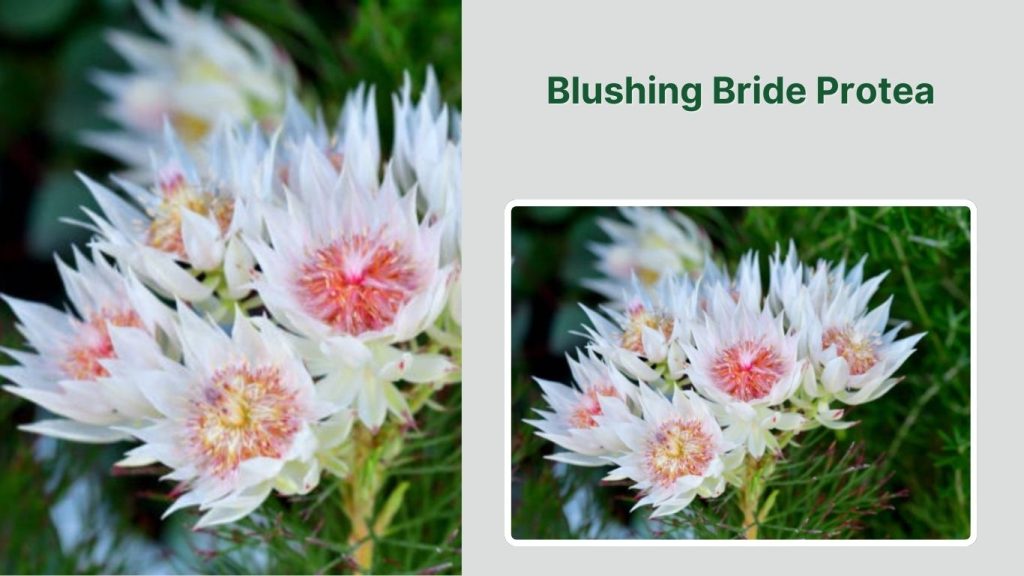
The Blushing Bride Protea is delicate and elegant, known for its soft white to pale pink, feathery flower clusters. Unlike the bold, cone-shaped proteas, this species produces finely textured blooms that give it a light, romantic appearance. It is one of the most popular protea relatives in bridal bouquets and floral design.
Identification
- Soft, fluffy, rounded flower heads
- White to pale pink coloration
- Fine, needle-like leaves creating a feathery look
- Slender, branching woody stems
- Compact shrub growth habit
Natural Habitat
Blushing Bride Protea is native to the Cape Floristic Region of South Africa. It grows in sandy, acidic soils within fynbos vegetation, often on slopes and open plains. The species depends on seasonal fires to clear competing vegetation and stimulate regeneration.
Blooming Season and Growth
This protea relative typically flowers from winter through early summer. It forms a small to medium shrub, usually 3 to 5 feet tall. It prefers full sun, excellent drainage, and gentle watering, making it well suited to coastal and Mediterranean-type climates.
Uses and Symbolism
Blushing Bride Protea is strongly associated with weddings and celebrations, symbolizing purity, new beginnings, and gentle love. It is widely cultivated for floral arrangements and decorative gardens, where its soft texture contrasts beautifully with bolder protea species.
6. Feather Protea (Protea nitida)
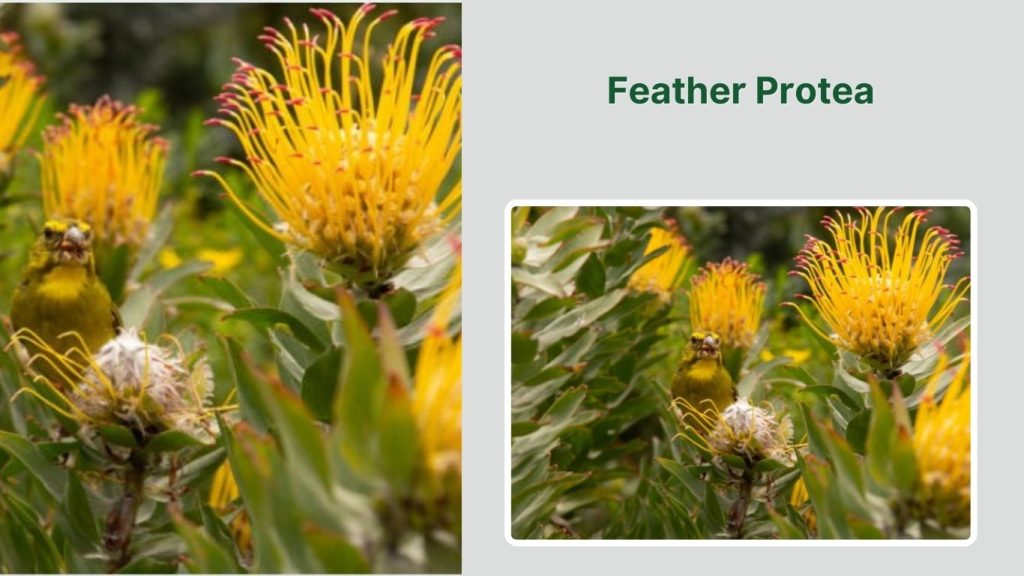
The Feather Protea is a tall, tree-like protea known for its slender leaves and softly textured flower heads. It is one of the few proteas that can grow into a small tree, giving it a distinctive appearance compared to shrub-forming species. Its flowers are usually creamy white to pale pink and blend beautifully into natural landscapes.
Identification
- Oval to cone-shaped flower heads
- Cream, white, or pale pink bracts
- Narrow, feather-like leathery leaves
- Tall, woody growth form, sometimes tree-like
- Thick trunk with spreading branches
Natural Habitat
Feather Protea is native to mountainous and forest-edge regions of South Africa. It often grows on rocky slopes and well-drained hillsides where rainfall is moderate and soils are poor in nutrients. The species is adapted to fire-affected environments, resprouting from its base after burns.
Blooming Season and Growth
Flowering usually occurs from late winter to spring. Feather Protea is slow-growing but long-lived, capable of reaching 15 to 25 feet in height under ideal conditions. It prefers full sun, cool air movement, and deep, well-drained soils for strong root development.
Uses and Symbolism
Feather Protea is valued for large landscape plantings, restoration projects, and specialty cut-flower markets. Symbolically, it represents endurance and stability because of its long lifespan and ability to survive harsh mountain climates.
7. Black Beard Protea (Protea lepidocarpodendron)
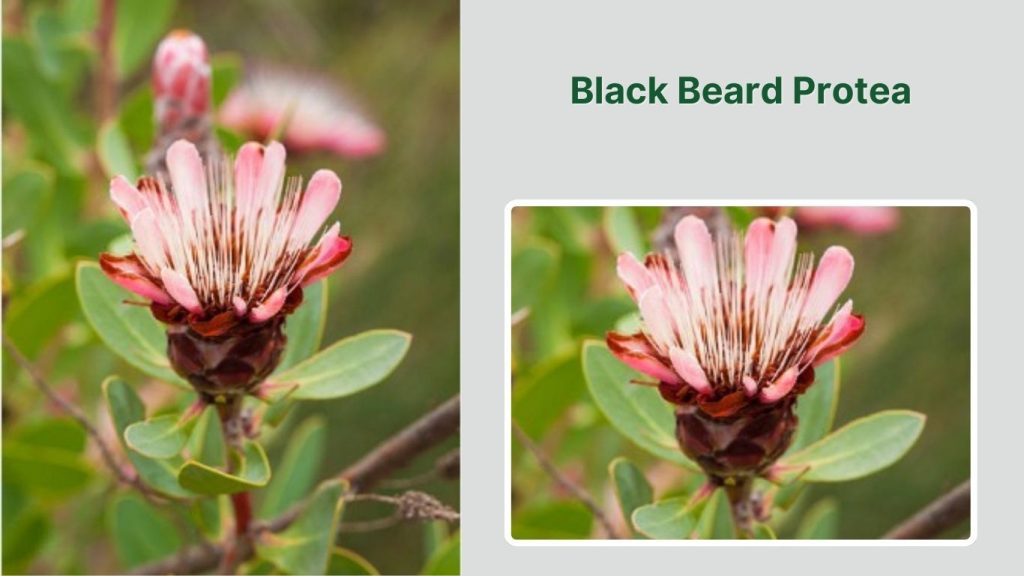
The Black Beard Protea is recognized for its dramatic dark, hairy flower centers that contrast sharply with its pale outer bracts. This unique appearance gives the flower a bold, almost exotic look. It is less common in cultivation but highly prized by collectors and native-plant enthusiasts.
Identification
- Rounded flower heads with dark, hairy central florets
- Cream to pink outer bracts
- Thick, leathery, elongated leaves
- Upright, woody shrub structure
- Strong contrast between center and bracts
Natural Habitat
Black Beard Protea grows naturally in South Africa’s fynbos regions, especially in sandstone soils on mountain slopes. It favors open, sunny habitats with good air circulation and periodic fires, which help maintain healthy populations and reduce competition.
Blooming Season and Growth
This species typically flowers from winter through early spring. It forms a medium-sized evergreen shrub, usually growing 4 to 8 feet tall. It requires excellent drainage, full sunlight, and low-phosphorus soils to grow successfully.
Uses and Symbolism
Black Beard Protea is used mainly in specialty floral arrangements and botanical collections. Its striking color contrast makes it a symbol of mystery, individuality, and strength, standing out clearly among lighter-colored protea species.
8. Pink Ice Protea (Protea neriifolia × susannae)
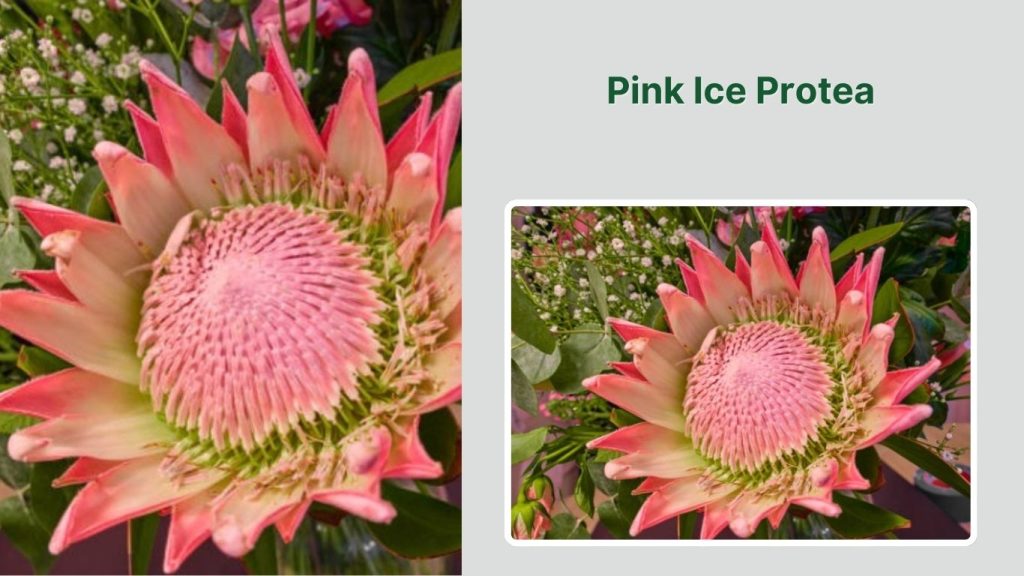
The Pink Ice Protea is a popular hybrid protea admired for its soft pink bracts edged with silvery tones. It is widely grown in gardens and flower farms because of its reliable blooming, strong stems, and long-lasting flowers. This hybrid combines beauty with resilience, making it one of the most commercially successful proteas.
Identification
- Large, oval flower heads
- Soft pink bracts with silvery edges
- Narrow, leathery, lance-shaped leaves
- Strong, upright woody stems
- Compact to medium shrub form
Natural Habitat
As a cultivated hybrid, Pink Ice Protea does not occur naturally in the wild. However, its parent species originate from South Africa’s fynbos biome. It thrives in climates similar to its native relatives, especially regions with cool, wet winters and warm, dry summers.
Blooming Season and Growth
Pink Ice Protea typically blooms from autumn through spring. It grows as a dense evergreen shrub, often reaching 4 to 6 feet tall. The plant prefers full sun, excellent drainage, and low-nutrient, acidic soils to produce high-quality blooms.
Uses and Symbolism
Pink Ice Protea is one of the most important proteas in the international cut-flower trade. It symbolizes admiration, elegance, and gentle strength. It is also widely used in ornamental landscaping and decorative bouquets due to its consistent shape and color.
9. White Crown Protea (Protea lacticolor)
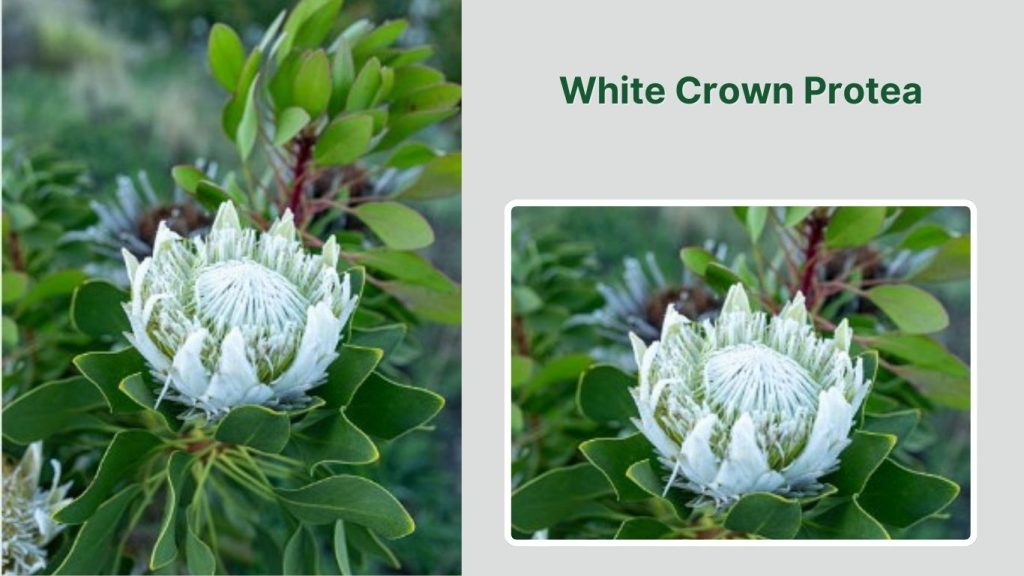
The White Crown Protea is known for its creamy-white bracts and elegant, crown-like flower form. It produces large, attractive blooms that stand out beautifully against its dark green foliage. This species is valued both for naturalistic garden planting and for refined floral arrangements.
Identification
- Large, rounded flower heads
- Creamy white to pale blush bracts
- Thick, leathery, oval leaves
- Upright evergreen shrub habit
- Prominent central dome of florets
Natural Habitat
White Crown Protea is native to South Africa’s Cape region, where it grows in well-drained mountain soils and open fynbos vegetation. It thrives in areas with cool winters, moderate rainfall, and frequent sunlight, often occupying slopes and elevated plains.
Blooming Season and Growth
Flowering usually occurs from late winter into spring. The shrub typically grows 4 to 7 feet tall and develops a strong, woody structure. It requires full sun exposure, excellent drainage, and low-phosphorus soils for healthy growth.
Uses and Symbolism
White Crown Protea is popular in wedding floristry and formal garden designs. It symbolizes purity, dignity, and new beginnings. Its light coloration and refined shape make it a favorite for elegant floral compositions and botanical collections.
10. Red Ice Protea (Protea neriifolia × susannae ‘Red’)
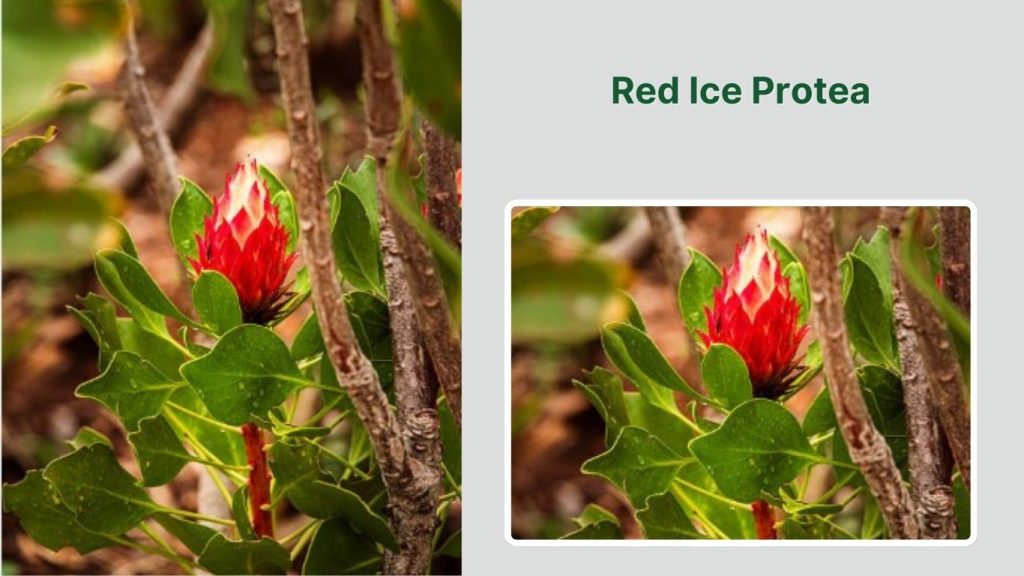
The Red Ice Protea is a striking hybrid protea valued for its deep rose to crimson-red bracts and strong, upright stems. It is closely related to Pink Ice Protea but distinguished by its richer coloration and slightly bolder appearance. This variety is widely cultivated for both garden use and the commercial cut-flower market.
Identification
- Large, oval to goblet-shaped flower heads
- Deep pink to red bracts with silvery margins
- Long, narrow, leathery leaves
- Thick, sturdy woody stems
- Compact, well-branched shrub habit
Natural Habitat
Red Ice Protea is a cultivated hybrid and does not occur naturally in the wild. Its parent species originate from South Africa’s fynbos biome, which is characterized by nutrient-poor, acidic soils and seasonal rainfall. It performs best in similar Mediterranean-type climates.
Blooming Season and Growth
This protea blooms mainly from autumn through spring. It grows into a medium evergreen shrub, commonly 4 to 6 feet tall. Full sun, excellent air circulation, and fast-draining soil are essential for healthy growth and high-quality flower production.
Uses and Symbolism
Red Ice Protea is a favorite in bold floral arrangements due to its vivid color and long vase life. It symbolizes passion, strength, and admiration, making it a popular choice for statement bouquets and ornamental garden displays.
11. Venus Protea (Protea compacta)
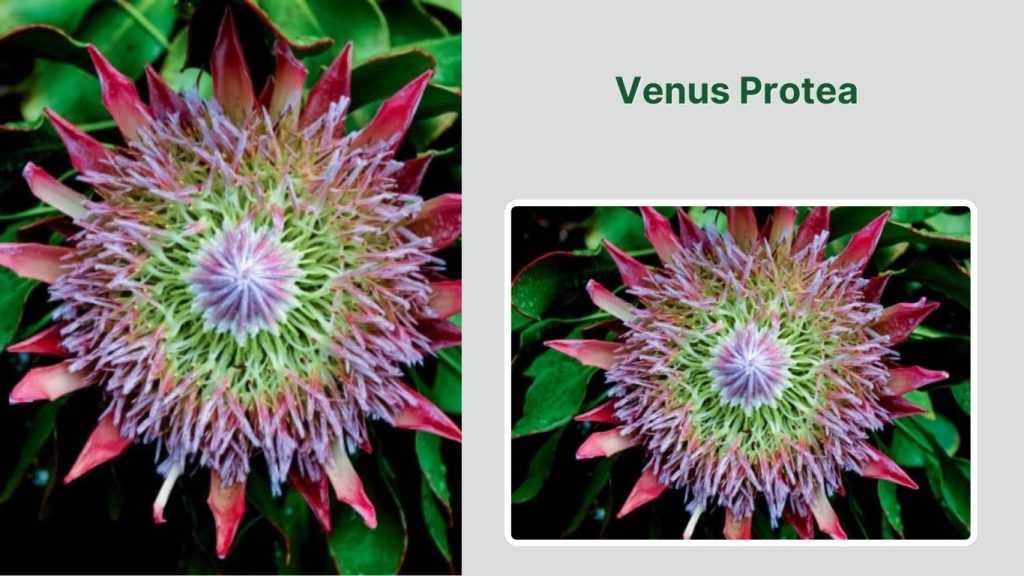
The Venus Protea is admired for its neatly shaped flower heads and soft pink to creamy bracts. Compared to larger proteas, it produces more compact blooms and a denser growth habit, making it especially attractive for smaller gardens and container-friendly landscapes.
Identification
- Rounded, medium-sized flower heads
- Pale pink, cream, or blush-colored bracts
- Thick, oval, leathery leaves
- Dense, compact shrub form
- Prominent central floral dome
Natural Habitat
Venus Protea is native to the Western Cape region of South Africa. It naturally grows in sandy, well-drained soils within fynbos vegetation, often in coastal plains and low mountain slopes. The species is adapted to full sunlight and periodic natural fires.
Blooming Season and Growth
Flowering usually occurs from late winter through early summer. Venus Protea forms a low to medium shrub, typically 3 to 5 feet tall. It prefers full sun exposure, minimal fertilization, and excellent drainage for healthy blooming.
Uses and Symbolism
Venus Protea is widely used in decorative gardens and floral design due to its symmetrical shape and soft coloring. It symbolizes beauty, harmony, and balance and is frequently chosen for elegant floral arrangements and refined landscape designs.
12. Scarlet Ribbon Protea (Protea laurifolia)
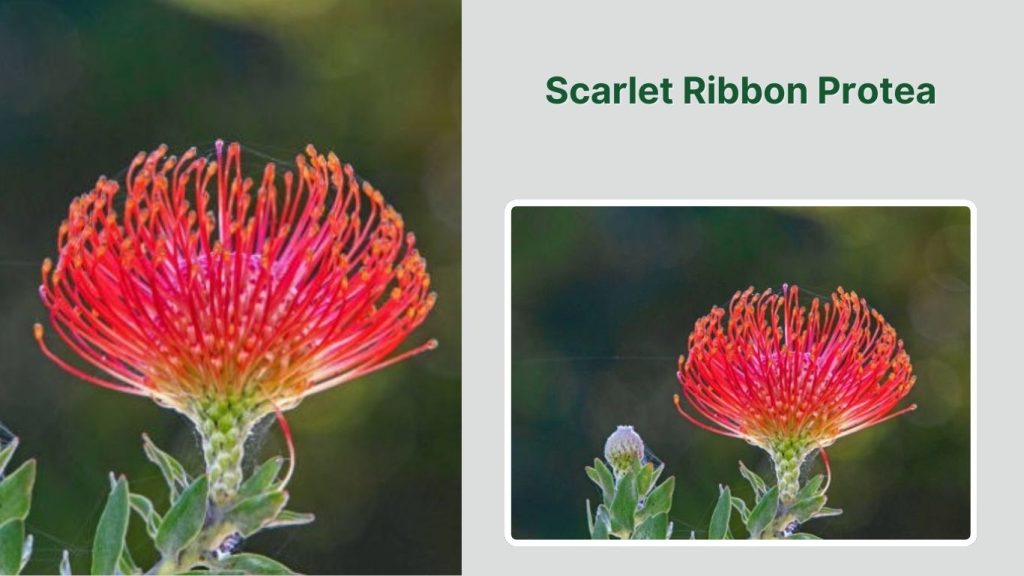
The Scarlet Ribbon Protea is known for its elongated flower heads and dramatic red bracts that often appear ribbon-like when in full bloom. This elegant species has a more upright and slender look compared to round-headed proteas, making it especially distinctive in both wild landscapes and cultivated gardens.
Identification
- Tall, elongated flower heads
- Deep red to crimson bracts
- Long, narrow, leathery leaves
- Upright woody shrub form
- Smooth, strong flowering stems
Natural Habitat
Scarlet Ribbon Protea is native to mountainous and coastal areas of South Africa. It grows on rocky slopes and sandy flats within the fynbos biome, where soils are acidic, nutrient-poor, and well drained. The plant is adapted to fire-prone environments and open sunlight exposure.
Blooming Season and Growth
This species usually flowers from winter through spring. It grows as a tall evergreen shrub, commonly reaching 5 to 8 feet in height. It prefers full sun, free-draining soils, and good air movement to support healthy flowering.
Uses and Symbolism
Scarlet Ribbon Protea is valued for tall floral arrangements and bold garden plantings. Its vivid color symbolizes passion, vitality, and transformation, making it popular in dramatic bouquets and focal landscape designs.
13. Little Prince Protea (Protea compacta ‘Little Prince’)
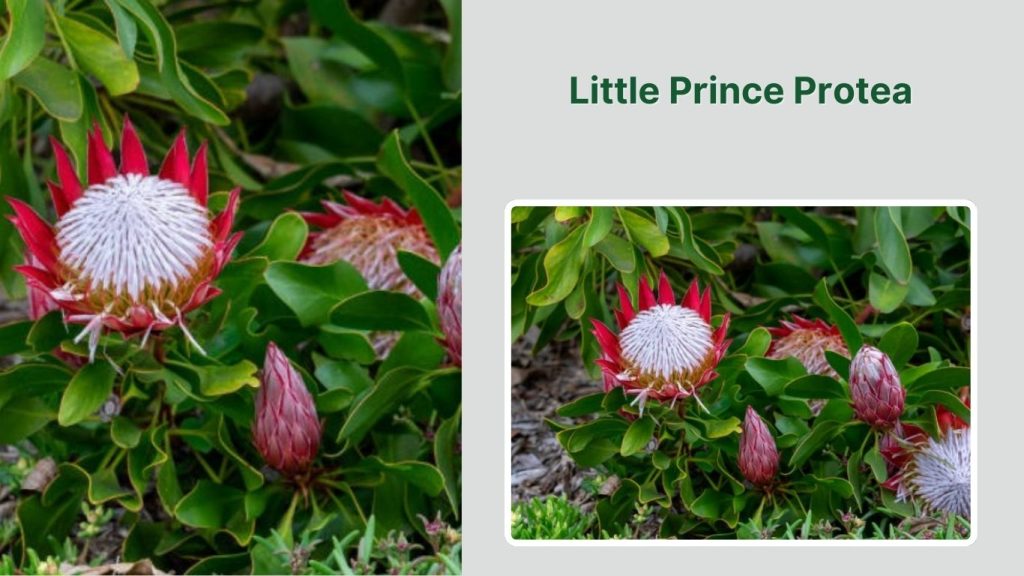
The Little Prince Protea is a compact cultivar admired for its smaller, perfectly shaped blooms and dense growth habit. It produces soft pink flower heads that resemble miniature versions of larger king proteas, making it ideal for limited spaces and ornamental container planting.
Identification
- Small to medium rounded flower heads
- Soft pink to blush-colored bracts
- Thick, oval, leathery leaves
- Compact, bushy shrub structure
- Short, sturdy flowering stems
Natural Habitat
As a cultivated variety, Little Prince Protea is not found naturally in the wild. Its parent species originate from South Africa’s fynbos regions, where plants grow in sandy, acidic, well-drained soils and open, sunny environments.
Blooming Season and Growth
Little Prince Protea blooms mainly from late winter into spring. It remains relatively small, usually 2.5 to 4 feet tall. The plant requires full sun, excellent drainage, and low-nutrient soil to maintain its compact form and consistent flowering.
Uses and Symbolism
Little Prince Protea is popular for patio gardens, decorative containers, and floral design. It symbolizes charm, delicacy, and refined beauty, making it a favorite choice for soft-toned arrangements and small-space landscapes.
14. Carnivora Protea (Protea cynaroides ‘Carnivora’)
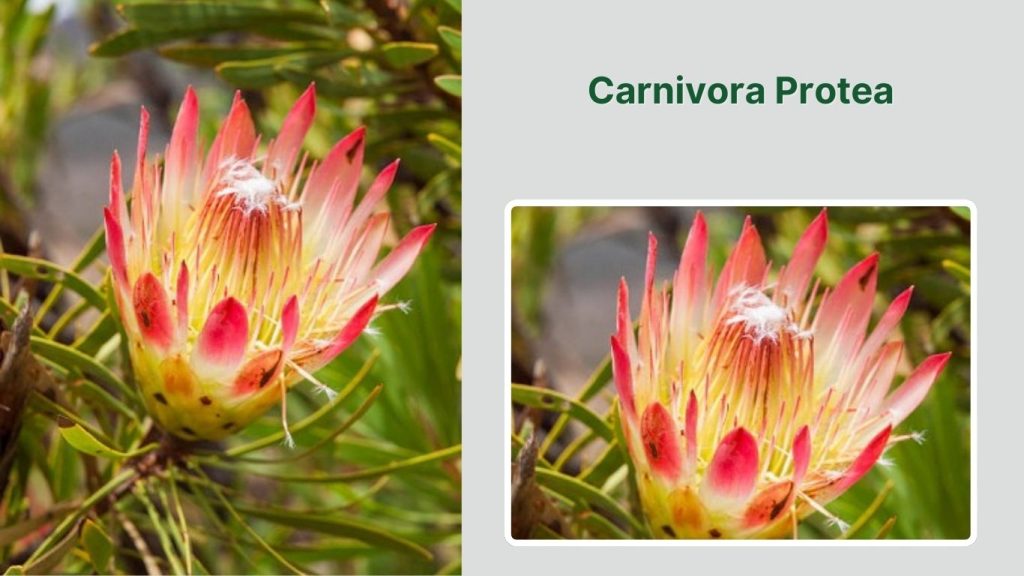
The Carnivora Protea is a cultivated form of the King Protea, distinguished by its dramatic deep pink to reddish bracts and bold central dome. It is especially prized for its intense coloration and large, show-quality blooms, making it a standout variety in both commercial flower farming and ornamental gardens.
Identification
- Very large, crown-shaped flower heads
- Deep pink to red outer bracts
- Thick, leathery, oval green leaves
- Strong, upright woody stems
- Evergreen shrub growth habit
Natural Habitat
Carnivora Protea does not grow in the wild, as it is a selected cultivar. Its parent species originates from South Africa’s fynbos biome, where plants thrive in sandy, acidic, nutrient-poor soils under full sun and seasonal rainfall patterns.
Blooming Season and Growth
This protea blooms mainly from winter through spring. It forms a medium evergreen shrub, generally 3 to 5 feet tall. The plant performs best in full sun with excellent drainage and minimal fertilizer, producing high-quality flowers under dry, airy conditions.
Uses and Symbolism
Carnivora Protea is widely used in luxury floral arrangements and export-quality bouquets. It symbolizes power, richness, and admiration due to its bold color, impressive size, and long-lasting blooms.
15. Sylvia Protea (Protea eximia ‘Sylvia’)
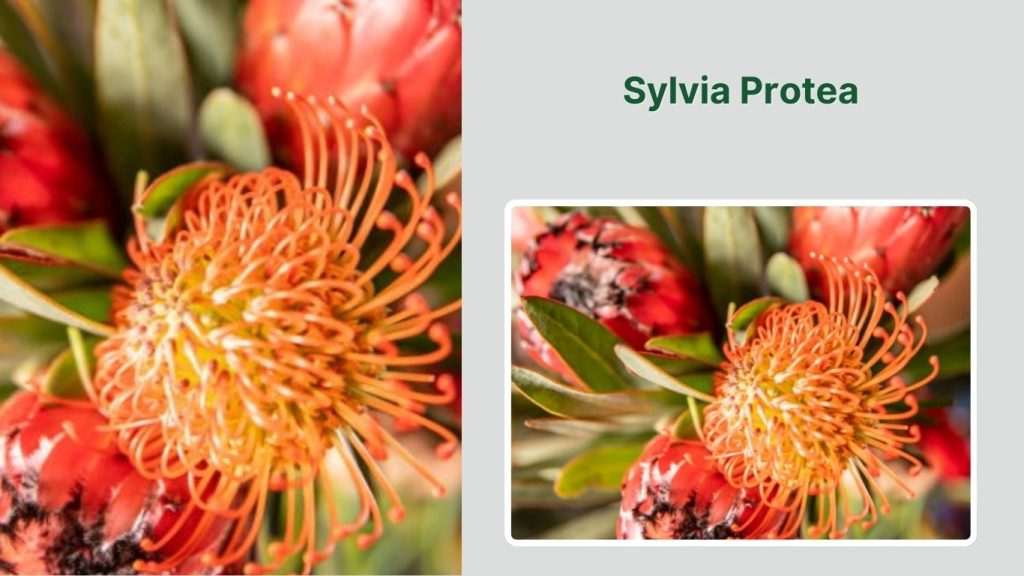
The Sylvia Protea is a refined hybrid protea known for its soft silvery-pink bracts and elegant, elongated flower heads. It is a popular commercial variety because of its strong stems, consistent flowering, and graceful form, making it suitable for both landscaping and professional floristry.
Identification
- Elongated to oval flower heads
- Pale pink bracts with silvery sheen
- Long, narrow leathery leaves
- Upright, well-branched shrub form
- Thick, straight floral stems
Natural Habitat
Sylvia Protea is a cultivated hybrid and does not occur naturally in the wild. Its parent species are native to South Africa’s fynbos ecosystem, where soils are acidic, low in nutrients, and well drained, and where plants are adapted to seasonal fires.
Blooming Season and Growth
This protea usually flowers from late autumn through spring. It grows into a medium evergreen shrub, typically 4 to 7 feet tall. Full sun exposure, good airflow, and fast-draining soil are essential for healthy plant development.
Uses and Symbolism
Sylvia Protea is extensively used in the international cut-flower trade. It symbolizes elegance, resilience, and gentle strength, making it a popular choice for sophisticated floral designs and ornamental garden displays.
16. Green Ice Protea (Protea neriifolia × susannae ‘Green Ice’)
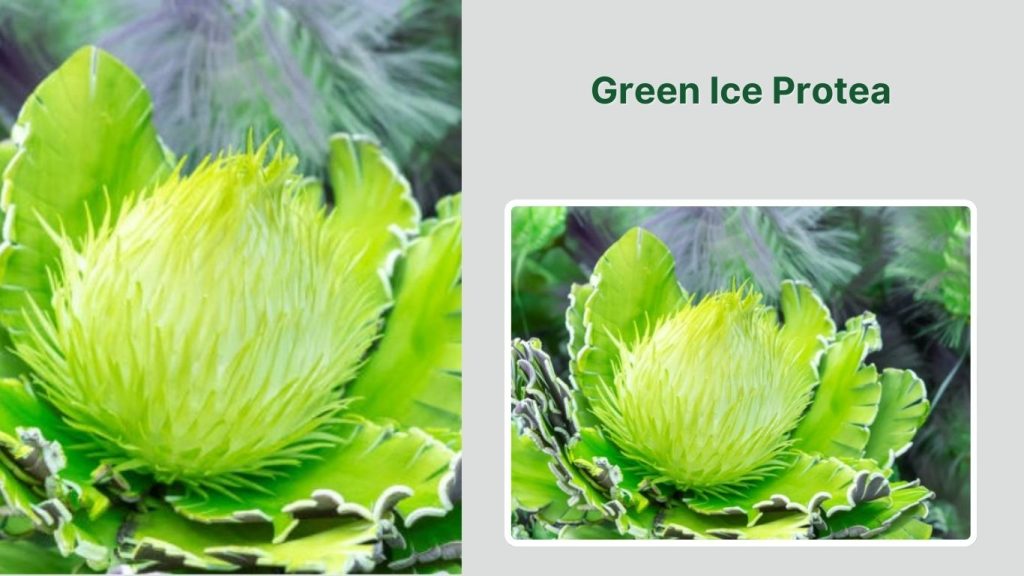
The Green Ice Protea is a distinctive hybrid protea recognized for its pale green to creamy bracts often tipped with soft pink. Its cool-toned coloration and strong, upright growth habit make it especially attractive for modern floral design and landscape use.
Identification
- Large, oval flower heads
- Pale green to cream bracts with pink edges
- Long, narrow leathery leaves
- Thick, upright woody stems
- Medium-sized evergreen shrub form
Natural Habitat
Green Ice Protea is a cultivated hybrid and does not exist naturally in the wild. Its parent species are native to South Africa’s fynbos regions, characterized by acidic, sandy soils and Mediterranean-type climates with winter rainfall and dry summers.
Blooming Season and Growth
Blooming generally occurs from autumn through spring. Green Ice Protea grows as a dense shrub, typically 4 to 6 feet tall. It requires full sun, excellent drainage, and low-phosphorus soils to thrive and produce high-quality flowers.
Uses and Symbolism
Green Ice Protea is widely used in the cut-flower industry for its unusual color and long vase life. It symbolizes freshness, renewal, and calm strength, making it popular in contemporary floral arrangements.
17. High Gold Protea (Protea susannae ‘High Gold’)
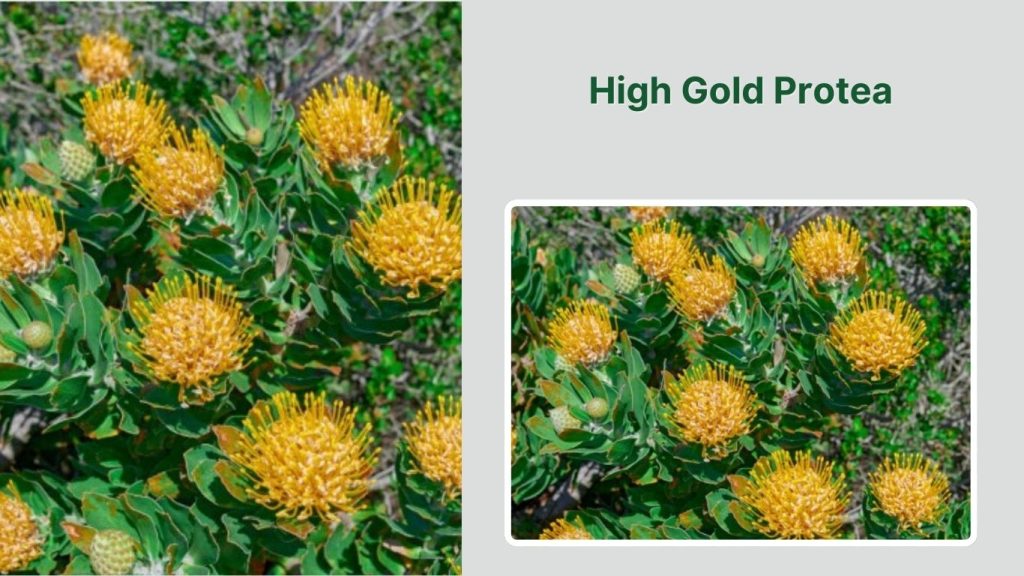
The High Gold Protea is admired for its warm golden-yellow to peach-toned bracts and tall, elegant flower form. It is a selected cultivar known for reliable flowering and strong stems, often grown for premium floral markets and decorative gardens.
Identification
- Tall, oval to elongated flower heads
- Golden-yellow to peach bracts
- Narrow, leathery, elongated leaves
- Upright, woody shrub structure
- Smooth, sturdy flowering stems
Natural Habitat
High Gold Protea is a cultivated protea variety. Its parent species originate from South Africa’s fynbos biome, where plants grow in open, sunny habitats with nutrient-poor, well-drained soils and natural fire cycles.
Blooming Season and Growth
This protea usually blooms from late winter into spring. It grows into a medium to tall evergreen shrub, often reaching 5 to 8 feet in height. The plant prefers full sun exposure, excellent soil drainage, and minimal fertilization.
Uses and Symbolism
High Gold Protea is popular in bright floral arrangements and ornamental plantings. It symbolizes warmth, prosperity, and optimism, making it a favored choice for cheerful bouquets and standout garden displays.
18. Lemon Honey Protea (Protea susannae ‘Lemon Honey’)
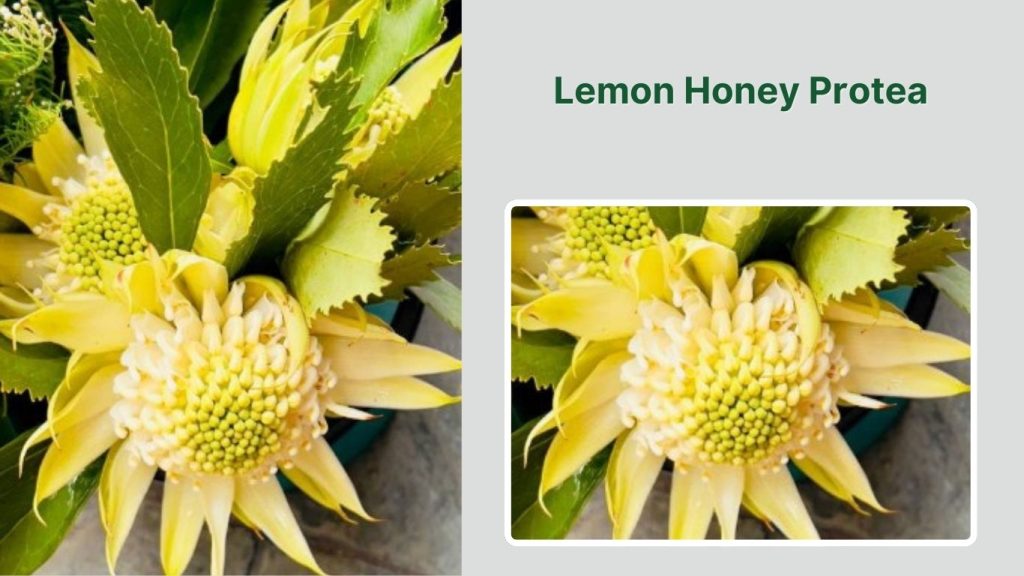
The Lemon Honey Protea is a luminous cultivar known for its soft lemon-yellow bracts often washed with warm honey tones. Its cheerful coloration and symmetrical flower heads make it a favorite among florists and gardeners seeking bright yet elegant proteas.
Identification
- Medium to large oval flower heads
- Lemon-yellow bracts with honey-gold shading
- Long, narrow leathery leaves
- Upright, woody flowering stems
- Evergreen shrub growth habit
Natural Habitat
Lemon Honey Protea is a cultivated variety and does not grow naturally in the wild. Its parent species come from South Africa’s fynbos ecosystem, where plants thrive in sandy, acidic, nutrient-poor soils with strong sunlight and seasonal rainfall.
Blooming Season and Growth
This protea blooms mainly from late winter through spring. It forms a medium evergreen shrub, typically growing 4 to 7 feet tall. Full sun exposure, excellent drainage, and minimal fertilization are essential for healthy growth and vibrant blooms.
Uses and Symbolism
Lemon Honey Protea is widely used in wedding floristry, bright floral arrangements, and ornamental landscaping. It symbolizes happiness, warmth, and new beginnings, making it especially popular for celebratory bouquets.
19. Longifolia Protea (Protea longifolia)
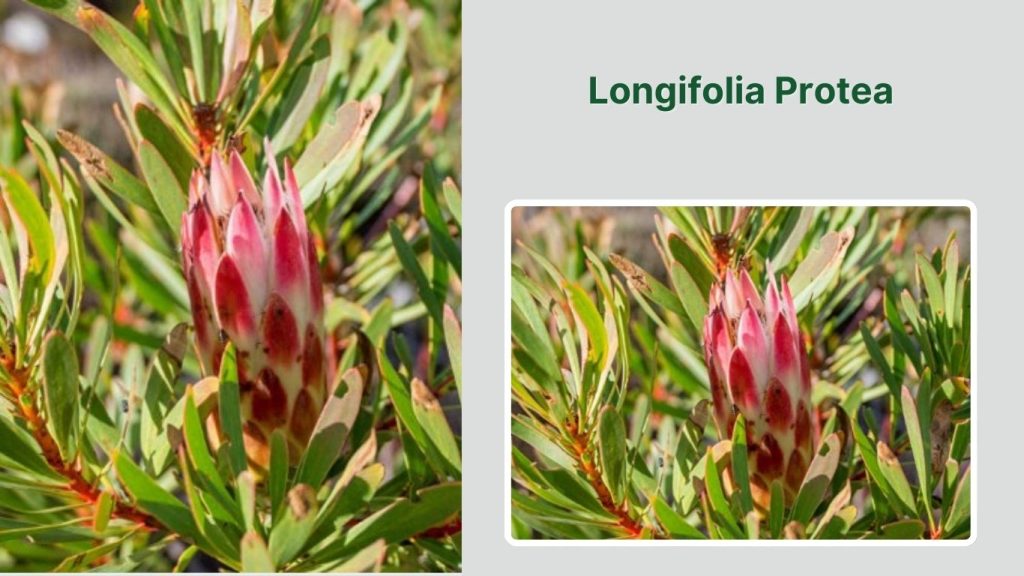
The Longifolia Protea is characterized by its slender, elongated leaves and elegant, narrow flower heads. Compared to rounder proteas, it has a more refined, upright form that gives it a graceful presence in natural habitats and cultivated gardens.
Identification
- Elongated, narrow flower heads
- Long, strap-like leathery leaves
- Pale pink to creamy bracts
- Upright, woody shrub form
- Slim, smooth flowering stems
Natural Habitat
Longifolia Protea is native to South Africa, where it grows in sandy coastal plains and low mountain slopes. It is part of the fynbos vegetation and thrives in nutrient-poor, acidic, well-drained soils with full sun exposure.
Blooming Season and Growth
This species typically flowers from late winter to early summer. It grows as a medium to tall evergreen shrub, often reaching 5 to 9 feet in height. The plant prefers open locations, good air movement, and fast-draining soil.
Uses and Symbolism
Longifolia Protea is used in naturalistic landscaping and specialty floral arrangements. It symbolizes elegance, adaptability, and quiet strength due to its slender structure and resilience in harsh growing conditions.
20. Magnifica Protea (Protea magnifica)
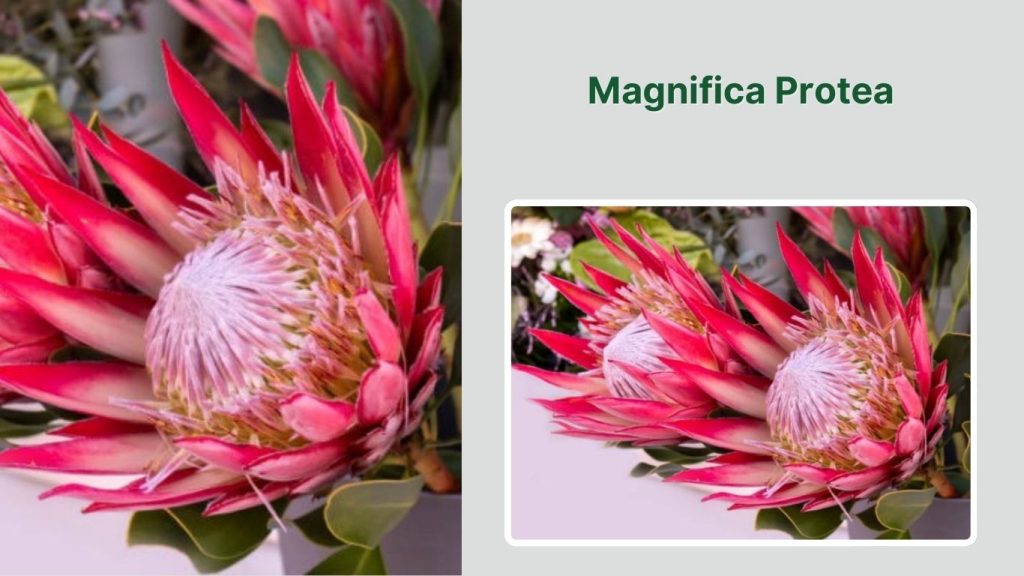
The Magnifica Protea is a spectacular large-flowered species admired for its silvery-pink bracts and impressive, rounded blooms. Often confused with Queen Protea, it stands out for its particularly bold flower heads and soft metallic sheen, making it one of the most visually striking wild proteas.
Identification
- Very large, rounded flower heads
- Silvery-pink to rose-colored bracts
- Thick, oval, leathery leaves
- Upright, robust woody shrub
- Prominent central floral dome
Natural Habitat
Magnifica Protea is native to mountainous regions of South Africa, especially in high-altitude fynbos environments. It grows on rocky slopes and sandstone soils where drainage is excellent and temperatures are cooler.
Blooming Season and Growth
Flowering generally occurs from winter into spring. It grows as a medium to tall evergreen shrub, commonly reaching 5 to 9 feet. The plant prefers full sun, good air circulation, and nutrient-poor soils.
Uses and Symbolism
Magnifica Protea is highly valued for premium cut flowers and botanical garden displays. It symbolizes magnificence, resilience, and natural beauty, reflecting both its name and commanding floral presence.
21. Nerifolia Protea (Protea neriifolia)
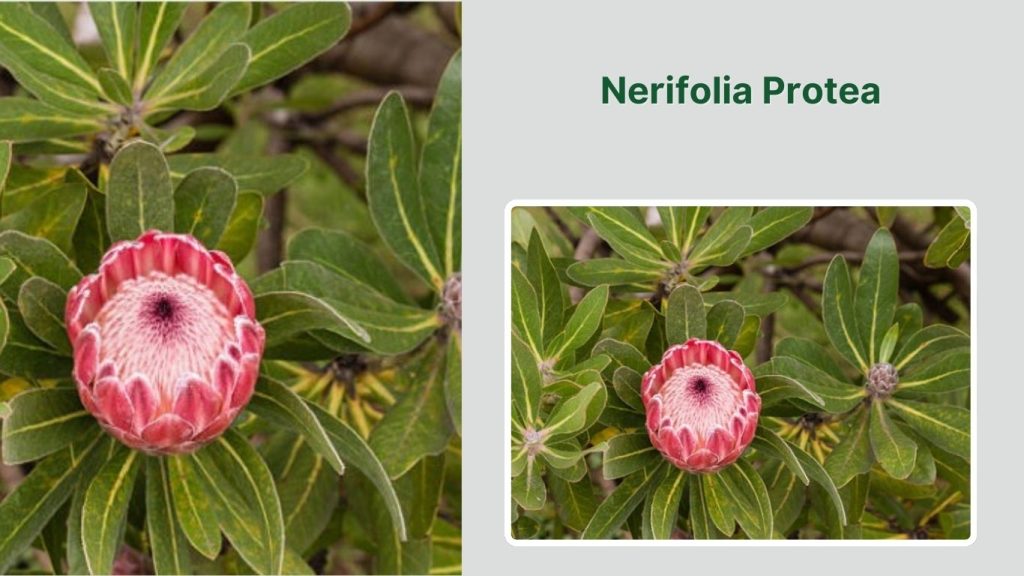
The Nerifolia Protea, often called the Oleander-leaf Protea, is known for its narrow leaves and striking flower heads edged with dark, feathery margins. It is one of the most important parent species used in protea hybridization.
Identification
- Oval to goblet-shaped flower heads
- Pink bracts edged with dark, hairy tips
- Long, narrow oleander-like leaves
- Upright, woody shrub form
- Strong, straight flowering stems
Natural Habitat
Nerifolia Protea is native to South Africa’s Cape Floristic Region. It grows on mountain slopes and open fynbos plains, favoring sandy, acidic, well-drained soils and full sun exposure.
Blooming Season and Growth
This species blooms mainly from autumn through winter. It grows as a medium to tall evergreen shrub, often 6 to 10 feet high. It thrives in sunny, open sites with good air flow and minimal fertilizer.
Uses and Symbolism
Nerifolia Protea is widely cultivated for breeding, cut flowers, and landscaping. It symbolizes endurance, versatility, and strength due to its adaptability and importance in protea cultivation.
22. Repens Protea (Protea repens)
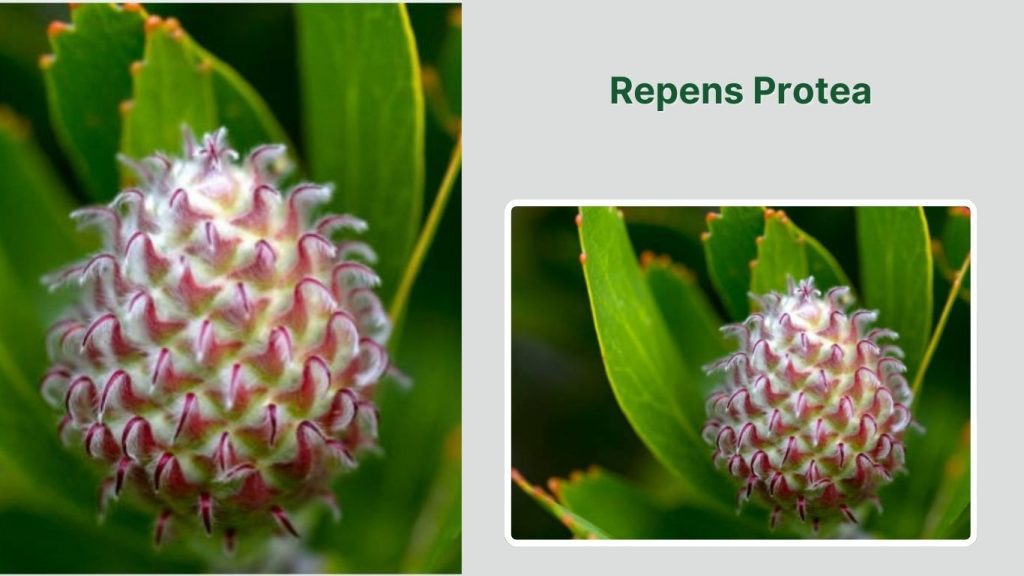
The Repens Protea, also known as the Common Sugarbush, is one of the best-known protea species and a key nectar source for birds. It produces elongated flower heads that vary widely in color, from creamy white and soft pink to deep red, depending on the variety and location.
Identification
- Elongated, goblet-shaped flower heads
- Bracts ranging from white and pink to deep red
- Narrow, leathery green leaves
- Upright to spreading woody shrub
- Abundant nectar-rich central florets
Natural Habitat
Repens Protea is native to the Western and Eastern Cape of South Africa. It grows in coastal plains, foothills, and mountain slopes within fynbos vegetation, thriving in acidic, nutrient-poor, well-drained soils.
Blooming Season and Growth
This species typically flowers from autumn through spring. It forms a medium to tall evergreen shrub, often 5 to 10 feet in height. It prefers full sun, open air circulation, and minimal soil enrichment.
Uses and Symbolism
Repens Protea is widely planted to attract birds and is commercially grown for cut flowers. It symbolizes vitality, abundance, and connection to nature because of its rich nectar and ecological importance.
23. Compacta Protea (Protea compacta)
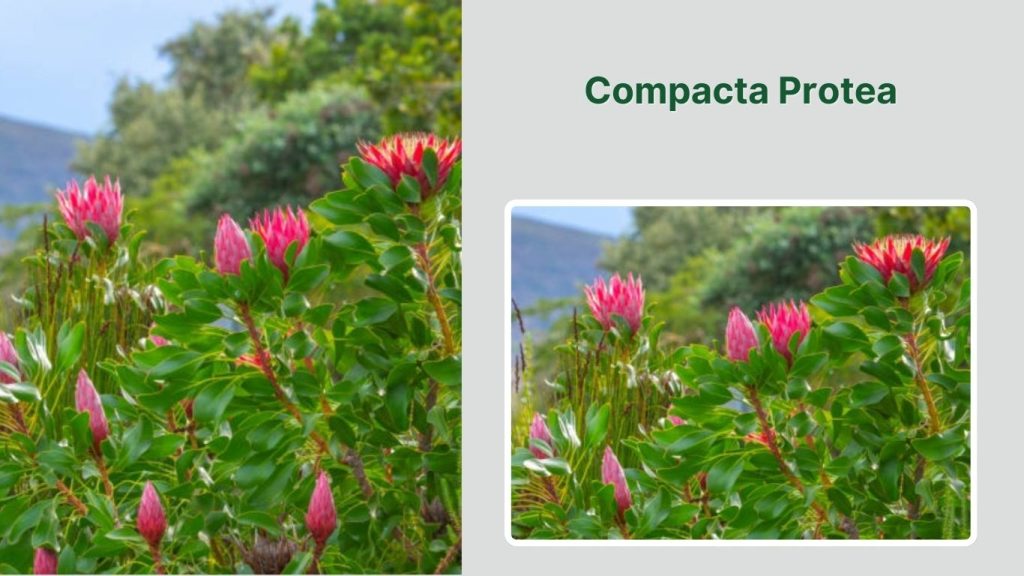
The Compacta Protea is a naturally smaller-growing protea species known for its neat growth habit and soft pink, rounded flower heads. Its tidy form and manageable size make it especially suitable for home gardens and landscape use.
Identification
- Rounded, medium-sized flower heads
- Soft pink to pale rose bracts
- Thick, oval, leathery leaves
- Dense, compact shrub form
- Short, sturdy flowering stems
Natural Habitat
Compacta Protea is native to coastal regions of South Africa, where it grows in sandy soils and lowland fynbos habitats. It thrives in sunny, open environments with excellent drainage and low soil fertility.
Blooming Season and Growth
Flowering usually occurs from late winter into spring. Compacta Protea grows as a low to medium evergreen shrub, typically reaching 3 to 5 feet tall. It performs best in full sun with well-drained, acidic soil.
Uses and Symbolism
Compacta Protea is popular in ornamental landscaping and small garden designs. It symbolizes harmony, simplicity, and quiet beauty, reflecting its balanced form and gentle coloration.
24. Eximia Protea (Protea eximia)
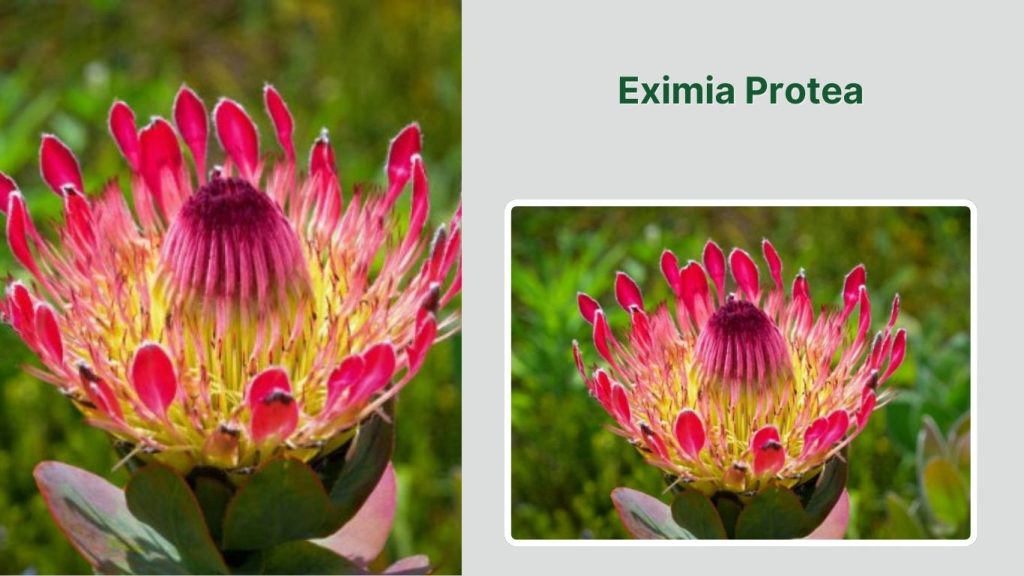
The Eximia Protea, sometimes called the Broad-leaved Sugarbush, is admired for its large, soft pink flower heads and broad, rounded leaves. It is one of the most graceful-looking proteas, combining substantial blooms with a lush, ornamental appearance.
Identification
- Large, rounded flower heads
- Soft pink to blush bracts
- Broad, thick, leathery leaves
- Upright, woody shrub form
- Prominent central dome of florets
Natural Habitat
Eximia Protea is native to the Cape Floristic Region of South Africa. It grows mainly in mountain fynbos on sandstone soils, where drainage is excellent and nutrients are scarce.
Blooming Season and Growth
This species usually flowers from winter into spring. It forms a medium evergreen shrub, commonly reaching 4 to 7 feet tall. It prefers full sun, cool air movement, and low-phosphorus soils.
Uses and Symbolism
Eximia Protea is valued for refined floral arrangements and ornamental garden planting. It symbolizes elegance, grace, and distinction due to its soft coloring and well-balanced flower form.
25. Grandiceps Protea (Protea grandiceps)
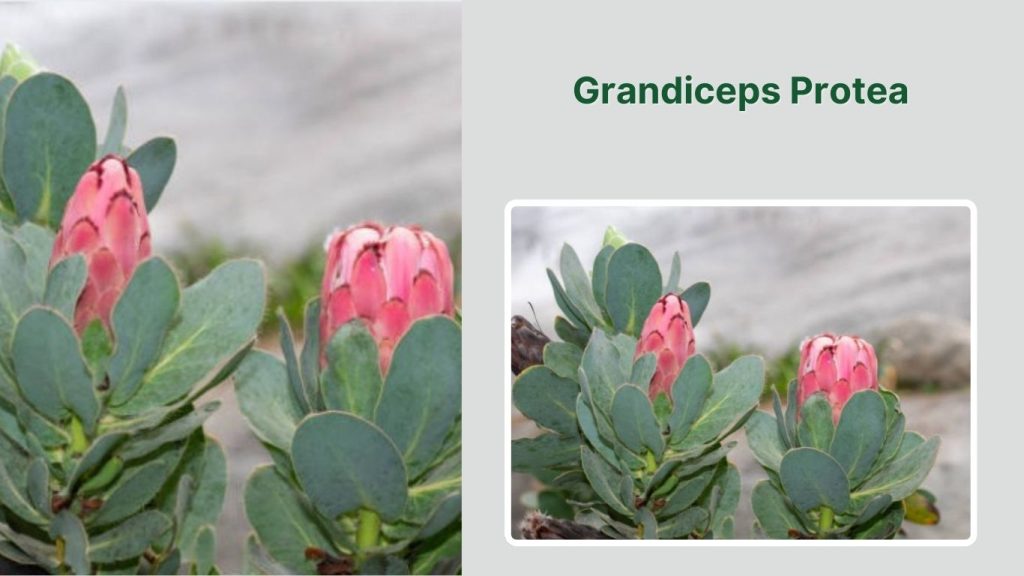
The Grandiceps Protea, often known as the Bearded Sugarbush, is recognized for its distinctive dark, hairy bract tips and bold, upright flower heads. This contrast between pale outer bracts and dark fringes gives the bloom a dramatic and exotic appearance.
Identification
- Large, oval flower heads
- Cream to pink bracts with dark, hairy tips
- Narrow, leathery leaves
- Upright, woody shrub growth
- Strong, straight flowering stems
Natural Habitat
Grandiceps Protea is native to mountainous regions of South Africa, where it grows on rocky slopes and sandstone-derived soils within fynbos vegetation.
Blooming Season and Growth
Flowering typically occurs from winter through spring. It grows into a medium to tall evergreen shrub, usually 5 to 9 feet high. The plant thrives in full sun and well-drained, nutrient-poor soils.
Uses and Symbolism
Grandiceps Protea is popular in bold floral designs and botanical collections. It symbolizes individuality, mystery, and strength, reflecting its dark-fringed, striking flower heads.