Tiny jumping spiders are among the most charming creatures in the spider world. Despite their small size, they have an oversized personality, often turning heads with their curious stares and quick hops. Many people even describe them as “cute,” thanks to their big, forward-facing eyes and fuzzy little bodies. These spiders can appear in different colors—black, brown, white, yellow, green, or even tan—and are commonly spotted in both homes and gardens. Let’s explore everything you need to know about these fascinating arachnids.
What Is a Tiny Jumping Spider?
Tiny jumping spiders belong to the Salticidae family, which includes over 6,000 species worldwide. They are known for their compact size, with many being only 1–6 millimeters long. While larger species such as the bold jumping spider may reach 12–15 mm, these miniature ones are often overlooked because of their tiny frames.
Unlike web-building spiders, jumping spiders rely on their keen eyesight and leaping ability to hunt prey. They use short bursts of silk only as safety lines rather than for building webs. Their hunting style, along with their size, makes them unique in the spider world.
Identifying Tiny Jumping Spiders
Size and Appearance
Tiny jumping spiders are easy to identify once you know what to look for. They are usually very small, sometimes just a dot on the wall, yet their large eyes give them away. Their bodies are compact, with short legs and a fuzzy coating of hair.
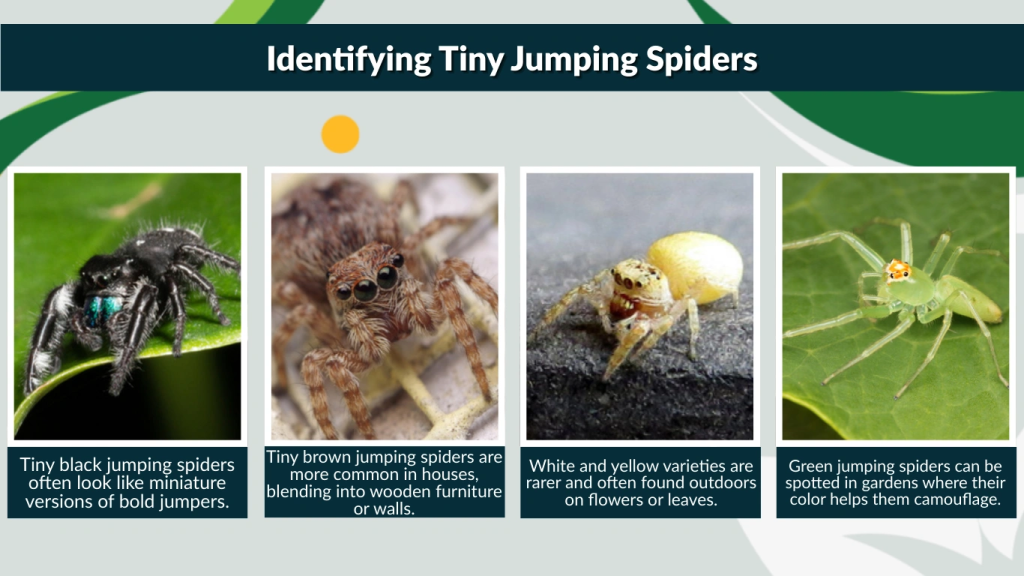
- Tiny black jumping spiders often look like miniature versions of bold jumpers.
- Tiny brown jumping spiders are more common in houses, blending into wooden furniture or walls.
- White and yellow varieties are rarer and often found outdoors on flowers or leaves.
- Green jumping spiders can be spotted in gardens where their color helps them camouflage.
Distinctive Features
What makes these spiders stand out are their two large forward-facing eyes, part of a total of eight eyes arranged across their head. This gives them excellent depth perception. They also exhibit a quirky behavior of tilting their heads as if they are curiously observing humans.
Common Types of Tiny Jumping Spiders

Tiny Black Jumping Spider
These are perhaps the most frequently spotted indoors. They are usually glossy black with a fuzzy body, and they hop quickly when disturbed. People often mistake them for small ants or beetles until they see the distinctive jumping motion.
Tiny Brown Jumping Spider (in houses)
The brown-colored ones are very common in households. Their dull tones make them blend well with furniture, curtains, or wall corners. Despite their presence, they are harmless and often help control small pests like fruit flies.
Tiny White and Yellow Jumping Spiders
These spiders are usually found on flowers. The white and yellow coloration allows them to hide from both predators and prey. Gardeners may notice them near blossoms where they wait to ambush pollinating insects.
Tiny Green Jumping Spider
Green jumping spiders are stunning to see. Their bright shade of green gives them perfect camouflage on leaves and plants. They are less common indoors but frequently spotted outdoors in gardens or forests.
Behavior and Movements

Tiny jumping spiders are incredibly agile. Instead of crawling slowly like other spiders, they pounce on their prey with sudden leaps. They attach a silk thread before every jump, which works like a safety rope in case they miss the target.
One of the most fascinating aspects of their behavior is their curiosity toward humans. If you watch closely, you may see them turning their heads, raising their bodies slightly, or even hopping toward you as if investigating. Unlike most spiders that scurry away, jumping spiders are known for this boldness.
Are Tiny Jumping Spiders Cute?
It might sound odd to call a spider “cute,” but jumping spiders have earned that reputation. Their oversized eyes, fuzzy bodies, and curious head tilts give them an almost cartoon-like appearance. Social media platforms are full of short videos showing these spiders moving adorably, often winning over even those who normally fear arachnids.
Many artists and tattoo lovers have even embraced their image, creating designs inspired by their round bodies and expressive faces.
Tiny Baby Jumping Spiders

Baby jumping spiders, also known as spiderlings, are incredibly small—sometimes no bigger than a pinhead. They hatch from egg sacs laid by the female spider and emerge as tiny replicas of adults.
- At first, they may appear translucent.
- As they grow, their color and patterns become more visible.
- They begin practicing their jumping skills very early, learning to hunt tiny prey such as fruit flies.
Watching baby jumping spiders can be fascinating because they display the same curiosity and intelligence as adults, just on a smaller scale.
Tiny Jumping Spiders in the House
It’s common to find tiny jumping spiders indoors, especially in warm regions. They often come inside through open windows, cracks, or carried in on plants.
They prefer places like:
- Windowsills, where they can hunt for flies.
- Corners of rooms and ceilings.
- Indoor plants, which attract insects.
The good news is that they are harmless to humans and can actually be beneficial because they help keep small insect populations under control.
Tiny Jumping Spider Bites – Are They Dangerous?

One of the most common questions people ask is whether tiny jumping spiders bite. The truth is, they rarely bite humans, and even when they do, it’s not medically significant. Their fangs are so small that most people wouldn’t even notice unless they had sensitive skin.
Bite symptoms, if they occur, may include:
- Slight redness or swelling at the bite site
- A mild, itchy sensation
- Very rarely, localized pain that fades within hours
Unlike dangerous spiders such as the brown recluse or black widow, tiny jumping spiders do not pose a threat. They are naturally shy and only bite if they feel trapped or pressed against the skin.
Keeping Tiny Jumping Spiders as Pets

In recent years, tiny jumping spiders have become increasingly popular as exotic pets. Their playful appearance and easy care make them a favorite among spider enthusiasts.
Housing Needs
- A small terrarium or enclosure with ventilation
- Hiding spots such as leaves, bark, or artificial plants
- A secure lid to prevent escape
Diet
- Tiny insects such as fruit flies, pinhead crickets, or small gnats
- Feeding two to three times a week is usually enough
Care Tips
- Provide light misting for hydration (never standing water, as they can drown)
- Handle them gently—most enthusiasts prefer watching rather than touching
- Keep their enclosure clean and free of uneaten prey
Because of their small size and curious nature, these spiders make fascinating observation pets, especially for beginners interested in arachnids.
Symbolism and Tattoos
Tiny jumping spiders have found their way into tattoo culture, often chosen for their unique symbolism. People associate them with:
- Curiosity – their habit of tilting their heads as if examining the world
- Agility and energy – representing adaptability and quick thinking
- Uniqueness – a reminder that even small creatures can make an impression
Tattoo designs range from realistic depictions to cartoon-like versions, often emphasizing their large eyes and adorable expressions. For many, a tiny jumping spider tattoo represents courage in embracing the unusual and seeing beauty where others may not.
Are Tiny Jumping Spiders Poisonous?
A common misconception is that all spiders are dangerous. In reality, tiny jumping spiders are not poisonous to humans. Like all spiders, they do have venom, but it is designed for subduing their prey—tiny insects—not people.
Their venom is so mild and their fangs so small that they pose no medical risk. Instead of being pests, they are helpful insect controllers around the home and garden. Their presence often indicates a healthy environment where pest populations are naturally balanced.
Fun Facts About Tiny Jumping Spiders
- Excellent eyesight: They have among the best vision of any spider, able to detect movement several body lengths away.
- Head tilting: They can tilt their heads like curious pets, making them seem unusually intelligent.
- Recognition ability: Studies suggest they may recognize human faces and distinguish shapes.
- Courtship dances: Males perform elaborate dances to impress females, sometimes involving leg waves or colorful displays.
- Non-web weavers: Instead of building webs, they rely on silk draglines and active hunting.
These traits set them apart from most other spiders and add to their popularity among animal lovers.
FAQs
How small can a jumping spider be?
Some species measure only 1–2 millimeters in length, making them nearly invisible unless you look closely. Others grow slightly larger, up to 6 mm, but still fall into the “tiny” category.
Are tiny jumping spiders friendly to humans?
They are not exactly “friendly” in the human sense, but they are harmless and often curious about people. Many owners describe them as bold and inquisitive rather than fearful.
What do tiny baby jumping spiders eat?
Spiderlings eat extremely small prey such as fruit flies, springtails, or tiny gnats. They begin hunting almost immediately after leaving the egg sac.
Can you keep a tiny jumping spider as a pet safely?
Yes, many people successfully keep them as pets. With proper care—such as feeding small insects and providing a safe enclosure—they can live happily in captivity for one to two years.
Do tiny jumping spiders build webs like other spiders?
No, they don’t spin large webs for catching food. Instead, they hunt actively and use silk only for safety lines, egg sacs, or creating small shelters.