
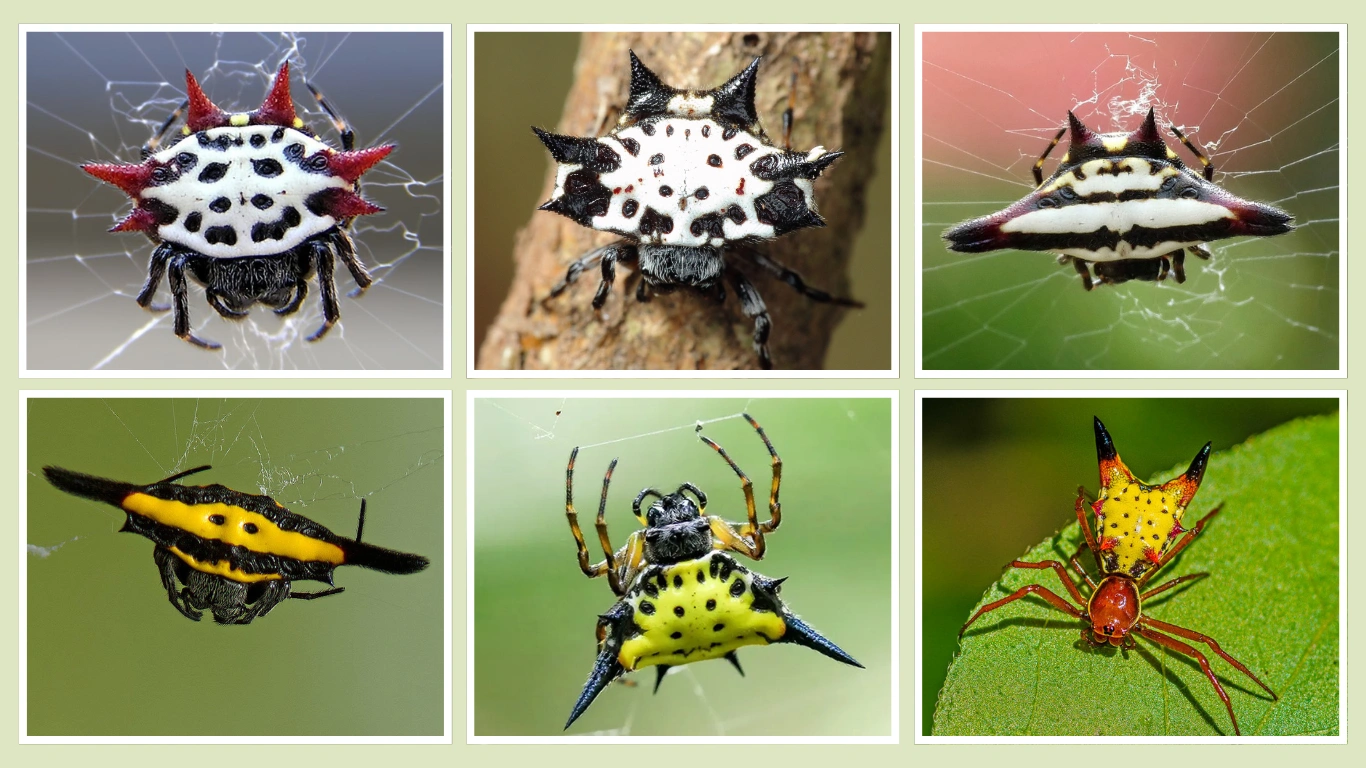
Spiny orb-weavers are among the most visually striking spiders in the world, known for their bold colors, flattened bodies, and distinctive spines. Found across tropical and subtropical regions, these small but eye-catching spiders build circular webs and play a key role in natural pest control. In this guide, we’ll explore seven unique species—from the well-known Gasteracantha cancriformis to the rare and exotic Gasteracantha sturi.
1. Gasteracantha cancriformis

Gasteracantha cancriformis, also known as the Spinybacked Orbweaver, is the most well-known species of the Gasteracantha genus, especially common in the southeastern United States, the Caribbean, and parts of Central and South America. Its bright, crab-like appearance and wide distribution make it the most recognized spiny orb-weaver.
Identification Features
- Small size: females about 5–9 mm wide
- Flattened, crab-shaped abdomen
- Six prominent black spines on the sides and rear
- Bright white, yellow, or red abdomen with black spots
Color Pattern and Appearance
The body color varies but is typically white, yellow, or red with black spines and a series of black spots or dimples across the back. Males are smaller, duller, and lack the distinctive spines. The spider’s legs are usually dark and short relative to its body width.
Habitat and Web Location
You can find G. cancriformis in gardens, forests, parks, and hedgerows, often near human habitation. It builds large, circular orb webs in open spaces between shrubs or trees, typically around head height.
Behavior and Lifestyle
This spider is a daytime web builder, often rebuilding its web each morning. It sits in the center of the web, waiting for flying insects. Despite its flashy appearance, it’s harmless to humans and plays a beneficial role in controlling pest insects.
2. Gasteracantha kuhli
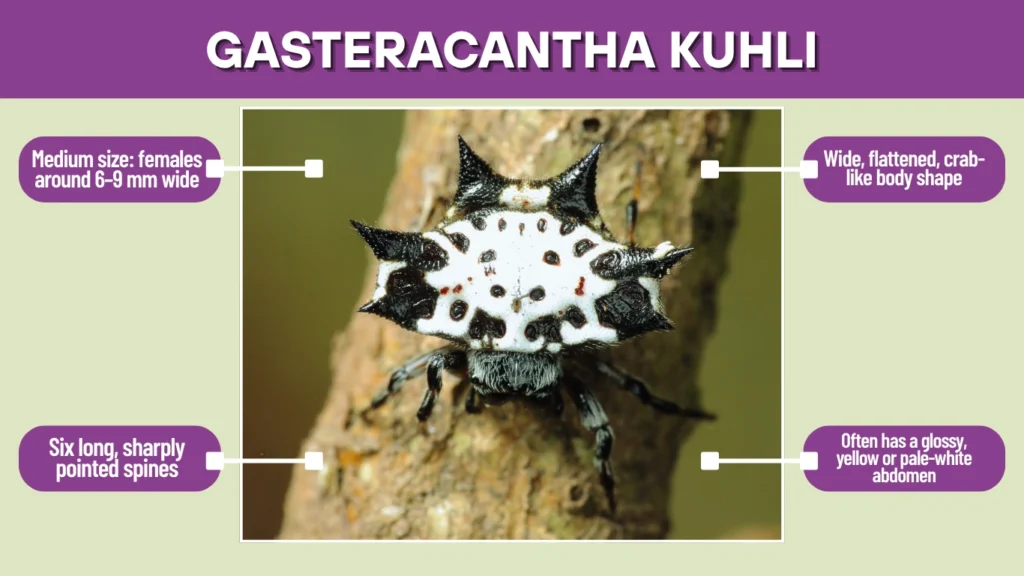
Gasteracantha kuhli is a distinctive spiny orb-weaver found across Southeast Asia, especially in countries like Indonesia, Malaysia, and the Philippines. Known for its wide, flattened body and sharp spines, it is often seen on forest edges and gardens.
Identification Features
- Medium size: females around 6–9 mm wide
- Six long, sharply pointed spines
- Wide, flattened, crab-like body shape
- Often has a glossy, yellow or pale-white abdomen
Color Pattern and Appearance
The abdomen is typically yellow, cream, or white, often with dark bands or spots. The six spines are black, long, and rigid—three on each side. Its striking look helps deter predators by mimicking thorns or dangerous insects.
Habitat and Web Location
This species prefers wooded areas, tropical forests, and garden edges. It constructs its orb webs across trails or between branches, often at eye level.
Behavior and Lifestyle
G. kuhli is a passive predator, sitting still in the center of its web during the day. It rarely leaves its web and quickly rebuilds it if disturbed. The spider is not aggressive and poses no threat to humans.
3. Gasteracantha geminata

Gasteracantha geminata is native to India and parts of South Asia. It’s one of the most eye-catching orb-weavers due to its unusually elongated spines and wide, colorful body. Its distinct appearance makes it a favorite among nature photographers.
Identification Features
- Body width around 8–10 mm
- Long lateral spines, especially the central pair
- Flattened, oval-shaped abdomen
- Often red, yellow, or orange with black markings
Color Pattern and Appearance
The abdomen of G. geminata can appear red-orange or yellow, usually with black dots or markings. The long black spines on each side of its body are its most defining feature, especially the middle ones which extend far beyond the body’s edge.
Habitat and Web Location
It is commonly found in open woodlands, gardens, and agricultural lands, spinning its orb-shaped webs in sunny, open areas.
Behavior and Lifestyle
Just like other Gasteracantha spiders, G. geminata is non-aggressive and hunts by waiting in its web for flying insects. It’s most active during daylight and rebuilds its web regularly when damaged or weathered.
4. Gasteracantha hecata

Gasteracantha hecata is a visually striking spiny orb-weaver found mainly in the Philippines, Malaysia, and Indonesia. This species is easily recognized by its bright coloration and six sharply defined spines, giving it a bold, armored appearance.
Identification Features
- Body size: 6–9 mm wide
- Flat, broad abdomen with six medium-length spines
- Thick, compact body structure
- Females are more colorful and spiny than males
Color Pattern and Appearance
G. hecata usually has a bright orange, red, or yellow abdomen, sometimes with dark spots or fine markings. Its spines are black and evenly spaced, creating a star-like outline. The legs are short, usually brown or dark gray.
Habitat and Web Location
This spider prefers dense tropical forests and shaded gardens. It builds circular orb webs between bushes, tree trunks, or low-hanging branches where flying insects are common.
Behavior and Lifestyle
It is diurnal, spending most of the day in the center of its web. If threatened, it may drop from the web or remain completely still. It rebuilds its web frequently and contributes to natural pest control by trapping small flies and moths.
5. Gasteracantha hasselti

Gasteracantha hasselti, also known as the Red Spiny Orb-Weaver, is found across Southeast Asia and northern Australia. This species is particularly famous for its bright red abdomen and jet-black spines, making it one of the most visually distinctive of the Gasteracantha genus.
Identification Features
- Width: around 8–10 mm
- Broad, rounded abdomen with six strong black spines
- Females much larger and more colorful than males
- Legs usually dark brown to black
Color Pattern and Appearance
The abdomen is often bright red or crimson, bordered with black spikes. Some individuals show small white or yellow dots or faint side markings. The contrast between the body and the spines gives it a dramatic, almost armored appearance.
Habitat and Web Location
This species inhabits tropical woodlands, gardens, and forest edges. It often builds its web across clearing paths, shrubs, or between trees, especially in areas with high insect activity.
Behavior and Lifestyle
G. hasselti is not aggressive and stays in the center of its web throughout the day. It relies on its bold coloration and spines as a deterrent to predators. Like other orb-weavers, it traps flying insects and may rebuild its web daily if damaged.
6. Micrathena sagittata
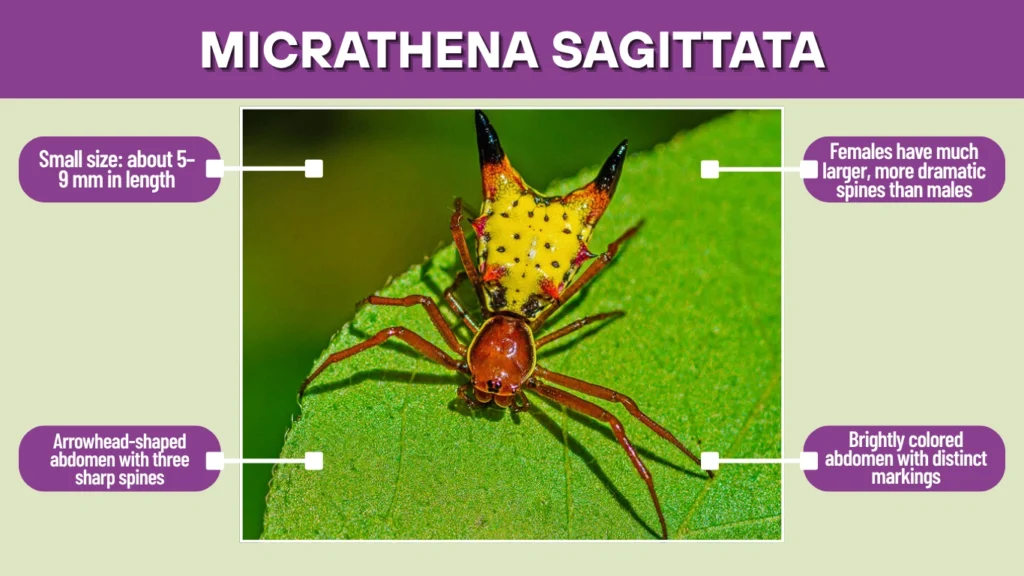
Though not a true Gasteracantha, Micrathena sagittata—commonly called the Arrow-Shaped Micrathena—is a close relative and often grouped with spiny orb-weavers due to its similarly armored, spiny body. This spider is native to the eastern United States, Central America, and parts of South America.
Identification Features
- Small size: about 5–9 mm in length
- Arrowhead-shaped abdomen with three sharp spines
- Females have much larger, more dramatic spines than males
- Brightly colored abdomen with distinct markings
Color Pattern and Appearance
Micrathena sagittata has a bright yellow to red abdomen, shaped like a pointed triangle or arrowhead. The rear-facing spines are long and pronounced, giving it a very recognizable silhouette. The legs are dark and spiny.
Habitat and Web Location
It prefers wooded areas, forest edges, and overgrown trails, often building orb webs across narrow paths or between shrubs where prey is likely to fly through.
Behavior and Lifestyle
This spider is a day-active web builder. Females remain in the center of the web while males are often seen nearby during mating seasons. It feeds on small flying insects and relies on its strange shape and color for protection from predators.
7. Gasteracantha sturi
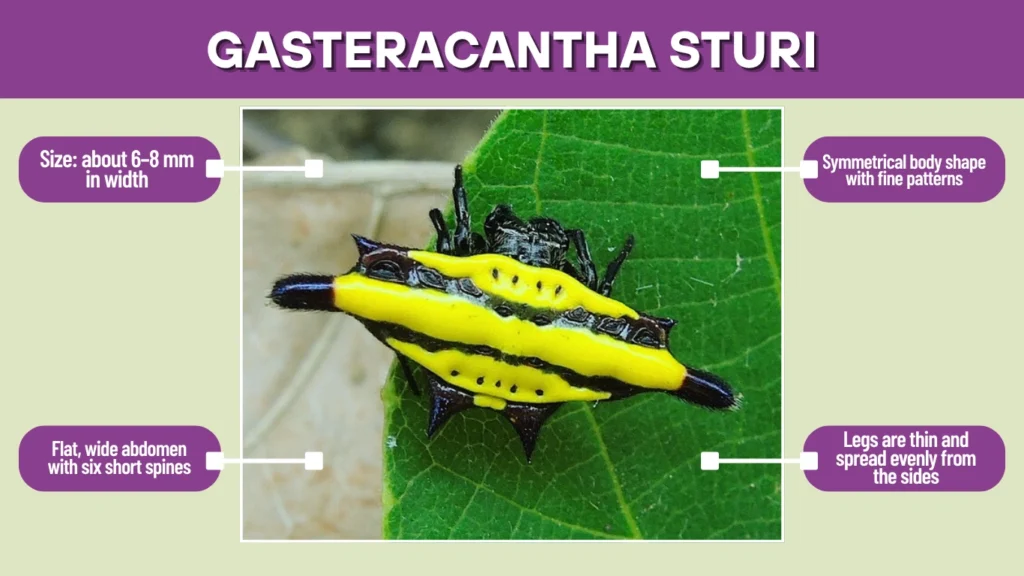
Gasteracantha sturi is a lesser-known but stunning spiny orb-weaver found primarily in Southeast Asia, particularly Thailand, Vietnam, and Malaysia. It features a flat, colorful abdomen with six small spines and detailed markings.
Identification Features
- Size: about 6–8 mm in width
- Flat, wide abdomen with six short spines
- Symmetrical body shape with fine patterns
- Legs are thin and spread evenly from the sides
Color Pattern and Appearance
The abdomen is usually cream, orange, or pale yellow, decorated with complex black markings or dots. Unlike other Gasteracantha species, G. sturi has shorter, more subtle spines, giving it a smoother edge. Its compact design and color variation make it a standout species.
Habitat and Web Location
You’ll find G. sturi in lowland forests, gardens, and roadside vegetation, where it builds typical orb-shaped webs in low, shaded areas among branches or tall plants.
Behavior and Lifestyle
This species is quiet and still, usually seen resting in the center of its web. It waits for small insects to get trapped in the silk and uses its coloring to blend in with light-colored backgrounds like dried leaves or pale bark. Like other orb-weavers, it is harmless to humans and helps reduce garden pests.
Summary:
Spiny orb-weavers, especially those in the Gasteracantha genus, are small, colorful spiders recognized for their thorny, crab-like bodies and vivid markings. This guide introduced seven fascinating species, including common types like G. cancriformis and more exotic ones like G. sturi and Micrathena sagittata. Each species has its own preferred habitat and distinctive appearance, but all share similar behaviors—spinning orb webs and capturing flying insects. Despite their dramatic look, they’re harmless and beneficial to gardens and ecosystems.