

Yellow sac spiders are small, nocturnal hunters known for their pale yellow bodies and sac-like silk retreats. Belonging primarily to the Cheiracanthium genus, these spiders are found across North America, Europe, Asia, and Australia. While only a few are commonly encountered in homes, many species live outdoors in grasses, shrubs, and forests. Some are known for their medically significant bites, though most are harmless to humans. Here, I’ll introduce 12 different types of yellow sac spiders
1. Northern Yellow Sac Spider (Cheiracanthium mildei)

The Northern Yellow Sac Spider is one of the most widespread and commonly encountered species in North America. Known for its pale yellow or light green body and nocturnal habits, this spider often enters homes and can deliver a bite that causes mild to moderate symptoms in humans. It prefers hidden corners, ceilings, or folds of fabric for building its signature sac-like retreat.
Identification
- Scientific Name: Cheiracanthium mildei
- Color: Pale yellow to light green
- Size: About 5–10 mm in body length
- Legs: Long and thin, sometimes slightly darker than the body
- Distinctive Feature: Nocturnal hunter; builds silken sacs rather than webs
- Eye Pattern: 8 eyes arranged in two rows
- Location: Commonly found indoors in the northeastern United States and parts of Europe
Habitat
The Northern Yellow Sac Spider typically inhabits homes, gardens, garages, and basements. It hides in crevices, under furniture, behind picture frames, or inside folded clothes and curtains. Outdoors, it shelters under bark, stones, and leaves during the day.
Behavior
This spider is a nocturnal predator, hunting small insects and arthropods rather than catching prey in a web. It is solitary and shy, but may bite in self-defense if trapped against skin. It constructs a silken sac to rest in during the daytime, which is where its name originates.
Bite and Symptoms
Bites from the Northern Yellow Sac Spider are typically not medically dangerous but can be painful. The bite may resemble a bee sting and can cause localized redness, swelling, and mild necrosis in rare cases. The symptoms usually subside within a few days with basic first aid.
15 Most Dangerous Spiders in the World: Toxic and Aggressive
2. Black-Footed Yellow Sac Spider (Cheiracanthium inclusum)

The Black-Footed Yellow Sac Spider is another well-known species in the Cheiracanthium genus. It is widespread throughout the southern and central United States and is often confused with its northern counterpart. The name “black-footed” refers to the slightly darker coloration at the tips of its legs.
Identification
- Scientific Name: Cheiracanthium inclusum
- Color: Pale yellow or light beige, with darker leg tips
- Size: Around 6–10 mm in body length
- Legs: Long and slender, with black “feet” (tarsal segments)
- Eye Pattern: 8 eyes in two horizontal rows
- Common Regions: Found throughout the U.S., especially in warmer climates
- Other Names: Yellow house spider, Long-legged sac spider
Habitat
This spider often enters homes during cooler months and is commonly found in window frames, closets, corners, or under baseboards. Outdoors, it may hide under rocks, logs, and leaf litter or inside rolled leaves.
Behavior
The Black-Footed Yellow Sac Spider is a fast-moving, aggressive hunter, known for patrolling walls and ceilings at night. Like others in its genus, it does not spin traditional webs but constructs a small silk sac to hide in during the day.
Bite and Symptoms
While the bite of C. inclusum is not life-threatening, it can cause localized pain, itching, swelling, and sometimes a small ulcer at the bite site. It is often mistaken for more serious bites like that of a brown recluse, but symptoms are typically milder and heal without medical intervention.
3. European Yellow Sac Spider (Cheiracanthium punctorium)

The European Yellow Sac Spider is one of the largest species in the Cheiracanthium genus and is native to parts of Europe and Central Asia. It is known for its vivid yellow coloration and occasional defensive behavior.
Identification
- Scientific Name: Cheiracanthium punctorium
- Color: Bright yellow or yellow-green
- Size: Up to 15 mm in body length (larger than most sac spiders)
- Legs: Long and thin, usually the same color as the body
- Eye Pattern: 8 eyes arranged in two rows
- Range: Central and Eastern Europe, occasionally found in gardens and grasslands
- Notable Feature: Larger size and brighter color than other yellow sac spiders
Habitat
This spider is often found in open grassy areas, shrubs, and meadows. It builds a tubular silk sac between leaves, where it rests during the day. Unlike others in its genus, it prefers outdoor environments and is rarely seen indoors.
Behavior
The European Yellow Sac Spider is more defensive and may bite more readily when disturbed. It’s an active hunter at night, preying on a variety of insects and other small arthropods.
Bite and Symptoms
The bite of C. punctorium is more painful than that of other yellow sac spiders due to its larger size. Victims may experience sharp pain, redness, swelling, and in some cases, mild systemic effects like headache or nausea. However, serious medical complications are extremely rare.
23 Types of American Spiders: Identification With Images
4. Two-Clawed Cheiracanthium (Cheiracanthium erraticum)

The Two-Clawed Cheiracanthium is a small yellow sac spider found primarily in Europe and parts of Asia. It gets its name from the two prominent claws on each foot, a characteristic trait of the genus. Though less common indoors, it can be found in vegetation and natural landscapes.
Identification
- Scientific Name: Cheiracanthium erraticum
- Color: Yellow to yellow-green
- Size: 5–8 mm in body length
- Legs: Long, thin, and adapted for quick movement
- Distinctive Feature: Two claws on each tarsus; translucent appearance
- Range: Found across Europe, Central Asia, and sometimes in North Africa
- Preferred Environment: Bushes, tall grass, hedgerows
Habitat
This spider tends to live in shrubs, hedgerows, grasslands, and crop fields. It builds a silken sac among leaves or grass stems to rest during the day and becomes active at dusk.
Behavior
Cheiracanthium erraticum is a solitary, active hunter, feeding on small insects and larvae. It does not build a catching web and instead relies on speed and stealth to ambush its prey.
Bite and Symptoms
Bites from this species are rare and mild. If they do occur, symptoms typically include a slight stinging sensation, mild swelling, and redness. The discomfort usually disappears within 1–2 days.
5. Japanese Yellow Sac Spider (Cheiracanthium japonicum)

The Japanese Yellow Sac Spider is native to Japan and some parts of East Asia. It resembles its European and American relatives in appearance but has adapted to local environments and climates, including urban areas.
Identification
- Scientific Name: Cheiracanthium japonicum
- Color: Pale yellow or cream-colored body
- Size: 6–9 mm in body length
- Legs: Proportionally long, often slightly darker at the joints
- Eye Pattern: 8 eyes arranged in two rows
- Found In: Japan, Taiwan, parts of China and Korea
- Key Trait: Similar in look to C. mildei and C. inclusum
Habitat
This spider can be found in both rural and urban environments, including homes, gardens, warehouses, and greenhouses. It often shelters in folds of fabric, boxes, and building corners.
Behavior
A shy and fast-moving spider, it prefers to stay hidden during the day and becomes active at night. It builds sac-like shelters where it rests and sometimes lays eggs. It is not aggressive and usually avoids human contact.
Bite and Symptoms
Bites are uncommon and typically occur when the spider is accidentally pressed against the skin. Reactions include slight pain, redness, and itching. The symptoms generally resolve on their own without medical treatment.
6. Cheiracanthium gratum

Cheiracanthium gratum is a lesser-known yellow sac spider species primarily found in Eastern Europe and parts of Central Asia. Though not as widespread as some of its relatives, it shares similar traits in appearance and behavior.
Identification
- Scientific Name: Cheiracanthium gratum
- Color: Light yellow to pale green
- Size: Around 6–8 mm in body length
- Legs: Thin, matching body color, well-adapted for climbing
- Distinctive Feature: Smooth, shiny body with translucent legs
- Location: Ukraine, Russia, parts of Kazakhstan
- Visual Note: Often confused with other Cheiracanthium species due to similar size and color
Habitat
This spider is typically found in fields, meadows, and forest edges. It builds its daytime sac in tall grass or between plant leaves. It may enter homes located near dense vegetation.
Behavior
It is a non-aggressive, nocturnal spider that actively hunts its prey. Like others in the genus, it constructs a silken sac as a resting or nesting place and avoids direct contact with humans.
Bite and Symptoms
Bites are very rare and usually occur outdoors. If bitten, mild symptoms such as localized swelling, itching, and discomfort may occur, but serious reactions are not common.
7. Cheiracanthium oncognathum
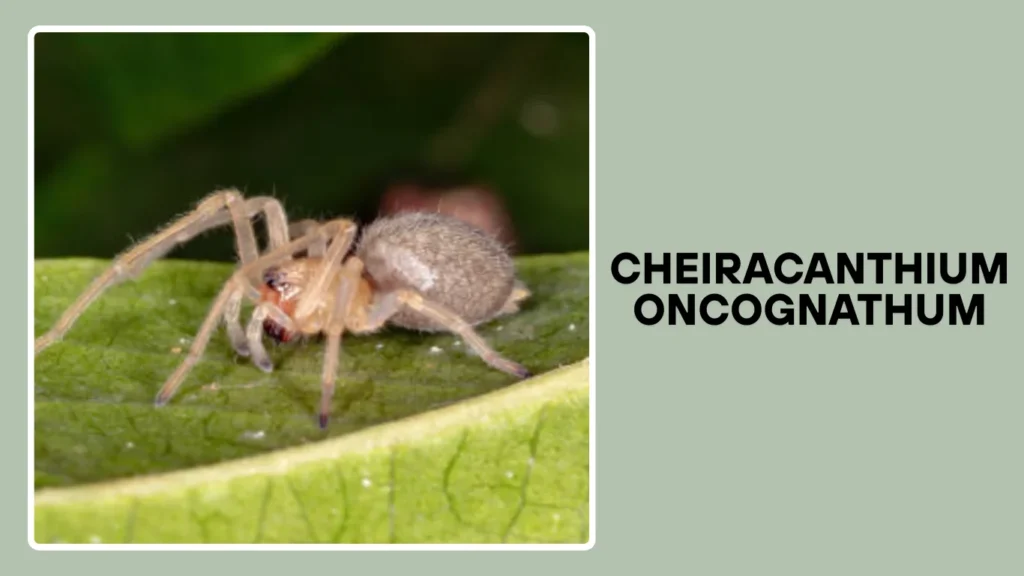
Cheiracanthium oncognathum is a yellow sac spider species known mostly in parts of Africa. It’s not as thoroughly studied as others in its genus but is occasionally mentioned in arachnological surveys and regional spider documentation.
Identification
- Scientific Name: Cheiracanthium oncognathum
- Color: Yellow to beige with slightly darker leg joints
- Size: Typically 5–7 mm in body length
- Legs: Long, smooth, and fast-moving
- Eye Pattern: Characteristic 8-eye layout of the genus
- Found In: Southern and central Africa
- Notes: Less frequently observed compared to more urban-adapted species
Habitat
This spider inhabits dry grasslands, savannas, and occasionally agricultural areas. It builds sacs in cracks, under leaves, or inside bark. Unlike others, it rarely appears indoors.
Behavior
It is an elusive hunter, preying on insects at night. Its behavior mirrors that of better-known Cheiracanthium species, though it is adapted to warmer, drier climates.
Bite and Symptoms
Though not aggressive, its bite can cause mild discomfort. Symptoms may include a red bump, slight pain, and swelling. No severe medical issues are commonly associated with this species.
8. Cheiracanthium elegans
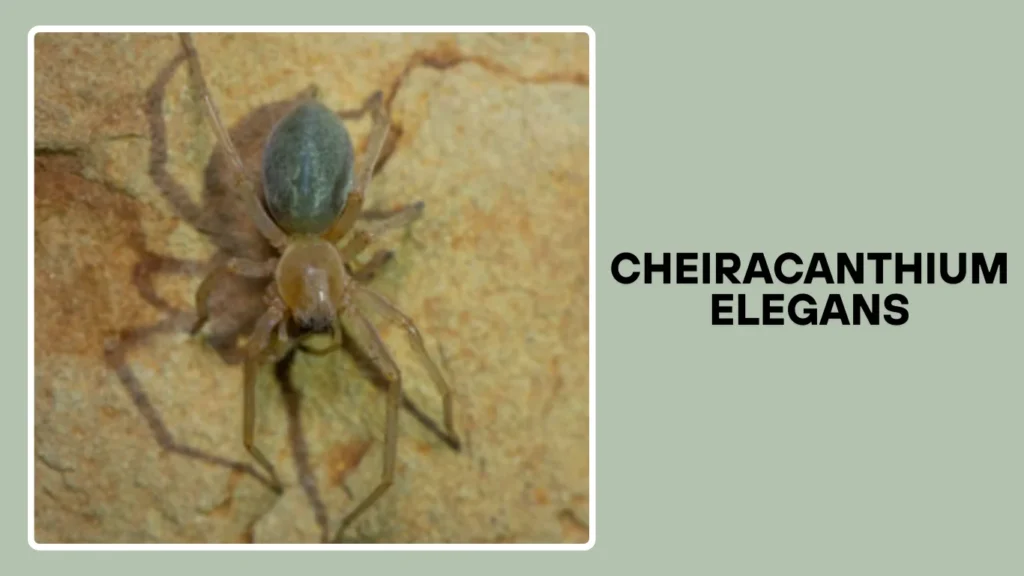
Cheiracanthium elegans is a yellow sac spider species known for its graceful appearance and smooth body. It is found in regions of Central Asia and parts of Eastern Europe, though it’s less frequently encountered by humans.
Identification
- Scientific Name: Cheiracanthium elegans
- Color: Pale yellow or cream with a glossy texture
- Size: Around 7–9 mm in body length
- Legs: Long, evenly colored, slightly translucent
- Eye Pattern: 8 eyes arranged in two rows
- Distribution: Central Asia, Russia, Eastern Europe
- Visual Feature: Sleek and uniform appearance with few markings
Habitat
This species favors open fields, meadows, and dry grasslands. It builds sac-like retreats between stones, in dense grass, or on the undersides of leaves. It is rarely found indoors.
Behavior
Cheiracanthium elegans is a calm and elusive nocturnal predator, feeding on small insects. It rarely interacts with humans and uses its silk sacs for shelter and protection.
Bite and Symptoms
Bites are extremely rare and generally harmless. If a bite occurs, symptoms may include slight burning, swelling, or mild itching. These effects usually resolve within a short time.
9. Cheiracanthium insulare
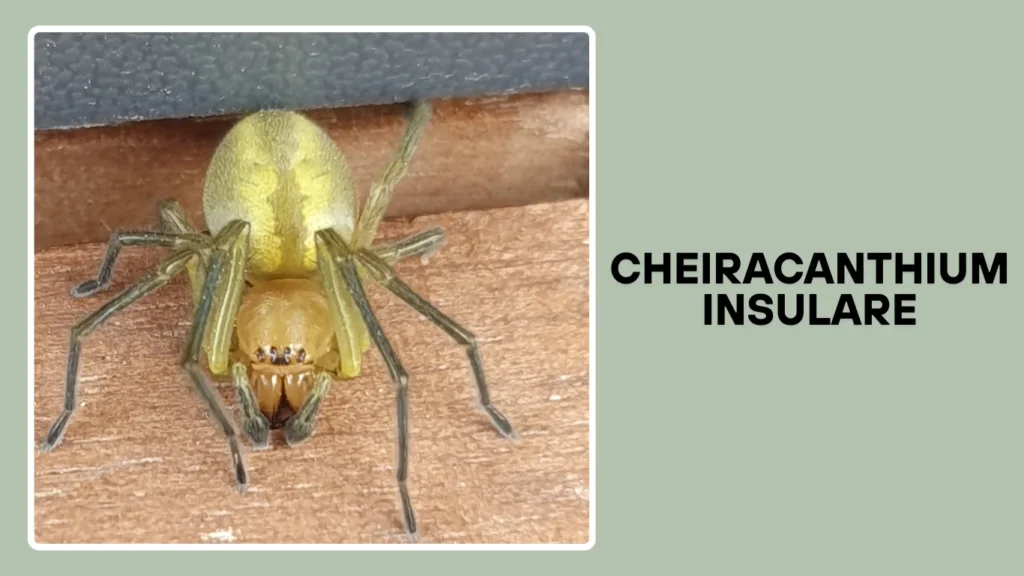
Cheiracanthium insulare is native to the Canary Islands and nearby Atlantic regions. As an island-adapted species, it shows slight differences in behavior and habitat preference compared to its mainland relatives.
Identification
- Scientific Name: Cheiracanthium insulare
- Color: Yellowish to pale beige
- Size: Approximately 6–8 mm in body length
- Legs: Long, thin, with a delicate build
- Eyes: Standard 8-eye configuration
- Distribution: Canary Islands and nearby island habitats
- Special Note: Rarely migrates or spreads beyond island environments
Habitat
This spider prefers coastal vegetation, rocky outcrops, and garden plants. It shelters in folded leaves or among rocks. It’s also occasionally seen around buildings in island towns.
Behavior
A non-aggressive and solitary spider, it hunts small prey at night and avoids human contact. It relies heavily on its silk sac for protection during daylight hours.
Bite and Symptoms
Bites are uncommon and pose no major health risks. Symptoms include slight irritation, redness, or tenderness at the bite site, typically fading within a day or two.
10. Cheiracanthium caudatum

Cheiracanthium caudatum is a lesser-known yellow sac spider species primarily distributed across Southeast Asia. Though not as well-studied as its American or European relatives, it displays many of the same traits typical of the Cheiracanthium genus.
Identification
- Scientific Name: Cheiracanthium caudatum
- Color: Yellow to pale green
- Size: Around 6–9 mm in body length
- Legs: Long and slender, often with slightly darker joints
- Range: Southeast Asia, including parts of Thailand, Vietnam, and Malaysia
- Eye Layout: Two rows of 8 eyes
Habitat
It resides in tropical and subtropical environments, including forests, fields, and sometimes plantations. It makes sac-like shelters on plants, especially in dense vegetation.
Behavior
A nighttime hunter, it moves quickly and hides during the day in protective sacs. While rarely encountered by humans, it may bite if provoked or trapped.
Bite and Symptoms
Bites from this species are uncommon and generally mild. Reactions include temporary redness, itching, and slight swelling, resolving with basic first aid.
11. Cheiracanthium triviale

Cheiracanthium triviale is a small yellow sac spider commonly found in Japan and parts of East Asia. It is similar in appearance to other Asian Cheiracanthium species and is often spotted in gardens and green areas.
Identification
- Scientific Name: Cheiracanthium triviale
- Color: Pale yellow or light cream
- Size: 5–8 mm in body length
- Legs: Thin, long, and agile
- Distribution: Japan, Taiwan, parts of China
- Other Features: Smooth body with no strong markings
Habitat
It prefers shrubs, tall grasses, and garden beds. You may find its sac hidden between leaves or in the crevices of tree bark. It does not typically enter homes.
Behavior
Cheiracanthium triviale is a timid and fast-moving spider. It spends most of the day hiding and becomes active at night to hunt insects. It is solitary and not aggressive.
Bite and Symptoms
Its bite is harmless to humans. In rare cases, mild pain or redness may occur. No serious symptoms or long-term effects have been recorded.
12. Cheiracanthium australicum (Australian Yellow Sac Spider)

Cheiracanthium australicum is a yellow sac spider species found in Australia. Despite Australia’s reputation for dangerous spiders, this species is not considered a serious threat to humans.
Identification
- Scientific Name: Cheiracanthium australicum
- Color: Pale yellow to light tan
- Size: 6–10 mm in body length
- Legs: Long and slightly darker near the feet
- Location: Found throughout Australia
- Eye Arrangement: 8 eyes in two straight rows
Habitat
This spider lives in woodlands, grassy areas, and sometimes around houses and sheds. It constructs its signature silk sac in leaf litter, bark gaps, or between manmade objects.
Behavior
It is a cautious, nocturnal hunter that feeds on insects and small arthropods. Though it may come indoors occasionally, it avoids humans and prefers to remain hidden.
Bite and Symptoms
The bite may cause localized pain, swelling, or redness, but it is not venomous to the point of medical danger. Effects are mild and subside quickly without treatment.