

The White Crab Spider (Misumenoides formosipes), commonly known as the White-Banded Crab Spider, is a fascinating flower-dwelling predator found across North America and beyond. Known for its pure white color, crab-like stance, and stealthy hunting technique, it blends perfectly with petals to ambush pollinating insects. Despite its fierce appearance, it’s harmless to humans and is often celebrated for its role in natural pest control and ecological balance.
What Is a White Crab Spider?

The White Crab Spider belongs to the Thomisidae family, a group of crab-like spiders that hunt without using webs. Instead of spinning silk traps, these spiders rely on camouflage, patience, and lightning-fast reflexes. Their name comes from their ability to move sideways and backward, just like real crabs.
Scientific Classification:
- Scientific Name: Misumenoides formosipes
- Common Names: White Crab Spider, White-Banded Crab Spider
- Family: Thomisidae
- Venomous: Only to insects, not humans
- Preferred Habitat: Flowering plants and meadows
While often confused with the Goldenrod Crab Spider (Misumena vatia), the White-Banded Crab Spider can be distinguished by the pale horizontal band across its face and its preference for white or pink flowers.
Habitat and Distribution
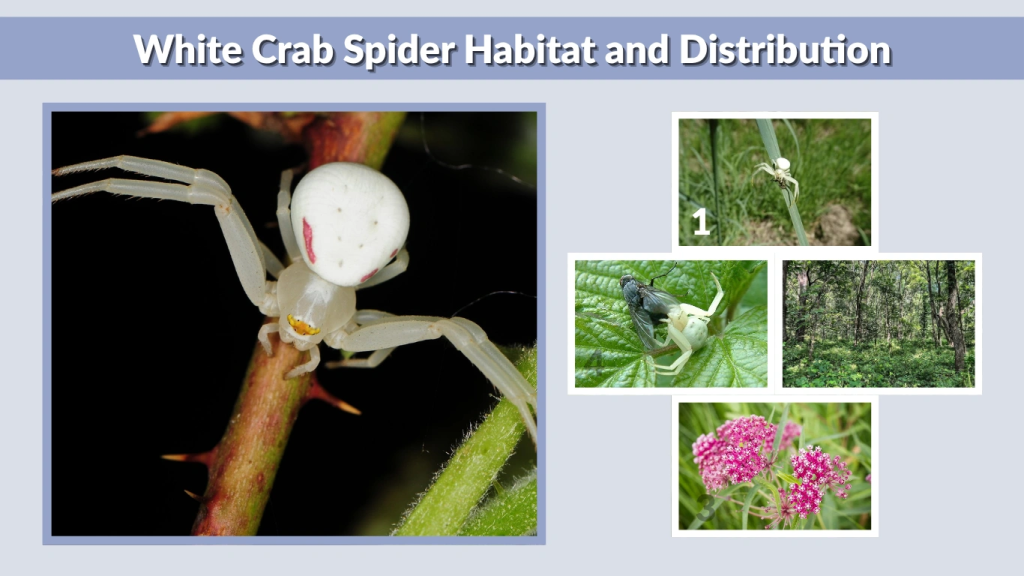
These spiders thrive in temperate and subtropical regions, particularly where wildflowers bloom. They’re commonly found across North America, including the United States and southern Canada, and are also seen in parts of Europe, Australia, and Africa.
Typical Habitats:
- Gardens and grassy meadows
- Forest edges and open fields
- Flowering plants such as daisies, milkweed, and roses
- Sunlit areas with abundant insect activity
The White Crab Spider prefers bright, open spaces, using its coloration to hide in plain sight. Its camouflage allows it to blend seamlessly with white or light-colored petals, making it nearly invisible to both prey and predators.
Physical Characteristics and Size
The White Crab Spider is compact yet strong, built for stillness and precision rather than speed. Its flattened body helps it stay close to flower surfaces, and its long front legs are designed for snatching prey with quick, powerful movements.
| Feature | Female | Male |
| Body Length | 0.25–0.4 in (6–10 mm) | 0.15–0.2 in (3–5 mm) |
| Color | White or cream with subtle pink or yellow tints | Pale brown or greenish |
| Distinctive Mark | White facial band | Lighter overall tone |
| Lifespan | 1–2 years | Less than 1 year |
Sexual Differences
Females are larger and more visible, often stationed prominently on flowers to hunt. Males, on the other hand, are smaller and less colorful, spending most of their lives searching for mates rather than prey. This sexual dimorphism ensures each plays a unique role in the species’ survival.
Color Variations
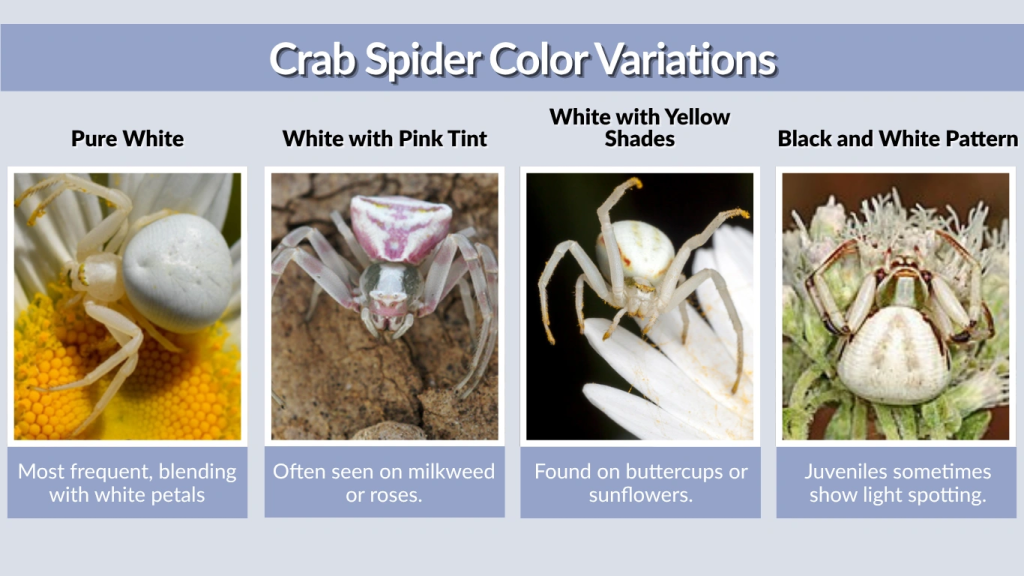
While typically white, these spiders can display subtle color variations depending on their surroundings and diet. Their hue allows them to remain concealed within floral environments.
Common Color Forms:
- Pure White: Most frequent, blending with white petals.
- White with Pink Tint: Often seen on milkweed or roses.
- White with Yellow Shades: Found on buttercups or sunflowers.
- Black and White Pattern: Juveniles sometimes show light spotting.
Though their color-changing ability is limited compared to the Goldenrod Crab Spider, the White Crab Spider’s natural pigmentation provides sufficient camouflage to make it a formidable predator.
Behavior and Adaptations
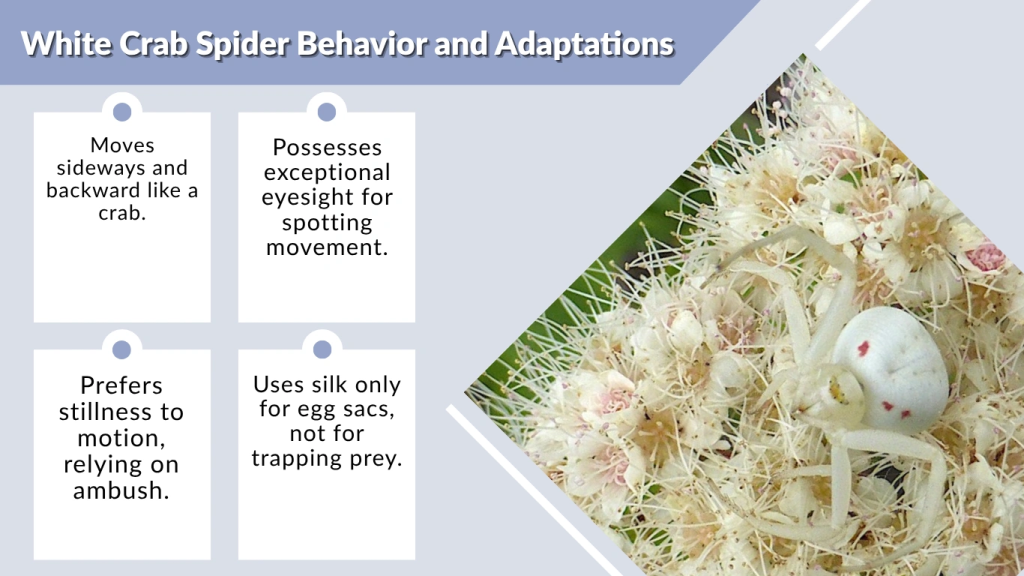
The White Crab Spider is an ambush hunter, relying on stealth rather than webs. It spends hours, sometimes days, waiting motionless on flowers, its two front legs spread wide to grab any insect that ventures too close. This technique conserves energy while maximizing hunting success.
Behavioral Traits:
- Moves sideways and backward like a crab.
- Possesses exceptional eyesight for spotting movement.
- Prefers stillness to motion, relying on ambush.
- Uses silk only for egg sacs, not for trapping prey.
- Females guard their eggs until they die.
This hunting behavior makes the White Crab Spider a key regulator of insect populations, helping maintain natural balance in gardens and meadows.
Diet and Feeding Habits
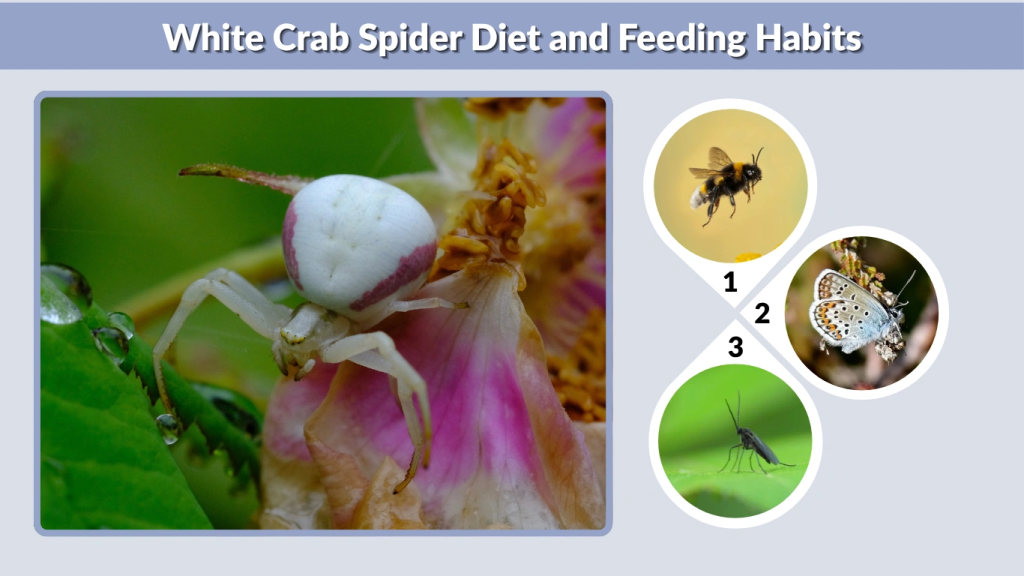
The diet of the White Crab Spider consists mainly of insects drawn to flowers for nectar and pollen. Their ambush strategy allows them to capture prey several times their own size.
Common Prey Includes:
- Bees and wasps
- Butterflies and moths
- Flies and gnats
- Small beetles
Once the prey is caught, the spider injects paralyzing venom to immobilize it instantly. The venom breaks down the insect’s internal tissues, allowing the spider to suck up liquefied nutrients through its fangs.
This efficient feeding behavior provides both nourishment and ecological benefits — reducing harmful insects while keeping pollinator populations in balance.
Venom and Human Safety
Despite common myths, the White Crab Spider is not poisonous to humans. Its venom is potent only against small insects, and its fangs are too short to penetrate human skin effectively.
Venom Facts:
- Used strictly for hunting insects
- Non-toxic to humans and pets
- Bites are rare and cause only mild redness
- The species is non-aggressive by nature
In gardens and wildflower areas, their presence is entirely beneficial. They pose no threat to people and should be seen as allies in maintaining healthy ecosystems.
Life Cycle and Reproduction
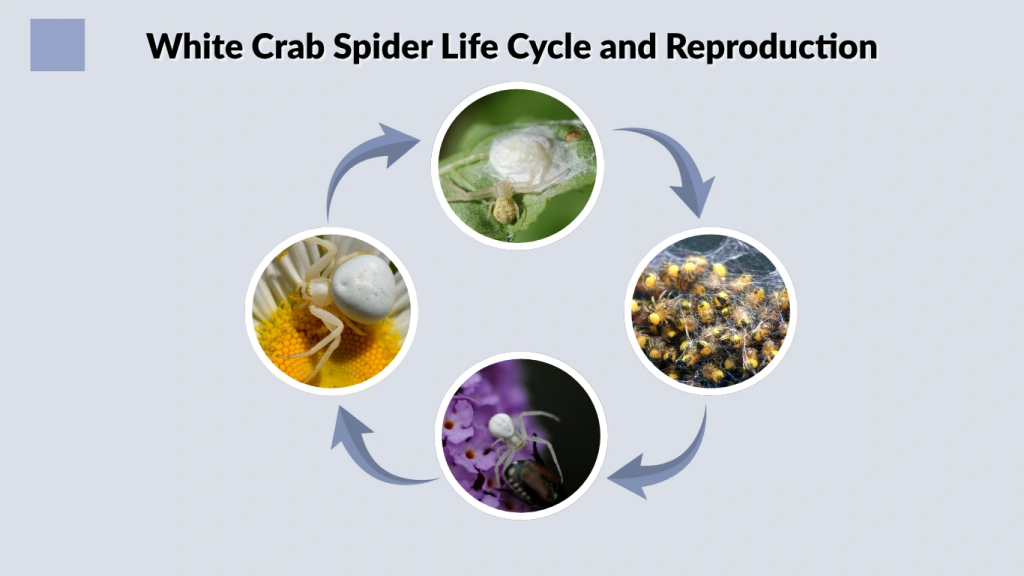
The White Crab Spider follows a fascinating life cycle that mirrors most crab spider species but with distinct adaptations for flower-based living.
Egg Stage
After mating, the female constructs a silk sac beneath a leaf or flower petal. Inside, she lays between 100–200 eggs. The sac is camouflaged and guarded fiercely, with the female refusing to eat or move far until the spiderlings hatch.
Spiderling Stage
Spiderlings emerge after about 2–3 weeks and begin their lives as miniature hunters. They disperse using a behavior called ballooning — releasing silk threads that catch air currents and carry them to new habitats.
Juvenile to Adult
During growth, spiderlings molt several times, shedding their exoskeletons to expand. By late spring or early summer, they reach adulthood and establish hunting territories on flowers. Females usually survive longer, sometimes up to two years, while males live shorter lives focused on mating.
Predators and Threats

Despite their excellent camouflage, White Crab Spiders face natural dangers from larger predators and environmental stressors.
Common Predators:
- Birds such as warblers and sparrows that can detect movement.
- Parasitic Wasps that lay eggs on spiderlings.
- Larger Spiders and mantises that invade their floral hunting zones.
Environmental Threats:
- Pesticide Use: Reduces insect prey and poisons spider habitats.
- Habitat Loss: Decline of wildflowers limits their natural range.
- Climate Changes: Affects blooming seasons and prey availability.
Still, they adapt remarkably well to human environments and are frequently found in backyard gardens and urban parks.
White Crab Spider vs Goldenrod Crab Spider
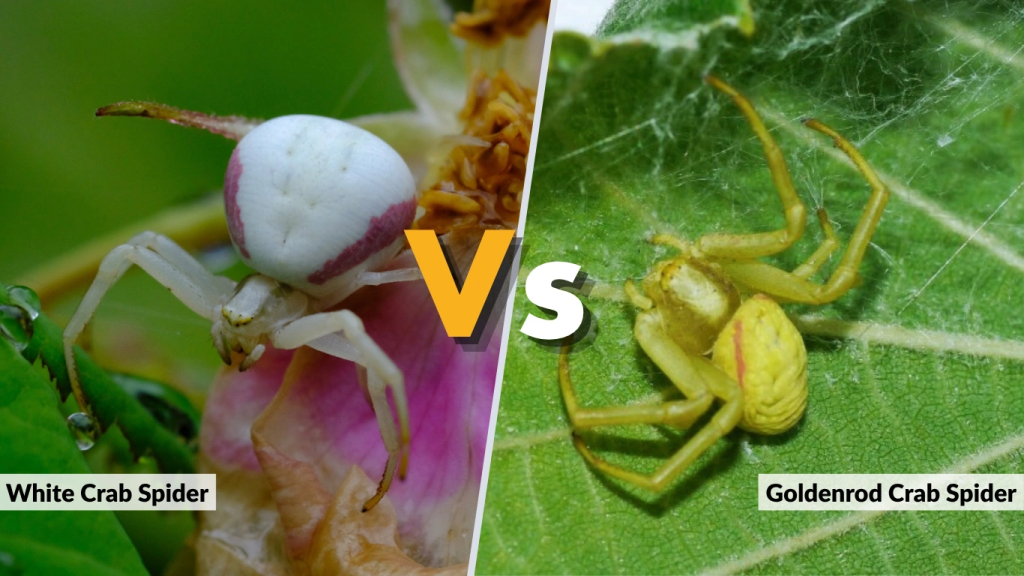
The White Crab Spider and the Goldenrod Crab Spider (Misumena vatia) are often mistaken for one another due to their similar shapes and flower-based lifestyles. However, several key differences set them apart:
| Feature | White Crab Spider (Misumenoides formosipes) | Goldenrod Crab Spider (Misumena vatia) |
| Color Range | White with faint pink or yellow bands | White or bright yellow |
| Color Change Ability | Limited | Dynamic (changes from yellow ↔ white) |
| Distinct Mark | White band across face | No facial band |
| Preferred Flowers | Daisies, roses, milkweed | Goldenrod, daisies |
| Geographic Range | North America (mainly U.S.) | North America and Europe |
While the Goldenrod Crab Spider is famous for its color-shifting camouflage, the White-Banded Crab Spider relies more on static patterning and perfect flower choice for concealment.
Hunting Strategy and Vision
Unlike web-building spiders, White Crab Spiders use ambush predation. They stay still for hours, blending with petals while waiting for prey. When an unsuspecting insect lands nearby, the spider lunges with lightning speed, immobilizing it with venom.
Key Hunting Features:
- Binocular Vision: Front eyes detect distance precisely for striking.
- Vibration Sensitivity: Hairs on legs sense flower movement from approaching insects.
- Energy Efficiency: Hours of stillness conserve energy between hunts.
Their exceptional patience and stealth make them one of the most successful ambush predators in the insect world.
Role in the Ecosystem
White Crab Spiders play a vital role in maintaining ecological balance. Their predation controls populations of flies, mosquitoes, beetles, and small bees, reducing crop and garden pests.
Ecological Benefits:
- Natural pest regulation
- Promotes balanced pollinator activity
- Provides prey for birds and small reptiles
- Indicator of low pesticide environments
Their presence signifies a healthy, biodiverse garden or meadow — an ecosystem working in harmony.
Interesting Facts About White Crab Spiders
- They can rotate their bodies 180 degrees while sitting on flowers.
- The female’s bright white body can reflect UV light, confusing insect vision.
- They do not spin webs for hunting — only silk for egg sacs.
- Juveniles may display pink, red, or black markings before molting to white.
- Their legs and stance help them maintain stability even on delicate petals.
Though small and easily overlooked, their beauty and function make them one of nature’s most efficient miniature hunters.
White Crab Spider and Human Interaction
White Crab Spiders occasionally catch the attention of gardeners and photographers due to their pure coloration and elegant posture. They are non-aggressive, preferring to retreat rather than defend.
In folklore, they symbolize patience, adaptability, and balance, representing the ability to stay still and strike only when necessary. In photography and nature art, they’re admired for their serene, sculptural appearance against colorful floral backgrounds.
FAQs
Are White Crab Spiders poisonous to humans?
No, White Crab Spiders are not poisonous. Their venom is effective only against insects. Human bites are extremely rare and result in little more than mild redness or irritation.
Where are White Crab Spiders found?
They are common throughout North America, especially in the U.S. and southern Canada. They live on flowering plants in gardens, meadows, and forest edges, blending with petals to ambush prey.
Do White Crab Spiders bite people?
They almost never bite humans. If handled roughly, they might nip in defense, but their fangs are too small to cause any harm. They are considered harmless and beneficial garden residents.
What do White Crab Spiders eat?
Their diet includes bees, butterflies, flies, and small beetles. They ambush prey on flowers, inject venom to paralyze it, and then feed on the liquefied tissues. This makes them natural pest controllers.
How long do White Crab Spiders live?
Most live between one and two years. Females usually survive through multiple breeding cycles, while males die shortly after mating in the summer season.