

Yellow and black spiders are not only visually striking but also helpful garden companions. Their bold coloring helps them blend into flowers or warn off predators. Found in gardens, forests, and even around homes, these spiders vary in size and behavior but are mostly harmless to humans. This guide highlights seven yellow and black spiders you may encounter, from web weavers to hunters, each with its own unique look.
1. Yellow Garden Spider (Argiope aurantia)

The Yellow Garden Spider is one of the most striking and recognizable orb-weaving spiders in North America. Known for its vivid yellow and black markings, it’s often seen in gardens, meadows, and near homes during late summer and fall. Its large, symmetrical web—often featuring a zigzag pattern—is just as dramatic as its bold body colors.
Identification
- Size: Females range from 19 to 28 mm; males are smaller at 5 to 9 mm
- Color: Bright yellow and deep black patterns on the abdomen
- Body Shape: Oval abdomen with a slim cephalothorax covered in silver hairs
- Legs: Long black legs with yellow or orange bands
- Markings: Abdomen has symmetrical yellow patches over a black base
Habitat and Behavior
This spider prefers sunny, open areas with low vegetation. It builds large orb webs in gardens, hedges, tall grass, and along fences. The female usually sits at the center of the web, head down, waiting for prey. These spiders are not aggressive and will often vibrate their webs rapidly if disturbed.
Bite and Human Interaction
Yellow Garden Spiders are not a danger to humans. Bites are rare and only occur if the spider is directly threatened or trapped. If bitten, symptoms may include mild swelling and redness, similar to a bee sting. They are considered beneficial predators, feeding on flies, mosquitoes, and garden pests.
Color Pattern
The body of the Yellow Garden Spider displays a bold black base with bright yellow spots and patches on the abdomen. Its legs are mostly black with orange-yellow banding. The contrast of colors not only provides camouflage among flowers and plants but also serves as a warning to predators.
2. Banded Garden Spider (Argiope trifasciata)

The Banded Garden Spider is a close relative of the Yellow Garden Spider and shares its dramatic web-building habits and striking appearance. This species is recognized by its elegant yellow, black, and white bands running horizontally across the abdomen. It’s commonly found in open grassy areas, gardens, and meadows during late summer.
Identification
- Size: Females measure 15 to 25 mm; males are smaller, around 4 to 6 mm
- Color: Yellow, black, and white bands across the abdomen
- Body Shape: Elongated oval abdomen with a smooth silver cephalothorax
- Legs: Long legs with alternating black and yellow-orange bands
- Markings: Horizontal bands give it a “striped” appearance, distinct from the patchy look of other orb weavers
Habitat and Behavior
This spider prefers tall grass, shrubs, and gardens. It spins large vertical orb webs, usually between plants or along fences. During the day, the female sits in the web’s center, sometimes adding a zigzag stabilimentum. It captures flying insects like grasshoppers, wasps, and bees.
Bite and Human Interaction
Bites from this species are rare and not considered dangerous. If they occur, the symptoms are mild—similar to a bee sting. Most people observe the spider from a distance, appreciating its appearance and pest control benefits.
Color Pattern
The Banded Garden Spider features alternating black and yellow horizontal stripes across its abdomen, with some white or silver highlights. Its legs are boldly banded, enhancing its visibility in the web. These markings provide camouflage and warning coloration to potential predators.
3. Golden Orb-Weaver (Trichonephila clavipes)
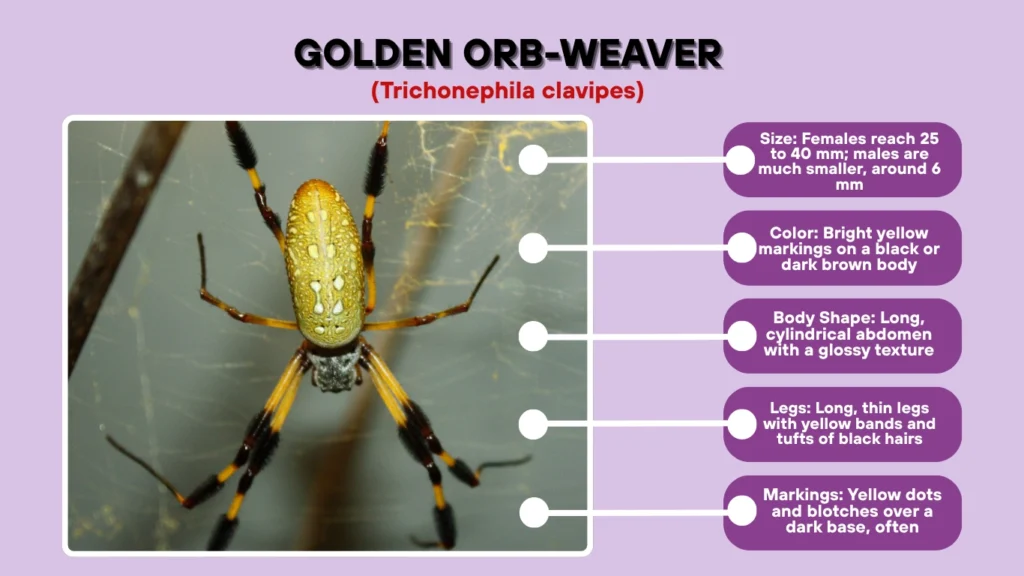
The Golden Orb-Weaver is a large, impressive spider known for its shimmering yellow silk and vibrant black and yellow body. Common in the southeastern U.S., especially in Florida and along the Gulf Coast, it often builds massive webs in forest edges, gardens, and tall shrubbery.
Identification
- Size: Females reach 25 to 40 mm; males are much smaller, around 6 mm
- Color: Bright yellow markings on a black or dark brown body
- Body Shape: Long, cylindrical abdomen with a glossy texture
- Legs: Long, thin legs with yellow bands and tufts of black hairs
- Markings: Yellow dots and blotches over a dark base, often with reddish highlights near the cephalothorax
Habitat and Behavior
Golden Orb-Weavers spin very large orb webs, often stretching several feet across. These webs are built in open areas like forest clearings, trails, and garden perimeters. The spider usually hangs head down in the center of the web during the day.
Bite and Human Interaction
While their size may be intimidating, these spiders are not dangerous. Their bite is mild, causing minor irritation at most. They are non-aggressive and beneficial for controlling flying insects.
Color Pattern
Golden Orb-Weavers have a dark brown to black body covered in bright yellow markings. Their legs are long and banded with black and yellow, and the golden hue of their silk is particularly distinctive in sunlight. Their striking appearance is a mix of beauty and camouflage.
4. Arrowhead Orb Weaver (Verrucosa arenata)

The Arrowhead Orb Weaver is a small but visually distinct spider known for its bold, triangular-shaped abdomen. While the abdomen is often white or yellow with a black outline, some individuals show a strong mix of black and yellow across the body. Found mostly in wooded areas and gardens, this spider is easy to spot in its delicate orb web.
Identification
- Size: Females range from 7 to 10 mm; males are smaller
- Color: Bright yellow or white abdomen outlined in black
- Body Shape: Triangular or arrowhead-shaped abdomen
- Legs: Short to medium length legs, usually dark brown or black
- Markings: Yellow triangular patch on the back bordered by thick black edges
Habitat and Behavior
This spider spins small orb webs in wooded gardens, shrubs, and along fences. Unlike many orb weavers, it often rests facing upward in its web. It feeds on flying insects and usually remains hidden near the web’s edge until prey arrives.
Bite and Human Interaction
Arrowhead Orb Weavers are not harmful to humans. They are shy and avoid contact. Bites are extremely rare and produce minimal irritation, if any.
Color Pattern
The most recognizable feature is the large, arrowhead-shaped yellow patch on the black abdomen. This strong contrast makes it easy to identify in natural settings. The rest of the body and legs are usually dark brown to black, enhancing its bold appearance.
5. Spinybacked Orb Weaver (Yellow Morph) (Gasteracantha cancriformis)

The Spinybacked Orb Weaver comes in several color forms, but the yellow morph with black spots is especially eye-catching. Its crab-like, spiny body shape and bright yellow coloring make it one of the most unusual spiders you’ll find in gardens and backyards.
Identification
- Size: Small; body length ranges from 5 to 9 mm
- Color: Bright yellow abdomen with bold black spots and black spines
- Body Shape: Flat, wide, crab-like body with six spines
- Legs: Short legs, typically black or very dark brown
- Markings: Six black dots spread across a bright yellow, hard exoskeleton
Habitat and Behavior
This spider builds its web in shrubs, trees, gardens, and sometimes near windows or patios. It is active during the day and typically stays in the center of its orb web. Its sharp spines serve as a deterrent to predators.
Bite and Human Interaction
Though they look intimidating, Spinybacked Orb Weavers are completely harmless to humans. Bites are rare and cause little to no irritation. They are often welcomed in gardens for their ability to catch pests.
Color Pattern
The yellow morph features a vibrant yellow abdomen adorned with black dots and six sturdy black spines. Its legs and body are mostly black or dark brown, creating a dramatic black-and-yellow contrast that helps in both defense and visibility.
6. Marbled Orb Weaver (Yellow-Black Morph) (Araneus marmoreus)
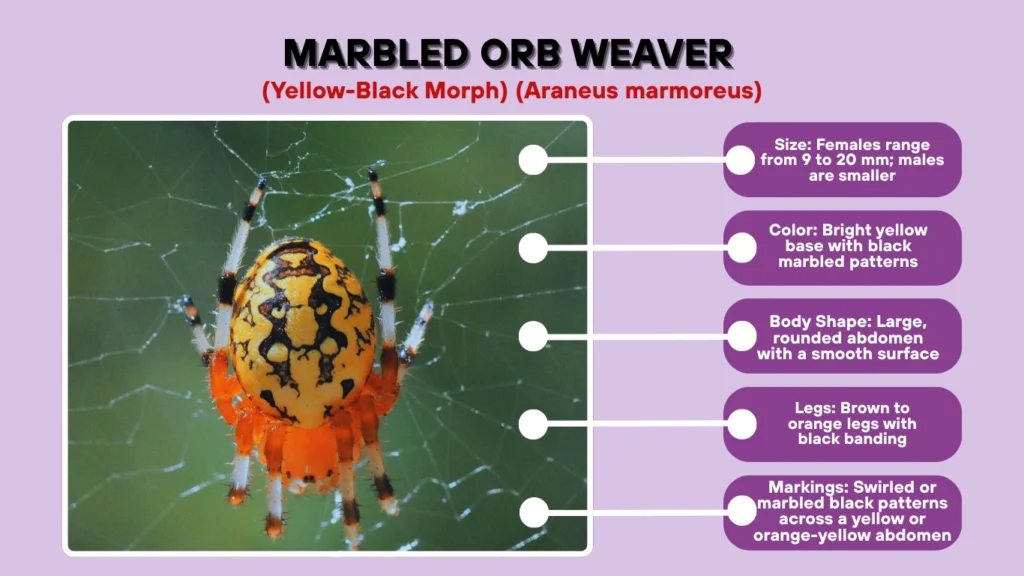
The Marbled Orb Weaver is a beautifully patterned spider that comes in several color variations, including a striking yellow and black morph. Its plump body and marbled markings make it easily identifiable in woodlands, gardens, and near water. Though it may look dramatic, it is harmless and spends its time constructing webs in quiet, natural areas.
Identification
- Size: Females range from 9 to 20 mm; males are smaller
- Color: Bright yellow base with black marbled patterns
- Body Shape: Large, rounded abdomen with a smooth surface
- Legs: Brown to orange legs with black banding
- Markings: Swirled or marbled black patterns across a yellow or orange-yellow abdomen
Habitat and Behavior
Marbled Orb Weavers favor moist environments and are often found near wooded trails, riverbanks, and forest clearings. They spin classic orb webs and are typically more active in autumn. During the day, they often hide in a curled leaf or retreat near their web.
Bite and Human Interaction
They are non-aggressive and rarely bite. If handled, a bite may cause minor itching or redness but is not considered medically significant. Most humans encounter this spider only in passing.
Color Pattern
This morph has a rich yellow abdomen covered in swirling black lines and curves, creating a marbled effect. The legs may show faint black and orange banding, enhancing the contrast with the vibrant body. Its bold coloration makes it both beautiful and easily visible in its environment.
7. Orchard Orb Weaver (Yellow-Black Morph) (Leucauge venusta)
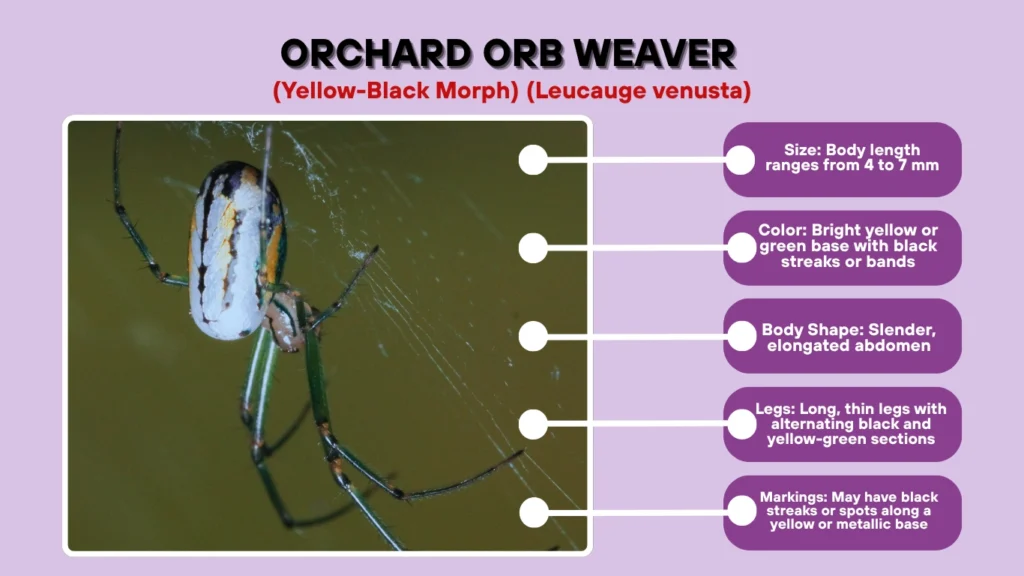
The Orchard Orb Weaver is a small, delicate spider known for its shimmering, iridescent body. Though usually greenish, some individuals show vivid yellow and black combinations across the body and legs. It’s a common spider in gardens, orchards, and along wooded trails, often spinning its web close to ground level.
Identification
- Size: Body length ranges from 4 to 7 mm
- Color: Bright yellow or green base with black streaks or bands
- Body Shape: Slender, elongated abdomen
- Legs: Long, thin legs with alternating black and yellow-green sections
- Markings: May have black streaks or spots along a yellow or metallic base
Habitat and Behavior
Orchard Orb Weavers build small horizontal orb webs in low vegetation, especially in humid areas. They are active during the day and usually hang upside down in the center of their webs. Their web silk often appears iridescent in sunlight.
Bite and Human Interaction
These spiders are completely harmless. They do not bite unless provoked, and any bite would result in extremely mild symptoms. They play an important role in controlling flying pests.
Color Pattern
The yellow-black morph has a bright yellow to greenish body with black markings along the sides or back. Its long legs often display alternating dark and yellow segments, making the spider look elegant and slender. In sunlight, its body may shimmer with metallic reflections, adding to its distinctive beauty.
Summary:
These seven yellow and black spiders—such as the Yellow Garden Spider, Banded Garden Spider, and Golden Orb-Weaver—are easy to recognize due to their vivid color patterns and distinctive webs. Although their appearance may seem intimidating, they are non-aggressive and beneficial in managing insect populations. Whether spinning webs in shrubs or lurking near the forest edge, these colorful spiders are a fascinating and essential part of local ecosystems.