
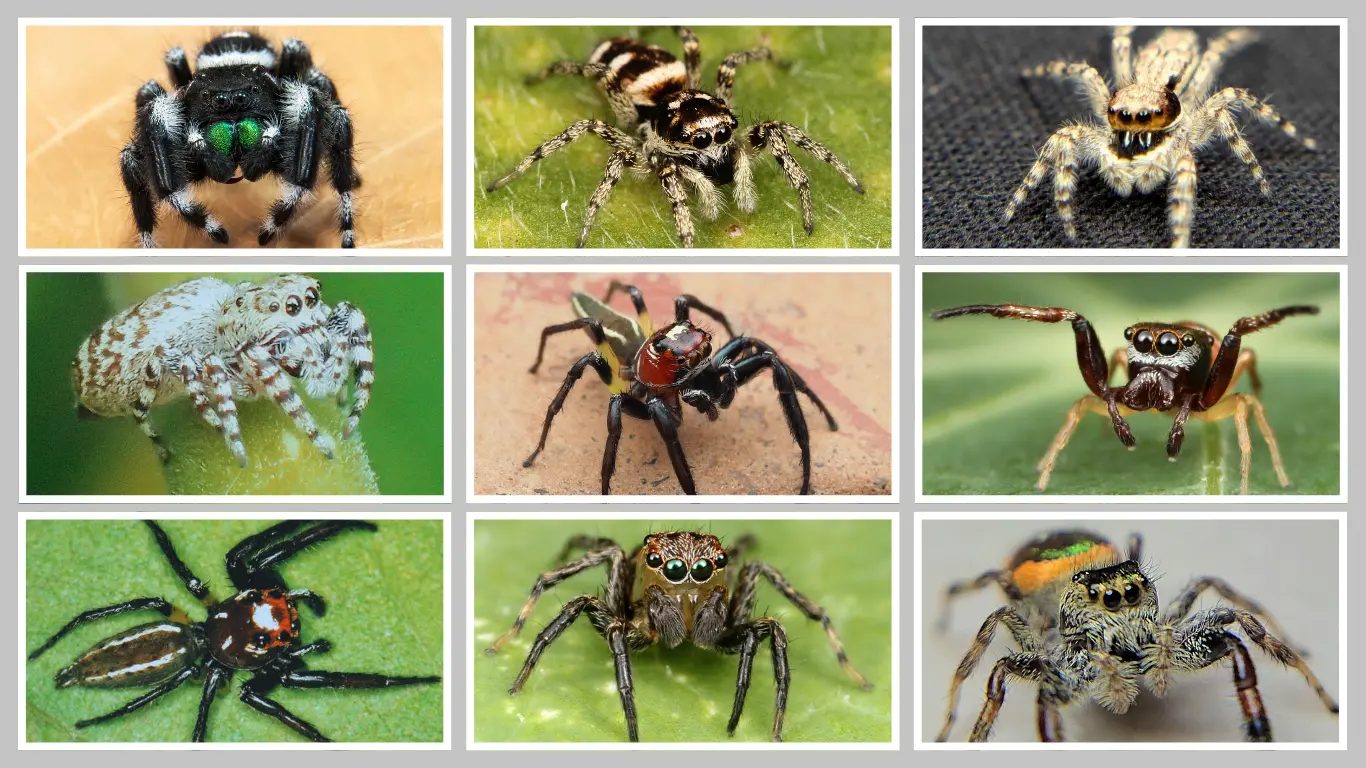
Black and white jumping spiders are not just visually captivating—they’re also agile hunters with unique personalities. From the bold patterns of Phidippus audax to the sleek stripes of Salticus scenicus, these spiders come in a wide range of sizes and styles. Whether you’re spotting one on a sunny wall or among forest leaves, learning their features makes them easier to identify and appreciate.
1. Phidippus audax (Bold Jumping Spider)
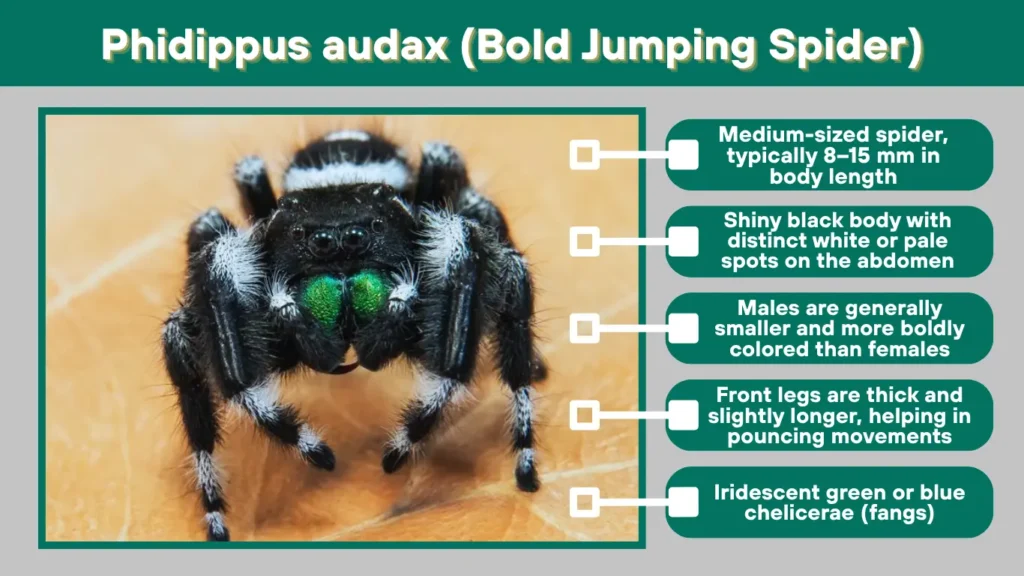
The Phidippus audax, commonly known as the Bold Jumping Spider, is one of the most recognizable black and white jumping spiders in North America. Known for its curious nature and striking appearance, this species is often spotted in gardens, homes, and fields. Its distinctive white spots and iridescent green fangs make it a favorite among spider enthusiasts and photographers.
Identification
- Medium-sized spider, typically 8–15 mm in body length
- Shiny black body with distinct white or pale spots on the abdomen
- Males are generally smaller and more boldly colored than females
- Front legs are thick and slightly longer, helping in pouncing movements
- Iridescent green or blue chelicerae (fangs)
Color Pattern
Phidippus audax features a deep black body with three prominent white dots or patches on its abdomen. These spots may vary in size and brightness. Juveniles often have orange or yellowish spots, which turn white as they mature. Their green or teal fangs add a unique, colorful contrast to their dark appearance.
Habitat and Behaviors
This species thrives in various environments—from suburban gardens and barns to grasslands and forest edges. They don’t spin webs to catch prey but instead rely on ambush and short leaps to hunt insects. They’re diurnal, often active during the day, and known for their keen vision and curious approach toward humans. Bold Jumping Spiders may wave their front legs or turn to face observers directly, adding to their bold reputation.
2. Phidippus regius (Regal Jumping Spider – White Morph)
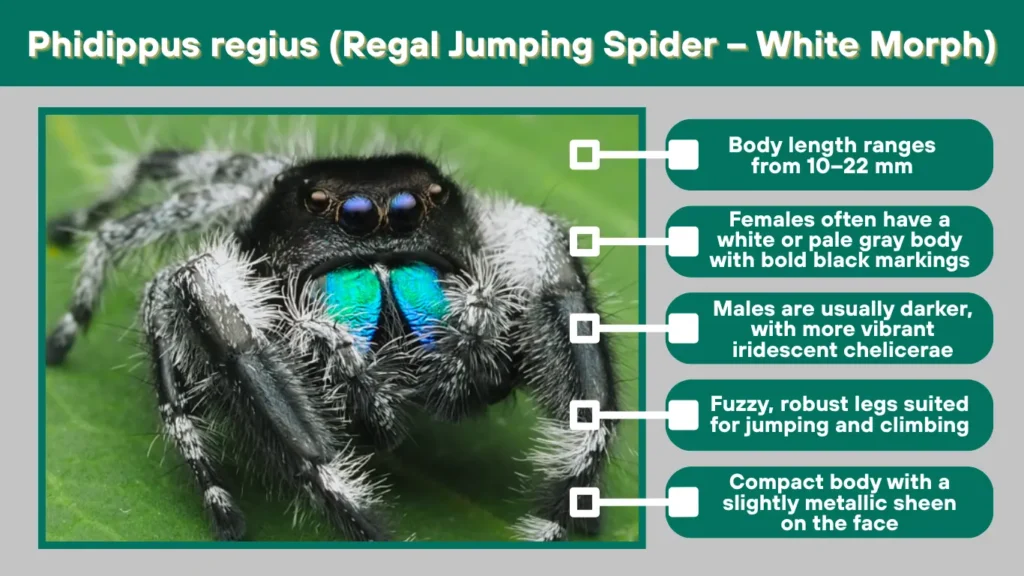
Phidippus regius, or the Regal Jumping Spider, is another striking species that comes in several color variations. The white morph, commonly seen in females, features bold black and white contrasts. It’s one of the largest jumping spiders in the United States and is well known for its gentle temperament and expressive appearance.
Identification
- Body length ranges from 10–22 mm
- Females often have a white or pale gray body with bold black markings
- Males are usually darker, with more vibrant iridescent chelicerae
- Fuzzy, robust legs suited for jumping and climbing
- Compact body with a slightly metallic sheen on the face
Color Pattern
The white morph features a predominantly white or pale gray abdomen and cephalothorax, with black stripes or spots. Some individuals may have hints of orange or tan. The iridescent green or purple fangs stand out dramatically against the light-colored body.
Habitat and Behaviors
Native to the southeastern United States, this species prefers warm climates and is commonly found in gardens, wooded areas, and around buildings. They are excellent hunters, stalking and pouncing on their prey. Unlike many spiders, Regal Jumpers are often calm when approached and are popular in the pet trade due to their docile behavior.
3. Salticus scenicus (Zebra Jumping Spider)

The Zebra Jumping Spider, scientifically known as Salticus scenicus, is a small black and white jumping spider known for its striped pattern. As the name suggests, it resembles a miniature zebra and is commonly seen across Europe and North America, especially on sunny walls and fences.
Identification
- Small size, generally 4–8 mm
- Distinct black body with white horizontal stripes
- Short legs compared to other jumping spiders
- Large forward-facing eyes typical of jumping spiders
- Compact, rounded body shape
Color Pattern
Salticus scenicus is easy to identify thanks to its bold black and white stripes running across its body. The legs may have faint banding, and its contrasting pattern helps it blend into bark, rocks, and manmade surfaces.
Habitat and Behaviors
This species prefers vertical surfaces like walls, fences, and tree trunks, especially in sunny spots. It’s often seen actively hunting during the day, using its excellent vision to track small insects. It moves in short, jerky motions and may hop when startled. While tiny, the Zebra Jumping Spider is a curious and effective predator.
4. Menemerus bivittatus (Gray Wall Jumper)
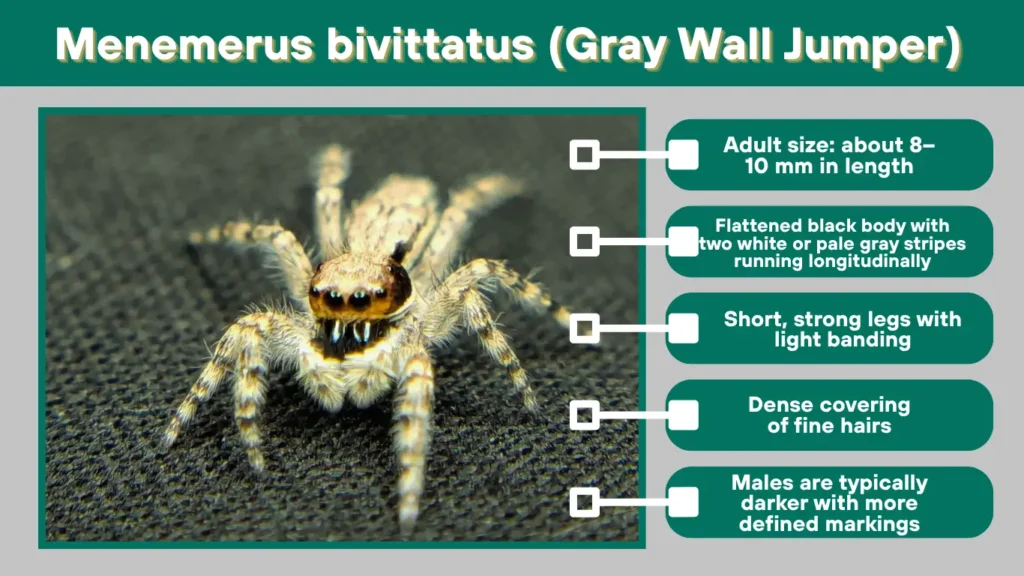
Menemerus bivittatus, commonly known as the Gray Wall Jumper, is a widespread black and white jumping spider often found on sunlit walls, fences, and rocks. Its flattened body and fast movements make it well-suited for urban environments. Though small, it has excellent vision and agility.
Identification
- Adult size: about 8–10 mm in length
- Flattened black body with two white or pale gray stripes running longitudinally
- Short, strong legs with light banding
- Dense covering of fine hairs
- Males are typically darker with more defined markings
Color Pattern
The species has a dark brown to black base color with two white or gray stripes running from the head to the abdomen. The legs often appear lighter with some banding, giving the spider a dusty, striped look ideal for camouflage on concrete or stucco surfaces.
Habitat and Behaviors
Often seen on exterior walls, especially in tropical and subtropical regions, Menemerus bivittatus is an urban explorer. It prefers vertical, sunlit surfaces where it stalks flies and other small insects. It uses its flat body to squeeze into narrow spaces and jumps quickly when threatened. Though fast, it’s not aggressive and avoids human interaction.
5. Pelegrina galathea
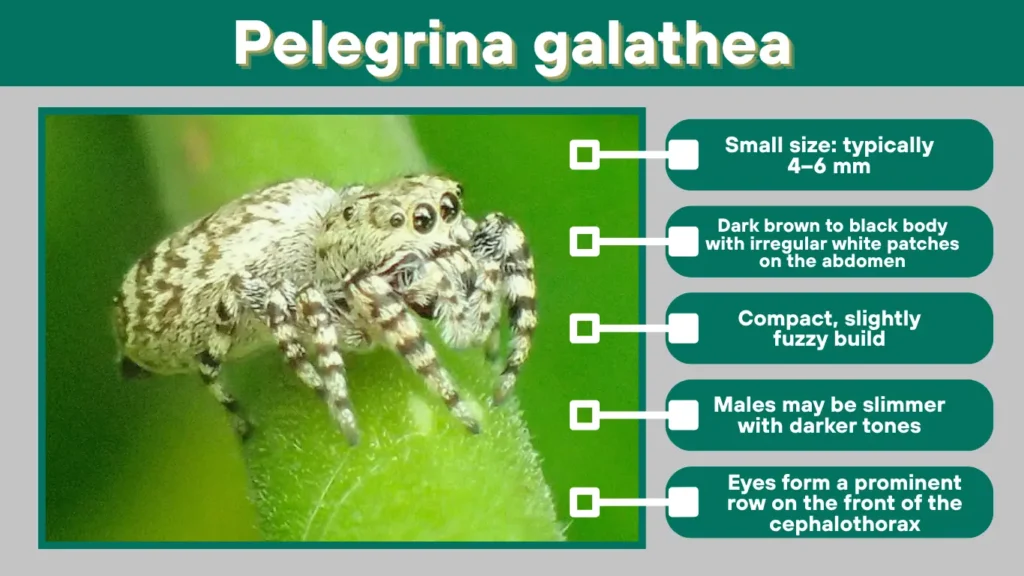
Pelegrina galathea is a less well-known but widespread black and white jumping spider found across North America. It is small and often overlooked, but close inspection reveals a charming combination of dark and light body markings and energetic behavior.
Identification
- Small size: typically 4–6 mm
- Dark brown to black body with irregular white patches on the abdomen
- Compact, slightly fuzzy build
- Males may be slimmer with darker tones
- Eyes form a prominent row on the front of the cephalothorax
Color Pattern
The color is not boldly striped but mottled—mainly black or dark brown with broken white patterns across the body. Some individuals may appear more gray than black, depending on lighting and environment.
Habitat and Behaviors
Found in leaf litter, low vegetation, gardens, and forest edges, Pelegrina galathea is a ground-level jumper. It actively hunts during the day and uses its excellent vision to spot and pounce on prey. Despite its small size, it’s curious and energetic, frequently seen investigating its surroundings.
6. Colonus sylvanus
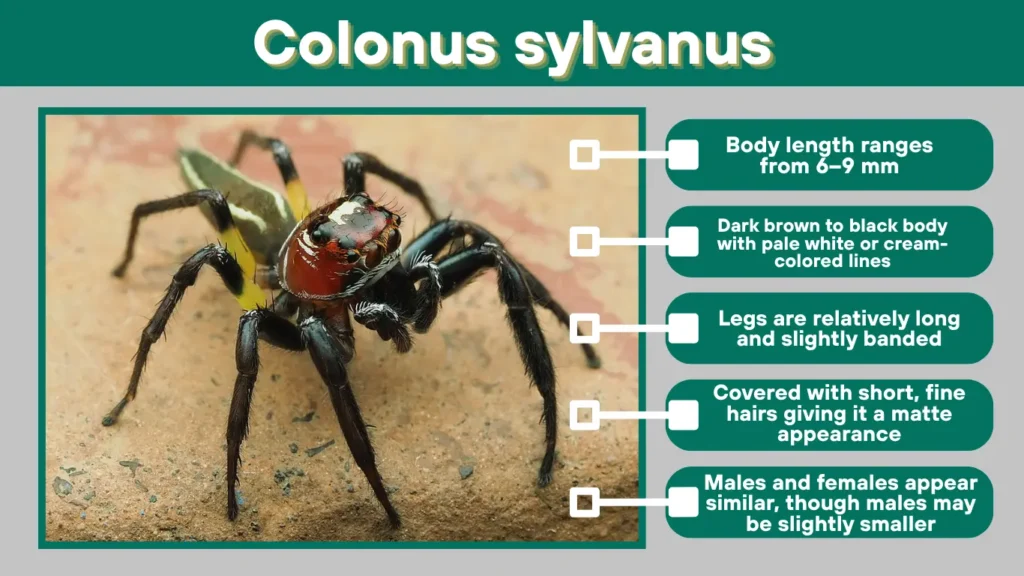
Colonus sylvanus is a medium-sized jumping spider native to parts of North and Central America. Though less famous than other species, it is often spotted in wooded areas and gardens. This spider features subtle black and white markings, blending easily into its natural habitat.
Identification
- Body length ranges from 6–9 mm
- Dark brown to black body with pale white or cream-colored lines on the carapace and abdomen
- Legs are relatively long and slightly banded
- Covered with short, fine hairs giving it a matte appearance
- Males and females appear similar, though males may be slightly smaller
Color Pattern
The body is primarily dark with lighter stripes or spots, often giving a “shadowy” black and white appearance. These markings are not sharply defined but are enough to make the spider stand out against bark and leaves.
Habitat and Behaviors
Colonus sylvanus prefers shrubs, tree trunks, and low vegetation in forested or semi-wooded regions. It uses its agile jumping ability to ambush prey and escape threats. This spider is active in the daytime and tends to move slowly when unprovoked, relying on camouflage over speed for protection.
7. Zygoballus rufipes
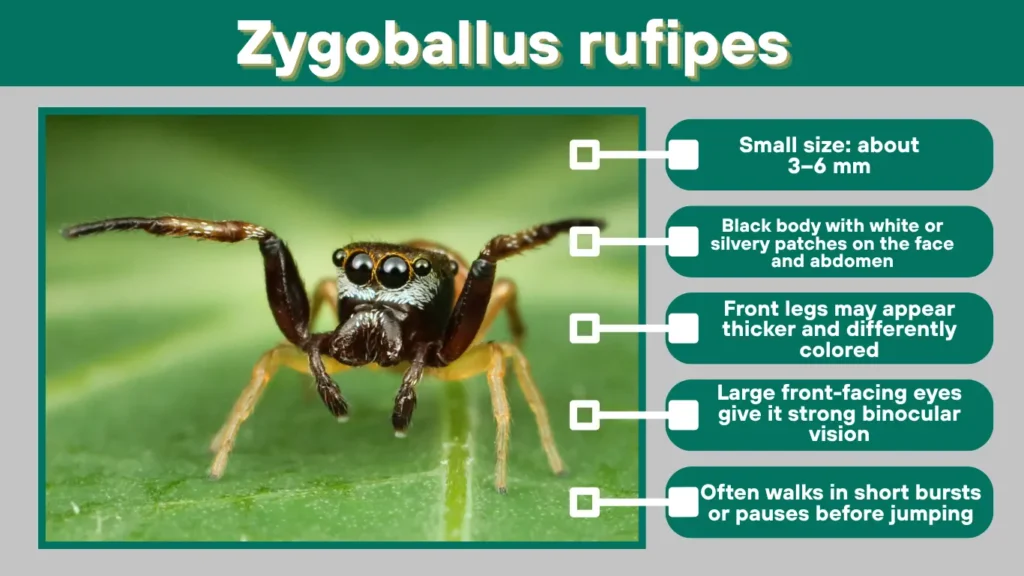
Zygoballus rufipes is a small jumping spider known for its bold stance and color variation, often appearing black with contrasting white or pale markings. Though its name refers to its red legs, some morphs have a distinctly black-and-white appearance, especially in males.
Identification
- Small size: about 3–6 mm
- Black body with white or silvery patches on the face and abdomen
- Front legs may appear thicker and differently colored
- Large front-facing eyes give it strong binocular vision
- Often walks in short bursts or pauses before jumping
Color Pattern
While the “rufipes” name suggests reddish legs, many individuals—especially males—have a shiny black body with white facial scales or spots on the abdomen. The contrasting patterns can give them a tuxedo-like look.
Habitat and Behaviors
This species is commonly found in meadows, woodlands, and occasionally near human dwellings. Zygoballus rufipes is a lively jumper that scans its environment frequently. It uses its strong vision to lock onto prey and makes calculated leaps to catch insects. Although small, its curiosity and crisp black-and-white coloring make it a standout in its range.
8. Thiodina sylvana
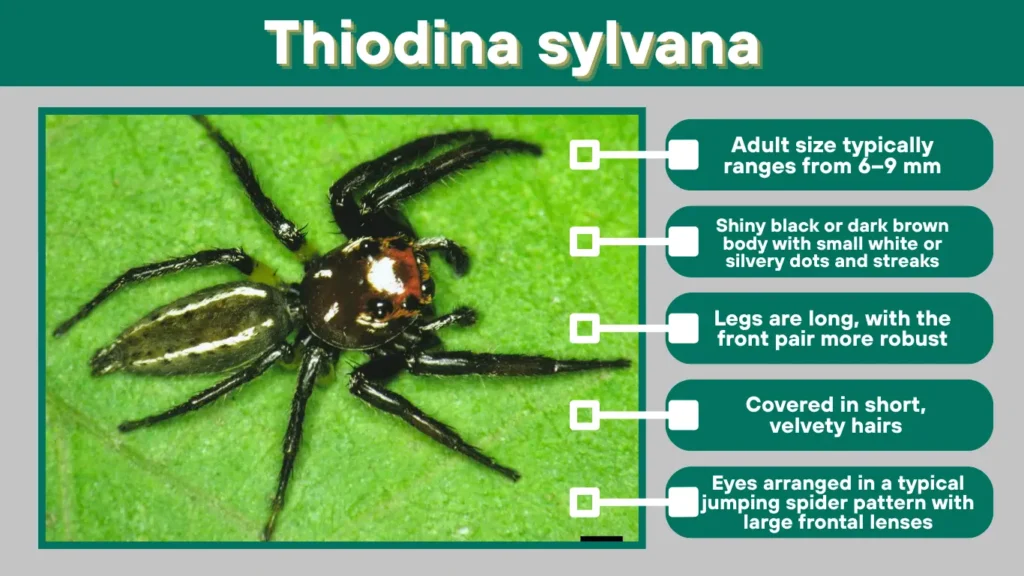
Thiodina sylvana is a sleek, agile jumping spider found in wooded and shrubby habitats throughout the eastern United States. Though not as commonly recognized as some others, this species features a dark body with subtle white markings, especially on the abdomen and legs.
Identification
- Adult size typically ranges from 6–9 mm
- Shiny black or dark brown body with small white or silvery dots and streaks
- Legs are long, with the front pair more robust
- Covered in short, velvety hairs
- Eyes arranged in a typical jumping spider pattern with large frontal lenses
Color Pattern
Its overall appearance is dark and understated, with occasional white spots or lines that may appear on the back or legs. Under the right light, some individuals may show a faint iridescent shimmer.
Habitat and Behaviors
Thiodina sylvana prefers forest edges, bushes, and low vegetation. It uses excellent vision and jumping ability to ambush small insects. Unlike web-weaving spiders, it relies on stealth and speed. It tends to be more elusive and reserved, often freezing when observed closely before making a sudden leap to safety.
9. Naphrys pulex

Naphrys pulex is a small, inconspicuous black and white jumping spider often found in leaf litter and on tree bark. Despite its tiny size, it exhibits bold movement patterns and an ability to blend into complex backgrounds, making it a well-camouflaged hunter.
Identification
- Size: 4–5 mm in length
- Dark brown to black base with irregular pale white or gray speckling
- Compact body and relatively short legs
- Faint striping or banding on legs
- Dense, fuzzy hair coverage across the body
Color Pattern
Naphrys pulex does not have sharply defined black and white contrast but rather a speckled pattern that mimics dirt, lichen, or bark. The muted tones make it a master of camouflage, especially among leaves and woody surfaces.
Habitat and Behaviors
It typically inhabits wooded areas, garden beds, and forest floors. This spider relies on both camouflage and agility to catch its prey. It’s mostly active during the day, moving with short bursts of motion, often pausing mid-step. Though rarely seen due to its size and stealth, it plays an important role in controlling insect populations in its environment.
10. Salticus peckhamae
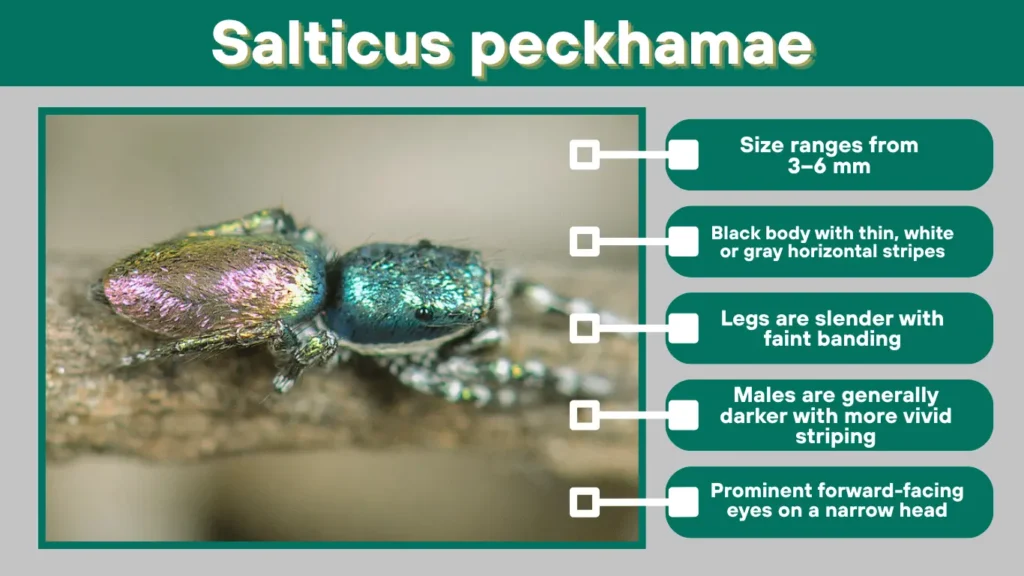
Salticus peckhamae is a small, slender black and white jumping spider that closely resembles the more common Zebra Jumping Spider. Though less widely known, it shares similar striping and quick, jerky movement. It’s often found in dry, open habitats and occasionally on buildings.
Identification
- Size ranges from 3–6 mm
- Black body with thin, white or gray horizontal stripes
- Legs are slender with faint banding
- Males are generally darker with more vivid striping
- Prominent forward-facing eyes on a narrow head
Color Pattern
This species shows fine black and white striping, often less bold than Salticus scenicus. The overall appearance is sleek and low-contrast, helping it blend into rocky or manmade surfaces.
Habitat and Behaviors
Salticus peckhamae inhabits dry, rocky areas, cliffs, fences, and walls, often in sunny environments. It’s diurnal, using vision to actively hunt tiny flies and insects. Like other Salticus species, it tends to move with twitchy, precise steps and is highly responsive to environmental changes.
11. Paraphidippus aurantius (Golden Jumping Spider – Black and White Morph)
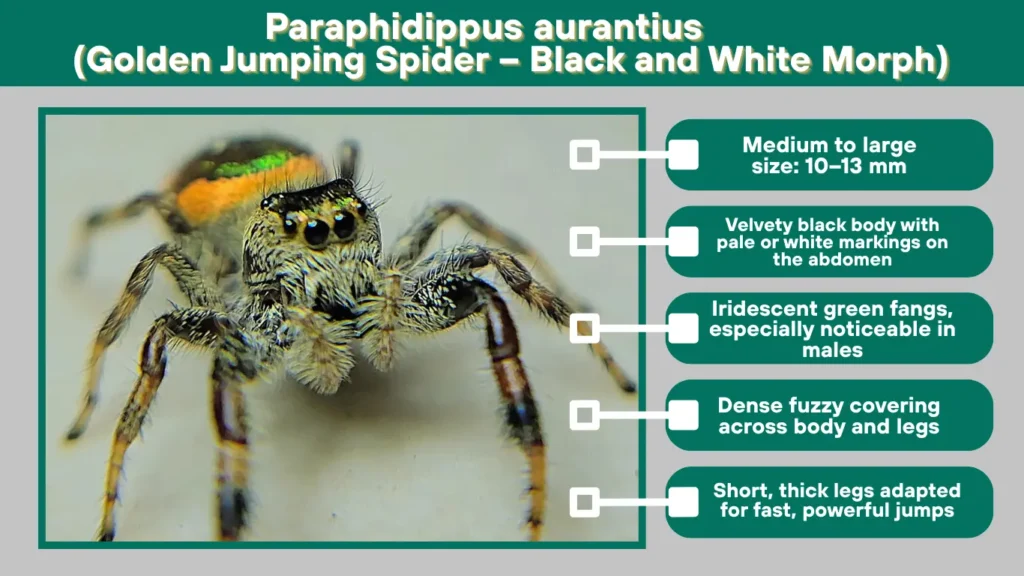
Though typically recognized for its golden or greenish sheen, Paraphidippus aurantius also exists in a black and white morph, particularly in females or younger individuals. This version features a velvet-black body with pale or white markings and striking metallic green chelicerae.
Identification
- Medium to large size: 10–13 mm
- Velvety black body with pale or white markings on the abdomen
- Iridescent green fangs, especially noticeable in males
- Dense fuzzy covering across body and legs
- Short, thick legs adapted for fast, powerful jumps
Color Pattern
The black and white morph presents a deep black base with white dots or lateral stripes on the abdomen. Combined with its green chelicerae, this gives it a bold, almost metallic look, especially under sunlight.
Habitat and Behaviors
Common in gardens, wooded edges, and urban yards across the eastern and southern U.S., Paraphidippus aurantius is both curious and highly visual. It stalks prey with patience, then leaps with pinpoint accuracy. When approached, it may raise its front legs in a defensive or curious display, a behavior typical of many jumping spiders.
Summary
This guide explores 11 types of black and white jumping spiders, covering their identification, color patterns, habitats, and behaviors. Each species brings its own mix of markings—from bold dots and stripes to fuzzy coats and iridescent fangs. Found across gardens, forests, walls, and even indoors, these spiders are harmless to humans and incredibly skilled predators. Whether you’re a nature enthusiast or curious observer, recognizing these distinct jumpers adds depth to your spider-watching experience.
