

Trapdoor spiders are some of nature’s most elusive predators, silently waiting beneath camouflaged lids to ambush unsuspecting prey. Found across the globe—from Australia to Africa and the Americas—these spiders are masters of concealment. With a wide range of species like the California, African Red, and Cork Lid trapdoor spiders, each type has unique adaptations suited to its environment. In this guide, we explore 20 remarkable trapdoor spider types and their secretive lifestyles.
1. California Trapdoor Spider
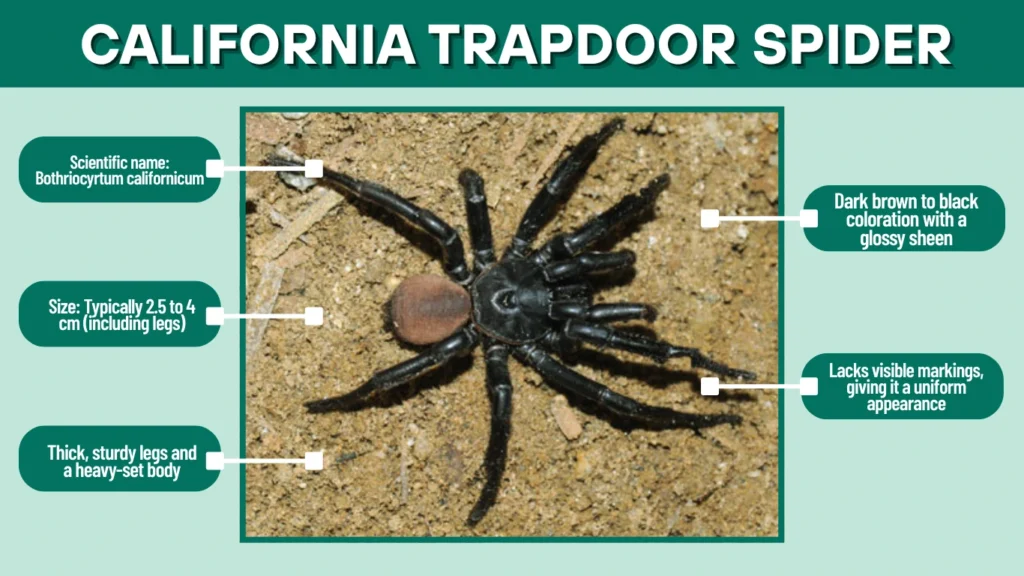
The California Trapdoor Spider is a native species found along the Pacific Coast of the United States. Known for its secretive nature and burrow-dwelling lifestyle, this spider spends most of its life underground. It constructs a camouflaged lid for its burrow, which it uses to ambush prey. Though it may look intimidating, it is generally harmless to humans.
Identification
- Scientific name: Bothriocyrtum californicum
- Size: Typically 2.5 to 4 cm (including legs)
- Thick, sturdy legs and a heavy-set body
- Dark brown to black coloration with a glossy sheen
- Lacks visible markings, giving it a uniform appearance
Color Pattern
The body is typically a dark, shiny brown or black, often mistaken for tarantulas due to its bulky appearance. It has no bright markings or patterns, which helps it stay hidden in soil or leaf litter.
Habitat and Behaviors
Found primarily in Southern California, this species prefers dry, sandy or loose soil environments like hillsides, canyons, and scrublands. It digs deep vertical burrows with a silk-lined interior and a hinged trapdoor made of soil and silk. The spider hides beneath the door and strikes quickly at unsuspecting insects passing by. Despite its fierce hunting method, it avoids confrontation with humans and rarely bites.
2. Australian Trapdoor Spider

The Australian Trapdoor Spider refers to a group of native spiders found throughout Australia, known for their burrowing behavior and powerful bite. These spiders are often mistaken for funnel-webs due to their size and appearance, but they are less aggressive and rarely dangerous to humans.
Identification
- Belongs to several genera, including Misgolas, Cteniza, and Gaius
- Size ranges from 2.5 to 4.5 cm (excluding legs)
- Thick legs with visible spines
- Dense, hairy body—usually brown or dark gray
- Males are typically smaller and more slender than females
Color Pattern
Australian trapdoor spiders vary in color from reddish-brown to black. Some may appear dull or dusty due to soil particles sticking to their fine body hairs. Their lack of distinctive patterns allows them to blend into their natural habitat.
Habitat and Behaviors
They prefer forest floors, gardens, and bushlands with compact or sandy soil. The spider builds a silk-lined tunnel with a sturdy trapdoor and uses vibration detection to locate prey. When disturbed, it may retreat quickly into its burrow. Females rarely leave their nests, while males wander in search of mates during breeding season. These spiders are shy and defensive rather than aggressive.
3. African Trapdoor Spider

The African Trapdoor Spider is one of the lesser-known but widely distributed species across various regions of Africa. These spiders are known for their highly camouflaged burrows and patient ambush tactics. Their bite may be painful but is not considered medically significant for humans.
Identification
- Commonly found in the genus Stasimopus
- Size ranges from 3 to 5 cm in body length
- Stocky build with strong front legs
- Smooth, shiny carapace and dark abdomen
- Fangs curve slightly inward, designed for powerful strikes
Color Pattern
African trapdoor spiders often appear dark brown to pitch black, with a slightly metallic sheen on the carapace. Their thick setae (hairs) are usually sparse, giving them a glossy look.
Habitat and Behaviors
These spiders inhabit savannas, dry forests, and arid scrublands. They excavate deep burrows and craft a tight-fitting trapdoor with surrounding materials for camouflage. Mostly nocturnal, they wait just beneath the door to seize prey that passes by. Males may roam during the mating season but otherwise, the species remains concealed underground.
4. Chinese Trapdoor Spider
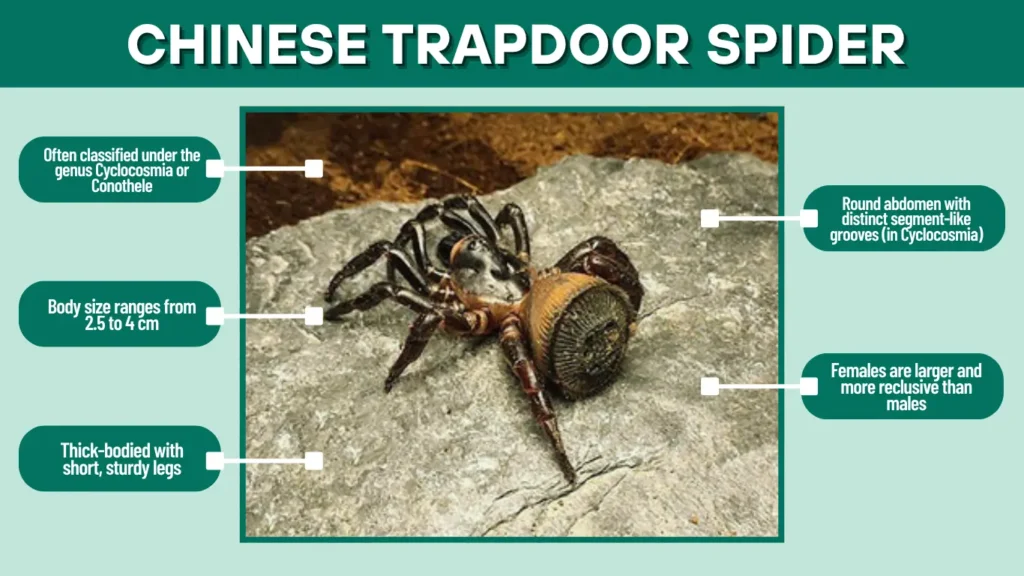
The Chinese Trapdoor Spider is native to various provinces in China and is known for its impressive trapdoor construction and secretive habits. While relatively understudied, it’s recognized for its robust body and stealthy ambush techniques. It remains underground most of its life and surfaces only to catch prey or find a mate.
Identification
- Often classified under the genus Cyclocosmia or Conothele
- Body size ranges from 2.5 to 4 cm
- Thick-bodied with short, sturdy legs
- Round abdomen with distinct segment-like grooves (in Cyclocosmia)
- Females are larger and more reclusive than males
Color Pattern
This spider typically has a dark brown to reddish-brown coloration. Its body may have subtle markings or textures but lacks strong contrast or patterns. The texture often mimics soil or bark for camouflage.
Habitat and Behaviors
The Chinese trapdoor spider prefers subtropical and forested areas with soft soil. It constructs a deep tunnel with a silk-reinforced trapdoor and remains hidden for most of its life. These spiders are ambush predators and use sensory cues from vibrations to detect prey. They’re not aggressive toward humans and only bite in self-defense.
5. Ravine Trapdoor Spider

The Ravine Trapdoor Spider is a rare species native to limited regions, especially steep, rocky terrains like ravines or cliffs. Known for its tightly sealed burrow and excellent concealment, this spider is a master of disguise in rough landscapes. Its name reflects its preferred habitat type.
Identification
- Belongs to the genus Cyclocosmia
- Size: Around 3–4 cm in length
- Rounded abdomen with armor-like ridges
- Short, muscular legs adapted for digging
- Strong jaws for burrow shaping and prey capture
Color Pattern
The Ravine trapdoor spider displays a muted palette of dark browns and grays with a matte finish. Its armored abdomen may have faint, radiating grooves, giving it a fossilized appearance that blends perfectly with stone and leaf litter.
Habitat and Behaviors
Typically found in forested ravines or rocky hillsides, this spider creates a burrow with a cork-like lid that seals flush with its surroundings. It remains hidden beneath the trapdoor and strikes instantly when prey nears. Females are sedentary, while males occasionally wander during mating periods. Despite its intimidating look, it poses no real threat to humans.
6. Cork Lid Trapdoor Spider

The Cork Lid Trapdoor Spider is named for the unique, cork-like lid it creates to seal its burrow. This lid is thick, rounded, and fits tightly into the tunnel opening, making it nearly invisible. These spiders are expert engineers and rarely leave their burrows unless absolutely necessary.
Identification
- Typically from the family Ctenizidae
- Size: 2.5 to 3.5 cm in body length
- Broad body with sturdy legs
- Females are larger and bulkier than males
- Lid of the burrow has a spongey, bark-like texture
Color Pattern
These spiders are often dark brown or black, with a matte or slightly rough texture. The legs may have faint banding, but overall the spider’s appearance is uniform, matching the soil around its burrow.
Habitat and Behaviors
Found in forest floors, gardens, and woodland edges, this spider creates a silk-lined tunnel with a thick, round “cork” lid. It spends most of its life underground, ambushing prey from beneath the door. The lid not only camouflages the entrance but also protects it from predators and environmental hazards.
7. Wafer Lid Trapdoor Spider

The Wafer Lid Trapdoor Spider constructs a flat, thin lid for its burrow—one that lies nearly flush with the ground like a wafer. Unlike the cork lid type, this spider’s door is lightweight but well-camouflaged, making it almost invisible among leaf litter or soil.
Identification
- Belongs to genera like Aptostichus and Promyrmekiaphila
- Size: 2 to 3.5 cm
- Flat, elongated body
- Slender legs and slightly tapered abdomen
- Often found in dry, rugged environments
Color Pattern
The wafer lid trapdoor spider is usually dull brown, gray, or reddish in tone. Its body tends to be dusty-looking due to soil contact, with minimal variation in coloring. This helps it blend into dry environments.
Habitat and Behaviors
These spiders are common in deserts, hillsides, and rocky terrains, especially in western North America. The wafer lid is a marvel of disguise—almost indistinguishable from the surroundings. These spiders lie in wait just under the surface, detecting vibrations from passing prey. Their lightweight lid allows for a quick strike.
8. Black Armored Trapdoor Spider

The Black Armored Trapdoor Spider is a striking species known for its tough, shiny exoskeleton and deep black coloration. Its hardened body structure provides protection from predators and environmental challenges. This spider is both powerful and elusive, living most of its life concealed in a secure underground burrow.
Identification
- Often placed in the genus Stasimopus or Idiops
- Size: 3 to 4.5 cm
- Thick, glossy black exoskeleton
- Strong, spiny legs ideal for digging
- Heavyset body with a slightly domed cephalothorax
Color Pattern
The entire body is deep black with a polished, armor-like sheen. The legs and cephalothorax may show hints of dark brown, but overall, the spider appears uniformly black—making it a fitting name for an “armored” trapdoor species.
Habitat and Behaviors
It is typically found in southern Africa and other arid or semi-arid regions. The spider constructs a silk-reinforced tunnel with a tightly sealed trapdoor, staying inside for most of its life. Its heavily armored body helps it resist dehydration and predator attacks. It ambushes insects by sensing vibrations and delivers a fast, forceful strike from below the door. Though it looks formidable, it poses little risk to humans.
9. Blue Trapdoor Spider

The Blue Trapdoor Spider stands out for its rare and shimmering blue coloration, a feature that makes it one of the most visually striking trapdoor species. Although not widely documented, its metallic hue and elusive nature have made it a subject of fascination among arachnid enthusiasts.
Identification
- May belong to genera like Idiops or Gaius
- Size: around 3 to 4 cm
- Compact body with thick legs
- Iridescent blue or bluish-black carapace
- Covered with fine hairs that enhance its metallic look
Color Pattern
The carapace and legs display a brilliant blue or bluish-black hue that can appear metallic under light. This coloration varies slightly depending on age, region, and lighting. The abdomen may be darker or more subdued compared to the carapace.
Habitat and Behaviors
Found in parts of Australia and Asia, this spider prefers shaded, humid environments with firm soil. Like other trapdoor spiders, it builds a silk-lined tunnel with a hidden lid. Despite its vivid coloring, it remains out of sight most of the time. It hunts using ambush tactics and quickly retreats into its burrow if disturbed.
10. Golden Trapdoor Spider

The Golden Trapdoor Spider is admired for its warm-toned, golden-brown body and silk-lined burrows. Though less flashy than the blue variety, its earthy coloration and excellent camouflage make it a master of stealth in leaf-covered ground.
Identification
- Typically 2.5 to 4 cm in size
- Belongs to lesser-known regional genera in Australia or Southeast Asia
- Rounded abdomen and strong digging legs
- Densely hairy with a velvety texture
- Females are more robust and rarely leave their burrows
Color Pattern
Golden trapdoor spiders range in color from light brown to honey-gold. The body is usually uniformly colored, though some individuals may have faint striping or shading. Their hair can reflect light, giving them a soft golden glow under sunlight.
Habitat and Behaviors
This spider prefers forested regions, garden beds, and jungle edges. It builds a well-hidden burrow with a tight-fitting door. The golden tones of its body help it blend perfectly into dry soil and fallen leaves. It hunts at night by sensing movement near the burrow entrance and striking quickly from beneath the door.
11. Folding Trapdoor Spider

The Folding Trapdoor Spider is named for its unique lid mechanism that folds inward like a flap rather than lifting like a hinged door. This specialized adaptation makes the burrow entrance nearly invisible to predators and prey. It’s a rarely seen spider due to its excellent concealment and reclusive nature.
Identification
- Typically belongs to the genus Galeosoma
- Size: around 2.5 to 3.5 cm
- Flattened body shape for better movement within narrow tunnels
- Legs are sturdy and slightly curved inward
- Distinctive burrow lid that folds rather than hinges
Color Pattern
Usually dark brown to black with a slightly dull or muddy appearance. The folding lid is covered in soil and silk, blending perfectly with the surface and giving the spider natural camouflage.
Habitat and Behaviors
This spider inhabits dry and semi-arid regions, often found in sparsely vegetated soils. It digs a short, silk-reinforced tunnel and creates a folding flap that seals the entrance. The spider remains hidden most of the time and lunges when it feels vibration from nearby prey. Despite its intimidating look, it avoids confrontation with humans and rarely bites.
12. African Red Trapdoor Spider

The African Red Trapdoor Spider is a bold and visually striking species with reddish-brown coloration. Native to various African regions, this spider is known for its strong burrow defenses and aggressive prey response. Its vibrant body color makes it easier to recognize compared to other local species.
Identification
- Likely belongs to the genus Stasimopus or a related African group
- Size: 3 to 5 cm in body length
- Thick legs with fine red-brown hairs
- Bulky, heavy-set abdomen
- Chelicerae are large and fang-like
Color Pattern
This spider’s body is usually reddish-brown or rust-colored, with the legs slightly darker than the cephalothorax. Some individuals show subtle striping or mottling on the abdomen.
Habitat and Behaviors
Found in savanna and woodland areas of Southern and Central Africa, the African red trapdoor spider builds deep burrows with reinforced lids. It is nocturnal and emerges only to capture prey or during the mating season. Its bite can be painful but is not considered dangerous to humans. The spider’s striking color and defensive posture can serve as a warning to potential threats.
13. Brown Trapdoor Spider
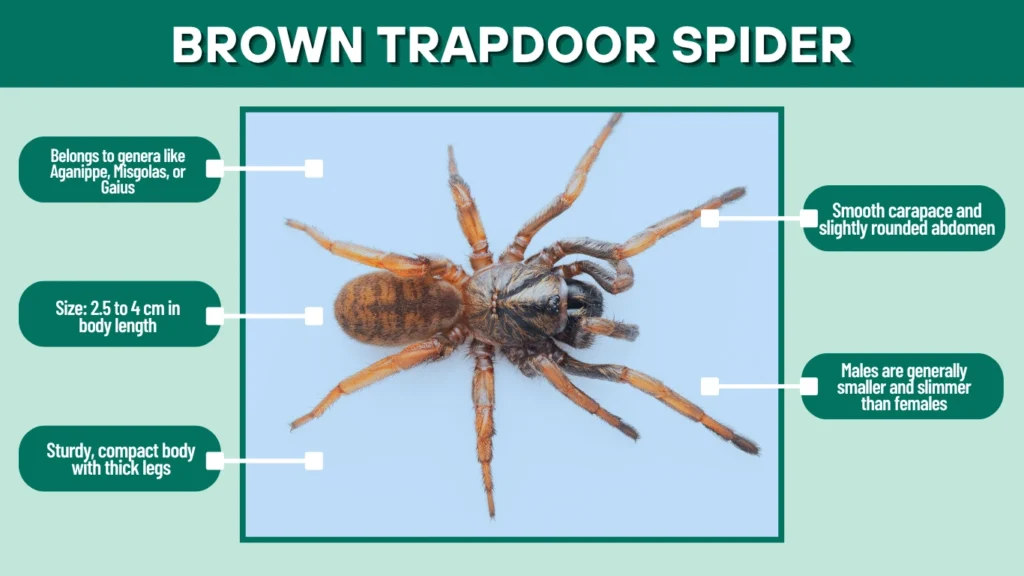
The Brown Trapdoor Spider is one of the most widespread and recognizable members of the trapdoor spider group. Its earthy tones and classic burrowing behavior make it a textbook example of this spider family. Common in forests and suburban gardens, it often goes unnoticed due to its excellent camouflage.
Identification
- Belongs to genera like Aganippe, Misgolas, or Gaius
- Size: 2.5 to 4 cm in body length
- Sturdy, compact body with thick legs
- Smooth carapace and slightly rounded abdomen
- Males are generally smaller and slimmer than females
Color Pattern
These spiders have a rich brown body—sometimes reddish or chocolate-toned—with slightly lighter legs. There are usually no distinctive markings, allowing them to blend seamlessly into soil, leaf litter, or bark.
Habitat and Behaviors
Brown trapdoor spiders prefer moist soil near wooded areas, gardens, and creek banks. They dig vertical burrows lined with silk and topped with a circular trapdoor. These spiders are ambush predators, waiting near the surface to snatch insects and small arthropods. They’re non-aggressive and will retreat into their tunnels when disturbed.
14. Brush Footed Trapdoor Spider

The Brush Footed Trapdoor Spider gets its name from the unique brush-like hairs found on its front legs. This feature enhances its sensory detection and helps it respond faster to prey movement. It is a rare and visually distinct species often found in dense foliage or leaf litter.
Identification
- Size: Typically 2.5 to 3.5 cm
- Stocky build with dense leg hairs
- Wide-set eyes on a slightly raised head
- Strong jaws and spiny legs
- Distinct tufts or brushes on the tarsi of the front legs
Color Pattern
The spider is typically a blend of dark brown and black, often with some reddish tint on the legs. The brush-like structures on its legs may appear lighter or more reflective than the rest of its body.
Habitat and Behaviors
This species prefers woodland floors with plenty of plant cover and loose soil. It builds shallow burrows with well-camouflaged lids and uses its specialized front legs to detect vibrations and catch prey. While it may look intimidating, the brush footed trapdoor spider is harmless to humans and plays a helpful role in controlling insect populations.
15. Chinese Hourglass Trapdoor Spider

The Chinese Hourglass Trapdoor Spider is a rare and intriguing species found in parts of China, named for the hourglass-like pattern or body shape observed in some individuals. With its powerful build and secretive lifestyle, this spider is a skilled predator that rarely emerges from its hidden burrow.
Identification
- Likely from the genus Cyclocosmia
- Size: 2.5 to 3.5 cm in body length
- Broad, flattened rear abdomen resembling an hourglass disk
- Short legs and compact body adapted for burrowing
- Females larger than males, both reclusive
Color Pattern
Dark brown to reddish-black, often with a hardened, disk-shaped abdomen featuring radiating grooves that resemble an hourglass. The pattern provides protection and helps seal the burrow from inside.
Habitat and Behaviors
These spiders inhabit moist, forested slopes with soft, loamy soil. They dig short, flat tunnels that terminate in a tight-fitting trapdoor. The hourglass-shaped abdomen can be used to block the entrance, a defensive mechanism seen in few spider species. They wait just beneath the door to detect and ambush small invertebrates.
16. Comstock’s Wafer Trapdoor Spider

Comstock’s Wafer Trapdoor Spider is a North American species named after arachnologist John Henry Comstock. Known for its thin, wafer-like trapdoor and inconspicuous presence, this spider is native to the western U.S. and thrives in arid habitats.
Identification
- Scientific name: Aptostichus comstocki
- Size: Approximately 2.5 to 3 cm
- Slender legs and a flattened body
- Females are darker and more robust; males are lighter and smaller
- Trapdoor is extremely thin and soil-colored
Color Pattern
This spider is generally dull brown or gray, matching the dusty environment where it lives. Its lack of bold markings makes it easy to overlook in natural settings.
Habitat and Behaviors
Found in California and nearby regions, Comstock’s Wafer Trapdoor Spider favors dry, sloped ground with loose soil. It constructs a silk-lined burrow with a fragile, camouflaged door that lies flush with the ground. Despite its delicate trapdoor, the spider is a patient ambush predator, quick to strike insects that pass nearby. It is not aggressive and poses no threat to people.
17. Fagilde’s Trapdoor Spider
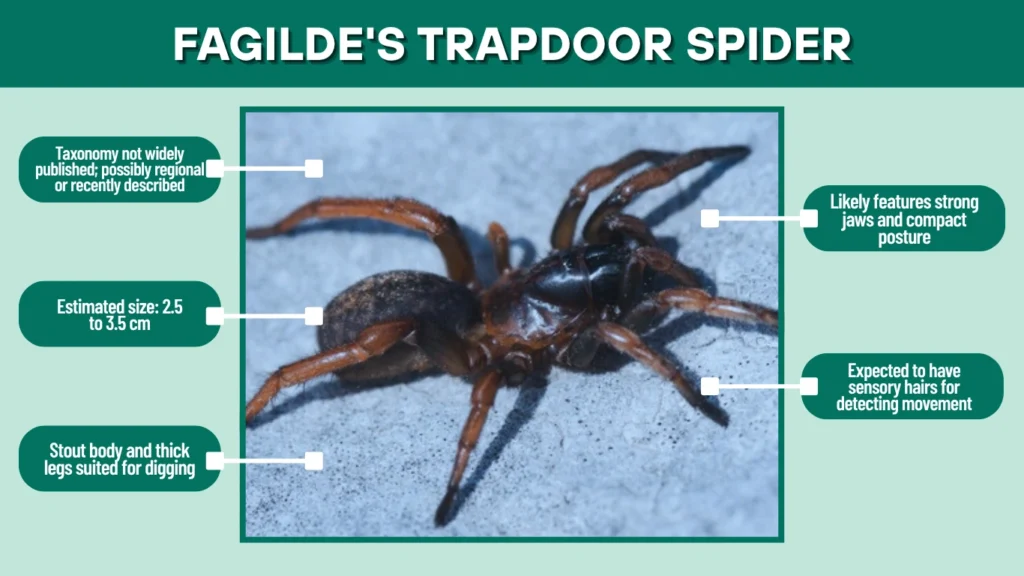
Fagilde’s Trapdoor Spider is a lesser-known species, named after its discoverer or the region it was first identified in. Though not widely documented, it is believed to exhibit the classic trapdoor behavior of constructing silk-lined tunnels with concealed lids for ambush hunting.
Identification
- Taxonomy not widely published; possibly regional or recently described
- Estimated size: 2.5 to 3.5 cm
- Stout body and thick legs suited for digging
- Likely features strong jaws and compact posture
- Expected to have sensory hairs for detecting movement
Color Pattern
Most likely dark brown or black with a matte or earthy texture that blends with surrounding soil. The spider likely has minimal markings, aiding in camouflage around its burrow.
Habitat and Behaviors
Fagilde’s Trapdoor Spider likely inhabits forest floors or dry grasslands. It builds burrows topped with camouflaged trapdoors and waits below for prey to wander past. While its behaviors align with typical trapdoor spiders, further details remain limited due to its rarity or regional isolation.
18. Pine Rockland Trapdoor Spider

The Pine Rockland Trapdoor Spider (Ummidia richmond) is a rare and recently described species native to the endangered pine rockland habitat of southern Florida. Its discovery highlighted the importance of preserving unique ecosystems that house rare, cryptic species.
Identification
- Scientific name: Ummidia richmond
- Size: Around 2 to 3 cm
- Robust, velvety black or dark brown body
- Thick legs with fine sensory hairs
- Males are more mobile, females remain burrowed for life
Color Pattern
Typically a uniform dark brown or black, lacking vivid markings. The body is slightly shiny with dense, velvety hairs that can collect soil for additional camouflage.
Habitat and Behaviors
This spider is found only in the disappearing pine rockland habitats of southern Florida. It constructs deep, silk-lined tunnels with flat trapdoors and spends nearly its entire life underground. It hunts by ambush, detecting vibrations on the soil surface. As an endangered habitat specialist, it is extremely rare and under protection due to its fragile environment.
19. Southern Trapdoor Spider (Ummidia audouini)

The Southern Trapdoor Spider, scientifically known as Ummidia audouini, is a secretive, burrowing species found in the southeastern United States. It’s one of the most recognizable members of the Ummidia genus and is known for its deep burrows and stealthy ambush strategy.
Identification
- Scientific name: Ummidia audouini
- Size: Around 2.5 to 4 cm in body length
- Compact, heavyset body with short, strong legs
- Glossy dark brown to black carapace
- Females are larger and remain in burrows; males wander to mate
Color Pattern
This species is dark brown to nearly black, with a smooth, shiny carapace and velvety abdomen. It does not display bright markings, helping it remain hidden in leaf litter and soil.
Habitat and Behaviors
Found in wooded and coastal regions of the southeastern U.S., particularly in Alabama, Georgia, and Florida, this spider digs long, silk-lined tunnels capped with a tight trapdoor. It rarely emerges and relies on its keen sensitivity to ground vibrations to catch passing prey. Though it may appear intimidating, it is non-aggressive and rarely encountered by people.
20. Eastern Stirling Range Pygmy Trapdoor Spider

The Eastern Stirling Range Pygmy Trapdoor Spider is an extremely rare and critically endangered species discovered in a small area of Western Australia. Its discovery has drawn significant attention to the conservation of microhabitats and cryptic fauna.
Identification
- Scientific name: Idiommata blackwalli or related species
- Size: Small—1.5 to 2.5 cm
- Stocky build with short legs and a wide head
- Faint banding on the legs may be visible
- Known from very limited specimens
Color Pattern
Usually a uniform light to dark brown with no bold markings. Its muted appearance helps it blend into the sandy or gravelly soils of its native region.
Habitat and Behaviors
This spider is native to the Stirling Range in Western Australia, found only in a restricted and fragile ecosystem. It builds a short burrow with a thin trapdoor and lives nearly its entire life underground. The species is at high risk due to habitat degradation and climate change. Conservation efforts are in progress to protect what may be one of Australia’s rarest trapdoor spiders.
Trapdoor Spider Bite
A trapdoor spider bite is typically not dangerous to humans, though it can be painful. These spiders are not aggressive and usually bite only when provoked or handled. The bite may cause mild to moderate symptoms such as localized pain, swelling, redness, or itching. In rare cases, more sensitive individuals may experience minor allergic reactions. Unlike venomous spiders like the black widow, trapdoor spiders do not inject medically significant venom. Their strong fangs are mainly used for subduing prey. If bitten, cleaning the area and applying a cold compress is usually sufficient, but medical attention should be sought if symptoms worsen.