The terms wood spider and wolf spider are often used interchangeably, but they actually refer to different spiders. While both are large, hairy, and intimidating to many, they vary in habitat, behavior, and physical characteristics. In this guide, we’ll explore the real differences between these two spiders and help you correctly identify which one you’re looking at.
Wood Spider vs Wolf Spider
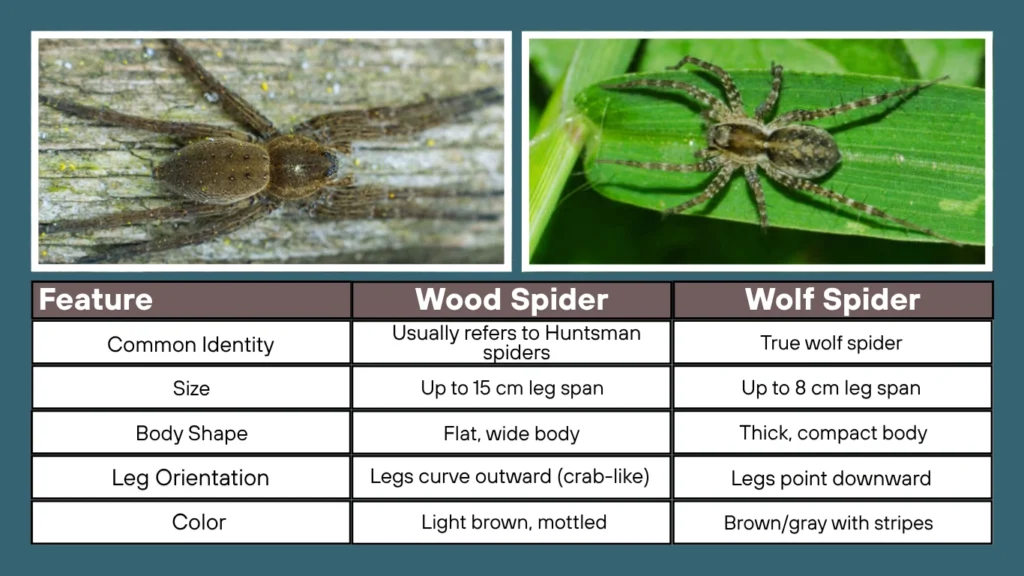
| Feature | Wood Spider (Huntsman / Nephila commonly) | Wolf Spider (Lycosidae family) |
| Common Identity | Usually refers to Huntsman spiders | True wolf spider |
| Size | Up to 15 cm leg span | Up to 8 cm leg span |
| Body Shape | Flat, wide body | Thick, compact body |
| Leg Orientation | Legs curve outward (crab-like) | Legs point downward |
| Color | Light brown, mottled | Brown/gray with stripes |
| Speed & Movement | Fast, sideways scuttle | Fast, straight-line dash |
| Eye Arrangement | 8 eyes in 2 rows | 8 eyes in 3 rows |
| Habitat | Indoors, bark, wood piles, sheds | Outdoors, leaf litter, garden areas |
| Web Use | No hunting web | No hunting web |
| Venom Risk | Mild, not dangerous | Mild, not dangerous |
What Is a “Wood Spider”?

The term “wood spider” is not a scientific classification. It’s a common name that varies by region. In most cases, people use it to refer to:
- Huntsman spiders (Sparassidae family), especially in *Australia, Southeast Asia, and the southern United States)
- Occasionally, golden orb-weavers (Nephila), but less commonly
In this article, we’ll treat wood spiders as huntsman spiders, since that’s the most widely accepted interpretation.
Size and Appearance
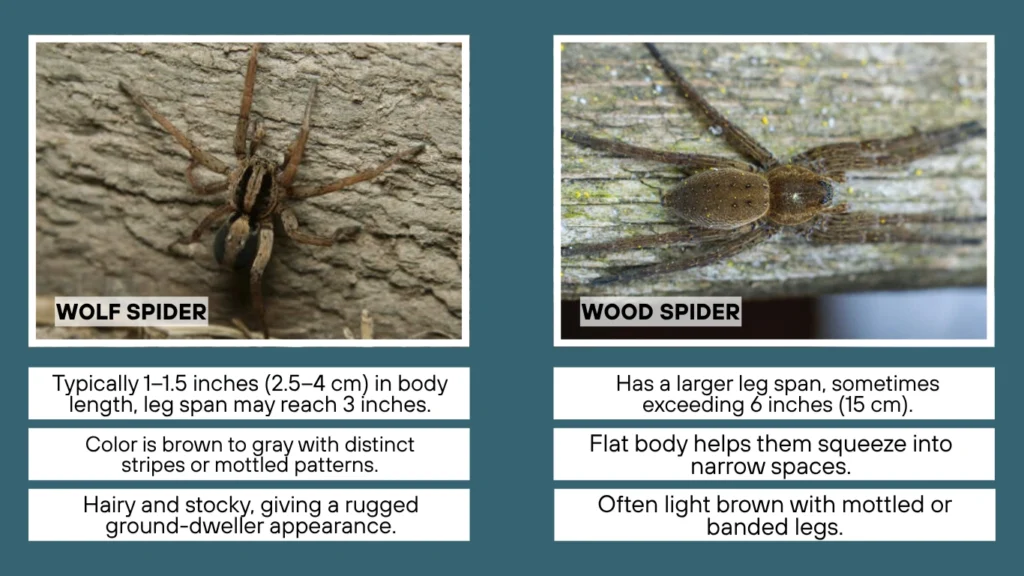
Wolf Spider
- Typically 1–1.5 inches (2.5–4 cm) in body length, leg span may reach 3 inches.
- Color is brown to gray with distinct stripes or mottled patterns.
- Hairy and stocky, giving a rugged ground-dweller appearance.
Wood Spider (Huntsman)
- Has a larger leg span, sometimes exceeding 6 inches (15 cm).
- Flat body helps them squeeze into narrow spaces.
- Often light brown with mottled or banded legs.
- Legs are extended sideways, giving a crab-like shape.
Leg Structure and Movement
- Wolf Spider: Legs point forward and downward. They move quickly in straight lines, chasing prey across the ground.
- Wood Spider: Legs are splayed outward, allowing sideways movement. They scuttle like a crab and can move very quickly when disturbed.
Eye Arrangement
- Wolf Spider: Has eight eyes in three rows:
- Four small eyes at the bottom
- Two large central eyes
- Two medium-sized eyes on top
Their middle eyes shine in light at night—great for night hunting.
- Four small eyes at the bottom
- Wood Spider: Also has eight eyes, but arranged in two curved rows. They don’t have the same strong central eye shine as wolf spiders.
Habitat and Range

Wolf Spider
- Found worldwide, especially in gardens, forests, fields, and sometimes indoors.
- Lives close to the ground—under rocks, logs, or debris.
- Does not build a web but may create silk-lined burrows.
Wood Spider
- Often lives under tree bark, in wood piles, sheds, and indoor spaces like behind furniture or baseboards.
- Found in tropical and subtropical regions, especially in Australia, Southeast Asia, Africa, and southern parts of the U.S.
Hunting and Behavior
Wolf Spider
- An active hunter that roams at night, chasing prey like beetles and ants.
- Does not use a web to catch food—relies on speed and vision.
Wood Spider
- Also a visual hunter that ambushes or chases prey.
- Stays in hidden locations during the day and becomes active at night.
- Often waits near walls or ceiling corners to catch insects.
Maternal Care and Reproduction
Wolf Spider
- Female carries egg sac on her spinnerets.
- Once spiderlings hatch, they ride on her back for several days.
- Offers significant maternal protection.
Wood Spider (Huntsman)
- Carries egg sac beneath her body and may guard it aggressively.
- Some species may help the young emerge from the sac.
- The spiderlings disperse shortly after hatching.
Venom and Danger to Humans
Wolf Spider
- Bites are rare and not dangerous.
- May cause:
- Mild pain and redness
- Slight swelling
- Mild pain and redness
- No serious medical concern for healthy adults.
Wood Spider (Huntsman)
- Large fangs can cause painful bites, especially if provoked.
- Symptoms may include:
- Pain
- Mild swelling
- Headache or fatigue (in rare cases)
- Pain
- Not considered dangerous to humans.
Key Differences at a Glance
| Trait | Wood Spider (Huntsman) | Wolf Spider |
| Common Location | Inside homes, wood piles | Gardens, under rocks |
| Movement Style | Sideways, crab-like | Direct, fast dash |
| Size | Larger (wider leg span) | Smaller but stocky |
| Eye Reflection at Night | Not prominent | Strong central eye shine |
| Maternal Care | Carries egg sac beneath body | Carries egg sac and babies on back |
| Threat Level to Humans | Low | Very low |
FAQs
1. Are wood spiders and wolf spiders dangerous?
Neither spider poses serious danger to humans. Their bites may cause minor discomfort, but they’re not aggressive. Both are more likely to flee than bite unless cornered or threatened.
2. Which one is more likely to enter homes?
Wood spiders (huntsman) are more likely to be seen indoors, especially in warmer climates. Wolf spiders prefer outdoor habitats but may accidentally wander inside during colder seasons.
3. How can I tell them apart quickly?
Check the leg orientation and movement. A spider with crab-like, sideways movement and wide stance is a huntsman (wood spider). If it runs directly and quickly, with thick legs beneath its body, it’s likely a wolf spider.
4. Should I remove them from my home?
If you’re uncomfortable, gently remove them using a container and release them outside. Both spiders are natural pest controllers and eat insects like cockroaches, moths, and flies.
5. Do they live in the same regions?
Sometimes. In warmer climates, especially in the southern U.S., both may be present. However, huntsman spiders (wood spiders) are more common in tropical areas, while wolf spiders can survive in a wider range of climates.