

Brightly colored spiders are often noticed more than most, especially when they build giant webs near our homes or in our gardens. Two such spiders are the Joro spider and the garden spider. While they may look similar at first glance, especially to those not familiar with spiders, these two species are different in several important ways. From web structure to leg patterns and behavior, there are clear distinctions once you take a closer look.
Below is a side-by-side table to help you compare their key traits before we break it all down in detail.
Joro Spider vs Garden Spider

| Feature | Joro Spider (Trichonephila clavata) | Garden Spider (Argiope aurantia) |
| Native Region | East Asia (invasive in U.S.) | North America |
| Body Size (Female) | Up to 1 inch, 3–4 inch leg span | Up to 1 inch, 2–3 inch leg span |
| Abdomen Color | Yellow with dark blue and red marks | Black and yellow pattern |
| Leg Appearance | Long, banded yellow and black | Brown to black with orange bands |
| Web Structure | Large, yellow-gold orb web | Large, clear web with zigzag center |
| Web Height | High in trees or structures | Lower in gardens and shrubs |
| Behavior | Tolerant of human activity | Shy, retreats if disturbed |
| Venom | Mild, not dangerous | Mild, not dangerous |
| Egg Sac Location | Hidden on bark or foliage | Attached near web or secure location |
Origins and Expansion

Joro spiders are native to East Asia, especially countries like Japan and Korea. They were first noticed in the southeastern United States around 2014 and have since spread rapidly through Georgia and nearby states. Because they tolerate cold weather, their population may continue to expand.
Garden spiders, also called yellow garden spiders or writing spiders, are native to North America. Unlike Joro spiders, they are well-established residents and commonly seen from late summer to fall in backyards, fields, and vegetable patches.
Appearance Differences
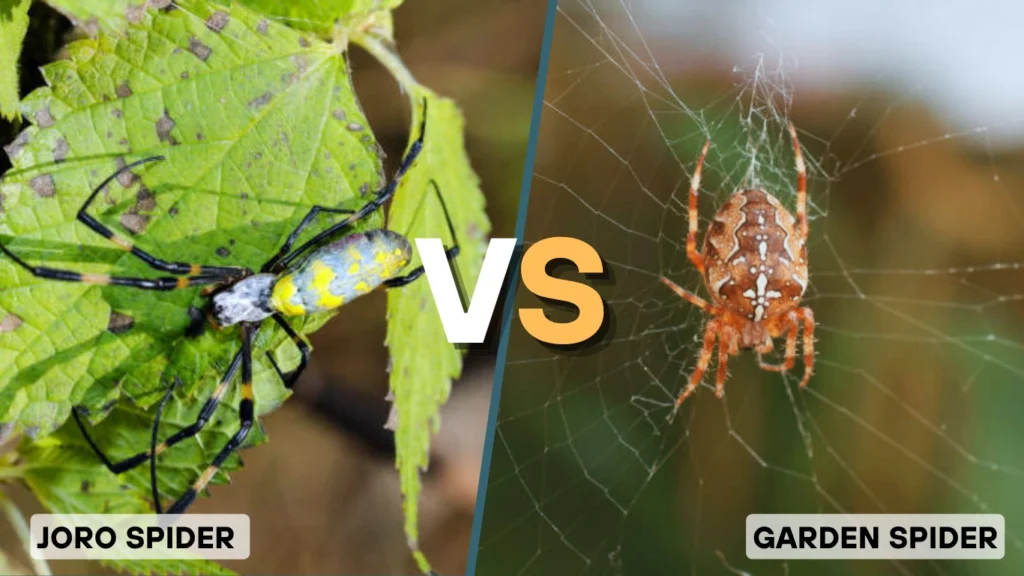
Both spiders have large, showy appearances—especially the females—but their markings and colors are different.
Joro spiders are striking with a yellow abdomen and bold black-blue vertical lines, sometimes showing reddish spots underneath. Their legs are long, thin, and banded with yellow and black, giving them an elegant look. Males are much smaller and less colorful, often going unnoticed.
Garden spiders have a black abdomen with a pattern of yellow markings, which often appear like brushstrokes. Their legs are robust and typically show black and orange or brownish bands, especially near the body. Unlike the Joro, the garden spider has a stockier frame.
Web Design and Placement
Joro spiders are known for their golden orb webs, which can span over 3 feet in diameter and shimmer in the sunlight due to the yellow tint of their silk. These webs are usually placed high off the ground, between trees, power lines, or building corners. In dense areas, you may even find several Joro webs built closely together.
Garden spiders spin classic orb webs with no gold tint. Instead, their webs are typically white or clear and feature a prominent zigzag pattern (stabilimentum) in the center. These webs are more likely to appear lower to the ground, among tall grasses, garden plants, or even fences.
Behavior and Temperament
Despite their intimidating size, both spiders are non-aggressive and beneficial to have around.
Joro spiders tend to stay still, often sitting calmly in the center of their web even if approached. They don’t spook easily and rarely abandon their web when disturbed. This calmness makes them noticeable but not dangerous.
Garden spiders are more reactive. They may retreat to the edge of the web or drop down quickly if they feel vibrations. While they rebuild their webs often and return, they’re a little more private than the Joro.
Hunting and Diet

Both spiders are orb-weavers, using their webs to catch prey rather than hunting on the ground. Their diet mainly includes:
- Flies
- Mosquitoes
- Beetles
- Moths
- Small wasps
Joro spiders may consume slightly larger prey due to their web size and leg reach. Still, both are excellent natural pest controllers in gardens and yards.
Reproduction and Egg Sac Behavior
Toward the end of the season, female spiders lay egg sacs that will overwinter and hatch in the spring.
- Joro spiders usually hide their egg sacs on tree bark, leaves, or under eaves, often away from their web. The sacs are papery and light brown.
- Garden spiders produce one or more brown, round egg sacs and attach them to nearby solid structures like stems, fences, or corners near the web.
The females of both species usually die shortly after laying eggs, leaving the sac to survive the winter.
Venom and Human Safety
Neither spider poses any danger to humans. Their venom is mild and not considered medically significant. They only bite if pressed against the skin or severely threatened, and even then, symptoms are minimal—such as slight redness or itching.
For people with spider fears, it’s worth knowing that these spiders are not just harmless—they’re helpful. Both reduce garden pests naturally, and their presence is actually a good sign of a balanced yard ecosystem.
FAQs
1. Which one is more likely to be invasive?
The Joro spider. It’s non-native to the U.S. and has shown rapid population growth since its accidental introduction. That said, it hasn’t been proven to harm native species significantly.
2. Is the garden spider native to North America?
Yes. The garden spider (Argiope aurantia) is widespread throughout North America and is considered beneficial and non-invasive.
3. How can I quickly tell the difference between the two?
If the spider is high up with yellow-and-blue colors and a golden web, it’s likely a Joro. If it’s lower down with a bold black-and-yellow body and a zigzag web, it’s a garden spider.
4. Should I remove these spiders from my garden?
No need. Both are harmless to humans and pets, and they help control insect populations. If you must relocate one, gently do so without killing it.
5. Can Joro and garden spiders coexist?
Yes. They occupy different levels and web heights, and there is little evidence of conflict or competition between the two in shared environments.