
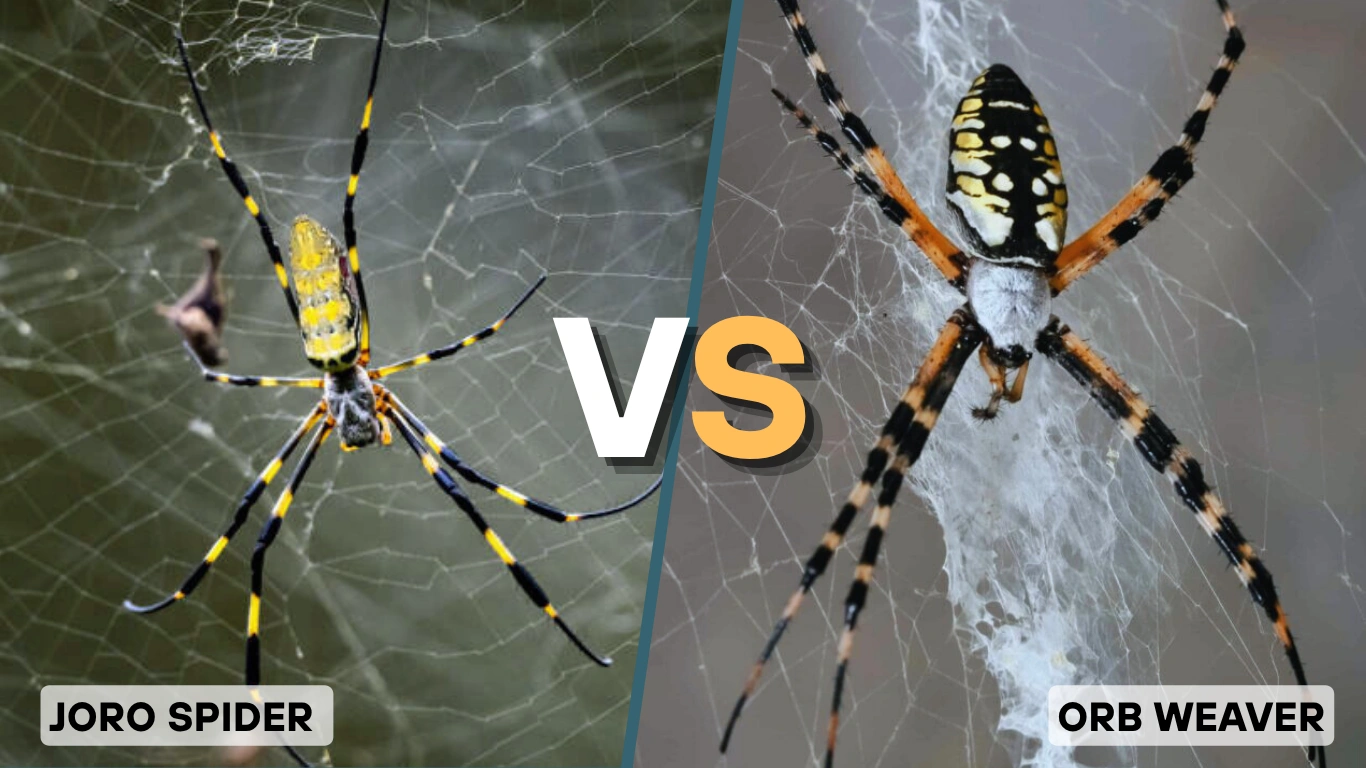
The Joro spider is a colorful new arrival making headlines in the United States, while orb weavers are a familiar backyard presence around the world. Both spiders build round, intricate webs and are often confused due to their size and appearance. But the Joro spider is actually a specific type of orb weaver, not a totally separate group. So what sets it apart from the many other orb-weaving spiders?
This article breaks down the key differences between the Joro spider and typical orb weavers—including behavior, color, web style, and regional presence.
Joro Spider vs Other Orb Weavers

| Feature | Joro Spider (Trichonephila clavata) | Other Orb Weavers (Araneidae family) |
| Scientific Classification | Orb weaver (Nephilinae subfamily) | Orb weavers (various species in Araneidae) |
| Origin | East Asia (invasive in U.S.) | Native worldwide |
| Abdomen Color | Yellow with blue and red markings | Typically brown, orange, black, or striped |
| Leg Appearance | Long, banded yellow and black | Often shorter, sometimes fuzzy or striped |
| Web Color | Golden yellow web | Clear or white web |
| Web Size | Very large (3+ feet wide) | Varies, typically smaller than Joro’s |
| Web Placement | High in trees, buildings, power lines | Lower shrubs, gardens, fences |
| Activity Time | Day and night (high visibility) | Primarily night or dusk |
| Native to U.S.? | No | Many species are native |
| Venom to Humans | Mild, not dangerous | Mild, not dangerous |
Taxonomy and Family Tree

To clarify, the Joro spider is a type of orb-weaving spider, but not all orb weavers are Joro spiders. The Joro spider (Trichonephila clavata) belongs to a subfamily called Nephilinae, which is distinct from the more common orb weavers in the Araneidae family.
Araneidae includes spiders like:
- Yellow garden spiders (Argiope aurantia)
- Barn spiders (Araneus cavaticus)
- Cross orb weavers (Araneus diadematus)
These spiders are diverse in color, shape, and size, but they all spin wheel-shaped webs and are found across North America, Europe, and beyond.
Physical Appearance
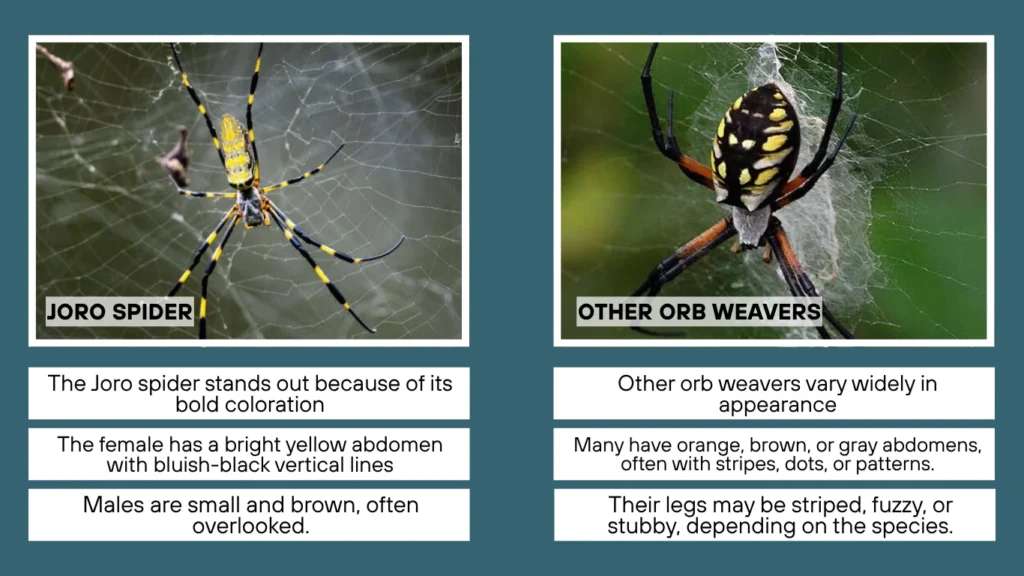
The Joro spider stands out because of its bold coloration. The female has a bright yellow abdomen with bluish-black vertical lines, red markings underneath, and long, slender legs banded in yellow and black. Males are small and brown, often overlooked.
Other orb weavers vary widely in appearance. Many have orange, brown, or gray abdomens, often with stripes, dots, or patterns. Their legs may be striped, fuzzy, or stubby, depending on the species.
While some orb weavers like the garden spider are large, few match the Joro spider’s leg span and web size.
Web Structure and Color
One of the Joro spider’s most unique features is its golden silk, which gives its orb web a yellow shimmer in the sun. These webs are not just colorful—they’re enormous, often spanning over three feet in diameter and positioned high up in trees or attached to man-made structures like power lines or porches.
Most other orb weavers create colorless or white webs, usually lower to the ground, between fence posts, shrubs, or tall grasses. Though structurally similar, their webs lack the golden sheen and massive vertical reach of the Joro’s creation.
Geographic Range and Spread
Joro spiders are native to East Asia, including Japan, Korea, and China. Since around 2014, they’ve been rapidly spreading through the southeastern United States, including Georgia, South Carolina, and Tennessee. Their ability to survive cold temperatures makes further expansion likely.
Orb weavers from the Araneidae family are native to nearly every continent, including hundreds of species in the U.S. They are part of the natural ecosystem and have well-established populations in gardens, forests, and fields.
Behavior and Temperament
Joro spiders tend to be calm and tolerant of human activity. They often sit in the center of their web during the day and don’t flee when approached. Their high-positioned webs keep them out of reach for most people.
In contrast, many common orb weavers are nocturnal or crepuscular (active at dawn and dusk). If disturbed, they may drop from the web or hide in nearby foliage. While still harmless, they tend to be shyer and more sensitive to movement than the Joro.
Egg Sacs and Reproduction
Both Joro spiders and orb weavers produce egg sacs that hatch in the spring, but their placement differs.
Joro spiders usually place their egg sacs on tree bark or leaves, sometimes in hidden crevices. Each sac can contain hundreds of eggs, which hatch into spiderlings that balloon away on silk threads in early spring.
Other orb weavers attach their egg sacs near their webs—on nearby stems, leaves, or fence posts. While both types of spiders die after laying eggs, their offspring disperse similarly and rebuild the cycle the following year.
Ecological Role and Safety
Joro spiders and orb weavers are both beneficial predators, feeding on a wide range of flying insects, including:
- Mosquitoes
- Moths
- Flies
- Beetles
- Gnats
Despite their size, they are not aggressive and rarely bite. Even if they do, their venom is mild and comparable to a bee sting at worst. Both are considered harmless to humans and pets.
FAQs
1. Is the Joro spider more dangerous than other orb weavers?
No. Joro spiders are not dangerous. Like other orb weavers, their venom is mild, and they avoid human contact. They only bite if physically pressed or provoked.
2. Why are Joro spiders spreading so quickly in the U.S.?
They likely arrived via shipping containers and thrive in suburban environments. Their ability to withstand cold winters gives them an advantage over other tropical spiders.
3. Are orb weavers good for gardens?
Yes. All orb weavers, including Joros, are natural pest controllers. They reduce harmful insect populations and require no maintenance.
4. How do I tell a Joro spider from a typical orb weaver?
Joro spiders are larger, more colorful, and spin golden webs high off the ground. Most orb weavers spin white webs lower down and are less vividly colored.
5. Should I remove Joro spiders from my yard?
No. They are non-aggressive and beneficial. If you must relocate one, gently move it using a container. Avoid using chemicals or harming them—they’re a helpful part of the ecosystem.