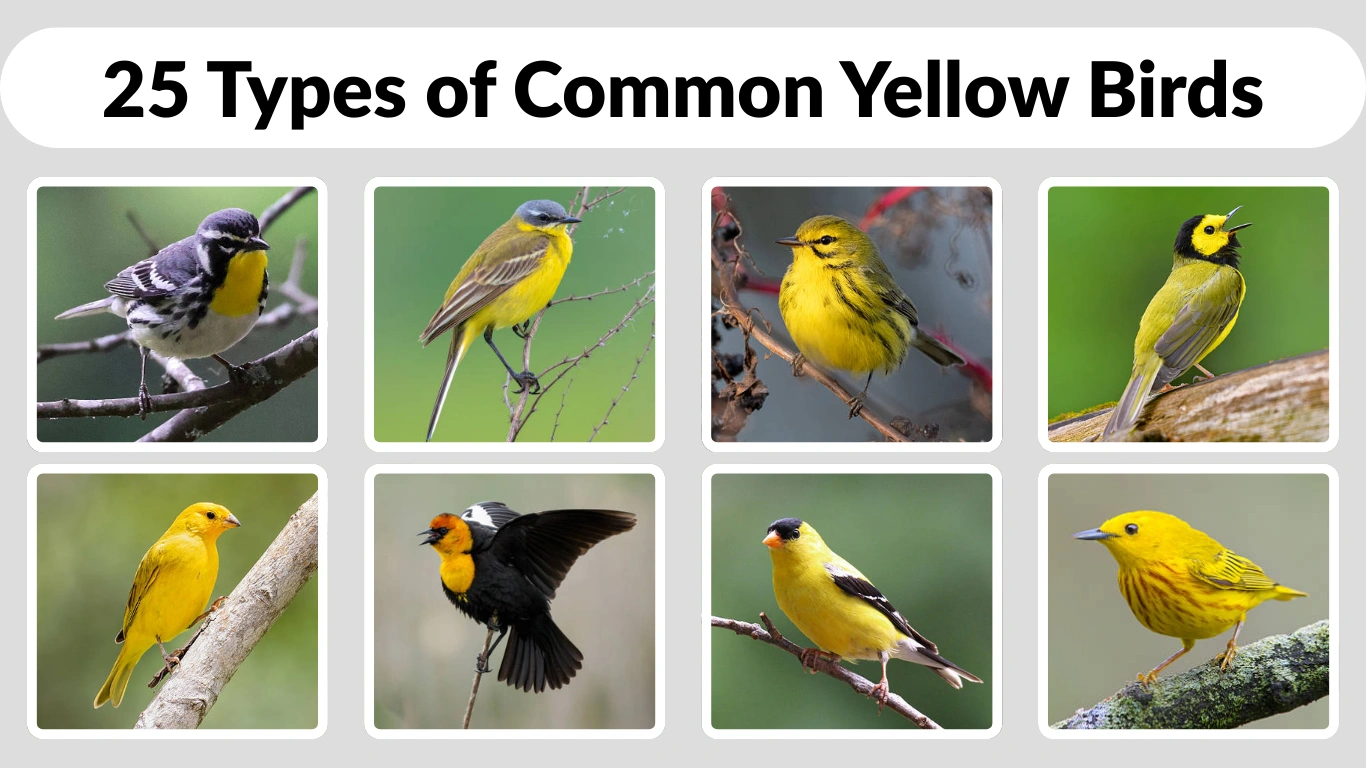
Yellow birds bring brightness and energy to landscapes across the world, from backyards and wetlands to forests and grasslands. Their vivid plumage, cheerful songs, and diverse behaviors make them some of the most enjoyable birds to observe. This collection features 25 common yellow bird species, each with unique traits and habitats. Whether you’re a birdwatcher, nature enthusiast, or beginner, these species offer a colorful glimpse into avian diversity.
1. American Goldfinch

A bright and cheerful songbird known for its vibrant yellow plumage and bouncy flight. Common across North America, the American Goldfinch is often seen visiting gardens, meadows, and feeders, especially during summer when males display their brightest colors.
Identification
- Bright yellow body in breeding males
- Black cap on the forehead
- Black wings with white markings
- Conical seed-eating bill
- Females are olive-yellow with duller tones
Habitat
American Goldfinches prefer open areas such as fields, meadows, orchards, and suburban gardens. They are also frequent visitors to backyard feeders, especially where thistle or sunflower seeds are available.
Behavior
They display a distinctive, bouncy flight pattern and often travel in flocks outside the breeding season. Goldfinches are late breeders, often nesting in midsummer when seeds are abundant. Their calls are sweet, rhythmic, and easily recognizable.
Diet
Their diet consists mainly of seeds, especially thistle, sunflower, and dandelion seeds. They occasionally eat small insects but rely heavily on plant-based foods throughout the year.
2. Yellow Warbler

A bright and widespread songbird recognized for its rich yellow plumage and sweet, whistled song. Found across North America, the Yellow Warbler brings vibrant color to wetlands, forests, and gardens during spring and summer.
Identification
- Bright golden-yellow body overall
- Rusty streaks on the breast in males
- Slim, pointed bill
- Females are slightly duller but still yellow
- Active, flitting movements among foliage
Habitat
Yellow Warblers prefer wetlands, willow thickets, forest edges, and shrubby areas. They thrive near streams, marshes, and moist habitats where insects are abundant.
Behavior
Energetic and vocal, they constantly move through trees while searching for prey. Males sing persistently to defend territory. They migrate long distances, wintering in Central and South America.
Diet
Their diet is primarily insect-based, including caterpillars, beetles, midges, and spiders. They forage by gleaning insects from leaves and branches, especially in dense shrubs.
3. Western Tanager

A striking songbird known for its bright yellow body contrasted with red and black markings. Despite its tropical appearance, the Western Tanager breeds across western North America in coniferous forests and mountainous regions.
Identification
- Bright yellow body
- Red head in adult males
- Black wings with bold wingbars
- Females are yellow-green with subdued markings
- Stout, pointed bill
Habitat
Western Tanagers inhabit coniferous forests, mixed woodlands, and mountainous regions. They prefer tall trees for nesting and are often seen flitting among high branches while foraging.
Behavior
These birds migrate long distances and often join mixed foraging flocks. Males sing a short, burry song during breeding season. They are discreet foragers, moving steadily among foliage rather than in open areas.
Diet
Their diet includes insects, berries, and fruits. They often catch flying insects midair and supplement their diet with fruits during migration and late summer.
4. Prothonotary Warbler

A glowing golden-yellow bird of swampy forests, the Prothonotary Warbler is one of the few warblers that nests in tree cavities. Its vibrant coloring makes it stand out among dark wetlands and cypress swamps.
Identification
- Bright golden-yellow head and breast
- Blue-gray wings and tail
- White under-tail area
- Sturdy, pointed bill
- Females are slightly duller but still richly yellow
Habitat
Prothonotary Warblers thrive in flooded forests, swamps, wooded wetlands, and slow-moving streams. They often nest in natural cavities or abandoned woodpecker holes near water.
Behavior
These birds forage actively along branches, probing bark and leaves for insects. During breeding, males fiercely defend territories and sing a loud, ringing song. They migrate to Central and northern South America for winter.
Diet
Their diet consists mainly of insects, spiders, and snails. They also eat small aquatic invertebrates and will occasionally forage near water surfaces for prey.
5. Yellow-breasted Chat

A large, bold warbler known for its bright yellow chest and wide range of unusual vocalizations. The Yellow-breasted Chat thrives in dense thickets and overgrown fields, where it often stays hidden despite its vibrant color.
Identification
- Bright yellow throat and breast
- Olive-green back and wings
- White spectacles around the eyes
- Long tail and heavy warbler bill
- Larger than most other warblers
Habitat
Chats prefer dense shrubs, thickets, regenerating forests, and overgrown meadows. They thrive in areas with thick vegetation that provides cover and nesting sites.
Behavior
They are secretive but vocal, producing whistles, clucks, and mimic-like calls. Males perform dramatic courtship displays that include fluttering flights and loud songs from exposed perches.
Diet
Their diet consists of insects, berries, and small fruits. During summer, they rely heavily on caterpillars and beetles to feed nestlings.
6. Common Yellowthroat

A lively and widespread warbler recognized by its bright yellow throat and the male’s distinctive black facial mask. Common Yellowthroats thrive in wetlands and dense vegetation across much of North America.
Identification
- Bright yellow throat and breast
- Males have a bold black mask with a white border
- Olive-brown back and wings
- Slender body with a thin, pointed bill
- Females lack the mask and have softer yellow tones
Habitat
They inhabit marshes, wet meadows, brushy fields, and areas with dense low vegetation. Common Yellowthroats are especially abundant near wetlands but also occupy suburban thickets.
Behavior
Active and curious, they flit through tall grasses and shrubs while giving their distinctive “witchety-witchety” song. They often stay low in vegetation, rarely perching high unless singing.
Diet
Their diet is primarily insect-based, including beetles, caterpillars, spiders, and small flies. They forage near the ground, gleaning insects from foliage and occasionally catching them in flight.
7. Evening Grosbeak

A bold, heavy-billed finch known for its bright yellow plumage and powerful flight. Evening Grosbeaks are social birds that travel in flocks, especially during winter when they visit feeders in dramatic numbers.
Identification
- Bright yellow body in males
- Bold black wings with white patches
- Massive, pale-green conical bill
- Females are grayish with soft yellow highlights
- Thick neck and robust finch build
Habitat
These birds inhabit northern forests, especially coniferous and mixed woodlands. In winter, they may wander widely into suburban areas and parks, often following food availability.
Behavior
Evening Grosbeaks are strong fliers and move in noisy flocks. They are energetic feeder visitors, cracking seeds with their powerful bills. They communicate with sharp calls and exhibit flock cohesion year-round.
Diet
Their diet includes seeds, nuts, buds, berries, and insects. They are particularly fond of sunflower seeds at feeders and also feed on tree buds in early spring.
8. Yellow-headed Blackbird

A striking wetland bird known for its bold yellow head and contrasting black body. The Yellow-headed Blackbird is often seen perched among cattails, filling marshes with its loud, rasping calls during breeding season.
Identification
- Bright yellow head and chest
- Glossy black body and wings
- White wing patches visible in flight
- Females are brownish with muted yellow tones
- Strong, pointed black bill
Habitat
These birds thrive in freshwater marshes, cattail wetlands, and reedy lakeshores. During migration and winter, they gather in agricultural fields, grasslands, and open country.
Behavior
Highly social, they form large flocks outside the breeding season. Males fiercely defend territories in marshes, often displaying from tall cattails. Their calls are harsh and buzzing, unlike most songbirds.
Diet
Their diet includes insects, seeds, grains, and aquatic invertebrates. In summer, they feed heavily on insects such as beetles and larvae; in winter, they shift to seeds and agricultural grains.
9. Cape Weaver

A brightly colored African songbird known for its vivid yellow plumage and beautifully woven nests. The Cape Weaver is commonly found in southern Africa, especially in wetlands and farmlands.
Identification
- Bright yellow body in males during breeding
- Orange wash on the face and throat
- Strong, conical bill (often dark in males)
- Females are duller yellow-brown
- Medium-sized with a sleek, active build
Habitat
Cape Weavers inhabit wetlands, reed beds, agricultural fields, savannas, and suburban gardens. They often nest in colonies near water, weaving intricately suspended nests from grasses.
Behavior
Highly social, Cape Weavers build elaborate hanging nests and form noisy breeding colonies. Males construct multiple nests to attract females. They remain active throughout the day, foraging in flocks.
Diet
Their diet consists mainly of seeds, grains, and insects. They forage on the ground and among vegetation, especially targeting grass seeds and small invertebrates during breeding season.
10. Saffron Finch

A bright, cheerful bird commonly found in open habitats of South America. Known for its glowing yellow plumage and melodious song, the Saffron Finch often frequents gardens, farms, and grassy areas.
Identification
- Vibrant yellow body in males
- Orange crown on the head (mostly in adult males)
- Females are duller, yellowish-brown
- Medium-sized finch with a stout, pointed bill
- Active posture and lively movements
Habitat
Saffron Finches thrive in grasslands, savannas, agricultural areas, and urban gardens. They readily adapt to human-modified landscapes and often nest in buildings or shrubs.
Behavior
They are social and frequently seen in small flocks. Males sing from exposed perches to attract mates and establish territory. These birds are active foragers, moving quickly across open ground.
Diet
Their diet includes seeds, grains, and small insects. They forage mostly on the ground, using their strong bills to crack open seeds and find hidden invertebrates.
11. Eurasian Golden Oriole

A striking and melodic bird known for its brilliant yellow plumage and flute-like song. Found across Europe and western Asia, the Eurasian Golden Oriole prefers tall woodlands and lush forest edges.
Identification
- Bright golden-yellow body in males
- Black wings and tail
- Females are greenish-yellow with streaked underparts
- Slender, pointed bill
- Graceful, medium-sized body
Habitat
These orioles inhabit deciduous and mixed forests, especially areas with tall trees. They also frequent orchards, parks, and riverine woodlands during breeding season.
Behavior
Elusive and often hidden in treetops, they move silently through foliage despite their bright coloration. Males sing rich, fluting whistles. They migrate long distances between Europe and sub-Saharan Africa.
Diet
Their diet includes insects, caterpillars, fruits, and berries. During breeding season, they focus on caterpillars and other soft-bodied insects to feed their young.
12. Orchard Oriole (Female)

The female Orchard Oriole is a warm yellow-green songbird commonly seen across North America in summer. Though less colorful than the male, her soft yellow plumage makes her easy to spot in orchards and open woodlands.
Identification
- Yellow-green body overall
- Dusky wings with faint wingbars
- Slender, slightly curved bill typical of orioles
- Smaller and slimmer than other oriole species
- Males are chestnut and black, contrasting sharply
Habitat
Females inhabit orchards, river edges, open woodlands, farms, and parks. They prefer areas with scattered trees and shrubs where they can forage and nest.
Behavior
Active and agile, Orchard Orioles flit among branches catching insects and sipping nectar. Females build hanging, pouch-like nests woven from grasses. They migrate long distances, wintering in Central America.
Diet
Their diet includes insects, nectar, small fruits, and berries. They frequently forage in flowering trees and shrubs, especially during spring and early summer.
13. Wilson’s Warbler

A small, lively warbler recognized by its bright yellow body and distinctive black cap. Wilson’s Warblers are energetic migrants, commonly seen flitting through shrubs and forest edges across North America.
Identification
- Bright yellow body overall
- Distinct black cap in males
- Olive-green back and wings
- Thin, pointed bill
- Females lack full black cap but remain vividly yellow
Habitat
They occupy wet thickets, shrubby forest edges, riparian zones, and mountain meadows. During migration, they appear in parks, gardens, and any area with dense low vegetation.
Behavior
Fast-moving and active, Wilson’s Warblers constantly flick their wings and hop through foliage while searching for prey. They migrate long distances, wintering in Mexico and Central America.
Diet
Their diet is mainly insectivorous, consisting of caterpillars, beetles, small flies, and spiders. They glean insects from leaves and branches, often foraging close to the ground or in shrubs.
14. Hooded Warbler

A striking woodland bird known for its bright yellow face contrasting with a bold black hood. The Hooded Warbler is commonly found in shaded forests of eastern North America during spring and summer.
Identification
- Bright yellow face and underparts
- Males have a solid black hood and throat
- Olive-green back and wings
- Females have partial or faint hoods
- Small, slim body with a thin pointed bill
Habitat
Hooded Warblers inhabit mature deciduous forests, especially those with dense understory vegetation. They favor shaded, moist areas where insects are abundant.
Behavior
These birds are agile and active, flicking their tails to reveal white outer feathers that startle insects. Males sing a clear, ringing song to defend territories during breeding season.
Diet
Their diet consists mainly of insects, including caterpillars, beetles, moths, and spiders. They forage low in vegetation, often making short flycatching flights to capture prey.
15. Tropical Kingbird

A bright yellow, bold, and active flycatcher found across Central and South America, extending into the southern United States. Tropical Kingbirds are easily recognized by their striking plumage and assertive behavior.
Identification
- Bright yellow belly and breast
- Gray head with a darker mask
- Olive-green back and wings
- Long tail and sturdy, straight bill
- Large, upright posture typical of kingbirds
Habitat
These birds thrive in open areas, forest edges, savannas, agricultural fields, and urban parks. They prefer scattered trees and open spaces ideal for flycatching.
Behavior
Tropical Kingbirds are aggressive defenders of their territory, often chasing away larger birds. They perch prominently while scanning for insects, then dart out in swift, acrobatic flights to catch prey midair.
Diet
Their diet consists mainly of flying insects such as beetles, wasps, and flies. They also consume fruits and berries, especially during migration or in the non-breeding season.
16. Western Meadowlark

A well-known grassland bird famous for its bright yellow chest and flute-like song. The Western Meadowlark inhabits prairies and open fields across western and central North America.
Identification
- Bright yellow throat and breast
- Distinct black “V” marking on the chest
- Brown, streaked back and wings
- Long, pointed bill
- Sturdy, medium-sized body
Habitat
Western Meadowlarks thrive in grasslands, prairies, farmlands, and pastures. They prefer open spaces with tall grasses for nesting and foraging.
Behavior
These birds are ground foragers, walking through grasses as they search for insects. Males sing loud, melodious whistles from fence posts or shrubs to defend their territory during breeding season.
Diet
Their diet consists mainly of insects such as beetles, grasshoppers, and caterpillars, along with seeds and grains, especially outside the breeding season.
17. Meadow Pipit

A small, slender songbird often found in open fields and grassy landscapes. Though generally brown, many Meadow Pipits show soft yellowish tones on the belly and face, especially in certain light, making them a commonly noted “yellowish” species in open habitats.
Identification
- Brown, streaked upperparts
- Pale yellowish underparts with fine streaking
- Thin, pointed bill
- Slender body with long legs
- Distinctive bobbing and fluttering flight
Habitat
Meadow Pipits inhabit grasslands, moors, pastures, and coastal meadows. They prefer open, treeless landscapes where they can forage on the ground and nest among tall grasses.
Behavior
Active and restless, they walk or run through grass while searching for prey. They perform fluttering flight displays during breeding season and often perch on rocks or fence posts.
Diet
Their diet includes insects, spiders, small invertebrates, and occasional seeds. They forage mainly on the ground, probing the soil and vegetation for hidden prey.
18. Yellowhammer

A bright, melodic songbird of Europe and parts of Asia, the Yellowhammer is known for its vivid yellow plumage and distinctive “little-bit-of-bread-and-no-cheese” song.
Identification
- Bright yellow head and underparts in males
- Chestnut-brown streaked back and wings
- Females are duller with more brown tones
- Slender, conical seed-eating bill
- Long tail with white outer feathers
Habitat
Yellowhammers thrive in farmlands, hedgerows, open countryside, and grasslands. They prefer areas with scattered shrubs and hedges for nesting and shelter.
Behavior
Often seen perched on fence posts or hedges while singing, they form flocks during winter and feed together in open fields. Males sing frequently from exposed perches during breeding season.
Diet
Their diet consists mainly of seeds and grains, with insects fed to chicks during the breeding season. They forage both on the ground and among low vegetation.
19. Yellow-throated Vireo

A boldly marked woodland bird known for its bright yellow throat and strong facial pattern. The Yellow-throated Vireo is commonly seen in eastern North America during spring and summer.
Identification
- Bright yellow throat and spectacles
- Olive-green head and back
- White belly and wingbars
- Thick, slightly hooked bill
- Slow, deliberate foraging style
Habitat
This species inhabits mature deciduous forests, mixed woodlands, and forest edges. They prefer tall trees, often foraging high in the canopy.
Behavior
Yellow-throated Vireos are methodical and steady, moving slowly through branches while hunting insects. Males sing a burry, repeated song to defend territories during the breeding season.
Diet
Their diet consists mostly of insects, including caterpillars, beetles, and moths. They also eat berries and small fruits, especially during migration.
20. Pine Warbler

A gentle and melodic songbird that favors pine forests across eastern North America. The Pine Warbler’s warm yellow plumage and soft trill make it a familiar presence in wooded landscapes dominated by pines.
Identification
- Yellow throat, breast, and face
- Olive-yellow back and wings
- White wingbars
- Slender body with a thin, pointed bill
- Females and juveniles are duller with grayish tones
Habitat
Pine Warblers primarily inhabit pine woodlands, mixed forests, and areas dominated by mature pine trees. They often forage high in the canopy but will visit feeders in winter.
Behavior
Calm and deliberate, they move slowly among pine needles, searching for insects. They are one of the few warblers that regularly eat seeds and often join mixed flocks in winter.
Diet
Their diet includes insects, spiders, seeds, and berries. During colder months, they rely more heavily on seeds and may visit feeders for suet or millet.
21. Prairie Warbler

A small, energetic songbird known for its bright yellow plumage and distinctive rising, buzzy song. Prairie Warblers frequent scrubby fields and regenerating forests across eastern and southeastern North America.
Identification
- Bright yellow face and underparts
- Black streaks along the sides
- Olive-green back with subtle streaks
- Thin, pointed bill
- Tail often flicked, showing white outer feathers
Habitat
Despite the name, Prairie Warblers prefer scrublands, young forests, overgrown fields, and areas recovering from disturbance. They thrive where low shrubs and saplings dominate the landscape.
Behavior
Lively and active, they hop through shrubs and low branches in search of insects. Males hold territories with a characteristic rising buzzy song and may chase intruders vigorously during breeding season.
Diet
Their diet is primarily insect-based, consisting of caterpillars, flies, beetles, and spiders. They glean prey from leaves and twigs and occasionally make short flights to catch insects in the air.
22. Yellow Wagtail

A slender, graceful bird widely distributed across Europe, Asia, and parts of Africa. The Yellow Wagtail is known for its bright yellow plumage and constant tail-wagging behavior.
Identification
- Bright yellow underparts and face (varies by subspecies)
- Olive-green back
- Long, constantly wagging tail
- Thin, pointed bill
- Slender legs adapted for walking on open ground
Habitat
Yellow Wagtails inhabit grasslands, agricultural fields, marshes, and riverbanks. They prefer open areas where they can forage for insects while walking or running on the ground.
Behavior
Restless and energetic, they continuously wag their tails as they move. They often travel in flocks, especially during migration, and are known for their soft, high-pitched calls in flight.
Diet
Their diet consists mainly of insects, including flies, beetles, and small invertebrates. They forage actively on the ground, frequently near water or livestock where insect activity is high.
23. Yellow Oriole

A vibrant tropical bird native to Central and South America, the Yellow Oriole stands out with its rich yellow plumage and graceful movements among forest edges and gardens.
Identification
- Bright golden-yellow body
- Black wings and tail
- Slender, slightly curved bill
- Females similar but slightly duller
- Medium-sized oriole with sleek posture
Habitat
Yellow Orioles inhabit tropical forests, woodland edges, plantations, savannas, and suburban gardens. They prefer areas with scattered tall trees and abundant fruiting plants.
Behavior
They move gracefully through branches, often foraging in pairs or small groups. Males sing a sweet, fluid song, and both sexes build delicate hanging nests woven from plant fibers.
Diet
Their diet includes fruits, nectar, insects, and small arthropods. They frequently visit flowering trees and fruiting shrubs, making them important seed dispersers.
24. Golden-hooded Tanager

A colorful tropical bird found in Central America, the Golden-hooded Tanager is admired for its brilliant yellow hood contrasted with blue, black, and white plumage. It is commonly seen in humid forests and gardens.
Identification
- Bright yellow or golden head
- Black mask and upper body
- Blue wings, rump, and underparts
- White belly patch
- Slender tanager bill
Habitat
These tanagers inhabit humid lowland forests, forest edges, plantations, and gardens. They are particularly common near fruiting trees and flowering plants.
Behavior
Golden-hooded Tanagers are active, social birds often found in pairs or small flocks. They frequently join mixed-species flocks while foraging high in the canopy.
Diet
Their diet includes fruits, berries, insects, and small arthropods. They pluck fruits from branches and also glean insects from leaves and flowers.
25. Yellow-rumped Warbler

A widespread and adaptable songbird known for its distinctive yellow patches, especially the bright “rump” that flashes in flight. Yellow-rumped Warblers thrive across North America in forests, parks, and gardens.
Identification
- Yellow rump patch (most distinctive feature)
- Yellow sides and sometimes a yellow crown spot
- Gray body with streaking
- White wingbars
- Slender, pointed warbler bill
Habitat
Yellow-rumped Warblers inhabit coniferous forests, mixed woodlands, and forest edges. During migration, they appear in parks, suburban yards, and coastal areas in large numbers.
Behavior
They are active foragers, flitting between branches and making short flights to catch insects. Unlike many warblers, they can digest wax from berries, allowing them to overwinter farther north.
Diet
Their diet includes insects, berries, wax-coated fruits, and small arthropods. In winter, they rely heavily on bayberries and wax myrtles, enabling them to survive in colder climates.