The Goldenrod Crab Spider (Misumena vatia) is one of the most fascinating spiders found in North America and Europe. Recognized for its striking yellow or white coloration, this spider has an incredible ability to blend into its surroundings. Hidden among flowers, it ambushes prey using stealth rather than webs. Despite its venomous nature toward insects, it poses no danger to humans. The Goldenrod Crab Spider is a master of camouflage and patience — a true artist of the natural world.
What Is a Goldenrod Crab Spider?
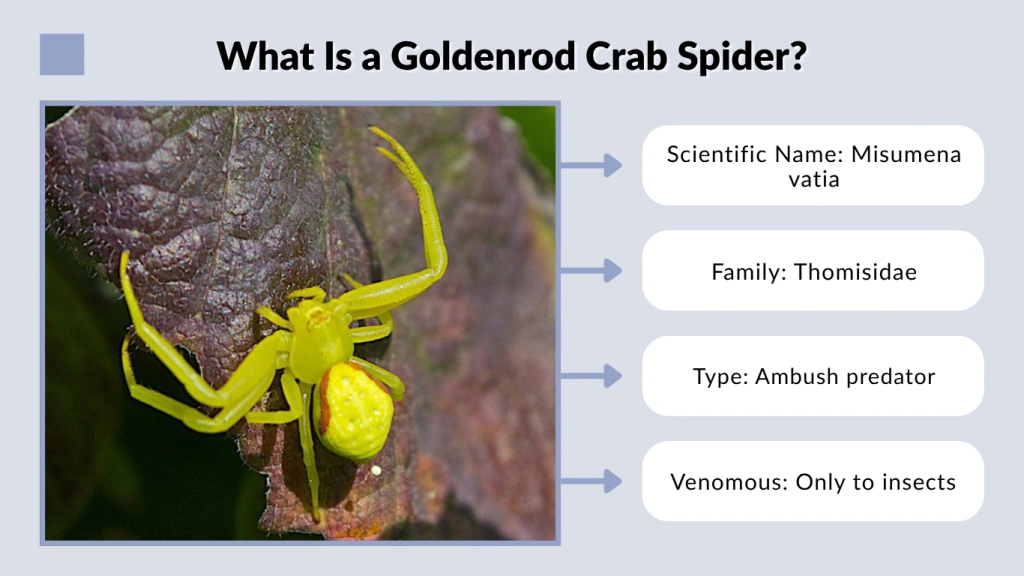
The Goldenrod Crab Spider belongs to the Thomisidae family, known as the crab spiders for their sideways walking and crab-like posture. Instead of spinning webs, they rely on ambush hunting, waiting motionless on flowers until unsuspecting pollinators come within reach.
These spiders are small but perfectly adapted to floral life. Their appearance can shift from bright yellow to pure white, helping them blend seamlessly into flower petals like goldenrod or daisies.
Scientific Classification:
- Scientific Name: Misumena vatia
- Family: Thomisidae
- Common Name: Goldenrod Crab Spider
- Type: Ambush predator
- Venomous: Only to insects
They are among the most recognizable crab spiders and one of the few capable of color transformation — a feature that makes them both beautiful and mysterious.
Habitat and Distribution
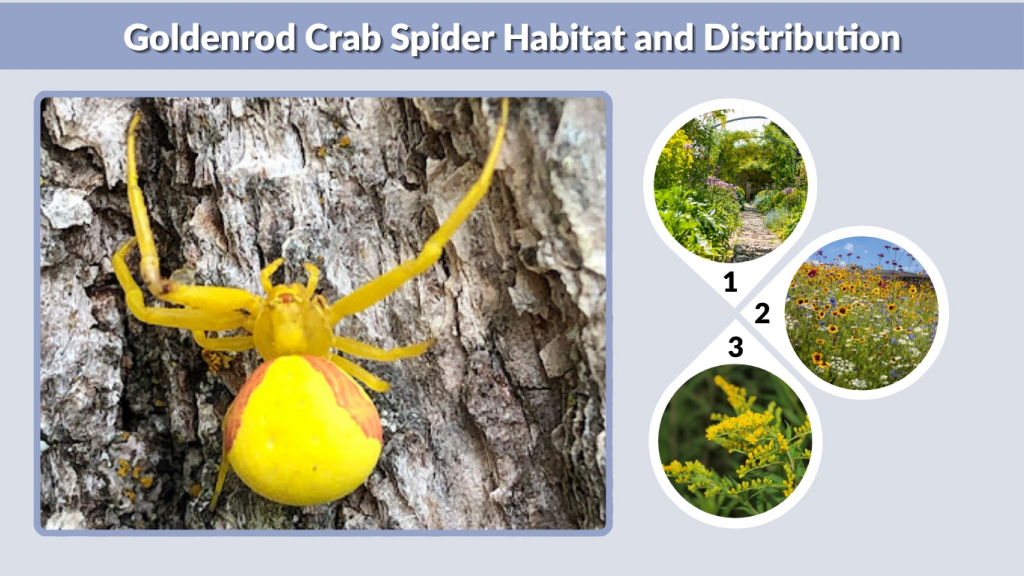
Goldenrod Crab Spiders prefer sunlit environments where flowers thrive. Their favorite hunting spots are yellow and white blossoms that attract pollinators, providing both food and camouflage.
Habitat Details:
- Found throughout North America, Europe, and northern Asia
- Especially common in gardens, meadows, and forest edges
- Often seen on goldenrod, daisies, and sunflowers
- Active during spring to early autumn
Because they depend on flowering plants, their presence peaks in late summer when goldenrod blooms. They sit on petals with legs outstretched, perfectly still, waiting for bees, flies, or butterflies to approach.
Physical Characteristics and Size
Goldenrod Crab Spiders are small, compact, and sturdy, designed for agility rather than speed. Their legs extend outward like a crab’s, allowing them to walk sideways and grasp prey efficiently.
| Feature | Female | Male |
| Body Length | 0.25–0.4 in (6–10 mm) | 0.15–0.2 in (3–5 mm) |
| Color | Yellow or white | Brown or greenish |
| Abdomen Markings | Red or orange stripes | Often plain |
| Lifespan | Up to 2 years | Less than 1 year |
Male vs Female
Females are noticeably larger and more colorful. Their round abdomen allows them to store eggs, while their bright hues match floral environments. Males, by contrast, are smaller and duller, built for mobility and mate-seeking rather than ambush hunting. This sexual dimorphism is typical in crab spiders and influences their behavior and visibility in nature.
Camouflage and Color-Changing Ability

The Goldenrod Crab Spider’s greatest adaptation is its ability to change color to match its surroundings. Females can switch between yellow and white, depending on the color of the flower they rest upon — an evolutionary masterpiece that helps them both hunt effectively and avoid predators.
Color-Change Process:
- Pigment cells beneath the spider’s outer layer shift chemically.
- When on yellow flowers, the spider produces a yellow pigment.
- On white flowers, the pigment breaks down, revealing white coloration.
- The full change can take several days to complete.
This slow but effective camouflage lets the spider remain nearly invisible to prey such as bees and butterflies. Interestingly, males do not possess this ability and rely more on quick movement and smaller size to stay hidden.
Diet and Hunting Behavior
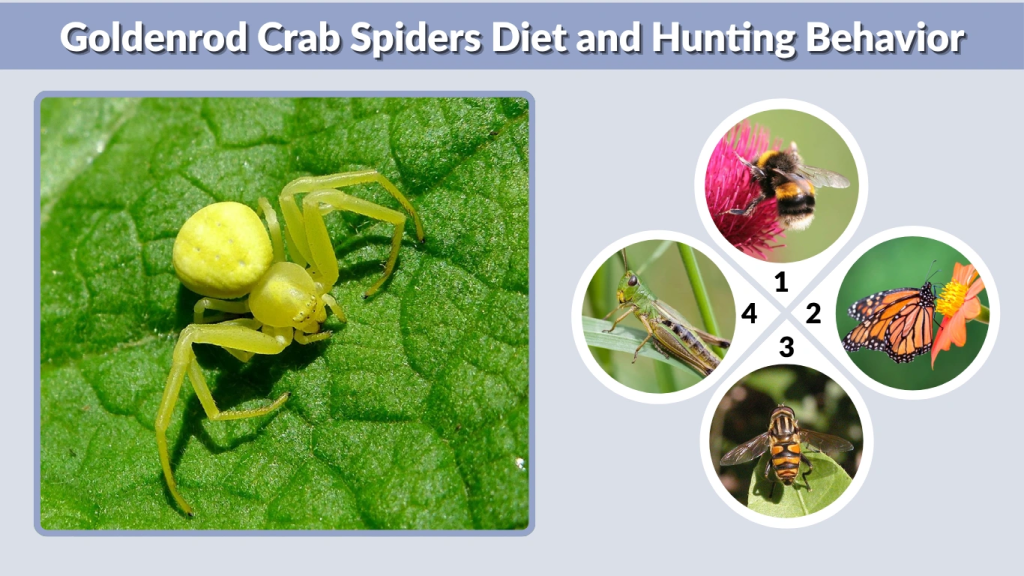
Goldenrod Crab Spiders are ambush predators that rely on stealth rather than webs. They use patience, stillness, and precision to strike at pollinating insects visiting flowers.
Common Prey:
- Bees and bumblebees
- Butterflies
- Hoverflies and houseflies
- Grasshoppers
- Small beetles
Once prey lands nearby, the spider strikes quickly with its front legs, injecting venom through small fangs. The venom immobilizes the insect instantly. Then, digestive enzymes liquefy the prey’s insides, allowing the spider to consume it by sucking up the nutrients.
This hunting method benefits gardens — reducing pest populations while keeping pollinators in check. Gardeners often welcome these spiders for their natural pest control abilities.
Venom and Human Safety
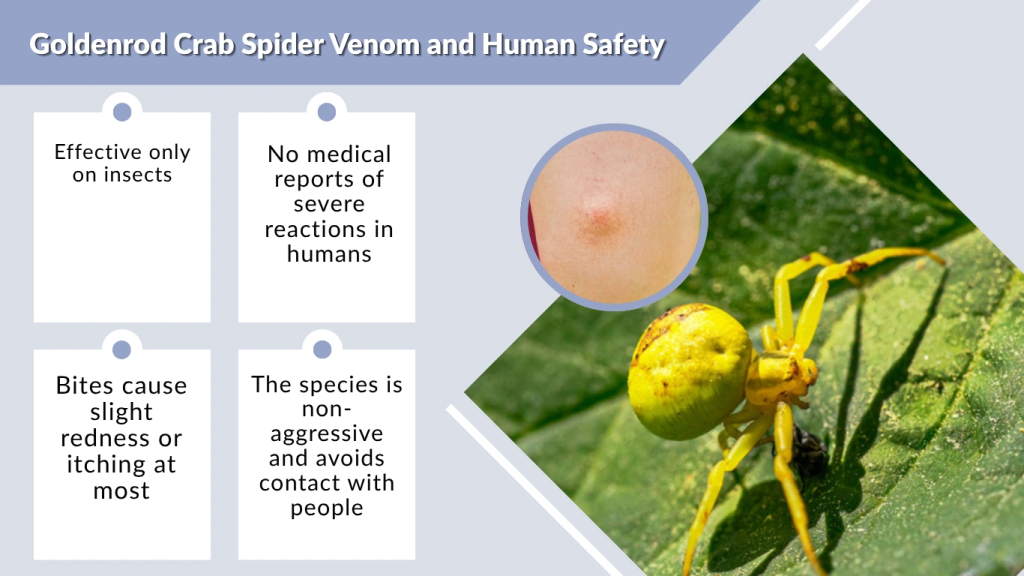
Though the Goldenrod Crab Spider is venomous, it is harmless to humans. Its venom is designed for small prey, not mammals. The fangs are too short to penetrate human skin effectively, and even if a bite occurs, symptoms are mild.
Key Facts About Its Venom:
- Effective only on insects
- No medical reports of severe reactions in humans
- Bites cause slight redness or itching at most
- The species is non-aggressive and avoids contact with people
These spiders are more likely to flee than bite, making them safe companions in gardens and wildflower fields. Their presence should never be a cause for concern.
Life Cycle and Reproduction
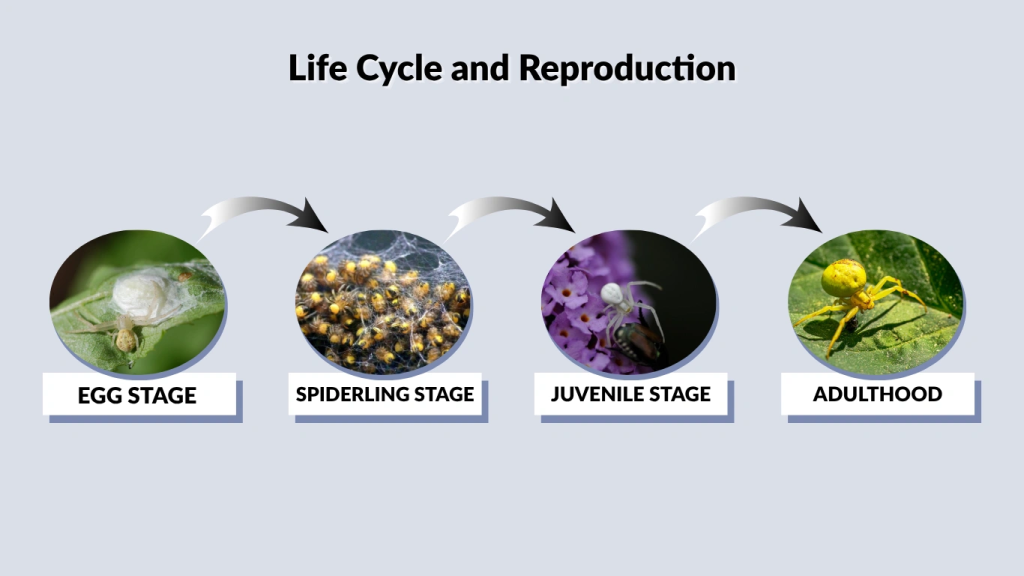
The life of a Goldenrod Crab Spider follows a simple yet fascinating pattern that repeats annually.
Egg Stage
After mating in late summer, the female produces a silk sac attached to a flower or leaf. She lays dozens of eggs, sealing them safely inside. The mother remains nearby, guarding the sac until her death — a sacrifice ensuring the next generation’s survival.
Spiderling Stage
The spiderlings hatch after several weeks. Tiny and translucent, they disperse using a behavior called ballooning, where they release silk threads that catch the wind and carry them to new locations.
Juvenile Stage
As they grow, spiderlings molt several times throughout spring and summer, gradually developing their distinctive yellow or white color.
Adulthood
By late spring, the survivors mature into adults ready to hunt and reproduce. Females usually live for two years, while males die soon after mating. This brief lifespan cycle sustains stable populations each season.
Behavior and Adaptations
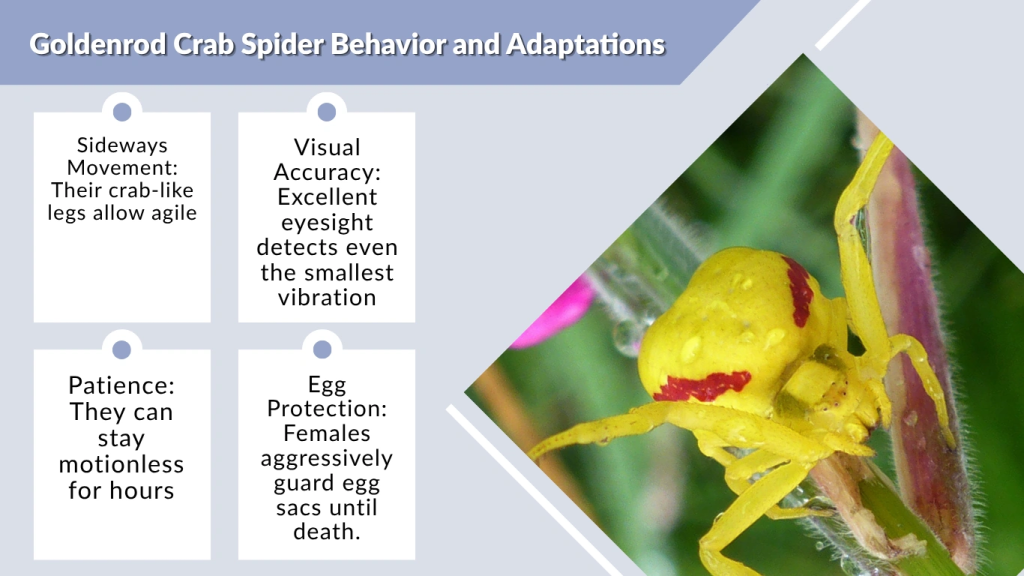
The Goldenrod Crab Spider’s body design and instincts make it one of the most effective ambush predators in the insect world.
Behavioral Adaptations:
- Sideways Movement: Their crab-like legs allow agile, precise positioning on petals.
- Visual Accuracy: Excellent eyesight detects even the smallest vibration or motion.
- Patience: They can stay motionless for hours or even days waiting for prey.
- Egg Protection: Females aggressively guard egg sacs until death.
This combination of patience, vision, and camouflage ensures their dominance in their floral hunting zones. They rarely wander off flowers, preferring a stationary lifestyle that conserves energy and minimizes risk.
Predators and Threats

Goldenrod Crab Spiders face several natural and environmental threats. Their camouflage protects them well, but they are not invincible.
Natural Predators:
- Birds that spot them during color transition
- Parasitic wasps that lay eggs on spiderlings
- Larger spiders that invade their hunting areas
Environmental Dangers:
- Habitat destruction from urban development
- Overuse of pesticides that kill insects and remove food sources
- Loss of wildflowers due to mowing or land clearing
Despite these challenges, their populations remain stable thanks to their wide range and adaptability to gardens, parks, and natural meadows.
Goldenrod Crab Spider and Color Variations
The Goldenrod Crab Spider is best known for its ability to change color, but this transformation is limited to shades of yellow, white, and pale green. The process is gradual, taking several days or even weeks, depending on light, temperature, and the type of flower.
Color Variation Insights:
- White Form: Found on daisies, lilies, and white wildflowers.
- Yellow Form: Blends with goldenrod, buttercups, and sunflowers.
- Intermediate Shades: Light green or creamy tones appear during transitions.
Some individuals appear pinkish or albino, though these are rare and usually caused by lighting or genetic variation. This flexible coloration makes them nearly invisible against floral backgrounds, allowing them to capture prey efficiently and avoid predators like birds and wasps.
Goldenrod Crab Spider vs Other Crab Spiders
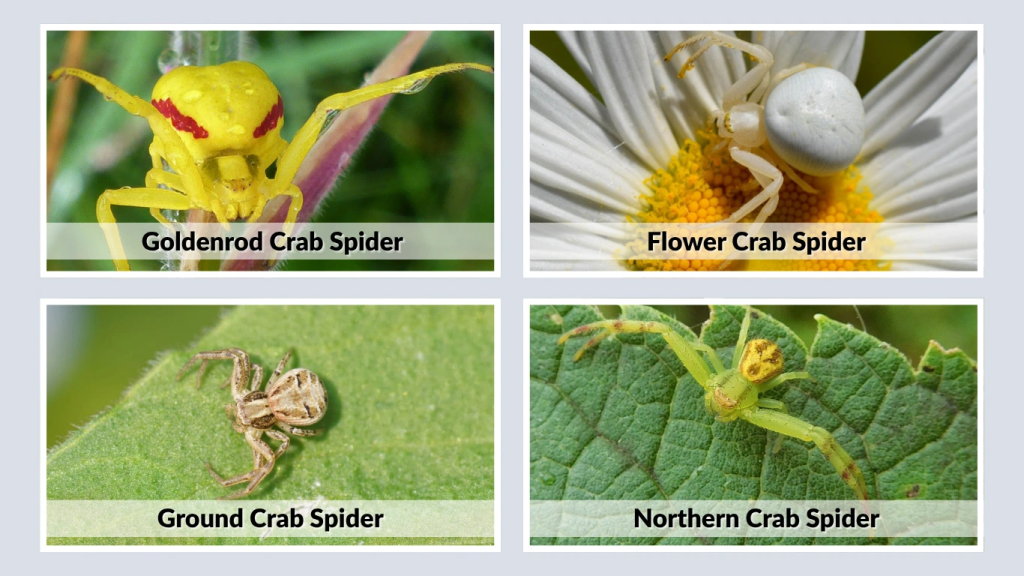
Though all crab spiders share a similar stance and hunting method, the Goldenrod Crab Spider stands out for its exceptional camouflage and flower association.
| Species | Distinctive Feature | Primary Color | Habitat |
| Goldenrod Crab Spider (Misumena vatia) | Changes color between white and yellow | Yellow / White | Flowers (North America, Europe) |
| Flower Crab Spider (Thomisus onustus) | Brighter colors like pink or violet | Pink / Purple | Mediterranean meadows |
| Ground Crab Spider (Xysticus cristatus) | Camouflages in soil and bark | Brown / Tan | Forest floor and gardens |
| Northern Crab Spider (Diaea dorsata) | Green body with red markings | Green | Leafy shrubs and trees |
Unlike ground-dwelling species, the Goldenrod Crab Spider specializes in flower hunting, relying on vivid coloration and slow, deliberate ambushes rather than quick chases or burrow hiding.
Goldenrod Crab Spider and Pollinators
Interestingly, this spider’s camouflage does more than just hide it — it can attract certain insects. Many pollinators, including bees and butterflies, see ultraviolet (UV) light differently than humans. The spider’s body reflects UV in a way that mimics floral patterns, making it look even more appealing to potential prey.
This optical illusion draws pollinators closer, increasing hunting success. Researchers have described this as “aggressive mimicry,” where the predator’s appearance helps lure victims instead of scaring them away.
Reproduction and Egg Protection
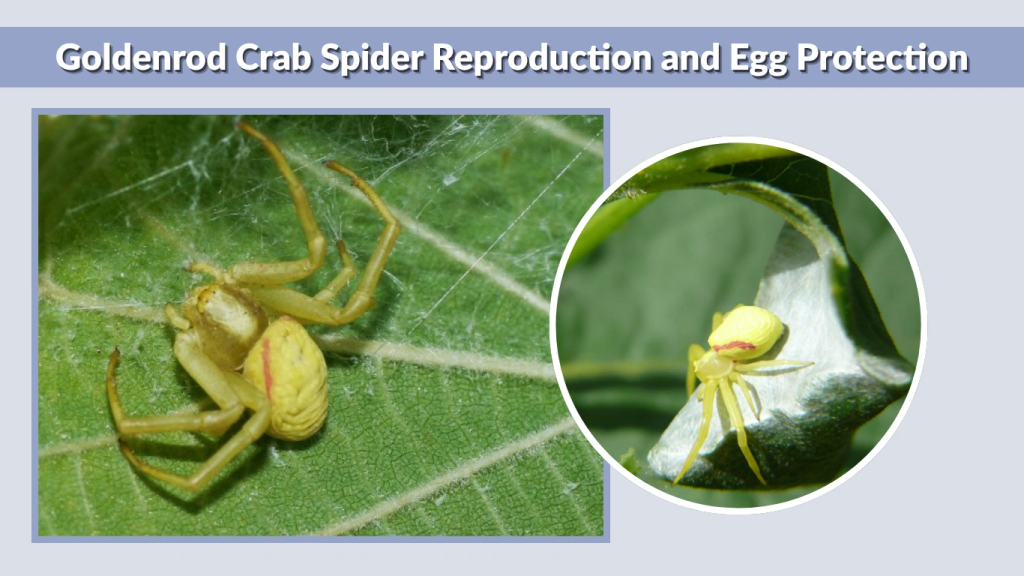
The Goldenrod Crab Spider’s reproductive process is both brief and intense. Males locate females by scent and approach cautiously to avoid being mistaken for prey. Once mating is complete, the female begins preparing for egg-laying.
Reproductive Cycle:
- Mating season occurs in late spring to summer.
- Females lay 50–100 eggs in a silk sac attached beneath a leaf or petal.
- The female guards her eggs fiercely, refusing to feed during this period.
- After the spiderlings hatch, the mother often dies soon after, completing her life cycle.
The spiderlings disperse by ballooning, releasing silk threads that catch the wind, carrying them to new habitats where they’ll start their own hunting territories.
Role in the Ecosystem
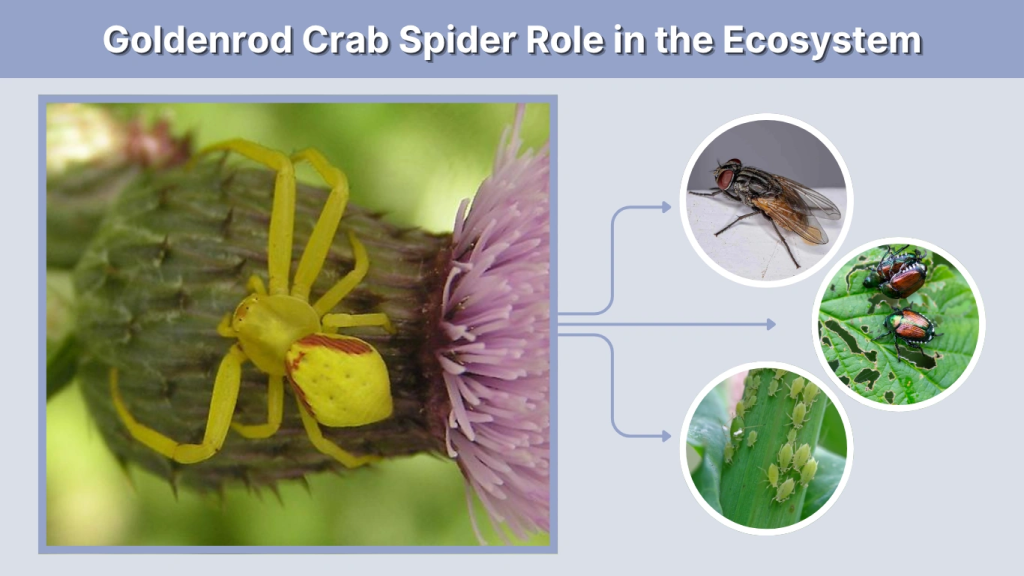
Goldenrod Crab Spiders are small but significant components of natural ecosystems. Their ambush-hunting style helps regulate insect populations, balancing pollinators and pest species alike.
Ecological Importance:
- Pest Control: Reduces flies, beetles, and aphids.
- Pollination Balance: Limits overpopulation of pollinators that can harm floral diversity.
- Prey Base: Provides food for birds and parasitic wasps.
By living among flowers and preying on active insects, they maintain a natural equilibrium essential for the health of meadows and gardens.
Behavior in Different Seasons
Goldenrod Crab Spiders adapt their activities to the seasons. In spring and summer, they are active hunters, while in autumn, females guard eggs and prepare for dormancy. Males, having completed mating, die off before winter.
During colder months, surviving juveniles find shelter beneath bark, leaves, or soil, where they remain dormant until warmth returns. This seasonal cycle keeps their numbers stable across diverse climates, from North American meadows to European grasslands.
Goldenrod Crab Spider Fun Facts
- These spiders can take down prey larger than themselves, including bumblebees.
- Females are capable of changing color multiple times in their lifetime.
- Their front two pairs of legs are longer and stronger for grabbing prey.
- They don’t spin webs for hunting — only for egg sacs.
- The spider’s eyes reflect UV light, making it invisible to most of its prey.
These small but powerful spiders represent some of the most advanced camouflage strategies found in the arthropod world.
Predators and Natural Defense
Goldenrod Crab Spiders rely on camouflage as their primary defense mechanism, but when threatened, they also use specific behaviors to avoid harm.
- They drop off flowers and hide in the vegetation below.
- When cornered, they lift their front legs in a defensive pose.
- Their coloration often tricks predators even at close range.
Predators Include:
- Birds (especially warblers and finches)
- Parasitic wasps
- Jumping spiders and larger crab spiders
Despite these dangers, their adaptability ensures widespread survival in different environments.
Goldenrod Crab Spider in Human Culture
Because of their distinct color and behavior, Goldenrod Crab Spiders are common subjects of photography and nature education. They symbolize balance, patience, and transformation — traits inspired by their color-changing ability and tranquil hunting methods.
Naturalists and photographers often highlight their beauty as a sign of biodiversity in healthy ecosystems. Their presence is a positive indicator of low pesticide use and thriving wildflower growth.
FAQs
Is the Goldenrod Crab Spider poisonous to humans?
No, the Goldenrod Crab Spider’s venom is harmless to humans. It uses venom only to paralyze insects like bees and flies. Bites are extremely rare and cause nothing more than minor redness or itching, if anything.
How does the Goldenrod Crab Spider change color?
It changes color by producing or breaking down yellow pigments beneath its outer shell. This process can take several days and helps it blend perfectly with the flowers it inhabits, such as goldenrod or daisies.
Where can you find Goldenrod Crab Spiders?
They are found across North America, Europe, and parts of Asia. You’ll see them in gardens, meadows, and forest edges sitting on bright flowers, where they wait patiently for pollinators to approach.
What do Goldenrod Crab Spiders eat?
They feed on insects like bees, flies, and butterflies. Using camouflage, they ambush prey, inject venom to paralyze them, and consume the liquefied nutrients. Their diet makes them valuable natural pest controllers.
Do Goldenrod Crab Spiders build webs?
No, they do not spin webs to catch prey. Instead, they rely on stealth and camouflage. The only silk they produce is for egg sacs, which protect their eggs until the spiderlings hatch.