

The Japanese Spider Crab (Macrocheira kaempferi) is one of nature’s most extraordinary marine creatures, often called the giant of the deep sea. Known for its incredible size and spider-like appearance, this species inhabits the cold Pacific waters surrounding Japan. Despite its intimidating look, it’s a calm and slow-moving scavenger that plays a vital role in the ocean’s ecosystem. From its record-breaking leg span to its century-long life, the Japanese Spider Crab continues to fascinate scientists and ocean lovers alike.
What Is the Japanese Spider Crab?
The Japanese Spider Crab is the largest living crab species on Earth. Its long legs, orange shell, and white-spotted limbs make it look like something from another world. Belonging to the arthropod group, it’s closely related to crabs, lobsters, and shrimp.
This species can grow to an enormous size, but unlike many deep-sea predators, it is a gentle scavenger, feeding on decaying matter and algae. Its name “spider crab” comes from its spindly legs that resemble a spider’s.
Native to Japan, it’s considered both a cultural symbol and a natural marvel — a creature that embodies the mystery and adaptability of deep-sea life.
Scientific Classification

Understanding its classification helps explain its biology and evolution. The Japanese Spider Crab is a marine arthropod belonging to the family Inachidae.
Taxonomic Breakdown:
- Kingdom: Animalia
- Phylum: Arthropoda
- Class: Malacostraca
- Order: Decapoda
- Family: Inachidae
- Genus: Macrocheira
- Species: M. kaempferi
Unlike its name suggests, it’s not related to spiders. The term “spider crab” simply refers to its appearance, particularly its long legs and small, rounded body. This structure gives it balance and reach — both essential for survival on the rocky seafloor.
Habitat and Distribution
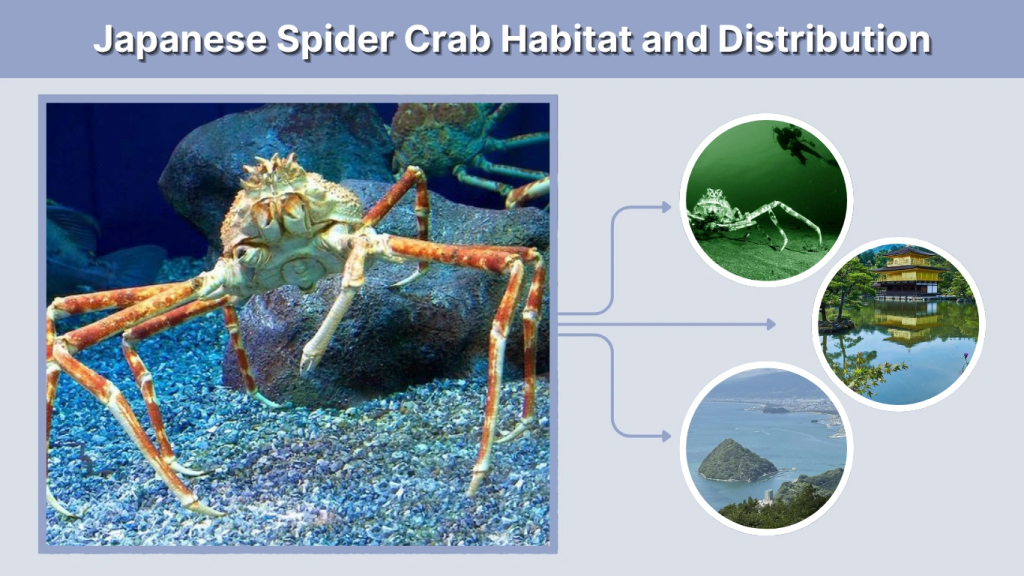
The Japanese Spider Crab thrives in the cold, deep waters surrounding the Japanese archipelago, especially off the coast of Honshu Island in regions like Suruga Bay and Sagami Bay.
Habitat Details:
- Depth Range: 150–300 meters below sea level
- Temperature Preference: 10°C to 13°C (50°F to 55°F)
- Environment: Rocky ocean floors and trenches
- Migration Pattern: Moves to shallower waters during breeding season
Their deep-sea environment is dark and high-pressure, but the crab’s strong exoskeleton and slow metabolism allow it to survive in these harsh conditions. Because they live so deep, they are rarely seen by humans outside aquariums.
Physical Characteristics and Size Comparison
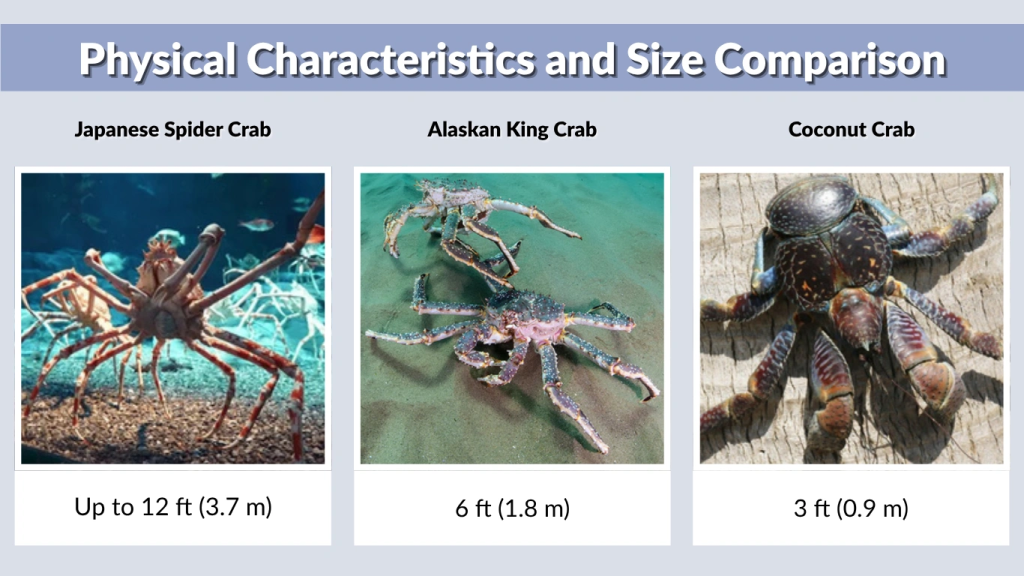
| Feature | Japanese Spider Crab | Alaskan King Crab | Coconut Crab |
| Leg Span | Up to 12 ft (3.7 m) | 6 ft (1.8 m) | 3 ft (0.9 m) |
| Weight | 40 lbs (18 kg) | 24 lbs (11 kg) | 9 lbs (4 kg) |
| Lifespan | 100 years | 30 years | 60 years |
| Habitat | Deep sea (Japan) | Cold northern seas | Tropical islands |
The Japanese Spider Crab’s body is relatively small compared to its enormous legs. Its carapace (shell) measures about 15 inches (38 cm) across, while its legs stretch up to 12 feet (3.7 m) from claw to claw.
When compared to a human, its leg span can be nearly twice an adult’s height. The crab’s color — bright orange with pale spots — provides camouflage among coral and rocks, while its hard exoskeleton offers excellent defense against predators.
Diet and Feeding Behavior
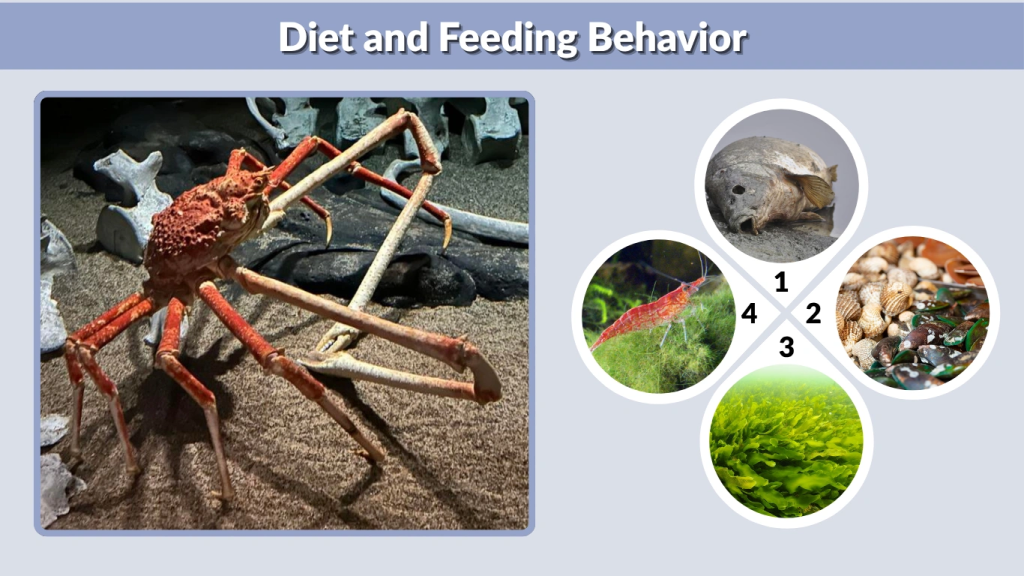
The Japanese Spider Crab is an omnivorous scavenger, meaning it eats both plants and animals. Its main role in the ecosystem is as a cleaner, consuming dead matter from the ocean floor.
Diet Includes:
- Dead fish and other decaying sea creatures
- Mollusks and shellfish
- Algae and seaweed
- Small crustaceans
Their long, delicate claws allow them to reach into tight spaces for hidden food. They are not aggressive hunters but instead rely on patience — waiting for food to drift close or for carcasses to settle on the seabed.
This diet helps recycle nutrients back into the ecosystem, keeping the marine environment healthy and balanced.
Life Cycle and Reproduction
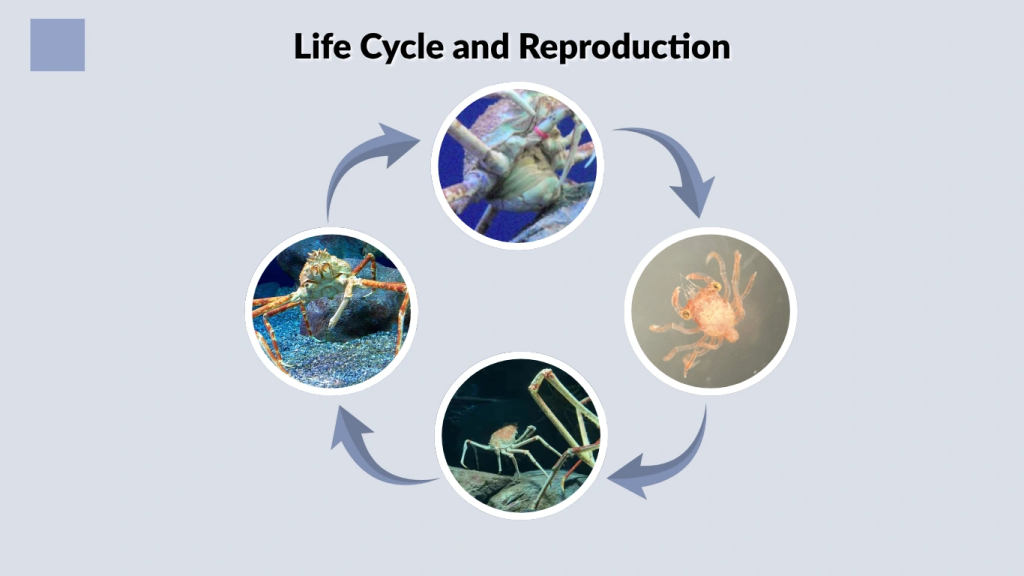
The life cycle of a Japanese Spider Crab is complex and spans several distinct stages — egg, larva, juvenile, and adult.
Egg Stage
After mating, females carry up to 1.5 million fertilized eggs under their abdomen. These eggs are attached to specialized hairs and kept oxygenated until they hatch. The incubation period lasts between 10 days to two months, depending on water temperature.
Larval Stage
Once hatched, the larvae float near the ocean surface in a planktonic stage, where they look nothing like adult crabs. They are transparent and vulnerable to predators, surviving on microscopic plankton.
During this period, they go through two major larval phases — Zoea and Megalopa — before descending back to the ocean floor. Only a small percentage survive to adulthood.
Juvenile Stage
As juveniles, they start developing a recognizable crab form with long legs and a hard shell. They move to deeper waters for safety and begin scavenging for food. Growth occurs through molting, as their rigid exoskeleton must be shed to expand.
Reproduction occurs annually, usually in spring, when crabs migrate to shallower waters to mate.
Molting and Growth
Molting is one of the most crucial parts of the Japanese Spider Crab’s life. Since their shells don’t grow, they must periodically shed them to form larger ones.
Molting Process:
- The crab’s body absorbs seawater, causing the old shell to split.
- It slowly slides out, leaving behind the empty exoskeleton.
- The new shell beneath is soft, allowing the crab to expand.
- Over several hours, minerals harden the new exoskeleton.
- Lost limbs or claws are regenerated over successive molts.
Young crabs molt several times a year, while older ones molt less frequently. The process is physically exhausting and dangerous, as the crab is soft and defenseless until its new shell hardens. Despite the risk, molting is vital for survival, healing, and growth.
Adaptations and Survival Mechanisms
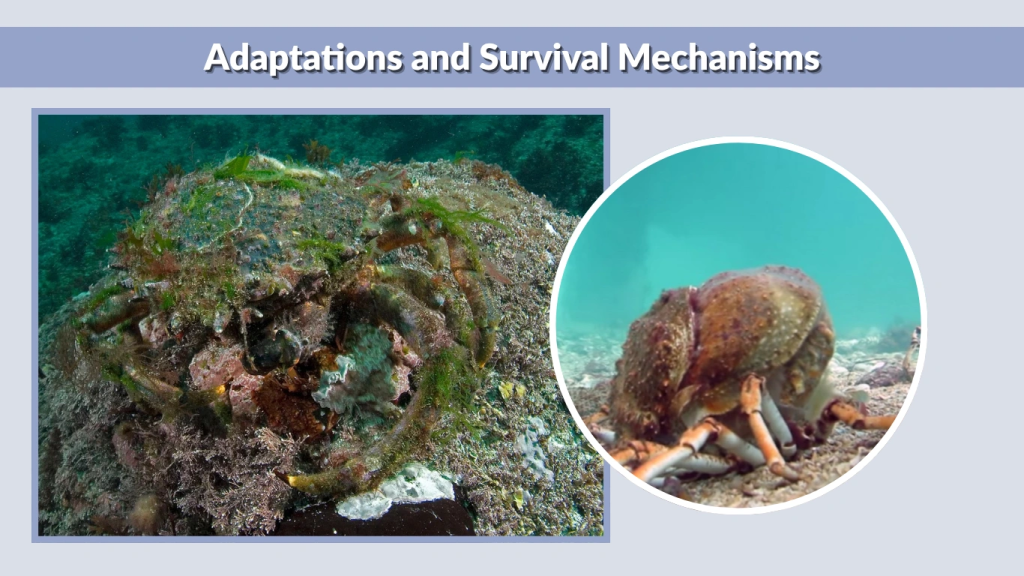
To thrive in such extreme ocean depths, the Japanese Spider Crab has evolved unique adaptations over millions of years.
Key Adaptations:
- Camouflage: Uses debris and shells to disguise itself from predators.
- Hard Exoskeleton: Provides excellent protection against pressure and attacks.
- Long Limbs: Enable it to grab distant food sources and navigate rocky terrain.
- Slow Metabolism: Helps conserve energy in low-oxygen environments.
- Enhanced Sensory Antennae: Detect subtle vibrations in the dark ocean.
These survival traits not only protect the crab but also allow it to live for nearly a century in some of the harshest marine habitats on Earth.
Predators and Threats

While the Japanese Spider Crab has few natural enemies due to its size and depth of habitat, it still faces dangers from both predators and human activity.
Natural Predators:
- Octopuses – capable of prying open shells during molting.
- Large Fish – feed on juvenile and larval crabs.
Human-Related Threats:
- Overfishing – especially during breeding season when crabs approach shallower waters.
- Pollution – affects larval survival rates and habitat quality.
- Rising Ocean Temperatures – disrupt breeding cycles and oxygen balance.
Conservation measures, such as fishing bans during mating seasons, have been introduced in Japan to help maintain stable populations of this deep-sea species.
Edibility and Culinary Use
Despite their size, Japanese Spider Crabs are edible and even considered a rare delicacy in parts of Japan. However, due to strict conservation laws, they are only caught during limited seasons.
Culinary Highlights:
- Flavor: Sweet, delicate, and similar to snow crab.
- Preparation: Commonly boiled or steamed; sometimes grilled (Yaki-gani style).
- Caution: Overharvesting is illegal; only licensed fishermen may catch them.
In traditional Japanese cuisine, the crab symbolizes longevity and prosperity — a fitting tribute to an animal that can live for a hundred years beneath the sea.
Record Holders and World Records
The Japanese Spider Crab holds the title of the largest arthropod in the world, often earning nicknames like Crabzilla or Big Daddy. Some specimens have achieved astonishing leg spans of up to 12.5 feet (3.8 meters) from claw to claw. The largest ever recorded weighed over 42 pounds (19 kilograms).
These incredible creatures sometimes appear in viral photos and exaggerated legends — including the so-called “50-foot Japanese Spider Crab” — which are almost always digitally altered. While no crab grows to such extremes, the real specimens already challenge the limits of marine biology.
World Record Highlights:
- Longest leg span officially recorded: 3.8 meters (12.5 feet)
- Heaviest specimen: 19 kilograms (42 pounds)
- Longest lifespan recorded: Over 100 years
- Oldest fossil relative: Over 100 million years old
These facts secure the Japanese Spider Crab’s reputation as a true ocean giant and one of the most iconic creatures in marine history.
Japanese Spider Crab vs King Crab
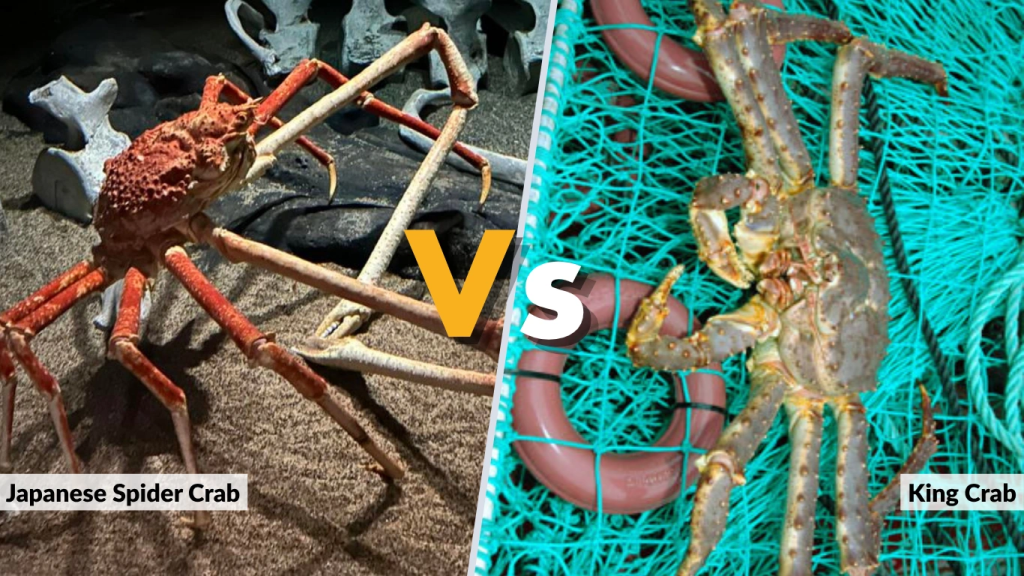
| Feature | Japanese Spider Crab | Alaskan King Crab |
| Size | Up to 12 feet | Around 6 feet |
| Weight | 40 lbs | 24 lbs |
| Lifespan | Up to 100 years | 30 years |
| Habitat | Deep Pacific (Japan) | Cold Arctic seas |
| Diet | Scavenger, omnivorous | Carnivorous |
| Behavior | Gentle and slow-moving | Aggressive predator |
While both species are known for their size and commercial value, the Japanese Spider Crab far surpasses the King Crab in span and longevity. However, King Crabs are more abundant and widely fished, while Japanese Spider Crabs remain protected and relatively rare.
Aquarium Displays and Human Interaction
Because of their deep-sea habitat, few people ever encounter a Japanese Spider Crab in the wild. Thankfully, some of the world’s largest aquariums offer a chance to see them up close.
Popular Aquariums Featuring Japanese Spider Crabs:
- Osaka Aquarium Kaiyukan (Japan): One of the few to breed them successfully.
- Blackpool Sea Life Centre (UK): Famous for its massive Crabzilla display.
- Mystic Aquarium (USA): Hosts educational programs on deep-sea life.
- Tokyo Sea Life Park (Japan): Features temperature-controlled tanks replicating natural conditions.
Visitors can watch these crabs glide across rocky tanks, showcasing their slow and deliberate movements. Educational programs explain their molting, diet, and unique adaptations, making them a fascinating part of marine exhibits worldwide.
Behavior and Adaptation in Deep Sea
The Japanese Spider Crab’s behavioral traits are a direct response to the extreme environment it inhabits. It moves slowly, conserving energy in the cold, low-oxygen depths. Its long legs allow it to cover wide areas when foraging for food or avoiding predators.
Unique Behavioral Traits
- Nocturnal: Most active during nighttime when it can feed unseen.
- Solitary: Prefers living alone except during mating season.
- Sedentary: Often remains motionless for long periods to conserve energy.
- Camouflaging Behavior: Attaches algae, shells, and sponges to its shell for disguise.
These habits help it blend into its environment, surviving for decades in the vast silence of the deep ocean.
Interesting and Fun Facts
The Japanese Spider Crab isn’t just a biological wonder — it’s also full of surprising trivia that makes it one of the ocean’s most beloved creatures.
- The Japanese call it “Takaashigani,” meaning “long-legged crab.”
- Its legs can grow longer than a small car is wide.
- Despite its frightening appearance, it’s completely harmless to humans.
- It’s often called a “living fossil” because its ancestors date back millions of years.
- It can regenerate lost limbs during molting.
- It only travels to shallow waters once a year to breed.
- It plays a key role in ocean recycling, feeding on decaying matter.
- A molted exoskeleton can look like a new crab, confusing predators.
Their eerie beauty and ancient lineage have made them stars of documentaries, memes, and viral videos alike.
Cultural Significance in Japan
In Japanese culture, the Japanese Spider Crab represents strength, longevity, and endurance. Some folklore tales describe them as ocean guardians, symbolizing wisdom gained from the deep.
While some fishing villages view them as a delicacy, others protect them as spiritual beings linked to the sea’s balance. The image of the crab has even appeared in Japanese art and folklore, where its shape resembles the armor of mythical sea warriors.
Japanese Spider Crab in Popular Media
These fascinating creatures often make appearances in nature documentaries, aquariums, and viral internet content. National Geographic, BBC Earth, and YouTube channels feature stunning underwater footage that captures their graceful, slow movements.
They’ve also appeared in animated films and educational programs, where their size and alien appearance are used to inspire curiosity about deep-sea biodiversity.
Economic and Conservation Aspects
The Japanese Spider Crab is rarely caught for mass consumption, but it still holds economic and ecological importance.
Fishing and Conservation Facts:
- Harvesting is regulated with seasonal bans during spawning.
- Breeding programs in Japan aim to maintain stable populations.
- Environmental groups monitor ocean temperatures that affect reproduction.
- Their presence indicates a healthy deep-sea ecosystem.
While not officially endangered, they are listed as vulnerable, meaning long-term sustainability depends on continuous conservation efforts.
Japanese Spider Crab Anatomy and Structure
The crab’s anatomy reflects perfect adaptation to life in deep ocean trenches.
Key Physical Features:
- Exoskeleton: Thick, orange shell with white patches for camouflage.
- Legs: Extremely long, thin, and jointed for efficient movement.
- Claws (Chelipeds): Used for defense and feeding.
- Eyes: Positioned on stalks for panoramic vision.
- Mouth: Located underneath the body, specialized for crushing soft food.
Each body part serves a functional purpose — from the legs that reach over two meters long to the claws that can delicately pick apart decaying shells.
FAQs
What is the scientific name of the Japanese Spider Crab?
The scientific name is Macrocheira kaempferi. It belongs to the arthropod family Inachidae and is native to the Pacific Ocean near Japan.
How big can a Japanese Spider Crab grow?
A full-grown Japanese Spider Crab can have a leg span of up to 12 feet (3.7 meters) and weigh around 40 pounds (18 kilograms), making it the largest known crab species on Earth.
Are Japanese Spider Crabs dangerous?
No, they are not dangerous. Despite their enormous claws, they move very slowly and rarely attack. They are gentle scavengers that pose no threat to humans.
Can you eat Japanese Spider Crabs?
Yes, they are edible and occasionally served in Japan. The meat is soft, sweet, and delicate. However, due to conservation measures, fishing is only allowed during limited seasons.
Where do Japanese Spider Crabs live?
They inhabit the deep Pacific waters off Japan, typically between 150 and 300 meters below the surface. They prefer rocky ocean floors and dark, cold environments.
