
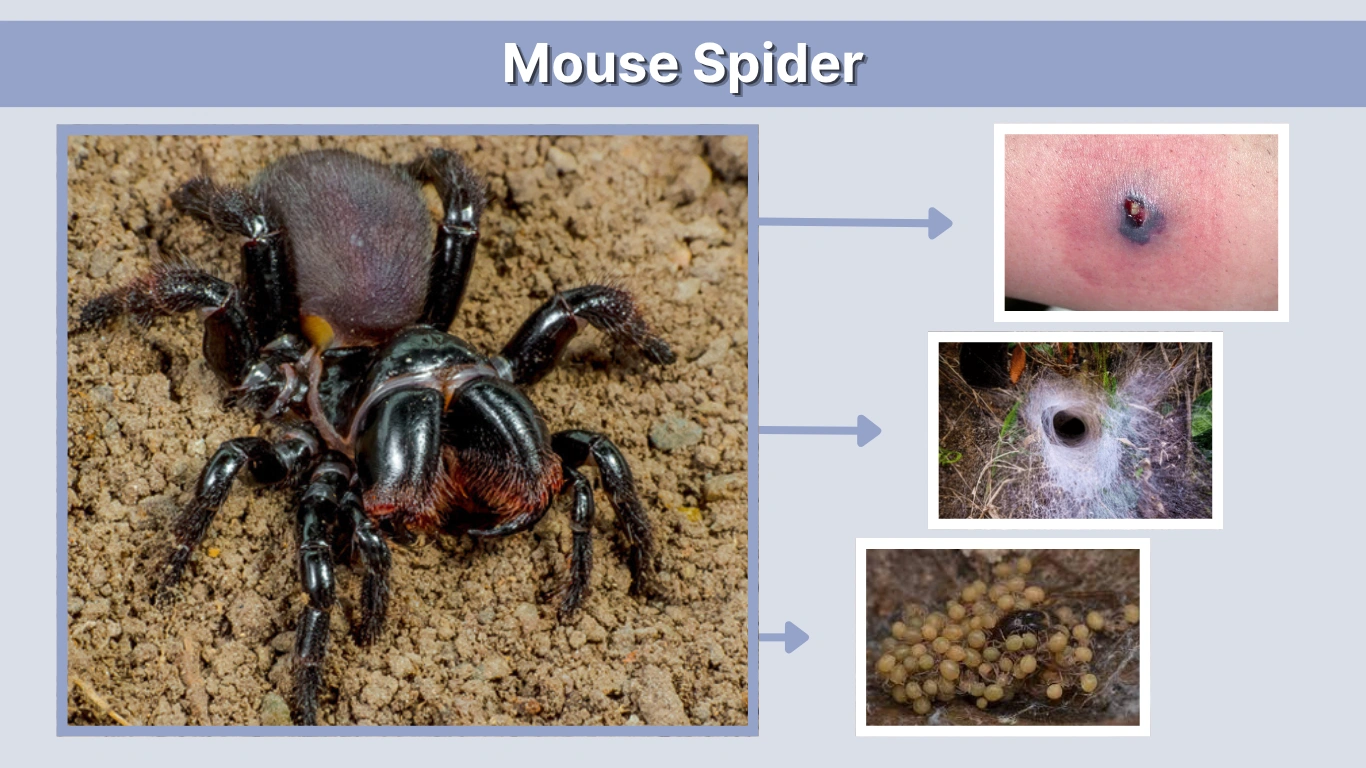
Mouse spiders are intriguing arachnids known for their glossy bodies, powerful fangs, and underground burrows. Though they resemble funnel-web spiders, mouse spiders belong to a different genus—Missulena—and are found mainly in Australia. Their potent venom and distinctive red jaws have made them both feared and fascinating. This article explores their size, identification, habitats, and bite characteristics to better understand these mysterious spiders.
Physical Identification and Size

Mouse spiders are medium-to-large mygalomorph spiders with robust, shiny bodies and short, thick legs. Their overall appearance often leads people to mistake them for funnel-web spiders, but several key traits help tell them apart.
Key Identification Points
- Males often have striking red or orange jaws and head regions.
- Females are bulkier, reaching around 2–3 cm in body length, while males are smaller.
- Their carapace has a glossy texture with a smooth, hardened look.
- Fangs are strong and downward-pointing, capable of delivering a deep venom injection.
- The abdomen is typically black or deep brown, covered in fine hair.
Mouse spiders are burrowing creatures that rely on camouflage and strong jaws for survival, rarely venturing far from their shelters unless searching for mates or food.
Mouse Spider Species

The genus Missulena includes over a dozen recognized species, many of which are native to Australia. Each species has distinct coloring and habitat preferences. The Eastern Mouse Spider (Missulena bradleyi) and the Red-headed Mouse Spider (Missulena occatoria) are among the most recognizable.
While most species are native to Australia, the UK mouse spider often mentioned in online searches refers to Scotophaeus blackwalli, a completely different spider that only resembles a mouse spider in appearance. It’s harmless and belongs to a separate family (Gnaphosidae).
Mouse Spider Locations
Mouse spiders thrive in various environments, from woodlands to deserts. Their burrows are key to survival—silk-lined tunnels that provide moisture and protection.
Common habitats include:
- Western Australia: Home to Missulena occatoria, often found in dry inland regions.
- Eastern Australia: Species like Missulena bradleyi inhabit forested and coastal areas.
- UK Gardens: The similar-looking Scotophaeus blackwalli is common indoors but nonvenomous.
- United States: Reports from Oregon, California, and Washington are typically cases of mistaken identity with trapdoor or mygalomorph spiders.
These spiders are rarely aggressive, preferring to retreat into their burrows when threatened.
Mouse Spider Bite

Mouse spiders are capable of delivering a painful bite. Though they rarely attack unprovoked, their venom can be medically significant.
Common Symptoms Include
- Intense local pain and redness
- Muscle twitching and sweating
- Headache, nausea, and dizziness
- In severe cases, breathing difficulty
Fortunately, the funnel-web spider antivenom has been proven effective for mouse spider bites because their venoms share similar toxins. Fatalities are extremely rare, and most victims recover quickly with medical treatment.
Venom Toxicity and Comparison
In the debate of Mouse Spider vs Funnel-Web Spider, both possess potent neurotoxins. The funnel-web spider is more aggressive, but the mouse spider’s venom can be equally dangerous if delivered in sufficient quantity. Laboratory studies have confirmed that male Missulena bradleyi venom is almost as toxic as that of the Sydney funnel-web (Atrax robustus).
However, due to the mouse spider’s less confrontational nature, bites are uncommon. They usually inject little venom, and fatalities are virtually unheard of thanks to the shared antivenom.
Female Mouse Spider Behavior

Female mouse spiders spend nearly their entire lives underground. Their burrows can extend deep into the soil, ending in a silk-lined chamber. Females are not known to wander and primarily emerge to feed on passing insects or small invertebrates.
They are also protective mothers, guarding their eggs until the spiderlings hatch. Once hatched, young spiders disperse and dig their own burrows nearby. Because females rarely leave their shelters, encounters with humans usually involve wandering males during mating season.
Mouse Spider in Australia
Australia is home to at least 17 known Missulena species, distributed widely across the continent. They are most prevalent in Western and South Australia, where they inhabit dry, sandy soils.
Some notable species include:
- Missulena occatoria – Red-headed mouse spider, found in arid inland areas.
- Missulena bradleyi – Eastern mouse spider, distributed in New South Wales and Queensland.
- Missulena insignis – Occurs across southern Australia.
Their burrows often have a trapdoor-like lid made from silk and soil, which conceals them perfectly from predators. Despite their venomous reputation, most Australians never encounter them due to their secretive habits.
Mouse Spider in the UK and USA
United Kingdom
In the UK, the so-called “mouse spider” is not a true Missulena species but Scotophaeus blackwalli, a harmless ground spider. It’s common in homes and gardens, where it hunts insects at night. Despite its name, it poses no venom threat and is only visually similar to the Australian mouse spider due to its dark body and thick legs.
United States
Reports of mouse spiders in the USA—especially in Oregon, California, and Washington—are typically cases of misidentification. True mouse spiders do not naturally inhabit North America. However, certain trapdoor spiders and mygalomorph species in these regions share similar traits, such as shiny carapaces and burrowing habits, leading to confusion among the public.
Mouse Spider Venom Treatment

If bitten, quick and calm action is essential. The venom’s potency makes immediate medical care necessary. Use the pressure immobilization technique—apply a firm bandage over the bite site and keep the affected limb still.
Steps to Follow
- Keep the person calm and still to reduce venom spread.
- Apply a tight bandage from the bite site upward.
- Avoid cutting or sucking the wound.
- Seek emergency help immediately.
Doctors may administer funnel-web spider antivenom, which works effectively against mouse spider venom. With timely care, patients usually recover fully within days.
Prevention and Safety Tips
Mouse spiders are not naturally aggressive, but prevention reduces the risk of accidental bites. These simple precautions help avoid unwanted encounters:
- Wear gloves while gardening or moving debris.
- Avoid sticking hands into burrows or crevices.
- Keep outdoor shoes inside or shake them before use.
- Seal cracks and gaps around your home.
- Maintain tidy gardens to remove hiding spots.
Because males roam more during mating season (usually after rain), people are most likely to encounter them between late summer and early autumn.
FAQs
What is the size of a mouse spider?
Mouse spiders usually measure between 1–3 cm in body length, with females being larger and more robust than males. Their thick, glossy exoskeleton and compact build make them appear heavier. Certain species like Missulena occatoria can reach up to 35 mm, ranking among the larger Australian spiders.
Are mouse spiders dangerous to humans?
Yes, they can be dangerous because their venom contains potent neurotoxins similar to those found in funnel-web spiders. However, mouse spiders are less aggressive and rarely bite humans. With medical care and available antivenom, serious health outcomes are extremely rare.
Where are mouse spiders commonly found?
They are native mainly to Australia, especially in Western, South, and Eastern regions. Lookalike species occur in the UK and USA, but only the Australian types are venomous. They prefer dry, sandy environments and often build silk-lined burrows with trapdoor lids.
How can you identify a male mouse spider?
Male mouse spiders are smaller and have bright red jaws or heads, particularly noticeable during mating season. They often wander in search of females after rainfall. Their vivid coloring helps distinguish them from females, which remain larger, darker, and stay within burrows.
What should you do if a mouse spider bites you?
Stay calm, immobilize the affected limb, and apply a pressure bandage to slow venom movement. Do not cut, suck, or apply ice. Seek medical attention promptly—doctors may use funnel-web spider antivenom, which is proven to neutralize mouse spider venom effectively.