






Japanese lily flowers are admired worldwide for their large, fragrant blooms, elegant shapes, and deep cultural significance. Japan is home to several native lily species that have influenced modern ornamental lilies grown across the globe. These flowers are celebrated not only for their beauty but also for their symbolic associations with purity, renewal, and refined grace. This guide explores what Japanese lilies are, how to identify them, their most famous types, and where they naturally grow.
What Is a Japanese Lily Flower?
A Japanese lily flower refers to any lily species native to Japan or traditionally associated with Japanese flora and horticulture. Many well-known ornamental lilies were developed from Japanese species, making Japan one of the most important regions in the world for lily diversity.
Japanese lilies belong to the genus Lilium and grow from underground bulbs. They are known for their large flowers, often marked with spots, stripes, or golden rays. Some Japanese lilies are intensely fragrant, while others have lighter scents. These lilies have played a major role in the breeding of Oriental lilies and other popular garden hybrids.
Japanese Lily Flower Identification
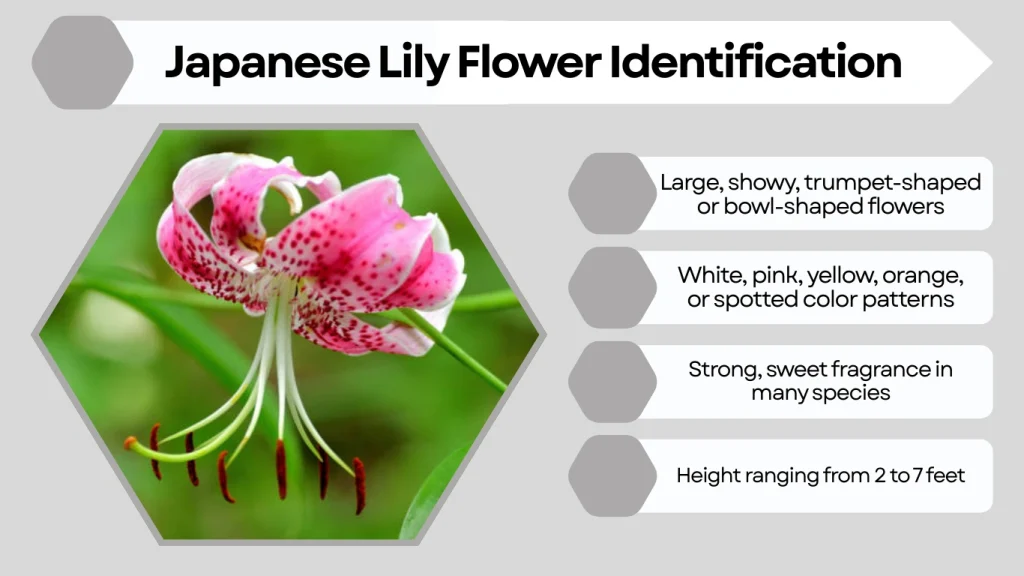
- Large, showy, trumpet-shaped or bowl-shaped flowers
- White, pink, yellow, orange, or spotted color patterns
- Strong, sweet fragrance in many species
- Long, narrow, glossy green leaves
- Upright, unbranched stems
- Height ranging from 2 to 7 feet
- Blooming season from early to late summer
- Prominent stamens with colorful pollen
- Flowers often face outward or downward
- Grows from layered underground bulbs
Common Types of Japanese Lily Flowers
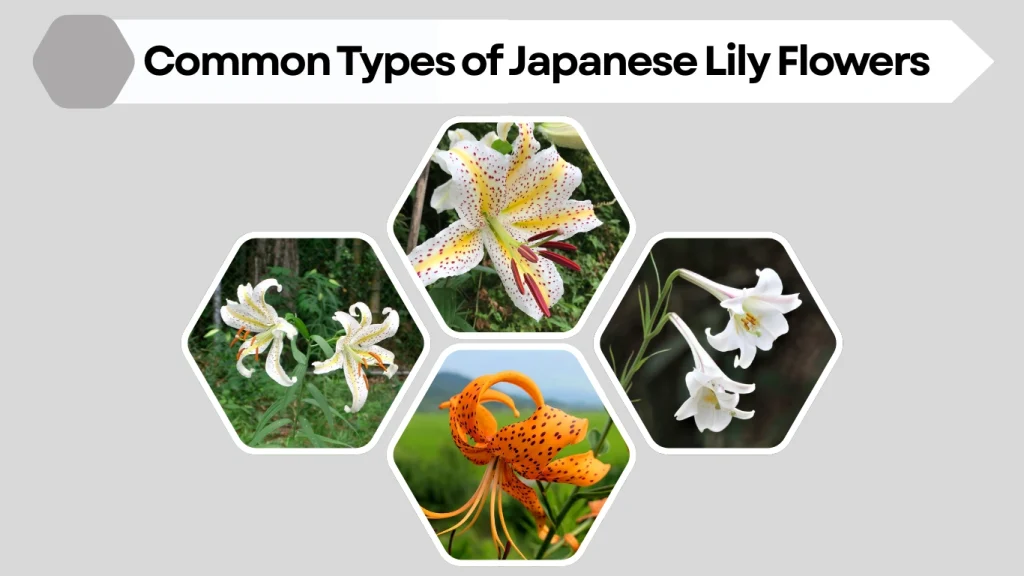
Yamayuri (Golden-Rayed Lily – Lilium auratum)
Yamayuri is one of the most famous Japanese lilies and is often considered the national lily of Japan. It produces enormous white flowers decorated with golden-yellow stripes and scattered crimson spots. The blooms are powerfully fragrant and can reach over 10 inches in diameter.
Yamayuri naturally grows in mountainous and forested regions of Japan. It blooms in mid to late summer and has been widely used in the development of Oriental hybrid lilies.
Sakayuri (Formosa Lily – Lilium formosanum)
Sakayuri, commonly known as the Formosa lily, features long, trumpet-shaped white flowers with a soft fragrance. Although native to Taiwan, it is widely cultivated in Japan and often included among Japanese garden lilies.
This lily grows tall, sometimes exceeding six feet, and blooms from summer into early autumn. It is fast-growing, adaptable, and valued for its elegant form and long flowering season.
Oniyuri (Tiger Lily – Lilium lancifolium)
Oniyuri, or the tiger lily, is easily recognized by its bright orange-red petals covered with dark spots and strongly reflexed shape. It is native to East Asia, including Japan, and grows naturally along roadsides, grasslands, and forest edges.
Tiger lilies are extremely hardy and multiply quickly through bulbils that form along the stem. They bloom in midsummer and are popular for both traditional and modern garden designs.
Ubayuri (Mountain Lily – Lilium cordifolium)
Ubayuri is a tall Japanese mountain lily with pale yellow to creamy white flowers and heart-shaped leaves. Its blossoms often face downward and release a gentle fragrance.
This species grows in cool mountainous forests and blooms in summer. In Japanese culture, it has been associated with endurance and natural beauty because of its ability to thrive in high-altitude environments.
Natural Habitat and Distribution
Japanese lilies naturally grow across many regions of Japan, from lowland forests to mountainous slopes. They are commonly found in meadows, woodland edges, riverbanks, and open mountain areas where sunlight is abundant but soil remains well-drained.
These environments provide cool winters, warm summers, and consistent moisture, conditions ideal for bulb development. Japanese lilies thrive in loose, organic-rich soils and locations where their roots stay cool while stems receive sunlight. Many species have also adapted to rocky hillsides and forest clearings.
How to Grow Japanese Lily Flowers
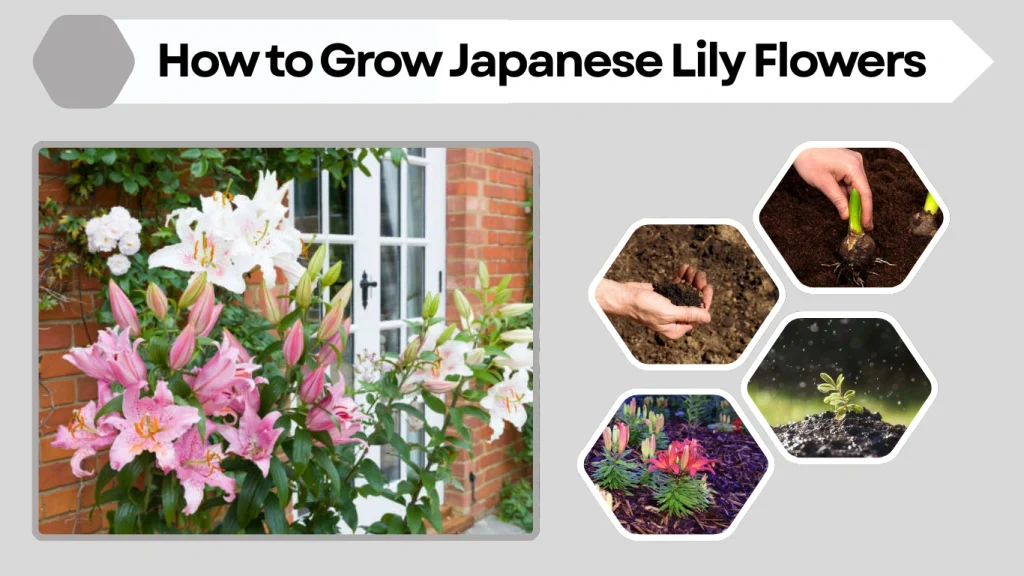
- Choose large, firm, healthy bulbs
- Plant in early spring or autumn
- Use loose, fertile, well-drained soil
- Plant bulbs 4–6 inches deep
- Space bulbs 8–12 inches apart
- Place in full sun to partial shade
- Keep soil consistently moist
- Apply mulch to cool the roots
- Protect tall varieties from strong wind
- Avoid waterlogged planting sites
Japanese Lily Flower Care Guide

Proper care allows Japanese lilies to bloom abundantly and remain healthy year after year. While lilies are generally low-maintenance, they perform best with consistent moisture, sunlight, and seasonal feeding.
Watering
Japanese lilies prefer evenly moist soil, especially during active growth and flowering. Water deeply once or twice a week, depending on rainfall and temperature. Avoid soggy soil, as excess moisture can cause bulb rot.
Light Requirements
Most Japanese lilies grow best in full sun, receiving at least six hours of sunlight daily. In hot climates, light afternoon shade helps prevent stress and flower fading.
Fertilizing
Feed lilies in early spring using a balanced or bulb-specific fertilizer. A second light feeding just before blooming supports healthy flower production. Avoid over-fertilizing, especially with high-nitrogen products.
Pruning and Deadheading
Remove spent flowers to prevent seed formation and conserve energy in the bulb. After flowering, allow leaves and stems to remain until they yellow naturally. This stage is critical for storing nutrients for the next season.
Japanese Lily Flower Meaning and Symbolism
In Japanese culture, lilies symbolize purity, beauty, renewal, and refined elegance. They are often associated with fresh beginnings, spiritual cleanliness, and the quiet strength of nature. White and pale-colored Japanese lilies are especially linked to innocence and harmony.
Japanese lilies also appear in traditional art and poetry, where they represent fleeting beauty and the peaceful rhythm of the natural world.
Japanese Lily Flower Lifecycle
- Bulb dormancy during winter
- Root development underground
- Spring sprouting and stem emergence
- Leaf expansion
- Bud formation
- Flowering stage
- Pollination by insects
- Energy storage in the bulb before dormancy
Common Problems With Japanese Lilies
Pests
Lily beetles, aphids, and spider mites are common pests. Lily beetles are particularly destructive and can rapidly strip plants of leaves. Regular inspection and early control are essential.
Diseases
Botrytis blight causes brown spots and gray mold on leaves and flowers. Bulb rot occurs when soil drainage is poor. Viral diseases may cause distorted growth and streaked leaves. Proper spacing, airflow, and clean gardening practices reduce disease risk.
Propagation of Japanese Lily Flowers
Japanese lilies are most commonly propagated through bulb division. Mature bulbs produce smaller bulblets that can be separated and replanted in autumn. Scaling, where individual bulb scales are rooted to produce new plants, is another effective method. Growing lilies from seed is possible but slow.
Japanese Lilies in Gardens and Floral Design
Japanese lilies are widely used in traditional Japanese gardens, cottage gardens, and modern landscape designs. Their tall stems and large blooms make them ideal background plants or natural focal points.
They are also highly valued as cut flowers due to their size, fragrance, and long vase life. Japanese lilies are frequently used in elegant floral arrangements and ceremonial displays.
FAQs
What is a Japanese lily flower?
A Japanese lily is a lily species native to Japan or traditionally cultivated there, such as Lilium auratum or Lilium lancifolium. These lilies are known for their beauty, fragrance, and cultural importance.
Are Japanese lilies easy to grow?
Yes, Japanese lilies are generally easy to grow when planted in well-drained soil with adequate sunlight. Basic care such as proper watering and seasonal feeding is usually sufficient.
Do Japanese lilies come back every year?
Most Japanese lilies are perennial. Their bulbs survive underground during winter and regrow each year when conditions are suitable.
What do Japanese lilies symbolize?
Japanese lilies symbolize purity, renewal, natural beauty, and refined elegance. They are often associated with harmony and spiritual cleanliness.
Can Japanese lilies grow in pots?
Yes, Japanese lilies can grow in large containers if the pots are deep, well-drained, and placed in sunny locations. Container growing is useful for patios and controlled garden spaces.