

Washington State is home to a wide variety of spiders, ranging from harmless house dwellers to elusive outdoor hunters. Understanding these species helps with proper identification and peaceful coexistence. This guide covers 17 common spiders found across the region, detailing their appearance, habitat, and behavior to help you recognize the ones living around your home or garden.
2. Widow Spiders (Genus: Latrodectus)

Widow spiders are among the most recognizable spiders in North America, and a few species—including the Western Black Widow—can be found in Washington State. Known for their shiny black bodies and red hourglass markings, these spiders tend to stay hidden and are not aggressive unless disturbed.
Identification
- Size: Females about 10–13 mm, males are much smaller
- Color: Glossy black (females) with red or orange hourglass on the underside of the abdomen
- Body shape: Rounded abdomen, long slender legs
- Web: Irregular, sticky tangle webs often close to the ground
Habitat and Distribution in Washington
Widow spiders are primarily found in eastern Washington, particularly in drier, warmer areas. They build webs in protected locations such as under porches, sheds, woodpiles, and old furniture. They prefer dark, quiet environments where they are less likely to be disturbed.
Behavior and Life Cycle
Female widow spiders are solitary and remain near their webs, while males roam to find mates. Mating usually occurs in warmer months. Females lay several egg sacs, each potentially holding hundreds of eggs. Hatchlings disperse quickly and may not survive to adulthood due to cannibalism or environmental factors. The typical lifespan for a female is 1–3 years.
3. Wolf Spiders (Family: Lycosidae)

Wolf spiders are widespread in Washington State and are known for their large size and excellent eyesight. Unlike many web-building spiders, wolf spiders are active hunters that chase down their prey rather than trapping it in webs.
Identification
- Size: Ranges from 10 to 35 mm depending on species
- Color: Usually brown or gray with dark stripes or mottled patterns
- Eyes: Prominent eyes, arranged in three rows (four small, two large, and two medium)
- Legs: Sturdy and hairy, built for fast movement
- Web: Do not spin capture webs
Habitat and Distribution in Washington
Wolf spiders are adaptable and can be found throughout Washington in grassy fields, forests, gardens, and even inside homes. They typically shelter under rocks, leaves, or logs during the day and come out to hunt at night. Some species are more common in eastern Washington’s dry grasslands, while others prefer western forests and meadows.
Behavior and Life Cycle
Wolf spiders are solitary hunters and use speed and vision to catch prey. Females carry their egg sacs attached to their spinnerets and later carry spiderlings on their backs. This maternal behavior is unique and makes them easily recognizable. Most wolf spiders live up to two years, depending on their environment and food supply.
4. Yellow Sac Spider (Cheiracanthium spp.)

The Yellow Sac Spider is a small, pale-colored spider found throughout Washington State, particularly in homes and gardens. Although its bite can cause mild irritation, it plays an important role in controlling insect populations indoors and outdoors.
Identification
- Size: Adults range from 5 to 10 mm
- Color: Pale yellow, beige, or light green with a slightly darker stripe on the back
- Body: Slender with long, fine legs
- Web: Does not build traditional webs; instead, it creates small silk sacs or retreats in corners and hidden spots
Habitat and Distribution in Washington
Yellow Sac Spiders are widespread across Washington, often seen inside homes during colder months. They create sac-like silk retreats in wall corners, ceilings, baseboards, and behind furniture. Outdoors, they inhabit leaf litter, shrubs, and under rocks. Their ability to survive indoors makes them common year-round in urban and suburban areas.Yellow Sac Spider: Bites
Behavior and Life Cycle
These spiders are nocturnal hunters, leaving their silk retreats at night to search for prey. They feed on small insects and other arthropods. Mating occurs in warmer months, and females lay egg sacs within their silk retreats. The life span is generally about one year, with new generations emerging in spring or early summer.
5. Jumping Spiders (Family: Salticidae)

Jumping spiders are among the most recognizable and fascinating spiders in Washington due to their jerky movements, bold patterns, and large front eyes. They are harmless to humans and are known for their curious nature and excellent vision.
Identification
- Size: Typically 4 to 12 mm
- Color: Varies by species—black, brown, gray, or even iridescent green or blue
- Eyes: Four large front-facing eyes and four smaller ones, giving excellent depth perception
- Movement: Quick, jerky hops; can leap several times their body length
- Web: Do not spin webs to catch prey but build small silken retreats
Habitat and Distribution in Washington
Jumping spiders are found throughout Washington in a wide range of environments—from gardens, meadows, and forests to window sills, decks, and home interiors. They are active during the day and are often spotted basking in the sun or exploring vertical surfaces like walls and fences.
Behavior and Life Cycle
Jumping spiders are visual hunters, stalking and pouncing on their prey. They are solitary and territorial. Mating rituals often involve complex dances performed by males to attract females. After mating, females lay eggs in silken sacs and guard them until hatching. Most species live for about one year, with some surviving through mild winters indoors.
6. Giant House Spider (Eratigena atrica)

The Giant House Spider is one of the largest and fastest-moving spiders in Washington State. Despite its intimidating size and speed, it is harmless to humans and often confused with the hobo spider due to similar appearance and overlapping habitats.
Identification
- Size: Body length up to 18 mm; leg span can reach up to 75 mm
- Color: Brown to dark brown with lighter patterns on the abdomen
- Legs: Long, hairy, and powerful, allowing quick movement
- Web: Funnel-shaped web in undisturbed indoor or outdoor locations
Habitat and Distribution in Washington
Giant House Spiders are commonly found in western Washington, especially in older homes, basements, attics, sheds, and garages. Outdoors, they may reside in woodpiles, garden corners, or under stones. They prefer dry, sheltered areas where they can build large webs to capture prey.
Behavior and Life Cycle
These spiders are primarily nocturnal and tend to remain near their webs. Males wander in late summer and early fall to find mates and are frequently spotted indoors during this time. Females remain in their webs, laying egg sacs that contain several dozen eggs. The spider’s life cycle typically spans 2 to 3 years, with adults often surviving through multiple mating seasons.
7. Orb Weavers (Family: Araneidae)
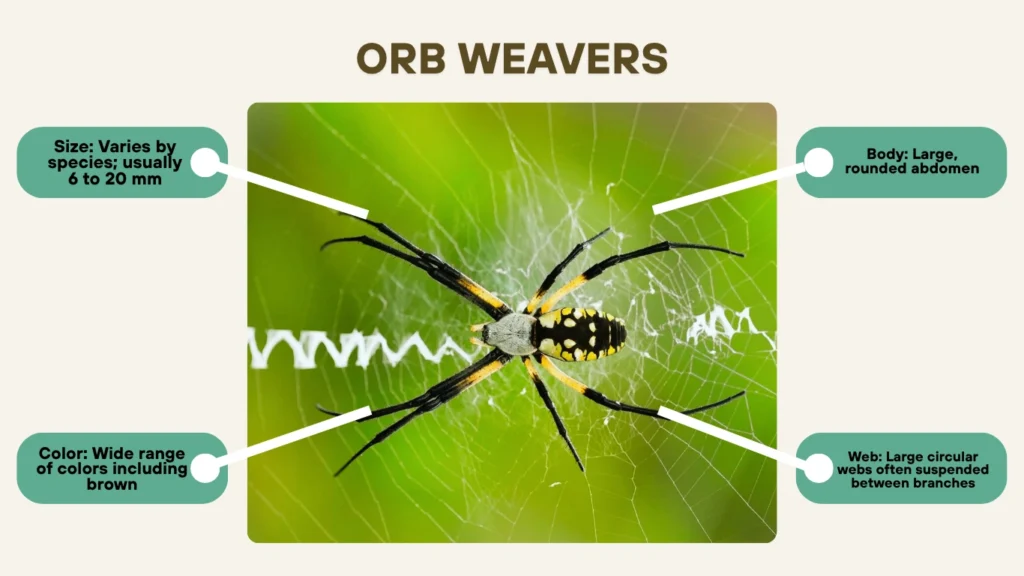
Orb Weavers are a diverse group of spiders known for creating the classic spiral-shaped webs seen in gardens and wooded areas throughout Washington. They are beneficial predators and pose no danger to humans.
Identification
- Size: Varies by species; usually 6 to 20 mm
- Color: Wide range of colors including brown, yellow, orange, red, and black
- Body: Large, rounded abdomen with distinct patterns
- Web: Large circular webs often suspended between branches or structures
Habitat and Distribution in Washington
Orb Weavers are abundant across both urban and rural parts of Washington, especially in gardens, fields, forests, and near lights where insects gather. They are typically active during late summer and fall, when their large webs become more noticeable.
Behavior and Life Cycle
These spiders build new webs daily, usually in the evening, and wait at the center or in nearby retreats for prey. They rely on vibrations to detect trapped insects. Mating occurs in late summer, followed by egg sac production. Most Orb Weavers die after the first frost, leaving behind egg sacs that hatch in spring. Their life cycle is typically one year.
8. Brown Recluse (Loxosceles reclusa) – Rare or Misidentified
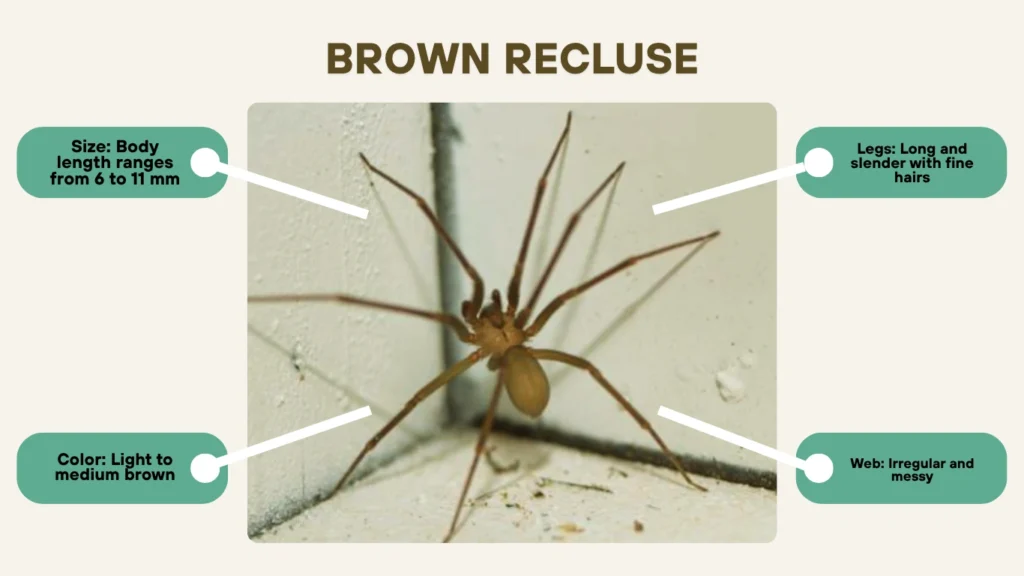
Although often mentioned in discussions about dangerous spiders, the Brown Recluse is not native to Washington State. Verified sightings are extremely rare, and most reports turn out to be cases of misidentification. However, it’s included here due to frequent confusion with other species, particularly the hobo spider.
Identification
- Size: Body length ranges from 6 to 11 mm
- Color: Light to medium brown with a distinctive violin-shaped marking on the cephalothorax
- Legs: Long and slender with fine hairs (no bands)
- Web: Irregular and messy, typically in hidden locations
Habitat and Distribution in Washington
True Brown Recluses are native to the south-central and midwestern United States. They are not known to have established populations in Washington, though isolated cases may occur due to transported goods. Most “recluse” sightings in Washington are actually hobo spiders, cellar spiders, or house spiders.
Behavior and Life Cycle
Brown Recluses are nocturnal and reclusive, preferring quiet, undisturbed indoor areas such as closets, basements, and behind furniture. They hunt for insects rather than relying on webs for capture. Their life span is generally 1 to 2 years, and females can produce multiple egg sacs throughout their adult lives.
9. Cellar Spiders (Family: Pholcidae)

Often referred to as “daddy long-legs” (not to be confused with harvestmen), Cellar Spiders are common residents of Washington homes. With their delicate appearance and long legs, they’re harmless and often welcomed for their insect-hunting habits.
Identification
- Size: Small body (2–10 mm) with very long, thin legs
- Color: Pale yellow, gray, or light brown
- Body: Small oval abdomen and a tiny cephalothorax
- Web: Loose, tangled webs typically in corners and ceilings
Habitat and Distribution in Washington
Cellar Spiders are widespread across residential and commercial buildings in Washington, particularly in basements, garages, attics, crawl spaces, and ceiling corners. They prefer quiet, undisturbed places where their webs can remain undisturbed for long periods.
Behavior and Life Cycle
These spiders do not hunt but instead wait for insects to become entangled in their webs. They may also shake their webs rapidly when disturbed to confuse predators. Mating can occur year-round in indoor environments. Females carry eggs in their mouthparts until hatching. The average life span is up to two years, and they may produce multiple generations annually indoors.
10. Crab Spiders (Family: Thomisidae)
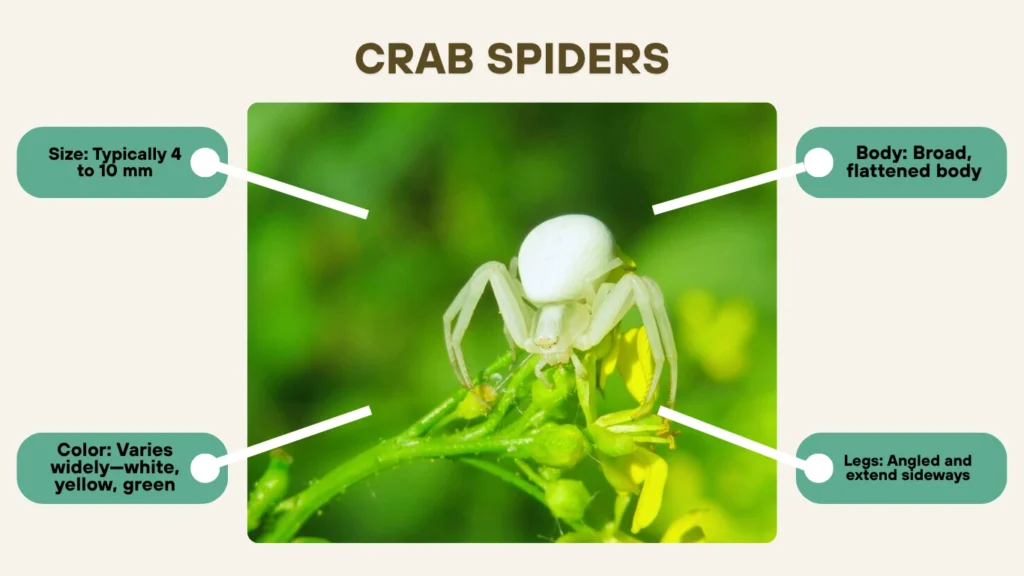
Crab spiders are named for their crab-like appearance and sideways movement. They are ambush predators and do not build webs to catch prey. In Washington State, crab spiders are often found in gardens and flower beds, blending in with petals and leaves to surprise pollinators.
Identification
- Size: Typically 4 to 10 mm
- Color: Varies widely—white, yellow, green, or pink, often matching their surroundings
- Body: Broad, flattened body with front legs longer than the others
- Legs: Angled and extend sideways, resembling a crab
- Web: Do not spin capture webs
Habitat and Distribution in Washington
Crab spiders are common in gardens, meadows, and wooded edges across Washington. They are particularly abundant in spring and summer when flowers bloom. These spiders perch on blossoms, leaves, and stems, patiently waiting for prey like bees, flies, and butterflies.
Behavior and Life Cycle
Crab spiders rely on camouflage to ambush prey rather than chasing or trapping it. They are solitary and usually stay in the same location for several days. Females lay eggs in a silken sac attached to vegetation and often guard it until they die. The average life span is about one year, depending on the species and climate.
11. European Cross Spider (Araneus diadematus)

Also known as the Cross Orbweaver, this spider is easy to recognize by the white cross-like markings on its back. Common in gardens and wooded areas, it is one of the most visible orb-weaving spiders in Washington State during late summer and early fall.
Identification
- Size: Females up to 20 mm; males are smaller
- Color: Varies—usually orange, brown, or gray with white cross-shaped markings on the abdomen
- Body: Rounded abdomen with symmetrical white spots forming a cross
- Web: Large, circular webs often built in open spaces
Habitat and Distribution in Washington
The European Cross Spider is found throughout western and central Washington, especially in gardens, hedges, parks, and forest edges. They build their webs between plants, fences, and even manmade structures where flying insects are common.
Behavior and Life Cycle
These spiders rebuild their webs daily, typically in the evening. They remain in the center of the web or in a nearby retreat, waiting for prey to get trapped. Mating occurs in late summer, after which females produce egg sacs that overwinter. Adults usually die after the first frost, with eggs hatching in the spring. Their full life cycle takes about one year.
12. False Black Widow (Steatoda grossa)
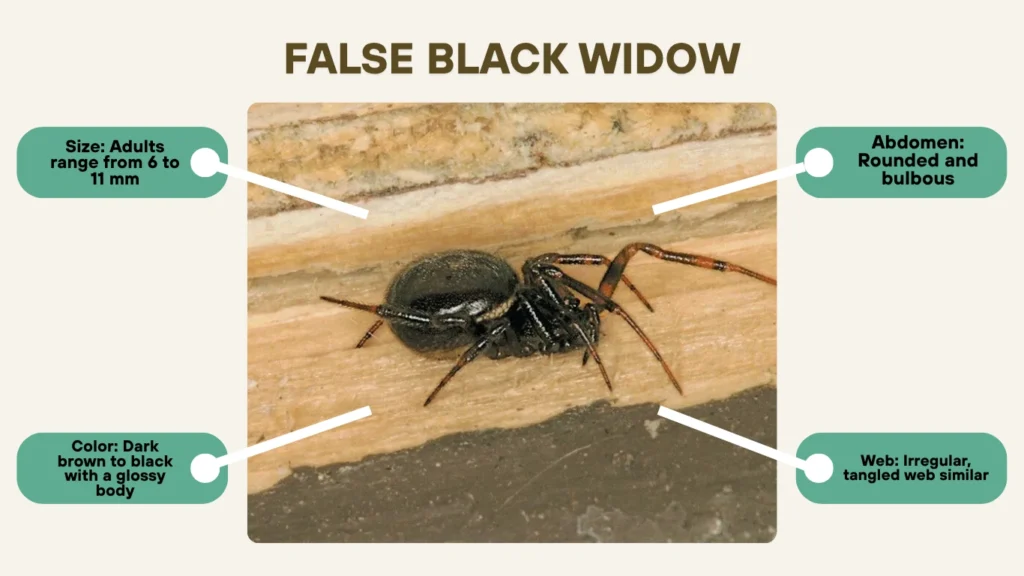
Often mistaken for the more dangerous black widow, the False Black Widow is a common spider in Washington homes. It shares a similar body shape but lacks the red hourglass marking. Despite its ominous appearance, this spider is not considered harmful to humans.
Identification
- Size: Adults range from 6 to 11 mm
- Color: Dark brown to black with a glossy body; no red markings
- Abdomen: Rounded and bulbous, sometimes with faint pale markings
- Web: Irregular, tangled web similar to a true widow spider’s web
Habitat and Distribution in Washington
False Black Widows are frequently found in urban and suburban areas across western and eastern Washington, especially in garages, basements, sheds, under furniture, and behind appliances. They prefer dark, undisturbed places where they can spin their sticky webs.
Behavior and Life Cycle
These spiders are sedentary and remain in their webs to catch prey. They feed on small insects and other spiders, sometimes even outcompeting true black widows. Mating occurs year-round in indoor environments, and females produce several egg sacs. Their life span typically ranges from 1 to 3 years, with females outliving males.
13. Common House Spider (Parasteatoda tepidariorum)
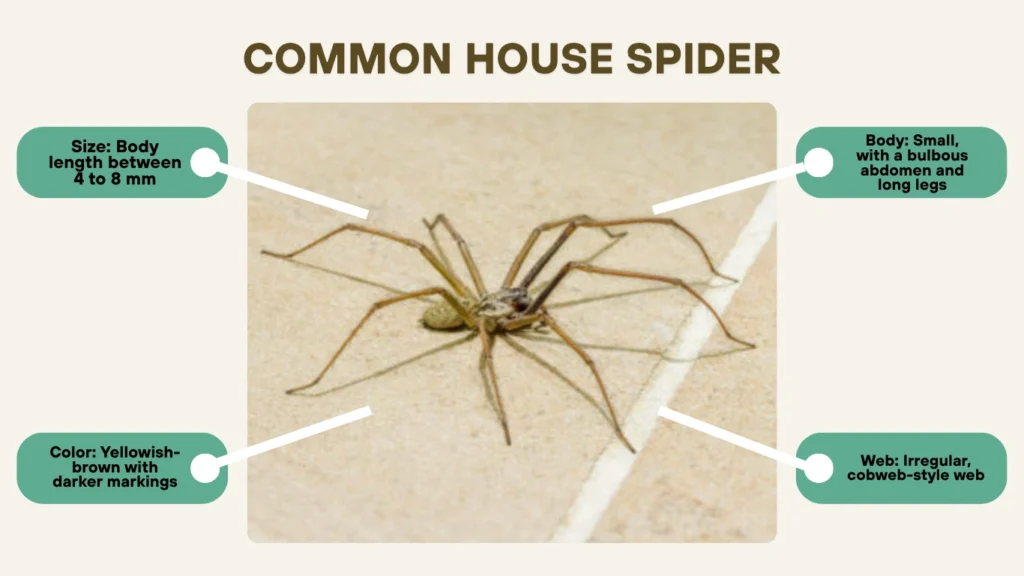
The Common House Spider is a small web-building species regularly seen in homes and buildings throughout Washington State. While often unnoticed due to its small size and hidden webs, it plays a beneficial role by catching household pests.
Identification
- Size: Body length between 4 to 8 mm
- Color: Yellowish-brown with darker markings on the abdomen
- Body: Small, with a bulbous abdomen and long legs
- Web: Irregular, cobweb-style web usually found in corners
Habitat and Distribution in Washington
This spider thrives in indoor environments such as window sills, ceilings, garages, basements, and closets. It is found throughout Washington, especially in temperate residential areas. Outdoors, it may live under eaves or in barns and sheds.
Behavior and Life Cycle
Common House Spiders are not aggressive and tend to retreat if disturbed. They remain in their webs, capturing small insects that wander too close. Females produce multiple egg sacs during their lifetime, often leaving them attached to the web. Their typical life span is about one year, though some may live longer indoors.
14. Eratigena agrestis (Hobo Spider – Scientific Focus)
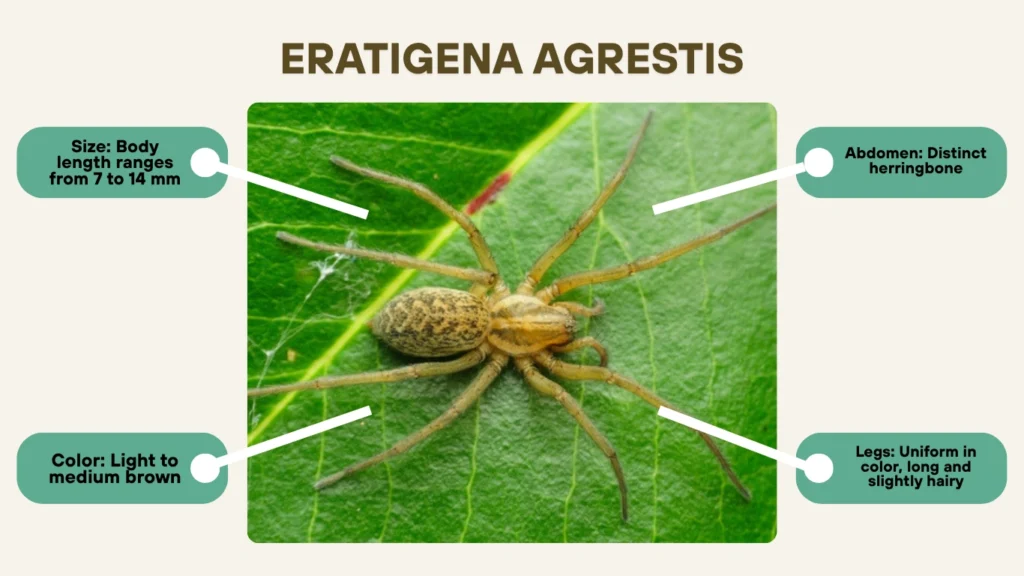
Eratigena agrestis is the scientific name for the Hobo Spider, previously discussed in the first entry. However, it’s worth detailing it here as a separate listing because some sources refer to it specifically by its Latin name. It’s one of the most frequently encountered funnel-web spiders in Washington homes.
Identification
- Size: Body length ranges from 7 to 14 mm
- Color: Light to medium brown
- Abdomen: Distinct herringbone (chevron-like) pattern
- Legs: Uniform in color, long and slightly hairy
- Web: Funnel-shaped, often near ground level
Habitat and Distribution in Washington
Eratigena agrestis is found throughout western and eastern Washington, especially in urban areas, basements, crawl spaces, and beneath rocks and woodpiles. It prefers dry, sheltered environments both indoors and outdoors.
Behavior and Life Cycle
This spider is known for its reclusive behavior. Males wander during late summer to find mates, while females stay near their webs. Egg sacs are laid in hidden crevices and hatch after a few weeks. The spider’s life cycle typically lasts 1 to 2 years.
15. Grass Spiders (Genus: Agelenopsis)

Grass Spiders are fast-moving funnel weavers that are commonly seen across lawns and bushes in Washington. They are often mistaken for hobo spiders but are easily distinguished by the presence of striped markings and their outdoor funnel webs.
Identification
- Size: 8 to 20 mm in body length
- Color: Brown with two dark longitudinal stripes running down the cephalothorax
- Legs: Long, spindly, and adapted for speed
- Web: Dense, sheet-like web with a funnel retreat
Habitat and Distribution in Washington
Grass Spiders are common in lawns, shrubs, hedges, garden beds, and occasionally inside garages or sheds. They are found throughout both eastern and western Washington, especially during late summer and fall when their funnel webs are more visible in morning dew.
Behavior and Life Cycle
These spiders are active during warmer months and typically stay near their webs. They wait inside the funnel retreat and dash out to grab prey that lands on the web surface. Mating occurs in summer, and egg sacs are produced shortly after. Their life span is typically one year, with spiderlings hatching in the spring.
16. Sierra Dome Spider (Neriene litigiosa)

The Sierra Dome Spider is a small, lesser-known species found in forested and mountainous areas of Washington. It’s part of the sheet weaver family and is known for its unique dome-shaped web.
Identification
- Size: 3 to 6 mm in body length
- Color: Dark brown or black body with light patterns on the abdomen
- Body: Slender with long legs relative to its small size
- Web: Dome-shaped sheet web suspended between vegetation
Habitat and Distribution in Washington
Sierra Dome Spiders are found primarily in forests, mountain meadows, and shaded woodland edges. In Washington, they are more commonly observed in higher elevation or cooler, moist areas, especially in late spring through fall. Their dome-shaped webs are usually built close to the ground among shrubs, tall grasses, or low vegetation.
Behavior and Life Cycle
These spiders remain hidden beneath the dome web, waiting for prey to fall onto the silk sheet. They are non-aggressive and avoid human contact. Females produce egg sacs in their webs or in sheltered plant areas. Their life span is generally under a year, with most activity occurring during warmer months.
17. Trapdoor Spiders (Family: Antrodiaetidae)

Trapdoor Spiders are secretive, ground-dwelling spiders known for their unique burrows sealed with a camouflaged trapdoor. Though rarely seen, they are native to parts of Washington, particularly in wooded or undisturbed natural areas.
Identification
- Size: 10 to 30 mm depending on species
- Color: Dark brown to black with a stout, robust body
- Legs: Thick and powerful for digging
- Web: No visible web; they live in silk-lined burrows with a hinged door made of soil and silk
Habitat and Distribution in Washington
Trapdoor Spiders are found in woodlands, mossy forests, and undisturbed hillsides, especially in western Washington. They dig burrows in moist, shaded soil, often near fallen logs, leaf litter, or roots. Their burrows are difficult to spot due to the well-camouflaged trapdoor.
Behavior and Life Cycle
These spiders are nocturnal ambush hunters. They wait just behind their trapdoor and strike when prey passes by. They are extremely sedentary and may remain in the same burrow for many years. Mating takes place when males leave their burrows in search of females. Females can live up to 10–20 years, while males typically die after mating.