




Sea turtles are majestic marine reptiles that have roamed Earth’s oceans for over 100 million years. Today, seven recognized species inhabit tropical and subtropical seas worldwide. Each type varies in size, shell shape, diet, and nesting behavior. This guide explores all seven species of sea turtles—from the massive Leatherback to the rare Kemp’s Ridley—highlighting their key features, natural habitats, and fascinating adaptations for life at sea.
1. Green Sea Turtle

The Green Sea Turtle is one of the largest and most widespread sea turtles, known for its herbivorous diet and smooth, heart-shaped shell. Despite its name, its shell isn’t always green—it’s named after the greenish fat beneath its carapace.
Identification
- Smooth, olive to brown-colored shell with mottled patterns
- Heart-shaped carapace
- Single pair of scales in front of eyes
- Grows up to 4 feet long and can weigh over 300 pounds
Habitat
Green sea turtles inhabit tropical and subtropical coastal waters worldwide, including coral reefs, seagrass beds, and lagoons. They nest on sandy beaches, often returning to the same site where they were born.
Diet
Adults are primarily herbivores, feeding on seagrasses and algae. Juveniles, however, are more omnivorous, eating invertebrates like jellyfish and crustaceans before transitioning to a plant-based diet.
Behavior
Green sea turtles are strong swimmers and capable of long migrations between feeding and nesting grounds. They are solitary, surfacing to breathe every few minutes while active and less frequently while resting underwater.
2. Loggerhead Sea Turtle

The Loggerhead Sea Turtle is named for its large, blocky head and powerful jaws. It is one of the most commonly observed sea turtles in temperate and subtropical oceans.
Identification
- Reddish-brown, heart-shaped shell
- Large head with strong jaws
- Five scutes (plates) on each side of the carapace
- Adults typically measure 2.5–3.5 feet and weigh around 200–400 pounds
Habitat
Loggerheads inhabit coastal bays, estuaries, and continental shelves of the Atlantic, Pacific, and Indian Oceans. They nest on sandy beaches and forage in shallow marine environments.
Diet
They are carnivorous and feed primarily on hard-shelled prey like crabs, mollusks, conchs, and sea urchins, which they can crush easily with their strong jaws.
Behavior
Loggerheads are solitary and migrate long distances between nesting and foraging areas. They are known to nest at night and often return to the beach where they were hatched.
3. Leatherback Sea Turtle
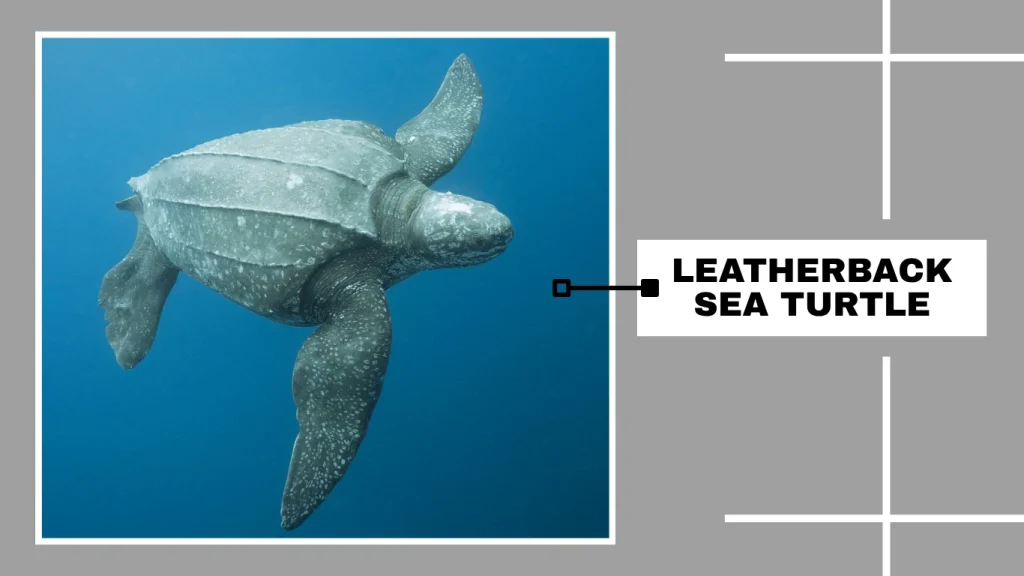
The Leatherback Sea Turtle is the largest and deepest-diving of all sea turtles. It’s easily distinguished by its soft, leathery shell and long front flippers.
Identification
- Lack of hard shell; back is covered by rubbery, leathery skin
- Long, tapered body with seven longitudinal ridges
- Dark gray to black color with white spots
- Grows up to 7 feet long and weighs over 1,000 pounds
Habitat
Leatherbacks are found in open oceans around the world, from tropical to subpolar waters. They nest on tropical beaches but forage in colder regions.
Diet
Specialized in feeding on jellyfish and other soft-bodied invertebrates. Their scissor-like jaws are adapted for grasping slippery prey.
Behavior
Leatherbacks are strong swimmers and long-distance migrants, traveling thousands of miles between nesting and feeding areas. They can dive deeper than 3,000 feet in search of prey.
4. Hawksbill Sea Turtle
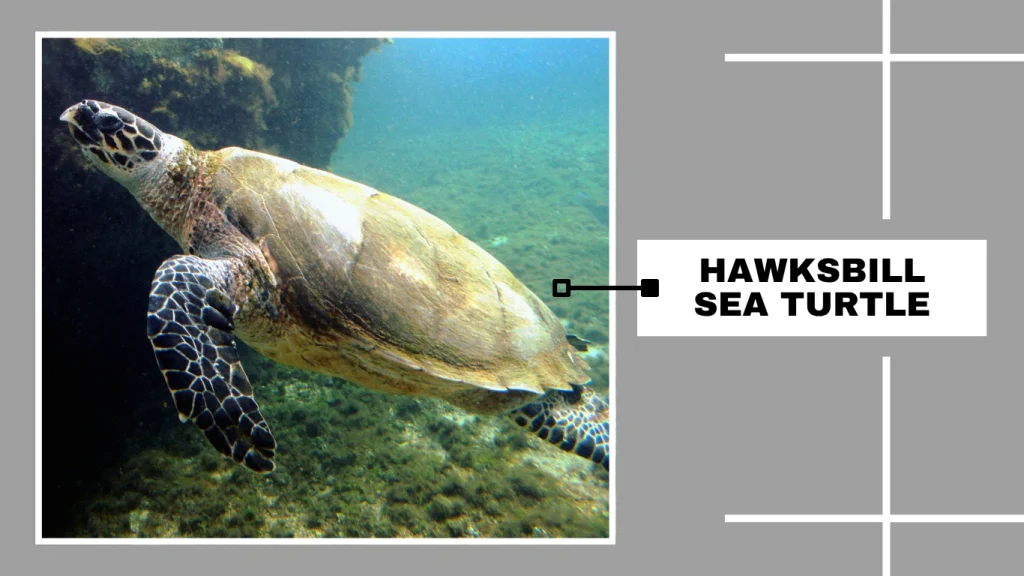
The Hawksbill Sea Turtle is a small, beautifully patterned sea turtle known for its narrow, pointed beak and striking shell used historically in jewelry.
Identification
- Overlapping scutes on a serrated shell with amber, brown, and yellow patterns
- Narrow, curved beak resembling a bird’s bill
- Small size: 2.5–3 feet in length, up to 150 pounds
- Two pairs of scales in front of the eyes
Habitat
Found primarily in tropical coral reefs of the Atlantic, Pacific, and Indian Oceans. They nest on remote beaches and prefer shallow coastal environments with sponges and coral.
Diet
Hawksbills are omnivores but specialize in eating sponges. They also consume soft corals, anemones, and other invertebrates.
Behavior
They are solitary and shy, often hiding in coral crevices. Hawksbills help maintain healthy reef ecosystems by controlling sponge populations.
5. Kemp’s Ridley Sea Turtle

Kemp’s Ridley is the smallest and one of the rarest sea turtles. It is best known for its unique mass nesting behavior called “arribada.”
Identification
- Olive-gray, nearly circular shell
- Small size: about 2 feet long and 75–100 pounds
- Five scutes on each side of the shell
- Pale plastron (underside)
Habitat
Mostly found in the Gulf of Mexico and the western Atlantic Ocean. Nesting sites are concentrated on the Gulf coasts of Mexico and Texas.
Diet
They are primarily carnivorous, feeding on crabs, shrimp, jellyfish, and fish. Juveniles may also consume algae or seaweed occasionally.
Behavior
Kemp’s Ridleys are known for nesting in synchronized groups (arribadas). They are strong swimmers and spend most of their life in shallow, coastal waters.
6. Olive Ridley Sea Turtle
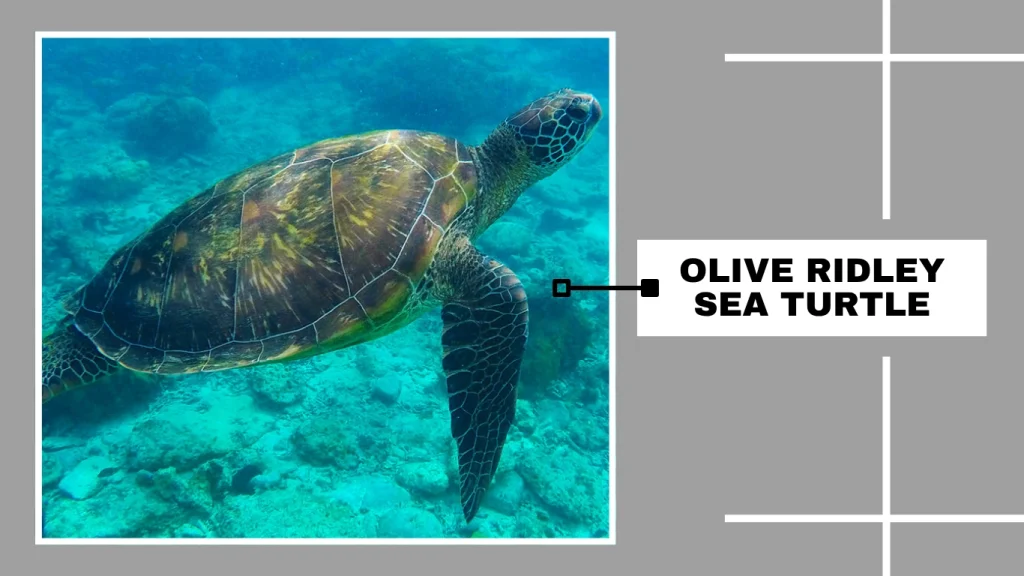
The Olive Ridley Sea Turtle is named for its olive-colored, heart-shaped shell. It is among the smallest sea turtles and is famous for its synchronized mass nesting events.
Identification
- Olive-green, nearly round carapace
- Slightly domed shell with 5 to 9 scutes on each side
- Grows up to 2–2.5 feet long and weighs 75–100 pounds
- Typically has a grayish-white plastron
Habitat
Olive Ridleys are found in warm waters of the Pacific, Atlantic, and Indian Oceans. They commonly nest on tropical sandy beaches, especially in India, Mexico, and Costa Rica.
Diet
Omnivorous. They eat jellyfish, shrimp, crabs, seaweed, fish, and sometimes algae. Their flexible diet helps them thrive in different marine environments.
Behavior
They participate in mass nesting events known as “arribadas,” where thousands nest together on the same beach. Olive Ridleys are strong swimmers and often travel long distances.
7. Flatback Sea Turtle

The Flatback Sea Turtle is native to northern Australia and nearby waters. It is named for its smooth, flat shell and has the smallest distribution of all sea turtles.
Identification
- Flat, olive-gray shell with upturned edges
- Only four costal scutes on each side
- Adult size: 2–3 feet long and weighs up to 200 pounds
- Pale-colored plastron and soft edges
Habitat
Found only in the waters around northern Australia, Papua New Guinea, and Indonesia. They prefer shallow coastal waters, bays, and lagoons.
Diet
Carnivorous. Their diet includes soft-bodied invertebrates like sea cucumbers, jellyfish, mollusks, and shrimp. They rarely consume plant matter.
Behavior
Flatbacks rarely venture into deep ocean waters and are the least migratory of sea turtles. They often nest on remote Australian beaches and show site fidelity to nesting grounds.
FAQs
1. How long do sea turtles live?
Most sea turtles live between 50 and 100 years, depending on the species and environmental factors. They have long lifespans and reach sexual maturity slowly, often after 10 to 30 years.
2. Do all sea turtles lay eggs on beaches?
Yes, all female sea turtles return to land to lay their eggs, typically on sandy beaches. Most species show natal homing, meaning they return to the beach where they were born.
3. Are sea turtles endangered?
Yes, many sea turtle species are classified as endangered or vulnerable due to threats like habitat loss, poaching, pollution, and accidental capture in fishing gear. Conservation efforts are ongoing worldwide.
4. What’s the biggest sea turtle species?
The Leatherback Sea Turtle is the largest, growing up to 7 feet long and weighing over 1,000 pounds. It also holds the record for the deepest diving among all sea turtles.
5. Can sea turtles retract into their shells?
No, unlike land turtles, sea turtles cannot retract their heads or limbs into their shells. Their anatomy is adapted for swimming rather than defense through retraction.
10 Facts About Sea Turtles
1. They’ve existed for over 100 million years
Sea turtles are ancient reptiles that lived alongside dinosaurs and have survived mass extinctions, making them one of the oldest living species on Earth.
2. Temperature determines the hatchling’s sex
The temperature of the sand during egg incubation affects the sex of hatchlings: warmer sand produces more females, while cooler sand yields more males.
3. Only 1 in 1,000 hatchlings survives to adulthood
Due to predation, environmental hazards, and human threats, very few hatchlings survive to maturity. This is why females lay so many eggs during nesting.
4. Sea turtles can migrate thousands of miles
Some species, like the Leatherback and Loggerhead, migrate across entire ocean basins between feeding and nesting grounds, covering up to 10,000 miles a year.
5. They have excellent navigation skills
Sea turtles use the Earth’s magnetic field and environmental cues to navigate with astonishing accuracy, often returning to the same beach where they were born.
6. Leatherbacks can dive deeper than whales
Leatherback sea turtles are exceptional divers, reaching depths over 3,000 feet while hunting for jellyfish in cold, dark ocean waters.
7. They don’t have teeth
Sea turtles don’t have teeth but have strong, beak-like jaws suited to their specific diets, whether it’s jellyfish, seagrass, or crustaceans.
8. Green turtles get their name from fat, not shell color
Their name comes from the greenish color of their body fat, which is tinted by their plant-based diet—not from their shell color, which is usually brown or olive.
9. Hawksbills help maintain healthy coral reefs
By feeding on sponges that compete with coral, Hawksbill turtles play a vital ecological role in maintaining the balance and health of reef ecosystems.
10. Every sea turtle species is protected by law
All seven sea turtle species are protected under international law, such as CITES, and national legislation in many countries to help combat poaching and promote conservation.