




Sea turtles are among the most ancient and resilient creatures on Earth, with a life journey filled with challenges, instinct, and migration. From the moment a female sea turtle lays her eggs in the sand to the decades-long life of an adult roaming the oceans, every stage of their life cycle is remarkable and vital for survival.
This article breaks down the complete life cycle of sea turtles, stage by stage. You’ll discover how they hatch, grow, mature, and reproduce—along with the dangers they face and the adaptations that help them survive one of nature’s most demanding life journeys.
1. Nesting and Egg Laying
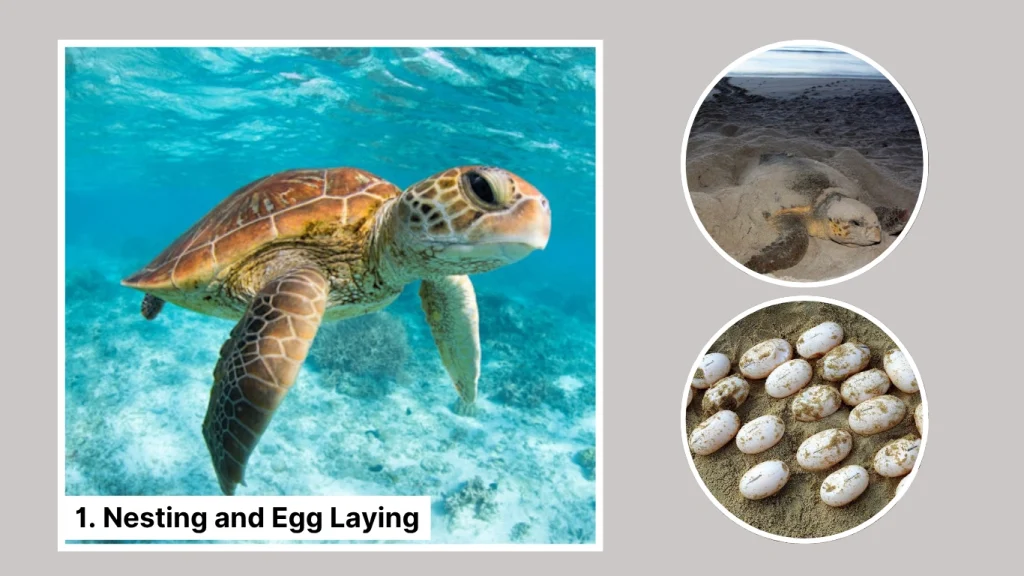
The life of a sea turtle begins on a sandy beach, where adult females return—often after decades at sea—to lay their eggs. This instinct-driven journey sets the foundation for the entire life cycle.
Natal Homing and Nesting Behavior
Female sea turtles return to the same beach where they were born, using Earth’s magnetic field to navigate across thousands of miles. Nesting typically happens at night to avoid predators and extreme heat.
Egg Laying Process
Once ashore, the female digs a deep hole using her hind flippers and lays between 80–120 soft-shelled eggs. After laying, she buries the eggs with sand and immediately returns to the sea, leaving the nest unattended.
Nesting Frequency
Most females lay multiple clutches in a season, usually 2–8 nests spaced about two weeks apart. However, they typically only nest every 2 to 4 years.
2. Incubation Period (Egg Development)

After the eggs are laid, they undergo a critical development phase under the sand, completely dependent on environmental conditions.
Duration and Environmental Influence
The eggs incubate for about 45–70 days. The surrounding sand’s temperature, moisture, and composition all affect the speed and success of development.
Temperature-Dependent Sex Determination
Remarkably, the temperature of the nest determines the sex of the hatchlings. Warmer nests generally produce females, while cooler nests yield males—a natural mechanism critical to population balance.
Natural Threats to Eggs
During this time, the eggs are highly vulnerable to predators like raccoons, foxes, and crabs. Flooding, beach erosion, and human activity can also damage or destroy nests, reducing hatch success rates.
3. Hatching

After weeks of incubation, the baby sea turtles are ready to emerge from their eggs and begin their journey toward the ocean. This stage marks their first big challenge in life.
Breaking Through the Shell
Hatchlings use a temporary, sharp structure on their nose called a caruncle to break open the eggshell. This process can take several hours as the turtles slowly wiggle free from the egg.
Synchronized Emergence
Hatchlings usually emerge as a group—mostly at night—to reduce the risk of predation and overheating. Working together, they push through the sand, creating an escape tunnel to the surface.
Rush to the Ocean
Once on the surface, hatchlings instinctively crawl toward the brightest horizon, which is usually the ocean under moonlight. Along the way, they face predators like crabs, birds, and raccoons. Only a small percentage make it to the water.
4. Frenzy Period (First Swim)
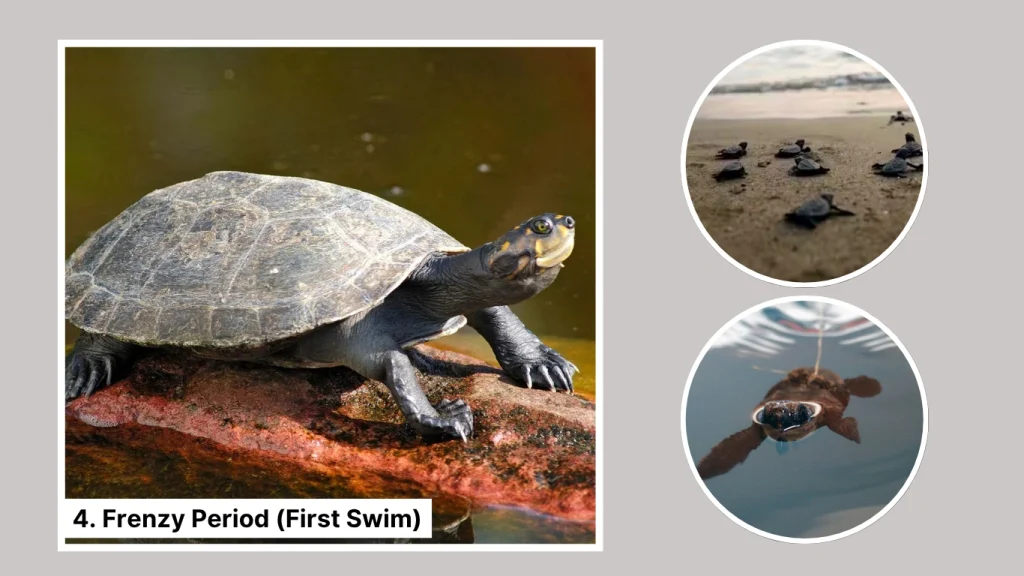
The first 24–48 hours after reaching the ocean are known as the frenzy period, a critical survival phase filled with nonstop swimming.
Instinctive Swimming Burst
Newly hatched turtles swim almost continuously for one to two days. This burst of activity helps them escape the predator-rich shallow zone near the beach and reach deeper, safer waters.
Predator Avoidance
During this stage, hatchlings are vulnerable to a wide range of ocean predators, including fish, seabirds, and even larger turtles. Their small size and frantic movement make them easy targets.
Goal: Open Ocean
The objective of this phase is to reach floating seaweed mats (like Sargassum) in the open ocean. These provide both cover from predators and a source of food, increasing their chances of survival.
5. The Lost Years

After the frenzy swim, sea turtle hatchlings enter a mysterious and little-observed phase known as “the lost years”, which can last several years as they drift in the open ocean.
Life in Ocean Currents
During this time, young turtles ride ocean currents and gyres, often hiding in floating seaweed like Sargassum, which offers both shelter and food. They remain mostly out of sight and avoid coastal waters where predators are more common.
Diet and Growth
Hatchlings feed on small organisms found in the seaweed, such as plankton, jellyfish, tiny crustaceans, and algae. This high-protein diet fuels rapid growth during their most vulnerable years.
Limited Research
Because they are rarely seen during this time, much about the lost years remains unknown. However, satellite tagging and recent studies suggest that this stage is critical for dispersal and survival.
6. Juvenile Stage

After surviving the lost years, sea turtles enter the juvenile stage, when they begin to settle into nearshore habitats and establish feeding areas.
Moving to Coastal Waters
Juvenile turtles migrate closer to coastlines, bays, and lagoons, where food is more abundant and water temperatures are favorable. This is when species differences in diet become more apparent (herbivorous vs. carnivorous preferences).
Active Growth and Learning
Turtles continue to grow rapidly and develop stronger shells. They also begin learning migration routes and establishing foraging behaviors. Juveniles are still vulnerable to predators but are better equipped to avoid danger.
Species-Specific Behavior
For example, green sea turtles shift toward a mostly plant-based diet, while loggerheads and Kemp’s ridleys continue consuming crustaceans and small marine animals. This shift prepares them for adult survival.
7. Subadult Stage

As sea turtles grow larger and stronger, they enter the subadult stage, a transitional phase before reaching full sexual maturity. This period can last several years, depending on the species.
Expanding Range and Migration
Subadult turtles begin to travel greater distances between feeding grounds, coastal areas, and deeper waters. They explore larger territories and gain strength for future long migrations to breeding and nesting sites.
Physical and Behavioral Changes
Their shells harden further, body size increases significantly, and their diet becomes more consistent with adult preferences. Although they resemble adults in appearance, they are not yet capable of reproduction.
Increasing Independence
Subadults are more adept at avoiding predators and navigating ocean currents. They develop strong swimming endurance and start exhibiting solitary behaviors seen in adult turtles.
8. Adult Maturity

Reaching adulthood is a significant milestone in a sea turtle’s life, often achieved between 10 to 30+ years of age, depending on the species and environmental conditions.
Onset of Reproduction
Once mature, turtles are ready to mate. Males remain in the ocean year-round, while females begin long migrations to return to the beaches where they were born—sometimes traveling thousands of miles.
Physical Differences
Adult males develop longer tails and sometimes curved claws on their front flippers for mating. Females, while slightly larger, remain otherwise similar to their juvenile form.
Continued Growth and Longevity
Even after maturity, turtles continue to grow slowly. Many sea turtles can live 50 years or more, with some species reaching lifespans of 80–100 years under ideal conditions.
9. Reproduction and Mating
Once sea turtles reach adulthood, the focus of their life cycle shifts toward reproduction. This stage is essential for the continuation of the species and is driven by powerful migratory instincts.
Courtship and Mating Behavior
Mating typically occurs in shallow coastal waters near nesting beaches. Males may compete for access to females and often mate with several partners during the breeding season. Females can store sperm from one or more males to fertilize multiple clutches.
Breeding Season and Frequency
Most sea turtles breed every 2 to 4 years. After mating, males return to the open sea, while females remain near shore to lay multiple nests over the course of the season.
Energy Demands
Reproduction requires a huge amount of energy, especially for females. They may travel thousands of miles and go weeks without eating while nesting multiple times in a single season.
10. Life Cycle Repeats

After successful reproduction, the life cycle of a sea turtle begins again with a new generation of hatchlings—continuing the ancient rhythm of birth, migration, and return.
Female Return to Natal Beach
Females return to the same beach where they were born, repeating the cycle by laying eggs in the sand. This site fidelity is critical for maintaining nesting colonies and species survival.
Generation Continuity
Each successful nest produces dozens of hatchlings, though only a few will survive to adulthood. Those that do will one day return to repeat the process, often after decades in the ocean.
Importance of Conservation
Understanding and protecting every stage of this life cycle is crucial. Sea turtles face numerous threats, including habitat loss, pollution, climate change, and fishing gear entanglement. Supporting conservation ensures this remarkable cycle continues for generations to come.
FAQs
1. How long does it take for a sea turtle to reach adulthood?
Most sea turtles take between 10 and 30 years to reach sexual maturity, depending on the species, habitat conditions, and food availability. For example, loggerhead turtles mature around 25–30 years, while Kemp’s ridley turtles may mature slightly earlier.
2. What percentage of sea turtle hatchlings survive to adulthood?
Unfortunately, only about 1 in 1,000 to 1 in 10,000 hatchlings survive to adulthood. Most are eaten by predators or face environmental threats early in life, especially during the crawl to the ocean and the frenzy swim.
3. Do sea turtles return to the same beach where they were born?
Yes, female sea turtles exhibit a behavior called natal homing, meaning they return to the same beach where they hatched to lay their eggs. This remarkable navigation ability is guided by Earth’s magnetic field.
4. How many eggs does a sea turtle lay in one nesting season?
A female sea turtle usually lays 2 to 8 clutches per season, with each clutch containing 80 to 120 eggs. That means one female can lay several hundred eggs during a single nesting season.
5. What is the biggest threat to the sea turtle life cycle?
The biggest threats include habitat destruction, climate change (which affects sex ratios and nesting success), plastic pollution, and bycatch in fishing gear. Conservation efforts aim to protect turtles at every stage of their life—from egg to adult.