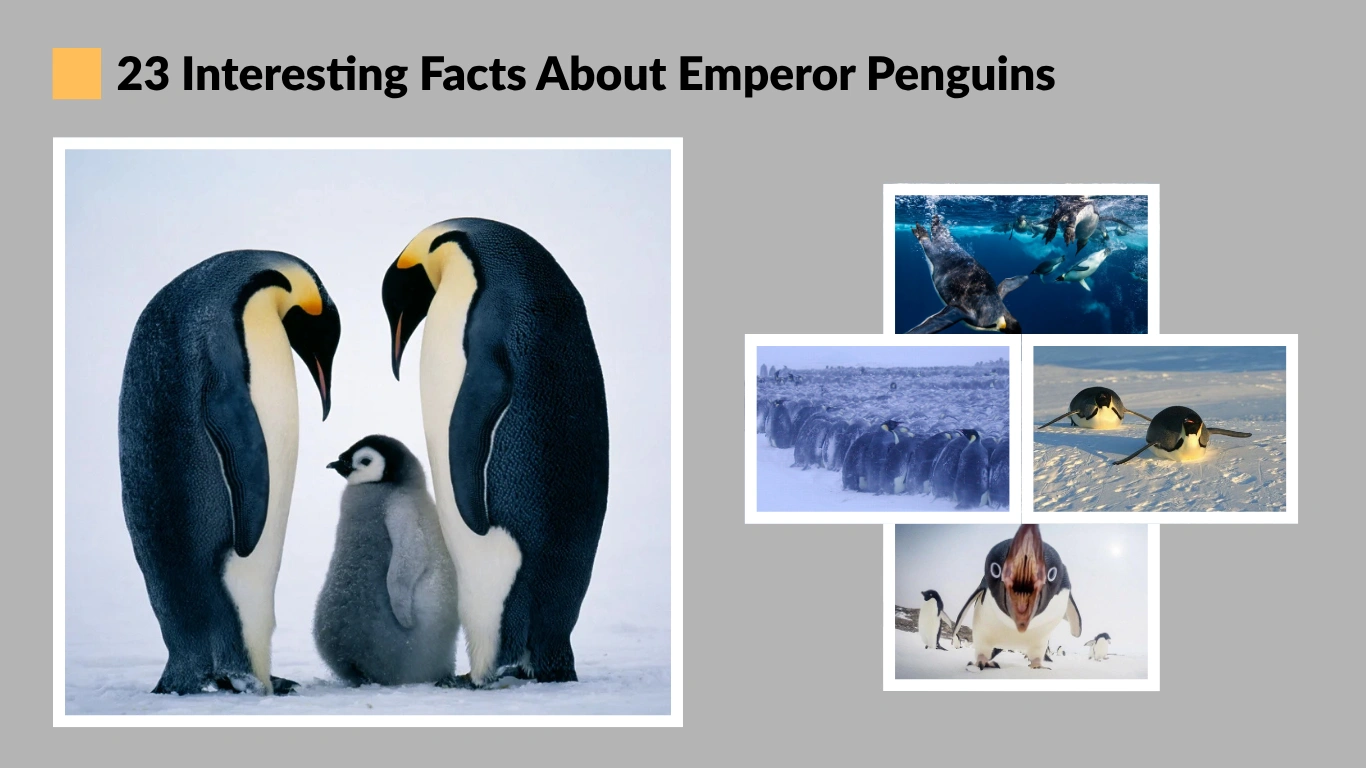





The emperor penguin is the largest, heaviest, and arguably the most remarkable penguin species on Earth. Endemic to the icy wilderness of Antarctica, these flightless birds are famous not only for their towering size but also for their extraordinary survival strategies and parenting behaviors. From standing nearly four feet tall to enduring months of brutal cold to protect their young, emperor penguins are true icons of resilience.
In this article, we’ll explore everything from how long they live and where they call home to how big they grow and why the emperor penguin father is one of nature’s most dedicated parents.
Life Cycle of the Emperor Penguin

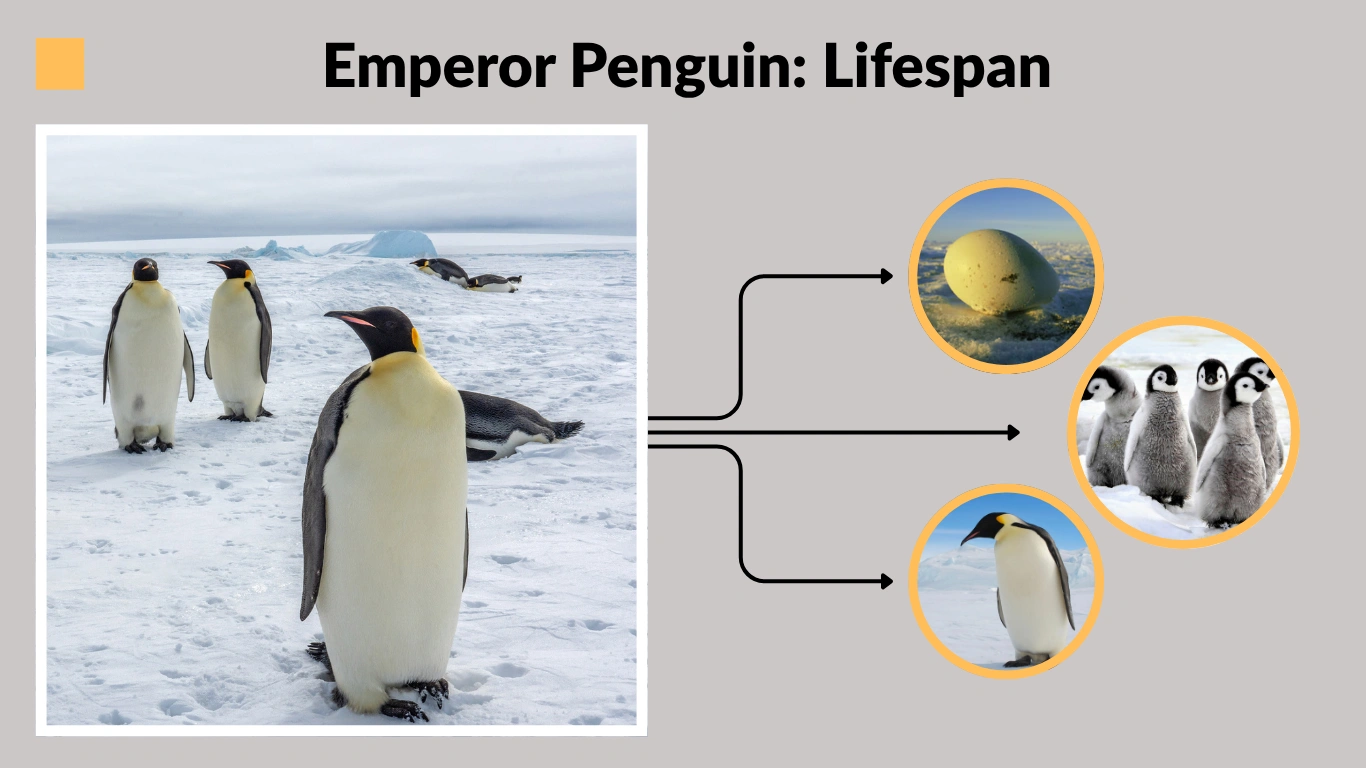
The life cycle of the emperor penguin is uniquely adapted to Antarctica’s extreme environment. From mating in freezing temperatures to chicks growing on shifting sea ice, each stage is tightly linked to the seasonal rhythm of the polar south.
1. Mating and Courtship
The cycle begins in March or April, during the start of Antarctica’s winter. Adult emperor penguins travel long distances from the ocean to reach their breeding colonies on stable sea ice.
Males and females engage in courtship rituals that include synchronized movements and vocal calls. Each penguin has a distinct call, helping partners find and recognize each other in massive colonies.
2. Egg Laying and Male Incubation
By May or early June, after successful mating, the female lays a single egg—the only one they produce each season.
She carefully transfers the egg to the male’s feet, where he balances it under a flap of warm skin called a brood pouch. This keeps the egg from touching the ice, which would be fatal within minutes.
After this, the female leaves for the ocean to feed, and the male begins his incubation duty. He fasts for about 65 days, surviving on stored body fat, enduring darkness, and temperatures below –60°C.
3. Hatching and Early Chick Care
The egg hatches in July or early August, just before the mother returns. The chick is covered in gray down and weighs about 300 grams.
If the mother hasn’t arrived yet, the father produces a nutrient-rich secretion called crop milk to keep the chick alive for a short period. Once the mother returns, she takes over feeding with regurgitated food from her recent trip to the sea.
The male, now extremely thin, finally leaves to feed after more than two months of fasting.
4. Chick Growth and Parental Roles
During August through November, both parents take turns feeding the chick and traveling to the sea. One guards and warms the chick while the other hunts for fish, krill, and squid.
As the chick grows, it becomes too large for the brood pouch. It begins to stand on the ice and develop thicker down. Parents continue alternating roles every few days to ensure constant food supply and protection.
5. Crèche Formation
By late spring (October to December), the chick joins a crèche—a group of other young penguins that huddle together for warmth and safety. This allows both parents to forage at the same time.
Crèche behavior is essential for survival, as Antarctic temperatures can still be dangerously low. The chicks begin to develop independence during this stage but still rely on their parents for food.
6. Molting and Becoming Independent
Around December to January, the young penguins begin to molt, shedding their soft gray down and growing waterproof adult feathers. This molt is vital, as it allows them to swim and survive at sea.
Once fully molted, the juvenile emperor penguin heads out to sea. At this point, they are no longer dependent on their parents and begin hunting on their own.
7. Maturity and Breeding
Juvenile emperor penguins stay at sea for 3 to 6 years, feeding and growing. Once mature, they return to the colony where they were born to find a mate and start the life cycle again.
However, only a fraction of chicks survive to adulthood. Those that do contribute to one of the most remarkable survival strategies in the animal kingdom.
How Long Do Emperor Penguins Live?
The lifespan of an emperor penguin depends heavily on its environment. In the wild, these birds must survive freezing temperatures, long fasting periods, and natural predators. Despite such challenges, emperor penguins are surprisingly long-lived for birds that face such extreme conditions.
Average Lifespan in the Wild
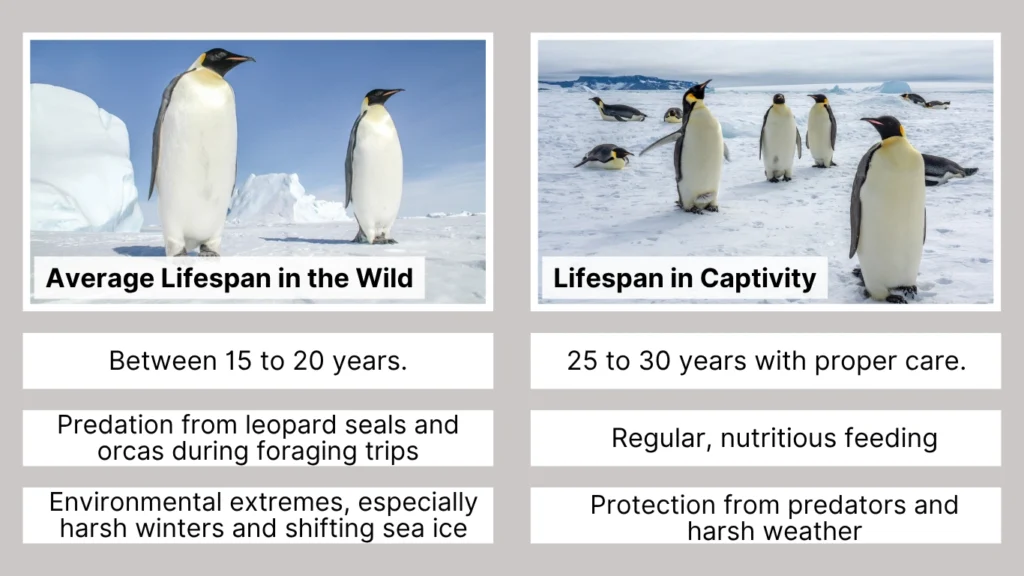
In their natural Antarctic habitat, emperor penguins typically live between 15 to 20 years. However, reaching that age is not guaranteed. Many chicks do not survive their first year due to starvation, predation by birds like skuas, or exposure to the cold during severe storms.
For adults, lifespan is influenced by several key factors:
- Predation from leopard seals and orcas during foraging trips
- Environmental extremes, especially harsh winters and shifting sea ice
- Food availability, which can vary seasonally and affect breeding success
Those that survive into adulthood are tough and resilient, with a life pattern that follows the rhythm of Antarctica’s seasons.
Lifespan in Captivity
In controlled environments such as wildlife parks or research centers, emperor penguins can live significantly longer. They may reach 25 to 30 years with proper care.
This extended lifespan is due to:
- Regular, nutritious feeding
- Protection from predators and harsh weather
- Medical care for illness or injury
While captivity provides a safer and more stable environment, it also limits natural behaviors like long-distance swimming or forming massive colonies. Still, studying captive emperor penguins has contributed greatly to our understanding of their biology.
Where Do Emperor Penguins Live?
Emperor penguins are a species uniquely adapted to one of the harshest environments on Earth—Antarctica. They are the only penguin species that breeds during the Antarctic winter, relying on strong social behaviors and physical adaptations to survive in a place where temperatures can drop below –60°C and winds exceed 100 km/h.
Natural Habitat – Antarctica’s Icy Wilderness
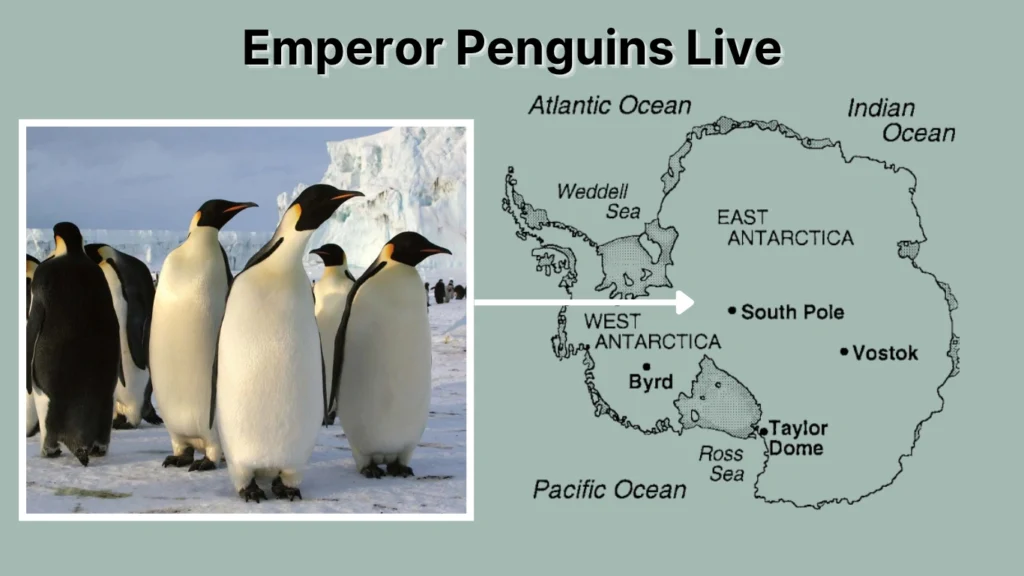
Emperor penguins are found exclusively in Antarctica. They live and breed on the stable sea ice that surrounds the continent. These remote, frozen locations offer safety from land predators and allow colonies to remain undisturbed.
Their preferred breeding grounds are:
- Flat, unbroken areas of fast ice (sea ice attached to the land or grounded icebergs)
- Sheltered regions near ice cliffs or natural windbreaks
- Zones that remain frozen through the entire breeding cycle (March–January)
These conditions are crucial for egg incubation, chick rearing, and adult survival during the harsh polar night.
Why Antarctica Is Ideal for Emperor Penguins
Despite its deadly climate, Antarctica provides the perfect combination of conditions for emperor penguins to thrive:
- Sea ice stability supports colony formation and protects chicks during development.
- Cold temperatures prevent overheating during dense huddling.
- Abundant marine life near the coast ensures rich feeding grounds once adults return to the sea.
They rely on open leads in the ice (cracks in the frozen sea) to dive and hunt for food such as fish, squid, and krill.
Emperor Penguin Colonies and Distribution
There are approximately 50 known emperor penguin colonies, scattered around the Antarctic coastline. Some of the better-known colony locations include:
- Cape Washington
- Snow Hill Island
- Halley Bay
- Dawson-Lambton Glacier
- Taylor Glacier
Many of these colonies are monitored using satellite imagery, since they are so remote and often inaccessible to researchers.
Colony size varies, but some can hold tens of thousands of individuals, especially during the breeding season.
Emperor Penguin Height and Size
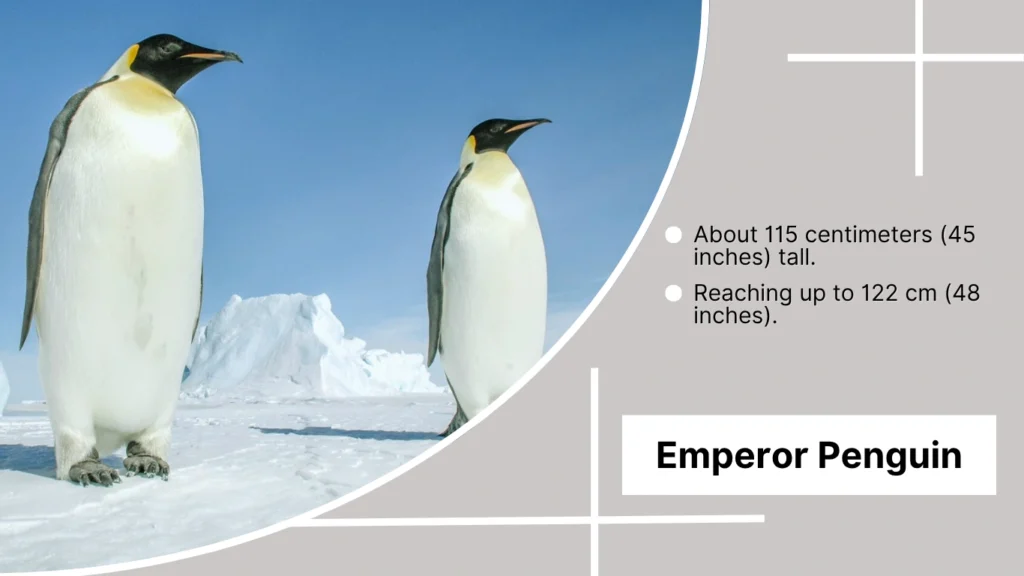
Emperor penguins are not only the tallest but also the heaviest penguin species in the world. Their size helps them retain body heat in the frigid Antarctic environment, and it contributes to their strong and powerful swimming ability in icy waters.
How Tall Are They?
An average adult emperor penguin stands between 100 and 122 centimeters tall, which is about 3.3 to 4 feet. Most adults are around 115 cm (45 inches). This height makes them comparable to a small child and noticeably taller than all other penguin species.
Their upright posture adds to the impression of height. When seen in large colonies, their size is even more striking—especially when contrasted with smaller penguin species like Adélies or Gentoo penguins.
Weight and Body Mass
Adult emperor penguins typically weigh between 22 and 45 kilograms (49 to 99 pounds). Their weight can fluctuate dramatically depending on the time of year and their role in the breeding cycle.
- Males may weigh more before egg incubation, gaining fat to survive their long fasting period.
- Females also gain weight before laying the egg but then lose weight during their return to sea.
This thick body mass, combined with a dense layer of blubber and waterproof feathers, provides insulation against the Antarctic cold.
Physical Appearance Summary
The emperor penguin has a distinctive and elegant appearance that sets it apart:
- Coloration: A black head, chin, and back contrast sharply with a white belly. The upper chest features a soft golden or yellow-orange hue.
- Neck Patches: Pale yellow ear patches stretch behind the eyes and blend into the upper chest coloration.
- Flippers: Short, stiff flippers are adapted for swimming, appearing black on the outside and silvery on the inside.
- Feet: Large, strong, and black with visible claws for gripping the ice.
- Beak: Long and narrow, often with a touch of orange or pink on the lower mandible.
This streamlined body allows them to glide gracefully underwater and endure the biting wind on land.
What Makes the Emperor Penguin Father Unique?
Among all bird species, the emperor penguin father has one of the most extraordinary parenting roles in the animal kingdom. In the most extreme environment on Earth, he performs a task that few other males in nature undertake alone—incubating the egg and protecting the chick without eating for over two months.
Role During Breeding Season
After the female lays a single egg, she carefully passes it to the male’s feet. The father immediately tucks it under a fold of skin called the brood pouch, shielding it from the ice and freezing air.
While the female returns to the sea to feed, the male remains behind with the egg, standing almost motionless for about 65 days. During this time, he does not eat and relies entirely on fat reserves accumulated before the breeding season.
He stays alert and protective, enduring the coldest part of the Antarctic winter to give his offspring the best chance of survival.
Use of Brood Pouch
The brood pouch is a critical part of the emperor penguin’s anatomy. It’s a loose fold of feathered skin located just above the male’s feet. The egg sits in this pouch, kept at a constant temperature of about 35°C (95°F)—even while the air around the penguin can drop below –60°C (–76°F).
The male keeps the egg off the ice at all times. A slight misstep or too much exposure can lead to the egg freezing and dying in minutes. This intense level of care and stillness during the darkest, windiest time of year is unmatched in the bird world.
Bonding with Chick
When the chick hatches in July or early August, the father continues to care for it until the mother returns. If she is delayed, the male produces crop milk, a thick secretion from his esophagus that keeps the chick alive for several days.
Once the mother returns, parents identify each other and their chick through unique vocalizations. This vocal recognition system is essential in massive colonies where thousands of birds look nearly identical.
The father then takes his turn heading to sea to eat, often having lost over 40% of his body weight. Despite his exhausted condition, the father returns again and again to help raise the chick until it becomes independent.
FAQs
1. How big is a full-grown emperor penguin?
A fully grown emperor penguin typically stands between 100 and 122 cm (39 to 48 inches) tall and weighs 22 to 45 kg (49 to 99 pounds). Males tend to be slightly taller and heavier than females, especially before the breeding season when they store fat for fasting.
2. What country do emperor penguins live in?
Emperor penguins do not live in any country—they are exclusive to Antarctica, which is not owned by any single nation. Their colonies are scattered around the Antarctic coastline, often on stable sea ice near the edges of the continent.
3. Why does the male emperor penguin care for the egg?
In a rare reversal of roles among birds, the male emperor penguin takes full responsibility for incubating the egg. This allows the female to return to the ocean to feed after the energy-intensive process of laying the egg. The male protects and warms the egg using a brood pouch, enduring extreme cold and fasting for about 65 days until the chick hatches.
4. Can emperor penguins survive climate change?
Emperor penguins are vulnerable to climate change, especially due to the loss of stable sea ice—which they rely on for breeding and raising chicks. As warming continues, colonies in some regions have already experienced failures in chick survival. Conservation efforts and climate research are underway to protect their future.
5. What predators do emperor penguins face?
While adults are relatively safe on land, they are preyed upon in the ocean by leopard seals and orcas. Chicks and eggs are vulnerable to skuas and giant petrels, which attack when adult penguins are away or distracted.