

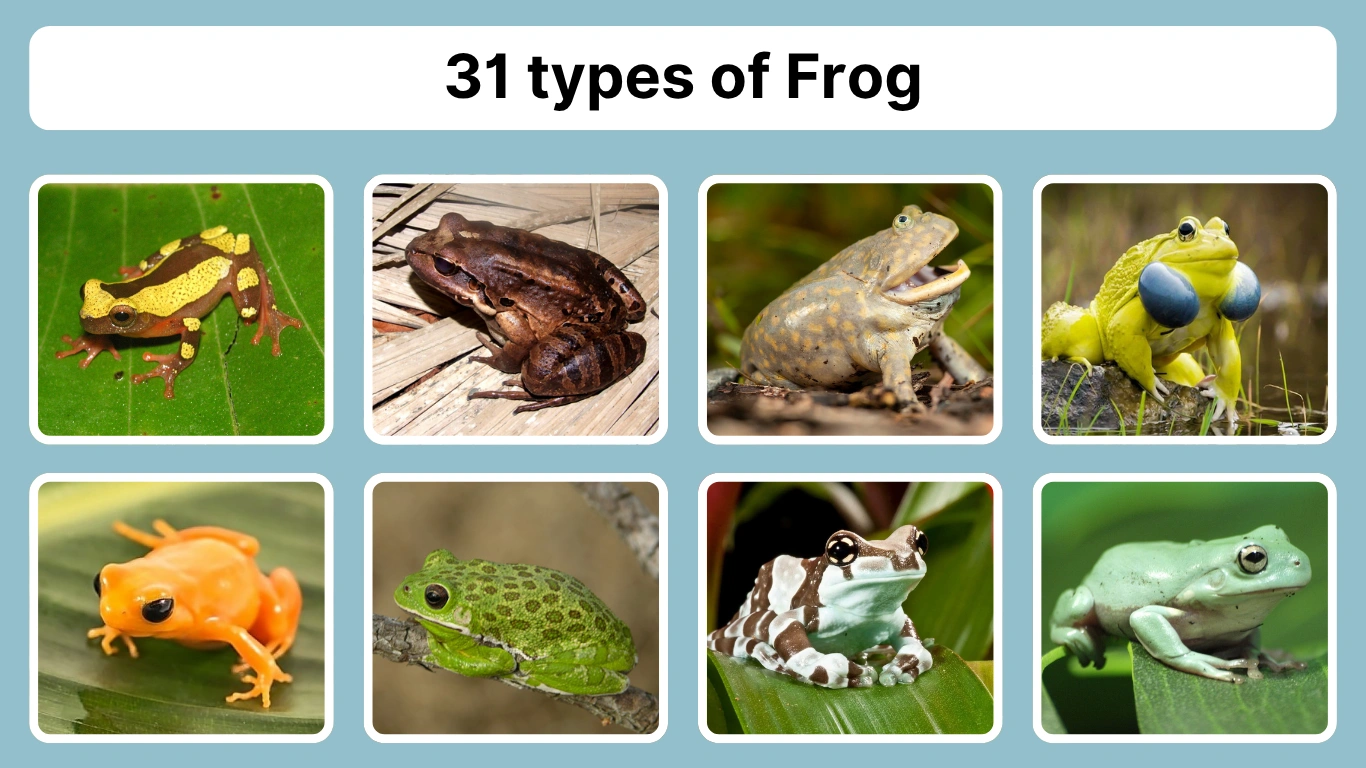
Frogs are among the most diverse and fascinating creatures in the animal kingdom, with over 7,000 species found in a wide range of habitats—from lush rainforests to arid deserts. In this guide, we explore 31 remarkable types of frogs, each with its own distinctive colors, behaviors, adaptations, and calls. From the massive Goliath Frog of Africa to the jewel-toned Poison Dart Frogs of South America, these amphibians showcase the beauty and complexity of evolution. Whether you’re a nature enthusiast, student, or simply curious, this collection offers a deeper look into the rich world of frogs—covering their physical traits, habitats, lifestyles, and how they thrive across the globe.
1. American Bullfrog

The American Bullfrog is the largest frog species native to North America and is well-known for its loud, booming croak that can be heard from great distances during the breeding season. Commonly found near lakes, ponds, and marshes, this frog plays an important role in wetland ecosystems. Its powerful legs and appetite make it a dominant predator among amphibians.
Identification
- Scientific Name: Lithobates catesbeianus
- Size: 3.5 to 6 inches (can reach up to 8 inches)
- Color: Olive green to brownish green with a lighter belly
- Eyes: Prominent with golden iris
- Tympanum (eardrum): Large and visible, larger than the eye in males
- Legs: Long and muscular with webbed hind feet
- Skin Texture: Smooth with some folds behind the eyes
- Call: Deep, resonant “jug-o-rum” call
- Habitat Range: United States, southern Canada, and invasive populations in other countries
- Diet: Carnivorous – eats insects, fish, small birds, and other frogs
Behavior and Temperament
American Bullfrogs are aggressive predators and often dominate their habitat. They are primarily nocturnal and prefer warm, stagnant waters for breeding and feeding.
Habitat and Adaptation
They thrive in permanent bodies of freshwater such as lakes, swamps, and slow-moving streams. Due to their strong legs and adaptability, they are successful colonizers and can survive in diverse environments when introduced.
Reproduction and Lifecycle
Bullfrogs breed in late spring to early summer. Females lay up to 20,000 eggs in a single clutch. Tadpoles are large and may take up to 2 years to metamorphose into adult frogs. Their lifespan ranges from 7 to 10 years in the wild.
2. African Clawed Frog

The African Clawed Frog is a fully aquatic amphibian native to sub-Saharan Africa, widely known for its unique appearance and use in laboratory research. It is named after the three short claws on its hind feet, which are used for tearing apart food.
Identification
- Scientific Name: Xenopus laevis
- Size: 2 to 5 inches
- Color: Mottled gray, olive, or brown
- Eyes: Positioned on top of the head
- Limbs: Strong hind limbs with claws; forelimbs are unwebbed
- Skin Texture: Smooth and slippery with no tongue or eyelids
- Call: Males produce a clicking or buzzing sound underwater
- Habitat Range: Native to Africa; introduced populations exist globally
- Diet: Omnivorous – eats insects, worms, small fish, and even other frogs
Behavior and Temperament
This species is highly adaptable and can survive dry periods by burrowing into mud. It is active both day and night in the water and is known to be opportunistic in feeding.
Habitat and Adaptation
Preferring stagnant or slow-moving waters like ponds and ditches, African Clawed Frogs are tolerant of polluted and low-oxygen environments. They often live entirely underwater, surfacing only to breathe.
Reproduction and Lifecycle
Females lay several hundred to a few thousand eggs after mating. Tadpoles metamorphose in about 6 to 8 weeks, and adults may live over 15 years in captivity.
3. Poison Dart Frog

Poison Dart Frogs are a group of brightly colored frogs found in Central and South America. Known for their toxic skin secretions, they have become symbols of beauty and danger in the animal kingdom.
Identification
- Scientific Name: Dendrobatidae family (many species)
- Size: 0.5 to 2.5 inches
- Color: Vivid hues of blue, yellow, red, green, or orange with striking patterns
- Skin Texture: Smooth but secretes potent alkaloid toxins
- Eyes: Large, forward-facing
- Limbs: Slender with unwebbed fingers for climbing
- Call: High-pitched trills or chirps
- Habitat Range: Central and South American rainforests
- Diet: Ants, termites, and small insects (diet influences toxicity)
Behavior and Temperament
These frogs are diurnal and very active during the day. Males often call to attract mates and defend territory. They exhibit strong parental care, sometimes transporting tadpoles on their backs.
Habitat and Adaptation
Poison Dart Frogs live in moist, tropical lowland forests near streams. Their bright colors serve as a warning to predators, a survival strategy known as aposematism.
Reproduction and Lifecycle
Eggs are laid on leaves or in moist crevices. After hatching, parents may carry tadpoles to water-filled bromeliads or tree holes. Depending on the species, the development from tadpole to froglet may take several weeks.
4. Red-Eyed Tree Frog

The Red-Eyed Tree Frog is an iconic amphibian known for its vibrant green body and striking red eyes. Native to Central America’s rainforests, this species is often seen resting on broad leaves and is admired for its vivid coloration and climbing ability.
Identification
- Scientific Name: Agalychnis callidryas
- Size: 2 to 3 inches
- Color: Bright green body with blue and yellow sides
- Eyes: Large and bright red with vertical pupils
- Legs: Long, with orange or red webbed feet and suction-cup toe pads
- Skin Texture: Smooth
- Call: Males produce a soft croaking sound during mating season
- Habitat Range: Lowland rainforests from southern Mexico to northern Colombia
- Diet: Insects such as crickets, moths, and flies
Behavior and Temperament
Red-Eyed Tree Frogs are nocturnal and rely on their camouflage to stay hidden during the day. When startled, they open their eyes suddenly to scare predators—a behavior called startle coloration.
Habitat and Adaptation
These frogs are arboreal and spend most of their lives in trees, rarely descending to the ground. Their toe pads allow them to cling to leaves and branches in humid, tropical environments.
Reproduction and Lifecycle
Females lay eggs on leaves overhanging water. Once hatched, the tadpoles drop into the water below. The metamorphosis from tadpole to adult takes about 2 months.
5. Pacman Frog

The Pacman Frog is a round, bulky frog named after the video game character due to its large mouth and wide body. Native to South America, this frog is a popular pet because of its unique appearance and minimal care needs.
Identification
- Scientific Name: Ceratophrys ornata
- Size: 4 to 7 inches (females larger than males)
- Color: Green, brown, or tan with bold markings
- Eyes: Positioned on top of the head, giving a frog-like stare
- Mouth: Extremely wide with visible bony “fangs” in the lower jaw
- Body Shape: Round and squat
- Skin Texture: Bumpy and leathery
- Call: Loud croaking, especially by males
- Habitat Range: Argentina, Brazil, and Uruguay
- Diet: Insects, rodents, reptiles, and even other frogs
Behavior and Temperament
Pacman Frogs are ambush predators, sitting motionless for long periods and lunging at prey. They can be aggressive and may bite when handled.
Habitat and Adaptation
They inhabit humid forest floors and grasslands. Though not aquatic, they require a moist environment and often burrow into substrate to stay cool.
Reproduction and Lifecycle
Breeding occurs during rainy seasons. Eggs are laid in water, and tadpoles hatch within a few days. The complete metamorphosis happens within 30–50 days.
6. Tomato Frog

The Tomato Frog is a plump, brightly colored amphibian native to Madagascar, named for its vivid red-orange skin. When threatened, it can puff up its body and secrete a sticky substance as a defense mechanism.
Identification
- Scientific Name: Dyscophus antongilii
- Size: 2.5 to 4 inches (females larger than males)
- Color: Bright reddish-orange; females more vibrant
- Eyes: Small and set to the sides
- Body Shape: Round and squat
- Skin Texture: Smooth with sticky secretions
- Call: Low-pitched growl-like croak
- Habitat Range: Northeastern Madagascar
- Diet: Insects, small invertebrates, and worms
Behavior and Temperament
Tomato Frogs are mostly nocturnal and prefer to stay buried or hidden during the day. They are generally calm but become defensive if disturbed.
Habitat and Adaptation
They thrive in lowland rainforests, swamps, and near slow-moving water. They can tolerate brief periods of drought by burrowing into the soil.
Reproduction and Lifecycle
Eggs are laid in water in clusters, and tadpoles hatch quickly. Metamorphosis occurs in about 45–60 days.
7. Leopard Frog

Leopard Frogs are a group of spotted frogs named for their distinctive dark spots resembling those of a leopard. They are widespread across North America and are often found near freshwater sources.
Identification
- Scientific Name: Lithobates pipiens (Northern Leopard Frog)
- Size: 2 to 4.5 inches
- Color: Green or brown with rounded dark spots bordered by light halos
- Eyes: Positioned on top of the head
- Body Shape: Slender with long legs
- Skin Texture: Smooth and moist
- Call: Snore-like chuckle or grunt
- Habitat Range: Canada, United States, and parts of Mexico
- Diet: Insects, spiders, worms, and even small birds or snakes
Behavior and Temperament
They are quick and agile, often leaping into water to escape predators. Generally shy, they prefer to remain hidden in vegetation.
Habitat and Adaptation
Leopard Frogs inhabit ponds, lakeshores, and slow streams. They need both aquatic environments for breeding and grassy areas for foraging.
Reproduction and Lifecycle
Breeding occurs in spring. Females lay several thousand eggs in clusters. Tadpoles undergo metamorphosis in 2 to 3 months depending on temperature and food availability.
8. Green Tree Frog

The Green Tree Frog is a slender, bright-green amphibian commonly found in the southeastern United States. It is known for its sticky toe pads and high-pitched nighttime calls during warm seasons, making it a common backyard visitor.
Identification
- Scientific Name: Dryophytes cinereus
- Size: 1.25 to 2.5 inches
- Color: Bright lime to dark green with a light white or cream stripe along each side
- Eyes: Golden with horizontal pupils
- Body Shape: Slim and agile
- Skin Texture: Smooth and slightly moist
- Call: Loud, nasal “queenk, queenk” repeated in quick succession
- Habitat Range: Southeastern United States (especially near the Gulf Coast)
- Diet: Small insects like flies, moths, and beetles
Behavior and Temperament
Green Tree Frogs are nocturnal, arboreal, and active climbers. They are not aggressive and tend to remain motionless during the day, often clinging to smooth surfaces or leaves.
Habitat and Adaptation
They live in shrubs, reeds, trees, and even window sills near water sources. Their adhesive toe pads help them climb vertical surfaces with ease. They’re tolerant of suburban environments if moisture and shelter are present.
Reproduction and Lifecycle
Mating occurs after heavy rains during the spring and summer. Males call to attract females who lay eggs in shallow water. Tadpoles transform into frogs in 4 to 6 weeks depending on temperature and conditions.
9. Glass Frog

Glass Frogs are named for the transparent skin on their undersides, allowing visibility of internal organs. They live in the cloud forests of Central and South America and are known for their delicate size and hidden, leaf-dwelling behavior.
Identification
- Scientific Name: Family Centrolenidae (multiple species)
- Size: 1.2 to 3 inches
- Color: Light green with semi-translucent or fully transparent bellies
- Eyes: Forward-facing, large, and golden
- Body Shape: Small and flattened
- Skin Texture: Smooth and gelatinous
- Call: High-pitched whistles or chirps
- Habitat Range: Tropical forests from Mexico to Bolivia
- Diet: Small insects like gnats, ants, and spiders
Behavior and Temperament
Glass Frogs are secretive and nocturnal. They cling to the underside of leaves over streams and are hard to spot due to their green camouflage and translucent appearance.
Habitat and Adaptation
They inhabit humid mountain forests, often near fast-flowing streams where they lay their eggs. Their transparency may help in camouflage by mimicking the color and texture of leaves.
Reproduction and Lifecycle
Females lay clusters of eggs on the underside of leaves above streams. Males guard the eggs until hatching. Upon hatching, tadpoles drop into the water below and undergo metamorphosis over several weeks.
10. Goliath Frog

The Goliath Frog is the largest frog species in the world, reaching lengths and weights unmatched by any other amphibian. Native to fast-flowing rivers in Central Africa, this colossal frog is surprisingly elusive in the wild.
Identification
- Scientific Name: Conraua goliath
- Size: 6.5 to 12.5 inches in body length
- Weight: Up to 7.2 pounds (3.3 kg)
- Color: Olive green to dark brown on top; pale yellow or cream underside
- Eyes: Large, positioned toward the sides of the head
- Body Shape: Powerful and muscular with strong hind limbs
- Skin Texture: Granular and firm
- Call: Surprisingly, Goliath Frogs do not vocalize
- Habitat Range: Cameroon and Equatorial Guinea
- Diet: Insects, crabs, fish, snakes, and other amphibians
Behavior and Temperament
Goliath Frogs are mostly nocturnal and shy. They tend to leap into water when disturbed and are capable of powerful, long-distance jumps thanks to their strong hind legs.
Habitat and Adaptation
They prefer fast-moving, oxygen-rich rivers and waterfalls in dense rainforest areas. Their large size and strength allow them to navigate rocky, slippery environments and even move objects to build nest pools for breeding.
Reproduction and Lifecycle
Males dig shallow pools in riverbeds to create safe nesting sites. Females lay hundreds of eggs, and the tadpoles are herbivorous—feeding on aquatic plants until metamorphosis, which takes several months.
11. African Bullfrog

The African Bullfrog, also called the Pixie Frog, is one of the largest and most aggressive frog species found in sub-Saharan Africa. It’s known for its wide mouth, voracious appetite, and protective parental care.
Identification
- Scientific Name: Pyxicephalus adspersus
- Size: Males 6 to 10 inches; females smaller
- Weight: Males can exceed 2 pounds
- Color: Olive green with a yellow or cream underside
- Eyes: Small and forward-facing
- Body Shape: Broad and rounded
- Skin Texture: Rough and leathery
- Call: Deep, low-pitched croaks and grunts
- Habitat Range: Sub-Saharan Africa, especially savannas and grasslands
- Diet: Rodents, birds, reptiles, insects, and other frogs
Behavior and Temperament
They are sit-and-wait predators and can be extremely aggressive when defending territory or offspring. Males have been seen attacking snakes or even humans when provoked.
Habitat and Adaptation
These frogs inhabit dry savannas and dig deep burrows to survive droughts. They enter estivation (a dormant state) in dry seasons and re-emerge during rains.
Reproduction and Lifecycle
Breeding occurs in temporary pools formed by seasonal rains. Males call to attract females, and fertilization occurs externally. Males sometimes guard the tadpoles and even dig channels to help them escape drying ponds. Metamorphosis happens rapidly, usually within 2–3 weeks.
12. Gray Tree Frog

The Gray Tree Frog is a small, adaptable amphibian native to the eastern United States and parts of Canada. It’s known for its remarkable camouflage, capable of changing its skin color to match surroundings, and for its melodic trill during mating season.
Identification
- Scientific Name: Dryophytes versicolor
- Size: 1.25 to 2 inches
- Color: Gray, green, or brown with mottled patterns; bright orange-yellow inner thighs
- Eyes: Golden with horizontal pupils
- Body Shape: Short and stout with large toe pads
- Skin Texture: Warty and moist
- Call: Musical trill, especially during humid evenings
- Habitat Range: Eastern North America, from Texas to Ontario
- Diet: Insects, spiders, small invertebrates
Behavior and Temperament
Gray Tree Frogs are nocturnal and arboreal. During the day, they stay motionless against tree bark or leaves. They are calm, secretive, and solitary outside of the breeding season.
Habitat and Adaptation
They live in woodlands, swamps, and suburban gardens, often found on trees, shrubs, or windows. Their toe pads allow climbing, and their coloration shifts from green to gray to provide camouflage.
Reproduction and Lifecycle
Breeding occurs in spring and early summer. Females lay eggs in shallow water. Tadpoles transform into froglets within 1.5 to 2 months, with juveniles climbing into trees soon after metamorphosis.
13. Spring Peeper

Spring Peepers are tiny frogs best known for their loud, high-pitched chorus that signals the beginning of spring in the eastern United States. Though rarely seen, they are one of the first frogs to become active after winter.
Identification
- Scientific Name: Pseudacris crucifer
- Size: 0.75 to 1.5 inches
- Color: Tan to brown with a distinctive dark “X” on the back
- Eyes: Round and dark with golden ring
- Body Shape: Small and slender
- Skin Texture: Smooth and slightly moist
- Call: Loud “peep” repeated rapidly, often forming large choruses
- Habitat Range: Eastern U.S. and Canada
- Diet: Small insects like ants, beetles, and mites
Behavior and Temperament
They are shy and remain hidden during daylight, becoming active at dusk. Despite their size, males produce very loud calls to attract mates.
Habitat and Adaptation
Spring Peepers inhabit moist woodlands, grassy marsh edges, and vernal pools. They have sticky toe pads for climbing and can tolerate cold temperatures, even freezing briefly during hibernation.
Reproduction and Lifecycle
Breeding begins as early as March. Eggs are laid in shallow water, attached to vegetation. Tadpoles develop quickly, usually transforming within 6–12 weeks.
14. Wood Frog

The Wood Frog is a hardy amphibian found across North America, especially noted for its incredible ability to survive being frozen during winter. It plays a vital ecological role in forested wetlands and is often the first frog to breed in spring.
Identification
- Scientific Name: Lithobates sylvaticus
- Size: 1.5 to 3.25 inches
- Color: Tan, brown, or reddish-brown with a distinct dark eye mask
- Eyes: Black with a bronze iris
- Body Shape: Slender with long hind legs
- Skin Texture: Smooth
- Call: Short, duck-like “quack”
- Habitat Range: From Georgia to the Arctic Circle; highly northern distribution
- Diet: Ants, beetles, spiders, slugs, and small invertebrates
Behavior and Temperament
Wood Frogs are shy and terrestrial, often hiding under leaves or logs. They become active early in spring, sometimes while snow is still on the ground.
Habitat and Adaptation
Found in moist woodlands and forested wetlands, Wood Frogs are the only frogs known to live north of the Arctic Circle. They can survive freezing by producing natural antifreeze compounds in their bodies.
Reproduction and Lifecycle
Breeding begins shortly after thaw in temporary woodland pools. Females lay up to 2,000 eggs. Tadpoles metamorphose in 6 to 12 weeks, depending on water temperature and pool duration.
15. Northern Leopard Frog

The Northern Leopard Frog is a brightly patterned amphibian once common throughout Canada and the northern U.S. Its distinctive spots and powerful leap make it a recognizable species across grasslands and wetland habitats.
Identification
- Scientific Name: Lithobates pipiens
- Size: 2 to 4.5 inches
- Color: Bright green to brown with round, dark spots surrounded by pale rings
- Eyes: Large and set laterally
- Body Shape: Long-legged and streamlined
- Skin Texture: Smooth and moist
- Call: Snore-like with grunts and clicks
- Habitat Range: From British Columbia to the Great Lakes and northeast U.S.
- Diet: Insects, earthworms, small birds, fish, and other amphibians
Behavior and Temperament
Northern Leopard Frogs are skittish and quick to jump away from threats. They are most active in the early morning and evening hours, often found along the water’s edge.
Habitat and Adaptation
They live in marshes, ponds, wet meadows, and slow-moving streams. Although dependent on water for breeding, they can roam into grasslands for foraging and return to water for shelter.
Reproduction and Lifecycle
Breeding occurs in spring. Females lay egg masses in shallow water. Tadpoles transform in 2–3 months. Their populations are declining in some areas due to pollution, habitat loss, and disease.
16. Ornate Horned Frog

The Ornate Horned Frog, often called the Argentine Horned Frog or simply “Pacman Frog,” is a large, round amphibian known for its wide mouth and voracious appetite. Native to South America, this species is both colorful and bold in behavior.
Identification
- Scientific Name: Ceratophrys ornata
- Size: 4 to 7 inches (females are generally larger)
- Color: Bright green, yellow, or brown with black and dark red markings
- Eyes: Set on top of the head with small horn-like projections
- Body Shape: Very round with a wide mouth and short limbs
- Skin Texture: Rough and bumpy
- Call: Deep croaking, especially from males
- Habitat Range: Grasslands and forests of Argentina, Uruguay, and Brazil
- Diet: Insects, small reptiles, mammals, and amphibians
Behavior and Temperament
Ornate Horned Frogs are sit-and-wait predators, remaining still for long periods until prey comes near. They are aggressive when hungry and will attempt to eat prey as large as themselves.
Habitat and Adaptation
These frogs prefer moist environments but are tolerant of dry conditions during estivation. They often burrow into the soil to stay cool and conserve moisture.
Reproduction and Lifecycle
Breeding occurs after seasonal rains. Females lay hundreds of eggs in temporary ponds. Tadpoles hatch quickly and may become cannibalistic. Full metamorphosis takes 30 to 60 days.
17. Cuban Tree Frog

The Cuban Tree Frog is a large, invasive amphibian that has spread beyond its native Cuba into Florida and other Caribbean islands. It is known for displacing native frog species and causing electrical outages by entering transformers.
Identification
- Scientific Name: Osteopilus septentrionalis
- Size: 2 to 5.5 inches
- Color: Varies from gray to brown, green, or white; can change color depending on surroundings
- Eyes: Large with golden irises and horizontal pupils
- Body Shape: Slender with long legs and large toe pads
- Skin Texture: Warty and bumpy
- Call: Loud, raspy “gronk” or snore-like sound
- Habitat Range: Native to Cuba; invasive in Florida, Bahamas, and other islands
- Diet: Insects, small frogs, lizards, even other Cuban Tree Frogs
Behavior and Temperament
These frogs are nocturnal, highly adaptable, and aggressive predators. They often outcompete native frogs and are difficult to remove once established.
Habitat and Adaptation
They live in both natural and urban environments—found in trees, houses, gutters, and even toilets. Their ability to absorb water through skin helps them survive in various moisture conditions.
Reproduction and Lifecycle
Females lay eggs in water bodies ranging from ponds to birdbaths. Tadpoles develop rapidly, often metamorphosing in just a few weeks. Juveniles grow quickly and begin preying on other species almost immediately.
18. White’s Tree Frog

White’s Tree Frog, also called the Dumpy Tree Frog or Australian Green Tree Frog, is a popular pet due to its gentle nature and chubby appearance. Native to Australia and New Guinea, this frog is known for its calm temperament and waxy skin that helps retain moisture.
Identification
- Scientific Name: Ranoidea caerulea
- Size: 3 to 4.5 inches (females slightly larger)
- Color: Pale green to turquoise or blue-green; may change based on temperature and mood
- Eyes: Golden with horizontal pupils
- Body Shape: Plump with noticeable fatty ridges over the eyes
- Skin Texture: Smooth, waxy, sometimes slightly bumpy
- Call: Low-pitched, repetitive croaking
- Habitat Range: Northern and eastern Australia, New Guinea
- Diet: Insects, moths, crickets, and small reptiles
Behavior and Temperament
White’s Tree Frogs are docile, slow-moving, and tolerate human handling better than most frogs. They are known to be intelligent and will even recognize feeding routines in captivity.
Habitat and Adaptation
They are arboreal, commonly found in trees, shrubs, bathrooms, and drainpipes. A waxy secretion from their skin protects them from dehydration, allowing survival in dry environments.
Reproduction and Lifecycle
Breeding usually occurs after heavy rains. Females lay hundreds to thousands of eggs in still water. Tadpoles metamorphose within 6 to 10 weeks under favorable conditions.
19. Waxy Monkey Tree Frog

The Waxy Monkey Tree Frog is a unique, slow-moving amphibian found in South America’s dry forests. It gets its name from its monkey-like climbing and a waxy substance it secretes to protect against dehydration.
Identification
- Scientific Name: Phyllomedusa sauvagii
- Size: 2 to 3 inches
- Color: Light green to olive, sometimes with pale stripes on limbs
- Eyes: Prominent with horizontal pupils
- Body Shape: Slender with long limbs and fingers
- Skin Texture: Smooth and dry; appears leathery
- Call: Soft clucks or croaks at night
- Habitat Range: Dry Chaco forests of Argentina, Paraguay, Bolivia, and Brazil
- Diet: Crickets, moths, grasshoppers, and other insects
Behavior and Temperament
These frogs are nocturnal and arboreal. They move slowly and deliberately, much like a monkey, gripping branches with their opposable thumbs. They are calm and rarely aggressive.
Habitat and Adaptation
They thrive in dry, forested areas. Their waxy skin secretion, which they spread over their body using their limbs, prevents moisture loss—a key adaptation for living away from constant water sources.
Reproduction and Lifecycle
Females lay eggs on leaves overhanging water. After hatching, tadpoles drop into the water below. Tadpole development takes 6–8 weeks depending on humidity and temperature.
20. Amazon Milk Frog

The Amazon Milk Frog, also known as the Mission Golden-eyed Tree Frog, is a large, arboreal species known for its striking black and white pattern and milky skin secretions. It lives in the rainforests of the Amazon Basin.
Identification
- Scientific Name: Trachycephalus resinifictrix
- Size: 2.5 to 4 inches
- Color: Gray to pale blue with black or brown banding
- Eyes: Large and golden with horizontal pupils
- Body Shape: Stout and muscular with large toe pads
- Skin Texture: Smooth with a sticky, waxy secretion
- Call: Loud croaks and trills at night
- Habitat Range: Amazon rainforest, especially Brazil, Colombia, and Peru
- Diet: Insects, spiders, and small invertebrates
Behavior and Temperament
These frogs are calm and rarely aggressive. They are nocturnal, spending their days hiding in bromeliads or tree holes and emerging at night to hunt.
Habitat and Adaptation
They are tree dwellers that live high in the forest canopy. Their sticky toes allow them to cling to leaves and branches. The milky fluid they secrete when threatened is a defense mechanism against predators.
Reproduction and Lifecycle
Eggs are laid in water-filled tree holes. Tadpoles grow within these small pools, developing over 6 to 10 weeks. Juveniles have a different color pattern, becoming more vivid as they mature.
21. Surinam Toad

The Surinam Toad is a bizarre and fascinating aquatic frog best known for its flat, leaf-like body and unique reproductive method where embryos develop in pockets on the female’s back.
Identification
- Scientific Name: Pipa pipa
- Size: 4 to 7 inches
- Color: Dull brown or gray with a flattened, triangular body
- Eyes: Small and lidless, positioned on top of the head
- Body Shape: Extremely flat and wide, almost two-dimensional in appearance
- Skin Texture: Rough, pitted, and bumpy
- Call: Clicking sounds underwater
- Habitat Range: Amazon Basin and tropical rivers of northern South America
- Diet: Aquatic insects, small fish, and worms
Behavior and Temperament
These frogs are fully aquatic and rarely leave the water. They are passive, bottom-dwelling ambush predators that use their large, webbed hands to push food into their mouths.
Habitat and Adaptation
Surinam Toads prefer slow-moving, muddy rivers and swampy areas. Their flattened bodies help them hide under debris, and their camouflaged skin makes them nearly invisible to predators.
Reproduction and Lifecycle
Females carry fertilized eggs on their backs, where the skin absorbs and encloses each egg in a chamber. Tadpoles develop inside these pockets and emerge as fully formed froglets after 3 to 4 months.
22. Vietnamese Mossy Frog

The Vietnamese Mossy Frog is a master of camouflage, mimicking moss-covered rocks with its warty, uneven skin and mottled coloration. Native to northern Vietnam, it inhabits cool, humid, mountainous forests and is rarely seen in the wild due to its cryptic appearance.
Identification
- Scientific Name: Theloderma corticale
- Size: 2.5 to 3.5 inches
- Color: Mottled green and black, resembling moss or lichen
- Eyes: Large with vertical pupils and coppery irises
- Body Shape: Compact with rough, lumpy skin
- Skin Texture: Highly textured, bumpy, and sponge-like
- Call: Low-pitched, repetitive croaks
- Habitat Range: Northern Vietnam, particularly in limestone caves and forests
- Diet: Crickets, moths, flies, and small invertebrates
Behavior and Temperament
This species is nocturnal, shy, and very still during the day, blending seamlessly into mossy rocks. When disturbed, it may curl up and remain motionless as a defense mechanism.
Habitat and Adaptation
It thrives in cool, moist environments like rocky crevices and tree hollows above water. Its coloration and bumpy skin provide excellent camouflage, making it nearly impossible to spot among wet foliage and moss.
Reproduction and Lifecycle
Eggs are laid above water in moist crevices. After hatching, tadpoles drop into the water below, developing over 6 to 8 weeks. The juveniles retain excellent camouflage even at an early age.
23. Barking Tree Frog

The Barking Tree Frog is one of the largest native tree frogs in the southeastern United States, known for its distinctive, dog-like “barking” call and ability to change color. It’s often found in pine forests and wetlands.
Identification
- Scientific Name: Dryophytes gratiosus
- Size: 2 to 2.8 inches
- Color: Bright green to brown or gray, often with dark round spots on the back
- Eyes: Large with horizontal pupils
- Body Shape: Plump and robust
- Skin Texture: Slightly granular or rough
- Call: Deep, hollow “donk-donk-donk” bark-like sound
- Habitat Range: Southeastern U.S. including Florida, Georgia, and the Carolinas
- Diet: Moths, beetles, crickets, and other small insects
Behavior and Temperament
These frogs are nocturnal, solitary, and mostly arboreal. They spend daylight hours hiding in tree cavities or beneath bark and become active on warm, humid nights.
Habitat and Adaptation
They prefer pine flatwoods, cypress swamps, and wet prairies. Their color can shift to match their surroundings—from green in foliage to brown on tree trunks. They have large toe pads for strong grip on smooth surfaces.
Reproduction and Lifecycle
Breeding happens in fish-free ponds and temporary pools during spring and summer rains. Males call from vegetation above water. Females lay clusters of eggs, and tadpoles develop in 1–2 months depending on temperature.
24. Cricket Frog

Cricket Frogs are small, energetic amphibians known for their rapid, hopping movements and cricket-like calls. Despite their tiny size, they are abundant across the central and southeastern United States and are commonly found along the edges of ponds and streams.
Identification
- Scientific Name: Acris crepitans (Northern Cricket Frog), Acris gryllus (Southern Cricket Frog)
- Size: 0.5 to 1.5 inches
- Color: Gray, brown, or green with a distinctive dark triangle between the eyes
- Eyes: Prominent and bulging with golden irises
- Body Shape: Slender with long legs
- Skin Texture: Warty or rough
- Call: Series of rapid “clicks,” like pebbles tapping together
- Habitat Range: Central and southeastern United States
- Diet: Mosquitoes, ants, small flies, and tiny insects
Behavior and Temperament
Cricket Frogs are diurnal and highly active. They are excellent jumpers and often escape predators by leaping into water. While not climbers like tree frogs, they are agile and thrive at ground level.
Habitat and Adaptation
They prefer sunny, shallow-water habitats with plenty of vegetation—edges of ponds, marshes, and ditches. Their coloration helps them blend into muddy or grassy surroundings for camouflage.
Reproduction and Lifecycle
Breeding occurs in spring and early summer. Males call from floating vegetation to attract females. Eggs are laid singly or in small clusters, and tadpoles metamorphose in 6 to 12 weeks.
25. Golden Mantella

The Golden Mantella is a brightly colored, endangered frog species native to Madagascar. Known for its toxic skin and vibrant appearance, it serves as a warning to predators in the dense rainforests where it lives.
Identification
- Scientific Name: Mantella aurantiaca
- Size: 0.75 to 1.2 inches
- Color: Bright orange or yellow-gold
- Eyes: Black and round with no visible iris color
- Body Shape: Short and rounded with thin limbs
- Skin Texture: Smooth and slightly moist
- Call: Short, repeated squeaks or chirps
- Habitat Range: Eastern Madagascar, in swampy rainforests and bamboo thickets
- Diet: Small insects, termites, and ants
Behavior and Temperament
These frogs are diurnal and highly active during the day. They live in small colonies and communicate using vocalizations and movement. They are not aggressive but will display territorial behavior.
Habitat and Adaptation
Golden Mantellas live in moist forest floors near shallow water. Their bright color acts as aposematic signaling—warning predators of their toxicity, which comes from their insect-based diet.
Reproduction and Lifecycle
During the rainy season, males gather in choruses to attract females. Eggs are laid in damp leaf litter or shallow pools. Tadpoles develop in water and metamorphose within 6 to 8 weeks. Due to habitat destruction, they are critically endangered.
26. Pine Barrens Tree Frog

The Pine Barrens Tree Frog is a small, vividly colored frog native to the eastern United States. It is closely associated with acidic wetlands and is considered a symbol of the biodiversity found in the Pine Barrens ecosystem.
Identification
- Scientific Name: Dryophytes andersonii
- Size: 1 to 1.75 inches
- Color: Bright green with a deep purple or lavender stripe from the snout through the eye to the groin
- Eyes: Large with horizontal pupils
- Body Shape: Slender with long limbs and toe pads
- Skin Texture: Smooth
- Call: Nasal “honk” repeated rapidly, resembling a duck’s quack
- Habitat Range: Isolated populations in New Jersey, North Carolina, and the Florida Panhandle
- Diet: Flies, beetles, ants, moths, and other small insects
Behavior and Temperament
This frog is secretive, often hiding under vegetation during the day and becoming active at night. Males are territorial during the breeding season and call from dense cover.
Habitat and Adaptation
They inhabit sphagnum bogs, acidic pine wetlands, and pitcher plant bogs. Their bright coloration and dark stripes provide camouflage among mosses and shrubs.
Reproduction and Lifecycle
Breeding begins in late spring. Females lay small egg masses attached to submerged vegetation. Tadpoles develop in acidic water and metamorphose after 6 to 10 weeks.
27. Indian Bullfrog

The Indian Bullfrog is a large, loud amphibian found throughout the Indian subcontinent. During breeding season, males develop bright yellow skin and large blue vocal sacs to attract mates.
Identification
- Scientific Name: Hoplobatrachus tigerinus
- Size: 6 to 7 inches
- Color: Olive green to bright yellow during mating; tiger-like dark bands on hind legs
- Eyes: Very large with horizontal pupils and golden irises
- Body Shape: Stout with long, muscular legs
- Skin Texture: Smooth and slimy
- Call: Loud, booming croaks with inflated blue vocal sacs
- Habitat Range: India, Pakistan, Nepal, Bangladesh, Sri Lanka
- Diet: Insects, small birds, fish, and reptiles
Behavior and Temperament
They are mostly nocturnal and remain near water bodies. Males are aggressive during mating and engage in vocal and physical competition.
Habitat and Adaptation
Indian Bullfrogs are found in ponds, rice fields, and ditches. They are excellent swimmers and jumpers, adapted to both aquatic and terrestrial life. Their color change during breeding enhances visibility to potential mates.
Reproduction and Lifecycle
Breeding occurs during the monsoon season. Females lay thousands of eggs in water. Tadpoles develop quickly in warm, stagnant water and metamorphose in 3 to 5 weeks.
28. Budgett’s Frog

Budgett’s Frog, also known as the Paraguay Horned Frog, is a bizarre-looking amphibian with a flattened body and a wide, grumpy-looking face. Despite its comical appearance, it is an aggressive predator and inflates its body when threatened.
Identification
- Scientific Name: Lepidobatrachus laevis
- Size: 4 to 6 inches
- Color: Olive green or grayish-brown with mottled patterns
- Eyes: Small and set high on the head
- Body Shape: Flat, wide, and squat with a large mouth
- Skin Texture: Smooth and slippery
- Call: Loud squawk or grunt, especially when handled
- Habitat Range: Paraguay, Bolivia, Argentina
- Diet: Insects, fish, small amphibians, and even other frogs
Behavior and Temperament
They are aggressive and known to bite when disturbed. Budgett’s Frogs are nocturnal ambush predators and will puff up and emit loud squeaks when threatened, giving them the nickname “screaming frog.”
Habitat and Adaptation
They inhabit shallow pools, flooded grasslands, and marshes during the wet season. During dry periods, they burrow into the mud and enter estivation for months until rain returns.
Reproduction and Lifecycle
Breeding occurs during heavy seasonal rains. Males call from temporary pools to attract females. Tadpoles grow rapidly and are highly carnivorous, often feeding on each other. Metamorphosis takes about 2 to 4 weeks.
29. Mountain Chicken Frog

Despite its name, the Mountain Chicken Frog is not a bird but a large, critically endangered frog native to the Caribbean. Once hunted heavily for its meat (tasting like chicken), this species now faces extinction due to habitat loss and chytrid fungus.
Identification
- Scientific Name: Leptodactylus fallax
- Size: 6 to 8 inches
- Color: Brown or gray with irregular black markings and a white belly
- Eyes: Large and forward-facing
- Body Shape: Muscular with strong hind legs
- Skin Texture: Smooth to slightly granular
- Call: Deep booming croaks, often heard at night
- Habitat Range: Montserrat and Dominica in the Caribbean
- Diet: Crabs, insects, small reptiles, and amphibians
Behavior and Temperament
This species is mostly nocturnal and terrestrial. It is a powerful jumper and predator, often feeding on anything it can overpower. Males are territorial and use loud calls to attract females.
Habitat and Adaptation
They live in moist valleys, rainforests, and rocky ravines with freshwater sources. Their strong limbs allow them to navigate rugged terrain effectively.
Reproduction and Lifecycle
They breed in hidden burrows lined with foam nests. Unlike most frogs, they do not lay eggs in water. The female guards the nest, and tadpoles develop in the foam, feeding on unfertilized eggs until they metamorphose.
30. Clown Tree Frog

The Clown Tree Frog is a small, colorful amphibian native to the tropical rainforests of South America. Its striking patterns and vibrant hues give it a clown-like appearance, making it a favorite among frog enthusiasts and collectors.
Identification
- Scientific Name: Dendropsophus leucophyllatus
- Size: 1 to 1.5 inches
- Color: Yellow, orange, or brown with irregular white or cream blotches
- Eyes: Large with black pupils and bronze irises
- Body Shape: Small and delicate with long limbs
- Skin Texture: Smooth and glossy
- Call: High-pitched trills or peeps at night
- Habitat Range: Amazon Basin, including Brazil, Colombia, Ecuador, and Peru
- Diet: Small insects such as ants, fruit flies, and tiny beetles
Behavior and Temperament
These frogs are nocturnal and shy, often spending the day hiding in bromeliads or beneath leaves. They are gentle and non-aggressive, becoming active and vocal after dark.
Habitat and Adaptation
Clown Tree Frogs are arboreal and live in humid rainforests near slow-moving water. Their sticky toe pads help them grip leaves and stems. Their coloration provides camouflage against mottled leaf litter and bark.
Reproduction and Lifecycle
Breeding occurs during the rainy season. Males call from vegetation above water. Eggs are laid on leaves, and after hatching, tadpoles drop into the water. Metamorphosis occurs over 4–6 weeks, depending on environmental conditions.
31. Túngara Frog

The Túngara Frog is a small, ground-dwelling species known for its complex, bubbling mating call. Native to Central and South America, it has become a model organism in behavioral and evolutionary studies due to its acoustic communication.
Identification
- Scientific Name: Engystomops pustulosus
- Size: 1 to 1.5 inches
- Color: Brown or gray with a speckled, rough appearance
- Eyes: Round and dark with coppery rings
- Body Shape: Plump with short legs
- Skin Texture: Warty and bumpy
- Call: A series of “whines” followed by “chuck” sounds that create complex rhythms
- Habitat Range: Southern Mexico to northern South America
- Diet: Small invertebrates such as ants, mites, and flies
Behavior and Temperament
Túngara Frogs are mostly nocturnal. Males form choruses in shallow puddles or roadside ditches, using their calls to compete for mates. They are tolerant of human presence and adapt well to urban environments.
Habitat and Adaptation
They thrive in lowland forests, disturbed areas, gardens, and open fields. Their cryptic coloration helps them blend with soil and leaf litter.
Reproduction and Lifecycle
Males build foam nests on water surfaces during the rainy season. Females lay eggs inside these nests. Tadpoles hatch within days and metamorphose within 4–6 weeks. Their unique mating calls and foam-nesting strategy help increase reproductive success.